115
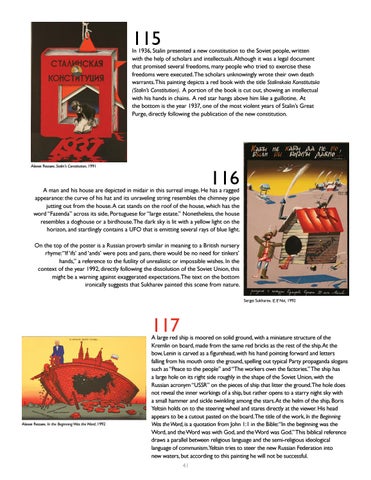
In 1936, Stalin presented a new constitution to the Soviet people, written with the help of scholars and intellectuals. Although it was a legal document that promised several freedoms, many people who tried to exercise these freedoms were executed. The scholars unknowingly wrote their own death warrants. This painting depicts a red book with the title Stalinskaia Konstitutsiia (Stalin’s Constitution). A portion of the book is cut out, showing an intellectual with his hands in chains. A red star hangs above him like a guillotine. At the bottom is the year 1937, one of the most violent years of Stalin’s Great Purge, directly following the publication of the new constitution.
Alexei Rezaev, Stalin’s Constitution, 1991
116
A man and his house are depicted in midair in this surreal image. He has a ragged appearance: the curve of his hat and its unraveling string resembles the chimney pipe jutting out from the house. A cat stands on the roof of the house, which has the word “Fazenda” across its side, Portuguese for “large estate.” Nonetheless, the house resembles a doghouse or a birdhouse. The dark sky is lit with a yellow light on the horizon, and startlingly contains a UFO that is emitting several rays of blue light. On the top of the poster is a Russian proverb similar in meaning to a British nursery rhyme: “If ‘ifs’ and ‘ands’ were pots and pans, there would be no need for tinkers’ hands,” a reference to the futility of unrealistic or impossible wishes. In the context of the year 1992, directly following the dissolution of the Soviet Union, this might be a warning against exaggerated expectations. The text on the bottom ironically suggests that Sukharev painted this scene from nature. Sergei Sukharev, If, If Not, 1992
117
Alexei Rezaev, In the Beginning Was the Word, 1992
A large red ship is moored on solid ground, with a miniature structure of the Kremlin on board, made from the same red bricks as the rest of the ship. At the bow, Lenin is carved as a figurehead, with his hand pointing forward and letters falling from his mouth onto the ground, spelling out typical Party propaganda slogans such as “Peace to the people” and “The workers own the factories.” The ship has a large hole on its right side roughly in the shape of the Soviet Union, with the Russian acronym “USSR” on the pieces of ship that litter the ground.The hole does not reveal the inner workings of a ship, but rather opens to a starry night sky with a small hammer and sickle twinkling among the stars. At the helm of the ship, Boris Yeltsin holds on to the steering wheel and stares directly at the viewer. His head appears to be a cutout pasted on the board.The title of the work, In the Beginning Was the Word, is a quotation from John 1:1 in the Bible: “In the beginning was the Word, and the Word was with God, and the Word was God.” This biblical reference draws a parallel between religious language and the semi-religious ideological language of communism.Yeltsin tries to steer the new Russian Federation into new waters, but according to this painting he will not be successful. 41