CRUMBLING EMPIRE: THE POWER OF DISSIDENT VOICES February 10 to June 2, 2019 A
WENDE
MUSEUM O F T H E C O L D WA R
INTRODUCTION No matter how authoritarian and restrictive, a political system can never completely silence voices of dissent. The 1950s in the Soviet Union witnessed the birth of an artistic dissident movement that continued to flourish in spite of relentless censorship and intimidation. During the late 1980s, the period of Mikhail Gorbachev’s policy of glasnost (openness) and perestroika (reform), much of the accumulated countercultural energy found new room for expression. Thirty-eight Moscowbased artists, trained in poster design, used the opportunity to produce a unique series of paintings with a highly critical and at times ironic take on Soviet socialism. Beverly Hills High School teacher Tom Ferris and his wife, Jeri, got to know these artists and collected hundreds of their works during their regular travels to the Soviet Union. The Wende Museum acquired 234 of these paintings from the Ferrises. We present a selection of the Tom and Jeri Ferris Russian Collection here, along with glasnost and perestroika-era posters from the Ron Miriello Soviet Poster Show Collection | American Institute of Graphic Arts, San Diego, some of which are directly based on or inspired by works in the Ferris Collection. We also exhibit the central panel of Unity, a monumental 1993 installation by Vitaly Komar and Alexander Melamid (the founders of Sots Art, the Soviet counterpart to Pop Art), which offers an ironic perspective on both capitalism and communism. Shepard Fairey is a leading figure in street art, with his grassroots, artistic re-appropriation of public space. Fairey reflects on the societal pressures surrounding us and the questionable motivations and interests behind those pressures. He is a powerful voice in the tradition of such artistic free spirits as Francisco Goya, Gustave Courbet, Diego Rivera, John Heartfield, Ben Shahn, and Pablo Picasso, holding up a mirror to society when reality might escape our perception. Both the Ferris paintings and Shepard Fairey’s artwork are based on the aesthetics of poster design – as is Sun Mu’s work in the parallel exhibition in the West Gallery. These artists use, interpret, and appropriate symbols of power and oppression in the creation of artistic messages of liberation. By showing parallels and differences between East and West, past and present, we invite you to make better sense of the world in which we live. Numbers in red refer to works featured in the audio guide. The Wende Museum thanks Jeri Ferris, Amanda Fairey,Victoria Yarnish, Dan Flores, Ron Miriello, and AIGA San Diego. Crumbling Empire is generously supported by Stephen O. Lesser.
1
The Tom and Jeri Ferris Russian Collection
1
Our Road to Communism was inspired by Pieter Bruegel’s The Tower of Babel (c. 1563) in the Kunsthistorisches Museum in Vienna. Here it takes the form of a crumbling Tower of Socialism. Each level is marked with a significant date in Soviet history. The year 1917 references the October Revolution; 1937 notes the height of Stalin’s repressive Great Purge; 1953 marks Stalin’s death; 1975 alludes to the Helsinki accords, which would improve the relationship between the Communist Bloc and the West; and 1991 indicates the year in which the Soviet Union collapsed. On ground level, people carrying red flags are entering the tower; at the second level, with the year 1937, the red flags turn into blood dripping from the tower. The ship in the lake is the Aurora, which fired the first shot of the October Revolution in 1917.
2
The poster depicts a partially completed structure of a large metal dove with a rocket launcher for a beak, and military tanks and guns crowded around its bottom. All around the lower half of the dove’s body are red banners bearing slogans such as “Glory to work, Our work is for you, the Party” and “Our work — the cause of peace.” The image of a dove, the international symbol of peace, is here made up of gray metal pieces rather than the usual white feathers.The year the painting was made brought change and political turmoil as the Soviet Union fell apart.
Alexei Rezaev, Our Road to Communism, 1990
Alexander Lozenko, Dove, 1991
3
The massive steel ship set in a smoke-filled sky symbolizes the state. The ship came ashore a long time ago, but its captains believe that they are still sailing to a delightful future. The ship is crumbling and falling apart. Houses and factories are visible in the background because the ship’s lowermost deck has been completely removed, exposing its structural beams. Party slogans reference the unity between the Party and the people. The ship’s anchor, which no longer serves a purpose, has the shape of a hammer and sickle. Alexander Lozenko, Ship, 1991
2
4
A shattered Soviet commemorative plate has the words “He Who Doesn’t Work, Doesn’t Eat” on its rim. This socialist motto was rooted in the idea that the Soviet Union would build a new, classless society where the individual served the collective. However, this plate is shattered into pieces, undoing this socialist principle, which is embodied in the hammer and sickle formed by the empty space between the plate fragments. Alexander Utkin, He Who Doesn’t Work, Doesn’t Eat, 1990
5
A black hammer and sickle stands in front of the full moon, its shadow carving a deep groove into the ground. The title of the piece, Requiem, written in red at the bottom left of the painting, could reference the lost belief in state ideology.
Andrei Kolosov and V. Kavrigina, Requiem, 1990
6
The typical minute and hour hands on this clock have been replaced with a bent and warped hammer and sickle. Due to the curved nature of these objects, the viewer is unable to determine the time with any accuracy. The Russian text at the bottom of the poster reads, “Time works for communism.” V. Soloviev, Time Works for Communism, 1990
3
7
This painting ironically references the typical profile portraits of Karl Marx, Friedrich Engels, and Vladimir Lenin as the founding fathers of Marxism-Leninism. The three great men are presented as bright-colored balloons against a pink background sprinkled with confetti. Encircling the edges of the composition are the words, “The great appear great to us because we ourselves are standing on our knees,” a quote by Georgi Plekhanov (1856–1918), a Russian Marxist theoretician who opposed the Bolshevik Party led by Lenin. The image further suggests that the ideological basis of state socialism is filled with air. Viktor Dorokhov and Valentina Dorokhova, The Great Appear Great to Us Because We Ourselves Are Standing on Our Knees, 1990
8
Ironically titled Bright Path, this work features a portrait of Lenin painted in dark shades of blue and black. Lenin is looking directly at the viewer, his face mutedly separated down the middle into human and skeleton parts. His left, skeletal side no longer has an eye, but instead a dimly red hammer and sickle in his eye socket.
Mikhail Rozhdestvin, Bright Path, 1990
9
At first glance, this painting looks like a typical Soviet poster propagating communism by using an image of Lenin and the slogan “With a big communist greeting!” However, the phrase “s privetom” in colloquial Russian means “wrong in the head,” and Lenin is making a hand gesture that shows he is indeed “loose in the head.” Moreover, the red butterfly that appears on Lenin’s chest is a parody of the red ribbon that Lenin often wore to symbolize the revolution. The butterfly, normally a symbol of freedom, has the face of a skull in this painting. Mikhail Rozhdestvin, With a Big Communist Greeting!, 1991
4
10
A burlap surface with the text “Collectivization” and “1929” references Stalin’s forced collectivization of private farms. In 1929, land, livestock, equipment, and other farm assets became state property. The artwork also includes a black sickle smudged with red paint, alluding to the bloodshed caused by this forced collectivization. Those who resisted collectivization were forcibly resettled into exile settlements, sent to labor camps, or faced death sentences. The sickle’s left side is cut in such a way that the profile of Stalin is visible in the negative space on the burlap texture of the poster. Despite Stalin’s ambitious plan to raise agricultural production to create a more prosperous life for Soviet citizens, collectivization ended up damaging the very people whose lives it was supposed to improve.
11
Alexander Vaganov, Collectivization 1929, 1988–1991
Stalin and Sergey Kirov are depicted on a chessboard.There is blood on the base of the Stalin chess piece.The Kirov chess piece is leaning over, with blood on its head, and four silhouettes of fallen chess pieces behind him are all stained with blood.Two dark chess pieces stand in the background in front of an outline of the red Kremlin wall. The Kremlin Games refers to Stalin’s alleged order to assassinate Leningrad Party leader Kirov in 1934. A former Bolshevik revolutionary during the Tsarist era, Kirov had been a close friend and ally of Stalin’s, acting as the more personable and charismatic face of the Communist Party elite. His leniency with party dissidents in 1934, as well as his rising popularity in Leningrad, a city that Stalin despised for its European attitudes, turned Kirov from a friend into a threat in Stalin’s eyes. Kirov’s death was the starting point of Stalin’s Great Purge; he used the murder as an excuse to thoroughly cleanse all Party officials whom he suspected of undermining his power. Alexei Rezaev,The Kremlin Games, 1990–1991
12
Rezaev looks critically at the politically tumultuous period between Lenin’s death in January 1924 and the beginning of Stalin’s rule. In 1924, Lenin, Trotsky, and Stalin were the three men largely credited with orchestrating the Russian Revolution. Lenin initially held the reins of power, but after his death a power struggle ensued between Trotsky and Stalin, represented here by the entanglement of their snake tails. Trotsky, the more intellectual and charismatic of the two, seemed to be the likelier successor at the time. However, while Trotsky spent his time making crowd-rousing speeches, Stalin consolidated his position as the future leader of the Soviet Union, taking full advantage of his post as General Secretary to place his supporters into powerful offices. Stalin succeeded in framing his opponent and made sure that he was exiled, and later assassinated, in Mexico. Alexei Rezaev, Trotsky and Stalin, 1991–1992
5
13
This painting portrays the Stalin era as a meat grinder in which people’s lives were ground up by a cruel machine that could not be stopped. Instead of meat, skulls fit together to form Stalin’s face and litter the ground below the ominous machine. These remnants allude to the brutal purges Stalin conducted throughout his rule, most notably in the late 1930s. Sitting in the pile at the top of the grinder, where the unprocessed meat would go, are the heads of various Party members intermixed with the heads of anonymous men and women, all ready to be executed under Stalin’s orders.
Alexei Rezaev, Meat Grinder, 1991–1992
14
Stalin takes on the role of a butcher in this poster, hacking into a map of the Soviet Union with a hatchet that bears the face and name of secret police chief Lavrenti Beria. Beria’s name is forever tied with the Great Purge, as he carried out Stalin’s orders zealously. From 1938 on, Beria actively participated in administering the deportation of many people to the Gulag labor camps. The brick wall behind the image of Stalin is punctured with bullets. Incidentally, Beria himself was killed after his unsuccessful attempt to assume power after Stalin’s death; he was shot by a firing squad in December 1953. Ironically, he was condemned as an “enemy of the state,” a verdict he had used against thousands of his own victims.
Alexei Rezaev, The Kremlin Butcher and His Hatchet, 1991–1992
15
A portrait of a man with no eyes, nose, or mouth; the only facial features are the hairline and moustache that clearly identify him as Stalin.The featureless portrait could speak to the transient nature of Soviet leaders, or it may represent that faceless multitude of Soviet citizens arrested, exiled, and executed under Stalin’s rule.
Yuri Leonov, Stalinism!, 1990
6
16
The title of this painting refers to the traditional Russian saying “until the thunder sounds, the man won’t cross himself.” It means that people do not realize they are in danger and must take precautions until it might be too late. The portrayal of a cartoonish Gorbachev on a stage with curtains refers to the August 1991 coup that endeavored to oust him from power, hinting that Gorbachev should have seen it coming. The State Emergency Committee led by hard-line Communist Party members attempted to overtake the Kremlin while Gorbachev was far away from his post, vacationing in Foros in the Crimea. In this artwork, Gorbachev is portrayed as a figurehead ruler, losing his grip on the staff that holds the Soviet emblem while his crown is tumbling to the ground. Lightning in the form of the letters GKChP, the acronym of the State Emergency Committee (in Russian), is striking Gorbachev right on his famous birthmark.
Mikhail Rozhdestvin, Until the Thunder Sounds…, 1991
17
Gorbachev is depicted floating away as the Soviet Union falls apart beneath him. Rezaev portrays him as a sham who made empty promises, as indicated by balloons labeled “reform” and “reconstruction.” Gorbachev’s suitcase features stickers of various flags, showing him as a sell-out to foreign countries.
Alexei Rezaev, Inflated Reformer, 1992
18
Gorbachev is depicted as the king of clubs, wearing a sketched gold crown with stars at its peaks. The title of the work, Alternative, refers to the two apparent alternatives in the painting that are essentially identical. Gorbachev attempted to provide an alternative to the authoritarian style of Communist rule practiced by his predecessors, but the policies failed to create real changes. According to Sukharev, his policies simply represented the other side of the same card.
Sergei Sukharev, Alternative, 1990
7
19
The painting shows a cartoon accordion made up of two halves of a black-and-white photograph of Gorbachev, while on the bellows are four dancing characters: three women in low-cut tops with their skirts blown up, and one man made of red with yellow stars, a reference to the Communist Party. Gorbachev’s introduction of glasnost and perestroika led to a loosening of restrictions on censorship and ideas that went far beyond what Gorbachev had originally intended; thus, this image of him being played like an accordion, with loose women dancing in between, refers to the Soviet population taking their freedoms to unprecedented levels. M. Parshikov, Let’s Dance?, 1990
20
The Account of the Gorbachev Foundation depicts Gorbachev in tropical swim trunks, ankle-deep in the ocean, holding a pair of sunglasses and a red telephone with a frayed cord. There are two ships in the background bearing down on him from either side. This portrayal of the vacationing Gorbachev references Gorbachev’s trip to his vacation home in Foros in the Crimea on the eve of the August coup of 1991. The red phone line, now severed, is his connection to the Kremlin. The title references the Gorbachev Foundation, an organization founded by Gorbachev in December of 1991 to promote international research into social, political, and economic issues.
Mikhail Rozhdestvin, The Account of the Gorbachev Foundation, 1991
21
Boris Yeltsin raises his fist in victory, his profile superimposed over a painted background of red, white, and blue, the colors of the flag of the Russian Federation.Yeltsin’s face is obscured by multicolored scratches, a defacement of his image that is further emphasized by the splattered, bloody nature of the red paint of the flag. In 1991,Yeltsin was popularly elected to the office of President of the Russian Soviet Federative Socialist Republic.Yeltsin gained further popularity during the failed coup against Gorbachev in August 1991, when he famously stood atop a tank outside the Russian parliament building and gave a speech defending the Russian White House against the hard-line Communists attempting to grab power. The defacement of this work might be a critical reference to Yeltsin’s opportunistic speech during the coup attempt and subsequent power grab after Gorbachev eventually stepped down in December 1991. Sergei Sukharev, Viva Russia!, 1991
8
22
Boris Yeltsin is dressed in green armor, holding a megaphone and a shield in red, white, and blue, the colors of the Russian flag, with a miniature drawing of the Russian parliament building in the top left corner. During the coup of August 1991, when Communist hard-liners under the banner of the State Emergency Committee attempted to oust Gorbachev from power,Yeltsin famously climbed atop a tank to defend democracy with the help of a megaphone.Yeltsin subsequently became the first popularly elected leader in Russia’s history.
Alexei Rezaev, The Knight of the White House, 1991
23
In this painting Boris Yeltsin is represented in the likeness of St. George, the patron saint of Russia and a holy figure traditionally associated with the triumph of good over evil. At the top, the gold letters common in Russian Orthodox script spell out “Boris the Victorious.” This image references a ubiquitous Russian Orthodox icon that exhibits the saint slaying a dragon with a spear.Yeltsin holds the Russian White House topped with a Russian flag in his left hand, indicating his leadership of the Russian Federation after the collapse of the Soviet Union. The painting alludes to the failed coup attempt of August 1991. The Communist hard-liners are represented by the snake that Yeltsin is piercing with his spear, forming the Russian letters that transliterate to “GKChP,” an acronym for the State Emergency Committee formed by the so-called gang of eight who had attempted the original coup.
Mikhail Rozhdestvin, Boris the Victorious, 1991
24
Three pairs of hands are in the act of shaking: the top ones have the thumb wrapped under the index finger, the middle ones have all fingers spread out, and the bottom ones are mid-handshake. The top gesture is known in Russia as the fig sign, a mildly obscene and sexual gesture. The bottom handshake reveals the sleeves, the right hand wearing a hammer and sickle, the left hand an American flag, symbolizing the period of successful negotiations between the two countries.
Viktor Dorokhov and Valentina Dorokhova, Untitled, 1989–1990
9
25
A machine gun on wheels, filled with condoms instead of bullets, races across the poster. The title of the work, Meet AIDS Fully Armed!!!, and the inscription below the weapon, “Only safe sex,” play with the metaphor of the war on AIDS as an actual battle that requires the use of condoms as the means to win the war. Unknown, Meet AIDS Fully Armed!!!, n.d.
26
The dates that appear on this painting reference the years of World War II, known in Russia as the Great Patriotic War. The figures in the center are hugging each other. They are surrounded on all sides by light-colored candles painted over dark brown rectangles, reminiscent of coffins. The overlapping hands of the hugging figures, as well as their melancholic facial expressions, are scratched into the surface rather than painted. The sad embrace, in conjunction with the candles and coffins, pays homage to the high number of casualties of the war.
Sergei Alexandrov, 1941–1945, 1990
27
Stalin and Hitler stand side by side, each with one arm outstreched. The inscription at the top reads “ПартайGenossen,” which translates as “Party-Comrades.” The parallels between German and Soviet politics of terror mirror the link between the two leaders who have been handcuffed together in this poster.
Alexander Vaganov, Party-Comrades, 1991
10
28
A portrait of Stalin in profile appears on the cover of Mein Kampf, where Adolf Hitler’s face or name would normally be printed. The simplicity of the poster, with no words beyond the title, invites viewers to draw a parallel between Hitler and Stalin.
Alexander Vaganov, Stalin’s Mein Kampf, 1990
29
The central image of the painting is a golden swastika made up of a hammer and sickle placed over a red background. A dark shadow emerges under the swastika. Atop the swastika is the outline of the Communist star; to its bottom right is inscribed the year 1937. Stalin’s Great Purge took place from 1937 to 1939, a period of excessive violence. The hammer-and-sickle swastika draws a parallel between the Soviet government’s show trials and arrests of 1937 and Hitler’s reign in Germany.
Alexander Amelin, Cult, 1987
30
In this painting, windows in the foreground fade into smaller Christian crosses in the background, all suspended midair in a cloudy, red-tinged space. One window reveals the image of a man and woman with children. The title of the work, Requiem, is printed in red in the upper lefthand corner, conveying a message of remembrance for the souls of the dead. The painting references the period of Stalin’s Great Purge (1937–1939), when hundreds of thousands of Soviet citizens were arrested, exiled, or executed at Stalin’s whim. Alexei Rezaev, Requiem, n.d.
11
31
The work depicts a train stretching into the distance, with only the passengers in the first car visible through a hazy rendering of the train’s exterior. The car is filled to the brim. Above the train is a cloud of dark smoke with the dates 1935, 1936, 1937, 1938, 1939, and 1940. There is a hint of faded numbers both before and after the written dates. The dates encompass the years of Stalin’s Great Purge, when hundreds of thousands of Soviet citizens were arrested, exiled, and executed. Those exiled were shipped by train to live and work in gulags, often never to be seen again. Alexei Rezaev, 1935–1940, n.d.
32
Stalin’s train is stalled at a barrier containing the word “Communism.” The barrier is a cracked bar with bones, a skull laying on the ground below. Several sillouhettes of Lenin monuments are scattered behind the train, each pointing in a direction different from the pointing hand coming out of the train. The smoke from the engine contains the image of a faceless crowd behind a barbed-wire fence, an allusion to the Soviet citizens sent to the gulag under Stalin.
Alexei Rezaev, A Standstill in the Commune, 1991
33
Belozerov’s painting ironically depicts the Russian Order of Glory, the highest honor a soldier could attain for bravery. However, the medal here is fashioned out of barbed wire, hanging from a black piece of textile. The space is inscribed with the slogan “For Motherland, for Stalin,” the rallying cry for Soviet soldiers fighting Nazi troops during World War II. After the war, almost 1.5 million soldiers were arrested and sent to prison camps, accused of lack of bravery, as they had “allowed” the Germans to take them prisoner instead of fighting to death.
Gennadi Belozerov, For Motherland, For Stalin, 1990
12
34
A face is composed of four distinctive facial features of communist figures: the unkempt beard of Marx, the trademark mustache of Stalin, the bushy eyebrows of Leonid Brezhnev, and the forehead with birthmark of Gorbachev. The top of the poster is marked by a ruler, and there are numbers next to each quadrant of the face. Below are the words, “The specter is haunting…,” a reference to the famous quotation by Marx, “A specter is haunting Europe — the specter of communism.” However, in 1990 the quote has a sinister connotation: the painful memory of the failed Soviet experiment.
Alexander Amelin, The Specter is Haunting..., 1990
35
The painting shows a young foal suckling on a decripit, crumbling statue of an adult horse. The live animal attempting to get sustenance from a broken monument speaks to the environmental issues that arose during the fast industrialization of the Soviet Union. Nikolai Litvinenko, The Last Horse, 1990
36
A woman smoking a cigarette, with curlers in her hair, in high heels, and with a wine glass next to her, watches television with her back to the viewer. She appears to be made of stone, with parts of her chipped off and littering the floor around her chair. The television screen reveals parapsychologist Allan Chumak, who is wearing black-rimmed glasses and gesturing with his hands mid-sentence. Chumak appeared on the Soviet television show 120 Minutes, where he would practice “distance healing,” asking viewers to place jars of water or cold cream near the television screen in order to use the static electricity at the curve of the screen to transmit his healing energy. His large viewership in the later 1980s can be attributed to the overall feeling of uncertainty during Gorbachev’s policies of glasnost and perestroika. Mikhail Rozhdestvin, “They Say It Helps…”, 1990
13
37
The towering monument of Lenin depicted here is simultaneously being built and being destroyed, a reference to the mixed feelings people had about Lenin during the late 1980s and early 1990s. This duplicity aligns with the ambivalent attitudes toward the future of the Soviet Union at the time.
Alexander Lozenko, Monument, 1991
38
The famous Spasskaya Tower of the Kremlin in Moscow, an internationally recognized symbol of the Soviet Union, is drawn here in black and white, albeit with its clock replaced by a compass. The only colors on the painting are the red star topping the tower, the red needle of the compass, pointing due west, and the “E” of the compass’s demarcation of East. This work, painted in 1991 by Vaganov on a trip to Los Angeles, references Gorbachev’s policies of glasnost and perestroika, which characterized the drastic shift in Russian policy toward a friendlier approach to the West.
Alexander Vaganov, The Right Way, 1991
39
The painting depicts an abstract version of the Spasskaya Tower of the Kremlin. However, the top of the tower is drooped to one side, with the star hanging upside down. The colors and the shape suggest the appearance of a jester’s hat, drawing a comparison between court jesters and members of parliament.
Viktor Dorokhov and Valentina Dorokhova, Member of the Government, 1990
14
40
A traditional Russian Orthodox Church with golden domes is depicted enclosed by dark and maze-like apartment buildings, lit with windows of uniform yellow light. The influx of identical Soviet apartment complexes in cities across the Soviet Union characterized the architecture of the Soviet period, often overshadowing the once eye-catching presence of churches in cityscapes. The painting might also reference the suffocation of spiritual life in the Soviet Union by the strict rationalism of socialist planning in all aspects of life.
Alexander Utkin, Untitled, 1990
41
A hazy red sun rises over a Soviet city made up of a few scattered buildings nestled among links of sausages. The title of the piece, written above the sunset, reads, “Good morning, dear city,” a reference to a famous Russian song entitled “Moscow May,” in which the capital city is praised as a model city and the heart of the Soviet Motherland. The abundance of outsized sausages strewn about Moscow is a reference to the sausage as a national symbol of affluence. Once conceived as food for the poor, in Soviet times dining with sausages was a sign of the good life.
Suleiman Kadyberdeev, Good Morning, Dear City, 1990
42
A gramophone resting on a pile of potatoes, sausages, and paper money is playing the words, “Eh, what a good life in the Soviet State!,” referencing the song “Oh, Good” by Russian composer Isaak Dunaevsky, written to be performed by the Young Pioneers, a mass youth organization in the Soviet Union. The gramophone contains a photo of Moscow and the Kremlin painted on one side. The positive message of the song playing over this pile of Soviet symbols of affluence pokes fun at the idea that there ever was a “good life” in the Soviet Union.
Alexei Rezaev, Oh,What a Good Life in the Soviet State!, 1991
15
Shepard Fairey American street artist Shepard Fairey is known for his grassroots, artistic re-appropriation of public space. Fairey reflects on the societal pressures surrounding us and the questionable motivations and interests behind those pressures. The creator of iconic designs including the Barack Obama “HOPE” poster and the “Obey Giant” series, Fairey questions the status quo loudly and visibly in public space.
43
44 Shepard Fairey, Make Art Not War, 2015
Shepard Fairey, Angela Davis, 2005
16
45
Shepard Fairey, Obey Eye, 2011
46
47 Shepard Fairey, Ai Weiwei, 2014
Shepard Fairey, Keith Haring, 2010
17
48
49
Shepard Fairey, Dalai Lama, 2010
50
Shepard Fairey, Martin Luther King Jr., 2005
Shepard Fairey, Obey Giant Lenin Stamp, 2018
18
51
Shepard Fairey, Andy Warhol, 2005
52
53
Shepard Fairey, Peace and Justice Woman, 2013
Shepard Fairey, Golden Future for Some, 2017
19
54
Shepard Fairey, Constructivist Banner, 2010
55 56
Shepard Fairey, Paradise Turns, 2016
Shepard Fairey, Church of Consumption, 2017
20
57
58 Shepard Fairey, Big Brother City, 2007
59
Shepard Fairey, Obey Billboard (Consume), 2008
Shepard Fairey, Israel/Palestine, 2009
21
Ron Miriello Collection | AIGA San Diego In 1989, the San Diego chapter of the American Institute of Graphic Arts put on an exhibition of 75 Soviet posters at the La Jolla Museum of Contemporary Art (now the Museum of Contemporary Art San Diego-La Jolla), under the title Poster Art of the Soviet Union: A Window into Soviet Life. Ron Miriello, a founding board member of AIGA and the curator of the exhibition, acquired the Soviet poster collection in 2014. The show offered American audiences a chance to view outstanding graphics illustrating the radical social and political changes that were taking place under the leadership of Mikhail Gorbachev.
60
In the early years of the Soviet Union, the family was considered an anachronistic bourgeois institution, and kommunalki, or communal apartments, were built in a way that did not allow for family privacy. Later on, Soviet governments acknowledged the need for privacy and started to build family apartments. The text on top of the poster reads: “Family! Let there be happiness in it, and let work, the raising of children, love, and peace in your home contribute to it!”
Lilia Levshunova, Family, n.d.
61
A crocodile with human legs in shiny shoes, its body composed of apartment buildings and a factory spewing multicolored pollution, is about to devour a small, peaceful village. The text on the top right reads: “Comrades! Let us urgently save everything that we breathe and live by.” The poster expresses the ecological concerns among the Soviet population in the late 1980s. Igor Maystrovsky, Comrades, 1989
22
62
The film poster announces Alexander IvanovSukharevsky’s movie The Boat from 1988. In the 1990s, Ivanov-Sukharevsky became active as a politician on the extreme right. In 1994, he founded the People’s National Party (NNP), inspired by the ideas of Adolf Hitler and Benito Mussolini.
Alexander Chantsev, The Boat, 1989
63
Stalin’s face lacks eyes, and he is wearing a modern-day business suit, suggesting that Stalinism lives on today in different disguises. The poster is based on the painting in the Wende Museum’s Tom and Jeri Ferris Russian collection, no. 15 in this exhibition, by Yuri Leonov.
Yuri Leonov, Stalinism, 1990
64
This is a promotional poster for the film The Dissident (1988) by Valeriu Jereghi.
Igor Maystrovsky, The Dissident, 1989
23
65
This film poster advertises Andrei Tarkovsky’s movie Andrei Rublev, about the famous Russian icon and fresco painter (c. 1360 – c. 1430) of that name. Tarkovsky’s film from 1966 portrays the artist as the embodiment of creativity and spirituality in times of cruelty and base materialism.
Vitshin, Andrei Rublev, 1988
66
The poster references Milos Forman’s 1975 film One Flew Over the Cuckoo’s Nest, featuring Jack Nicholson as a rebellious inmate of a mental institution where the patients are stripped of their agency by all means. A comparison with totalitarian repression seems obvious. Igor Maystrovsky, One Flew Over the Cuckoo’s Nest, 1988
67
USSR, the Union of Soviet Socialist Republics (CCCP, in Cyrillic letters), is spelled out as part of the words reform (perestroika), openness (glasnost), acceleration, and democracy. At the bottom, the contour of the Kremlin tower is visible. The poster expresses the spirit of hope and expectation inspired by Mikhail Gorbachev’s political and economic reforms. V. Trubanov, USSR, 1989
24
V. Sachkov, 1917 — The Beginning of a New Era, 1989
68
Screaming revolutionaries are on the attack with pointed bayonets. Behind them appears the text “All Power to the Soviets!” On the left we see the cruiser Aurora, which fired the first shot of the Russian Revolution, and to the right the Winter Palace in (present-day) St. Petersburg.
Vitaly Komar and Alexander Melamid
69
The monumental angel was the central panel of a 54-foot-wide installation in the lobby of the U.S. Bank Tower in downtown Los Angeles. The subject of this piece was inspired by Los Angeles, the City of Angels, and incorporates symbols from multiple cultures. The artists Komar and Melamid were born in Moscow and founded the Sots Art movement, the Soviet counterpart to Pop Art. They emigrated to Israel in 1977, and one year later moved to New York City, where they both live now. The metaphysical connotation of the angel in the U.S. Bank could be interpreted as a subversive gesture, in tune with the ironic undertone of most of Komar and Melamid’s works. Vitaly Komar and Alexander Melamid, Unity (central panel), 1993
25
The Tom and Jeri Ferris Russian Collection
70
This poster is a reference to Kuzma Petrov-Vodkin’s most iconic work, Bathing of a Red Horse (1912), depicting a nude young boy riding a red horse and other youths cavorting in the water in the background. This version from 1990, however, depicts a muscular man with gray skin, his head straining upward as he stands stationary. Rather than sitting astride a strong red horse, this man’s waist is encircled by a red toy horse in the shape of a theater curtain. Pieces of white paper fall against a gray background, and the Russian text printed at the bottom reads: “Skinny Red Horse No. 2.” The muscular gray man, with a hammer and sickle emblem hung around his neck, ridicules images of Soviet heroes. The hollow horse, on the other hand, brings to mind the Trojan horse. The red color of the curtains alludes to the Communist state, and the year of the painting suggests that the curtains may symbolize the final curtain call of the Soviet Union.
71
Gennadi Belozerov, Bathing of the Red Horse, 1990
Vera Mukhina’s famous sculpture from 1937, Worker and Kolkhoz Woman, is defaced and tied down by two little figures. Instead of holding the hammer and sickle, the industrial worker and the farmer woman are holding the flag of the new Russian Federation. Behind them, Soviet statues and busts are falling apart. Two tiny figures are taking the hammer and sickle away from the toppled sculpture. The gigantic figures of Mukhina‘s sculpture once represented the Soviet Union, but just like Gulliver from Jonathan Swift’s novel, they are helplessly bound together by little men. These little men, identified as the politicians Alexander Rutskoy and Ruslan Khasbulatov, played a significant role, along with Boris Yeltsin, in defying the August coup attempt in 1991 by the State Emergency Committee. Rezaev seems to suggest that the Soviet Union was vandalized by the new career politicians trying to run the new Russian Federation.
Alexei Rezaev, Soviet Gullivers, 1992
72
This painting addresses the serious topic of AIDS in an ironically lighthearted manner. With cheerful colors, this image uses the red star and the hammer and sickle, key symbols of the Soviet Union, as confetti-like decoration. The famous sculpture by Vera Mukhina, Worker and Kolkhoz Woman, which was both the centerpiece of the Soviet pavilion at the 1937 International Exhibition in Paris and the logo of the Mosfilm studio, is further taken out of context with its placement in an AIDS awareness campaign. Instead of representing Soviet achievements, this monument promotes safe sex by dispensing condoms.
Alexei Rezaev, AIDS-No, 1991
26
73
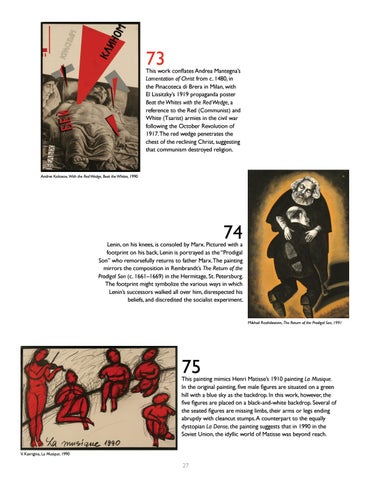
This work conflates Andrea Mantegna’s Lamentation of Christ from c. 1480, in the Pinacoteca di Brera in Milan, with El Lissitzky’s 1919 propaganda poster Beat the Whites with the Red Wedge, a reference to the Red (Communist) and White (Tsarist) armies in the civil war following the October Revolution of 1917. The red wedge penetrates the chest of the reclining Christ, suggesting that communism destroyed religion.
Andrei Kolosov, With the Red Wedge, Beat the Whites, 1990
74
Lenin, on his knees, is consoled by Marx. Pictured with a footprint on his back, Lenin is portrayed as the “Prodigal Son” who remorsefully returns to father Marx. The painting mirrors the composition in Rembrandt’s The Return of the Prodigal Son (c. 1661–1669) in the Hermitage, St. Petersburg. The footprint might symbolize the various ways in which Lenin’s successors walked all over him, disrespected his beliefs, and discredited the socialist experiment.
Mikhail Rozhdestvin, The Return of the Prodigal Son, 1991
75
This painting mimics Henri Matisse’s 1910 painting La Musique. In the original painting, five male figures are situated on a green hill with a blue sky as the backdrop. In this work, however, the five figures are placed on a black-and-white backdrop. Several of the seated figures are missing limbs, their arms or legs ending abruptly with cleancut stumps. A counterpart to the equally dystopian La Danse, the painting suggests that in 1990 in the Soviet Union, the idyllic world of Matisse was beyond reach. V. Kavrigina, La Musique, 1990
27
76
This work distorts another famous work by Henri Matisse, La Danse, of which there are two versions. In this painting, the dancers are clearly male (Matisse’s dancers are women), and their dance appears painful and forced, with the figures violently grabbing each other’s hair rather than hands. The second version of La Danse by Matisse was painted in 1910 for Russian art collector Sergey Shchukin, who later bequeathed it to the Hermitage Museum in St. Petersburg. The date painted across the bottom of the painting relates the painting to the chaos and uncertainty of life in the Soviet Union in 1990. V. Kavrigina, La Danse, 1990
77
Nine faces are crowded into the picture space, with more faces partly visible. They all have identical expressions and are wearing cloth blindfolds with eyes drawn on them. The uniformity of the faces, the blindfolds, and the expressionless eyes call to mind the repression and censorship of the Soviet masses, resulting in coerced conformism.
Alexander Lozenko, Unison View, 1988
78
A man wears a horse bridle, with the bit inside his closed mouth. The Russian text below reads, “Any sort of violence, even violence that is supposedly toward the greater good, against one’s will and consciousness is impermissible.”
A. Chebotarev, “Everything in the Name...”, 1990
28
79
The painting depicts an ostrich burying its head in the sand. The body of the ostrich is a human brain, still exposed to the world despite the bird’s efforts to hide from imminent danger. This painting demonstrates how people willfully ignore the realities of political life, rather than addressing them head-on.
Alexander Amelin, XX Century, 1977
80
A man’s tongue turns into a snake that chokes him. The title of the piece refers to the era of fear and mistrust under Stalin, when a misconstrued phrase or slip of the tongue was enough to be sent to the gulag or executed.
Alexander Lozenko, My Tongue – My Enemy, 1991
81
This painting shows a red typewriter with a typed page reading: “Welcome! Support! Vote ‘yes.’” The typewriter is unusual in that instead of keys, identical featureless heads wearing black suits fill the keyboard. The vote referred to the March 17, 1991, referendum on the future of the Soviet Union, when voters were asked: “Do you consider necessary the preservation of the Union of Soviet Socialist Republics as a renewed federation of equal sovereign republics in which the rights and freedom of an individual of any nationality will be fully guaranteed?” The voter turnout for the referendum, the only one in the history of the Soviet Union, equaled around 80 percent, with about 77 percent voting in favor of the preservation. Nonetheless, the Soviet Union fell apart in December 1991. Unknown, Unanimously!, n.d.
29
82
A man with a mohawk and mustache wearing lipstick, blush, a feather boa, and bracelets turns toward the viewer with the word “AIDS” blocking out his eyes. The text on the painting reads, “Meet at the fountain?” and “Dangerous games!” The use of a gender-nonconforming, punk male figure as the poster design for an AIDS awareness campaign would have been shockingly straightforward at the time.
Unknown, Meet at the Fountain?, n.d.
83
An image of a punk rocker wearing a leather vest, studded leather cuffs, and a crucifix necklace stares straight at the viewer. The title of the work, Welcome, Young Tribe, is taken from a poem from 1835 by Alexander Pushkin entitled, “Again I Visited,” wherein Pushkin muses on life, death, and the connection between humans and nature. Surrounding the man are the phrases, “rock against war,” “rock against drug addicts,” “rock against AIDS,” “rock for democracy,” and “green rock.” The poster welcomes a new generation of liberal, politically active youth to Soviet culture—a new “tribe” of people passionate about the civil rights causes that sprang out of the environmental activism of the 1990s.
Alexander Vaganov, Welcome,Young Tribe…, 1991
84
A punk rocker with dyed green hair is wearing leather studded cuffs, a leather choker, and crucifix earrings. Three questions surround the youth: “Who are we? Where are we going? From where?” The only text without a question mark is simply the word “Where” at the bottom right of the poster. The punk and the text represent the search for a new identity after the dissolution of the Soviet Union.
Unknown, Untitled, n.d.
30
85
The laundry on the line drips with oil. The cloths represent Lake Baikal, the Yellow Sea, and the Red Sea, all of which suffered ecological disasters in the twentieth century. This painting warns future generations against the dangers of pollution.
Mikhail Rozhdestvin, To the Laundry, n.d.
86
A Russian Orthodox Church is painted with a towering red smokestack on top. The church and the smokestack are connected, and the golden paint of the church turns into the red paint of the smokestack at its bottom right corner. The melding of church and industry reflects the secular character of Soviet communism, based on “the religion of progress.�
Nikolai Litvinenko, Do Not Violate the Ecology of Morality, 1989
87
The branches of a tree strangle one another, locked in a deadly embrace. The image of a self-destructive tree acts as commentary on the environmental concerns in Russia in the 1990s, when people began to take stock of the damage to the environment inflicted by the Soviet government’s industrialization campaigns. Alexander Lozenko, The Tree, 1991
31
88
This painting depicts a black radioactive symbol against a yellow background. The symbol resembles a fan or windmill blowing radioactive debris, referencing the explosion in the nuclear power plant in Chernobyl in 1986.
Alexander Vaganov, From Where Will It Blow Now?, 1991
89
The title of the work references the new era of space-travel technology that began with the 1957 launch of the Soviet satellite Sputnik. In this painting, a satellite is painted as a white outline, with the Earth at its nose, and rainbow paint at its rear in place of flames. The peaceful message across the top of the painting, in conjunction with the protected circle around the Earth, promotes the idea of the whole world working together in the name of progress and peace.
Alexander Vaganov, To the 21st Century in Peace and Consent, 1990
90
Andrei Sakharov was perhaps the Soviet Union’s best-known scientist and human rights activist. He was the father of the Soviet hydrogen bomb and winner of the Nobel Peace Prize in 1975. Sakharov was sent into exile during the Brezhnev era for protesting against Soviet military involvement in Afghanistan. In one of the most dramatic gestures of the early years of his leadership, Mikhail Gorbachev released Sakharov from exile. Sakharov died of heart failure in 1989. In this painting, he is represented as a comet lighting the darkness of Soviet history.
Alexander Vaganov, A.D. Sakharov, 1989–1990
32
91
Jesus Christ is portrayed carrying a wooden cross, with a hammer and sickle around his neck. A shower of bright light rains down, suggesting the presence of a comet trail. The quotation in the top left of the work reads, “Every nation has the government it deserves,” which is sometimes attributed to the American poet Ralph Waldo Emerson, but actually comes from Count Joseph de Maistre in 1811, in a disparaging reference to the new constitutional laws of Tsar Alexander I in Russia. 1991, when the painting was made, was the year the Soviet Union fell and the beginning of a turbulent political era in Russia. The painting reflects the uncertainty of the religious, political, and cultural environment in the Soviet Union in 1991.
Alexander Vaganov, Every Nation Deserves a Government..., 1991
92
This painting shows a large block of “Orbit” brand processed cheese on a black background with pink and blue sparks streaming out of it like a shooting star. Beneath the cheese is the tag, “Dense in the cosmos, empty on the table!”—a reference to the fact that space-era technology had received more state support than the production of basic consumer goods since the 1950s.
Viktor Dorokhov and Valentina Dorokhova, Dense in the Cosmos, Empty on the Table!, 1989
93
The painting shows a planet with geometrically patterned rockets sticking out of its surface at different angles. At the top left of the work, a yellow piece of paper says, “The world community is concerned with the violence against the environment in the sixth part of the world,” a reference to the 1926 Dziga Vertov film “A Sixth Part of the World.” A mix of travelogue, found footage, and newsreel, the film advocates unity of all parts of the Soviet Union, which then made up one-sixth of the world. A. Kravchenko, Untitled, n.d.
33
94
A shaded utility pole with bright orange power lines attached to its four insulators stands atop a hill with the words “Premonition of War” inscribed underneath. Instead of coming straight out of the ground, the pole zigzags to the left, giving it the appearance of a hovering cross. The war in the title of the painting might refer to “the war on the environment,” an issue hotly debated among critical intellectuals during the last years of the Soviet Union.
Sergei Alexandrov, Premonition of War, 1990
95
A Byzantine-style portrait of St. Nicholas fills the composition, his slightly asymmetric eyes gazing off to the left and his lips highlighted by a dark red shade. A yellow halo around the saint’s head contains a faint cross. St. Nicholas is one of the most venerated Russian Orthodox saints, and a popular subject on icons, for he is seen as the protector against catastrophes in Russia. The painting references the new national and religious pride of the Russian Federation after the dissolution of the Soviet Union in December 1991. Alexei Rezaev, St. Nicholas, 1992
96
A relief sculpture of a crucifix is painted against a twilight sky. A bucket covers the top of the cross. The Ukrainian text on the left of the image reads, “Whose sons? Where are the parents?” This might be a reference to the numerous youths who lost their lives during the Second World War or as a result of foreign occupation of Ukraine throughout the centuries.
Andrei Vishnevski and Yuri Panfilov, Untitled, 1989
34
97
A Byzantine-style portrait of Mary and the infant Jesus reflects the new role for the Russian Orthodox Church within the Russian Federation after the dissolution of the Soviet Union.
Alexei Rezaev, Mary and Christ, 1992
98
A wooden stool reveals an image of St. George on a horse, fighting a dragon. St. George was a revered figure in the pantheon of the Russian Orthodox Church. Normally, such an icon would be respectfully displayed inside a church, surrounded by candles and incense. The artist references the Soviet practice of turning religious spaces and images into practical objects for everyday life.
Valery Kolesnikov, Ecology of Culture, 1990
99
Instead of a halo, guns surround the Virgin Mary, their barrels pointing at her face. Her hands protect a candle flame made up of the Russian flag atop the Russian parliament building. The words at the bottom of the poster read, “Redeem and Save.� The depiction of religious protection of the Moscow White House references the 1991 coup attempt to oust Gorbachev from power, an event that culminated in a standoff between hard-line Communist Party members and the Soviet troops who refused to shoot protestors who were building barricades outside the parliament building. Mikhail Rozhdestvin, Redeem and Save, n.d.
35
100
A wooden tomb sculpture lies on the ground holding a single candle on her chest. The phrase at the top is taken from a poem by the Ukrainian poet Taras Shevchenko entitled, “Hosea, Chapter XIV,” from 1859. Its first two lines are, “And thou shalt perish, Ukraina / Vanish, leave no trace on this earth.” The poet uses biblical motifs to express regret at the destruction of Ukraine at the hands of the tsars and other imperial powers. If the poster is turned vertical, the sculpture appears to be standing, pierced by the candle and overlooking a village with a dome, trees, and rolling hills. The painting seems to lament the fate of Ukraine and its lack of national sovereignty, two years before Ukraine declared its independence. Andrei Vishnevski and Yuri Panfilov, Leave No Trace on This Earth, 1989
101
A portrait of a woman is divided in two parts. On the left, she is modestly dressed, with hair curled in a traditional style, while her counterpart on the right has multicolored hair, wears a large earring, and has her right breast prominently exposed. The contrast between the two sides speaks to the dichotomy between different lifestyles in the same city, Leningrad, which was renamed St. Petersburg in September 1991.
Sergei Sukharev, St. Leningrad, 1991
102
A bare-breasted woman holding a Russian flag to her chest stares straight at the viewer, wearing a kokoshnik, a traditional headdress. The headdress is embroidered with the word “Russia,” and sheaves of wheat flank either side. In the background, a large globe indicates the contours of Russia. The painting from 1991 speaks to the fall of the Soviet Communist Party from power and the political independence of the Russian Federation. Rezaev hints at the loose morals that come with this transition. The Russian text on top is a line from the 1864 poem “The Railway” by Nikolai Nekrasov: “And a road with the might of her bosom will lay.” The poem was originally banned in Russia, for it spoke about the building of the St. Petersburg–Moscow railroad and the many workers who died during its rapid and forced development. Rezaev allows viewers to draw their own parallels between Russian politics in the 1800s and in 1991. Alexei Rezaev, And a Road With the Might of Her Bosom Will Lay, 1991
36
103
Sibirtseva’s wooden windmill humorously represents the life of a typical Soviet woman. Women’s days in the Soviet Union were full of responsibilities and required multitasking. The many arms of this windmill illustrate the typical duties that a woman completed in the course of a day, and provide a breakdown of these tasks: one and a half hours for shopping, nine hours at work, one hour for laundry, one hour for cleaning, three hours for cooking, and finally seventeen minutes to spend with the children.
Vera Sibirtseva, The Fresh Winds of Change?, 1989
104
A nude woman stands facing away from the viewer, wearing a long, black braid tied with a 100 German mark bill. Her image is framed with hearts and semicircles, as well as by the phrase “Barbarian beauty, long braid” and two sets of multicolored hearts. Her body is scrawled upon with handwritten phrases like “I want you” and “My dear baby” in English and French, signed by “Bob” and “Bill,” respectively. The sexual notes on the body of a woman who has turned away from the viewer in discomfort emphasize the objectifying gaze. The use of a German bill in her hair, the descriptor “barbarian,” and the graffitti-like nature of the words on her body reduce this woman to a sexual object.
Alexei Rezaev, Barbarian Beauty, Long Braid, 1990 90
105
This painting depicts a traditional Russian matryoshka doll holding a flower, drawn on a pink background with multicolored hearts. However, instead of the inside of the doll being filled with smaller and smaller versions of the girl, the painted wooden upper half of her torso ends to reveal human legs wearing garters, fishnet stockings, and high heels. The sexualized rendition of a traditional Russian children’s doll, with the title We Were Not Born Yesterday, speaks to the turbulent changes occurring in the Soviet Union in 1991. Alexei Rezaev, We Were Not Born Yesterday, 1991
37
106
This painting of door buzzers alludes to Soviet public housing projects. It suggests that the Soviet state has given each of its republics, represented by their national flags, its own metaphorical apartment. The Lithuanian flag is coming off the hinge, a reference to the fact that Lithuania was the first republic to secede from the Soviet Union on March 11, 1990. The other two Baltic states, Latvia and Estonia, followed soon after, declaring themselves independent on May 4, 1990, and August 20, 1991, respectively. In the painting, their flags no longer show the Soviet emblem of the hammer and sickle. The title of the work is written on a torn piece of paper, reminiscent of the rental signs that were in use during the late 1980s and early 1990s.
Yuri Leonov, To Each Family an Individual Apartment, 1991
107
Two separate land masses, “Mother Armania” and “Artsakh,” are painted in the colors of the Armenian flag, and separated by a line of barbed wire. On the bottom-right corner of the work the word “Democracy” is painted. The region, with its majority Armenian population within Azerbaijani territory, is highly contested. According to the Armenian perspective, as represented by this work, Artsakh, also known as Nagorno-Karabakh, refers to the historic Armenian region. According to the Azerbaijani perspective, the region has been militarily occupied by Armenia since the early 1990s despite UN Security Council condemnation, when many Azerbaijani civilians were expelled from the region and beyond. The name on the right edge of the painting, S. Serzh, might be the artist’s signature or could refer to Serzh Sargsyan, the former president of Armenia who in the late 1980s and early 1990s was involved in the Nagorno-Karabakh War. Unknown, Democracy, n.d.
108
This map of the Soviet Union resembles dry bread breaking apart. Some of the cracks represent borders between the union’s various republics that claimed their independence in a delicate political situation that was further aggravated by food shortages. On the left side of the map, a Communist star is discernible in the cracks around where Moscow would be located. Dry bread had a powerful significance in the Soviet Union as a symbol of shortage and hunger. The edges of this depiction of the Soviet Union bear a resemblance to a bloody piece of meat. Alexander Vaganov, USSR,Year 1991, 1991
38
109
The image of an etching-like black-and-white eye dominates the painting, with a single tear in the colors of the Russian flag. Reflected in the pupil is the date 21.08.91, the day of the attempted coup by the State Emergency Committee to oust Gorbachev from power. The painting honors the memory of those fallen defending the White House, the Russian parliament building.
Sergei Sukharev, Dedicated to the Memory of Those Fallen Defending the White House, 1991
110
The painting features a large buttocks wearing a Soviet Army cap and two floating shoulders marked with Soviet Army insignias. It has the faint outline of a nose, giving it the appearance of a face, and beneath it are the letters “GKChP� (in Russian) in the form of feces. The GKChP was the acronym for the State Emergency Committee, the group of Communist Party hard-liners who attempted to overthrow Gorbachev in August 1991. The ridiculous image of a buttocks in Soviet military apparel alongside the painting title mocks the GKChP and their coup attempt.
Mikhail Rozhdestvin, An Official Announcement, 1991
111
An octopus is multitasking to repaint himself. One arm is painting his forehead, obscuring the Soviet hammer and sickle with the colors of the flag of the Russian Federation. Other arms embrace a stack of American dollars; a microphone; a copy of Pravda, the leading newspaper of the Soviet Union; a book by Marx; a pen; and a fired gun that has shot off the arm that held it. Alexei Rezaev, Repainting Itself, 1991
39
112
In Dinner Is Served, the food on the tray resembles a rainbowsplattered dessert, with miniature tanks as decorations, and a hammer and sickle on a red star as the cherry on top. The Russian acronym GKChP is spelled out in pastel-colored frosting, and the “dinner” is held by two hands emerging from sleeves decorated by olive branches, a symbol of peace. GKChP stands for the State Emergency Committee that engineered the failed 1991 coup attempt to remove Gorbachev from power. This coup turned out to be a relatively peaceful affair, because the Soviet army made a decision not to fire on citizens but instead to turn their tanks around and defend Russia’s parliament building, the White House. However, on the third day of the coup attempt, several demonstrators were killed and wounded. Mikhail Rozhdestvin, Dinner Is Served, 1991
113
Four sets of ballerina legs are drawn in a television-screen frame; the dancers stand before a camouflage-print stage curtain. The legs are positioned to spell out the Russian acronym “GKChP,” which stands for the State Emergency Committee, the group that staged the 1991 failed coup to overthrow Gorbachev. On the bottom left of the screen is the date 19.08.1991, the day of the attempted coup. The sign hanging off a television knob reads, “Quiet! Rehearsal in session!” The painting references the fact that the State Emergency Committee, in one of its first acts, occupied the Moscow television studios and broadcast a performance of Pyotr Ilyich Tchaikovsky’s Swan Lake, interrupting the scheduled program. Mikhail Rozhdestvin, Quiet Please—Rehearsal in Session, 1991
114
The painting shows a red silhouette of the torso of a pregnant woman in profile, her side marked with a star and hammer and sickle and her stomach emblazened with a white question mark. The title of the 1988 piece, Perestroika, references Mikhail Gorbachev’s policy shift of glasnost (openness) and perestoika (reform) in the Soviet Union. The unborn child, designated with the large question mark, highlights the uncertainty about the future effects and implications of these policies. Alexander Amelin, Perestroika, 1988
40
115
In 1936, Stalin presented a new constitution to the Soviet people, written with the help of scholars and intellectuals. Although it was a legal document that promised several freedoms, many people who tried to exercise these freedoms were executed. The scholars unknowingly wrote their own death warrants. This painting depicts a red book with the title Stalinskaia Konstitutsiia (Stalin’s Constitution). A portion of the book is cut out, showing an intellectual with his hands in chains. A red star hangs above him like a guillotine. At the bottom is the year 1937, one of the most violent years of Stalin’s Great Purge, directly following the publication of the new constitution.
Alexei Rezaev, Stalin’s Constitution, 1991
116
A man and his house are depicted in midair in this surreal image. He has a ragged appearance: the curve of his hat and its unraveling string resembles the chimney pipe jutting out from the house. A cat stands on the roof of the house, which has the word “Fazenda” across its side, Portuguese for “large estate.” Nonetheless, the house resembles a doghouse or a birdhouse. The dark sky is lit with a yellow light on the horizon, and startlingly contains a UFO that is emitting several rays of blue light. On the top of the poster is a Russian proverb similar in meaning to a British nursery rhyme: “If ‘ifs’ and ‘ands’ were pots and pans, there would be no need for tinkers’ hands,” a reference to the futility of unrealistic or impossible wishes. In the context of the year 1992, directly following the dissolution of the Soviet Union, this might be a warning against exaggerated expectations. The text on the bottom ironically suggests that Sukharev painted this scene from nature. Sergei Sukharev, If, If Not, 1992
117
Alexei Rezaev, In the Beginning Was the Word, 1992
A large red ship is moored on solid ground, with a miniature structure of the Kremlin on board, made from the same red bricks as the rest of the ship. At the bow, Lenin is carved as a figurehead, with his hand pointing forward and letters falling from his mouth onto the ground, spelling out typical Party propaganda slogans such as “Peace to the people” and “The workers own the factories.” The ship has a large hole on its right side roughly in the shape of the Soviet Union, with the Russian acronym “USSR” on the pieces of ship that litter the ground.The hole does not reveal the inner workings of a ship, but rather opens to a starry night sky with a small hammer and sickle twinkling among the stars. At the helm of the ship, Boris Yeltsin holds on to the steering wheel and stares directly at the viewer. His head appears to be a cutout pasted on the board.The title of the work, In the Beginning Was the Word, is a quotation from John 1:1 in the Bible: “In the beginning was the Word, and the Word was with God, and the Word was God.” This biblical reference draws a parallel between religious language and the semi-religious ideological language of communism.Yeltsin tries to steer the new Russian Federation into new waters, but according to this painting he will not be successful. 41
118
This painting features a trash can filled with a cracked bust of Stalin, a book entitled Stalin, and a pair of handcuffs. On the floor next to the trash can is a book entitled Lenin, as well as a smoldering pipe lit by a red ember that emitts a stream of black smoke. This late work from 1994 seems to definitively reckon with the heritage of Soviet Communism.
Alexei Rezaev, To the Scrapheap of History, 1994
119
The painting depicts Stalin scrawling text on an image of a line of Soviet soldiers. The soldier in front is in mid-salute and has a target superimposed over his face. The text reads (in Russian), “There are people, there are problems. Without people, there are no problems,” a quote from the 1987 novel Children of the Arbat by Anatoly Rybakov. When asked about the attribution of this quotation to Stalin in his novel, Rybakov responded, “This was a Stalinist principle. I only shortened and articulated it. That is the right of an artist.” In the bottom righthand corner is written, “From 1937–1939, 40,000 upper staff members of the Red Army were targeted,” referencing the years of Stalin’s purges. Alexei Rezaev, Untitled, 1994
42
Crumbling Empire:The Power of Dissident Voices was organized by Chief Curator and Director of Programming Joes Segal and Exhibition and Programming Associate Anna Rose Canzano, with support from Claremont Graduate University Curatorial Intern Abigail Beck. Special thanks to Shepard and Amanda Fairey, Dan Flores, Jane Friedman, Daniel Gower, Ron Miriello, Mark Valley, and Victoria Yarnish. This exhibition is generously supported by Stephen O. Lesser.
WENDE MUSEUM O F T H E C O L D WA R
10808 Culver Boulevard | Culver City, CA | 90230 www.wendemuseum.org 310.216.1600
@wendemuseum