The Tom and Jeri Ferris Russian Collection
70
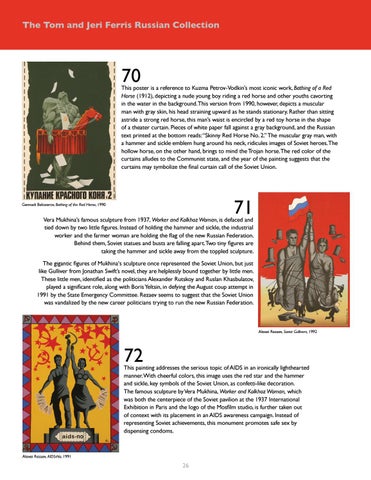
This poster is a reference to Kuzma Petrov-Vodkin’s most iconic work, Bathing of a Red Horse (1912), depicting a nude young boy riding a red horse and other youths cavorting in the water in the background. This version from 1990, however, depicts a muscular man with gray skin, his head straining upward as he stands stationary. Rather than sitting astride a strong red horse, this man’s waist is encircled by a red toy horse in the shape of a theater curtain. Pieces of white paper fall against a gray background, and the Russian text printed at the bottom reads: “Skinny Red Horse No. 2.” The muscular gray man, with a hammer and sickle emblem hung around his neck, ridicules images of Soviet heroes. The hollow horse, on the other hand, brings to mind the Trojan horse. The red color of the curtains alludes to the Communist state, and the year of the painting suggests that the curtains may symbolize the final curtain call of the Soviet Union.
71
Gennadi Belozerov, Bathing of the Red Horse, 1990
Vera Mukhina’s famous sculpture from 1937, Worker and Kolkhoz Woman, is defaced and tied down by two little figures. Instead of holding the hammer and sickle, the industrial worker and the farmer woman are holding the flag of the new Russian Federation. Behind them, Soviet statues and busts are falling apart. Two tiny figures are taking the hammer and sickle away from the toppled sculpture. The gigantic figures of Mukhina‘s sculpture once represented the Soviet Union, but just like Gulliver from Jonathan Swift’s novel, they are helplessly bound together by little men. These little men, identified as the politicians Alexander Rutskoy and Ruslan Khasbulatov, played a significant role, along with Boris Yeltsin, in defying the August coup attempt in 1991 by the State Emergency Committee. Rezaev seems to suggest that the Soviet Union was vandalized by the new career politicians trying to run the new Russian Federation.
Alexei Rezaev, Soviet Gullivers, 1992
72
This painting addresses the serious topic of AIDS in an ironically lighthearted manner. With cheerful colors, this image uses the red star and the hammer and sickle, key symbols of the Soviet Union, as confetti-like decoration. The famous sculpture by Vera Mukhina, Worker and Kolkhoz Woman, which was both the centerpiece of the Soviet pavilion at the 1937 International Exhibition in Paris and the logo of the Mosfilm studio, is further taken out of context with its placement in an AIDS awareness campaign. Instead of representing Soviet achievements, this monument promotes safe sex by dispensing condoms.
Alexei Rezaev, AIDS-No, 1991
26