34
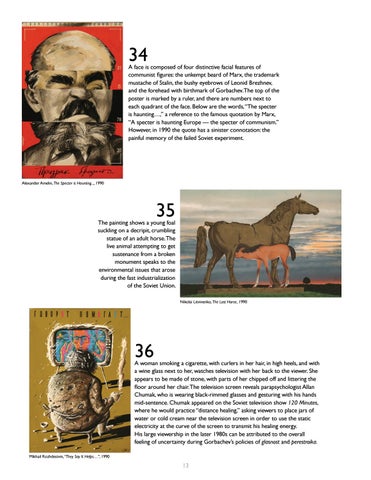
A face is composed of four distinctive facial features of communist figures: the unkempt beard of Marx, the trademark mustache of Stalin, the bushy eyebrows of Leonid Brezhnev, and the forehead with birthmark of Gorbachev. The top of the poster is marked by a ruler, and there are numbers next to each quadrant of the face. Below are the words, “The specter is haunting…,” a reference to the famous quotation by Marx, “A specter is haunting Europe — the specter of communism.” However, in 1990 the quote has a sinister connotation: the painful memory of the failed Soviet experiment.
Alexander Amelin, The Specter is Haunting..., 1990
35
The painting shows a young foal suckling on a decripit, crumbling statue of an adult horse. The live animal attempting to get sustenance from a broken monument speaks to the environmental issues that arose during the fast industrialization of the Soviet Union. Nikolai Litvinenko, The Last Horse, 1990
36
A woman smoking a cigarette, with curlers in her hair, in high heels, and with a wine glass next to her, watches television with her back to the viewer. She appears to be made of stone, with parts of her chipped off and littering the floor around her chair. The television screen reveals parapsychologist Allan Chumak, who is wearing black-rimmed glasses and gesturing with his hands mid-sentence. Chumak appeared on the Soviet television show 120 Minutes, where he would practice “distance healing,” asking viewers to place jars of water or cold cream near the television screen in order to use the static electricity at the curve of the screen to transmit his healing energy. His large viewership in the later 1980s can be attributed to the overall feeling of uncertainty during Gorbachev’s policies of glasnost and perestroika. Mikhail Rozhdestvin, “They Say It Helps…”, 1990
13