28
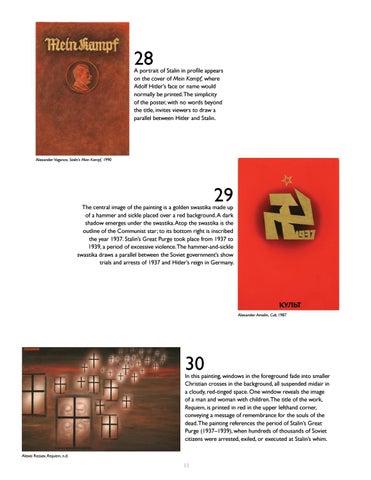
A portrait of Stalin in profile appears on the cover of Mein Kampf, where Adolf Hitler’s face or name would normally be printed. The simplicity of the poster, with no words beyond the title, invites viewers to draw a parallel between Hitler and Stalin.
Alexander Vaganov, Stalin’s Mein Kampf, 1990
29
The central image of the painting is a golden swastika made up of a hammer and sickle placed over a red background. A dark shadow emerges under the swastika. Atop the swastika is the outline of the Communist star; to its bottom right is inscribed the year 1937. Stalin’s Great Purge took place from 1937 to 1939, a period of excessive violence. The hammer-and-sickle swastika draws a parallel between the Soviet government’s show trials and arrests of 1937 and Hitler’s reign in Germany.
Alexander Amelin, Cult, 1987
30
In this painting, windows in the foreground fade into smaller Christian crosses in the background, all suspended midair in a cloudy, red-tinged space. One window reveals the image of a man and woman with children. The title of the work, Requiem, is printed in red in the upper lefthand corner, conveying a message of remembrance for the souls of the dead. The painting references the period of Stalin’s Great Purge (1937–1939), when hundreds of thousands of Soviet citizens were arrested, exiled, or executed at Stalin’s whim. Alexei Rezaev, Requiem, n.d.
11