Family Links - Can you equal or beat five generations of Wellington College connections? One of the components of building up a database, is linking all the relatives who have attended Wellington College from great-grandfathers to current sons, plus nephews, uncles, brothers and cousins to name a few. It’s always of great interest to connect the dots and review the family trees of so many families. Of course, it’s always more difficult to link families - if for instance, a current son is the grandson of his mother’s father and thus has a different surname. We do encourage those currently enrolling at the College to list any connections, but many overlook this section. We also ask each year on the feedback form that accompanies The Lampstand for Old Boys, to let us know of any family connections to add to the database, but this too is seldom acted upon. Please if you can take time, send us your family tree - the further it goes back - the greater the history.
T
here are a number of families that have a long and proud association with the College. The Brittain family are one who now have a fifth generation attending the College.
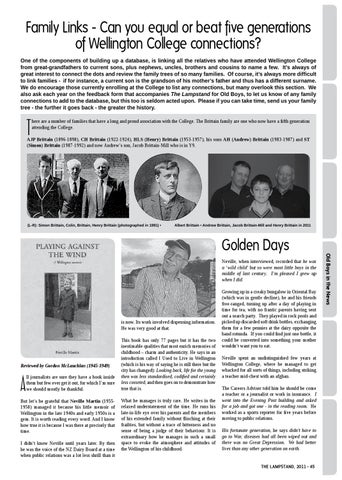
AJP Brittain (1896-1898), CH Brittain (1922-1924), HLS (Henry) Brittain (1953-1957), his sons AH (Andrew) Brittain (1983-1987) and ST (Simon) Brittain (1987-1992) and now Andrew’s son, Jacob Brittain-Mill who is in Y9.
(L-R): Simon Brittain, Colin, Brittain, Henry Brittain (photographed in 1991) •
Albert Brittain • Andrew Brittain, Jacob Brittain-Mill and Henry Brittain in 2011
Neville, when interviewed, recorded that he was a ‘wild child’ but so were most little boys in the middle of last century. I’m pleased I grew up when I did.
is now. Its work involved dispensing information. He was very good at that.
Reviewed by Gordon McLauchlan (1945-1949)
A
ll journalists are sure they have a book inside them but few ever get it out, for which I’m sure we should mostly be thankful.
But let’s be grateful that Neville Martin (19551958) managed it because his little memoir of Wellington in the late 1940s and early 1950s is a gem. It is worth reading every word. And I know how true it is because I was there at precisely that time. I didn’t know Neville until years later. By then he was the voice of the NZ Dairy Board at a time when public relations was a lot less shrill than it
This book has only 77 pages but it has the two inestimable qualities that most enrich memories of childhood – charm and authenticity. He says in an introduction called I Used to Live in Wellington (which is his way of saying he is still there but the city has changed): Looking back, life for the young then was less standardised, codified and certainly less cosseted, and then goes on to demonstrate how true that is. What he manages is truly rare. He writes in the relaxed understatement of the time. He runs his late-in-life eye over his parents and the members of his extended family without flinching at their frailties, but without a trace of bitterness and no sense of being a judge of their behaviour. It is extraordinary how he manages in such a small space to evoke the atmosphere and attitudes of the Wellington of his childhood.
Growing up in a creaky bungalow in Oriental Bay (which was in gentle decline), he and his friends free-ranged, turning up after a day of playing in time for tea, with no frantic parents having sent out a search party. They played in rock pools and picked up discarded soft drink bottles, exchanging them for a few pennies at the dairy opposite the band rotunda. If you could find just one bottle, it could be converted into something your mother wouldn’t want you to eat. Neville spent an undistinguished few years at Wellington College, where he managed to get whacked for all sorts of things, including striking a teacher mid-chest with an afghan. The Careers Adviser told him he should be come a teacher or a journalist or work in insurance. I went into the Evening Post building and asked for a job and got one - in the reading room. He worked as a sports reporter for five years before moving to public relations. His fortunate generation, he says didn’t have to go to War, diseases had all been wiped out and there was no Great Depression. We had better lives than any other generation on earth. THE LAMPSTAND, 2011 • 45
Old Boys in the News
Golden Days