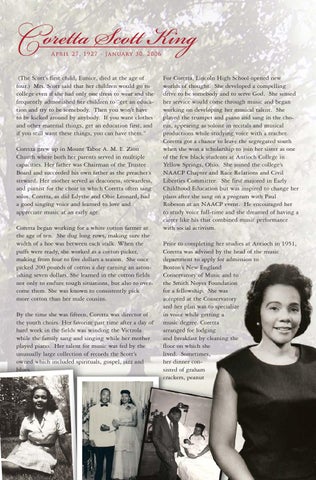
(The Scott’s first child, Eunice, died at the age of four.) Mrs. Scott said that her children would go to college even if she had only one dress to wear and she frequently admonished her children to “get an education and try to be somebody. Then you won’t have to be kicked around by anybody. If you want clothes and other material things, get an education first, and if you still want these things, you can have them.” Coretta grew up in Mount Tabor A. M. E. Zion Church where both her parents served in multiple capacities. Her father was Chairman of the Trustee Board and succeeded his own father as the preacher’s steward. Her mother served as deaconess, stewardess, and pianist for the choir in which Coretta often sang solos. Coretta, as did Edythe and Obie Leonard, had a good singing voice and learned to love and appreciate music at an early age. Coretta began working for a white cotton farmer at the age of ten. She dug long rows, making sure the width of a hoe was between each stalk. When the puffs were ready, she worked as a cotton picker, making from four to five dollars a season. She once picked 200 pounds of cotton a day earning an astonishing seven dollars. She learned in the cotton fields not only to endure tough situations, but also to overcome them. She was known to consistently pick more cotton than her male cousins. By the time she was fifteen, Coretta was director of the youth choirs. Her favorite past time after a day of hard work in the fields was winding the Victrola while the family sang and singing while her mother played piano. Her talent for music was fed by the unusually large collection of records the Scott’s owned which included spirituals, gospel, jazz and blues.
For Coretta, Lincoln High School opened new worlds of thought. She developed a compelling drive to be somebody and to serve God. She sensed her service would come through music and began working on developing her musical talent. She played the trumpet and piano and sang in the chorus, appearing as soloist in recitals and musical productions while studying voice with a teacher. Coretta got a chance to leave the segregated south when she won a scholarship to join her sister as one of the few black students at Antioch College in Yellow Springs, Ohio. She joined the college’s NAACP Chapter and Race Relations and Civil Liberties Committee. She first majored in Early Childhood Education but was inspired to change her plans after she sang on a program with Paul Robeson at an NAACP event. He encouraged her to study voice full-time and she dreamed of having a career like his that combined music performance with social activism. Prior to completing her studies at Antioch in 1951, Coretta was advised by the head of the music department to apply for admission to Boston’s New England Conservatory of Music and to the Smith Noyes Foundation for a fellowship. She was accepted at the Conservatory and her plan was to specialize in voice while getting a music degree. Coretta arranged for lodging and breakfast by cleaning the floor on which she lived. Sometimes, her dinner consisted of graham crackers, peanut