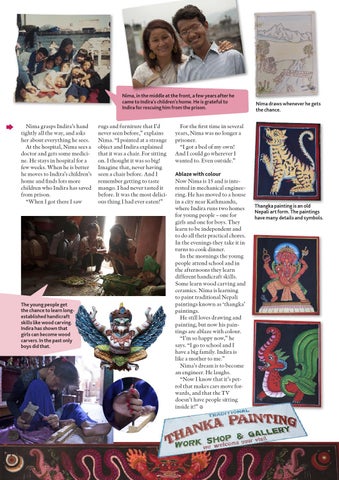
Nima, in the middle at the front, a few years after he came to Indira's children's home. He is grateful to Indira for rescuing him from the prison.
Nima grasps Indira’s hand tightly all the way, and asks her about everything he sees. At the hospital, Nima sees a doctor and gets some medici ne. He stays in hospital for a few weeks. When he is better he moves to Indira’s children’s home and finds lots more children who Indira has saved from prison. “When I got there I saw
The young people get the chance to learn longestablished handicraft skills like wood carving. Indira has shown that girls can become wood carvers. In the past only boys did that.
76
rugs and furniture that I’d never seen before,” explains Nima. “I pointed at a strange object and Indira explained that it was a chair. For sitting on. I thought it was so big! Imagine that, never having seen a chair before. And I remember getting to taste mango. I had never tasted it before. It was the most delici ous thing I had ever eaten!”
Nima draws whenever he gets the chance.
For the first time in several years, Nima was no longer a prisoner. “I got a bed of my own! And I could go wherever I wanted to. Even outside.” Ablaze with colour Now Nima is 15 and is inte rested in mechanical enginee ring. He has moved to a house in a city near Kathmandu, where Indira runs two homes for young people – one for girls and one for boys. They learn to be independent and to do all their practical chores. In the evenings they take it in turns to cook dinner. In the mornings the young people attend school and in the afternoons they learn different handicraft skills. Some learn wood carving and ceramics. Nima is learning to paint traditional Nepali paintings known as ‘thangka’ paintings. He still loves drawing and painting, but now his pain tings are ablaze with colour. “I’m so happy now,” he says. “I go to school and I have a big family. Indira is like a mother to me.” Nima’s dream is to become an engineer. He laughs. “Now I know that it’s pet rol that makes cars move for wards, and that the TV doesn’t have people sitting inside it!”
Thangka painting is an old Nepali art form. The paintings have many details and symbols.