almost a hundred years. These gangs have now started buying and selling children and women too. The centre of the trafficking industry in this area is in the small town of Mae Sai, by the border with Burma. When Sompop comes here for the first time, in 1989, there are almost 60 brothels in this small town. The girls there are abused and made ready to live their lives as brothel slaves. They are told never to say where they come from, or their real age. They are given fake ID documents and sold to tourist resorts in Thailand and countries like Malaysia, Japan and Singapore. One evening in Mae Sai, Sompop meets a tourist from Australia who has been com-
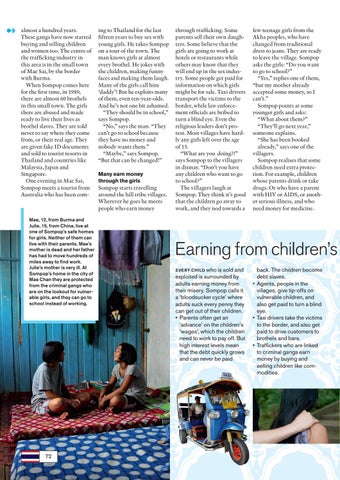
Mae, 12, from Burma and Julie, 15, from China, live at one of Sompop’s safe homes for girls. Neither of them can live with their parents. Mae’s mother is dead and her father has had to move hundreds of miles away to find work. Julie’s mother is very ill. At Sompop’s home in the city of Mae Chan they are protected from the criminal gangs who are on the lookout for vulnerable girls, and they can go to school instead of working.
ing to Thailand for the last fifteen years to buy sex with young girls. He takes Sompop on a tour of the town. The man knows girls at almost every brothel. He jokes with the children, making funny faces and making them laugh. Many of the girls call him ‘daddy’! But he exploits many of them, even ten-year-olds. And he’s not one bit ashamed. “They should be in school,” says Sompop. “No,” says the man. “They can’t go to school because they have no money and nobody wants them.” “Maybe,” says Sompop. “But that can be changed!” Many earn money through the girls
Sompop starts travelling around the hill tribe villages. Wherever he goes he meets people who earn money
through trafficking. Some parents sell their own daughters. Some believe that the girls are going to work at hotels or restaurants while others may know that they will end up in the sex industry. Some people get paid for information on which girls might be for sale. Taxi drivers transport the victims to the border, while law enforcement officials are bribed to turn a blind eye. Even the religious leaders don’t protest. Most villages have hardly any girls left over the age of 13. “What are you doing?!” says Sompop to the villagers in dismay. “Don’t you have any children who want to go to school?” The villagers laugh at Sompop. They think it’s good that the children go away to work, and they nod towards a
few teenage girls from the Akha peoples, who have changed from traditional dress to jeans. They are ready to leave the village. Sompop asks the girls: “Do you want to go to school?” “Yes,” replies one of them, “but my mother already accepted some money, so I can’t.” Sompop points at some younger girls and asks: “What about them?” “They’ll go next year,” someone explains. “She has been booked already,” says one of the villagers. Sompop realises that some children need extra protection. For example, children whose parents drink or take drugs. Or who have a parent with HIV or AIDS, or another serious illness, and who need money for medicine.
Earning from children’s mi every child who is sold and exploited is surrounded by adults earning money from their misery. Sompop calls it a ‘bloodsucker cycle’ where adults suck every penny they can get out of their children. • Parents often get an ‘advance’ on the children’s ‘wages’, which the children need to work to pay off. But high interest levels mean that the debt quickly grows and can never be paid
back. The children become debt slaves. • Agents, people in the villages, give tip-offs on vulnerable children, and also get paid to turn a blind eye. • Taxi drivers take the victims to the border, and also get paid to drive customers to brothels and bars. • Traffickers who are linked to criminal gangs earn money by buying and selling children like commodities.
72
70-89_Thailand.indd 72
2012-12-07 15.12