News »
Optimism despite tough times Jo Bailey There were sparks of optimism amongst the negative outlook at this year’s AusIMM NZ Branch conference, says Rene Sterk, chairperson of the organising committee. “Times are obviously still really tough with commodity prices low, people continuing to be laid off and very little new expenditure or investment in the industry. “However, some speakers at the conference said it is not all bad news, citing OceanaGold’s great progress and Newcrest’s big ideas and plans for New Zealand.” More than 250 delegates attended the event, which was held in Dunedin for the first time in more than 10 years. “Numbers were a little down on last year, but considering the state of the industry it was a pretty decent turnout,” says Sterk. With such a variety of speakers and sessions, he says it is difficult to pick a highlight.
However, the sessions with Tony Haworth, director of Campbell MacPherson, and Alan Broome, chairman emeritus of Austmine and also chairman of CRL, who provided overviews of the state of the New Zealand and Australian mining sectors, generated a lot of interesting debate. Tony Haworth said the commodities downturn was in its fifth year and there was no sign of recovery yet. Equity funding for the sector had plunged, and New Zealand’s global ranking as a host mining country dropped from 19 places to 35th out of 100. He said the attraction of investing in gold in New Zealand was one upside for the sector, given the availability of exploration ground, and data available from the government-funded aeromagnetic surveys. Alan Broome told a similar story with regards the Australian sector, where $155 billion in projects has been postponed due to the downturn. He said the sector needed to rethink the way it attracted capital, and employ smarter mining principles and the use of innovative technologies.
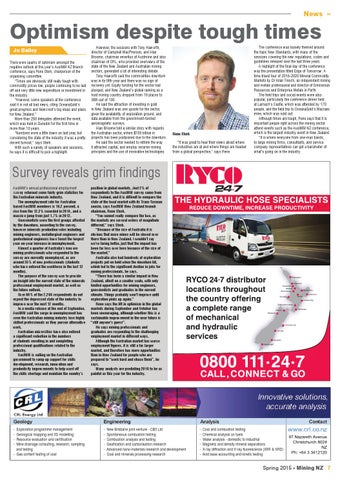
Rene Sterk
“It was great to hear their views about where the industries are at and where things are headed from a global perspective,” says Rene.
The conference was loosely themed around the topic New Standards, with many of the sessions covering the new regulations, codes and guidelines released over the last three years. A highlight of the final day of the conference was the presentation titled Edge of Tomorrow: A time-travel tour of 2016-2020 Mineral Commodity Markets by Dr Allan Trench, an independent mining and metals professional and director of Emmerson Resources and Enterprise Metals in Perth. The field trips and social events were also popular, particularly the conference dinner held at Larnach’s Castle, which was attended by 170 people, and the field trip to OceanaGold’s Macraes mine, which was sold out. Although times are tough, Rene says that it is important people right across the mining sector attend events such as the AusIMM NZ conference, which is the largest industry event in New Zealand. “It is where everyone from one-man bands, to large mining firms, consultants, and service company representatives can get a barometer of what’s going on in the industry.
Survey reveals grim findings AusIMM’s annual professional employment survey returned some fairly grim statistics for the Australian minerals industry. The unemployment rate for Australian based AusIMM members is 16.2 percent, a rise from the 12.2% recorded in 2014, and a massive jump from just 1.7% in 2012. Geoscientists were the first groups affected by the downturn, according to the survey, however minerals production roles including mining engineers, metallurgical engineers and geotechnical engineers have faced the largest year-on-year increase in unemployment. Almost a quarter of Australia’s iron ore mining professionals who responded to the survey are currently unemployed, as are around 35% of new professionals (students who have entered the workforce in the last 12 months). The purpose of the survey was to provide an insight into the current state of the minerals professional employment market, as well as the future outlook. Over 80% of the 2,266 respondents do not expect the depressed state of the industry to improve over the next 12 months. In a media release at the end of September, AusIMM said the surge in unemployment has seen the Australian mining industry lose highly skilled professionals as they pursue alternative work. Australian universities have also noticed a significant reduction in the numbers of students enrolling in and completing professional qualifications related to the industry. AusIMM is calling on the Australian government to ramp up support for skills development, research, innovation and productivity improvements to help ward off the skills shortage and maintain the country’s
-
Exploration programme management Geological mapping and 3D modelling Resource evaluation and certification Mine drainage consulting, research, sampling and testing - Gas content testing of coal
position in global markets. Just 2% of respondents to the AusIMM survey came from New Zealand, and it is difficult to compare the state of the local market with its Trans-Tasman cousin, says AusIMM New Zealand branch chairman, Rene Sterk. “You cannot really compare the two, as the markets are several orders of magnitude different,” says Sterk. “Because of the size of Australia it is obvious that more mines will be closed over there than in New Zealand. I wouldn’t say we’re faring better, just that the impact has been far less over here because of the size of the market.” Australia also had hundreds of exploration projects put on hold when the downturn hit, which led to the significant decline in jobs for mining professionals, he says. “There has been a similar impact in New Zealand, albeit on a smaller scale, with only limited opportunities for mining engineers, geoscientists and graduates in the current climate. Things probably won’t improve until exploration picks up again.” Rene says the lift in optimism in the global markets during September and October has been encouraging, although whether this is a sustainable improvement in the near future is “still anyone’s guess”. He says mining professionals and graduates are responding to the challenging employment market in different ways. Although the Australian market has worse employment figures, it is still a far larger market, and therefore has more opportunities than in New Zealand for people who are prepared to “work hard and chase them”, he says. Many analysts are predicting 2016 to be as painful as this year for the industry.
-
New Brisbane joint venture - CB3 Ltd Spontaneous combustion testing Combustion analysis and testing Gasification and carbonisation research Advanced nano-materials research and development Coal and minerals processing research
Whangarei
Pukekohe Waikato Otorohanga
Auckland
Taranaki
Whakatane Gisborne
Taupo
Hawkes Bay Palmerston North Wairarapa
Nelson Westport
Christchurch Temuka
Dunedin Invercargill
-
Coal and combustion testing Chemical analysis on fuels Water analysis - domestic to industrial Magnetic and density mineral separations X-ray diffraction and X-ray fluorescence (XRF & XRD) Acid base accounting and kinetic testing
Spring 2015 » Mining NZ 7