THE FACE OF THE CLIMATE STRIKE
SWEDISH TEENAGER GRETA THUNBERG LEADS THE CHARGE AGAINST ECOLOGICAL DISASTER
CLIMATE CRUSADERS NORDIC AMBASSADORS IN THE CLIMATE FIGHT THE QUEST FOR 1.5 DEGREES CENTIGRADE
NEW FACES ON EMBASSY ROW INSIDE HOMES: BAHRAIN AMBASSADOR’S McLEAN MANSE CBS’ NORAH O’DONNELL RETURNS HOME
10 44
28 '328)287 O C TO B E R 2 01 9
EDITOR'S LETTER Embassy Social Secretaries Reception ......................
FEATURES
Government Hall of Fame Gala ............................
NORDIC AMBASSADORS
Ambassadors Ball ...............................................
Front runners in the green transition........................
THE QUEST FOR DEGREE CENTIGRADE Can we save the planet? .......................................
GRETA THUNBERG Face of the youth climate movement ....................... NEW FACES OF EMBASSY ROW ............ Theresa May and Sir Kim Darroch ........................ The EU's Stavros Lambrinidis .............................. ETON: School for British Prime Ministers ..............
MPs Behaving Badly ...........................................
FYIDC SOCIAL CALENDAR ................................... THE DISH Wolfgang Puck .................................
IN CONVERSATION CBS' Norah O'Donnell...
WHO'S NEXT Christina McDowell...................
POLLYWOOD Joan Hisaoka 'Make a Difference' Gala...................
HOLLYWOOD ON THE POTOMAC ...................................
Halcyon Awards .................................................. The Cafritz's Welcome Back from Summer ..............
Wolf Trap Ball ................................................... Noche de Gala ................................................... CHARITY SPOTLIGHT Fight Night .............
LIFESTYLES BOOKS "A Great Party" ................................. WEDDINGS Kimberley Doyle and John Paszterko .. FASHION Town & Country .............................. African designers Patience Torlowei and Abai Schulze .... TRENDS Accessories ......................................... MUSIC Rocker Jim James .................................... SPORTS Carl Hagelin and Jonathan Allen ...........
43
WASHINGTON SOCIAL DIARY OVER THE MOON ......................................
The REACH Opening ......................................... Supporting Bill Weld .......................................... Marie Arana Book Party ........................................ Book Party for Kim Wehle ................................... La Cosecha 'Calle Latina' Opening ....................... Go Bo 'Bolympics' ..............................................
PARTIES PARTIES PARTIES .........................
HOME LIFE INSIDE HOMES Bahraini Ambassador's Residence... OPEN HOUSE ............................................... REAL ESTATE NEWS ................................... MY WASHINGTON Amb. Joe Hockey ................
28
COVER: Nordic Ambassadors: Lone Dencker Wisborg (Denmark), BergdÃs Ellertsdóttir (Iceland), Karin Olofsdotter (Sweden), Kirsti Kauppi (Finland) and KÃ¥re R. Aas (Norway) (Photo by Tony Powell)_ Greta Thunberg (Photo by Anders Hellberg). TOP: European Union Ambassador Stavros Lambrinidis (Photo Courtesy of E.U.); A home showcased in the DC Modern Home Tour; FASHION at Tusculum Farm (Photo by Tony Powell). RAHAMINOV gold and diamond band ring ($17,600) Tiny Jewel Box, 1155 Connecticut Ave. NW, 202. 393. 2747. Climate Stike (Photo: by Markus Spiske).
4
WA S H I N G T O N L I F E
| O C T O B E R | washingtonlife.com
T H E I N S I D E R’S G U I D E TO P OW E R , P H I L A N T H R O PY, A N D SO C I E T Y S I N C E 1 9 9 1
EDITOR IN CHIEF
Nancy Reynolds Bagley SENIOR EDITOR
Kevin Chaffee MANAGING EDITOR
Catherine Trifiletti EDITOR
Dara Klatt CONTRIBUTING EDITOR
Roland Flamini ASSISTANT EDITOR
Katelyn Rutt COLUMNISTS AND CONTRIBUTING WRITERS
Janet Donovan, Steve Houk,Vicky Moon, Stacey Grazier Pfarr and Donna Shor ART DIRECTOR
Matt Rippetoe PRINCIPAL PHOTOGRAPHER
Tony Powell CONTRIBUTING PHOTOGRAPHERS
Joy Asico, Ben Droz, Alfredo Flores, Larry French, Naku Mayo,Kyle Samperton, Erin Schaff, Jay Snap, Amanda Warden and Brian Wilson
PUBLISHER & CEO
Soroush Richard Shehabi SALES AND MARKETING REPRESENTATIVE
John Arundel BOOKKEEPER
Tomeka Tolson WEB TECHNOLOGIES DEVELOPMENT
Eddie Saleh,Triposs Mihail Iliev LEGAL
Mason Hammond Drake, Akerman, LLP EDITORIAL INTERNS
Lauryn Cantrell, Max Harwood, Kaitlyn Hopkins and Georgia Slater
FOUNDER
Vicki Bagley CREATIVE DIRECTOR EMERITUS (*)
J.C. Suarès CHAIRMAN, EXECUTIVE BOARD
Gerry Byrne Washington Life magazine publishes ten times a year. Issues are distributed in February, March, April, May, June, July/August, September, November, and December and are hand-delivered on a rotating basis to over 150,000 homes throughout D.C., Northern Virginia, and Maryland. Additional copies are available at various upscale retailers, hotels, select newstands, and Whole Foods stores in the area. For a complete listing, please consult our website at www.washingtonlife.com. You can also subscribe online at www.washingtonlife.com or send a check for $79.95 (one year) to: Washington Life Magazine, 2301 Tracy Place NW, Washington D.C., 20008. BPA audited. Email us at info@washingtonlife.com with press releases, tips, and editorial comments. Copyright ©2011 by Washington Life. All rights reserved. Reproduction or use of editorial content or photos in any manner without permission is strictly prohibited. Printed in the United States. We will not be responsible for unsolicited manuscripts or photographs. *deceased
EDITOR’S LETTER
FOREIGN AMBASSADORS CHANGING CLIMATE
T
hose who know me are aware of how passionate I am about the environment and my fervor to soak up diplomatic and policy news. Our October issue combines both topics with candid interviews, amazing insight and lots of interesting information, including our cover story on the urgent, do-or-die imperative, not to let the global termperature rise above 1.5 degrees Celsius and our hopes of success in this effort. From here on out, we at Washington Life will continue to do our part in the fight against climate change by bringing it to the forefront of our editorial coverage. It is our turn to show younger generations (like Greta Thunberg) that their calls to action are not falling on deaf ears. Contributing editor Roland Flamini spotlights the new faces on Embassy Row and their approach to diplomacy as well as many nations’ efforts to combat climate change. Our cover showcases ambassadors from the Nordic countries that are the global front-runners in the green transition.The representatives from Denmark, Finland, Iceland, Norway and Sweden carefully articulated their nations’ commitment to achieving credible climate goals. We also highlight 16-year-old Greta Thunberg, the powerful face of the youth climate movement, who has gotten world leaders’ attention on the stronger need to act. We dive in on the verbal slings and arrows of the British House of Commons debate over Brexit, hear from European Union Ambassador Stavros Lambrinidis on the E.U.’s thriving relationships with the U.S., and get an exclusive tour of the Bahraini Ambassador and Sheikha Aisha al Khalifa’s beautiful residence in McLean. Australian Ambassador Joe Hockey shares his favorite places in Washington to unwind and Kimberley Doyle, the daughter of Maguy Maccario Doyle, the current and first female ambassador of the Principality of Monaco, details her intimate wedding while reflecting on her mother’s influence. On the style front, changing autumn colors inspired us to head out of the city for a little country breeze with a selection of tailored and textured fashion. Principal photographer Tony Powell and our editors made friends on the shoot with some lambs, alpacas, a border collie and one rather stoic local resident—Tusculum Farm’s horse! We sipped some of the area’s best dry hard ciders and caught up with rocker Jim James, chef/restaurateur Wolfgang Puck and sports standouts from the Washington Capitals and Washington Redskins. CBS Evening News anchor Norah O’Donnell, who has, over the years, graced many of this magazine’s pages, tells us about coming home to Washington and her family traditions growing up (church and “60 Minutes”). In the midst of a now roaring social season, we didn’t forget to highlight a number of wonderful events, including the Kennedy Center’s new The REACH development, as well as a retrospective on the iconic Fight Night event, which is celebrating 30 years in November.We also include coverage of the WL-sponsored Joan Hisaoka “Make a Difference” Gala and the Wolf Trap and Ambassador’s balls.
Editor Katelyn Rutt fends off sheep at the fashion shoot at Tusculum Farm
Nancy R. Bagley Editor in Chief Readers wishing to contact Nancy Bagley can email her at nbagley@washingtonlife.com
8
WA S H I N G T O N L I F E
| O C T O B E R | washingtonlife.com
FYIDC The Insider’s Guide to Washington
MOTION PICTURE PERFECT The film elite descends upon Middleburg for the 7th annual film festival B Y K AT E LY N R U T T
P
erhaps one of the few places where the opposing realms of nature and media coexist so seamlessly, Middleburg — just an hour outside of Washington — remains a haven for those looking to escape the harsh spotlight of Hollywood. Salamander Resort, set under blue skies and tucked in 340 acres of lush, rolling hills, provides the perfect backdrop for the four-day gathering known for its star-studded attendance and Oscar-worthy films. Unlike other film festivals, it possesses a peaceful, almost organic aura with farm-to-table dinners, hikes and horseback rides alongside an action-packed schedule of films, concerts and discussions — resulting in a simultaneously relaxing and engaging experience. Last year, celebrities including Viggo Mortensen, Jason Reitman and Maggie Gyllenhaal headlined the event, and awardwinning films like “Green Book,” “Free Solo” and “The Favourite” were screened. Among the 28 films screened at the festival, there were
“Ford v Ferrari” starring Matt Damon and Christian Bale
38 Oscar nominations and 23 Golden Globe nominations. “Our goal is to curate the best possible selection of films reflecting a wide range of subjects and perspectives,” festival executive director and award-winning documentary filmmaker Susan Koch said. Koch added that, due to the high caliber of films this year, the festival will be featuring a total of 34 films — six more than in 2018. The 2019 lineup includes “Ford v. Ferrari” (directed by James Mangold and starring Matt Damon and Christian Bale), “The Irishman” (directed by Academy Award-winning Martin Scorsese)
DC-Metro Modern Homes Tour
RESIDENTIAL MASTERPIECES This fall, the International Modern Home Tour Series returns to the D.C. Metro area. Tour-goers are offered an up-close-and-personal glimpse into some of the most beautiful homes in the area, as well as the opportunity to learn from the creative minds behind the unique styles of architecture and design.Visitors are encouraged to set a customized itinerary for the day, choosing their own pace and tour order. Oct. 5, D.C. Metro Area, 11 a.m. – 5 p.m., Tickets: $20-$50, mads. media/2019metromod/.
10
“Harriet” with Cynthia Erivo
and “Harriet” (directed by Kasi Lemmons). The festival’s presenting sponsor is the Coca-Cola Company and the individual presenting sponsors are Gary and Christina Mather. “Every year, I wonder how we can top last year’s lineup, but I’m confident that our filmgoers will not be disappointed,” festival founder and board chair Sheila C. Johnson says. “I honestly believe this will be our best year yet.” The Middleburg Film Festival runs Oct. 1720 at various locations in Middleburg, Va. Visit middleburgfilm.org for details and tickets.
Fall Wine Festival at Mount Vernon
A CAPITAL CAB SAV Sample Virginia-grown wines and enjoy spectacular sunset views along the Potomac River at the home of George Washington. Clink glasses with the first president and his wife Martha (in full costume, of course), or listen to live music with “revolutionists.” The festival celebrates the country’s history of wine making allowing enjoyment of the peaceful sanctuary at one of the nation’s most historic properties. Oct. 11 – Oct. 13, Mount Vernon, 6 p.m., Tickets: $48, food available for purchase onsite, mountvernon.org.
WA S H I N G T O N L I F E
| O C T O B E R | washingtonlife.com
FYIDC
| WOLFGANG PUCK
BREAKING BREAD WITH WASHINGTON Acclaimed celebrity chef Wolfgang Puck headlines MetroCooking DC on November 16-17.
W
olfgang Puck has a lot on his proverbial plate, but at the opening party of his chic new restaurant Cut at the Rosewood Hotel in Georgetown, where the celebrity chef and I sat down for a chat, his actual plate carried crunchy Peking duck tacos, smoked salmon pizza and succulent skewers of beef heart. As his creative dishes would imply, Puck is perpetually curious and constantly learning. Catching up with the charismatic Austrianborn, Los Angeles-based talent, I can’t resist commenting on his many projects:“You really do it all,” I remark.“Because I’m interested in so many things!” he answers back without hesitation. Beyond his empire of restaurants, including Washington’s tailored version of the renowned Cut concept and the Frank Gehry-designed restaurant he is building from scratch on the shores of Malibu—the 70-year-old chef also has an eponymous cookware line, a new wine collaboration with
12
Schramsberg Vineyards and a 20-plus-year gig with the Home Shopping Network. For Puck, adding Cut to his Washington portfolio (he also owns The Source) means
‘It’s not just the food, but it’s the story you tell about the food.’ — Wolfgang Puck on cooking for a live audience at MetroCooking DC
re-engaging with local diners. As a headliner for Washington’s premier culinary event MetroCooking DC on Nov. 17 he plans to do just that. “If we want the community to be interested in us, we have to be interested in the community,” he says.
At the two-day event, Puck will join fellow culinary stars including Martha Stewart and Lidia Bastianich for a live cooking demo and meet-and-greets with guests. He looks forward to connecting with his audience through storytelling. “It’s not just the food, but it’s the story you tell about the food or about your life,” Puck says. “People want to know what makes somebody tick, what makes somebody do what they do.” He also plans to use the platform to introduce Cut’s executive chef, Andrew Skala, to Washington. Whether he is fussing with a potato dish or enrolling in Harvard University’s esteemed business school at age 66 (he graduated in March), Puck is perennially pushing personal boundaries. “What can we do differently?” and “What can we do new?” are questions he is consistently asking his team and himself. “I like the process of doing new things all the time,” he says.
WA S H I N G T O N L I F E
| O C T O B E R | washingtonlife.com
P H OTO CO U RT E SY WO L FGA N G P U C K
BY C AT H E R I N E T R I F I L E T T I
FYIDC | NORAH O’DONNELL
NORAH’S BACK
‘CBS Evening News’ anchor Norah O’Donnell on her career, a return to Washington and more hard news INTERVIEW BY KEVIN CHAFFEE
WHAT’S IT LIKE TO BE HEADING BACK TO WASHINGTON AFTER BEING HEADQUARTERED IN NEW YORK FOR THE PAST SEVEN YEARS? I love New York, but Washington has always been my home. And I’m so excited about what the move means for the Evening News— important decisions are made in Washington, and having the broadcast based there positions us to cover the rest of the country better. WHAT INFLUENCED YOU THE MOST IN YOUR DECISION TO BECOME A JOURNALIST? DID IT GO MOSTLY ACCORDING TO PLAN OR WERE THERE MAJOR HURDLES AND SURPRISES ALONG THE WAY? I’ve always been deeply curious—I was the kid who couldn’t stop asking questions. And my parents were, and still are, avid consumers of news. I like to say we had two traditions in our house: church and “60 Minutes.” So, I always had a deep appreciation for the news, and broadcast news in particular. WHO WERE YOUR ROLE MODELS, ESPECIALLY AMONG YOUR FEMALE NEWS COLLEAGUES, AND HOW DID THEY IMPACT YOUR CAREER? Barbara Walters was one of the first women I ever saw in a position of power, and that really stayed with me as I grew older. She actually sent me a note when I started this job, which was an incredible moment for me. I’ve been so humbled by the support I’ve received from
OF ESSENTIALLY LOCAL STORIES BASED ON SECURITY AND CELL PHONE VIDEOS (E.G. POLICE ENCOUNTERS), CELEBRITY SCANDALS AND FEELGOOD CLOSING SEGMENTS. DO YOU WANT TO SEE A FOCUS PRIMARILY ON MAJOR NATIONAL AND INTERNATIONAL NEWS? “CBS Evening News” is a hard news broadcast—the stories we put on the air every night are what we think are the most important things happening across the country and around the world. Holly Williams in Syrian refugee camps for example. Our reporting from inside the detention centers on the border. We take our responsibility to inform our viewers very seriously, and I’m exceptionally proud of the journalism our team produces.
journalists whose careers I admire—both men and women. YOU DRESS BEAUTIFULLY AND APPROPRIATELY FOR YOUR AUDIENCE EVERY NIGHT. THAT SAID, DO YOU THINK NEWSWOMEN NEED TO FOCUS ON THEIR APPEARANCE MORE THAN MALE COUNTERPARTS? I want people to focus on the substance of my work so I’ve always tried to make sure my appearance is professional and does not detract from the serious work we do. SOME OF THE MAJOR NETWORKS’ HALF-HOUR EVENING BROADCASTS NOW INCLUDE LOTS
YOU AND YOUR HUSBAND [NOTED WASHINGTON RESTAURATEUR] GEOFF TRACY MET DURING YOUR STUDENT DAYS AT GEORGETOWN UNIVERSITY. HOW OFTEN DO GET BACK TO THE CAMPUS FOR SPORTING EVENTS, ETC? I don’t get back as often as I’d like, but maybe that will change when I move back to Washington! DOES GEOFF HAVE DINNER WAITING WHEN YOU GET HOME? It is nice being married to a chef. Until the broadcast moves I’m still in New York, but having dinner with my family every night is something I’m really looking forward to. Right now I’m enjoying the pancakes and bacon!
NORAH ON THE WL SOCIAL SCENE When she’s not in a muted suit asking hard questions for CBS, O’Donnell glams it up for her favorite fêtes and causes in her hometown. WL searched its archive and found that she’s never missed a beat.
2008
2009
Ambassador’s Ball
2010
Joan Hisaoka ‘Make MSNBC WHCD a Difference’ Gala After Party
14
2011
2012
2013
2014
2015
2016
2017
2018
2019
MSNBC WHCD After Party
Kennedy Center Honors
Children’s Ball
Vital Voices Global Leadership Awards
Women on the Move Luncheon
WHCD Pre-parties
Children’s Ball
Kennedy Center Honors
Children’s Ball
WA S H I N G T O N L I F E
| O C T O B E R | washingtonlife.com
FYIDC | WHO’S NEXT
WHO’S NEXT After a well-received memoir about her family’s fall from grace, Christina McDowell’s new book focuses on the Washington elite. BY C AT H E R I N E T R I F I L E T T I PORTRAIT BY TONY POWELL
L
ife upended after Christina Prousalis’ father went to prison on Federal felony charges related to securities fraud, notably dealings with Jordan Belfort, the notorious investor on whom “Wolf of Wall Street” was based. Christina McDowell (who changed her name to distance herself from the scandal) wrote a scathing op-ed in LA Weekly lambasting the feature film’s star, Leonardo DiCaprio, and director, Martin Scorcese, for glamorizing Belfort’s criminal activities while ignoring his victims.The article went viral and led her to share her personal journey in “After Perfect:A Daughter’s Memoir” recounting the roller coaster ride that ensued after her family lost everything and became crippled by debt. The author notes that her father opened credit cards in her name, forcing her to drop out of college to chip away at the nearly $100,000 she owed to the banks.“At 18 I was financially paralyzed and spent years homeless,” she recalls.“I didn’t have any financial education growing up, it was always assumed that my parents would take care of me.” After rebuilding her life in Los Angeles, years of therapy, work with non-profit groups involved in helping victims of incarceration and the cathartic exercise of documenting her experience, McDowell is now working on her next book. “The Cave Dwellers” (Simon & Schuster, 2020) focuses on the dynasties that have dominated the Washington scene (and the nation) for years. Using four fictional families as protagonists, she explores her fascination with classism and pressures of living up to a name—referencing the du Ponts and other plutocratic clans that helped built the economy of the capital and the country as a whole. The title alludes to the term that describes the Washington old-money set who trace their lineage back generations while quietly maintaining their social status and economic clout. McDowell’s homecoming to the District became another aspect of her healing process. She immersed herself in researching the social circles she grew up in, attending galas, spending time at the Sulgrave Club and other old guard redoubts, visiting Middleburg, reading about the history of the city’s elite in the Peabody Room of the Georgetown Public Library and flipping through the pages of the “The Social List of Washington,” better known as “The Green Book.”The central question underpinning the novel became: “What does it take to break cycles?” —referencing her own experience as being a unique disruption in her family’s affluent trajectory.“ I lost everything, so in a way I was forced to build my life the way I wanted to build my life,” she says. “I found that very freeing in the sense that I spent a lot of time letting go of these ideas of how something should be.” Re-entering the throes of Washington society amid many of the people who ostracized her and her family years ago gave her a new positive lens from which to view her past.“I felt confused about my identity. Having this childhood that was really kind of a house of cards, but then reconnecting with some of my oldest friends I realized Washington is a part of who I am,” she says.“I can be proud of that.”
ADVICE TO YOUNG WRITERS Ask 16 yourself what it is you have to say. Have something to say that’s honest. Everything I’ve written has come from this need to be heard. Also, have the willingness to be messy and let go of perfectionism.
WA S H I N G T O N L I F E
| O C T O B E R | washingtonlife.com
POLLYWOOD The Nexus of Politics﹐ Hollywood﹐ Media and Diplomacy | Wolf Trap Ball, Meridian Social Secretaries Reception, Noche de Gala and more!
Britt McHenry at the Ambassador’s Ball (Photo by Tony Powell)
WA S H I N G T O N L I F E
| O C T O B E R | washingtonlife.com
19
POLLYWOOD
Annette and Tony Nader Alice and Tom Blair Dana Hines and Bob Hisaoka with Bonnie and Dick Patterson WL SPONSORED
JOAN HISAOKA ‘MAKE A DIFFERENCE’ GALA Gary and Tina Mather
The Mandarin Oriental PHOTOS BY ALFREDO FLORES AND CHRIS SPIELMANN
Amanda and Earl W. Stafford
SELLOUT CROWD: A new venue for the 12 yearold gala didn’t mean a loss of steam. The sold out crowd helped raise more than $1.83 million for programs providing support to individuals living with cancer, totaling about $16 million since Bob Hisaoka first created the gala. Hisaoka’s efforts are an hommage to his late sister Joan who lost her fight against cancer in 2008. Of the proceeds, 63 percent are allotted to Inova Schar Cancer Institute’s Life with Cancer program and 33 percent goes to Washington’s only independent cancer support center, Smith Center for Healing and the Arts. Hisaoka was joined by a powerhouse roster of sponsors, including Katherine and David Bradley, Richard Kay, Ted and Lynn Leonsis, Sachiko Kuno and Jack Davies and Kay Kendall.
John Deeken, Kathryn Jones and Inova President Dr. Stephen Jones
Ron Herman and Cedric Brown Steve and Marie Schram Barry Dixon, Jen Lopez and Will Thomas
Mark Lowham and Elizabeth Lowham
20
Mark and Sarah Kimsey
Jim Abdo and Tony Williams
WA S H I N G T O N L I F E
| O C T O B E R | washingtonlife.com
DONO T V E N
AN
JA
POLLYWOOD | HOLLYWOOD ON THE POTOMAC
Tamron Hall
22
“People always say, how do you choose your topics? And the glib instant answer out of my mouth is they choose me. But every once in a while something comes before you and it just knocks you over. Unlike in any other musical form I’ve ever come across, nearly [everyone involved in country music] was dedicated to understanding who their ancestors were, who their granddaddys and grandmamas were, and who their parents were and who their cousins are. And it’s a wonderful, wonderful family. Okay, that’s my debate speech. I’m throwing my hat in the ring.There aren’t enough Democrats.” — Filmmaker Ken Burns
— Journalist and author Myra MacPherson
WA S H I N G T O N L I F E
| O C T O B E R | washingtonlife.com
O F
A B C ;
P H O T O
C O U R T E S Y
O F
A U S T I N
F I L M
S O C I E T Y
“She could have been a great politician because she had the ability to pull people in. I’m a little tired of people trying to make Molly into some sort of tragic person who had lived a lonely life. She had tons of friends and tons of family. I do think she started drinking because that’s what you did. You started in journalism and there aren’t any other women around and there you are with the guys and you want to be one of the boys.”
C O U R T E S Y
Synopsis: Ken Burns presents a comprehensive look at the history of country music as a uniquely American art form. From its deep roots in ballads, blues and hymns, to its international popularity, the WETA/PBS docuseries covers country music’s evolution over the course of the 20th century.
Synopsis: The film tells the story of media firebrand Molly Ivins, six feet of Texas trouble who took on Good Ol’ Boy corruption wherever she found it. Her razor sharp wit left both sides of the aisle laughing, and craving ink in her columns. She knew the Bill of Rights was in peril, and said “Polarizing people is a good way to win an election and a good way to wreck a country.” Molly’s words have proved prescient.The event was moderated by Margaret (Peggy) Engel who wrote the screen play, which stars Kathleen Turner.
P H O T O
SCREENING OF ‘COUNTRY MUSIC’ WITH FILMMAKERS KEN BURNS JULIE DUNFEY AND KATHY MATTEA GW Lisner Auditorium
SCREENING OF ‘RAISE HELL THE LIFE & TIMES OF MOLLY IVINS’ Landmark E Street Cinema
W E T A ;
“When you’re a child, you look up and you draw the shape that’s lit, and it’s usually a crescent. As of now, I certainly see the orb that is sitting out in this inhospitable abyss. And beyond that are other solar systems, and endless stars. It’s just unfathomable. So, the mystery of it all is quite indelible, and it makes me believe in something bigger than us without being able to define it. ”— Brad Pitt
Larry Di Rita, Jonathan Barzilay, Kathy Mattea, Ken Burns, Bob Schieffer, Sharon Percy Rockefeller and Patricia de Stacy Harrison
F O R
Synopsis: In “Ad Astra,” astronaut Roy McBride (Pitt) undertakes a mission across an unforgiving solar system to uncover the truth about his missing father.
HE SCEN
R I S D O N
Brad Pitt ‘AD ASTRA’ A CONVERSATION WITH BRAD PITT JAMES GRAY AND NASA OFFICIALS Washington Post Live Center
T
C A B L E
— Tamron Hall on her sister’s murder from domestic violence
N
©
“I felt guilty for so long. [The audience] deserves my honesty.You cannot ask people to be honest and then you stand there holding in a secret that could free your guilt, free your family of hiding something and most important, save a life.”
O
Synopsis: ABC’s “Tamron Hall” will feature a dynamic mix of live and taped shows. From deeply moving stories to the purely fun, the nationally syndicated show will serve as a platform for viewers to connect with the people who are shaping our world through engaging and entertaining conversations.
E
LAUNCH OF ‘TAMRON HALL’ DAYTIME TALK SHOW
POLLYWOOD
Kate Goodall, Kei Tolliver, Sheila Johnson, Carol Melton and Sachiko Kuno
Simone Friedman and Gina Adams WL SPONSORED
HALCYON AWARDS Halcyon | PHOTOS BY VITHAYA PHONGSAVAN
Isaac Goldman, Jonah Goldman, Seth Goldman, Julie Farkas and Elie Goldman
Elsa M. and Laura Evans Manatos
Patti Grimes, Michelle Freeman and Molly Joyce
RECOGNIZING CHANGEMAKERS: The Washington Mystics’ new Entertainment and Sports Arena was bathed in blue light for the third annual Halcyon Awards celebrating change-makers who have pushed past traditional boundaries to impact the world. Musician/Philanthropist Troy “Trombone Shorty” Andrews, Beyond Meat executive chair and Honest Tea founder Seth Goldman, and former Senator Barbara Boxer were honored for dedicating their lives to affecting positive social change in the arts, business and public policy. The awards ceremony, co-chaired by Gina Adams of FedEx and Simone Friedman of EJF Philanthropies and emceed by TV newscasters Elsa M. and Laura Evans, provided a delicious plantbased (low-carbon impact) dinner prepared by Chef Sebastian Quiroga. Guests were regaled by Halcyon CEO Kate Goodall and her staff with an original rendition of an ABBA song thanking all sponsors. There was dancing late into the night to the tunes of DJ Bec Adams.
Lou Aronson, Ami Aronson and Troy “Trombone Shorty” Andrews
Lynne Assal and Ethan Assal Scott Greenberg and Kathleen Buhle
Patrice King Brickman, Anna Mason and John Mason
Virginia Shore, Eun Yang, Laura Evans Manatos, Lisa Hayes, Alex Migoya, Pilar O’Leary, Elisabeth LaMotte, Erin Egan, Nicole Rabner and Antigone Davis
58 Jack Davies, Kay Kendall, Pierre De Lucy, Jodie McLean and Mele Melton
WA S H I N G T O N L I F E
Australian Ambassador Joe Hockey
| O C T O B E R | washingtonlife.com Pete Slone, Ronit Avni and Wendee Wolfson
POLLYWOOD
Marcus Brauchli, Jane Cafritz, Melissa Chiu and Calvin Cafritz WL EXCLUSIVE
Marcelle Leahy, Ann Hand, Sen. Patrick Leahy, Elizabeth and George Stevens
WECOME BACK FROM SUMMER Calvin and Jane Cafritz Residence PHOTOS BY TONY POWELL
SALUTING THE SEASON: Receiving an invitation to attend Calvin and Jane Cafritz’s annual dinner dance to herald in the fall social season is always a coveted honor and the 250-plus guests who waited patiently in the long receiving line had plenty of time to take in the grand marquee and towering floral arrangements in the garden of their hosts’ Georgetown home before enjoying dinner delicacies (lobster salad, tenderloin of beef, crab cakes, salmon) followed by musical selections from the Washington National Opera’s upcoming season (“Otello,” “The Magic Flute”) performed by singers from Domingo-Cafritz Young Artists Program. “It’s a very special evening where we can get together with friends old and new,” Calvin Cafritz told the crowd before noting the presence of ambassadors and other luminaries including retired Justice Anthony Kennedy and Sen. Patrick Leahy, senior-most member of the Senate Judiciary Committee.
Justice Anthony Kennedy and Mary Kennedy Evelyn DiBona and Marie Ridder
Eden Rafshoon and Samia Farouki
24
Jan Smith with Belgian Amb. Dirk Wouters and Katrin Wouters
Bitsey Folger
WA S H I N G T O N L I F E
| O C T O B E R | washingtonlife.com
Gideon Malone and Arvind Manocha; Manjula and Srikant Sastry, Annie and Pat Pacious, Gouri Mirpuri and Singapore Ambassador Ashok Mirpuri WL SPONSORED
WOLF TRAP BALL Filene Center Stage | PHOTOS BY TONY POWELL AND VITHAYA PHONGSAVAN
Suzanne and Glenn Youngkin
Fred and Karen Schaufeld with Hillary and Tom Baltimore
SINGAPORE FLING: Those lucky enough to have visited the island city-state in southeast Asia know its fascinating history and multitude of cultural influences from China, India and Malaysia. Wolf Trap Foundation’s annual event – themed for 2019 after Singapore with honorary hosts Ambassador to the U.S. Ashok Mirpuri and his wife Gouri Mirpuri – proved a fitting nod to the diverse country. Lavish décor included greenery inspired by the popular destination Gardens by the Bay, pops of neon and colorful design elements reminiscent of Singapore’s lively street markets. An effort led by ball co-chairs Patrick and Annie Pacious and Srikant and Manjula Sastry, the seated dinner for 750 in support of the Foundation’s arts and education programs was the most successful fundraiser in the Wolf Trap Foundation’s 48-year-history. As a part of remarks, Chairman of the Foundation’s Board Dan D’Aniello was joined on stage by U.S. Secretary of the Interior David Bernhardt to thank guests for their dedication and support. MUSIC NATURALLY The Singapore and U.S. national anthems were performed by Wolf Trap Opera alumna soprano Tracy Cox and tenor Yongzhao Yu. Later in the evening, guests danced to big band hits by Sara Jones and the Wolf Trap Orchestra with many lingering for a night cap jam session by DJ Enferno.
Melissa and Steve Laskin Mark and Megan Frantz with Voula and Reza Akhavi
Joseph and Ludy Green
WA S H I N G T O N L I F E
| O C T O B E R | washingtonlife.com
Tina and Gary Mather
Stephen Labaton and Miriam Sapiro
25
POLLYWOOD
CHARITY SPOTLIGHT
THE FINAL ROUND Fight For Children’s annual benefit to celebrate 30 years with Fight Night: The Final Round.
L
ooking back on Fight Night’s 30 year history, it is hard to sum up all the unforgettable memories from the well attended black-tie fundraiser that has supported programs for at-risk children throughout the mid-Atlantic for three decades. Behind the cigar smoking, premium scotch and live boxing matches is the dedication and commitment of the event’s late founder Joseph E. Robert Jr., who rallied the community to support the region’s most
vulnerable citizens. Through the annual gathering of power players and titans of industry in sports, entertainment, business and politics, Robert hoped to share with friends and colleagues his passion for boxing and the valuable life lessons it taught him. Since its inception three decades ago, the popular evening has only gotten bigger and better. Despite all the upgrades Robert’s mission has remained simple and constant - to fight for children. Fittingly, Fight For Children is the
Fight Night: The Final Round will be held on November 14, 2019 at the Washington Hilton. For table and sponsorship information visit www.fightnightdc.org
Joe Robert and Kenneth “Babyface” Edmonds in 2009
Bill Coleman and Joe Robert in 1997
name of the nonprofit organization Robert created to ensure that all children in Washington, D.C. are on a path to a successful future. Since its start, Fight Night has generated nearly $70 million in support of 375,000 kids from across the region.
Boxers Joe Frazier and Sugar Ray Leonard in 1999
Jake “The Raging Bull” LaMotta in 2002
Christine Robert, Gen. Jim Jones, Aimee Lou and Cindy Robert in 2010
Quincy Jones, Chris Tucker and Mayor Adrian Fenty in 1997 James Brown in 1998
26
Kevin Plank in 2014
Sen. Mark Warner and Neil Cohen in 2016
“Join The Fight For Those Too Young To Fight For Themselves.” Joseph E. Robert, Jr.
Muhammad Ali in 1995
WA S H I N G T O N L I F E
Raul Fernandez and Michael Jordan in 1997
| O C T O B E R | washingtonlife.com
POLLYWOOD
Tracy Bernstein, David Adler and Rickie Niceta
2019 social secretaries and cultural attachés
EMBASSY SOCIAL SECRETARIES RECEPTION Meridian International Center | PHOTOS BY TONY POWELL PROTOCOL GURUS GATHER: Social secretaries from foreign embassies not only understand the importance of hospitality and diplomacy, they also know how to develop a narrative in high-profile event planning to reflect the values and priorities of their ambassadors. When they meet to compare notes, it makes for a unique gathering indeed. This summer, Ann Stock, who chairs Meridian International Center’s board of trustees, welcomed 120 guests to a discussion with officials from the Kennedy Center and the Motion Picture Association of America along with Diane Flamini, the Embassy of Spain’s longtime social secretary and Jonathan Steffert, public diplomacy and public affairs officer for the Embassy of New Zealand. The panel discussion was moderated by BizBash CEO David Adler. Others present included White House Social Secretary Rickie Niceta and Acting Chief of Protocol Mary-Kate Fisher.
The National Cathedral Choir
Sandra Pandit Cook, Francesca Baldanzi, Francesca Craig and Ann Stock
Gala host Major Garrett, Chief s Washington Correspondent, CBS News
Dwight Ink accepting his induction into the Government Hall of Fame
GOVERNMENT HALL OF FAME GALA Washington National Cathedral PHOTOS BY KRISTOFFER TRIPPLAAR
Dr. Christine Grady and Dr. Anthony Fauci with a senior Marine officer
28
DEDICATION TO PUBLIC SERVICE Jeweltoned lights illuminated the Washington National Cathedral as notable government officials gathered for the first Government Hall of Fame Gala to celebrate the ‘best of the best’ in public service. Those honored made “historic progress in changing government for the better.” VIPs included award winners Rep. Donna Shalala, Constance Berry Newman, Hubert T. Bell as well as speakers Rep. Tom Malinowski, Dana Deasy and Kay Coles James.
Commerce Secretary Wilbur Ross and Bob Brantner
WA S H I N G T O N L I F E
| O C T O B E R | washingtonlife.com
Channing Spencer and Tess Rayle WL SPONSORED
Sen. Tom Udall and Jill Cooper Udall, Italian Amb. Armando Varricchio and Micaela Varricchio, Chartese Berry, Susan Pompeo and Sec. Mike Pompeo
AMBASSADORS BALL The Anthem | PHOTOS BY TONY POWELL THE DIPLOMATS BID: For the 41st year, the National MS Society Ambassadors Ball welcomed members of Congress, ambassadors, business and philanthropic leaders and their spouses to honor the diplomatic corps for their charitable activities and humanitarian endeavors. Honorary co-chairpersons included Italian Amb. Armando Varricchio and Micaela Varricchio, Susan Pompeo and Jill Cooper Udall. One of the premiere events of the Washington fall social season raised over half a million dollars, bringing the total to more than $21 million to support the National MS Society through cutting-edge global research, advocacy and quality programs and services.
Debbie Meadows and Rep. Mark Meadows
Nomonde Nolutshungu, Candace Sahm and Virginia Lee
WA S H I N G T O N L I F E
| O C T O B E R | washingtonlife.com
Susan Blumenthal and Japan Amb. Shinsuke Sugiyama
Carol Crist and HUD Secretary Ben Carson
Tami Buckner, Cristina Antelo, Gino Duda, Anna Trevino and Lucia Alonzo
29
SPECIAL FEATURE
CLIMATE CHANGE
8LI :MOMRKW 8EOI 3R
'0-1%8) ',%2+)
T
The Nordic Ambassadors pictured at the Embassy of Finland. From top left: Lone Dencker Wisborg (Denmark), Bergdís Ellertsdóttir (Iceland), Karin Olofsdotter (Sweden), Kirsti Kauppi (Finland) and Kåre R. Aas (Norway)
LONE DENCKER WISBORG (Denmark) Denmark has already cut greenhouse gas emissions by more than 30 percent on 1990 levels, as well as integrating around 50 percent of renewables in the energy system. The next crucial step is to set the path for a society completely independent of fossil fuels by 2050. The government has a very ambitious goal of reducing Denmark’s emissions by 70 percent in 2030 compared to 1990. This requires new instruments and technologies, so the government is also looking at research across sectors in order to pursue a green transition throughout all parts of society. As an example, the government is initiating reduction targets for the agricultural sector to reduce greenhouse gas emissions. An additional example is the ambition to end the sale of all new diesel and petrol driven cars while instead investing more in public transportation. Another concrete step the government is taking is to initiate a Climate Change Action plan that will ensure that the national reduction
30
he Nordic countries are global front runners in the green transition. Supported by an environmentally concerned public, each of these climate-smart countries has taken major legislative and practical steps towards meeting its Paris Climate Accord commitments, starting with the race towards complete independence of fossil fuels by 2050. We asked the ambassadors of Denmark, Finland, Iceland, Norway and Sweden, for a brief rundown of their respective climate goals and these are their replies, redacted for space and content. >>
targets are actually met. The aspiration for the Danish government is to be among the countries that do the most in terms of combating climate change and to become a “green super power” that can actively contribute to moving things in the right direction globally. The government wants to lead the way in showing the rest of the world how to attract private investments to the green energy sector.
BERGDÍS ELLERTSDÓTTIR (Iceland) Climate change has already made itself felt in Iceland in the receding glaciers, which now cover 11 percent of the country and may all have melted away in the next 100 to 200 years, dramatically changing the landscape. For an island in the middle of the North Atlantic, the sea is paramount, and for a nation heavily dependent on fisheries the ocean acidification is of grave concern. Long before the Paris Accord, Iceland started harnessing renewable energy, both hydro and geothermal, to produce electricity and
heat houses, so that today almost all electricity, hot water and heating comes from renewable sources. But never before has the government allocated funding to environmental issues as the level now reached. There is also broad political support for a new government climate change action plan, the main emphasis of which are two measures: (1) to phase out fossil fuels in transport, and (2) increase carbon sequestration in land use by restoration of woodlands and wetlands, revegetation and afforestation. Climate mitigation measures will get a substantial increase in funding—almost 7 billion Icelandic krónur ($56.5 million) in the period 2019-2023. A general carbon tax, already in place, will be gradually increased. The aim is that Iceland will be carbon neutral by 2040 at the latest. Iceland will ban new registrations of fossil fuel cars after 2030. Efforts in land use are expected to greatly increase the uptake of carbon from the atmosphere, which is essential for its aim to achieve carbon neutrality
WA S H I N G T O N L I F E
| O C T O B E R | washingtonlife.com
by 2040. Often overlooked in this debate is the importance of combating soil erosion and revegetating denuded lands.
KÅRE R AAS (Norway) Norway will be climate neutral by 2030, and the government has committed to becoming a lowemissions society by 2050.To achieve these goals the Norwegian government has put a range of policies in place: Emissions from the transport sector will be reduced by 50 percent by 2030. In 2025, all new cars sold will have zero emissions or run on biofuel. Strong government incentives are in place to promote the sale and use of electric cars.Today, almost half of the new cars sold in Norway are electric. Car ownership and use are heavily taxed in Norway. Last June, the government launched a new strategy for green shipping. The ambition is to reduce emissions from domestic shipping and fisheries by 50 percent by 2030.The government aims to encourage the use of zero- and lowemissions technologies in all kinds of vessels and is expanding the electrification of the transport sector. By 2021, one in three ferries in Norway will be electric. In a European context, since 2008, Norwegian companies have been part of an emissions trading system that puts an overall limit, or cap, on emissions from industry and oil and gas production. Internationally, Norway’s International Climate and Forest Initiative, which pays for reductions in emissions from deforestation and forest degradation in developing countries, is definitely worth a mention. Stopping deforestation is perhaps the single most important measure for the climate. As much as one-third of the emissions reductions needed to solve the global climate problem could be achieved through cuts in emissions from deforestation and forest degradation. Norway contributes as much as half a billion dollars to developing countries via this initiative every year. KARIN OLOFSDOTTER (Sweden) Sweden is the world’s largest per capita donor to the climate funds, and will continue its strong leadership for climate action by contributing with policy, financing and innovative technology to support the transition to climate-smart societies and the implementation of the Paris Agreement. Science gives us about ten years to
WA S H I N G T O N L I F E
halve the world’s emissions, so accelerated action to reach the goals of the Paris Agreement will be crucial. Sweden will also be the world’s first fossilfree welfare nation. Many Swedish enterprises and municipalities have understood that climate change adaptation creates new business opportunities, technologies and better social solutions. Food retail, mining and minerals, and cement are examples of industries that have produced roadmaps to become fossil-free. A very exciting, and globally unique, development of carbon dioxidefree steel production is now under way in the city of Luleå, in northern Sweden. The Swedish Government initiated a new initiative ahead of Paris—Fossil Free Sweden— to show how enterprises, cities, municipalities and organizations contribute to climate efforts. As part of this, industries will develop sectorial roadmaps to how they will be fossil free while also increasing their competitiveness. Swedish public climate finance amounted to SEK 6.2 billion in 2018, of which SEK 4.3 billion was channeled through Sida (Swedish International Development Agency). The government has also initiated a robust green tax shift that will increase over the years ahead and introduced a Swedish state green bond.
KIRSTI KAUPPI (Finland) Finland is currently holding the rotating Presidency of the Council of the European Union, and climate change is the number one priority for its
| O C T O B E R | washingtonlife.com
six-month turn at the helm. EU’s medium-term target is to reach 40 percent emissions reduction by 2030 compared to 1990 levels. Key tools in this are a revised Emissions Trading System, new rules on land use and forestry, an EU –wide energy union and updating legislation on renewable energy and energy efficiency. The Paris Agreement requests signatory countries to prepare, by 2020, long-term strategies for climate neutrality. The European Union is working very hard to set a shared vision for our long-term climate goal, climate neutrality by 2050. Finland is doing well on delivering for climate. Most of its companies can be found in the cleantech sector.That is where innovation is booming. Finland’s greenhouse gas emissions have been cut by 21 percent to 1990 levels and increased its share of renewable energy sources to approximately 40 percent of energy end-consumption. Finland adopted a Climate Act in 2015, among the first countries in the world to do so. Finland’s northern location means that it feel the effects of global warming even more acutely. We have worked and will continue to work hard to make sure that the fragile ecosystem of the Arctic Region is safeguarded. Finland aims to be carbon neutral by 2035 and carbon negative soon after that.This will be done by accelerating emission reductions and strengthening our carbon sinks. Finland has already decided to phase out coal in energy production by 2029 and is now committed to phasing out fossil oil in heating by 2030.
31
SPECIAL FEATURE
CLIMATE CHANGE
8LI 5YIWX *SV
()+6))7 ')28-+6%() BY ROLAND FLAMINI
CAN THE PARIS CLIMATE AGREEMENT SAVE THE PLANET? In November, the Trump Administration plans to begin the process of withdrawing the U.S. from the Paris Climate Agreement, formally reversing America’s commitment made in 2015 together with about 195 other countries to confront the greatest existential crisis of our time. Meanwhile, other Paris signatories pressed on with their efforts to keep rises in global temperature to no more than 1.5 degrees Celsius above pre-industrial levels—notwithstanding a 2018 United Nations progress report on climate change that said the world was “nowhere near on track” to meet prescribed deadlines. The World Meteorological Association actually predicts a 3–5 degree increase by 2100. At a U.N. Climate Action Summit of world leaders and the private sector in NewYork in September, U.N. Secretary General Antonio Guterres called for more effort to reduce greenhouse gases as a matter of urgency.The U.N. wants to reduce gas emissions by 45 percent over the next decade, and to reach net zero emissions by 2050. Guterres has been urging countries, “don’t bring a speech, bring a plan,” but the summit was heavy on more cash commitments (Angela Merkel announced Germany’s new allocation of $100 billion for climate protection by 2030), but disappointingly light on fresh initiatives. One surprise: giant global corporations promising to phase out fossil fuels.
32
By most scientific estimates, Earth has to begin significant carbon pollution reductions to avert total planetary disaster, in just under a decade. What’s needed is a rapid and far reaching transformation of the world’s economy, the end of coal usage altogether, a significant decrease in the use of fossil fuels, a leap in renewable energy, electrification of our transportation system, and transformation of agricultural and land-use practices —all of which will require a $5-7 trillion investment in green infrastructure. “We are running out of time to stay under the 1.5 degree Celsius limit” warns Patricia Espinosa, a senior U.N. official on climate change. The Climate Action Tracker, a monitoring project run by three climate-research organizations, puts five countries in the “Critically Insufficient” column of its periodic list of how the Paris accord signatories are living up to their commitments. They are the United States, Russia, Saudi Arabia, Turkey, and Ukraine. But there are some bright spots: Morocco:“Morocco is currently Africa’s leader in terms of efforts to combat climate change, reaffirming the country’s commitment to the Paris Agreement on climate action,” the United Nations reports. The Maghreb kingdom has a climate program that puts it on track to do its fair share of keeping warming below the 1.5 degree Paris target. One of the world’s largest solar farms has been providing 600,000 consumers in and around
the Moroccan city of Ouarzazate on the edge of the Sahara Desert since 2016, and Morocco has commissioned other large-scale renewable energy projects, cut-back fossil fuel subsidies, and expects to get be getting 42 percent of its energy needs from renewable sources by 2020. India: One of the world’s biggest economies has one of the fastest growing renewable energy programs. India has promised that 40 percent of its electrical power generation would come from non-fossil-fuel sources by 2030, but experts believe it could well meet that goal this year. As the country seeks to replace the use of coal with renewables, India has emerged as the world’s second largest investor in renewable energy—$9.7 billion in new investments in 2017. Gambia: The small nation on the west coast of Africa is the other country on track to reach the 1.5 degree Celsius limit in it carbon output.A key part of the plan is a major reforestation project to stop environmental erosion and degradation by planting trees.The Gambia has also embarked in a cleanup of the river that gives it its name. United Kingdom: The U.K. has legislated reaching net-zero carbon emissions by 2050, making it the first G20 economy to establish a legally binding target. In September 2018, the Walney Extension, the world’s largest wind farm, went into operation off England’s north west coast, making the U.K. the global leader in offshore wind. Overall, wind generated 32 percent
WA S H I N G T O N L I F E
| O C T O B E R | washingtonlife.com
of the country’s electrical power, more than any other source. China:As the largest current emitter of greenhouse gases (the U.S. is the largest historic emitter), China’s actions have a major impact on the success or failure of the Paris objectives. It is on track to meet its own commitments to the agreement but falls short of reaching the 1.5 degrees Celsius mark, and Beijing has said it is working on new initiatives. Paradoxically, China is the world’s largest consumer of coal, but at the same time, leads the world in wind and solar installation. Its annual installation in these areas is more than the U.S., the European Union, Canada, Japan, Korea and Brazil combined.
AS POLAR ICE MELTS INDIAN OCEAN ISLANDS SINK—BUT SLOWLY “If the Arctic were a patient, doctors would be alarmed by its vital signs,” the Guardian newspaper reported. Higher than average temperatures are causing the ice to melt quicker and in greater volume than in previous summers. For example, Greenland is the world’s largest island; with its surrounding ice sheet, it is bigger still. Melting ice from Greenland’s ice sheet alone could raise the global sea level more than 20 feet. On August 1, the island shed about 12.5 billion tons of ice. That’s the most ever in a 24-hour period. Overall, in a week long heat wave, the world’s largest island shed about 55 billion tons of ice. The 2018 Arctic Report Card issued by the
WA S H I N G T O N L I F E
National Oceanic and Atmospheric Administration said “continued warming of the Arctic atmosphere and ocean are driving broad change in the environmental system in predicted and, also, unexpected ways. New emerging threats are taking form and highlighting the level of uncertainty in the breadth of environmental change that is to come.” It’s by now clear that the concept of global warming applies more emphatically to the Arctic, where, according to experts, temperatures are increasing twice as fast as the rest of the world. In November, according to a BBC report, when temperatures should have been 25 degrees Celsius below freezing, the North Pole basked in 1.2 degrees C above freezing. The Arctic region, in other words, shows no signs of returning to being a reliably frozen region. And as the frozen ocean melts and opens it has
| O C T O B E R | washingtonlife.com
created a kind of Arctic Klondike of nations as they compete to exploit new energy and mineral resources, new fishing areas, shipping routes and even archeological sites. The inevitable strategic impact of a richer and more maneuverable Arctic area includes Russia building up its military presence in the area, the U.S. enlarging and strengthening its airbase in Greenland (and Trump talking of buying the island from Denmark) and China moving in with offers of infrastructure projects. The Iceland-based Arctic Council, established in the 1990s mainly to settle fishing disputes, has emerged as the international forum for airing differences over climate change between the U.S. and other Council members, Russia, Denmark, Finland, Iceland, Canada, Norway and Sweden (China is an observer because Beijing insists China is an Arctic country).
33
SPECIAL FEATURE
CLIMATE CHANGE
At a recent Arctic summit, Secretary of State Mike Pompeo accused both Russia and China of “aggressive� behavior in the Arctic area, which “has become a region for power and competition.�The same summit ended without issuing a final declaration because the U.S. refused to include a statement that climate change was a serious threat to the Arctic. Most of which would be of marginal concern to Thilmeeza Hussain, Maldive Islands ambassador to both Washington and the United Nations, except for the threat of melting of terrestrial ice and rising sea levels to her low lying island nation thousands of miles away in the Indian Ocean— not to mention numerous other vulnerable island states in the Pacific. Hussain says climate change is already hitting the 1,200 coral islands of her homeland. “When you talk about climate change you’re talking about islands submerging,� she says, noting that most of the islands are barely five feet above sea level.“But it doesn’t happen overnight. Long before an island disappears it will become uninhabitable. It’s a slow sequence of events that eventually would lead to the death of nations. We will all become climate refugees, but where would we go?� Beach erosion is one current problem.Another big challenge: on most of the islands, fresh water has been contaminated by seawater, causing such serious shortages that the whole communities on some of islands have had to be relocated internally. Hussain represented the Maldives at the 2015 Paris agreement, but says the result was “a political
34
starting point, a compromise—a death sentence to small island-states.�
BOLSONARO FIDDLES WHILE THE AMAZON BURNS Brazil’s populist President Jair Bolsonaro has a Neronian streak.According to legend, the Emperor Nero is said to have played his fiddle while watching Rome burn in a great conflagration in July 64 A.D. As large areas of the vast Brazilian Amazon rainforest burned this summer, Bolsonaro also fiddled—but in other ways. Since his election in January he has cut back on government control of the Amazon area, set in motion his campaign promise to open up more protected land for commercial use, blamed the opposition and nongovernmental organizations for starting the fires to make him look bad and pushed back against the wave of international concern. When French President Emmanuel Macron tweeted,“The Amazon rainforest—the lung which produces 20 percent of our planet’s oxygen—is on fire. It is an international crisis,� Bolsonaro tweeted back that it was none of the Frenchman’s business. It turns out that climate change was getting a helping hand from large Brazilian agribusinesses who are still setting fire to land close to the Amazon forests to prepare it for crops and pasture, and the flames spread. In the past nine months to the end of August, 74,155 fires were reported, 40 percent more than in previous years, the result, observers say, of the Bolsonaro government relaxing the usual heavy fines. Bottom line: 7,200 square
miles of burned forest, so far. In September, the United Nations General Assembly gave Bolsonaro a platform for a cantankerous denunciation of the world’s concern over the slash and burn crisis in Brazil’s rainforest. He blamed “deceitful media� for hyping the fires, maintaining that, on the contrary, the Amazon forests were “virtually untouched;� and he rejected foreign leaders’ argument, central to their concerns, that the Brazil rainforest was part of a world heritage, calling such views “colonial,� and interference in Brazil’s internal affairs. Climate change is causing sea level rise, ecosystem collapse, national security challenges and international conflicts. Countries are beginning to take measures to combat the crisis but assessments of these actions and the larger Paris Agreement commitments indicate much more needs to be done. With less than 10 years left for meaningful action, countries and leaders must move to 100 percent renewable energy as soon as possible The eyes of all future generations are upon nations right now —glaring.
CLIMATE CHANGE BY THE NUMBERS
The year the U.N. is aiming to reduce gas emissions by 45 percent to reach net zero emissions
86-00-32 Amount of investment in global green infrastructure required to reduce the use of fossil fuels
Percent of wind generated electrical power in the U.K.
BILLION Tons of ice that Greenland shed on August 1 — the most ever in a 24-hour period
Number of fires reported in the Amazon in the past eight months
WA S H I N G T O N L I F E
Square miles of burned Amazon forest in 2019
| O C T O B E R | washingtonlife.com
CLIMATE CHANGE
+VIXE 8LYRFIVK
;%287 97 83 4%2-' 8,)2 %'8 The world is listening to the impassioned voice of a 16-year- old climate activist PHOTOS BY BEN DROZ
O
Activists held homemade signs to raise awareness for the climate strike.
‘…They must simply feel so threatened by us … But don’t waste your time giving them any more attention.The world is waking up. Change is coming whether they like it or not.’ — Great Thunberg in a Tweet
ur house is on fire. I am here to say, our house is on fire,” Greta Thunberg, the sixteen-year-old climate activist wrote in a column for The Guardian. “I don’t want your hope. I don’t want you to be hopeful. I want you to panic. I want you to feel the fear I feel every day. And then I want you to act.” Thunberg is one of the most prominent members in the youth-led climate crisis movement, and most recently spent six days in the District demanding action. She began her campaign by sailing across the Atlantic (she no longer flies because of the high carbon emission of aircrafts) from Plymouth, England for the United Nations Climate Action Summit in NewYork on the Malizia II, a state-of-the-art sailing boat with solar panels, hydro generators and an online lab to measure CO2 and water temperature. Her 14-day voyage was emission free. During her time in Washington,Thunberg not only held multiple rallies for young activists, but also met with Speaker Nancy Pelosi and former
PHOTO OF GRETA THUNBERG BY ANDERS HELLBERG
‘We deserve a safe future. And we demand a safe future. Is that really too much to ask?’ — Greta Thunberg at the Global Climate Strike
Greta Thunberg speaks with a reporter.
A group of young activists join together on the steps of the Supreme Court.
WA S H I N G T O N L I F E
| O C T O B E R | washingtonlife.com
President Barack Obama. She testified at the joint hearing of the House Foreign Affairs Subcommittee on Europe, Eurasia, Energy and the Environment and the Select Committee on the Climate Crisis, and implored lawmakers and activists to read the 2018 report by the Intergovernmental Panel on Climate Change and urged for measures that are commensurate with the crisis. But what riveted the nation and the world was her speech at the U.N. Climate Action Summit, where she powerfully called out lawmakers who haven’t done enough.“This is all wrong. I shouldn’t be up here. I should be back in school
on the other side of the ocean.Yet you all come to us young people for hope. How dare you!” Just over a year ago, Thunberg began her campaign for climate change, when she protested outside of the Swedish Parliament in Stockholm,
‘Adults keep saying we owe it to the young people to give them hope. But I don’t want your hope. I don’t want you to be hopeful; I want you to panic...I want you to feel the fear I feel every day. And then I want you to act, I want you to act as you would in a crisis. I want you to act as if the house was on fire, because it is.’ — Greta Thunberg in Davos
holding a sign reading “Skolstrejk for Klimatet” (School Strike for Climate) while updating her followers on social media. From there, the young Swede’s desperate cry for climate control went viral. In just over a year, Thunberg has attracted 6.5 million followers on Instagram. Earlier this spring, she helped organize a strike joined by nearly 1.6 million people in 133 countries, and last month, she tripled those numbers, galvanizing more than 6 million people to strike. For her efforts, she was recently nominated for the 2019 Nobel Peace Prize. As Thunberg is maintaining a front-andcenter position as the face of the youth climate movement, she has become the subject of a much scrutiny in the media—including mockery. To the mockery, Greta simply tweeted: ‘… They must simply feel so threatened by us … But don’t waste your time giving them any more attention.The world is waking up. Change is coming whether they like it or not.’
35 35
SPECIAL FEATURE
AMBASSADORS
*SVIMKR (MTPSQEXW *MRH %
',%2+)( %1)6-'% BY ROLAND FLAMINI
I
t’s still the crowning achievement of any foreign diplomat’s career, but these days being ambassador to Washington can sometimes feel like a seat at the Mad Hatter’s Tea Party in “Alice in Wonderland.” The group of envoys who most recently presented their credentials (listed here) must deal with an administration widely judged—even by some of its own staffers—as inexperienced, indecisive, unpredictable, hostile towards traditional friends and allies, while at the same time fawning over some very nasty world leaders, grudging and selective in its support of the most vulnerable, literally seeking to wall-out immigrants and indulging in highly debatable trade practices. Government policy is rabbits pulled out of a hat by the Chief Magician in the White House on his Twitter account. And, faced with a dearth of sources of information (many key government posts remain unfilled, which is one reason for the inefficiency), ambassadors pore over presidential tweets like Holy Writ—despite what a prominent grammarian recently described in the New York Times as Trump’s “self-evident transgressions against truth.”
36
But truth has little do with it, according to presidential counselor Kellyanne Conway, who early in the administration said Trump delivered “alternative facts.” Stephanie Grisham, the new press secretary, refined the White House position. Despite what dumb media types think, she said, Trump isn’t lying: he is really “speaking in hypotheticals.” Which brings us back to Alice in Wonderland and her conversation with Humpty Dumpty. “When I use a word,” Humpty Dumpty said in a rather scornful tone, “it means just what I choose it to mean—neither more nor less.” Ah well. On the plus side, there is Washington itself, more vibrant than ever, culturally rich, comfortable to live in and one of the country’s great culinary capitals. About two-thirds of the new intake are professional diplomats: The remainder are political appointees from banking, business, academia, medicine and even the police. Given that the usual ambassadorial assignment is four years, most can look forward to being witness to a defining moment in the American democratic process: the 2020 presidential elections. >>
WA S H I N G T O N L I F E
washingtonlife.com s hingtonlife.com | O C T O B E R | was
AMBASSADORS
AFGHANISTAN No one was more surprised than ROYA RAHMANI, a long-time women’s rights activist, when she was named ambassador to Washington. But it was a strategic appointment by the Kabul government, no doubt intended to demonstrate Afghanistan’s commitment to women’s rights. Receiving visitors to the embassy recently, she said that since the removal of the Taliban from power, “We now have a human resource that has developed that is quite impressive,” referring to women. “We have the highest [ever] number of women in government and women make up 25 percent of the Afghan legislative body.” Rahmani also singled out the Afghan cricket team, which has been making its mark on the international cricket circuit. Skeptics, however, see dark clouds looming. Trump abruptly broke off ongoing direct talks with the Taliban, but they could just as easily be revived, and the Taliban restored to a role in governing the country. When they ruled in Kabul, the Taliban made women virtual prisoners in their own homes, barring them from going to school or holding jobs. They also banned cricket and other sports. Have they really changed? Rahmani’s future as ambassador—and the future of Afghan women generally—largely depends on the answer to that crucial question. ANGOLA Washington is JOAQUIM DO ESPIRITO SANTO’s first ambassadorial post following nearly seven years as director for Africa, the Middle East and International Organizations at the ministry of foreign affairs in the capital, Luanda. Earlier he served as deputy chief of mission in Mexico and in France. Espirito Santo is a graduate of the Institute of Political Science (Sciences Po) in Paris.
WA S H I N G T O N L I F E
ARMENIA VARUZHAN NERSESYAN,
Armenia’s ambassador in Washington served previously in the nation’s capital as deputy chief of mission from 2004-2012. He has also represented his country at the Organization for Security and Co-operation in Europe (O.S.C.E.) in Vienna. Most recently he was, in succession, assistant to the prime minister of Armenia, and assistant for foreign policy and security issues to the Armenian president. He has a Master’s degree from the Fletcher School of Law & Diplomacy in Boston.
posting on a lower rung of the ladder. Wisborg, however, has held successive senior policy and security positions in the ministry of foreign affairs, with one previous ambassadorial post in Madrid. Before Washington, she was state secretary and chief operating officer, which she describes as being “in charge of running the Ministry as an organization.” She has declined to comment on Trump’s reported interest in buying Greenland, an integral part of the Danish kingdom, leaving it to the Danish prime minister to reject the idea as “absurd.” The world’s biggest island is not for sale.
ETHIOPIA FITUM AREGA doesn’t
BARBADOS NOEL ANDERSON LYNCH is a political
and sports figure in his native Eastern Caribbean island. He was a senator from 1994-1999 and then member of the National Assembly and minister of tourism and international transport from 2000-2008. A former national track and field champion, Lynch was manager of the national track and field team at the 2000 Summer Olympics and has headed the Barbados Cricket Association. Washington is his first diplomatic post.
BURUNDI GAUDENCE SINDAYIGAYA is a
career diplomat who was previously Burundi’s ambassador to Brazil. Among his assignments at home was a stint as chief of staff to the ministry of foreign affairs.
DENMARK Somewhat unusually for a Scandinavian ambassador, LONE DENCKER WISBORG is serving in
Washington for the first time. The more common career path would include a previous U.S.
| O C T O B E R | washingtonlife.com
have far to go to meet the Ethiopian diaspora in the U.S. A favorite home for a large segment of the 300,000 or so Ethiopian immigrants is the Washington area. Fitsum is a banker who was briefly chief-of-staff to the Ethiopian prime minister during the crucial period of reconciliation with long time rival Eritrea. He is best known in his country for his tenure as head of the Ethiopian Investment Commission.
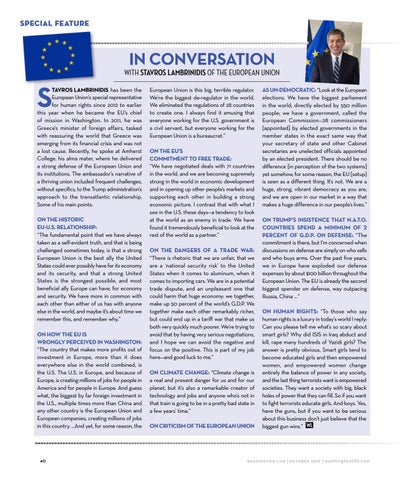
EUROPEAN UNION STAVROS LAMBRINIDIS (see page 40)
FRANCE Television coverage of the G7 summit in late August showed PHILIPPE ETIENNE, France’s new ambassador in Washington, seated behind President Emanuel Macron. For the occasion, Etienne was returning to his former role as the president’s senior foreign policy advisor. A European colleague describes Etienne as “a highly experienced, old school diplomat” and the French Foreign Ministry calls him “an expert in European affairs.” He was France’s permanent representative at the European Union in Brussels for five years, followed by a further three as French ambassador to Germany. At his
37
SPECIAL FEATURE
A VERY BRITISH FINALE MAY STANDS BY HER MAN
I
n July, German Ambassador Emily Haber posted a tweet of herself posing with her French, European Union and U.K. counterparts (Philippe Etienne, Stavros Lambrinidis, Sir Kim Darroch respectively). “Honored to host my colleagues and friends from the United Kingdom, France, and the European Union, for breakfast at my residence this morning,” the tweet said. Left unsaid in Haber’s tweet was any reference to the fact that Darroch had resigned his post the previous day in the most serious diplomatic incident to roil the U.S.-U.K. bi-lateral relationship in many years, and Haber’s action was seen as a subtle message of solidarity by some of the British ambassador’s European colleagues. In scathing confidential telegrams to the Foreign Office in London over many months, Darroch had called the White House a “uniquely dysfunctional environment” and said Trump “radiates insecurity,” made speeches full of “false claims and invented statistics,” and was indebted to “dodgy Russians.” Many other ambassadors had said as much in similar telegrams to their respective governments, but Darroch had been revealed doing it. Trump went ballistic, calling Darroch “stupid.” The president’s eruption, observed William Burns, a former senior U.S. diplomat and current president of the Carnegie International Institute for Peace, merely “reinforced the accuracy of Darroch’s portrait of him.” But more than that, it brought into sharper focus some of the new realities that face foreign ambassadors in Washington under Trump. Firstly, in diplomacy as in practically everything else, it’s goodbye to businessas-usual: the White House attaches little or no importance to following diplomatic practice, and has its own unique approach to international relations.
38
In Darroch’s case, for example, normal practice—not to mention common sense— would have required the State Department to try and find a diplomatic way out of the situation. Instead, a vindictive Trump jumped in, announcing, “We will not deal with” Darroch. The president himself had
effectively declared the ambassador of the United Kingdom—a historic ally—persona non grata, leaving him no option but to resign. The British government, keen to retain Trump’s support in Brexit, avoided escalating the incident. London’s defense of its ambassador was more formal than earnest, and he was quite possibly encouraged to withdraw. Much of bi-lateral diplomacy is based on reciprocity, and London could have pushed back by summoning the U.S. ambassador and lodging a formal complaint, or even expelling him altogether in a tit-fortat gesture. But there was no protest from Downing Street at the time. Then-Prime
Minister Theresa May praised Darroch— even as she accepted his resignation. London’s real response came in September when Kim Darroch was made a life peer —a member of the House of Lords. It was an unusual honor usually reserved for diplomats who rise to head the British foreign service, but it sent a signal to Trump what London thought of his rough handling of its envoy. Secondly, the Darroch narrative showed how Trump’s personalization of foreign policy allows only one go-to source for major decisions, and their implementation. Air-kissing Kellyanne Conway on both cheeks at diplomatic functions is all very well—if it delivers the goods. But in the Trump administration, only one set of cheeks does that—Donald Trump’s. Thirdly, in the era of Wikileaks and hostile-state cyber warfare the diplomatic telegram’s primacy is under threat and senior diplomats need to find more secure ways of analyzing events with the candor and openness their superiors expect of them. Depending to which ambassador you talk to, What’sApp messages, telephone briefings, the anonymity of airport computer stations, private email accounts outside of official systems where the risk of exposure by rivals is not so great are all being used to communicate with governments. Actually, Darroch’s criticism of Trump and his administration was not the first. That distinction goes to former French Ambassador Gérard Araud in May of this year. Araud sparked little reaction from Trump, in part because he was also critical of Barrack Obama, describing him as too intellectual and aloof; but also because he compared a dysfunctional White House with the court of Louis XIV—and Trump was not going to complain about being compared to a king of France. Or any other king for that matter.
WA S H I N G T O N L I F E
| O C T O B E R | washingtonlife.com
AMBASSADORS
first Bastille Day reception at the French embassy residence in Washington the European Union’s anthem, the chorale from Beethoven’s “Ninth Symphony”—the “Ode to Joy”—was played for the first time along with the French and American national anthems. But it’s his most recent appointment as head of the diplomatic unit of the French presidency that makes him a good choice to handle the complex Macron-Trump relationship. A good linguist, Etienne is comfortable speaking English, German, Russian, Romanian and Spanish.
GRENADA Even before career diplomat YOLANDE YVONNE SMITH presented her credentials to President Trump in April, 2019, she had totaled almost 20 years in the United States: nine years in the embassy in Washington followed by a stint at the International Monetary Fund (I.M.F.), and a further three-and-half years as deputy consul-general in Miami, Fla. Washington is her first appointment as ambassador. HONDURAS Until her appointment as her poverty-stricken country’s ambassador to Washington, MARIA DOLORES AGNERO had been minister of foreign affairs in Tegucigalpa since 2017 and before that vice-minister of foreign affairs from 2015. In other words, she was member of the government battling unsuccessfully against gang violence, drug trafficking and extreme poverty. Now she is at the receiving end of the consequences of that situation—waves of Hondurans attempting to seek refuge in the United States and the Trump administration’s equally determined attempts to stop them.
WA S H I N G T O N L I F E
ICELAND BERGDIS ELLERTSDOTTIR is a
crossover to Washington after representing her country as permanent representative to the United Nations. Previously she had served as head of the Icelandic mission to the European Union, which Iceland is seeking to join. In 2012, as director of International Trade Negotiations for Iceland, she negotiated the Iceland-China Free Trade Agreement. Ellertsdottir has also been foreign policy adviser to the prime minister of Iceland, deputy secretary general of the Free Trade Association (2007-2012), and held a senior post at N.A.T.O. headquarters. She is a graduate of universities in Reykjavik, Essex (U.K.), Heidelberg and Freiburg.
INDIA
INDONESIA
HARSH VARDHAN SHRINGLA has been
MAHENDRA SIREGAR
India’s ambassador to Thailand and high commissioner to Bangladesh (“high commissioner” is the title given to the ambassador of one British Commonwealth member country to another). In his more than 30-year career in the service of Indian diplomacy, he has also held senior posts in the Ministry of Foreign Affairs in New Delhi. Shringla’s appointment comes at a time when, according to Indian-born technology entrepreneur and writer Frank Islam, “the U.S.-Indian relationship is at a pivotal point, meaning that despite the challenges, there are also opportunities to effect change and achieve positive outcomes.” Shringla cites Trump’s “close relationship” with Indian Prime Minister Nerendra Modi as one reason for the good bi-lateral relations. In recent interviews since arriving in Washington, Shringla has also hit some of the key issues. On the long-standing India-Pakistan tension: “There’s an entire cyber industry in Pakistan that is involved
| O C T O B E R | washingtonlife.com
in circulating fake news and spreading rumor and speculation clearly designed to create confusion and rift between the two countries.” On reports that the Trump Administration is threatening new limits on the number of Indians admitted on H-1B visas work visas: “There is a shortfall of 2.4 million people in the high tech industry. These are U.S. figures. If you have that kind of shortfall it doesn’t make sense to deny an H-1b visa.” On Trump’s complaint that India does not grant American producers “reasonable access” to its markets: “I am amazed at the quantity of poultry we have imported from the U.S., helping farmers in the heartland … If you look at the defense basket, we have gone from zero to about $18 billion in defense imports. So, where is the issue of high tariffs, when trade is booming … and adverse trade imbalance is coming down?”
is Indonesia’s 19th ambassador to the United States in 70 years of diplomatic relations. Some Washington journalists may remember him from his assignment as the embassy’s spokesman from 1998–2001. An economist, Siregar has served as deputy trade minister in the Indonesian government and as deputy finance minister. He has also been executive director of the Jakarta-based Council of Palm Oil Producing Countries (principally Indonesia, Malaysia, Thailand, Colombia and Nigeria).
KYRGYZSTAN BOLOT OTUNBAYEV, who presented his credentials in January, is the brother of Rosa Otunbayeva, a leading political force in the Kyrgyz Republic. As an opposition politician in the Central Asian country’s immediate post-Soviet years, she helped oust two corrupt presidents in two successive revolutions, served as interim president
39
special feature
In Conversation
with Stavros Lambrinidis of the European Union
S
tavros Lambrinidis has been the European Union’s special representative for human rights since 2012 to earlier this year when he became the EU’s chief of mission in Washington. In 2011, he was Greece’s minister of foreign affairs, tasked with reassuring the world that Greece was emerging from its financial crisis and was not a lost cause. Recently, he spoke at Amherst College, his alma mater, where he delivered a strong defense of the European Union and its institutions. The ambassador’s narrative of a thriving union included frequent challenges, without specifics, to the Trump administration’s approach to the transatlantic relationship. Some of his main points: On the historic EU-U.S. relationship: “The fundamental point that we have always taken as a self-evident truth, and that is being challenged sometimes today, is that a strong European Union is the best ally the United States could ever possibly have for its economy and its security, and that a strong United States is the strongest possible, and most beneficial ally Europe can have, for economy and security. We have more in common with each other than either of us has with anyone else in the world, and maybe it’s about time we remember this, and remember why.”
On how the EU is wrongly perceived in Washington: “The country that makes more profits out of investment in Europe, more than it does everywhere else in the world combined, is the U.S. The U.S. in Europe, and because of Europe, is creating millions of jobs for people in America and for people in Europe. And guess what, the biggest by far foreign investment in the U.S., multiple times more than China and any other country is the European Union and European companies, creating millions of jobs in this country. ...And yet, for some reason, the
40
European Union is this big, terrible regulator. We’re the biggest de-regulator in the world. We eliminated the regulations of 28 countries to create one. I always find it amusing that everyone working for the U.S. government is a civil servant, but everyone working for the European Union is a bureaucrat.” On the EU’s commitment to free trade: “We have negotiated deals with 71 countries in the world, and we are becoming supremely strong in the world in economic development and in opening up other people’s markets and supporting each other in building a strong economic picture. I contrast that with what I see in the U.S. these days—a tendency to look at the world as an enemy in trade. We have found it tremendously beneficial to look at the rest of the world as a partner.” On the dangers of a trade war: “There is rhetoric that we are unfair, that we are a ‘national security risk’ to the United States when it comes to aluminum, when it comes to importing cars. We are in a potential trade dispute, and an unpleasant one that could harm that huge economy: we together, make up 50 percent of the world’s G.D.P. We together make each other remarkably richer, but could end up in a tariff war that make us both very quickly much poorer. We’re trying to avoid that by having very serious negotiations, and I hope we can avoid the negative and focus on the positive. This is part of my job here—and good luck to me.” On Climate Change: “Climate change is a real and present danger for us and for our planet, but it’s also a remarkable creator of technology and jobs and anyone who’s not in that train is going to be in a pretty bad state in a few years’ time.” On criticism of the European Union
as un-democratic: “Look at the European elections. We have the biggest parliament in the world, directly elected by 550 million people; we have a government, called the European Commission—28 commissioners [appointed] by elected governments in the member states in the exact same way that your secretary of state and other Cabinet secretaries are unelected officials appointed by an elected president. There should be no difference [in perception of the two systems] yet somehow, for some reason, the EU [setup] is seen as a different thing. It’s not. We are a huge, strong, vibrant democracy as you are, and we are open in our market in a way that makes a huge difference in our people’s lives.” On Trump’s insistence that N.A.T.O. countries spend a minimum of 2 percent of G.D.P. on defense: “The commitment is there, but I’m concerned when discussions on defense are simply on who sells and who buys arms. Over the past five years, we in Europe have exploded our defense expenses by about $100 billion throughout the European Union. The EU is already the second biggest spender on defense, way outpacing Russia, China …” On human rights: “To those who say human rights is a luxury in today’s world I reply: Can you please tell me what’s so scary about smart girls? Why did ISIS in Iraq abduct and kill, rape many hundreds of Yazidi girls? The answer is pretty obvious. Smart girls tend to become educated girls and then empowered women, and empowered women change entirely the balance of power in any society, and the last thing terrorists want is empowered societies. They want a society with big, black holes of power that they can fill. So if you want to fight terrorists educate girls. And boys. Yes, have the guns, but if you want to be serious about this business don’t just believe that the biggest gun wins.”
WA S H I N G T O N L I F E
| o c to b e r
2019
| washingtonlife.com
ambassadors
herself and wrote a new constitution to establish the region’s only parliamentary democracy, which is why, she said recently, “we could say we are trendsetters in the old Soviet space.” But the Kyrgyz Republic remains close to Russia: at Moscow’s insistence, its government in 2009 ordered the U.S. to close down its huge Manas air base, the key staging ground for transit and operations in Afghanistan. Rose Otunbayeva was also Kyrgyzstan’s first ambassador to Washington. Brother Bolot is his country’s all-purpose career diplomat. He has served as the Kyrgyz ambassador to Germany, all the Scandinavian countries (sometimes concurrently), Russia, Armenia and the Holy See.
LAOS Khamphan Anlavan
represents the Lao People’s Democratic Republic in Washington. He comes to the United States following a succession of top-ranking foreign policy posts including director-general of party affairs in the ministry of foreign affairs, head of the American Department and chief of the cabinet of the Committee for External Relations of Laos. He had also been Laotian ambassador to Malaysia and Papua New Guinea.
LATVIA When MARIS SELGA presented his credentials in September he was warmly received by President Trump. Here, at least, was one N.A.T.O. member whose spending on defense met the 2 percent of G.D.P. level that Trump wants to make the budgeted minimum throughout the alliance. Selga’s was previously Latvia’s ambassador to China. Prior to that he held key posts in the ministry of foreign affairs, and earlier was ambassador to Egypt.
WA S H I N G T O N L I F E
| o c to b e r
2019
LIBERIA No sooner had George S.W. Patten, a career diplomat, settled into his post as Liberia’s ambassador to Washington in January, when he was “invited” back to the Liberian capital, Monrovia, because of unfinished business. In his apparent haste to leave for the United States, Patten had failed to seek—and indeed to obtain—the Liberian Senate’s confirmation of his appointment. Never mind that the House and Senate were in recess at the time, the Senate Foreign Relations Committee was not prepared to overlook this slight to its constitutional role (borrowed wholesale from the United States). Ambassdor Patten was summoned to complete the process. Patten, whose previous posts include ambassador to Kenya, his country’s permanent representative to the African Union and chargé d’affaires at the United Nations, apologized to the committee, and his confirmation hearing took 20 minutes. At the same time, the Liberian government regretted what it called “an unusual error.” LUXEMBOURG GASTON STRONCK, who
as secretary general headed the Luxembourg Ministry of Foreign Affairs, has swapped posts with Sylvie Lucas, the Grand Duchy’s ambassador in Washington. Stronck, who headed the ministry from August 2017, has previously served as Luxembourg’s envoy in Delhi, Moscow, and Copenhagen.
MALAYSIA Azmil Bin Mohd Zabidi was director general of the Malaysia-based South East Asia Regional Center for Counter-Terrorism (SEARCCT), which trains security officials from governments in the region to deal with terrorism, when he was named his country’s ambassador
| washingtonlife.com
to Washington. His previous diplomatic appointments were consul general in Shanghai (2007-2010}, ambassador to Vietnam from 2011-2016 and undersecretary for Europe at the ministry of foreign affairs in 2017.
MALDIVES Thilmeeza Hussain
has the dual role of Washington ambassador and Maldives representative to the U.N. As the envoy of a country for whom global warming means the growing threat of being submerged by rising sea levels, she has championed climate change and sustainable development, heading delegations from the Maldives at high level international environmental meetings
MAURITANIA It’s a homecoming of sorts for Ba Samba mamadou who represents the huge and largely empty Maghreb country in the Sahara Desert, with Senegal, Mali and Algeria as neighbors. Mamadou, a graduate of Ohio State University, was appointed ambassador to Washington in 2019 as part of a major re-shuffle of ambassadorial appointments announced by the government in the capital Nouckchott. Prior to Washington, Mamadou was Mauritanian ambassador to Sudan and served before that as director general of international cooperation at the Ministry of Foreign Affairs. Oil producing Mauritania has the dubious distinction of being the last country to outlaw slavery—in 1981—but human trafficking remains a recurring problem. MEXICO As Mexico’s ambassador to Washington, Martha Elena Barcena is in the hot seat as President Trump harangues her government to shut off
41
SPECIAL FEATURE
immigrants, badgers his administration to construct hundreds of miles of border wall before 2020, undermines bi-lateral trade with tariffs and denigrates Mexican immigrants as criminals and rapists. Barcena, who is both a career diplomat and an academic, is a good pick for the post, having until recently headed the border cooperation section in the Mexican foreign ministry. Her previous posts included ambassadorships to Denmark, Turkey and the international organizations in Rome (for example, the Food and Agricultural Organization). She recently told the Detroit Free Press that the U.S. is mistaken in blaming Mexico for a humanitarian crisis in Central America. “It’s a huge misunderstanding,” she said. “The challenge is both for Mexico and the U.S. because the situation in Central America is dire, with no opportunities, problems of insecurity, drought.” The reality was that undocumented travel
among Mexicans has plummeted and more Mexicans are returning home than ever before. Still, there are still 11.3 million Mexican immigrants in the United States, the largest group in the country. “Some rhetoric in certain sectors is causing a lot of anxiety in our [U.S.] communities,” Barcena continued. “Children are not attending schools. Children are feeling ashamed and they ask psychologists if their parents are rapists and murderers or if their parents are going to jail. I think that’s unacceptable.” People in Mexico, she said, “understand the importance of the U.S. for us and that our future is tied to the U.S. in all senses— economic, social, cultural. In the U.S. they don’t understand this. They think Mexico is not important. It’s taken for granted.” A former professional ballet dancer, Barcena graduated from the diplomatic school in Spain, has a degree in philosophy from the Jesuit-run Pontifical Gregorian University
in Rome, and seems to be fluent in every language imaginable, including Mandarin. This is her first U.S. assignment but she does have an earlier American connection: her great aunt was a nun in Grand Rapids, Mich.
NETHERLANDS ANDRE HASPELS
presented his credentials in the Fall of 2019 to begin his first ever Washington posting. He was most recently political director at the ministry of foreign affairs in the Hague, a key policy position. A long-time career diplomat, he has served as Netherlands ambassador to Vietnam and South Africa.
ETON SCHOOL FOR BRITISH PRIME MINISTERS THE CLASS-CONSCIOUS BRIT
B
ritish media were quick to note that Boris Johnson was the 20th prime minister who had been at Eton College, the elite all-male secondary school on the banks of the River Thames, near Windsor. At $51,000 annually, Eton’s tuition fees are on a par with other “public schools”—as the English, somewhat perversely, label their private schools—but it has long been the chosen school of the British establishment. Founded in 1440, Eton has over the span of centuries provided education for countless members of the royal family, the latest being Prince William and Prince Harry. The trail of prime ministers didn’t begin until the 18th century—with Sir Robert Walpole, who was there from 1690-1696. Then came William Pitt, Earl of Chatham, also known in history as William Pitt the Elder.
42
Others followed, including Arthur Wellesley, Duke of Wellington, the hero of the battle of Waterloo and later prime minister. William Lamb, Lord Melbourne— the young Queen Victoria’s “Lord M”— entered Eton in 1792. Oxford and Cambridge universities
are major incubators for U. K. politicians of all party persuasions, but Eton’s ties with Conservative politics in the modern era is a separate phenomenon. The school pushes its swallowtail-coated and tophatted students towards public service, and by now politics is a school tradition. In the 1950s and 1960s, three Old Etonians, as the school’s alumni are styled, actually followed each other as the Conservative Party’s occupant of 10 Downing Street: Anthony Eden, Harold Macmillan and Alec Douglas Home. Among the political protagonists of the Brexit crisis David Cameron, Boris Johnson and his brother Joe also studied at Eton. Old Etonians also tend to pick fellow schoolmates as cabinet members. David Cameron holds the record—13 in a cabinet of 27. Nor is that a novelty for Tory prime ministers. Macmillan had nine.
WA S H I N G T O N L I F E
| O C T O B E R | washingtonlife.com
AMBASSADORS
NEW ZEALAND When MARY BANKS was appointed ambassador to Washington, she had retired from the New Zealand foreign service, and was helping to put right some of the wrongs of her country’s early history as a member of a government commission. In the Treaty of Waitangi of 1840, native New Zealand tribes recognized the authority of the British governors of their land. The commission was set up in 1975 to settle claims arising from breaches of the treaty; and Banks was a negotiator with Maori claimants filing for financial compensation or land restitution, or both. Prior to that, in almost three decades as a diplomat, Banks has served everywhere from the Solomon Islands to the United Nations in New York, where she was New Zealand’s permanent representative. She had also been ambassador to France and held a security post at the Ministry of Foreign Affairs when 9/11 happened, and the emergency response system she developed at that time is still in common use during crisis situations. For relaxation, the ambassador writes poetry, gardens and plays the violin. NIGER ABDALLAH WAFY represents a West African nation, once a French colony, situated in a dangerous neighborhood where terrorist groups and criminals roam freely. The African branches of ISIS, al-Qaida and other groups are all active in the area, and the surrounding Sahara Desert. Wholesale cross-border traffic of drugs, weapons and humans compound Niger’s security problems. The U.S. has about 1,000 troops in Niger, plus a large drone- and air base. In 2017, four American soldiers were killed in Niger by Islamic State militants. Wafy has a background in senior police work. Trained in France, he has top level
WA S H I N G T O N L I F E
experience in advising both his own government and the United Nations on security situations. Wafy was effectively police commissioner with the U.N. Stabilization Mission in the Democratic Republic of Congo, and later its deputy head, and prior to that served with the civilian police in the United Nations Operation in the Ivory Coast (Côte d’Ivoire). At home in Niger, he was inspector general of police and special security advisor to the president.
PANAMA JUAN RICARDO DE DIANOUS HENRIQUEZ
is President Laurentine Cortizo’s first diplomatic appointment since taking office in July. A graduate in business administration from the University of Southwestern Louisiana, Henriquez comes to diplomacy from a long career in banking, including five years (2004-2009) heading the Bank of Panama.
PAKISTAN By coincidence, new ambassadors from Pakistan, Afghanistan and India, three neighboring countries with serious differences in their respective bi-lateral relations, officially took up their Washington posts on the same day. Pakistan’s new envoy is ASAD MAJEED KHAN, a senior career diplomat who was deputy chief of mission in Washington from 2012–2015 and held earlier posts at the United Nations in New York. Outstanding issues between Washington and Islamabad include Pakistan providing cross-border shelter for Afghan Taliban fighters and for Osama bin Laden, who was killed there by U.S. Navy Seals in 2011. Pakistan’s involvement in shaping Afghanistan’s future and destabilizing tension between Pakistan and India, a U.S. weapons client.
| O C T O B E R | washingtonlife.com
PARAGUAY Ambassador MANUEL CACARES CARDOZO is
a high-ranking diplomat who has held the post of vice-minister for foreign relations—the top career post in the Ministry of Foreign Affairs—on two separate occasions. In between, he has been Paraguay’s ambassador to Brazil (20142018), Argentina, the European Union (including Belgium and the Netherlands) and the Organization of American States in Washington. A Harvard Law School graduate, he served also as his country’s deputy chief of mission here in 1995-1996.
PERU On July 8, HUGO DE ZELA MARTINEZ, viceminister of foreign affairs and a seasoned diplomat, presented his credentials as Peru’s ambassador to the United States, where he had already spent more than a decade of the past 25 years. He was chief of staff of the General Secretariat of the Washington-based Organization of American States (O.A.S.) from 1989-1994 and again from 2011-2015, and was his country’s permanent representative there in 2010-2011. He had also been Peru’s ambassador to Brazil and Argentina and his country’s lead negotiator in bi-lateral issues, including the border dispute talks with Ecuador 1997-1998. SAUDI ARABIA The spirit of slain Saudi journalist Jamal Khashoggi must surely follow Princess REEMA BINT BANDAR BIN SULTAN AL SAUD as
she goes about her business as the desert kingdom’s new ambassador to Washington. That’s because Khashoggi’s ruthless murder is inextricably linked to the embassy in the city where he lived and wrote columns for the Washington Post and continues to loom over bi-lateral relations between Washington and Riyadh. It was
43
SPECIAL FEATURE
MP’S BEHAVING BADLY BUT WHAT, EXACTLY, IS A GIRLY SWOT?
F
or repartee and refined insults, the ongoing Commons debate over Brexit is a gift that keeps on giving. It has raised the usual battle of words in the ancient chamber to levels not heard in many a year—or lowered it as when the prime minister reaches into the dark memories of his childhood and hurls one of his favorite playground insults, like calling another politician a “girl’s blouse” or “girly swot.” The rough American equivalent of a swot is a nerd. More memorable samples:
Prime Minister Boris Johnson, pointing to Labour leader Jeremy Corbin, who was sitting opposite at the time: “I know he’s worried about [post-Brexit] free trade deals with America, but there’s only one chlorinated chicken that I could see in this House, and he’s on that bench.” (The U.K., along with the European Union bars the importation of most U.S. poultry because the preparation process includes washing in chlorine). Prime Minister Boris Johnson: Corbin’s friends “are in the Kremlin, and in Iran, and in Caracas—and that’s what he is, carackers.” MP Nicholas Soames, Winston Churchill’s grandson, dismissed from the Conservative Party for voting against the government:
44
“I voted for the withdrawal agreement on every occasion that it’s been presented to the House, which is more than can said for my Right Honorable friend the Prime Minister and other members of the cabinet whose serial disloyalty has been such an inspiration for so many of us.”
Speaker John Berkow to a female government minister after she spoke persistently, without his permission: “What I say in all courtesy to the Honorable Lady is sit there, be quiet, and if you can’t do so, leave the Chamber, we can manage without you.”
MP Pete Wishart, Scottish National Party member, about government minister and House Leader Jacob ReesMogg, a Conservative arch-Brexiteer, known for his knowledge of the history of the House and his languid, superior manner: “[Rees-Mogg] is the fifth leader of the House that I’ve had in my 40 years, but it has to be said that he’s by far the most exotic. But it would be as well if he remembers that he’s leader of the House of Commons, not the House of Plantagenet, or the House of Tudor.”
MP Tom Brake, Liberal-Democrat: “I really welcome the Leader of the House [Rees-Mogg] to his position because certainly the Liberal Democrats couldn’t really want for a better recruiting sergeant than him as we set up a contrast between Victorian values and Liberal Democrat values.”
Jacob Rees-Mogg, in response to Wishart: “I want to point out that the House of Commons predates the House of Tudor. It started in 1265, when the burgesses come from the towns.” MP Pete Wishart, SNP: “Mr. Speaker, I went to bed last night and I had this horrible nightmare that the U.K. government had been taken over by rabid, right-wing Brexiteers, and I’m not sure whether I’m awake yet.”
Rees-Mogg, responding to Brake: “I may be a better recruiting sergeant for the Lib Dems than the honorable gentleman is, but I fear that may not be a difficult task.” Speaker Berkow to Prime Minister Boris Johnson: “I’m simply and politely informing the Prime Minister of the very long established procedure in which everybody, including the Prime Minister, must comply … It really is very, very unseemly. There is a procedure to statements of this kind, a very long established procedure, and I’m setting out the position and no one, be he ever so high, is going to tell me what the procedures in the chamber of the House of Commons are.”
WA S H I N G T O N L I F E
| O C T O B E R | washingtonlife.com
AMBASSADORS
Princess Reema’s predecessor, Prince Khalid bin Salman, who persuaded Khashoggi to go to Istanbul, where he was hacked to death, on the orders of Prince Khalid’s elder brother, Crown Prince Mohammad bin Salman, according to U.S. intelligence. In other words, the silencing of a voice critical of the Saudi royals was old-style family business. Amazingly, Khashoggi’s death has done little to diminish the Trump administration’s blind support for the Saudis. Secretary of State Mike Pompeo still beams his widest when photographed with Mohammad Bin Salman. But mostly, Princess Reema, daughter of Prince Bandar bin Sultan who was Saudi ambassador in Washington seemingly forever (1983-2005), and a cousin of the Crown Prince, faces the challenge of growing antagonism in Congress and from the wider public, and the realization that the Saudis are unreliable allies and Prince Mohammad an unstable leader. In her first week in Washington, bi-lateral Congressional action sought to bar weapons sales to Saudi Arabia but President Trump vetoed the measure. How much of this sinks in with Princess Reema is anybody’s guess. She has no diplomatic experience and her appointment as Saudi Arabia’s first woman ambassador is an extension of the regime’s recent moves to improve its global image by proclaiming reforms to relax the shackles on their female population. Although female activists who demanded the right to drive still languish in Saudi jails, the government has declared that women are permitted to drive and no longer need a family male’s permission to drive out of the country and never return— as many have done and are doing. For what it’s worth, Princess Reema is no stranger to Washington. She grew up going to high school and college in the District.
SIERRA LEONE SIDIQUE ABOU BAKRR WAI, who presented his
credentials in April, is a long-time immigrant from his West African homeland. An alumnus of Fordham
WA S H I N G T O N L I F E
University and New York University Wagner School of Public Service, he was for years active in the African diaspora as president of the United African Congress, which represents the interests of immigrants from Africa in the U.S., community advisor to the New York City Police Commissioner and as liaison between the city and African diplomats at the United Nations. One of his challenges as ambassador is to lift visa restrictions on diplomats and other visitors from his country, imposed because the Sierra Leone government was slow in accepting deportees from the U.S.
SOMALIA ALI SHARIF AHMED is
Somalia’s third ambassador to Washington in the four years since the war-torn east African country’s embassy reopened after more than two decades. The new envoy, who has also been ambassador to Ethiopia and to France, follows Ahmed Isse Fawad who returned to Mogadishu almost a year ago to become Somalia’s foreign minister. Ali Sharif Ahmed’s appointment coincides with stepped up U.S. counterinsurgency operations against Al-Shabab and ISIS radicals in Somalia, mainly in the form of drone strikes.
SRI LANKA When RODNEY PERERAmade his first appearance at the Embassy of Sri Lanka in Washington he lit a ceremonial lamp in the lobby and shared Sri Lankan milk rice and candy with members of the staff. The occasion perhaps had more significance than usual because the embassy had been without an ambassador for 22 months. In Perera, the Sri Lankan government has named a senior diplomat, fresh from an appointment as envoy to the European Union and Belgium. Earlier, Perera had been ambassador to Italy (2003-2007), Norway (2009-2012) and spokesman at the ministry of foreign affairs in Colombo.
| O C T O B E R | washingtonlife.com
SWITZERLAND JACQUES PITTELOUD is
a retired lieutenant colonel in the Swiss Armed Forces with a remarkable career in intelligence and diplomacy. After witnessing the genocide in Rwanda in 1994 (when 800,000 members of the Tutsi minority were murdered in 10 days by ethnic Hutu extremists) Pitteloud created an organization dedicated to bringing those responsible to justice, and several were prosecuted in international tribunals. At the age of 38, in the year 2000, he was appointed to head the Swiss Intelligence Service (Switzerland’s C.I.A.). Having reorganized that department, he joined the Swiss foreign service in 2006. He was Swiss ambassador to Kenya from 2010 – 2015. Prior to his Washington appointment he was director general of the ministry of foreign affairs.
VENEZUELA CARLOS ALFREDO VECCHIO represents
the opposition leader Juan Guaido in the latter’s ongoing, but so far unsuccessful attempt to topple Venezuelan President Nicolas Maduro.Vecchio is a former ExxonMobil lawyer and politician who fled his country ahead of police arrest. As Venezuela sinks deeper into chaos, the Trump administration has recognized Guaido as the country’s president, and—by extension—Vecchio as Guaido’s ambassador in Washington. Maduro had other ideas, and tried to deny Vecchio access to the Venezuelan embassy in Northwest Washington by filling it with squatters sympathetic to his regime. In June, a police charge cleared the building and Vecchio was able to take formal possession. Trump has also tried political and economic pressure to force Maduro, who has Russian and Cuban backing, to step down, but has stopped short of military intervention. Meanwhile, the future of the confrontation remains uncertain, as does Vecchio’s.
45
SPECIAL FEATURE
UNFORGETTABLE EVENTS
BOOK TALK
Bryan Rafanelli, one of the country’s glitziest event planners and the author of “A Great Party” shares his behind-the-scenes secrets on elegant diplomatic events and playful Kids’ State Dinners to A-list weddings and charity fêtes.
Japan State Dinner BY DA R A K L AT T
Kids’ State Dinner
nown for his exquisite style and attention to detail, Bryan Rafanelli has designed and produced some of the nation’s most exclusive and high-profile events. Over his 23 year career, his team has mounted more than 2,000 events in 50 cities, 23 states and nine countries, including the White House state dinners for China, Japan, Germany, France, Singapore, the United Kingdom and Italy; Governor’s Balls and five “Kids’ State Dinners.” He pulled off Chelsea Clinton’s super secret nuptials and other stunning celebrity weddings as well as glamorous corporate parties for Ralph Lauren and Louis Vuitton. With his debut book, “A Great Party: Designing The Perfect Celebration” (Rizzoli International Publications, Inc., 2019) out this month, Rafanelli was happy to share his pleasures and philosophy with Washington Life in creating such artful celebrations.
YOU HAVE DONE EVENTS ALL OVER THE WORLD. WHAT DO YOU LOVE THE MOST ABOUT WASHINGTON CELEBRATIONS? What I love most about entertaining in Washington is the extreme concentration of brainpower in any given room coupled with the most eclectic of guest lists. This is something I don’t believe can be truly replicated anywhere else in America, if not in the world. HOW DID YOU STRIVE FOR IMPACTFUL EVENTS IN THE WHITE HOUSE? As with every client, we want each
46
event to be unique, but we’re constantly reminded of where we are—a place of immense American tradition and history. I worked with Michelle Obama on seven state dinners and 15 other celebrations during President Obama’s administration. Mrs. Obama had a unique love of color and we could really make our celebrations standout when we had all the colors of the rainbow at our disposal! That also definitely kept each event vibrant and exciting, which is especially important since visiting the White House is often a once-in-alifetime experience, so the events should feel that way as well. DESCRIBE THE DIFFERENCE IN PLANNING A DIPLOMATIC EVENT VERSUS A WEDDING OR A GALA? There are a lot of additional considerations that go into the planning of a diplomatic event because of the intricacies with the host venue. For each state dinner we produced, I always investigated symbolism and cultural touchstones for the honored country and would incorporate into the event’s theme and aesthetics. WHAT WAS YOUR MOST MEMORABLE DIPLOMATIC EVENT? I really enjoyed planning the state dinner in honor of Matteo Renzi, the then-prime minister of Italy.This was the final state dinner of the Obama administration, just before the 2016 election. I’m Italian American so this was a personal
favorite, for not only that reason but because of the entertainment—Gwen Stefani, a fellow Italian American—and the location of the dinner in a structure glass-top tent on the South Lawn. It was such an exciting challenge to re-create the feeling of the White House outdoors. NOVEL ELEMENTS OF THE KIDS’ STATE DINNERS? The Kids’ State Dinners were especially fun to work on as the guest list included 56 children—one from each state and territory—who were each winners of the Healthy Lunchtime Challenge. These events allowed us to be a little more playful than usual, while still respecting the integrity of the house. They were said to be Mrs. Obama’s favorite events at the White House. WASHINGTON IS HOST TO MANY PHILANTHROPIC-BASED BALLS AND GALAS. HOW DO YOU BLEND A GREAT PARTY WITH A PURPOSE? When we develop design concepts for our nonprofit clients, we start with their mission statements. Just like with any event, in order for a party to be great, the guests need to feel an emotional connection to the event.What makes nonprofit work different, however, is that the emotional connection needs to yield tangible results. FINAL PIECE OF ADVICE? I always say, “Don’t expect the unexpected—create it.”
WA S H I N G T O N L I F E
| O C T O B E R | washingtonlife.com
P H OTO G R A P H O F B R YA N R A FA N E L L I B Y J O E L B E N J A M I N P H OTO G R A P H Y.
K
WEDDINGS
LIKE MOTHER, LIKE DAUGHTER The “driven and independent” daughter of Monaco’s ambassador celebrates her wedding with an intimate, non-traditional affair, and reflects on her mother’s influence. P H OTO S B Y S H E L LY P AT E , B OT TO M : P H OTO S C O U R T E S Y A N D Z A I D H A M I D
BY DA R A K L AT T
KIMBERLEY DOYLE AND JOHN PASZTERKO May 26, 2019 | Iron Gate Restaurant, Washington D.C.
W
hen Maguy Maccario-Doyle, the current and first female ambassador of the Principality of Monaco to the United States, spoke into the microphone atop the courtyard staircase of her Embassy Residence in Kalorama in a black and white leopard print dress, her words took on a jocular mood. “Always keep a sense of humor,” she advised her daughter and future son-in-law, in front of approximately 80 guests gathering on the wedding eve. “It’s important to laugh and not take yourselves too seriously.” It was veteran diplomat wisdom (wink).
WA S H I N G T O N L I F E
An overall aim for ease embodied Kimberley Doyle’s wedding to John Paszterko. The couple met at Georgetown University as graduate students and started dating after a bus-ride home together when Doyle mentioned her mother’s post. “He started speaking French all of a sudden. I was floored,” Doyle recalls. “He didn’t have an American accent and spoke extremely well … That’s when I knew, this guy was special.” The two bypassed a large, formal wedding celebration with bridesmaids, groomsmen and any semblance of a princess-style gown in exchange for an “intimate, warm and inclusive event”—complete with the bride in a modern white pantsuit and simple wedding bands exchanged by Doyle’s maternal grandparents 70 years previously.
| O C T O B E R | washingtonlife.com
HER EXCELLENCY, MY MOTHER “My mother has always been an incredible role model for me,” Doyle says. “She had a huge influence on my life and significantly shaped the person I am today.” Amb. Maccario-Doyle first came to America from Monaco at age 22, armed with what Doyle describes as incredible work ethic, courage and perseverance. The bride, now a senior director and consultant for a non-profit group focused on workplace gender, reflects on the example her mother set and other life lessons learned. ON LEADERSHIP & EQUALITY: “My mother first sparked my interest in gender equality and women’s leadership when I witnessed the challenges she had to navigate working in a predominately male field. Every time she faced an obstacle, she found a way to do what was right for not only for her country—but also our family. The lesson I learned as a young girl by watching her was that if you work hard and aren’t afraid, anything is possible.” ON RESPECT: “As the daughter of a diplomat, I learned at an early age how crucial it is to have respect for all people. Consequentially, this is something that I have valued and upheld throughout my personal and professional life. I genuinely enjoy building relationships with and learning from people who think, look, and act differently than me.” ON DIFFERENCES: “ [My mother and I] are both driven and independent. The biggest difference is that my mom is Monegasque and I am American!”
47
LIFESTYLES
TOW N & CO U N T RY
NEUTRALS TEXTURE PLAY AND IMPECCABLE TAILORING IS THE ULTIMATE EXPRESSION OF FALL FASHION
PHOTOGRAPHER TONY POWELL | WWW TONY-POWELL COM CO-CREATIVE DIRECTOR & STYLIST HENRY EDWARDS II | @HENRYEDWARDSII MAKEUP MARTIN PRETORIOUS HAIR FELICIA SAXONY PENDORF MODELS CHRISTIAN NULTY< LUCCIA WOLFE AND CLARA CORCORAN | T·H·E ARTIST AGENCY EDITORIAL DIRECTION CATHERINE TRIFILETTI< DARA KLATT AND KATELYN RUTT PHOTOGRAPHED AT TUSCULUM FARM WWW TUSCULUMFARM COM DAMASCUS ROAD LAYTONSVILLE MD TUSCULUM FARM IS A FAMILY OWNED -ACRE EVENTS VENUE AND B&B
On Clara: HUGO BOSS poncho scarf ($348); black boots (model’s own); HUGO BOSS black trousers ($298). Hugo Boss CityCenter 1054 Palmer Alley NW, 202-408-9845. On Christian: PAUL STEWART James wool mid-blue bants ($595); PAUL STEWART mustard gloves ($475); PAUL STEWART brown jacket ($1,900). Paul Stewart CityCenter 906 I St, NW, 202-754-8866.
LIFESTYLES
On Clara: PAUL STEWART camel jacket ($1,895), Paul Stewart CityCenter 906 I St, NW, 202-754-8866. NORDSTROM dark camel hat ($49), Nordstrom The Fashion Centre at Pentagon 1400 S Hayes St, 703-415-1121.
On Clara: REISS marlie contrast pleat skirt ($295); REISS yellow check jacket ($475), RAG AND BONE white priya tank ($275); NORDSTROM Louise et Cie Alabaster Mayfair Crocos ($118), Nordstrom The Fashion Centre at Pentagon 1400 S Hayes St, 703-415-1121. On Christian: PAUL STEWART mink pullover ($475); PAUL STEWART brown patterned coat ($1,595); shoes (model’s own); PAUL STEWART cream multi button down ($250). Paul Stewart CityCenter 906 I St, NW, 202-754-8866.
WA S H I N G T O N L I F E
| O C T O B E R | washingtonlife.com
51
LIFESTYLES
On Luccia: HUGO BOSS Factors paste brown knit sweater ($545); HUGO BOSS Seirita leather paste brown skirt ($595), Hugo Boss CityCenter 1054 Palmer Alley NW, 202-408-9845. NORDSTROM Louise et Cie Alabaster Mayfair Crocos ($118), Nordstrom The Fashion Centre at Pentagon 1400 S Hayes St, 703-415-1121. On Clara: HUGO BOSS beige coat ($695); HUGO BOSS beige blouse ($348); HUGO BOSS paste brown leather pants ($895), Hugo Boss CityCenter 1054 Palmer Alley NW, 202-408-9845. NORDSTROM Louise et Cie Alabaster Mayfair Crocos ($118), Nordstrom The Fashion Centre at Pentagon 1400 S Hayes St, 703-415-1121.
52
WA S H I N G T O N L I F E
| O C T O B E R | washingtonlife.com
On Luccia: HUGO BOSS Cerola paste brown jacket ($1,095), HUGO BOSS light beige leopard bag ($995), Hugo Boss CityCenter 1054 Palmer Alley NW, 202-408-9845. RAG AND BONE sunglasses ($225); The Fashion Centre at Pentagon 1400 S Hayes St, 703-415-1121.. Shoes (model’s own) WA S H I N G T O N L I F E
| o c to b e r
2019
| washingtonlife.com
53
LIFESTYLES
On Luccia: PAUL STEWART wine turtleneck ($200); PAUL STEWART velvet leggings ($395); shoes (model’s own); PAUL STEWART medium brown bag ($895), Paul Stewart CityCenter 906 I St, NW, 202-754-8866. HUGO BOSS gold horse print scarft ($365), Hugo Boss CityCenter 1054 Palmer Alley NW, 202-408-9845. On Clara: PAUL STEWART brown checked pants ($595); PAUL STEWART white gold chain blouse ($425); PAUL STEWART camel jacket ($1,895), Paul Stewart CityCenter 906 I St, NW, 202-754-8866. NORDSTROM Louise et Cie Alabaster Mayfair Crocos ($118), Nordstrom The Fashion Centre at Pentagon 1400 S Hayes St, 703-415-1121. Christian: PAUL STEWART cream multi button down ($250); Paul Stewart burgundy pocket tie ($90); PAUL STEWART model navy jacket ($1,695); PAUL STEWART green tweed pants ($595); shoes (model’s own), Paul Stewart CityCenter 906 I St, NW, 202-754-8866.
54
WA S H I N G T O N L I F E
| O C T O B E R | washingtonlife.com
WA S H I N G T O N L I F E
| O C T O B E R | washingtonlife.com
55
LIFESTYLES | AFRICAN DESIGNERS
COUTURE INSPIRED BY AFRICA’S RICHES
Attracting celebs and the Smithsonian’s Museum of African Art, two designers with D.C. ties embody the mood of their native-land’s lux landscape. BY DA R A K L AT T
FIND IT:
Explore the “I am” Exhibition at Smithsonian” African Art Museum. Shop at patiencetorlowei.com and zaafcollection.com; Visit the ZAAF Design Lab at 1409 Florida Ave. NW to customize a bag. Patience Torlowei design
Patience Torlowei with a model in her design at a recent runway show
56
y pieces aren’t always visible. It’s a secret between the item of clothing and her bearer,” says Patience Torlowei, a renowned fashion and high end lingerie designer based in Lagos, Nigeria. Torlowei says that though some women who wear her garments may look conservative on the outside,“she knows about the golden silk bodysuit with white and royal blue lace detailing she’s wearing under her black pencil dress.When the day gets boring or stressful it’s that little thing that makes her smile.” Lace aside (or underneath), a beaming grin is what Torlowei should have, based on her recent success. In fact, it’s no secret that Torlowei, as well as fellow African accessory designer Abai Schulze have been hitting the New York fashion shows, receiving international awards, attracting celebrity clients (For Torlowei: Naomi Campbell, Andre Leon Talley, the District’s Dr. Johnetta Cole and Ms. Lucia Riddle; for Schulze: U2’s Bono, and actors Maria Bello and Danny Glover), and both were recently honored by the Smithsonian’s Museum of African Art.Torlowei is the first African designer to have a dress permanently installed at the Washington institution, while Schulze debuted her brand ZAAF’s new line there this past summer. Despite diverging backgrounds, the affection to the African landscape and culture is strongly reflected in their artform. Torlowei is inspired by Nigeria’s quiet places, surrounded by nature and its sounds. She says “sometimes I’ll see a piece of fabric and based on how it falls, an idea will come to mind.” For her lingerie and dresses, she strives for “colourful, non-conventional twists,” working with faux leather, feathers and raffia. Schulze spent her first eleven years in Ethiopia before being adopted and moving to Texas. After studying in D.C. at George Washington University, she kept her Ethiopian ties and moved back to the nation’s capital, Addis Ababa, to launch her brand ZAAF.“I love the morning sound of the country and the people. I value how it has such a rich culture that people are very proud to show to others,” she says. Her motivation for ZAAF’s new line came from travels across the continent, and she was determined, with her campaign shoot, to go to “whatever extreme necessary to showcase to the world some of the rich and unique landscape in the heart of Ethiopia.” Repositioning perspectives of Africa, and what ‘Made in Africa’ signifies has become her passion, which is evident in her products at the ZAAF Design Lab on Florida Ave. NW in the District. For Torlowei, Africa’s haute fashion appeal is meant to make women feel “special, empowered, resilient, and most importantly, comfortable.” Perhaps it’s no surprise then that the new crop of women elected to the House are her dream clients who imbibe this “headstrong and driven attitude.” You never know, next time they smile on CSPAN it may because of that lace detailing.
WA S H I N G T O N L I F E
| O C T O B E R | washingtonlife.com
P H OTOS BY E M M AN U E L OVE L E K E
M
Accessories by ZAAF designer Abai Schulze
TREND REPORT PALOMA PICASSO Olive leaf pendant ($800); Tiffany & Co., 960 New York Ave. NW, 202. 772. 1008
MARIA CANALE 18k yellow gold bracelet with 1.85 carats of white diamonds ($20,350); Tiny Jewel Box, 1155 Connecticut Ave. NW, 202. 393. 2747
TODD REED 18k yellow gold and diamond ring ($11,630); I.Gorman Jewelers, 1133 20th St. NW, 202. 775. 8544
6)+%0 6):)06= Soak up the spotlight with these elegant accents. B Y K AT E LY N R U T T
PICCHIOTTI COLLECTION 18k white gold expandable diamond bracelet with 7.84 carats ($39,400); Liljenquist & Beckstead at The Shops at Fairfax Square, 8075 Leesburg Pike,Vienna,Va. 703. 749. 1200
GUCCI Le Marche des Merveilles earrings ($6,950); Gucci, CityCenterDC1000 I St. NW, 202. 795. 7950
OSCAR DE LA RENTA Pavé Bird Brooch ($290); Nordstrom at The Fashion Centre at Pentagon City, 1100 S. Hayes St.Arlington,Va. 704. 415. 1121 WA S H I N G T O N L I F E
| O C T O B E R | washingtonlife.com
ROGER VIVIER Club chain velvet evening clutch bag ($1,026); Neiman Marcus at Mazza Gallerie, 5300 Wisconsin Ave. NW, 202. 966. 9700
BRILLIANT EARTH 18k yellow gold eucalyptus diamond earrings ($450); Brilliant Earth Jewelry, 3332 Cady’s Alley NW, 202. 448. 9055
57
LIFESTYLES | BOOK ROUNDUP
TURN OVER A NEW LEAF Book October with fresh and intriguing reads. B Y K AT E LY N R U T T
Fall is officially here. Brew a cup of coffee and settle into the new season with one of these thought-provoking non-fictions. >>
THE PLAZA By Julie Satow It was once said, “Nothing unimportant ever happens at The Plaza.� This narrative weaves together years of history to pull back the curtain on one of America’s most vaunted hotels, its deepest secrets, mysterious owners and so much more. From stories of famed guests like F. Scott Fitzgerald and Marilyn Monroe to the tale of a tycoon who ran the hotel from a maximum-security prison cell in Delhi, this book will keep you on the edge of your seat craving more. THE MOON A HISTORY FOR THE FUTURE By Oliver Morton If your curiosity was piqued by the Apollo 11 50th anniversary, transport yourself to outer space with this contemplative and well-researched study. With clear and compelling language, Morton writes about the relationship of humans and the moon, all while connecting his thoughts to history, art, science and the future of space exploration. Before you know it, you’ll be Netflix’ing outer space documentaries and planning your next planetarium visit. NATURALLY TAN Tan France Dubbed as one of summer’s most anticipated books, this heartfelt memoir gives a glimpse into the story of “Queer Eye� fashion icon Tan France. With his honesty and trademark wit, Tan writes in a train-of-thought style about growing up
58
THE GOOD IMMIGRANT WRITERS REFLECT ON AMERICA By Nikesh Shukla and Chimene Suleyman From sea to shining sea, immigrants are a key component of the THE LEAGUE OF WIVES multicultural American landscape. Shukla and THE UNTOLD STORY Suleyman’s collection of essays sheds light on the OF THE WOMEN WHO powerful stories of 26 immigrant writers, as told TOOK ON THE U S from a chorus of perspectives that are as diverse as GOVERNMENT TO BRING America itself. From an Academy Award-winning THEIR HUSBANDS HOME Nigerian-American fashion designer to a Muslim By Heath Hardage Lee American punk rocker, the stories are sure to Told by Hardage Lee in dramatic, true- evoke tears, laughter and a greater understanding to-life details, the story of Vietnam POW of identity and belonging. wives and their determination to bring THE MOMENT OF LIFT their husbands home is sure to have a HOW EMPOWERING lasting impact. “Expected to sit down, shut WOMEN CHANGES up, keep a low profile,� the Vietnam-era THE WORLD women defied their traditional roles to be By Melinda Gates heard, forming a coalition that fought for From the businesswoman, their husbands’ freedom. Want more? Reese Witherspoon bought the rights to produce philanthropist and co-founder of the Bill & an adaptation, so be on the lookout for this Melinda Gates Foundation comes the positive and powerful book for the modern woman. powerful story on the big screen. Inspired by her work and experiences, Gates INHERITANCE provides an informative read that ties together A MEMOIR OF the stories of people she’s met across the world GENEALOGY PATERNITY with supporting data and an important call to AND LOVE unity, courage and inclusion. By Dani Shapiro PREFER PODCASTS? THE DROPOUT In the spr ing of 2016, -EPISODE SERIES 54-year-old Dani Shapiro made a lifeBy ABC News on Apple Podcasts altering discovery after taking a DNA test to Your morning commute will humor her husband: The beloved father she had admired her whole life was, in fact, not whiz by as you listen to the unbelievably her biological dad. Shapiro’s memoir reveals twisted tale of Elizabeth Holmes, the blackher search to uncover the truth hidden from turtleneck-wearing Stanford drop-out and former her for more than 50 years — the secret founder/CEO of Theranos, the sham medical both of her parents took to the grave — all tech company. The youngest self-made female while grappling with her new identity and billionaire, once heralded as “the next Steve Jobs,� questioning the ethics of DNA testing and hoodwinked America’s wealthiest investors, all the capacities of the human heart for love while putting millions of patients at risk — but not without a terrible fall from glory. and grief. gay in a traditional Muslim family, his wild career journey, behind-the-scenes of reality TV and more. Tan’s perspective on struggles, acceptance and passion will leave you deeply inspired and ready to throw out your bootcut jeans.
WA S H I N G T O N L I F E
| O C T O B E R | washingtonlife.com
JIM JAMES
A VISIONARY VOYAGE Rocker Jim James teams up with Louisville Orchestra’s Teddy Abrams to create a “large-scale symphonic suite” and an album called “The Order of Nature.” BY C AT H E R I N E T R I F I L E T T I
M
usic’s ability to transcend the basic human sensory experience is important to prolific musician Jim James. Beyond being an aural engagement, music can provide the groundwork for a visual journey, so says the 41 year-old My Morning Jacket frontman.“When you think about listening to music, there’s a whole other part of your brain that does the work of seeing visions,” he explains, comparing the exercise to reading a book. “The words create the story in your mind.” For his latest cinematic expression, James joined forces with Louisville Orchestra director Teddy Abrams to create a nine song album called “The Order of Nature,“ which James and Abrams are performing at select opera houses across the nation, including a collaboration with the National Symphony Orchestra at the Kennedy Center last month.What makes this project different for James is the interplay of instruments outside of his usual repertoire.“I think that’s one of the cool things about an orchestra,” he says, “you have such a larger paint box of different colors and different textures that your mind could see in a different way.” James and Abrams toyed with the idea for several years before making it reality. When the timing was right, James provided Abrams with a musical framework of vocals and guitar chords, which the composer then orchestrated into a seamless piece of music. Listeners can expect to hear four new songs on the album along with a handful of covers and a few from James’ solo catalogue. Of the actual technicalities associated with creating an original score, James was excited to hand over the reins to his co-collaborator. “That was fascinating to have a back and forth between Teddy and I,” he explains. “You tell him, ‘I want something to feel like a purple balloon floating off a mountain,” and he’ll go, ‘Oh, that’s F-sharp.’” The audience can expect more than pretty balloons though – the work’s underlying narrative addresses broader themes about the state of politics and the environment. For James it’s a way of contributing to a larger conversation about hate.“I’d love to figure out how we can stop fighting each other and get to a place where we can save the planet,” he says, referencing the anger-laden rhetoric dominating politics and dialogue surrounding the climate crisis. James emphasizes the fundamental aspects of life that connect humans. “We all need our families to be taken care of and we want to be able to live on a planet where we can breathe the air,” he says earnestly. For his part, he is encouraging young people to get out and vote and generally to resist hostility. “Let’s talk about the issues, without necessarily getting mad at people who want to change things,” he says. “Let’s change things rather than starting petty fights on social media.” Reflecting on the natural world through
WA S H I N G T O N L I F E
| O C T O B E R | washingtonlife.com
“The Order of Nature” is the antidote to the divisiveness he sees in the world. Keeping with the Kennedy Center’s ongoing efforts to be fresh and appeal to younger audiences, the Jim James/ Teddy Abrams collaboration shaped up to be the perfect fit for the NSO Pops and the Vocal Chorus of The Capital Hearings. So, what does the highly-anticipated show sound like? “I think there are purple balloons everywhere,” James tells us with a laugh. The full album will be released on October 18 along with a three-part documentary series about the making of the project.
59
LIFESTYLES | SPORTS PREVIEW
THE CAPS & THE SKINS
PLAYERS TO WATCH The Capitals’ Carl Hagelin and the Redskins’ Jonathan Allen are ready to win
BY DA R A K L AT T | P H OTO BY TO N Y P OW E L L AND COURTESY REDSKINS
AN OFF THE ICE CHAT WITH
CARL HAGELIN
Left Wing Carl Hagelin re-signed with the Washington Capitals in June in a four-year, $11 million deal. The Swedish player was first drafted by the New York Rangers in 2007 and won the Stanley Cup as a Pittsburgh Penguin in 2016 and 2017. He played for the Los Angeles Kings before being traded to Washington in February 2019. >> HOW DO YOU THINK YOU CAN MAKE A BIG IMPACT FOR THE CAPS THIS YEAR? Using my speed. That’s a reason they brought me in. They know my strength and [my ability to] get in on the four-check, be reliable defensively, move up and down the lineup, and play wherever they need me to for that night. My experience—having won two cups and having done a lot of deep runs in the playoffs—that’s especially where my qualities come in.
‘I’m going to bring it every night.’ — Carl Hagelin
WHAT ARE YOUR GREATEST STRENGTHS AS A PLAYER? My skating and my will to work hard. That’s the reason why I’m still in the league after nine years. As the season goes on, my skating usually gets a little better and better. WHAT KIND OF TEAM ARE THE CAPS COMPARED TO OTHER TEAMS YOU HAVE PLAYED ON? Caps have the skill of the
60
Pittsburgh Penguins and the superstar feel to it. And they still have that style of guys who are good at using their body and their size, similar to a team like the L.A. Kings. It’s a mix of those two teams. WHAT DO YOU WANT PEOPLE TO KNOW ABOUT YOU, AS A PLAYER AND AS A PERSON? I’m a person who likes to bring energy and keep it loose in the locker room. DESCRIBE THE CAPS FANS. They’re loud. They know their hockey. Being on the opposing team a lot, it’s always a tough building to play in and now I’m happy to be a Capital and have their support. WHAT ARE YOU MOST LOOKING FORWARD TO THIS SEASON? Winning games. That’s why we play. That’s what makes you happy.
WA S H I N G T O N L I F E
| O C T O B E R | washingtonlife.com
‘I’m here to win ballgames and help this defense be great.’ — Jonathan Allen
THINGS TO KNOW ABOUT JONATHAN ALLEN
THE REDSKINS FAN BECOMES A ‘SAUCY’ REDSKINS STANDOUT Defensive Lineman Jonathan Allen was 17th overall of the 2017 NFL Draft and last year started all 16 games, totaling 61 tackles (35 solo), 11 tackles for loss and eight sacks for Washington. >>
H
e’s really a dynamic player, he’s explosive” is how Stone Bridge head coach Mickey Thompson (Ashburn, Va.) described high school defensive end Jonathan Allen six years ago to “Sports Stars of Tomorrow.”That was right as Allen was headed to the University of Alabama in 2013 and went on to play in 13 games as a true freshman, recorded 154 tackles, then got voted seventh for the Heisman in 2016, and drafted a year later in 2017 by the Redskins in the first round. The kid who grew up in Redskins territory as a Redskins fan, was now on the field at FedEx.
WA S H I N G T O N L I F E
Since playing for the team, he’s continued to add that explosiveness, despite a knee injury that took him out during the week one loss this year to the Philadelphia Eagles. Now, after his return in a week three emotional loss to the Chicago Bears, he’s ready to unleash his frustration and give his fans and extended family—who come to every game and tailgate—a win to cheer for. “I’m trying to focus on being consistent, always being a threat and always playing in the backfield,” he says. “I just want to grow as a football player… get bigger, stronger, faster, be more impactful.”
| O C T O B E R | washingtonlife.com
1. Consistency, he says, is his greatest strength 2. Listening to R&B before a game calms his mind and nerves. 3. “Passionate” is the word he uses to describe himself. 4. When he’s not on the field, he’s playing videogames or hanging out with his wife, Hannah Franklin, and their two dogs in the park. 5. An abundance of free time, in transitioning from college to the NFL, has been his biggest adjustment 6. Heavy squats on Mondays and a heavy bench press on Tuesdays are post-game routines. 7. The spotlight doesn’t phase him. 8. The trombone, tuba and piano are all instruments he played. He still plays piano but his “hands get so beat up” during the regular season. 9. “Toughness and a desire to win” is what he says he brings to the Redskins defense.
61
WASHINGTON S O C I A L D I A R Y go bo party﹐ the reach opening﹐ the museum of the bible fashion show and more!
Jodie McLean and Carolina Furukrona at the La Cosecha Calle Latina Block Party (Photo by Tony Powell)
WA S H I N G T O N L I F E
| O C T O B E R | washingtonlife.com
63
OVER THE MOON
On the Runway A who’s who of Hunt Country gathered under a tent on an iconic private airstrip to support the local environment and honor the legacy of Paul and Bunny Mellon. BY VI C KY MO O N
Luciana Pedraza and Robert Duvall celebrated “On The Runway” to encourage wide open countryside.
T
here’s white-tie and then there’s “Country Chic All White,” the suggested attire for a sparkling “On The Runway” dinner hosted by the Oak Spring Garden Foundation to benefit the Piedmont Environmental Council. “The Runway” was the former private airstrip of the late Paul and Bunny Mellon at their Rokeby Farm near Upperville. The 700acre Oak Spring Garden Foundation, founded by garden devotee Bunny Mellon, shares the value of gardens with an extraordinary library, educational programs and sustainable agriculture. The sun settled to the west, awaiting the harvest moon, over the Blue Ridge Mountains as 530 guests including Cleo and Michael Gewirz, Stephen Graham, Pamela and Brad Ryder, Maria Tsoumis and George Grayson, Trevor Potter, Jacqueline Mars and Mimi Abel Smith, arrived at Mill Reef Road. Former Sen. John Warner noted that he has ridden across this land and fallen off his horse there, too. Paul Mellon was the original generous person,Warner noted of his one-time father-inlaw. “His priorities were family, philanthropy, art and horses. The original plan was to donate this airstrip to Middleburg as a turnkey airport, and send him the bill. But it didn’t quite work out.” Neighbor, actor and conservation advocate
64
The 156-acre remote enclave anchored by a log cabin built by the late Bunny and Paul Mellon for their friend Jacqueline Kennedy Onassis is now for sale.
Robert Duvall was spotted with his wife Luciana Pedraza. The Academy Award winner made a short video on saving the countryside, which was shown once everybody had settled in their seats at three long farm tables. “We can all play a part to protect and conserve this part of the Piedmont we call home for future generations,” neighbor Jean Perin, who co-chairs the PEC board with George Ohrstrom II, wrote in a note to guests. Meanwhile, tucked on the back of the former Mellon estate behind the Oak Spring Garden Foundation, is a 156-acre country retreat called the Oak Spring Dairy. It is an enclave anchored by a log cabin built by the Mellons for their friend Jacqueline Kennedy Onassis. The Mellons meticulously renovated the 19th-century log cabin surrounded by meadows, gurgling creeks, silos and stone spring houses on an out-of-the-way portion of their original sprawling 4,000-acre estate. This is where the life long equestrian rode to hounds and savored the refuge and relief she sought from the glaring limelight of an international celebrity and former first lady. In addition to the two-bedroom, two-bath cabin and the numerous farm outbuildings, two other houses are located on the property. Oak
Spring Dairy is now listed for $4.95 million with Cricket Bedford (a great niece of Bunny Mellon) of Thomas and Talbot Real Estate in Middleburg. The dairy, adjacent to the cabin, once provided the Mellons with fresh cottage cheese and dozen of varieties of cheeses from their Brown Swiss cows.The milking parlor is now a contemporary gathering place for entertaining with the same polished concrete floor where the cows once stood. “Bunny Mellon touches” inside the cabin incorporate her legendary blue paint on faux painted floors, a custom kitchen cabinet and concealed nautical style storage spaces inspired by time spent sailing with her father.While dining outside on the flagstone terrace, visitors can’t fail to notice that the shutters and gutters have been custom painted to match the pigment of the chinking between the logs. Warner summed up the party and the setting: “Paul’s first admonition to me was always to keep it short and try to make them laugh. He also wanted to stress the fact that his generation inherited the concept of preserving the Piedmont. It is magnificent. There is nothing like the Piedmont.And this generation has got to preserve it for future generations.” Indeed.
WA S H I N G T O N L I F E
| O C T O B E R | washingtonlife.com
Rep. Joyce Beatty and David Rubenstein
Alfre Woodard
Deborah Rutter and Steven Holl
THE REACH OPENING
Bobby Ourisman and Melanie Walser
Alfre Woodard
John F. Kennedy Center for Performing Arts | PHOTOS BY TONY POWELL
A NEW ERA IN THE ARTS In its first physical expansion since 1971, Washington’s world famous performing arts venue now has a new addition upon completion of architect Steven Holl’s $200 million structural marvel. After years in development and construction, the Kennedy Center’s president Deborah Ru er and chairman David Rubenstein welcomed guests to preview The REACH, an interactive, engaging option for visitors to experience both the performing and visual arts. (Major donors celebrated privately with first lady Melania Trump the night before.) Rubenstein called the partially underground structure “poetry in geometric form,” explaining that “it’s really in contrast to what I call the main building—the prose building. If any of you ever want poetry in your life come to The REACH.” Guests drifted through spaces featuring different live performances while sampling a smörgåsbord of bites and delights. GET ON YOUR FEET Even the most demure guests couldn’t resist the classic sounds of The O’Jays, who had the crowd rocking to hits that included “Love Train” and “Use Ta Be My Girl.”
Sen. Roy Blunt and Abigail Blunt, Joel Shapiro and Noemi and Michael Neidorff
Bill Weld and Joan Tobin Bicky Corman, Ricki Peltzman and Rachel Jacobson WL EXCLUSIVE
Bill and Ann Nitze
SUPPORTING BILL WELD Joan Tobin Residence | PHOTOS BY TONY POWELL
Gordon Dale and Alexandra de Borchgrave WA S H I N G T O N L I F E
| O C T O B E R | washingtonlife.com
RJ Lyman and Bill Kristol
MIXING THE RIGHT ELEMENTS Renegade Republicans joined Independents and even a few curious Democrats to hear what Bill Weld had to say about his impending primary challenge to President Trump at Joan Fleischmann Tobin’s Kalorama residence. The former G.O.P. Massachusetts governor, a fiscal conservative and social liberal, enthralled the crowd with his erudition and “cerebral courtliness,” a far cry from the current political norm of tweetstorms and charges of fake news. “When you bring togther different elements to make a bond, the alloy is stronger than the constituent parts,” Weld told guests, hoping for their support as he forges ahead to the New Hampshire primary on Feb. 11. 65
Jason Estrada and Diane Flamini WL EXCLUSIVE
Washington Post Editor Marty Baron and Marie Arana
Alexandra de Borchgrave, Lucky Roosevelt, Bob Kraft and Diane Rehm
MARIE ARANA BOOK PARTY Lucky Roosevelt Residence | PHOTOS BY TONY POWELL LITERARY LADIES Friends and admirers of author and former Washington Post Book World Editor Marie Arana gathered to celebrate publication of “Silver, Sword and Stone: Three Crucibles in the Latin American Story,” at the home of former chief of protocol Lucky Roosevelt, whose memoir, “Keeper of the Gate,” Arana edited 30 years ago when she was a vice president at Simon & Schuster. “We’ve been close ever since,” Roosevelt said of her friend’s seventh book, which recounts Latin American history through the experiences of a miner (the greed for riches), a one-time Cuban revolutionary (continuing violence) and a priest (the abiding power of religion). What emerges, according to one reviewer, is “a vibrant portrait of a people whose lives are increasingly intertwined with our own.” Guests waited patiently for inscribed copies between stops at the bar and buffet (everything was made in house), enjoying the hospitality of a hostess whose “worldliness, natural sophistication and Tennessee warmth,” the guest of honor duly noted, “make her irresistible.”
Jason and Paula Reid
Karen Fawcett and Jim Reston
Jon Allen, Megan Rupp, Katharine Weymouth, Kim Wehle and Maya MacGuineas
BOOK PARTY FOR KIM WEHLE Megan Rupp Residence | PHOTOS BY YASMIN HOLMAN
Lathey O’Hearn, Rod Rosenstein and Lisa Barsoomian
66
LAYMAN’S TERMS As a professor of law and a constitutional scholar, Kimberly Wehle is well versed in the esoteric 18th century text that governs the U.S. Her new book “How to Read the Constitution and Why” breaks down the essential document partly by explaining why it holds relevance in the current political landscape as age old laws are being called into question on a variety of subject matter. CNN’s Jake Tapper calls it “a must-read for this era.” Wehle, who is also a CBS legal analyst, chatted happily among colleagues and friends at her book’s launch party hosted by Katharine Weymouth, MSNBC’s Jon Allen and Megan Rupp. WA S H I N G T O N L I F E
| O C T O B E R | washingtonlife.com
Pilar O’Leary and Alex Migoya
Chloe Ein, Liz Gibbs, Sally Ein and Charlie Ein
The completed interior of La Cosecha
LA COSECHA ‘CALLE LATINA’ OPENING CONCERT & BLOCK PARTY La Cosecha, Union Market | PHOTOS BY TONY POWELL AND REY LOPEZ
Batala performs a street dance at the Calle Latina block party
Gibson Johns, Mariella Trager and Marisol Perlstein
Andra ‘AJ’ Johnson
NEW BEGINNINGS More than 8,000 guests gathered in September to celebrate the opening preview of La Cosecha, a brand new 20,000-square-foot Latin marketplace in the Union Market District. The day-long block party was headlined by Grammywinning Latin fusion band Ozmatli and pop singer and choreographer Jason Cerda with appearances by the director of the Office for Latino Affairs Jackie Reyes-Yanes and Ward 5 Councilmember Kenyan R. McDuffie. The event also offered family-friendly activities that included face painting, dance classes, chef demos and even a flash mob led by Cerda. All of the La Cosecha partners—El Cielo, NOVA BOSSA, Amparo, Ali Pacha, Grand Cata, Serenata, Café Unido, Filos Bakery, Zona E Home, La Casita and Peruvian Brothers—opened their spaces to give guests a sneak peak of the exciting cultural experience to come after the market’s grand opening in October.
Deb and Bo Johns
Chase Frederick and Allison Zack
Malcolm Dilley and Claire Kana
GO BO ‘BOLYMPICS’ Johns Residence | PHOTOS BY TONY POWELL
Yvonne Lascombes, Lucile Huber, and José Gonzalez Llamazares WA S H I N G T O N L I F E
COSTUMES FOR A CAUSE A few hundred costumed guests came to Georgetown for a “Bolympics”-themed evening of cocktails, music and philanthropy. Party hosts and SCOUT — the cult-classic bags and accessories brand — co-founders Deb and Ben Johns began the annual event to support the Family Relief Fund at Georgetown University Hospital after their son Bo was diagnosed with Lymphoma at 11 years old and spent 90 days in the hospital receiving treatment, resulting in his full recovery. Supporters also learned more about the Johns family’s philanthropic efforts with many adding to the nearly $1 million raised since the event’s inception.
| O C T O B E R | washingtonlife.com
67
PARTIES PARTIES PARTIES
IN CASE YOU MISSED IT CONGRESS & BEER [EASTERN MARKET] P H O T O S B Y B E N D R OZ F O R A N H E U S E R B U S C H
Ten members of Congress took lessons in suds-making from brewers in their home states to create signature beers inspired by local ingredients for Anheuser-Busch’s Brew Across America Festival. In its third year, the competition is meant to “bring members across the aisle together over a beer.” This year Rep. Ann Wagner in partnership with the St. Louis Brewery in Missouri took home the prize for their blonde ale Big House Brew. Cheers to #brewdemocracy.
Sen. Tammy Duckworth
Sen. Kyrsten Sinema
Reps. Ann Wagner and Dan Crenshaw
SALT & SUNDRY X OSAY [SALT & SUNDRY, 14TH STREET, NW] P H OTO BY M A RY SA R A H I V E R S
Salt & Sundry owner Amanda McClements, has made a conscious effort to stock her home goods and accessories store shelves with products made by socially-minded designers from a diverse range of cultures. At a recent launch party for a pop-up brand that represents just that, McClements welcomed O S A Y founders Kenza Fourati and Simone Carrica to introduce their brand to Washingtonians. The design duo set out to showcase artisans from Fourati’s native Tunisia and more broadly the Mediterranean region and the Middle East.
Kenza Fourati, Amanda McClements and Simone Carrica
HOLOCAUST NATIONAL TRIBUTE DINNER [WASHINGTON HILTON] P H O T O S B Y B E N D R OZ
For their contributions to Holocaust memory, education and justice, the United States Holocaust Memorial Museum conferred its highest honor, the Elie Wiesel Award, to Serge and Beate Klarsfeld at its tribute dinner. Serge Klarsfeld played a key role in the prosecution of high-ranking Nazi officials and French collaborators while Beate Klarsfeld confronted former Nazis serving in the West German government. Museum chairman Howard Lorber noted that “the courageous actions of all the honorees are the embodiment of Elie’s warning about the perils of indifference.” Established in 2011 and renamed for its inaugural recipient, the Elie Wiesel Award recognizes individuals whose actions have advanced the museum’s vision of a world where people confront hatred, prevent genocide and promote human dignity.
Tracy Bernstein and Shelly Gally
68
Jacob Rosen and Morris Rosen
WA S H I N G T O N L I F E
| O C T O B E R | washingtonlife.com
INSTITUTE FOR EDUCATION’S INNOVATION COOKOUT [CONGRESSIONAL COUNTRY CLUB] P H OTO BY T U N G T U
Technologists and innovators gathered at the Institute for Education’s annual event to celebrate the expanding role of tech in government. The cookout, hosted by IFE’s Coach Kathy Kemper, underscores the importance of continued bipartisan efforts of aspiring civic tech leaders and support for American innovation through fellowships and advocacy.
Yado Yakub, Brit Farmer, Kathy Kemper and Margaret Brennan with son Eamon
U.S. Chief Technology Officer Michael Kratsios, with former CTO’s Todd Park and Megan Smith
Ambassador of Oman, Hunaina Al Mughairy
John Paul Farmer
VETERANS & DOGS [THE CAPITOL HILL CLUB] P H O T O S B Y L I LY W O N G
The 75th anniversary of D-Day was commemorated at the annual bipartisan event recognizing members of Congress who served in the military. Several members including Reps. Peter King and Dan Crenshaw joined in festivities that also highlighted the nonprofit group Warrior Canine Connection that breeds, trains and places highly-trained service dogs with military veterans. The crowd enjoyed a performance by famed tenor Anthony Kearns who won over the group with his stirring rendition of “Amazing Grace.”
Jaffar Hassan and Sandy Wilson
Anthony Kearns, Col. James Tierney and Rep. Peter King
BOYS & GIRLS CLUB MEMBERS ATTEND THE CONGRESSIONAL BASEBALL GAME [NATIONALS PARK] P H O T O S B Y E R I C K AY N E / A P I M AG E S F O R B G C A
Team Democrats slugged Team Republicans, 14-7, in the annual “friendly” Capitol Hill tradition at Nationals Park, which sets aside politics in support of local charities. The game raised $1.3 million for the Congressional Sports Charity. The Boys & Girls Club joined in the festivities hosting a skybox for friends and supporters of the organization. Special guest Josh Norman joined the 2019 Youth of Year Malachi Haynes to mix and mingle with guests during the game.
WA S H I N G T O N L I F E
| O C T O B E R | washingtonlife.com
69
home life Real Estate News and Open House I Inside Homes and my washington
Welcome to Bahrain, in McLean The Bahraini Ambassador’s residence is a place for dignitaries to dine, artists to be showcased and neighborhood kids to playfully romp. By dara klatt photos by tony powell
home life | Inside homes
he Kingdom of Bahrain is a Middle Eastern archipelago, tucked in a bay in the Persian Gulf. Cosmopolitan, enterprising and modern, it’s a veritable oasis. So, perhaps it wasn’t such a stretch for a tolerant and Westernfriendly 21st century monarch, King Hamad, to offer its new ambassador to the U.S. – a father of five and a member of Bahrain’s royal family – another oasis for his young family for his first international posting. With one-year-old triplets in tow, the search in 2017 began for a contemporary home regal enough to host dignitaries, but a backyard expansive enough for barbecues and trampolines. Enter Daniel Heider, the Sotheby’s realtor that the kids came to regard like an uncle, who steered them to a bevy of McLean’s spacious cul de sacs. Now, the official residence of Ambassador Sheikh Abdullah bin Rashed bin Abdullah Al Khalifa is not only outside of D.C. for the first time, but quietly (and impressively) tucked in a neighborhood of modest, singlefamily detached properties at the end of an unassuming treefilled winding road, 25 minutes from the White House. Set on 4.1 acres, the 15,300-square-foot residence of Amb. AlKhalifa and his wife Shaikha Aisha Al Khalifa features a grand two-story reception hall, or great room; formal living room; art gallery spotlighting Bahraini painters; and banquet dining room, decorated with the help of interior designer Casey Sanford. Comfort was of “utmost importance,” Sanford says of the decor, along with creating an “inviting aura, a sense of warmth, [and] feeling of grandeur.” Stepping outside, the estate brandishes a leafy terraced area
72
WA S H I N G T O N L I F E
| o c to b e r
2019
| washingtonlife.com
ART GALLERY: At any time of year, Bahrain has a unique and interesting arts scene for visitors to enjoy. The residence’s art gallery “creates a platform for Bahraini artists to showcase their art, somewhere away from home.” OFFICE & LIBRARY: The deer head in the office was hunted by Amb. AlKhalifa and his brother in the U.S. Hunting has become a family affair. “It’s not the thrill of the hunt,” he says, “more the camaraderie.” In the library, King Hamad bin Isa Al Khalifa and the flag of the Kingdom of Bahrain. GREAT ROOM: From distressed oak finishes, marble table tops, and antique gold mohair throw pillows, the Great Room sits two stories high, anchored with a 57-inch iron and crystal chandelier designed by Niermann Weeks. A large day bed, upholstered in a Palladian Velvet finished in a driftwood finish in front of the large stone fireplace, sets the mood for a luxurious, relaxed venue. A 46.5-inch high wing chair in Amarillo Putty leather, designed by Peter Jacob with Wesley Hall, stands on its own flanking the fireplace.
WA S H I N G T O N L I F E
with heated pool overlooking the sports courts and jungle gym (and a place for the barbecue and trampoline). The children and twin golden retrievers can literally be playing outside or downstairs while the Crown Prince, Bahraini ministers, college students, or U.S. government officials, talk about security and trade enhancements between the U.S. and Bahrain … or perhaps just the beautiful autumn weather. It makes for a welcoming, inclusive atmosphere, just like the country itself has worked to be. “Just mentally, people crossing that bridge [from the District to Virginia], it puts them in a different state. The atmosphere is different,” Amb. AlKhalifa notes. “It’s not just politics we discuss. It’s a whole bunch of other issues that touch upon not only who we are, but what the region is all about, and finding ways to further strengthen a very deep and historic relationship between the two countries.” As Amb. Al Khalifa sits in the library which features storied Bahraini pieces, framed photos of the current and former kings (to whom he is related), as well as his family on various vacations, he discusses how welcoming and open the country is. “His Majesty the King for two decades now has ushered in the idea of inclusiveness, openness, freedom of religion, tolerance, and we contextualize that in many different forms.” Mealtimes at the residence are a very small, but perfect example of this, he says, as people of a variety of faiths and dietary restrictions visit. “Sometimes it can be hard to accommodate everyone, but you will have to. Whether it’s religion or preference. We do put that into consideration … kosher, halal, vegan…” This is when Shaikha Aisha sweetly smiles and chimes in, “We drive the chef nuts.” While juggling household duties, the Shaikha is also active in the diplomatic and congressional community, serving as a director of Washington Performing Arts and the Explore! Children’s Museum of Washington. She is incoming president of the International Friendship Club, where she will be holding gatherings of diplomatic and congressional spouses at the residence. “It has been nice to get to know different people,” she says. While Amb. AlKhalifa elaborates on how open his country is, and how “people have for generations respected one another … a rare case in that part of the world,” he seems to start with respect first in his household. “I couldn’t do my job without Aisha being next to me,” he says. “It’s a team effort. In my previous capacity as a governor, I was on my own. That was the status quo back home. Here it’s harder for an ambassador to function without an effort being put by his better half. I’m blessed for Aisha’s support.” Now, to only get an invitation to the next friendly neighborhood barbecue.
| o c to b e r
2019
| washingtonlife.com
(
says
FOYER: Antique demi-lune tables with reeded drawer fronts and antique brass hardware serve to balance the perfect symmetry on either side of the front entry. DINING ROOM: An 84-inch round telescoping table by Century Furniture, anchors the center of the room finished in mahogany and maple solids, along with walnut, santos, and rosewood veneers. A Ralph Lauren Marella Plaster covering accents the walls above the wainscoting and alongside the antique mirror wall design, custom made by the designer, Casey’s Sanford’s mother-in-law in Starkville, Miss. Sixteen glass panels were cut and antiqued by hand, then placed in the center of the wall to reflect the entertainment of dinner guests and the 47.5-inch, twotier, Belgian White chandelier. A pearl sculpture by a Bahraini artist pays homage to Bahrain’s history of pearling; Dinnerware with Bahrain’s royal crest.
73
HOME LIFE | OPEN HOUSE
Open House Grandiose Living around the DMV
KALORAMA
MASSACHUSETTS AVENUE NW ^
ASKING PRICE: $ 3,295,000
This spectacular co-op residence at Wendell Mansions occupies the entire third floor and offers over 4,000 square feet of interior living space.The subject of a meticulous renovation, the listing features four full bedrooms, a gorgeous chef ’s kitchen with marble countertops, and three fireplaces in one of Washington, D.C.’s most historic and desirable buildings.
POTOMAC CENTURION WAY
ASKING PRICE: $4,500,000
This sophisticated French château-style residence sits on a more than five-acre lot quietly set back at the end of a cul-de-sac. Luxury living is on full display with features that include main and upper level master suites, a 27-foot ceiling in the great room with a steel and glass staircase and over 14,000 square feet of open, contemporary living space across three levels.
LISTING AGENTS: Wendy Banner, (301) 370-5076, Wendy@ Bannerteam. com, Long & Foster | Christie’s
LISTING AGENT: Ma_ McCormick, (202) 365-5883, TTR Sotheby’s International Realty
MILL RUN ACRES JONQUIL CIRCLE< GREAT FALLS< VA ASKING PRICE: $3,790,000
In the heart of Great Falls, and within walking LISTING AGENT: distance of shopping, cafes, a wine bar and an Penny Yerks, (703) 760exercise studio, sits this five-bedroom, 9,6320744, Washington Fine square-foot residence. A new construction by Properties contemporary boutique developer ZSD Design + Build, the house features fine materials and workmanship. It’ offers modern living coupled with the peace and seclusion of the natural beauty of Great Falls. The main level features a gourmet kitchen with an expansive center island and a luxury master suite.
76
WA S H I N G T O N L I F E
| O C T O B E R | washingtonlife.com
HOME LIFE | REAL ESTATE NEWS
19th Century Abodes An unusual number of classic Washington homes change hands over the summer. BY STAC E Y G R A Z I E R P FA R R
DLA Piper Attorney Erik Wulf sold DUMBARTON STREET NW for $2.14 million to Joan and Dana Nelson. The beautifully renovated 19thcentury two-bedroom rowhouse sits on a quiet street and features a lower level den, a cozy eat-in kitchen and a charming private patio and garden. Washington Fine Properties’ Nancy Taylor Bubes was the listing agent. Washington Fine Properties Paul Newton represented the buyer.
THE DISTRICT Willy Walker, CEO of the Bethesda-based real estate lending firm Walker & Dunlop, and his wife, Sheila, sold NEWARK STREET NW for $5.85 million to a private trust. The grand Cleveland Park Victorian was built in 1899 and includes a picturesque wrap-around porch, a quarter-acre lot and a swimming pool. The interior of the tastefully restored property features a traditional floor plan with large rooms, wood-burning fireplaces, a wine cellar, a steam shower, a home gym and an oversized gourmet kitchen with an adjacent family room. The master suite boasts
78
panoramic views of Washington National Cathedral, a large dressing room and a master bath with Waterworks fixtures. TTR Sotheby’s International Realty’s Jonathan Taylor and Maxwell Rabin were the listing agents. Michael Rankin of TTR Sotheby’s International Realty was the buyer’s agent.
herringbone-patterned natural wood floors, elaborate custom millwork, Waterworks bathrooms throughout, and Savant home automation system controlling climate, lighting, entertainment and security. The house was listed by Washington Fine Properties’ Robert Hryniewicki and Christopher Leary and sold by Long & Foster’s Ira Hersh.
Ross and Sandra Flax bought the 19thcentury Victorian residence at
P STREET MARYLAND NW in Georgetown for $3.495 million from Dawn Hackney sold ARDNAVE PLACE
Akseizer Residential. Beyond the manicured front garden, the four-level East Village property features premier finishes including
in Potomac for $3.3 million to an undisclosed buyer. The 2001-built, custom French estate features an eight-foot mahogany elevator
WA S H I N G T O N L I F E
| O C T O B E R | washingtonlife.com
Rick and Susan English purchased TH STREET NW from Stanley Salett for $2.7 million. Mr. Salett is a civil rights organizer, national education policy advisor and creator of the Upward Bound Program. The 19th-century brick Federal in Georgetown’s East Village comes with a garage, a living room with new wood floors, five fireplaces and private outdoor spaces. The five-bedroom residence is ideal for both family living and entertaining. Long & Foster’s Judith Hackett listed the property. TTR Sotheby’s International Realty’s Gregg Zeiler was the buyers’ agent.
that provides access to all three living levels, a gourmet kitchen featuring high ceilings and reclaimed wood beams with a separate catering area for entertaining and a breakfast room featuring one of seven fireplaces. The 11,000square-foot residence boasts rich woodwork throughout, including walnut floors, a gloriously paneled library and one-piece millwork. Long & Foster’s Wendy Banner was the listing agent. Eric Stewart, also of Long & Foster Real Estate Inc. was the buyer’s agent.
VIRGINIA FOUNDERS RIDGE LANE in McLean fetched $3.2 million when Jinsong Xu
purchased the meticulously appointed 2006 Colonial in The Reserve that includes a two-story foyer with a floating staircase, a custom wrought iron bannister, walnut floors, arched doorways and an expansive kitchen. Compass’ Mark McFadden was the listing agent. Samson Properties Bettina Dee represented the buyer.
WA S H I N G T O N L I F E
Palisades Development Inc. sold the recently completed modern Craftsman-style house at
DORSETT PLACE NW for $2.71 million to Evan and Tiffany Chan. It was designed by award-winning Studio Z and built to exacting standards by local builder Michael Joy of Palisades Development. The five-bedroom abode includes a gourmet kitchen with custom cabinetry and Thermadore appliances, a master bedroom suite with a balcony, a walk-out lower level with an additional bedroom suite and a recreation room with a wet bar. TTR Sotheby’s William Abbott and Kelly Williams listed the property while Coldwell Banker Residential Brokerage’s Alexander Venditti represented the buyer.
| O C T O B E R | washingtonlife.com
79
HOME LIFE | REAL ESTATE NEWS
PROPERTY LINES
MASSIVE MANSION: Edward J. Mathias, managing director of The Carlyle Group, is selling the 1978 Georgetown Federal at - Q STREET NW for $8.75 million. Set back from the street and cloistered behind a brick privacy wall, the eight-bedroom, four-story residence boasts a whopping 11,000 square feet of living space—a rarity in Georgetown’s East Village. It includes a living room graced with 21-foot ceilings, a gourmet kitchen, a family room spanning the entire depth of the house, a master suite occupying the entire fourth level with two full baths, two elevators, a wine cellar, two laundry rooms, multiple gardens and a pool. TTR Sotheby’s International Real Estate’s Michael Rankin is the listing agent.
KALORAMA GRANDE DAME: Stephen Saff, a designer at Davis Carter Scott, listed his Kalorama residence at WYOMING AVENUE NW for $3.199 million. The stately brick center hall Colonial was built in 1922 and features a contemporary kitchen and modern dining room, warm dark brown hardwood throughout and a terraced backyard. The threebedroom property is clearly styled with an artist’s touch, blending both traditional and modern design elements. TTR Sotheby’s International Real Estate’s Jennifer Hammond is the listing agent.
80
DIPLOMATIC DWELLING: Former American diplomat Donald McHenry, U.S. ambassador to the United Nations under President Jimmy Carter, is selling PARTRIDGE LANE NW for $5.75 million. The seven-bedroom Colonial Revival structure was built in 2000 by the award-winning architectural firm Cunningham Quill Architects and features over 10,000 square feet of luxe living space on almost an acre of land. The property features grand-scale entertaining rooms and comfortable family living quarters including a large first-floor master suite and an additional second-floor master bedroom. The exterior includes multiple terraces for outdoor dining and entertaining, beautifully landscaped gardens and grounds and a large swimming pool with a nearby pergola. TTR Sotheby’s International Realty’s Michael Rankin is the listing agent.
WA S H I N G T O N L I F E
FORMER C O N S U L AT E PROPERTY: TRACY PLACE NW in Kalorama is on the market for $4.495 million. Tom and Maggie Sheedy restored the six-bedroom 1914 Georgian revival to a private residence after they purchased it for $2.101 million in 2013 from the Republic of Portugal, which used the dwelling as its military attache office. Designer Lauren Liess assisted in decorating the fourbedroom dwelling, which boasts custom hardwood floors, honed marble surfaces, a wood-paneled library, two laundry rooms and a sunny kitchen with an adjacent sunroom leading to a private patio and garden. Washington Fine Properties’ Nancy Taylor Bubes is the listing agent. Send real estate news to Stacey Grazier Pfarr at editorial@ washingtonlife.com.
| O C T O B E R | washingtonlife.com
MY WASHINGTON
JOE HOCKEY Ambassador of Australia to the United States BY DA R A K L AT T
W
MY TOP SPOTS
Joe’s Seafood. I love the fresh seafood and the familiarity of the staff. I walk in and they take me to the same table. They know my “usual” order and I can get on with the conversation with my guest. It’s my local canteen.
The backyard of my residence on Cleveland Avenue NW. The sounds of the gentle breeze through the trees, the birds and the melodic sounds of the bells from the National Cathedral are unforgettable.
82
We love Rock Creek Park. It has a seasonal diversity we don’t get in Australia. Because it is the “lungs of the city” it’s always a rejuvenating walk or bike ride.
Chevy Chase Club. A great golf course with terrific people.
hen Washington politics reels between the brash, mercurial and often unusual, Australian Ambassador Joe Hockey has shown how to rise to the diplomatic occasion. With 26 years of public service behind him, he has sustained his professional adrenalin to deal with an often polarizing U.S. president. Rule books tossed aside, Hockey not only survived Australia’s most important diplomatic post over more than three years in Washington but strode further to forge a warm, personal relationship with Trump that smoothed over what could have otherwise been somewhat cantankerous bargaining. Yes, there were a series of “holes,” “rough” patches and other “hazards.” They just happened to be along a fairway, which just happened to stir a bit of envy from others on Embassy Row. His post ends in January, but Hockey—who is married with three young children—doesn’t plan to leave Washington anytime soon. “We love this city,” he says (and that includes the golf courses). >>
WHAT HAS BEEN THE GUIDING MOTTO IN YOUR DIPLOMATIC JOURNEY? Be brave and do what’s right. At the end of the day, have no regrets. IN DEVELOPING PERSONAL RELATIONSHIPS IN THE WHITE HOUSE, YOU TOLD THE AUSTRALIAN NEWSPAPER THAT THE ANSWER WAS TO “NOT CURL UP IN THE CORNER AND SULK.” CAN YOU EXPLAIN? At times modern politics can be very depressing. I have to put aside my own views and deal with the reality in a professional manner. WHAT DO YOU SAY TO THOSE IN THE DIPLOMATIC COMMUNITY WHO ARE ENVIOUS OF YOUR GOLFING WITH PRESIDENT TRUMP? Learn golf and don’t be afraid to sink a winning putt on the President.
HOW HAS HAVING A FAMILY AFFECTED YOUR PROFESSIONAL LIFE? My children have taught me patience. My wife has taught me to appreciate the sacrifice of others for my own career. THE GRASS TENNIS COURTS AT YOUR RESIDENCE IN WASHINGTON WERE JUST RESTORED. WHAT HAS BEEN THE REACTION AND HOW HAVE THEY BEEN UTILIZED? It’s the only grass tennis court in Washington D.C. (apparently). So you need to use many tools to differentiate yourself from others in this city. Most people in D.C. spend most of their lives in office meetings.You need an escape from the daily grind of eating and meeting. YOU HAVE BEEN KNOWN TO LEVERAGE AUSTRALIAN CELEBRITIES TO WOO WASHINGTON POWERBROKERS. WHO ARE SOME OF YOUR FAVORITES AND WHY? Hugh Jackman and Cate Blanchett are good friends. Greg Norman is a close buddy and Rod Laver is a mate. It’s hard to get Hollywood to come to D.C. but Aussies are very patriotic, unique and most are much loved in this town. WHAT WILL YOU MISS THE MOST ABOUT WASHINGTON WHEN YOU LEAVE YOUR POST IN JANUARY? Even though I finish my Post in January, we certainly will not leave Washington for good. We have loved our schools and their communities. My wife is on the board of St. Albans School and I am on the board of the National Cathedral School and so the Cathedral community has had a massive impact on our family. WHAT WON’T YOU MISS? The sirens and the erratic drivers. But if that’s the worst of my gripes then you can understand how much we love this city.
WA S H I N G T O N L I F E
| O C T O B E R | washingtonlife.com
Because your Real Estate Advisors all need to be market experts.
Lou Cardenas Georgetown Office 202.669.4083
Beth Sheehy McLean Office 703.298.8143
Matt McCormick Georgetown Office 202.365.5883
Honor Ingersoll Chevy Chase Office 202.297.9681
LEADERS. SERVICE. RESULTS.TM premierpartnersdc.com
Justin Kitsch Logan Circle Office 202.486.9611