Courtesy Giorgio Furioso
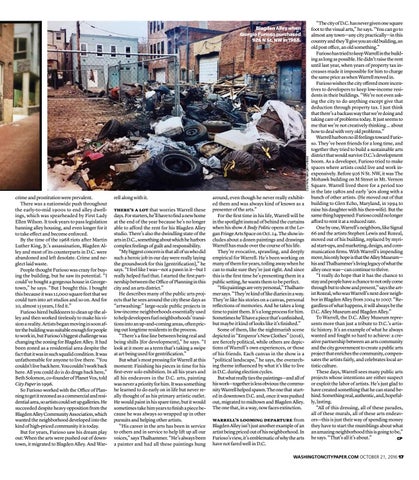
Blagden Alley when Giorgio Furioso purchased 926 N St. NW in 1988.
crime and prostitution were prevalent. There was a nationwide push throughout the early-to-mid 1900s to end alley dwellings, which was spearheaded by First Lady Ellen Wilson. It took years to pass legislation banning alley housing, and even longer for it to take effect and become enforced. By the time of the 1968 riots after Martin Luther King, Jr.’s assassination, Blagden Alley and most of its counterparts in D.C. were abandoned and left desolate. Crime and neglect laid waste. People thought Furioso was crazy for buying the building, but he saw its potential. “I could’ve bought a gorgeous house in Georgetown,” he says. “But I bought this. I bought this because it was 12,000 square feet that we could turn into art studios and so on. And for 10, almost 15 years, I fed it.” Furioso hired bulldozers to clean up the alley and then worked tirelessly to make his vision a reality. Artists began moving in soon after the building was suitable enough for people to work in, but Furioso’s biggest challenge was changing the zoning for Blagden Alley. It had been zoned as a residential area despite the fact that it was in such squalid condition. It was unfathomable for anyone to live there. “You couldn’t live back here. You couldn’t work back here. All you could do is do drugs back here,” Beth Solomon, co-founder of Planet Vox, told City Paper in 1996. So Furioso worked with the Office of Planning to get it rezoned as a commercial and residential area, so artists could set up galleries. He succeeded despite heavy opposition from the Blagden Alley Community Association, which wanted the neighborhood developed into the kind of high-priced community it is today. But for years, Furioso saw his dream play out: When the arts were pushed out of downtown, it migrated to Blagden Alley. And War-
rell along with it. There’s a loT that worries Warrell these days. For starters, he’ll have to find a new home at the end of the year because he’s no longer able to afford the rent for his Blagden Alley studio. There’s also the dwindling state of the arts in D.C., something about which he harbors complex feelings of guilt and responsibility. “My biggest concern is that all of us who did such a heroic job in our day were really laying the groundwork for this [gentrification],” he says. “I feel like I was—not a pawn in it—but I really helped fuel that. I started the first partnership between the Office of Planning in this city and an arts district.” He describes many of the public arts projects that he sees around the city these days as “artwashing:” large-scale public projects in low-income neighborhoods essentially used to help developers fuel neighborhoods’ transitions into an up-and-coming areas, often pricing out longtime residents in the process. “There’s a fine line between being real and being shills [for development],” he says. “I look at it more as a term that’s taking a swipe at art being used for gentrification.” But what’s most pressing for Warrell at this moment: Finishing his pieces in time for his first-ever solo exhibition. In all his years and all his endeavors in the D.C. arts, painting was never a priority for him. It was something he learned to do early on in life but never really thought of as his primary artistic outlet. He would paint in his spare time, but it would sometimes take him years to finish a piece because he was always so wrapped up in other pursuits and helping other artists. “His career in the arts has been in service to others and in service to help lift up all our voices,” says Thalhammer. “He’s always been a painter and had all these paintings hung
around, even though he never really exhibited them and was always kind of known as a presenter of the arts.” For the first time in his life, Warrell will be in the spotlight instead of behind the curtains when his show A Body Politic opens at the Logan Fringe Arts Space on Oct. 24. The show includes about a dozen paintings and drawings Warrell has made over the course of his life. They’re evocative, sprawling, and deeply empirical for Warrell. He’s been working on many of them for years, toiling away when he can to make sure they’re just right. And since this is the first time he’s presenting them in a public setting, he wants them to be perfect. “His paintings are very personal,” Thalhammer says. “They’re kind of like diaries in a way. They’re like his stories on a canvas, personal reflections of memories. And he takes a long time to paint them. It’s a long process for him. Sometimes he’ll have a piece that’s unfinished, but maybe it kind of looks like it’s finished.” Some of them, like the nightmarish scene depicted in “Emperor’s New Clothes” (2016), are fiercely political, while others are depictions of Warrell’s own experiences, or those of his friends. Each canvas in the show is a “political landscape,” he says, the overarching theme influenced by what it’s like to live in D.C. during election cycles. But what really ties the paintings—and all of his work—together is less obvious: the community Warrell helped spawn. The one that started in downtown D.C. and, once it was pushed out, migrated to midtown and Blagden Alley. The one that, in a way, now faces extinction. Warrell’s looming deparTure from Blagden Alley isn’t just another example of an artist being priced out of his neighborhood. In Furioso’s view, it’s emblematic of why the arts have not fared well in D.C.
“The city of D.C. has never given one square foot to the visual arts,” he says. “You can go to almost any town—any city practically—in this country and they’ll give you an old building, an old post office, an old something.” Furioso has tried to keep Warrell in the building as long as possible. He didn’t raise the rent until last year, when years of property tax increases made it impossible for him to charge the same price as when Warrell moved in. Furioso wishes the city offered more incentives to developers to keep low-income residents in their buildings. “We’re not even asking the city to do anything except give that deduction through property tax. I just think that there’s a backass way that we’re doing and taking care of problems today. It just seems to me that we’re not creatively thinking … about how to deal with very old problems.” Warrell harbors no ill feelings toward Furioso. They’ve been friends for a long time, and together they tried to build a sustainable arts district that would survive D.C.’s development boom. As a developer, Furioso tried to make spaces where artists could live and work inexpensively. Before 926 N St. NW, it was The Mohawk building on M Street in Mt. Vernon Square. Warrell lived there for a period too in the late 1980s and early ’90s along with a bunch of other artists. (He moved out of that building to Glen Echo, Maryland, in 1994 to raise his daughter with his then-wife). But the same thing happened: Furioso could no longer afford to rent it at a reduced rate. One by one, Warrell’s neighbors, like Signal 66 and the artists Stephen Lewis and Rozeal, moved out of his building, replaced by myriad start-ups, and marketing, design, and communication firms. With Warrell’s impending move, his only hope is that the Alley Museum— his and Thalhammer’s living legacy of what the alley once was—can continue to thrive. “I really do hope that it has the chance to stay and people have a chance to not only come through but to show and present,” says the artist Rozeal, who was Warrell’s next door neighbor in Blagden Alley from 2004 to 2007. “Regardless of what happens, it will always be the D.C. Alley Museum and Blagden Alley.” To Warrell, the D.C. Alley Museum represents more than just a tribute to D.C.’s artistic history. It’s an example of what he always wanted and fought so hard to achieve: a creative partnership between an arts community and the city government to create a public arts project that enriches the community, compensates the artists fairly, and celebrates local artistic culture. These days, Warrell sees many public arts projects whose intentions are either suspect or exploit the labor of artists. He’s just glad to have created something that he can stand behind. Something real, authentic, and, hopefully, lasting. “All of this dressing, all of these parades, all of these murals, all of these arts endeavors—this is just their way of spending money they have to start the mumblings about what an amazing neighborhood this is going to be,” he says. “That’s all it’s about.” CP
washingtoncitypaper.com october 21, 2016 17