FOOD ARTS BOOK REVIEW opportunity to revisit a more equitable pay system because we can start all over.” He acknowledges that eliminating tipping would work for some and not others. The heated discourse surrounding the 2018 ballot measure that sought to eliminate the tip credit demonstrated that a contingent of workers and owners strongly opposed getting rid of tipping. “In the long run, it’s more fair,” Bruner-Yang says. “We can provide better benefits. We can pay people more. I think now people will be like, ‘Yeah, that makes sense,’ from customers to employees.” Off-premise dining may stick around. Shouk co-founder Ran Nussbacher is convinced Washingtonians will be ordering in with greater frequency well into the future, especially in the fast-casual sector. Throughout the COVID-19 crisis, the vegetarian Israeli fast-casual restaurant has continued its usual take-out and delivery operations out of its K Street NW store. They’ve also added “hood drops” that allow people who live in areas outside of delivery ranges to get Shouk delivered at coordinated times. “I see this crisis as accelerating shifts and trends that were underway already,” Nussbacher says. “Off-premise dining is nothing new. We’ve known for the past few years it’s only been accelerating. I think now it’s going to get a boost.” “We also have generations of customers that are being forced to learn how to order online for the first time,” Nussbacher says. “We see that with our food drops. Elderly customers are getting comfortable with it.” Shouk uses Caviar, Uber Eats, and other third-party delivery apps. Those services have come under fire during this public health emergency for not doing enough to lower their commissions for struggling restaurants who are more dependent on them than ever. In response, some restaurants have tried doing delivery themselves. Nussbacher doesn’t think that’s sustainable. “It’s not realistic to have a delivery driver on demand who sits around waiting for the next delivery to come in,” he says. “That’s not a model that scales and it’s not something any restaurant can afford. The reason these services exist is there is no alternative.” The supply chain could become more local. During the COVID-19 crisis, some restaurants have turned away from large purveyors who’ve been inconsistent in terms of delivery schedules and product availability. Chefs are getting their produce, grains, and proteins from local farmers instead, and the supply chain looks a little different. “It’s going to create more of a local economy naturally and more local interdependence,” Babin says. “I’m in favor of it. I hate the reason it’s happening and I don’t know how long it’ll last, but it’s a good reminder to a lot of people who don’t normally think about it. Local is a more resilient system and regional economies with
lots of interdependence can be a good thing.” Viruses can spread easily in large factories and industrial operations where employees work in cramped quarters. Perdue Farms closed a Delaware poultry processing plant at the end of March after two employees tested positive for COVID-19. Four Tyson Foods employees working in Georgia died in April from the virus. At least 634 employees at the Smithfield Foods processing plant in South Dakota tested positive; the company has also been fighting outbreaks in other states. “If the Smithfield Plant is an indication of what we can expect from large producers, then the value of small, local producers is going to be great even if the price is higher,” Gresser says. Consumers will have to play their parts because restaurants will have to pass along some of the increased costs. “What’s the maximum that people will pay for a pizza? In the last few years it’s gotten tighter. If we’re going into an economic downturn, there could be further tightening.” Food is in the spotlight, but independent restaurants may not have the opportunity to advocate for their needs. Many media outlets are regularly covering how restaurants are coping with the COVID19 crisis. Because of this, Gresser thinks customers are bonding with their neighborhood eateries and watering holes like never before. “They’re recognizing how important these outside-the-home homes have been to them and how important the individuals are who work in them,” she says. “That’s why you’re seeing the generosity toward all of the restaurant relief funds.” Babin agrees. “People are focused on restaurants in a way they haven’t been because they’re aware of the pain that’s being felt,” he says. “There can be some good things that come out in terms of a seat at the table.” But Babin and Gresser aren’t sure these new bonds will last forever or lead to better representation when it comes time to advocate for their needs with local and federal legislators. “The restaurant industry isn’t a monolithic thing,” Babin says. “Comparing a giant chain to an independent restaurant is like the difference between Nike and a guy who makes shoes one pair at a time. They’re both in the shoe business, but the similarities end there. I worry the voices that are listened to are the giant voices who have a different perspective and agenda than independents.” Just look at the White House’s Economic Council for Restaurants. It includes the CEOs of Chick-fil-A, Subway, Outback Steakhouse, Papa John’s, and McDonald’s, as well as Thomas Keller, Wolfgang Puck, Jean-Georges Vongerichten, and Daniel Boulud, well known and acclaimed, though not particularly diverse, fine-dining chefs. The people on the council have little to nothing in common with mom-and-pop shops that make urban dining so enjoyable. “I worry about a huge consolidation and the idiosyncratic parts of the business getting squeezed down,” Babin says.
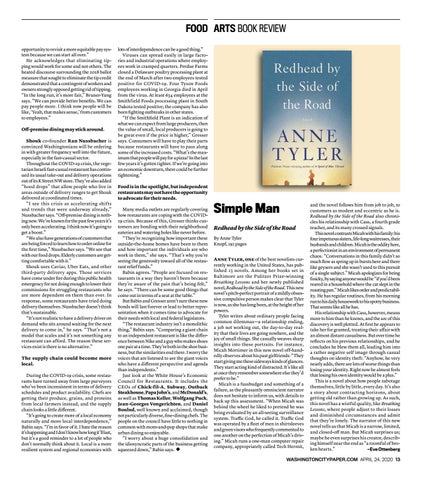
Simple Man Redhead by the Side of the Road By Anne Tyler Knopf, 192 pages Anne Tyler, one of the best novelists currently working in the United States, has published 23 novels. Among her books set in Baltimore are the Pulitzer Prize-winning Breathing Lessons and her newly published novel, Redhead by the Side of the Road. This new novel’s pitch-perfect portrait of a mildly obsessive compulsive person makes clear that Tyler is now, as she has long been, at the height of her powers. Tyler writes about ordinary people facing common dilemmas—a relationship ending, a job not working out, the day-to-day reality that their lives are going nowhere, and the joy of small things. She casually weaves sharp insights into these portraits. For instance, Micah Mortimer in this new novel off-handedly observes about his past girlfriends: “They start giving me these sideways kinds of glances. They start acting kind of distracted. It’s like all at once they remember somewhere else they’d prefer to be.” Micah is a fussbudget and something of a failure, as the pleasantly omniscient narrator does not hesitate to inform us, with details to back up this assessment. “When Micah was behind the wheel he liked to pretend he was being evaluated by an all-seeing surveillance system. Traffic God, he called it. Traffic God was operated by a fleet of men in shirtsleeves and green visors who frequently commented to one another on the perfection of Micah’s driving.” Micah runs a one-man computer repair company, appropriately called Tech Hermit,
and the novel follows him from job to job, to customers as modest and eccentric as he is. Redhead by the Side of the Road also chronicles his relationship with Cass, a fourth grade teacher, and its many crossed signals. This novel contrasts Micah with his family: his four impetuous sisters, life-long waitresses, their husbands and children. Micah is the oddity here, a perfectionist in an environment of permanent chaos. “Conversations in this family didn’t so much flow as spring up in bursts here and there like geysers and she wasn’t used to this pursuit of a single subject.” Micah apologizes for being finicky, by saying anyone would be “if you’d been reared in a household where the cat slept in the roasting pan.” Micah likes order and predictability. He has regular routines, from his morning run to his daily housework to his spotty business. That seems like all he has. His relationship with Cass, however, means more to him than he knows, and the arc of this discovery is well plotted. At first he appears to take her for granted, treating their affair with an almost distant casualness. But over time he reflects on his previous relationships, and he concludes he blew them all, leading him into a rather negative self image through casual thoughts on identity theft: “Anyhow, he very nearly adds, there are lots of worse things than losing your identity. Right now he almost feels that losing his own identity would be a plus.” This is a novel about how people sabotage themselves, little by little, every day. It’s also a story about contracting horizons, about getting old rather than growing up. As such, this novel has a wistful quality, like Breathing Lessons, where people adjust to their losses and diminished circumstances and admit that they’re lonely. The narrator of this new novel tells us that Micah is a narrow, limited, and closed-off man. But Micah surprises us; maybe he even surprises his creator, describing himself near the end as “a roomful of broken hearts.” —Eve Ottenberg
washingtoncitypaper.com april 24, 2020 13