FOOD YOUNG & HUNGRY
Taking Stock Restaurateurs consider what immediate and lasting changes the COVID-19 crisis will have on their industry.
When the dust settles and the country begins to reopen after the COVID-19 crisis, it will happen in phases. Mayor Muriel Bowser won’t ring a literal or figurative dinner bell announcing the city’s restaurants and bars are fully back in business once the city’s stay-athome order lifts. Because many of D.C.’s small, independent businesses have not been able to secure significant financial aid, a number of them will close, succumbing to the economic realities of months of depressed sales. Those who do make it will carry on operating under stressful conditions as they slowly relaunch. Restaurants have reinvented themselves throughout the crisis to keep up with evolving public health restrictions and keep staff and patrons safe. In the immediate term, when diners return to restaurants, they may encounter fewer seats, staff members wearing masks and gloves, and contact-free ways to settle the bill. “People will come out of this feeling a level of stress,” says Neighborhood Restaurant Group founder Michael Babin. “Not just financial, but stress and anxiety when they’re in groups. That could be really bad for restaurants.” “Restaurants are places to relax and unwind, where you’re supposed to leave the cares of the day behind,” Babin continues. “Walking into a beer garden where lots and lots of people are together—how long will the anxiety last? It’s antithetical to everything we’re trying to accomplish with our guests.” Babin says the restaurant industry was in a “fragile place” before the outbreak of COVID19 and in need of “a gradual correction of supply and demand.” At least 90 D.C. restaurants and bars closed in 2019. Some operators blamed landlords for increasing rent once their fiveor 10-year leases came up for renewal. Others wondered if D.C. was dense enough to support its restaurant boom. “If things had been more in balance before, we’d be looking at a different situation. This is crushing,” Babin says. Though any return to dine-in business is still a ways away, local restaurateurs like Babin are also thinking about what long lasting impacts the global pandemic may have on the hospitality industry. Everything from supply chains to
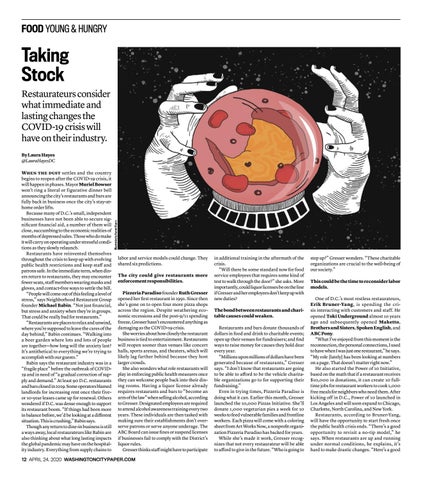
Illustration by Hunter Myers
By Laura Hayes @LauraHayesDC
labor and service models could change. They shared six predictions. The city could give restaurants more enforcement responsibilities. Pizzeria Paradiso founder Ruth Gresser opened her first restaurant in 1991. Since then she’s gone on to open four more pizza shops across the region. Despite weathering economic recessions and the post-9/11 spending freeze, Gresser hasn’t encountered anything as damaging as the COVID-19 crisis. She worries about how closely the restaurant business is tied to entertainment. Restaurants will reopen sooner than venues like concert halls, sports arenas, and theaters, which will likely lag farther behind because they host larger crowds. She also wonders what role restaurants will play in enforcing public health measures once they can welcome people back into their dining rooms. Having a liquor license already requires restaurants and bars to “become an arm of the law” when selling alcohol, according to Gresser. Designated employees are required to attend alcohol awareness training every two years. These individuals are then tasked with making sure their establishments don’t overserve patrons or serve anyone underage. The ABC Board can issue fines or suspend licenses if businesses fail to comply with the District’s liquor rules. Gresser thinks staff might have to participate
12 april 24, 2020 washingtoncitypaper.com
in additional training in the aftermath of the crisis. “Will there be some standard now for food service employees that requires some kind of test to walk through the door?” she asks. More importantly, could liquor licenses be on the line if Gresser and her employees don’t keep up with new duties? The bond between restaurants and charitable causes could weaken. Restaurants and bars donate thousands of dollars in food and drink to charitable events; open up their venues for fundraisers; and find ways to raise money for causes they hold dear every year. “Millions upon millions of dollars have been generated because of restaurants,” Gresser says. “I don’t know that restaurants are going to be able to afford to be the vehicle charitable organizations go to for supporting their fundraising.” Even in trying times, Pizzeria Paradiso is doing what it can. Earlier this month, Gresser launched the 10,000 Pizzas Initiative. She’ll donate 1,000 vegetarian pies a week for 10 weeks to feed vulnerable families and frontline workers. Each pizza will come with a coloring sheet from Art Works Now, a nonprofit organization Pizzeria Paradiso has backed for years. While she’s made it work, Gresser recognizes that not every restaurateur will be able to afford to give in the future. “Who is going to
step up?” Gresser wonders. “These charitable organizations are crucial to the well-being of our society.” This could be the time to reconsider labor models. One of D.C.’s most restless restaurateurs, Erik Bruner-Yang, is spending the crisis interacting with customers and staff. He opened Toki Underground almost 10 years ago and subsequently opened Maketto, Brothers and Sisters, Spoken English, and ABC Pony. “What I’ve enjoyed from this moment is the reconnection, the personal connections, I used to have when I was just one restaurant,” he says. “My role [lately] has been looking at numbers on a page. That doesn’t matter right now.” He also started the Power of 10 Initiative, based on the math that if a restaurant receives $10,000 in donations, it can create 10 fulltime jobs for restaurant workers to cook 1,000 free meals for neighbors who need them. After kicking off in D.C., Power of 10 launched in Los Angeles and will soon expand to Chicago, Charlotte, North Carolina, and New York. Restaurants, according to Bruner-Yang, will have the opportunity to start fresh once the public health crisis ends. “There’s a good opportunity to revisit a no-tip model,” he says. When restaurants are up and running under normal conditions, he explains, it’s hard to make drastic changes. “Here’s a good