SPORTS ARTS ALBUM REVIEW should they try to take advantage,” Schaffner adds. Dr. Glenn Wortmann, the chief of infectious diseases at MedStar Washington Hospital Center, agrees. “How much of the virus that actually comes out when you cough or breathe or how much is inhaled, there’s so many variables, it's impossible to predict,” he says. “The six feet that has been advised just in normal social distancing, you want to do at least that while exercising, but the risk of transmitting just running by someone that is walking, that instance is extraordinarily low, if not zero.” Like Schaffner, he understands that people are still nervous and recommends finding alternate times and pathways to exercise when there aren’t many out. He believes it’s OK to exercise without a mask—Wortmann rides his bike without one—but that not doing so means you should be vigilant about maintaining the appropriate distance away from others. “I would be courteous with regards to being around other people,” Wortmann says. “What that means is you should not be running in a pack. When you’re biking, you should not be drafting off the person in front of you. Leave adequate space.”
“I think a lot of people are trying to treat people with respect and give people the benefit of the doubt, and then there’s some people who aren't following the rules at all or are overzealous and seem to act like they're the only ones allowed to use the sidewalk, that it’s everyone else’s responsibility to stay far away from people. We live in a city. It takes cooperation from everyone.” Instead of shame, Tangney, the author, with Ronda L. Dearing, of the book Shame and Guilt, recommends instructing people in a constructive way by giving them an option. In general, she explains, the fundamental difference is when people feel shame, they feel bad about themselves, but when they feel guilt, they feel bad about a particular behavior. It’s hard to induce guilt without inducing shame, Tangney adds. “I hesitate to say [use] guilt in this case. I think it’s just getting people aware of, and expressing real concern,” she says. “Telling them, ‘I’m concerned about your health and other people’s health’—giving them a way to change their behavior, not a demand.” “There’s no easy answer,” she continues. “But I'm sympathetic of people's need to exercise and get out, a nd con nec t w it h nature and the world and also connect with the idea that we’re all in this together. We’re in the same world for the first time in a while. Everyone around the globe is dealing with this. It's quite an astounding thought.”
“I think people have so much stress in their lives right now, whether it’s the loss of a job or just fear. It kind of makes people around them an easy target or outlet for taking those feelings out on them.”
Wh at ’s m o r e clear is that shaming others isn’t always a n ef fec t ive to ol. Shouting at someone on the sidewalk or scolding them on Twitter won’t get people to change their behaviors, especially if they don’t believe they did anything wrong. “In general, when people feel shamed by others, they’re not inclined to take the other person’s perspective, so much as they’re likely to get defensive or angry or start pointing fingers back,” says George Mason University psychology professor June Price Tangney. “It doesn’t seem to cause people to change their behavior much. If anything, people are more likely to dig in their heels. One of the general questions is: This public shaming of people for not social distancing, is it a good idea? It kind of feels good, but it doesn't accomplish what people think it’s going to accomplish.” On a recent run, D.C. resident Kerry Allen was heading up 16th Street NW when she saw a man ahead staring at her on the sidewalk. As she got closer, the man yelled, “Give people their space!” It took Allen a few moments to realize what he had said. She estimates she was about eight feet away from him. “It doesn’t sound very dramatic at all, but it really ruined my run,” says Allen, who competed in the U.S. Olympic Marathon Trials in February. Allen, 31, replayed the interaction in her head for the rest of the workout. The incident itself won’t change her running routine, but she’s still experimenting with different routes and going at different times of the day to see which option would be safest for her and those around. “It’s a trying time for everyone,” Allen says.
When Sprock returned home after being scolded at the intersection, she went online and checked Montgomery County’s coronavirus website. She felt guilty and wanted to know if she did indeed break a rule by not wearing a mask. When she saw the local government’s recommendations did not specify runners, she felt relieved. But the woman’s comments still rang in her head. “I know in a lot of countries, some of the lockdowns include not running outside,” Sprock says. “I’m sticking to the guidelines because I don't want them to take running away from us. When someone yelled at me, it was a kick in the gut because I have tried really hard to follow guidelines. To be attacked for something that's not even an accurate guideline really bothered me a lot.” The following morning, she went on another run in the neighborhood and again chose not to wear a mask. With temperatures in the 60s, it was an ideal day to be outside. She saw other runners, walkers, and families enjoying the weather. No one made a comment to her. Sprock thought about the past month and how in these difficult and challenging times, most people she’s come across have been friendly. Walkers have thanked her for going around them with a smile or a wave. “Everyone,” she says, “is doing their best.”
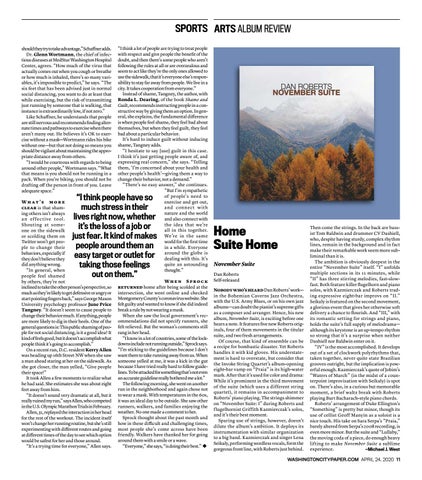
Home Suite Home November Suite Dan Roberts Self-released Nobody who’s heard Dan Roberts’ work— in the Bohemian Caverns Jazz Orchestra, with the U.S. Army Blues, or on his own jazz albums—can doubt the pianist’s supreme gifts as a composer and arranger. Hence, his new album, November Suite, is exciting before one hears a note. It features five new Roberts originals, four of them movements in the titular suite, and two fresh arrangements. Of course, that kind of ensemble can be a recipe for bombastic disaster. Yet Roberts handles it with kid gloves. His understatement is hard to overstate, but consider that the Invoke String Quartet’s album-opening eight-bar vamp on “Praia” is its high-water mark. After that it’s used for color and drama: While it’s prominent in the third movement of the suite (which uses a different string quartet), it remains in accompaniment to Roberts’ piano playing. The strings shimmer on “November Suite: I” during Roberts and flugelhornist Griffith Kazmierczak’s solos, and it’s their best moment. Sparing use of strings, however, doesn’t dilute the album’s ambition. It deploys its instrumentation with similar organization to a big band. Kazmierczak and singer Lena Seikaly, performing wordless vocals, form the gorgeous front line, with Roberts just behind.
Then come the strings. In the back are bassist Tom Baldwin and drummer CV Dashiell, who, despite having sturdy, complex rhythm lines, remain in the background and in fact make their remarkable work seem more subliminal than it is. The ambition is obviously deepest in the entire “November Suite” itself. “I” unfolds multiple sections in its 11 minutes, while “II” has three stirring melodies, fast-slowfast. Both feature killer flugelhorn and piano solos, with Kazmierczak and Roberts trading expressive eight-bar improvs on “II.” Seikaly is featured on the second movement, a glorious event that gives her otherwise soft delivery a chance to flourish. And “III,” with its romantic setting for strings and piano, holds the suite’s full supply of melodrama— although its keystone is an up-tempo rhythm so strong that it’s a surprise when neither Dashiell nor Baldwin enter on it. “IV” is the most accomplished. It develops out of a set of clockwork polyrhythms that, taken together, never quite state Brazilian grooves outright, but the implication is powerful enough. Kazmierczak’s quote of Jobim’s “Waters of March” (in the midst of a counterpoint improvisation with Seikaly) is spot on. There’s also, in a curious but memorable moment, a brief waltz break with Roberts playing Burt Bacharach-style piano chords. Roberts’ arrangement of Duke Ellington’s “Something” is pretty but minor, though its use of cellist Geoff Manyin as a soloist is a nice touch. His take on Sara Serpa’s “Praia,” barely altered from Serpa’s 2008 recording, is even more minor. But the suite and “Lullaby,” the moving coda of a piece, do enough heavy lifting to make November Suite a sublime experience. —Michael J. West
washingtoncitypaper.com april 24, 2020 11