CPARTS
Join the City Paper Arts Club! Social distancing, together. washingtoncitypaper.com/arts
The Day the Music Died D.C. area performers reflect on what life without live music means in the wake of the coronavirus outbreak.
By Kristina Gaddy
Nick Moreland
Steven Gellman waS on his way from the D.C. area to the Blue Moon Diner in Charlottesville, Virginia, when he received notice that his show had been canceled. He already knew that it might be his last gig for a while. Earlier in the week, his phone started ringing and emails appeared, with cancelation after cancelation. The singer-songwriter and guitarist has been making his living playing live music since the late 1990s, but last week, that income stream disappeared. “Within 24 hours, 90 percent of my income was gone,” he says. “Every single gig I had booked was canceled, and now I have no income.” Last week, following increased measures to limit the spread of the novel coronavirus, the cancelations grew like a crescendo for local musicians and performing artists. At first, they received emails and phone calls that individual performances, rehearsals, and gigs weren’t going to happen. By last Friday, entire venues, from the Kennedy Center to Black Cat, had shut down, both in response to official bans on mass gatherings like the one issued by DC Health and concern for public health at large. For musicians in the D.C. area, the result is financial and emotional distress. Gellman makes his full-time living playing live music. In the late 1990s, he realized that he could make a living playing at nursing homes, hospitals, and other institutional settings. “I’ve created a market for myself,” he says, and now, almost all of his income comes from these gigs. “[The money from] my daytime gigs is what I use to pay my mortgage.” He’s never had to rethink his career until this week. Blues musician Phil Wiggins says it’s been a long time since he’s felt this uncertainty. He started playing music as a teenager in D.C. in the 1970s, and although he says he struggled early in his career, he’s won multiple awards, including a National Endowment for the Arts National Heritage Fellowship. To have his performances disappear has created for him a bizarre and unfamiliar feeling. “To know that those gigs are gone and to not have really any idea when they will resume is something that
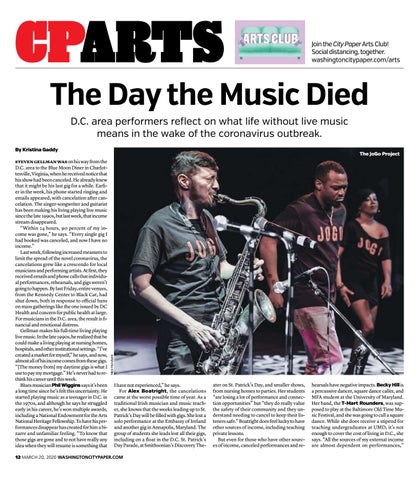
The JoGo Project
I have not experienced,” he says. For Alex Boatright, the cancelations came at the worst possible time of year. As a traditional Irish musician and music teacher, she knows that the weeks leading up to St. Patrick’s Day will be filled with gigs. She lost a solo performance at the Embassy of Ireland and another gig in Annapolis, Maryland. The group of students she leads lost all their gigs, including on a float in the D.C. St. Patrick’s Day Parade, at Smithsonian’s Discovery The-
12 march 20, 2020 washingtoncitypaper.com
ater on St. Patrick’s Day, and smaller shows, from nursing homes to parties. Her students “are losing a lot of performance and connection opportunities” but “they do really value the safety of their community and they understand needing to cancel to keep their listeners safe.” Boatright does feel lucky to have other sources of income, including teaching private lessons. But even for those who have other sources of income, canceled performances and re-
hearsals have negative impacts. Becky Hill is a percussive dancer, square dance caller, and MFA student at the University of Maryland. Her band, the T-Mart Rounders, was supposed to play at the Baltimore Old Time Music Festival, and she was going to call a square dance. While she does receive a stipend for teaching undergraduates at UMD, it’s not enough to cover the cost of living in D.C., she says. “All the sources of my external income are almost dependent on performances,”