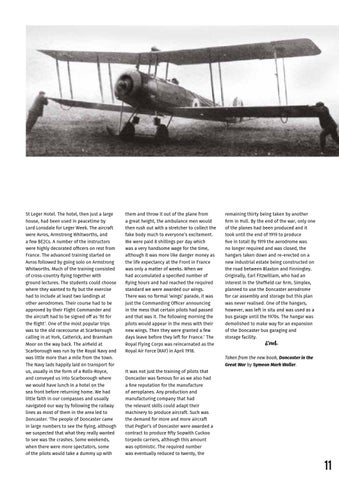
St Leger Hotel. The hotel, then just a large house, had been used in peacetime by Lord Lonsdale for Leger Week. The aircraft were Avros, Armstrong Whitworths, and a few BE2Cs. A number of the instructors were highly decorated officers on rest from France. The advanced training started on Avros followed by going solo on Armstrong Whitworths. Much of the training consisted of cross-country flying together with ground lectures. The students could choose where they wanted to fly but the exercise had to include at least two landings at other aerodromes. Their course had to be approved by their Flight Commander and the aircraft had to be signed off as ‘fit for the flight’. One of the most popular trips was to the old racecourse at Scarborough calling in at York, Catterick, and Bramham Moor on the way back. The airfield at Scarborough was run by the Royal Navy and was little more than a mile from the town. The Navy lads happily laid on transport for us, usually in the form of a Rolls-Royce, and conveyed us into Scarborough where we would have lunch in a hotel on the sea front before returning home. We had little faith in our compasses and usually navigated our way by following the railway lines as most of them in the area led to Doncaster. ‘The people of Doncaster came in large numbers to see the flying, although we suspected that what they really wanted to see was the crashes. Some weekends, when there were more spectators, some of the pilots would take a dummy up with
them and throw it out of the plane from a great height, the ambulance men would then rush out with a stretcher to collect the fake body much to everyone’s excitement. We were paid 8 shillings per day which was a very handsome wage for the time, although it was more like danger money as the life expectancy at the Front in France was only a matter of weeks. When we had accumulated a specified number of flying hours and had reached the required standard we were awarded our wings. There was no formal ‘wings’ parade, it was just the Commanding Officer announcing in the mess that certain pilots had passed and that was it. The following morning the pilots would appear in the mess with their new wings. Then they were granted a few days leave before they left for France.’ The Royal Flying Corps was reincarnated as the Royal Air Force (RAF) in April 1918.
It was not just the training of pilots that Doncaster was famous for as we also had a fine reputation for the manufacture of aeroplanes. Any production and manufacturing company that had the relevant skills could adapt their machinery to produce aircraft. Such was the demand for more and more aircraft that Pegler’s of Doncaster were awarded a contract to produce fifty Sopwith Cuckoo torpedo carriers, although this amount was optimistic. The required number was eventually reduced to twenty, the
remaining thirty being taken by another firm in Hull. By the end of the war, only one of the planes had been produced and it took until the end of 1919 to produce five in total! By 1919 the aerodrome was no longer required and was closed, the hangars taken down and re-erected on a new industrial estate being constructed on the road between Blaxton and Finningley. Originally, Earl Fitzwilliam, who had an interest in the Sheffield car firm, Simplex, planned to use the Doncaster aerodrome for car assembly and storage but this plan was never realised. One of the hangars, however, was left in situ and was used as a bus garage until the 1970s. The hangar was demolished to make way for an expansion of the Doncaster bus garaging and storage facility.
End
Taken from the new book, Doncaster in the Great War by Symeon Mark Waller.
11