Teawith the Gypsy Princess Rachel Horne In 2012 I met my first ever Romany Gypsy: Violet M. Cannon. Not only had I heard of her and her book, A Gypsy Princess, I’d also watched her being interviewed on This Morning by Holly Willoughby and Philip Schofield about the evictions of travellers from Dale Farm in Essex. Without getting into the politics of Dale Farm, I remember TV reports at that time. In particular, scenes where trailers were ready to be bulldozed, with a young girl crying out: “There aren’t enough hippies to save us.” I’ve never forgotten that little girl’s tears. The ‘hippies’ were activists known as Camp Constant. They had tied themselves to the entrance of the site to protect the homes of the families living on Dale Farm against eviction. Violet is of pure Romany gypsy stock, a different minority group to the predominantly Irish travellers at Dale Farm. Violet presented an insightful argument as why the travellers should have been allowed to stay on Dale Farm. I recommend you watch the interview and make up your own mind. In hindsight, the problem with gypsy and traveller culture is that their lives are hidden from us ‘gorjas’. Yet we have often romanticised their lifestyle in our own culture. Take the living wagon, the traditional gypsy home - I had one as a toy. Then there’s gypsy fashion trends, music and the mystic fortuneteller with a crystal ball. Never has a culture been so romanticised and demonised at the same time. In recent years, we’ve had My Big Fat Gypsy Wedding as a modern cultural reference point. Through Violet I’ve learnt how horrified and disgusted many families were at this use of the word ‘gypsy’ in the wrong context. It is mainly Irish travellers featured in the TV show and their lives and traditions are quite different. Understanding the true lives of gypsies and travellers over time, I’ve come to
16
Photography: Rachel Horne ©2015
learn their culture has been part of Doncaster life for hundreds of years. Violet once told me that “in any other part of the country, you can tell the gypsies and travellers apart from the gorjas, but not in Doncaster”. Apparently, we’re so similar it’s hard to tell who’s gypsy and who’s not. This statement really made me reflect on my own growing-up years at Northcliffe School in Conisbrough. In the mid 90s, all the girls wore big gold chains and clown necklaces. Wearing gold in this way had always been a gypsy trend, as you would always display your wealth rather than use a bank. Violet informed me that the clown necklaces were actually a trend that gypsy grandmothers would have worn 20 years earlier. Also, take the word ‘chav’. Some kids growing up in the 90s will remember this word wasn’t originally used in a derogatory way. Shortened from ‘chavvy’, it is actually a Romany gypsy word meaning ‘baby’ or ‘child’. According to Violet, gypsy men would call young gorja men ‘chavvy’ as a joke whilst doing business, and somehow in the 90s the word became commonly used in our own language. Not only is Violet a full-time gypsy princess, but she is also the Gypsy Traveller Engagement Office at CVS in Doncaster. This means her working week is spent with gypsy and traveller communities across Doncaster, helping young and old access the health and education services they need. Earlier this year, she also helped secure funding for a Heritage Lottery project exploring the stories of gypsies and travellers living in Doncaster over the last 100 years. Although gypsy and traveller life is ingrained in our own, photographs of people and the sites they lived at are often lost or hidden. The Proud Gypsy Traveller project is aimed at celebrating their hidden histories, acknowledging the families who have lived here for hundreds of years.
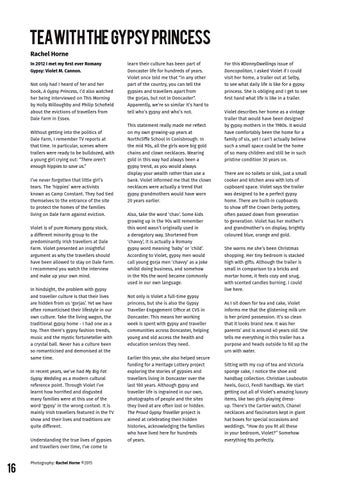
For this #DonnyDwellings issue of Doncopolitan, I asked Violet if I could visit her home, a trailer out at Selby, to see what daily life is like for a gypsy princess. She is obliging and I get to see first hand what life is like in a trailer. Violet describes her home as a vintage trailer that would have been designed by gypsy mothers in the 1980s. It would have comfortably been the home for a family of six, yet I can’t actually believe such a small space could be the home of so many children and still be in such pristine condition 30 years on. There are no toilets or sink, just a small cooker and kitchen area with lots of cupboard space. Violet says the trailer was designed to be a perfect gypsy home. There are built-in cupboards to show off the Crown Derby pottery, often passed down from generation to generation. Violet has her mother’s and grandmother’s on display, brightly coloured blue, orange and gold. She warns me she’s been Christmas shopping. Her tiny bedroom is stacked high with gifts. Although the trailer is small in comparison to a bricks and mortar home, it feels cozy and snug, with scented candles burning. I could live here. As I sit down for tea and cake, Violet informs me that the glistening milk urn is her prized possession. It’s so clean that it looks brand new. It was her parents’ and is around 40 years old. She tells me everything in this trailer has a purpose and heads outside to fill up the urn with water. Sitting with my cup of tea and Victoria sponge cake, I notice the shoe and handbag collection. Christian Louboutin heels, Gucci, Fendi handbags. We start getting out all of Violet’s amazing luxury items, like two girls playing dressup. There’s the Cartier watch, Chanel necklaces and fascinators kept in giant hat boxes for special occasions and weddings. “How do you fit all these in your bedroom, Violet?” Somehow everything fits perfectly.