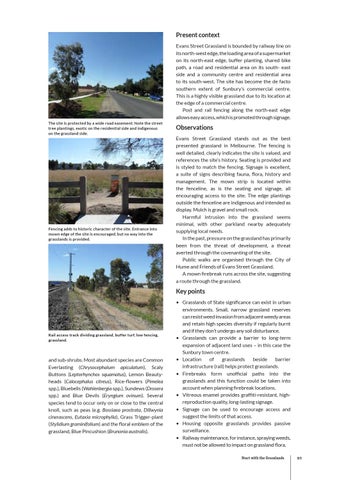
Present context Evans Street Grassland is bounded by railway line on its north-west edge, the loading area of a supermarket on its north-east edge, buffer planting, shared bike path, a road and residential area on its south- east side and a community centre and residential area to its south-west. The site has become the de facto southern extent of Sunbury’s commercial centre. This is a highly visible grassland due to its location at the edge of a commercial centre. Post and rail fencing along the north-east edge allows easy access, which is promoted through signage. The site is protected by a wide road easement. Note the street tree plantings, exotic on the residential side and indigenous on the grassland side.
Fencing adds to historic character of the site. Entrance into mown edge of the site is encouraged, but no way into the grasslands is provided.
Observations Evans Street Grassland stands out as the best presented grassland in Melbourne. The fencing is well detailed, clearly indicates the site is valued, and references the site’s history. Seating is provided and is styled to match the fencing. Signage is excellent, a suite of signs describing fauna, flora, history and management. The mown strip is located within the fenceline, as is the seating and signage, all encouraging access to the site. The edge plantings outside the fenceline are indigenous and intended as display. Mulch is gravel and small rock. Harmful intrusion into the grassland seems minimal, with other parkland nearby adequately supplying local needs. In the past, pressure on the grassland has primarily been from the threat of development, a threat averted through the covenanting of the site. Public walks are organised through the City of Hume and Friends of Evans Street Grassland. A mown firebreak runs across the site, suggesting a route through the grassland.
Key points
Rail access track dividing grassland, buffer turf, low fencing, grassland.
and sub-shrubs. Most abundant species are Common Everlasting (Chrysocephalum apiculatum), Scaly Buttons (Leptorhynchos squamatus), Lemon Beautyheads (Calocephalus citreus), Rice-flowers (Pimelea spp.), Bluebells (Wahlenbergia spp.), Sundews (Drosera spp.) and Blue Devils (Eryngium ovinum). Several species tend to occur only on or close to the central knoll, such as peas (e.g. Bossiaea prostrata, Dillwynia cinerascens, Eutaxia microphylla), Grass Trigger-plant (Stylidium graminifolium) and the floral emblem of the grassland, Blue Pincushion (Brunonia australis).
• Grasslands of State significance can exist in urban environments. Small, narrow grassland reserves can resist weed invasion from adjacent weedy areas and retain high species diversity if regularly burnt and if they don’t undergo any soil disturbance. • Grasslands can provide a barrier to long-term expansion of adjacent land uses – in this case the Sunbury town centre. • Location of grasslands beside barrier infrastructure (rail) helps protect grasslands. • Firebreaks form unofficial paths into the grasslands and this function could be taken into account when planning firebreak locations. • Vitreous enamel provides graffiti-resistant, highreproduction quality, long-lasting signage. • Signage can be used to encourage access and suggest the limits of that access. • Housing opposite grasslands provides passive surveillance. • Railway maintenance, for instance, spraying weeds, must not be allowed to impact on grassland flora. Start with the Grasslands
92