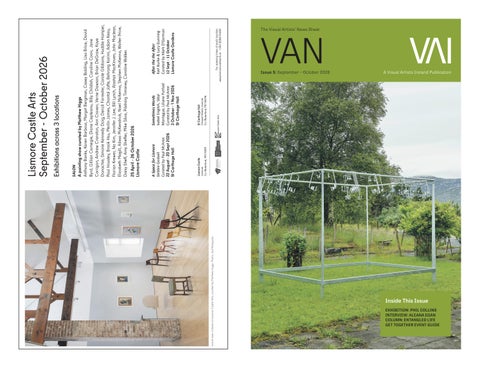
Install view of Salon at Lismore Castle Arts, curated by Matthew Higgs. Photo: Jed Niezgoda.
Sometimes Words Isabel English, Sibyl Montague, Liliane Puthod Curated by Paul McAree 3 October - 1 Nov 2026 St Carthage Hall
St Carthage Hall Chapel Street, Lismore Co Waterford, P51 WV96
A Space for Lismore Debbie Godsell Curated by Paul McAree 22 August - 20 Sept 2026 St Carthage Hall
Lismore Castle Lismore Co Waterford, P51 F859
25 April - 26 October 2026 Lismore Castle
For opening times of each location www.lismorecastlearts.ie +353 (0)58 54061
After the the After Karl Burke & Lucy Gunning Curated by Mark O’Gorman 12 Sept - 11 October Lismore Castle Gardens
SALON A painting show curated by Matthew Higgs Anthony Banks, Karen Barbour, Margot Bergman, Casey Bolding, Lisa Brice, David Byrd, Gillian Carnegie, Diana Cepleanu, Billy Childish, Caroline Coon, Jane Corrigan, Andrew Cranston, Ann Craven, Verne Dawson, Brian DeGraw, Kaye Donachie, Simone Kennedy Doig, Denzil Forrester, Carole Gibbons, Huddie Hamper, Paul Housley, Brook Hsu, Merlin James, Chantal Joffe, Behrang Karimi, Adam Keay, Florian Krewer, Na Kim, Jennifer J. Lee, Bill Lynch, Alastair MacKinven, John Maclean, Elizabeth Magill, Alissa McKendrick, Noel McKenna, Stephen McKenna, Walter Price, Daisy Sheff, Amy Sheffer, Mike Silva, Pádraig Timoney, Caroline Walker.
Exhibitions across 3 locations
Lismore Castle Arts September - October 2026
The Visual Artists’ News Sheet
VAN
Issue 5: September – October 2026
A Visual Artists Ireland Publication
Inside This Issue EXHIBITION: PHIL COLLINS INTERVIEW: ALEANA EGAN COLUMN: ENTANGLED LIFE GET TOGETHER EVENT GUIDE
ON THE COVER
Aleana Egan, ‘A maritime child’, installation view, Interface, Inagh, July 2026; photograph by Ros Kavanagh, courtesy of the artist. Roundup. Exhibitions from the past two months.
9
A Couple of Birdhouse Painters. Cornelius Browne discusses a recent joint exhibition at An Gailearaí. Out Walking in All Weathers. Lian Bell considers ideas emerging from the Dissident Paths project in Berlin. Cornafulla Bog. Meg Linton reflects on Amanda Ralph’s wetlands project in the midlands and related exhibition. Entangled Life. Cristina Nicotra discusses her programme exploring ecosystems where climate, art and community intertwine. Philosophy of Abstraction. Anna Liesching outlines the colour philosophy of the late Austrian artist Alice Berger Hammerschlag. From the Heart of Leitrim. Iarlaith Ní Fheorais outlines recent training as part of the Kunstverein Projects’ Creative Producers Programme.
10
11
Page 14
12
COLUMNS
FESTIVAL/BIENNIAL
Linguistic Threads. Aengus Woods discusses the participation of Irish artists at the 61st Venice Biennale.
Page 16
GET TOGETHER 2026
Editor: Joanne Laws Production/Design: Thomas Pool News/Opportunities: Thomas Pool, Lucy O’Sullivan Proofreading: Paul Dunne
15
Life: Being a Visual Artist. Event Guide to Ireland’s national networking day for visual artists.
28
A Gestalt Thing. Aengus Woods interviews Aleana Egan about her motivations, processes, and materials. Curated by Rain. Tom Lordan interviews Eamon Colman about his latest paintings. Something from Anything. Cherry Smyth reflects on the connections between poetry, painting, and curation.
30 31
CAREER DEVELOPMENT
INTERNATIONAL
32
Phantom Carousel. John Graham reviews Nan Goldin’s survey exhibition at Grand Palais in Paris.
33
Bones of Contention. Marie Brett highlights the need for health and wellbeing supports for artists.
34
These Four Walls. Rachael Gunning discusses a recent group exhibition installed in Sadbh O’Brien’s Dublin home. Another Kind of Freedom. Phillina Sun responds to a recent exhibition by Phil Collins at The Model in Sligo. Dungannon Tropicana. Michaela Razafima Nash considers a new film recently shown at the MAC. Panorama Europa. Sarah Long reviews the current exhibition at The Glucksman in Cork. Reading Sideways. Tanad Aaron interviews Blaine O’Donnell about his recent exhibition in Wexford.
36 Page 36
FIRST PAGES
6
37 38 40
41 42 43
44
SOCIALLY ENGAGED PRACTICE EXHIBITION
MEMBER
Rites of Homing. Christine Prescott reflects on her recent solo exhibition at Custom House Studios + Gallery. The Sum and Its Parts. Benjamin Stafford discusses the collage work of Cork-Based artist Tom Doig. A Space to Be Constructed Within. Reuben Brown discusses the ephemeral archives of queer nightlife.
PUBLIC ART
45
Ghost Riders in the Sky. Eileen MacDonagh outlines a sculpture restoration project in Hazelwood, Sligo. Public Art Roundup. Site-specific works.
46
VAI Lifelong Learning. Helpdesks, cafés, and webinars.
THE VISUAL ARTISTS’ NEWS SHEET
VISUAL ARTISTS IRELAND
CEO/Director: Noel Kelly Office Manager: Grazyna Rzanek Membership & Communications: Lucy O’Sullivan Advocacy & Advice: Laura Harvey-Graham Advocacy & Advice NI: Brian Kielt Services Design & Delivery: Emer Ferran News Provision: Thomas Pool Publications: Joanne Laws Accounts: Grazyna Rzanek Special Projects: Robert O’Neill Impact Measurement: Rob Hilken Shared Island Advocacy: Brian Kielt BOARD OF DIRECTORS Deborah Crowley (Secretary), Michael Fitzpatrick (Chair), Lorelei Harris, Maeve Jennings, Gina O’Kelly, Samir Mahmood, Ben Malcomson. REPUBLIC OF IRELAND OFFICE Visual Artists Ireland First Floor 2 Curved Street Temple Bar, Dublin 2 T: +353 (0)1 672 9488 E: info@visualartists.ie W: visualartists.ie NORTHERN IRELAND OFFICE Visual Artists Ireland 109 Royal Avenue Belfast BT1 1FF T: +44 (0)28 958 70361 E: info@visualartists-ni.org W: visualartists-ni.org
LAST PAGES
Page 39 Principal Funders
International Memberships
Safe to Create Safe to Create is a Dignity at Work programme looking to impact change on the culture and practices of the Arts and Creative sectors. If you or someone you know is facing bullying or harrasment please visit safetocreate.ie
08.08– 26.10.26
butlergallery.ie +353 (0)56 7761106
Evans’ Home, John’s Quay Kilkenny, R95 YX3F
richard malone
Chorus
Curated by Karla Sánchez Zepeda & Catherine Bowe
Wexford County Council 12 October - 20 November, 2026 Wexford County Council / 053 9196369 / wexfordcoco.ie Opening Hours: Monday - Friday, 9am-5pm The exhibition is open for the weekends of the Wexford Festival Opera from October 15th to 31st.
Tony O’Malley (1913-2003), The Studio – Our World, 1981, Oil on card, 44.5 × 54.6cm. Photo: courtesy Butler Gallery.
The Shared Tony & Jane Studio O’Malley
€10 (STG£9)
SAVE 10% OFF SUBSCRIPTION RATES TO IRISH ARTS REVIEW
ONE-YEAR SUBSCRIPTION FOR VAI MEMBERS NOW €44! BOOK A SUBSCRIPTION TODAY Email: subscriptions@irishartsreview.com Tel: +353 1 676 6711
IRISHARTSREVIEW.COM
thirty 6-inch top-down all-purpose Maitiú Mac Cárthaigh Emerging Visual Artist Award 2025 LHQ Gallery, Cork County Hall Opening 4th of September at 5pm 7th of September - 23rd of October
Leanne McDonagh
Community & Connection
Leanne McDonagh, Nature & Nurture, 2020
THE JOURNAL OF FINE ART, DESIGN, ARCHITECTURE, PHOTOGRAPHY, SCULPTURE, HERITAGE, DECORATIVE ARTS AND CRAFTS
Uillinn
West Cork Arts Centre
26 September to 31 October
CCA_NE2026_VAI_QuarterPageAd_FA2.pdf
1
18/08/2026
16:10
Creative Spark is proud to present
CREATE NETWORKING EVENT
Save The Date 19.11.26
LIMERICK CITY
Bailiú
C
M
Y
CM
MY
CY
CMY
K
Taking place in An Táin Arts Centre.
Opening Launch on Thursday 8th October at 7pm
Creative Spark is proud to present Bailiú, a group exhibition showcasing new work by artists from the 2025/26 Artist-in-Residence Programme. Runs from 9th Oct – 7th Nov Tuesday – Saturday | 10am – 4pm create-ireland.ie
Creative Spark Artist-in-Residence Programme is supported by the Arts Council of Ireland and The Arts Service of Louth County Council
FEXA 2026
·
FUMBALLY CONTEMPORARY
Making Space 5 C O N TE MP O R A R Y V I S U A L A R TI S TS I N D I A LO G U E
Caroline McCambridge · Conor Horgan · Stephen Dunne Frances Donnelly Jung · Natasha Conway
1 – 18 OCTOBER 2026 The Fumbally Exchange, Blackpitts, Dublin 8 Opening: Thursday 1 October, 6pm Opening event · Artist talks · Exhibition walk-throughs Opening hours and full programme online
WWW.FEXA.IE
@fumballycontemporary
Friday Lates at The Glucksman Open until 9 PM every Friday in September with a programme of talks, workshops and performances. The Glucksman, University College Cork, Ireland | www.glucksman.org | info@glucksman.org | +353 21 4901844
6
Visual Artists’ News Sheet | September – October 2026
EXHIBITION ROUNDUP
DUBLIN
BELFAST
Douglas Hyde Gallery
IMMA
ArtisAnn Gallery
Belfast Cathedral
‘Matters of time’ is the first solo exhibition in Ireland by Libyan artist Nour Jaouda. Jaouda’s multi-layered textile works traverse the languages of painting, sculpture and installation to produce ‘landscapes of memory’. The forms, colours and motifs within her intricately textured surfaces gesture towards different encounters across time and space, drawing on the artist’s childhood and experiences. On display from 3 July to 13 September.
‘Fisherwoman, Fisherwoman’ brings together two distinct art practices – of painter Camille Souter and contemporary artist Alberta Whittle – that insist upon working against the grain, unpicking urgencies of life and death, resistance and regeneration. Where Souter and Whittle meet, we see layered intersections of ecological and humanitarian concerns. The artists call attention to urgent environmental issues. On display from 6 March to 13 September.
‘Studio Miscellany’ by Diarmuid Delargy was on display from 1 July to 29 August. Delargy is an internationally recognised painter, printmaker and sculptor. He is renowned for his paintings of fish and sharks inspired from the Atlantic coast close to his studio in Sligo. His paintings are a personal commentary on the changing nature of the coast. Over the past 30 years, he has produced a body of work on the theme ‘Art and Extinction’.
‘I AM WOMAN’ by Lise McGreevy continues until 30 September. According to the press release, “Currently NI and Ireland still have vast gender inequality across all aspects of society. At a time when the adult population in NI is a majority 52% female and 50.5% in Ireland, inequality still reigns across all sectors of our community. This programme aims to support and promote female equality and diversity across race, religion, sexual orientations.”
thedouglashyde.ie
imma.ie
artisann.org
belfastcathedral.org
LexIcon
Photo Museum Ireland
Cultúrlann McAdam Ó Fiaich
Golden Thread Gallery
‘Lifework’ was an exhibition of artworks by seven artists who work at the Kilkenny Collective for Arts Talent (KCAT) Studio. The exhibition was presented at the Municipal Gallery, dlr LexIcon in Dún Laoghaire, and ran from 9 May to 26 August. The artists featured were Thomas Barron, Declan Byrne, Lorna Corrigan, Sinéad Fahey, Fergus Fitzgerald, Andrew Pike, Jason Turner, and the show was curated by artist Dominic Thorpe.
‘Afterimage: Photography in the Digital Age’ brought together a selection of cutting-edge work by Irish and international artists exploring the material and conceptual transformations that have profoundly altered our sense of what a photograph is and can be. The exhibition focused on new technology and its application to photography as part of challenging hybrid practices that embrace a range of visual media. On display from 11 July to 23 August.
‘Fós’ is a three-person exhibition by Martin Wedge, Alastair MacLennan, and Éanna Mac Cana featuring a vast collection of drawings and video work from the artists. These compelling works on paper are the result of countless plein-air drawing sessions which the artists have undertaken in recent years in Botanic Park, Belfast. ‘Fós’ is the convergence of the artist’s shared relationship. On display at Cultúrlann from 6 August to 24 September.
‘The Ignorant Art School: Outside the Circle x Belfast’, was a group exhibition and event programme inviting audiences to “witness and respond to radical emancipation, resistance, survival and collective action, inspired by and generated from feminist and queer movements.” The exhibition featured archives, drawings, ephemera, manifestos, paintings, performance, photographs, sculptures, video works and writings. On display from 4 July to 29 August.
dlrcoco.ie
photomuseumireland.ie
culturlann.ie
goldenthreadgallery.co.uk
Project Arts Centre
Temple Bar Gallery + Studios
The Lyric Theatre
University of Atypical
‘A Disentailing Deed,’ an exhibition by Ruth Clinton and Niamh Moriarty, explores how history has shaped popular ideas of ‘Irishness’ and the implications for contemporary political, environmental and cultural issues, runs from 7 August to 10 October. This show features video installation, sculpture, painting, and a live music performance. It brings together many strands from the artists’ collaborative practice.
‘(O-O-O)’ by Vanessa Donoso López at TBG+S continues until 20 September. Reflecting the artist’s experiences growing up in Barcelona and living in Ireland for over 20 years, her practice explores identity, migration, and cultural behaviours shaped by relocation and adaptation. She creates everyday forms, such as bowls, cups and other vessels, as well as more primordial shapes which resemble stones or rocks that act as ‘transitional objects’.
‘A House of Play’ celebrates the 75th anniversary of the Lyric, showcasing its rich history, which includes an art gallery, a literary magazine, a dance centre, a drama school, Belfast’s first music academy, and of course, a theatre. ‘A House of Play’ spotlights co-founder Mary O’Malley alongside the many creatives who built the Lyric from its beginnings in 1951, including Helen Lewis, Seamus Heaney, Brian Friel, and John Hewitt. On display until 8 November.
‘What Lies Within’ was a group exhibition of work brought together through a collaboration between three partnering organisations: Art is Collective (Belfast); Connections Arts Centre (Dublin); and Mencap Northern Ireland. These three outstanding organisations deliver programming that develops skills and professional ambition for artists who have a learning or mental health disability. The exhibition ran from 2 July to 21 August.
projectartscentre.ie
templebargallery.com
lyrictheatre.co.uk
universityofatypical.org
Left: Ruth Clinton and Niamh Moriarty, Táimse im’ chodladh is ná dúistear mé, 2025; film still courtesy of the artist and Project Arts Centre. Right: Grace Weir, Time Tries All Things, 2019; film still courtesy of the artist and Solstice Arts Centre.
Visual Artists’ News Sheet | September – October 2026
EXHIBITION ROUNDUP
7
REGIONAL & INTERNATIONAL
Courthouse Gallery
Droichead Arts Centre
KCAT Arts Centre
Linenhall Arts Centre
‘Veiled Realms’ by Brian Kielt is on display from 21 August to 2 October. The exhibition draws attention to how lived experience can surface indirectly, through trace, interruption, and what remains partially obscured. In a year shaped by questions of endurance and aftermath, Kielt’s work offers a space where images shift, collide, and refuse fixed resolution. The artist invites audiences into visual explorations of trauma, memory, and subjective experience.
‘The Things That Matter Most are the Things That Can’t be Seen’ was on display from 27 June to 22 August. Celebrating the 30th anniversary of Bridge Street Studios, this group exhibition featured the work of eight artists and craftspeople who are studio members, including Orlaith Cullinane, Rachel Tinniswood, Mary Cowan, Suzanne Carroll, Caóilfíonn Murphy O’Hanlon, Orla Barry, Sarah McKenna, and Fiona Quigley.
‘Allday & Everything’ a retrospective exhibition by Diana Chambers, was on display from 6 to 21 August. Chambers has been a practising artist at KCAT Arts Centre in Callan, County Kilkenny, since its inception 26 years ago. She maintains a prolific practice, working with immediacy, rhythm and an intuitive engagement through the medium of paint. Curated by Kate Strain, this exhibition brings together work that reflects Chambers’ artistic production.
‘Soft Fascination’, a new exhibition showcasing the work of five Mayo-based artists, was on display from 10 July to 22 August. Bringing together a diverse range of artforms, ‘Soft Fascination’ marks the culmination of the Bolay Programme 2025, an ambitious professional development initiative run by the Linenhall that supported five Mayo artists through an intensive fivemonth mentorship with curator and art critic, Marianne O’Kane Boal.
thecourthousegallery.com
droichead.com
kcat.ie
thelinenhall.com
Mermaid Arts Centre
Solas Art Gallery
Solstice Arts Centre
The Cash Shop
‘Dip in the Pool’ is Garth Gratrix’s first major solo exhibition in Ireland. The exhibition is described as a “sun-lounger of a show that looks, from a distance, like a holiday. Get closer, and it’s something else entirely: spinning plates, custom beach towels, suspended colour, cruising-app intimacy, grief, inheritance, fridge magnets and a very particular colour palette, all arranged according to rules that never quite resolve.” On display from 8 August to 17 October.
The joint solo exhibition series, on display from 19 June to 17 July, brought together two distinctive artistic voices, uniting across contrasting mediums. Tony Lock unapologetically navigates texture, colour and elements of abstraction for his show, ‘Wish You Were Here’, while Damien O’Rourke’s exhibition, ‘Reflections’, explores a process of giving form to feelings from a rich variety of landscapes, cities, animal and movement in motion subjects.
On display from 20 June to 29 August, ‘The Future is Open’ marked the 20th anniversary of Solstice Arts Centre. This group exhibition was a celebration of future possibilities. It brought together a selection of previously exhibited artists, whose work explores expansive theories of space, time and the cosmos, embracing ancient and technological ciphers of prophetic divination as a means for understanding the human experience in era of global crises.
Ben Sloat’s exhibition, ‘A New World is Possible, I Can Hear Her Breathing’, bridged the animist cultures of Taiwan and Ireland through use of materials which transform from raw to cultural states. Employing the respective craft traditions of these countries, Sloat proposed a new kind of syncretism of the handmade: one that blends histories, provides for coalition, and points to new possibilities for the future. On display from 16 May to 8 August.
mermaidartscentre.ie
solasart.ie
solsticeartscentre.ie
thecashshop.ie
The Dock
The Model
VISUAL Carlow
Wexford Arts Centre
The group exhibition ‘The Green Loy’ celebrated local folk art and culture, grounded in the life and traditions of Leitrim and the north-west. A cock of hay, a loy, and a vividly reimagined dresser formed part of a vision that elevated everyday objects into the realm of art. The exhibition was curated by writer and broadcaster Vincent Woods, ceramic artist Katy West, and dancer and community artist Edwina Guckian. On display from 20 June to 22 August.
The exhibition ‘Jack Butler Yeats; A Painted Universe’ continues until 27 September. Jack Butler Yeats (1871–1957) is one of Ireland’s most celebrated twentieth-century artists. The Niland Collection, housed at The Model, holds an extensive body of his work spanning the full arc of his career – from early pen-and-ink illustrations and lively watercolours, to the expressive oil paintings that define his mature style.
‘Our Place’ was an immersive sound and light group exhibition that playfully explored themes of human rights, happiness and belonging. ‘Our Place’ was a socially engaged art project that champions the human rights of people living with intellectual disabilities. This project placed the ideas, talents and lived experience of people with an intellectual disability at the centre of artmaking and exhibition design. On display from 28 May to 30 August.
Featuring works by Orla Barry, Brian Duggan and Alanna O’Kelly, the exhibition ‘Memory of a Free Festival’, runs from 8 August to 3 October. The project responds to the Carnsore Point anti-nuclear festivals that took place in Wexford between 1978 and 1981. Organised by a coalition of groups, the festivals were attended by thousands of people unified by their shared opposition to what would have been the first nuclear power plant in Ireland.
thedock.ie
themodel.ie
visualcarlow.ie
wexfordartscentre.ie
Left: ‘Memory of a Free Festival’, installation view, Ormston House, April 2026; photograph by Jed Niezgoda, courtesy of the artists and Wexford Arts Centre. Middle: Vanessa Donoso López, studio detail, 2026; photograph courtesy of the artist and Temple Bar Gallery + Studios. Right: Ben Sloat, ‘A New World is Possible, I Can Hear Her Breathing’, installation view, The Cash Shop, May 2026; photograph courtesy of the artist and The Cash Shop.
The Collie, The Cheviot & The Crouched Skeleton.
11 Sept – 25 Oct 2026 Una Sealy, Time Seen: Selected Works 2016-26, to 20 Dec
Orla Barry 10 July —26 September
Maïa Nunes, Lake Burst
WWW.RHAGALLERY.IE RHA Gallery Dublin 2
Rua Red
Mon—Sat 10:00—18:00 All welcome. Admission free.
Always Free Admission
Cnuasach,, Curated by Sinéad Ní Mhaonaigh PRHA Fionn McCann, Geokaun Mountain, to 8 Nov Adrian Duncan, Buildings from a Novel, to 20 Dec
Una Sealy, Brave New World, 2025, Oil on canvas, 50 x 70 cm, Image courtesy of the artist.
TECHNOLOGIES OF PEACE ART AND TRANSITION IN CONTEMPORARY 1989–2026 EUROPE 12 September 2026 – 9 May 2027 Admission Free
12 Meán Fómhair 2026 – 9 Bealtaine 2027 Saorchead Isteach
imma.ie
Visual Artists’ News Sheet | September – October 2026
COLUMNS
Plein Air
Art Work
A Couple of Birdhouse Painters
Out Walking in All Weathers
CORNELIUS BROWNE DISCUSSES A RECENT JOINT EXHIBITION WITH HIS WIFE PAULA CORCORAN AT AN GAILEARAÍ.
LIAN BELL CONSIDERS SOME IDEAS EMERGING FROM THE DISSIDENT PATHS CURATORIAL PROJECT IN BERLIN.
OUR SON, A budding gardener, avidly followed the air-and-branch dramas of generations of blue tits born in birdhouses destined, one day, to rest upon plinths in an art gallery. The autumn ritual of clearing out old nests, and disinfecting the boxes, last year brought to light a pair weathered beyond repair. My wife, Paula, and I were working on our first joint exhibition. The humble material of our day-to-day lives being the backbone of our art, in a wingbeat we knew we could give these broken birdhouses a second life. During the first summer of our love, as we trudged the streets of Dublin with rain blotching the addresses of hovels in the Evening Herald, Paula proposed exhibiting together. We had recently completed Foundation Studies at NCAD, and ahead of us lay Fine Art Painting. Beyond that stretched a future that has now been lived. The days of two teenagers waiting at the printer’s loading bay to secure a newspaper before it reached the shops, then dashing to phone boxes to dial landlords, could occupy the pages of a historical romance novel. As technology remodelled the world, we shared dwelling after boxy dwelling, each successive home a nest of paper and pencils, charcoal sticks and paint tubes, boards and canvases. ‘Homebirds: A Duet in Paint’ (23 May – 3 July) at An Gailearaí, the gallery nearest our Donegal home, was the story of two people making art together for the entirety of their adult lives. Each birdhouse supported five conjoined paintings on their gnarled walls and roof, holding a hollow that once held life. At her little painting table, by the light of our bedroom window, ajar so that birdsong floated through clearer, Paula painted parent birds and their young, gentling the rough surfaces of the box
“When does walking become a refusal?”
with delicate spring blossoms. A prayerful painter, Paula with a paintbrush in her hand, plumages and beaks flowing from its tip, often, for me, conjures up Saint Kevin. Kneeling with outstretched arms, the saint worshipped in a cell so narrow that one upturned palm protruded outside the window. A blackbird landed and proceeded to treat the holy hand as her nest. St Kevin felt the warm eggs and for weeks held his arm out like a branch, until the juveniles had hatched, fledged, and flown away. The companion to Paula’s birdhouse I painted outdoors, mostly within sight of the tree to which it was for so long attached. January snowfalls customarily see me slipping on our lane in a childlike dash to get out there with my paints, since snowy interludes this close to the sea are short lived. The temptation to extend winter onto the front of the birdhouse coaxed me into the cold. The birdhouse was touch dry when I ventured out after dark in early March to paint the full Lenten Moon. Weeks later, around the corner from winter, I painted spring exploding. On Easter Sunday, walking to the sea to paint the rooftop, I was fittingly surprised by a thunderous cloudburst. Paula and I, alongside the paintings that are our second selves, have roots firmly in the analogue world. A longer-vanished world, that of the Donegal peasantry, imbues my painting life. This pre-electric age linked humanity to the movement of the moon and stars, the migratory patterns of birds, the blossoming of bushes and trees, and weather cycles, in ways now remote. Among our choral trees, we’re already looking up at birdhouses that may be nearing the end of their old lives. Cornelius Browne is a Donegal-based artist.
Painted birdhouses by Paula Corcoran and Cornelius Browne, 2026; photograph by Paula Corcoran.
SITTING ON A bench in sweltering London this summer, I opened a pocket-sized book with sticky hands and read these opening words of Walk Notations (nGbK, 2026). In a week when it was too hot to think or to write, I instead sought out cooler places in the city to walk and contemplate walking as quiet refusal – a small act of stubborn resistance to speed, consumption, institution, individualism, and productivity. This little purple companion book emerged from Dissident Paths: walking together as a method, a curatorial project presented in Berlin by the grassroots membership-based art association, neue Gesellschaft für bildende Kunst (ngbk.de). Two curatorial groups – Cruising Curators and ReRouting – collectively presented 23 walks by artists across the city throughout 2025. The book is a trove of reflections, prompts, scores, and challenges by those involved. An ethos of subversion and dissent unfolds between its covers; the collected thoughts of a diversity of people making walking art in a country actively and violently clamping down on the use of public space for protest. Genocide was the anxiety of summer 2025. “To walk together is to rehearse another way of being in public.” One hot day that summer, I was on a walking tour of Berlin’s puddles as part of Dissident Paths. My friend Xan whispered informally-interpreted German so that I could understand the artist Mirja Busch, as she led us through dusty streets near Moritzplatz. She has worked over a decade studying the ontology of city puddles – from the definition and characterisation of their forms to the chemical analysis of their contents. I learned a new word, the German for ‘puddle’, which was repeated often: Pfütze. Lining up small glass jars along a pavement filled with samples of sedimented puddle waters, she described her founding of the Institut für Pfützologie, and how puddles factor in the study of urban climate change impacts. We grouped together looking solemnly at that summer’s dry pavements and nodding. I enjoy what she’s doing: approaching something overlooked or apparently trivial with rigour, seriousness, poetry, and a tongue in cheek. Towards the end of our walk, Mirja emptied water from big plastic bottles into a dry puddle shape to give us a sense of the volume capacity – the only actual pfütze that day. Transforming the mundane into the sublime, and doing it in public too, gave me new ways of looking at and being in the world. A year later, I read her poetic text in Walk Notations through the translation function of my phone. “Puddles are. […] They belong to the things that exist without lasting.” “The world felt overwhelming;
9
sometimes I felt paralyzed […] I kept returning to the idea that dissidence […] is in the practice of how you move, how you gather, how you work with others.” On an even hotter summer day this year, I walked around a parched brown London park with Andrew Stuck of walk.listen.create, an artist-led organisation that hosts an archive of walking art, among other things (walklistencreate.org). Climate breakdown is the anxiety of summer 2026. We move from shadow to dusty shadow. He remarks that, although decades apart, aspects of our walking practices have echoing concerns, particularly as a method of resisting and subverting institutional thinking. I wonder if walking art rises in waves, at moments of anxiety or crisis. Recently I have begun to notice walking incorporated into many exhibitions and programmes; perhaps it is confirmation bias arising from my own interests, but I think it is more than that. I remember in the wake of the 2008 economic crash, when I was Programme Manager for Dublin Fringe Festival, seeing a spate of walking-based artworks, reclaiming and reimagining the city’s public spaces. Small acts of dissent returning in waves; an accumulation of quiet persistence. “So often we had to surrender to external factors. Slowly, that instinct to control got replaced by a different kind of attention and care.” I write this article a few days before the seemingly endless summer heat is due to break. My friend Xan and I message to make plans for rain during a walking performance we will be testing in Sligo the following week. We are attempting to make something that offers space for thinking and talking about big things that we don’t really understand. The walk is gently structured in a way to allow participants to pause and experience a sense of wonder at the world again. Next summer, we hope to tour the work; next summer is set to be even hotter again. “A right to be present: those who are present change the meaning of a place simply by being there.” A handwritten note I scrawled in pencil at the back of Walk Notations: “Walking as a template for a way of practicing art (or indeed living)? Light, responsive, relational, politically engaged, non-materialist.” Lian Bell is an artist and arts worker based in Dublin. lianbell.com
10
Visual Artists’ News Sheet | September – October 2026
COLUMNS
Ecologies
Ecologies
Cornafulla Bog
Entangled Life
MEG LINTON REFLECTS ON AMANDA RALPH’S WETLANDS PROJECT IN THE MIDLANDS AND RELATED EXHIBITION.
CRISTINA NICOTRA DISCUSSES HER PROGRAMME EXPLORING HOW CLIMATE, ART AND COMMUNITY INTERTWINE.
ARTIST AMANDA RALPH recently invited me from Los Angeles for a month-long conversation about her beloved Athlone wetlands and the work she was doing in preparation for her exhibition ‘Field Station: Cornafulla’ at Luan Gallery (1 July – 30 August). My trip was funded in part through a Fulbright Alumni Project award. When I arrived in early June, I had no concept of the draw and presence of the River Shannon, or the generative power of Cornafulla Bog, until I walked the river’s edge, sunk my feet into the rich peat, and saw the bog cotton fluttering in the wind. I first met Amanda in 2010 when I participated in a Culture Ireland programme with a group of Southern California-based curators. I had only known Amanda in urban and art academic settings, but when I walked the bog with her for the first time, I realised she had found a new place in the world. After acquiring 20 acres of neglected farmland, she began the process of living with the land, witnessing its seasons, meeting its community of farmers, caretakers, and advocates, and learning from its blooms and scars. Amanda’s research-based practice is designed to tell stories through objects and films presented in art contexts. However, her move to the Shannon Callows marks a significant expansion of her practice. For her exhibition at Luan Gallery, Amanda decided to approach the landscape through artistic inquiry rather than environmental advocacy. As she explained, “If I had set out to be a conservationist or an environmentalist, I would have a different relationship to this place. But as an artist, I instead started exploring by recording things I found fascinating and seeing what stories would unfold from the environment.” She allows herself to wonder, play, and remain with the ambiguities and contradictions she encounters, adding: “My work does not replace scientific knowledge, but it does offer another way of understanding a place and bringing people into relation with it.” Amanda has never considered herself a socially engaged artist or environmental activist, yet she is increasingly working within those territories as she immerses herself in the Cornafulla community and the often-competing agendas shaping this region. In thinking about this project, I was reminded of the Woman’s Building in Los Angeles and its Feminist Studio Workshop, which aimed to raise consciousness, invite dialogue, and transform culture. Amanda’s work founding the Cornafulla Micro Reserve operates in a similar spirit, as an initiative developed in partnership with local landowners and the wider community to conserve and communicate the bog’s natural, cultural, and ecological heritage. Amanda’s practice is now not simply about producing art objects – it is also about creating conditions for research,
MY MIND KEPT coming back to the bubbly, colourful system-thinking map, where, scarily but fascinatingly, each bubble is inevitably connected to every other one. It is either a colourful looping nightmare or a bubbly site of potential, depending on how you choose to look at it. That image became the starting point for thinking about the structure of the ‘Entangled Life’ programme that I curated at Pallas Projects/Studios last year. My background, neighbourhood, and community involvement have shaped how I understand the uneven impacts of the climate crisis and the green transition. These can be seen as interconnected elements within a broader complex that defines reality, like ecologies and assemblages, following Donna Haraway and Anna Tsing, or the mycelial networks described by Merlin Sheldrake. I envisioned accessible starting points for research and reflection for artists and the wider community, within a shared space. I started researching and imagining ‘Entangled Life’ in the summer of 2024 and found a rich constellation of initiatives focused on ecology, many of which I was unaware of. Acknowledging that I start from an urban, class-conscious point of view, potentially quite different from many artists and curators working with an ecological perspective, I detailed what bothered me at different levels and what wasn’t yet widely discussed in Ireland and made a list of topics. In this context, I decided to adopt a format that would bring together as many community members as possible, alongside artists. With Pallas Projects/ Studios giving me the freedom to design and run the programme, and with funding from Community Foundation Ireland, the programme took shape as a monthly gathering from May to December 2025. Talks and workshops were always accompanied by fresh mint tea and a porous exhibition where the programme continued. The intended audience informed the format; this included choosing an accessible time slot after regular working hours (artists often have an unmentionable 9 to 5 life too). The gallery space itself embodied important principles: non-hierarchical, co-creating, diverse, dynamic, and unpredictable connections, which helped to flatten the hierarchy between speakers and participants. It worked. I was surprised by the wide interest in topics and witnessed a network forming. Conversations, material experimentation, embodied practice, and collective reflection had the scope to diverge widely from what I imagined; frictions and situated perspectives were implicitly accepted as part of the ecology. Participants encountered three main interconnected themes embedded in our shared ecology: the materiality of practice and life; equality, equity, and identities;
conversation, public access, and sustained attention to place, through exhibition-making, local initiatives, and forms of shared inquiry. Observing Amanda preparing for the exhibition, it became evident that her passion for the natural habitat extends far beyond the confines of a gallery, a property line, or even her own identity as an artist. It is about the land and everything the relationship to it entails. Amanda told me that when she first acquired the property, she assumed an expert ecologist would arrive and write a management plan for her. When this did not happen, she realised she would have to learn how to read the land herself. Drawing on years of research experience, she engaged local experts, resident farmers, and anyone willing to share knowledge about the bog. She installed trail cameras and paid close attention to what the site revealed: animal activity, flowering cycles, flooding patterns, and so on. “While visiting specialists can identify species, advise on habitats, or explain hydrology,” she reflected, “none of that experience substitutes for the daily living on, in, and with a place over time and noticing what shifts from season to season.” One of the most impactful parts of our extended conversation was Amanda’s realisation of how powerful pleasure and accessibility can be in driving curiosity and instilling empathy in others. Rather than communicating only environmental threat, she wants to convey the experience of being in a rich, healthy, biodiverse landscape, and the wonder it can provoke. She now believes people do not need to arrive as experts to engage with ecological questions; they can enter the conversation at any point, if provided access. Such concepts permeate Cornafulla: Field Station, the exhibition’s central video installation, in which Amanda shares what she sees and finds exciting about Cornafulla Bog. The resulting work creates a powerful poetic encounter with the landscape, allowing viewers to look directly into the eyes of a fox, badger, or hare moving through the grasses. As she put it, “Animals meet the camera without performing for a human viewer; in the gallery, their enlarged presence creates a direct bodily encounter.” By showing us the bog on an intimate scale, Amanda demonstrates how art can transform attention into affection, and affection into protection of what might disappear if it remains unnoticed or is ignored. As an artist, she can flip the script from the bog as wasteland to the bog as a vital, thriving, and necessary ecosystem for community enjoyment and survival. Meg Linton is a Los Angeles-based independent curator, writer, and producer. @meg_linton
and action – all of which were incorporated into the ‘Entangled Life’ exhibition (28 November – 18 December 2025). I am deeply grateful to the remarkable artists, experts, and scientists who accepted my invitation across ten events and were so generous. There were 28 contributors in total; their names, bios, and recordings are available on the Pallas Projects/Studios website, YouTube and Substack channels. The theme of materiality in practice and life was touched on during various events, but those on biomaterials proved especially popular. That was not only for the novelty, but also thanks to the knowledgeable and generous artists and experts. It showed the low barrier for starting to experiment with bio-based materials without needing a lab. Moreover, it offered cues for deeper reflection on materials, on what story science is telling us, and on considering ephemerality rather than treating durability as automatically desirable. The second macro theme, equality, equity, and identities, suggested that artists audit who is actually in the room during the process of making. Whether or not the artwork or the exhibition itself addresses environmental issues, artists can ask whose labour and materials they rely on, and whether their chosen format or institution reflects the values they claim to hold. The advice here is to monitor biases and include collective care in the process. Last but not least, the theme of action invited, as a first step, reflection and self-reflection. It began with observing where we are situated, and practicing compassion for ourselves and others, drawing on the foundational frameworks of Joanna Macy and Looby Macnamara. Multiple exceptional guests shared their insights, reinforcing the idea that small, sustained acts of care are important for restoring a sense of belonging, meaning, and mental wellbeing. From growing potatoes to connecting with fellow artists or neighbours, these acts speak to biodiversity, interdisciplinary ecological learning, and simply making space for conversations that would not otherwise happen. In the end, although tracking tangible ripple effects is challenging, the original system map was a source of inspiration and a surprise for many participants, creating unexpected multidisciplinary connections and empowering feedback loops. The programme has since concluded but most of the insights are still accessible online, and the network is still very much alive. Cristina Nicotra is an artist and independent curator. cristinanicotra.com
Visual Artists’ News Sheet | September – October 2026
COLUMNS
Art History
Creative Producers
Philosophy of Abstraction
From the Heart of Leitrim
ANNA LIESCHING DISCUSSES THE COLOUR PHILOSOPHY OF THE LATE AUSTRIAN ARTIST ALICE BERGER HAMMERSCHLAG.
IARLAITH NÍ FHEORAIS OUTLINES RECENT TRAINING FOR KUNSTVEREIN PROJECTS’ CREATIVE PRODUCERS PROGRAMME.
AS ART LOVERS, we often seek a philosophy in a painter’s work, particularly within abstraction, in order to create understanding. It is rare and exciting when a painter provides a formula in order to connect to their personal philosophy and ‘understand’ their work. Austrian-born refugee and Belfast-based artist Alice Berger Hammerschlag (1917–1969) poured great personal feeling and deep spirituality into her painting, which translated into a colour philosophy. Every mark on the canvas had symbolism through her mechanism of connecting emotion to depictions of natural forces. Though her work was abstract, the colour choices were representative: life and energy were shown with reds and earth colours, greens symbolised growth, blues and pinks stood for abstract values and positivity, whilst dull browns and blacks were the negation of life. Calvary Old and New (1962) encapsulates this outlook perfectly. The three cross-like shapes casting a sweep of darkness across the left of the canvas symbolise suffering and despair. White light at the top conveys ideas of regeneration and hope. A later work, Point of Release No. 2, was displayed in her 1968 exhibition at Queens University in Belfast. It repeated this notion of darkness with hope coming through. Mercy Hunter, a critic, artist, and art teacher, (and Alice’s close friend) stated “it is painted in dull greens and reds, and there is a threatening pincer-like feature in it; out of which escapes a green globular shape. I think the symbolism here is clearly pointed.”1 Having this formula through which to view Berger Hammerschlag’s work affords us the opportunity to reflect on her choice of abstraction. Curator Laura Smith discusses the importance of relooking at the history of abstract expressionism in her essay for the 2023 exhibition on women artists and
FOR THE THIRD training day of the Kunstverein Projects Creative Producer Programme, the cohort travelled to Carrick-on-Shannon for a session at The Dock. The session was led by director Mary Conlon, who began with an introduction to the art centre that variously included aspects of governance, programming, capital projects, and relationships with stakeholders – emphasising the various ways in which The Dock integrates support for artists and audiences operationally. Interestingly, this involved discussion of upcoming capital development projects designed to improve access at The Dock, including public realm interventions, such as gardens that will be utilised during artist workshops. This is in addition to forthcoming renovation plans to develop accessible showers and changing facilities, which came about from a conversation with an integrated dance group who were previously on residency at The Dock. Conlon then led a tour of the current exhibitions at The Dock: ‘Soft Spot’ by Helen O’Leary and ‘Tír Breac / Speckled Land’ by Anna Macleod, which ran from 21 March to 30 May. Based between New York and Leitrim, O’Leary had reassembled her studio in the gallery space, creating a workspace composed of objects made through processes of reuse, repair, and make do – including dyes, frames, hand tools, and artworks that embody an ecological approach to making. Macleod is a ScottishIrish artist based in north County Leitrim. She sourced much of the material for ‘Tír Breac / Speckled Land’ from the Outer Hebrides of Scotland and the northwest of Ireland, including hay, found bog wood, and other types of timber that had fallen or been cleared as part of hedgerow maintenance. Alongside large sculptural elements, the exhibition also included a striking photograph showing the afterbirth of a cow, hung on the branch of a Hawthorn tree. This is known as a ‘clainings tree’ – a site of an ancient form of blessing for the cow and her calf, practised by local farmers to protect herds from the malevolent influence of fairies. Following the gallery tour, we were joined by Leitrim County Council Arts Officer, Philip Delamare, who presented on the Social Practice Toolkit – an online resource with practical information on how to run socially engaged projects in Ireland. Organised under the subheading of ‘Propose, Prepare, Process and Present’, the toolkit includes downloadable templates for workshops plans, risk assessments, contracts, letters of agreement, and safeguarding statements, among others. The toolkit was developed through Creative Ireland funding and involved a series of masterclasses with artists working with or through socially engaged practice, including Aideen Barry, Marie Brett, Siobhán Clancy, Mike
global abstraction, ‘Action, Gesture, Paint’. Smith proposes that “gestural abstraction allowed these artists to define their work as immersive areas for actions, process, immediacy. Their paintings were regarded not as images but as events.”2 When we look at Berger Hammerschlag’s works as events, we can see these paintings sitting within the canon of international abstract expressionism, a genre emerging out of the anxieties of WWII. If we then consider these paintings as immediate personal events tied to processing her own experience, we can view these works as deeply human. She said her paintings were “bordering on philosophy in a wider and personal sense – things to live by.”3 Her personal analysis of her own work continued beyond the moment of painting, long after a work left her hands. A month before her death in 1969, she wrote to the Ulster Museum to request removing Calvary from the collection and swapping it for another work because it made her “feel uncomfortable each time (she) faced it.” The event, and processing, of her paintings continued and evolved beyond their execution, with her colour philosophy perhaps an invitation for us to observe the twisting and changing process of being human. Anna Liesching is Curator of Art at the Ulster Museum, National Museums NI, where an exhibition of Alice Berger Hammerschlag’s work opens on 23 October. nationalmuseumsni.org 1 Mercy Hunter, ‘Painter with a complicated philoso-
phy’, The Irish Times, 2 November 1968. 2 Laura Smith (ed.), Action, Gesture, Paint: Women Artists and Global Abstraction 1940–70 (London: Whitechapel Gallery, 2023) 3 From a recording between Alice Berger Hammerschlag and Mercy Hunter (date unknown), Ulster Museum archive.
Alice Berger Hammerschlag, Calvary Old and New (1962), oil on canvas, Ulster Museum Collection © National Museums NI: [BELUM.U300].
11
McLoughlin, Deirdre O’Mahony, John Scott, Mark Storor, and Kate Wilson. Subsequently, Leitrim Arts Office, in partnership with Cork City Council Arts Office, worked with Siobhán Clancy to gather the material into the toolkit. Earlier that morning, Conlon had introduced the Farm Walks, a cross-border project co-created by The Dock in partnership with Leitrim County Council Arts Office with the Leitrim Sustainable Agriculture Group and Ulster Wildlife Farmers’ Group in Fermanagh. The project is funded through the Creative Ireland Shared Island Programme and consists of six creative Farm Walks (three in Leitrim and three in Fermanagh), featuring a tour of each farm and a talk by an invited artist whose work resonates with that farm, its creative potential, heritage or other special characteristics. The initial Farm Walks took place in 2024, while the second phase is taking place this year, with a new cohort of artists and farmers. To reflect on the expanded ways in which projects can be evaluated, we were joined by Douglas Lonie, a co-founder and co-director of TIALT (There Is An Alternative), a research and evaluation agency that works with organisations seeking to create meaningful change. Lonie presented on the various methodologies and approaches he undertook in evaluating the Farm Walks project, including interviews and reflection sessions in which participants could draw and write about their experiences. Lonie discussed the ethics and power structures of evaluation and social research, and ways of building people-centred approaches that are rigorous and beneficial for stakeholders. To conclude the richly varied day, we visited the farm of Gerry Bohan, a Farm Walk participant who recently published a book, The Clainings Tree and Other Stories from the Heart of Leitrim (Drumshanbo Written Word Press, 2023), about his evolving experiences of the landscape. Bohan generously led a walk through his farm outside Mohill, bringing us to a cairn overlooking a bog, and sharing local myths associated with the burial mound that inform land-use practices. We were then led to a lower field, where we observed a ‘clainings tree’, draped with years of dried bovine afterbirth, as Bohan recounted stories associated with hawthorn trees. As our trip to Leitrim drew to a close, we reflected on socially engaged practices as being integral to the operations of regional arts centre, as a means of working alongside communities that impacts all programmes. Iarlaith Ni Fheorais is a curator and writer based in London.
12
FESTIVAL/BIENNIAL
Visual Artists’ News Sheet | September – October 2026
Isabel Nolan, ‘Dreamshook’, installation view, Pavilion of Ireland, 61st International Art Exhibition, La Biennale di Venezia; photograph by Mark Blower, courtesy of the artist and Kerlin Gallery.
Linguistic Threads AENGUS WOODS DISCUSSES THE PARTICIPATION OF IRISH ARTISTS AT THE 61ST VENICE BIENNALE.
THERE IS SOMETHING discomfiting about walking through the national pavilions that occupy the Arsenale and Giardini sites at the 61st Venice Biennale. Perhaps it has been ever thus, but in 2026, as far-right ideologies gain potency across the globe, conflicts around nationality and statehood rage unabated in Palestine and Ukraine, while migrants everywhere, desperate for a life of safety, continue to fall foul of border and flag, this microcosmic spectacle of nations jostling for cultural glory and validation, in this particular moment, feels jarring to say the least. Efforts are made here and there by players and participants to conspicuously place themselves on the right side of history. The Russian pavilion is predictably boycotted, demands are made for Israel’s exclusion, and of course the work of Alma Allen in the American pavilion is summarily dismissed by most commentators as merely reflective of the cultural bankruptcy of the Trump Administration. This latter point may well be true: Allen’s biomorphic sculptures are indeed almost comically bad exercises in faux monumentality. However, there is plenty of questionable art to be found all over the biennale and he is hardly the worst offender. Ultimately, there is a sense in which the very structure of the biennale, profiting from and reinforcing compulsions toward nationalistic chauvinism, display and defensiveness, does little to question and much to reinforce the more problematic taxonomies by which humans have chosen to arrange themselves, in this day and age. It is in this light that Isabel Nolan’s presentation at the Pavilion of Ireland takes on a particularly apt resonance. In harking back to a moment at the very dawn of the Enlightenment, ‘Dreamshook’, a series of works centering on the early Renaissance artist and printer Aldo Manuzio (c1450–1515), gestures hopefully to a kind of open humanism, built on knowledge and learning. Based for most
Visual Artists’ News Sheet | September – October 2026
of his adult life in Venice, where he established The Aldine Press in 1494, Manuzio was a pioneer in bookbinding, producing pocket-sized editions of classical works. His efforts to disseminate the great Greek and Roman texts as widely as possible reflected a utopian desire to make a shared cultural inheritance available to all. In this way, the particular moment that interests Nolan here presents itself as almost an antidote or alternative to the kind of nationalism that would soon begin to emerge, as Enlightenment thought provided the technical grounds for the vast industrial and colonial projects that would follow. The work itself is sumptuous. Three hand tufted tapestries nicely translate Nolan’s drawing style into arresting tableaux of dream scenes, drama and allegory. Aldus Dreams of a Plentiful Supply of Books (2026), with its arched window shape, foreshortening, angelic figures, and the dreaming Aldo, gently echoes late Byzantine art, while Make Haste Slowly (2026) seems to map the sedimented layers of history, from primitive spiral forms through scrolls and codices up to modernist geometrics. These are offset by three sculptural works in painted steel, each continuing with the dream thematic. Oh! (2026) is a graceful pink frame with a beautifully wrought blown curtain, outlined in green. A Hole into the Future (2026) melds architectural forms with echoes of the geometrics found in the neighbouring tapestry, yet it seems literally grounded by an anchor, rendered in blue. Threaded through the show are a series of works on paper in which notes, sketches and quotes from Manuzio, Erasmus, and John Berryman, amongst others, are interspersed. Presented in groups with a series of artist-made benches before them, they serve simultaneously as clues, indexes, and flights of fancy. Manuzio’s pocketbooks and their dissemination have taken on a strange and unforeseen resonance, as recent stories in the press describe AI developers buying rare books en masse to feed their insatiable Large Language Models (LLMs) before shredding them. Yet, dissemination has always been a complex process with varied outcomes. We might remember too, as the great Anglo-Irish political scientist Benedict Anderson argued in Imagined
Communities: Reflections on the Origin and Spread of Nationalism (Verso, 1983), that the strange coagulation of nation states around single languages was, in no small part, a result of the power of the printing press. Representing the Republic of San Marino, an exhibition of paintings and film by Mark Francis continues his exploration into the visualisation of acoustics and time. ‘Sea of Sound’ presents 12 canvases and a looped audiovisual work, Listening Field (2025), originally commissioned by and presented at Solstice Arts Centre. The paintings are tightly unified, all achieved through similar techniques to produce a stuttering series of vertical patterns that oscillate with colour. There is a temporal feel that calls to mind the hypnotic dream machines of William Burroughs and Brion Gysin. Despite the considerable size of some of the individual works, they are well presented in the narrow confines of the Tana Art Space. To be surrounded by and in such close proximity to the rhythms of the canvases only deepens the sense of pulsation running through them. In a darkened room, Listening Field is accompanied by a small number of spot-lit works and has been scaled to complement their dimensions. This serves to create a strange oscillation, both within the works and between them, the eye and ear flitting from screen to canvas, stasis to movement, sound heard to sound seen. In contrast to the bombast surrounding the national pavilions, ‘In Minor Keys’, the main curated exhibition, provides an altogether more sombre and considered tone. This is, of course, due in no small part to the untimely passing in 2025 of Koyo Kouoh, the artistic director for the 61st biennale. Kouoh had previously forged strong connections with Ireland as curator of the 2016 edition of EVA International in Limerick, which informed the inclusion of several Irish artists in her Venice lineup. In the aftermath of her death, the vision for ‘In Minor Keys’ was followed through by an international team of her collaborators. As might be expected, in the absence of Kouoh’s unifying presence, the show has a sprawling, tentacle-like expansiveness to it. Craft, textiles and ceramics abound, and
FESTIVAL/BIENNIAL
13
Top left: Amanda Coogan, Sabat Mater, 2026, live performance, 9 May 2026, Palazzo Rocca Contarini Corfù, collateral event of the 61st International Art Exhibition – La Biennale di Venezia; image courtesy of the artist. Top right: Alice Maher, The Sibyls, 2025, charcoal, chalk, graphite on Somerset 410 gsm paper, nickel plated cast bronze elements, acrylic mirrored discs, installation view, 61st International Art Exhibition – La Biennale di Venezia, In Minor Keys; photograph by Andrea Avezzù, courtesy of La Biennale di Venezia. Bottom: Alan Phelan, RGB Window, 2026, site-specific installation, custom printed self-adhesive vinyl, dimensions variable, installation view, 61st International Art Exhibition – La Biennale di Venezia, In Minor Keys; photograph by Marco Zorzanello, courtesy of La Biennale di Venezia.
14
FESTIVAL/BIENNIAL
there is a sense that ritual and traditional practices exemplify those ‘minor keys’ that the curators are listening out for. A particular highlight is the substantial selection of work by Beverly Buchanan (1940–2015), a multi-faceted but long overlooked sculptor and land artist, born in Ann Arbor, Michigan. Her work has been rarely seen in Europe until recently; a major survey of her work at Brooklyn Museum in 2016 at last brought her to a wider global audience. Here, her unassuming shack sculptures, based on the small, vernacular, hand-built homes dotted throughout the wilds of the American Deep South, are mesmerising. As with much of the work throughout the show, their inclusion displays a curatorial sympathy for elemental materials and overlooked practices. Yet, arguably standing as something of a hollowed out heart to all this, is Alfredo Jaar’s installation, The End of the World (2023–2024) a cavernous, churchlike room, lit in a pungent blood red, at the centre of which stand a small cubic stack of rare earth minerals. These are the commodities feeding our demands for phones, microchips and AI components, posing only the latest threat to the kinds of cultural practices celebrated here. Amongst this plethora of 110 artists, works by Alan Phelan, Alice Maher and Rachel Fallon comfortably take their places. Phelan’s explorations with the Joly screen process are presented across a freestanding zigzag wall and overseen by his transparent vinyl RGB stripe interventions on the windows of the Arsenale. 18 Joly screen photographs – backlit colour images covered in the tight vertical lines of the filter screen – offer a combination of still life and portraiture. There is a linguistic dexterity and gentle humour to the works – Underpants Darth, 1977, when it’s best to remain hidden (2019) a case in point. Yet the titles, like the images themselves, serve to simultaneously reveal and conceal. Faces are consistently obscured, feathers and plants take on symbolic overtones, and a kind of performativity also reveals itself as a strategy for hiding things in plain sight. In this manner, something like a queer history is imagined within the strictures of Joly’s analogue process. This queering strategy is then extended into space through Phelan’s architectural interventions, most notably a Carlo Scarpa designed window in the Central Pavilion, its bisecting circles contrasting beautifully with the vertical RGB bands. The Map (2021), a large-scale cartographic tapestry by Alice Maher and Rachel Fallon, which has been widely exhibited around Ireland and internationally, finds itself suitably ensconced among other craft and textile work. It too offers an alternate history of sorts, weaving mythology, folklore and the all too real story of the abuse of women by church and state, into a defiant exercise in the assertion of female autonomy. Created by the artists in a collaborative to-and-fro during the pandemic lockdown, its razor sharp locations (Heterotopia, Outer Sanctimonia, Slag Island) are presided over by the expansive red tresses of Mary Magdalene’s hair. It’s a powerful work of righteous indignation and one whose mythic and symbolic connotations are further enriched by two other bodies of work by Maher included in the show. Les Filles d’Ouranos (1996/2025), a series of red heads floating in the shipyard docks of the Arsenale, references the
birth of Aphrodite, yet the multiplication of the half-submerged heads gives them a powerful aura, both tenacious and fugitive. Most satisfying of all is The Sibyls, an installation of three large-scale drawings with sculptural elements. Sibyls were Greek oracles identified with prophetic priestesses. Here, Maher renders them faceless with impossibly long and burdensome hair. Before each drawing is a darkly reflective disc upon which biomorphic globs of metal rest, imbuing the figures with an elemental quality. One of a number of collateral exhibitions alongside the biennale, ‘The Spirits of Maritime Crossing’, presented at Palazzo Rocca Contarini Corfù, featured work by 20 international artists, including Amanda Coogan. It was curated by Dr Apinan Poshyananda of the Bangkok Art Biennale (and curator of EV+A in 2002). Coogan presented a video of her group performance, Ode to Joy – Thai Sign Language (2024), and also delivered a live performance over several days. Dressed in red, Coogan moved among and through artworks by Parada Wiratsee and Ruangsak Anuwatwimon. A sign language user, born to deaf parents, Coogan seems to offer a kind of amplified, fully embodied language in her work, its non-verbal yet highly communicative nature creating moments of intensity between audiences and fellow performers. Much like Nolan’s dreamlike encounters with Manuzio, Maher and Fallon’s entanglements with Irish history and mythology, or Phelan’s imaginings of alternate queer narratives within the history of an obsolete photographic process, Coogan offers a way of engaging our cultural inheritances that open them up to fresh possibilities, rather than isolating them within the domain of the privileged. Aengus Woods is a writer and critic based in County Louth. @aengus_woods
Visual Artists’ News Sheet | September – October 2026
Top left: Isabel Nolan, Make Haste Slowly, 2026, and A Hole into the Future, 2026, installation view, Pavilion of Ireland, 61st International Art Exhibition, La Biennale di Venezia; photograph by Mark Blower, courtesy of the artist and Kerlin Gallery. Top right: Mark Francis, ‘Sea of Sound’, installation view, Pavilion of San Marino, 61st International Art Exhibition, La Biennale di Venezia; photograph by Daniele Cortese Photography, courtesy of the artist and Kerlin Gallery. Bottom: Alice Maher, Les Filles d’Ouranos, 1996/2025, Marine gelcoat, glassfibre reinforced polymer, moorings, weights, 12 elements, 50 × 60 × 50 cm each, installation view, 61st International Art Exhibition – La Biennale di Venezia, In Minor Keys; photograph by Marco Zorzanello, courtesy of La Biennale di Venezia.
GET TOGETHER 2026
Connection Knowledge Collective Resilience
Life: Being a Visual Artist Get Together 2026 brings artists together with curators, producers, funders, and other arts professionals to explore the realities, challenges, and possibilities of sustaining a life in the visual arts. Learn directly from artists and other arts professionals, hear real-world experience, and better understand the supports, protections and opportunities that have been hard won in recent years. Featuring panels, keynote lecture, specialist clinics, information desks, networking, discursive sessions, and speed curating.
TU Dublin East Quad, Grangegorman Friday 11 September 9:30am – 5pm
Navigating Power in Contemporary Curating Online Curatorial Conference Thursday 17 September
GET TOGETHER 2026
Keynote Claire Fontaine Auditorium: 2pm – 3pm Claire Fontaine is a collective, conceptual and feminist artist founded by Fulvia Carnevale and James Thornhill in Paris in 2004. Since 2017, they live and work in Palermo. Their works have been exhibited worldwide, they are present in numerous museum collections and represent a space of resistance within the artworld to the transformation of artists’ authorship into brands and to the homogenisation of formats and contents in times of censorship and crisis. The 60th Venice Biennale in 2024 was titled Stranieri Ovunque – Foreigners Everywhere after the series of their seminal neon works, Foreigners Everywhere. Their works were presented in the main venues of the Giardini and Arsenale and with the largest to date installation of 60 neons from the series Foreigners Everywhere suspended on the lagoon in the Gaggiandre. Her works were also featured in the acclaimed Vatican Pavilion in the Venice Biennale of 2024 in the exhibition With Your Eyes installed inside the functioning women’s prison of Giudecca. Several anthologies of their writings have been published in English, French, Italian and Portuguese by Semiotext(e), Diaphanes, DeriveApprodi and GLAC. Two monographs on the artist’s work have been published by Koenig’s Books: Foreigners Everywhere, 2011, and Newsfloor, 2020. The first critical essay on the artist’s practice and philosophical position, A User’s Manual to Claire Fontaine by Anita Chari, was published by Lenz Press in 2024. In 2025 Claire Fontaine was a recipient of the Italian Council with the project Show Less whose first part was presented in Mimosa House, London, and that will open, at WoW Foundation in Rome in 2027, its second iteration alongside her retrospective curated by Julia Bryan-Wilson. Top: Claire Fontaine, Left & Right, 2023, shaped led lightbox, digital print, dimmer, transformer and cables, 400×400×100 cm, Pescia Fiorentina; photograph by Daniele Molajoli, copyright Studio Claire Fontaine, courtesy of Hypermaremma and Claire Fontaine. Middle: Claire Fontaine, Patriarchy = CO2, 2020, wall mounted or suspended LED three dimensional letters, framework and support, 60×658×25 cm, installation view, Àlma Venùs, Buonivini Planeta, Noto IT, August 2022; photograph by James Thornhill, copyright and courtesy of Claire Fontaine. Bottom: Claire Fontaine, Le Déjeuner sur l’herbe, 2024, oil paint and spray paint on canvas, 207 × 265 cm; image copyright and courtesy of Claire Fontaine.
11 September 2026 | TU Dublin, Grangegorman
11 September 2026 | TU Dublin, Grangegorman
GET TOGETHER 2026
The After Sessions with Hettie Judah Session One: 11:45am – 1pm Session Two: 3pm – 4:15pm
For VAI Get Together 2026, Hettie Judah will host The After Sessions – open conversations on art, creativity, and navigating a creative life. This informal, intimate, discursive event considers how artistic careers deviate from established routes, with Hettie taking centre stage to receive questions about the art world. Can you make it without going to art school? Can you get back into the art world after years away? What does ‘success’ actually mean? Hettie will also be signing copies of her new book, How to Enter the Art World …After (Hoxton Mini Press, 2026), which illuminates the many different ways to be an artist, regardless of life’s obstacles and interruptions. Hettie Judah is a writer and curator based in London. She is a regular contributor to The Guardian, Frieze and The Times Literary Supplement, and writes a monthly column for Apollo magazine. Her writing on art can also be found in Art Quarterly, Art Monthly, ArtReview and other publications. Recent books include Tracey Emin: A Second Life (Tate, 2026), The Secret Lives of Stones (Laurence King, 2025), Acts of Creation: On Art and Motherhood (Thames & Hudson, 2024), and How Not to Exclude Artist Mothers (and Other Parents) (Lund Humphries, 2022). Hettie was curator of the Hayward Gallery touring exhibition, ‘Acts of Creation: On Art and Motherhood’ which also ran at VISUAL, Carlow, until early 2026. Based on years spent talking with artists and arts professionals, her latest book, How to Enter the Art World… After is a compendium of guidelines, pointers, and tips to help readers chart their own route as an artist. She is currently working on a major book on art and women’s desire, to be published by Thames & Hudson in autumn 2027.
Top: Hettie Judah, 2026; photograph © Hannah Judah, courtesy of the author. Bottom: Hettie Judah, How to Enter the Art World… After (Hoxton Mini Press, 2026); cover image courtesy of the author and Hoxton Mini Press.
GET TOGETHER 2026
Panel One: Archival Impulses
11 September 2026 | TU Dublin, Grangegorman
Session One 10am – 11:15am
This panel seeks to explore the role of archives within artistic practice. Coined by American art critic and historian, Hal Foster, in his seminal essay for October (Issue 110, Fall 2004), ‘An Archival Impulse’ describes a practice in which artists operate as archivists. The panellists will discuss how they access, utilise, and activate archival records, objects, and ephemera within their work, while also considering the shaping of cultural meaning and the authoring of alternative histories. JOHN BEATTIE is a visual artist whose work investigates historical and cultural narratives through video, film, and photography. Beattie’s work reconstructs temporal themes, prompting questions on cultural history, time, and its interpretation. MARIANNE KEATING is an Irish artist and researcher based in London. Her practice-based research addresses overlooked Irish histories, particularly those of the Irish diaspora in Jamaica. She narratively reconstructs these histories through visual, material and oral traces, and onsite investigation, seeking to insert these previously muted voices into the archive and give them a presence through her work. MAIRÉAD MCCLEAN is a visual artist and filmmaker from Northern Ireland, based in Bath, UK. Working across film, sound, installation, photography and drawing, her practice explores memory, transmission and the ways personal and collective histories are carried through objects, images and archives. FRANK WASSER is an Irish artist, writer, curator, and educator based between Vienna, Dublin, and London. Spanning performance, installation, text, and moving image, his interdisciplinary practice examines institutional power, artistic labour, working-class methodologies, and the production of cultural knowledge through archives, pedagogy, and critical writing.
Panel Two: (Re)Establishing Your Practice
Session Two 11:45am – 1pm
This panel presents contributions from artists who have recalibrated their practices in new settings – whether moving to different countries or shifting towards or away from urban centres. The conversation will explore concepts or diaspora and home sickness, while also considering how to establish critical discourse, infrastructure, and community in new locations. CHLOE AUSTIN is an interdisciplinary artist whose work bridges text and video installations to interrogate the intersections of language, history and feminism. She completed her PhD exploring queer and feminist typographic interventions at Ulster University in 2025, where she also earned an MFA in 2020. VIVIENNE GRIFFIN was born in Dublin. They studied fine art at Hunter College, City University of New York, and recently completed a PhD in music at SARC: The Center for Interdisciplinary Research in Sound and Music. Griffin’s practice spans time-based and site-responsive works, sculpture, works on paper, and experimental sound. DIAA LAGAN is a multidisciplinary artist based in Dublin, whose practice weaves together mythology, history, and contemporary realities to explore the complexities of human experience. Through metaphorical narratives and symbolic imagery, Diaa Lagan reinterprets ancient myths and cultural archetypes to reflect contemporary socio-political conditions. JOANNA PEACE is an artist and educator, formerly based in Glasgow and London, and now living in the rural west of Ireland. Her interdisciplinary practice spans sculptural installations, performances, publications, and moving image. Tethered to temporality and context, her work explores the rhythms and entanglements that connect bodies to their environments, pasts, and potential futures.
Panel Three: Critical Spaces
Session Three 3pm – 4:15pm
This panel focuses on critical spaces established by artists out of necessity and in response to perceived needs. This includes physical spaces (like galleries or studios) in which artists can gather and work, or positive mindsets and spaces of retreat that help to cultivate creative agency and growth. CATHERINE BARRON is a mid-career artist who lives and works in Waterford city. Her expansive painting practice is her primary research methodology, which is foundational to all other activities; it allows her to engage with questions relating to the profound and often ineffable human experience. FIONA CASHELL is a lens-based interdisciplinary artist working with digital, material and hybrid practices to explore the boundaries and artistic use of expanded photography, text, textile, print and moving image. She holds an MFA in Studio Art from Stony Brook University, New York, and a BDes (Hons) in Visual Communication from MTU, Cork. LAUREN MORRISON is an emerging artist from County Tyrone and a Co-Director of Catalyst Arts. Formed in 1993, Catalyst Arts has a long history at the forefront of the arts scene in Belfast. The organisation’s voluntary, artist-led model is based on collaboration and community, with a strong emphasis on promoting and supporting the arts in Northern Ireland and beyond. ORLA WHELAN is a visual artist working primarily in painting, whose practice includes expanded, floor-based paintings, writing and collaborations. She has a BA Painting from NCAD, MA European Fine Art form WSA, Barcelona, and an MA Visual Arts Practice from IADT.
11 September 2026 | TU Dublin, Grangegorman
GET TOGETHER 2026
Artists Speak Session One 11:45am – 1pm
VOLODYMYR TOPIY is a Ukrainian multidisciplinary visual and performance artist based in Ireland. Working across painting, graphics, performance, and contemporary iconography, his practice explores memory, spirituality, identity, displacement, and the relationship between personal experience and collective history. His work has been exhibited internationally across Europe, Japan, and Israel. A recipient of the 2025 Arts Council of Ireland Agility Award, Topiy creates interdisciplinary projects that bridge traditional icon painting with contemporary art and live performance.
Session Two 3pm – 4:15pm
MANAR MERVAT AL SHOUHA is a Syrian painter based in Dublin, raised in Damascus, Syria. Her figurative practice examines self-recognition, human relationships, and the tension between inner experience and outward identity. She received the RHA Homan Potterton Award (2026) and was shortlisted for the Herbert Smith Freehills Portrait Award at the National Portrait Gallery, London (2025). Her work was recently shown in London’s Royal Academy Summer Exhibition, and the Hennessy Craig Exhibition. Manar is currently artist-inresidence at Temple Bar Gallery + Studios.
MAJELLA CLANCY is a painter based in Belfast. In 2012 she completed a practicebased PhD at Ulster University, where now she lectures in Fine Art Painting. Her work was recently presented in the Royal Academy Summer Show, London (2026), Outset Gallery, Galway (2026), John Moores Painting Prize Exhibition, Liverpool (2025-26), and ‘Matter Out of Place’, a solo exhibition at Ulster University Gallery, Belfast (2025). Her chapter ‘The Oblique Gesture: Painting Gender and Materiality after de Kooning’ will be published in The Routledge Companion to Contemporary Painting (2026). SIAN COSTELLO is a multidisciplinary artist based in Limerick City. In her painting, drawing, and performance, she uses her own body to intertwine the roles of artist and model, using this corporeal research to reflect on her own lived female experience as well as interrogating the legacy of the figurative painting tradition. Sian graduated with a BA in Fine Art Painting from LSAD in 2020, and has since exhibited nationally and internationally, with recent solo shows including ‘Hymn to Him’ last year at The Dock in Carrick-on-Shannon.
MARK GARRY is an Irish educator, artist, curator, writer, and occasional musician. His multifaceted practice is driven by a fundamental interest in observing how we navigate the world and the subjectivity inherent in these navigations. While located in research, his work prioritises the poetic over the didactic, where research elements are subtly embedded, and the works combine to enable an encounter that merges modesty and complexity. Mark has held exhibitions at museums and art venues in Europe, North America, Australia and Asia and he was one of the artists who represented Ireland at the 2005 Venice Biennale. CONOR MCFEELY’S work has been exhibited widely in Ireland and abroad. Working across installation, sculpture, sound, photography, video, and found materials, his work investigates fractured narratives, countercultural histories, and structures of ideological, architectural, and psychological control. Material curiosity and media experimentation sit alongside focused research interests. While these points of departure are important, they do not predetermine outcomes; improvisation is integral to his process, and the visceral frequently competes with the conceptual.
Speed Curating
GET TOGETHER 2026
RACHEL BEYUN WANG
is Assistant Curator at Gasworks, a leading nonprofit arts organisation based in south London. Previously the Asymmetry Curatorial Research Fellow at Chisenhale Gallery (2023– 25), Rachel has worked on the commissions of Rory Pilgrim, Alia Farid, and Dan Guthrie, amongst others, and edited award-winning artist’s books, including titles by Bruno Zhu and Joshua Leon. Prior to moving to London, she also worked on the Beijing Art and Technology Biennale: Synthetic Ecology, 798CUBE, Beijing (2022); Ever Archive, Serralves Foundation, Porto (2022); and Material Tales, CAFA Museum, Beijing (2021).
LUKE CURRAL
is Curator for Waterford City and County Council, where he is responsible for the care, conservation and curation of the Waterford Art Collection, the programming and running of the Waterford Gallery of Art (WGOA), and exhibitions at the Old Market House Arts Centre, Dungarvan. Graduating from University College London with a degree in Anthropology, Luke worked as a stonemason, and then Assistant Curator at the British Museum. He has since worked on projects for the Wellcome Collection, V&A, Venice Biennale, European Commission, National Trust, London Fashion Week, Kent County Council, and others, before relocating to Waterford in 2022.
11 September 2026 | TU Dublin, Grangegorman
CLODAGH ASSATA BOYCE
DR FIONA BYRNE
JUDITH CARLTON
VIVIANA CHECCHIA
is a Trini-Irish anti-disciplinary cultural producer based in Dublin. Influenced by the radical traditions of Black feminist thought, their work is rooted in the politics of care and practices of refusal, challenging extractive logics and turning toward opacity and interdependence as strategies of resistance. Clodagh’s curatorial work has recently been presented with PS², Outburst Queer Arts Festival, 21st Berwick Film and Media Arts Festival, aemi, and Dublin International Film Festival. Clodagh’s devotion to memory work and archives has led them to develop projects with Studio Museum in Harlem, The International Centre for the Image, and Kunstverein Aughrim.
is an artist, researcher and producer working across contemporary art, craft, education and socially engaged practice. Her work focuses on developing exhibitions and collaborative cultural projects that explore materiality, place, and embodiment. Fiona has delivered projects in museums, galleries and unconventional spaces in Ireland and internationally, most recently, the Glowing Glacier Festival in Iceland. She holds a PhD in visitor research from the University of Limerick. Fiona contributes to evaluation and audience development for arts and cultural programmes, including Disrupt Disability Arts Festival and Divergently Together, reflecting her contribution to access in the arts.
is Director at Southwark Park Galleries, a non-profit contemporary art gallery, ACE NPO, and educational charity, established in 1984, which spans two venues in the heart of Southwark Park, in South East London. Former Deputy Director of Matt’s Gallery (London), and Gallery Manager at Cubitt Gallery & Studios (London), Judith has held previous positions at the Serpentine Galleries (London), The Hatton Gallery (Newcastle), and various artist/studio assistance roles. Judith is a trustee of Workplace Foundation (Newcastle) and is a visiting lecturer in fine art and professional contemporary art practice across the UK.
is a curator, programmer, and researcher active internationally, and currently Director of Metal – Peterborough and Cambridgeshire. She was previously Director of Void Art Centre in Derry, where she and the Void team created a living practice of Social Permaculture. Viviana is also Co-Director of Vessel, an international curatorial platform based in Puglia, Italy, for the support of social, cultural, and economic development through contemporary art. Viviana holds a PhD from Loughborough University that focused on alternative Mediterranean curatorial practices. She currently serves as a trustee of Timespan, a cultural organisation in Helmsdale, Scotland.
JOHN DALY
NIAMH DARLING
RUTH DORBER
CATHERINE HEMELRYK
is director of Hillsboro Fine Art, with more than 30 years’ experience as a visual arts writer, consultant and curator. He is the current Chair of the Contemporary Art Gallery Association (CAGA). John has contributed to numerous publications and seminars, and his advice is regularly sought by institutions, private collections and auction houses. His monograph, Karl Weschke: Painting order out of chaos, was published in 2025 to mark the artist’s centenary. Though Hillsboro Fine Art continues to develop international links, its principal focus is on promoting Irish artists represented by the gallery.
is a Dublin-based curator whose practice is concerned with the political narratives that sustain precarity under late capitalism. She recently curated ‘Incubator’ (2026), a group exhibition by artists in residence at Fire Station Artists’ Studios, and ‘Living Conditions’ (2025) at The Douglas Hyde Gallery. Niamh is currently Assistant Curator at The Douglas Hyde Gallery and worked on Ireland at Venice in 2026. Her writing has been published in Dreamshook: Isabel Nolan (2026), and by The Visual Artist’s News Sheet, Paper Visual Art, and The LAB Gallery.
is a curator and writer. She is currently Curator at Wysing Arts Centre, Cambridgeshire, where she oversees the residency, events, and commissioning programmes. Current research interests include support structures and hosting, the maintenance of small-scale, community supported infrastructure for the visual and performing arts, and practices involving publishing and printed matter. She has previously worked with MIMA, Headlands Centre for the Arts, Atlas Arts, The Association for Art History, Understate Projects, and as an artist assistant to Indira Allegra. She also runs Gush Residency, which works with artists to examine themes of love, care and desire.
is Director of CCA Derry~Londonderry, a curator and arts leader based in Northern Ireland. She has worked across the arts for over 20 years, with experience spanning European programming, artist development, and organisational strategy. She is a Fellow of the RSA and Trustee of Axis and regularly volunteers with Foyle Pride, Alliance for Choice, and is a co-founder of Queer Sheds NW.
GET TOGETHER 2026
11 September 2026 | TU Dublin, Grangegorman
MICHAEL HILL
is Programme Curator at Temple Bar Gallery + Studios, Dublin, and one half of the curatorial team (with Clíodhna Shaffrey) that represented Ireland at the 59th Venice Biennale 2022, and Irish Tour 2023, with artist Niamh O’Malley. He has curated exhibitions at Interface, Inagh; Weatherproof, Chicago; The Model, Sligo; The Douglas Hyde Gallery, Dublin; and Pallas Projects, Dublin.
KEVIN KAVANAGH
BRIAN MAC DOMHNAILL is a gallerist working in Dublin who has been promoting artists’ work for over 30 years. Established in 1994, the Kevin Kavanagh Gallery is a leading contemporary visual art space, designed by architect Philip Crowe, located on Chancery Lane in Dublin 8. The gallery represents both established and emerging Irish and international artists, and hosts solo and curated group shows, artists’ talks, and special performances. The gallery also participates in international art fairs and publishes books on contemporary art.
MARTINA SÉAMUS MCCORMACK MCDONALD
is a London-based curator. As Senior Curator at New Contemporaries, he supports early-career artists through exhibitions, public programmes, and artist development, curating exhibitions at South London Gallery, ICA, Camden Arts Centre and across the UK including Leeds, Plymouth, Blackpool and Hull. Previously, Séamus held curatorial roles at Whitechapel Gallery and IMMA. In 2021, he founded Commonage Projects, and has curated exhibitions at Lismore Castle Arts, The LAB Gallery, The Bomb Factory, Sarabande Foundation, and Luan Gallery.
is a curator and visual artist based in Kildare, with over 16 years of experience in the creative sector. As curator for visual arts at Riverbank Arts Centre, Martina collaborates closely with the team to develop creative projects and exhibitions across both the McKenna and Children’s galleries. Here, Martina brings a lifelong passion for art, engagement, and participation into her curatorial practice, striving to connect and collaborate with local and national artists.
BEN
TOM MALCOLMSON MCLEAN
has been Director of Lavit Gallery since 2022. In this role, he has developed a hybrid model of programming featuring ten sales-based exhibitions in the main gallery and introducing a parallel programme of six non-sales-based art installations in the adjoining vaults. Since moving into the visual arts from the heritage sector, he has gained considerable experience through the production and marketing of over one hundred visual art exhibitions and associated events in a variety of contexts. Previous roles include Programme and Operations Manager at Sirius Arts Centre (2015–2022) and Studio Coordinator at Backwater Artists Group (2015–2021).
is a visual artist and curator from Belfast who is based in Dublin. His curatorial interests encompass social engagement and activism through a public-centred approach, particularly relating to education and young people. He graduated from Belfast School of Art in 2021 with a first-class honours degree in Photography with Video and completed the International Studies programme at The Royal Academy of Art in The Hague (2019-20). Ben has presented at conferences and delivered workshops while working at Photo Museum Ireland as Curator of Education (2024) and Belfast Exposed as Assistant Curator (2022-23). He is currently the Registrar at the Kerlin Gallery.
is an independent curator, artist and cultural producer based in Galway. Over the past decade, he has developed and delivered exhibitions, artist development programmes and public events across institutional and artist-led contexts. His curatorial experience includes producing exhibitions and public programmes with 126 Artist-Run Gallery, Galway Arts Centre, and Outset Gallery, which he co-founded in 2022. McLean is also the founder of Satellite Projects, an artist-led initiative supporting accessible studio provision, exhibitions and professional development opportunities.
DAVEY MOOR
ANNE MULLEE
CIARA O’CONNELL
has worked as a curator since 2004, across a range of independent and institutional roles, and has also written and lectured on art. Alongside the many freelance exhibitions he has produced, he was Head Curator at Monster Truck (2008–2014), Director at Kevin Kavanagh Gallery (2008–2010), Collection Manager & Registrar at the Irish State Art Collection in the OPW (2010–2024), and Curator at the RHA (2025–2026).
has been the Gallery Programme Curator at Mermaid Arts Centre in Bray since 2021, while also maintaining an independent practice as a curator, researcher and writer. Over the past decade, she has initiated and commissioned new work from artists for over 40 projects, including public art, gallery exhibitions and site-specific projects, as well as producing artist-made film. She is the founder of the curatorial research platform Stuck Behind a Tractor, an apparatus to examine contemporary art in rural contexts. Her writing has appeared in PVA, The Visual Artists News Sheet, and the Irish Museum Journal, among other art publications.
is CEO of Dunamaise Arts Centre and an arts leader, cultural strategist and creative producer working across festivals, theatre, music, arts centres and cultural development. She has worked across Ireland and the UK, leading creative programmes, building partnerships and delivering projects with artists, communities, funders and stakeholders. At Dunamaise, she leads the organisation’s artistic, strategic and operational development, with a focus on regional collaboration, artist support, audience development and long-term sustainability. Her work is focused on strengthening cultural infrastructure in the Midlands and creating accessible, high-quality arts experiences for artists, audiences and communities.
GET TOGETHER 2026
11 September 2026 | TU Dublin, Grangegorman
EDEL O’REILLY
EMMA QUIN
DAWN WILLIAMS
EVE WOODS
is an Irish curator and organiser based in Teesside, where she is Executive Director of The Auxiliary and Middlesbrough Art Week. Informed by a background in artist-led initiatives and collaborative production models, she has worked across Ireland, the UK and Europe. In Belfast, she was co-director at Catalyst Arts and an associate member of Array Studios. Following postgraduate studies at the Dutch Art Institute, she worked as Curator of Exhibitions at Aalto University, Finland. Edel has previously worked at Belfast Exposed, Frieze Projects in London, Temple Bar Gallery + Studios in Dublin, and BoersLi Gallery, Beijing.
is a curator and facilitator with over 20 years of exhibition-making experience, working at Crawford Art Gallery in Cork. Recent projects include ‘A Matter of Time’ (2024); ‘Bodywork: New Acquisitions from IMMA and Crawford Art Gallery’ (2023); ‘Corban Walker: As Far As I Can See’ (2022); ‘Daphne Wright: A Quiet Mutiny’ (2019) and she is a curator of the ‘Artists’ Film International’ programme. Dawn completed an MA in Visual Arts Practices/Curation at IADT and has taught at Chelsea College of Arts in London, and MTU Crawford College of Art & Design in Cork.
ALANNAH ROBINS
is a curator and artist based is a visual artist and the in Belfast. She initiates founder and artistic direcprojects which consider how tor of Interface Inagh in power is distributed across Connemara, where she society, suggesting a more curates a programme of equal, shared future. With a background in sociology, her residencies, exhibitions and performances at the interwork combines sociological sections of art and ecology. A thought and collaborative, artist-led approaches. Emma graduate of NCAD, Alannah’s is a former co-director of work has been shown widely Catalyst Arts in Belfast, and internationally including at: recipient of Emerging Curator Galleri Verkligheten, Umeå; Awards from Backwater Galleri Duerr, Stockholm; Artists Group in Cork, and Altán Klamovka, Prague; CCA Derry~Londonderry. She Oblastní Galerie Liberec, is founder of the artist-led Czech Republic; Pasaj, initiative Pigeon Projects, Istanbul; Galleri CC, Malmö; and co-founder of the and Dialogue Cultural Space, performance art collective, London. Her work is found Rehearsal Space. in collections including the Museum of European Art, Czech Republic.
is an artist, researcher and curator/programme producer at Pallas Projects/ Studios, where she leads on the Artist-Initiated Projects and special projects. She is interested in the politics of space, power structures and soft ways of interrupting and interrogating these systems. Eve worked on projects such as ‘Staring at the Sea: Land art and reflection symposium’ and ‘Dubliners Reel’ at the 6th Biennial of Painting in Zagreb. She has previously worked at the Science Gallery and at Green on Red Gallery in Dublin. She has been a visiting lecturer for IADT since 2021, and is a mentor for Chronic Connections, a networking programme at Fire Station Artists’ Studios.
TOBY SMITH
is a Director at the Belfast Photo Festival with over 18 years’ experience in the photography sector. His work has a specific emphasis on positive social and environmental impact, especially innovation in public engagement around the environment and widening participation in lens-based photography. Toby graduated from the MA Photography course at London College of Communication before embarking on a successful international photojournalism career with representation by Getty Images and clients including National Geographic, The Guardian, and the BBC.
MARYSIA
WIĘCKIEWICZ
is a curator and art writer who was appointed Curator of Visual Arts at Project Arts Centre in July 2025. She was the founding director and curator of Berlin Opticians Gallery which supported and exhibited artistic practices both online and in unconventional spaces. Marysia has held curatorial roles at the Hugh Lane Gallery and IMMA and she co-edited Paper Visual Art Journal between 2014 and 2018. She has organised exhibitions and projects across Ireland and abroad with various institutions including Temple Bar Gallery + Studios, Wexford Arts Centre, and Wyspa Institute of Art in Gdańsk, Poland.
GET TOGETHER 2026
11 September 2026 | TU Dublin, Grangegorman
Specialist Clinics
Session One: 10am – 11:15am Session Two: 11:45am – 1pm Session Three: 3pm – 5pm
Curatorial Support for Artists
Artists Experimental Moving Image
NIAMH BROWN is a curator, researcher and producer based in Limerick city. In 2012, she joined the Ormston House team and currently works there as Curator (Strategy & Development). She was Creative Producer for the 39th edition of EVA International (2019–21). In 2024, she was awarded the inaugural Backwater Artists Group Emerging Curator Award. Outside of organisations, Niamh works independently to support artists in the development and delivery of exhibitions and projects. This includes Laura Fitzgerald’s multidisciplinary project ‘Community Spirits’ in Inch, County Kerry, and Sian Costello’s solo exhibition ‘Hymn to Him’ at The Dock, County Leitrim.
ALICE BUTLER is co-director of aemi, an Arts Council-funded organisation that supports and screens work by artist and experimental filmmakers. Alice is a film programmer for the Hugh Lane Gallery, and she teaches ‘Through Another Lens’ at Trinity College Dublin, a module on experimental film devised with Daniel Fitzpatrick. Alice has written for Sight and Sound, VDrome, Paper Visual Art, CIRCA and Enclave Review as well as texts on the work of Saskia Holmkvist, Atoosa Pour Hosseini, Colin Martin, Sylvia Schedelbauer and Pat Murphy. Alice is co-curator of ‘I’ll Always Remember…’ by Morgan Quaintance opening at TBG+S in October 2026.
Working with Regional Art Centres
Creative Coaching
ANN DAVOREN is Director of Uillinn: West Cork Arts Centre, Skibbereen, County Cork where since 2001, she has worked with many emerging and established Irish and international artists, curators and arts organisations to develop commissions, projects, publications, exhibitions and symposia. With a focus on the visual arts, arts education and socially engaged arts practice, she has supported the development of the BA Visual Art Degree Programme and the MA Art and Environment Programme for west Cork.
AOIBHEANN GREENAN is an Irish artist, certified coach and the founder of Rodeo Oracle, a creative coaching and mentoring platform for artists. She holds an MA in Performance Making and an MA in Artist’s Moving Image from Goldsmiths University, London, and a BA in Painting from NCAD, Dublin. Aoibheann works across moving image, performance, installation, sculpture, costume and drawing. Her work has been presented at South London Gallery, Tate Modern, Raven Row, and New Contemporaries in London; KW Institute for Contemporary Art in Berlin; IMMA, Project Arts Centre, and TBG+S in Dublin; and EVA International in Limerick.
Engaging with Audiences
Public Funding Opportunities for Artists
BRENDAN MAHER is Artistic Director at The Source Arts Centre, Thurles, County Tipperary. He studied at Limerick School of Art and Design (BA in Design) and University College Dublin (Post Grad. Diploma In Arts Administration). He has worked at The Hunt Museum, Limerick, Galway Arts Centre, and Galway Film Fleadh and was previously director at South Tipperary Arts Centre and Nenagh Arts Centre.
AOIBHIE MCCARTHY is Artistic Director of Sample-Studios, a role she has held since 2020. She has previously held positions at Cork International Film Festival, Garter Lane Arts Centre, and Limerick City Gallery of Art. Aoibhie has been an assessment panellist for Culture Ireland, Create Ireland, and Limerick City and County Council. She currently serves on the Board of Uillinn: West Cork Arts Centre and is a Minding Creative Minds mentor.
GET TOGETHER 2026
11 September 2026 | TU Dublin, Grangegorman
Navigating Power in Contemporary Curating International Curatorial Conference – Online Thursday 17 September 2026, 10am to 3:30pm
As part of the Get Together 2026 programme, Visual Artists Ireland is hosting the international curatorial conference, Navigating Power in Contemporary Curating. Drawing on their research and expertise, six esteemed international curators will variously examine how exhibitions are assembled, the relationships that inform this work, and the kinds of influence, criticality, and forms of attention they produce.
10am
10:45am
Cukrarna Gallery, Ljubljana: Between Memory and the Contemporary
The Politicisation of Institutional Programming
ALENKA GREGORIČ is an art historian, curator and writer based in Ljubljana. Since 2021, she has been artistic director of Cukrarna Gallery, part of the Museum and Galleries of Ljubljana (MGML). She was previously artistic director of Škuc Gallery, Ljubljana (2003–2009) and artistic director and curator of City Art Gallery Ljubljana and Tobačna Gallery (2010 to 2020). Gregorič’s most recent major research-based project was ‘ART VITAL – 12 Years of Ulay / Marina Abramović’, curated with Felicitas ThunHohenstein.
RALPH RUGOFF served as Director of the Hayward Gallery in London from 2006 to 2026. In addition to developing the overall programme during this period, Rugoff curated major exhibitions, including various group shows, and monographic exhibitions on Jeremy Deller, Tracey Emin, Hiroshi Sugimoto, Kader Attia, Louise Bourgeois, and Tavares Strachan. In 2019, Rugoff served as Artistic Director of the 58th Venice Biennale, ‘May You Live in Interesting Times’ and in 2015 he curated the 2015 Lyon Biennale, ‘La Vie Moderne.’
11:45am
12:30pm
L’Internationale: A Mission Statement in Times of Emergency
Lahore Biennale 03: A Case Study for 21st Century Globalism
NICK AIKENS is a curator, researcher, editor and educator. He is researcher at HDK-Valand, University of Gothenburg, and Managing Editor for L’Internationale Online. Nick has a PhD from HDK-Valand, academic partner of L’Internationale, and was previously curator at the Van Abbemuseum (2012–2023). He was a tutor and course leader at the Dutch Art Institute in Arnhem (2012–2019) and guest professor in the department of Exhibitions and Scenography at Karlsruhe University (2023–2024).
JOHN TAIN is Director of Curatorial Affairs at Carnegie Museum of Art in Pittsburgh, USA. He curated ‘Of Mountains and Seas’, the third edition of the Lahore Biennale (2024). From 2017 to 2023, he served as Head of Research at Asia Art Archive, where exhibitions and projects included ‘translations, expansions,’ documenta fifteen (Kassel, 2022). Prior to that, he was a curator for modern and contemporary collections at the Getty Research Institute.
2pm
2:45pm
Queering Exhibitions
Art, Politics, Influence, and the Meaning of Public Programmes When Trust Is Low
JOÃO LAIA is the Artistic Director of the Contemporary Art Department of the Municipality of Porto. From 2019 to 2024, he was chief curator at Kiasma – National Museum of Contemporary Art in Helsinki. With Valentinas Klimašauskas, he curated the Lithuanian National Pavilion at the 60th Venice Biennale (2024) and the 14th Baltic Triennial at the CAC in Vilnius (2021). Laia curated the 12th Gothenburg Biennial (2023) and co-curated the 18th and 19th editions of Videobrasil in São Paulo (2015–17).
NATO THOMPSON is a curator, author, and cultural producer whose work explores the intersections of art, politics, public life, and social imagination. He is the founder of The Alternative Art School, a global online school and community for artists, and the Artistic Director of Art Market Productions, where he develops public programmes and artist projects for fairs in New York, San Francisco, Seattle, and Atlanta. Thompson is the author of several books, including Culture as Weapon and Seeing Power.
11 September 2026 | TU Dublin, Grangegorman
VAI Café
GET TOGETHER 2026
TIMETABLE 9:30am
Registration & Coffee
9:30am – 5pm
VAI Café
10am – 11:15am
Speed Curation & Specialist Clinics Panel One: Archival Impulses
11:15am
Coffee Break
11:45am – 1pm
The After Sessions with Hettie Judah Speed Curation & Specialist Clinics Panel Two: (Re)Establishing Your Practice Artists Speak: Session One
1pm – 2pm
Lunch
2pm – 3pm
Keynote: Claire Fontaine
3pm – 4:15pm
The After Sessions with Hettie Judah Panel Three: Critical Spaces Artists Speak: Session Two
3pm – 5pm
Speed Curation & Specialist Clinics
5pm
Final Plenary & Raffle
HOLDING GROUND Kate Ora Conor O’Connell Marita O’Hanlon Curated by Laura Mahon Roscommon Arts Centre 18 September – 31 October 2026 Exhibition Opens Friday 18 September | 6pm All welcome www.roscommonartscentre.ie
Solstice Arts Centre
The First Frontier Was the Horizon
12 September – 24 October 2026 Reception: Friday 18 September, 6 p.m. - 8 p.m. Rachel Clarke, Kevin Cosgrove, Paul Gaffney, Aileen Hamilton, Penelope Lacey Monaghan, Ben McCabe, Jennifer O’ Brien, Lesley Ann O’ Connell, Abigail O’ Connell, Carol O’ Connor, William O’ Neill, Eileen O’ Sullivan, Hazel O’ Sullivan, Annabel Potterton, Joanne Reid, Mette Sofie Roche, Annette Smyth, Charles Tyrrell, Suella Wynne.
As part of the 20th anniversary celebrations of Solstice Arts Centre, The First Frontier was the Horizon showcases the work of many emerging and established contemporary artists originating from County Meath. This expansive group exhibition includes a wide range of artists with a previous connection to Solstice Arts Centre and demonstrates the evolving multi-disciplinary practices emerging from the region, reflecting the breadth of visual inquiry through a selection of painting, photography and sculptural installation. www.solsticeartscentre.ie | 046 909 2300 Solstice Arts Centre, Railway Street, Navan, Co. Meath, C15 KWP1 Image Detail: William O'Neill, Night-time imposter, Oil on linen, 110 x 140 cm, 2022. Courtesy the artist.
coracle
celebrating the work of Erica Van Horn and Simon Cutts
12 sept - 24 oct
28
CAREER DEVELOPMENT
Visual Artists’ News Sheet | September – October 2026
All Images: Aleana Egan, ‘A maritime child’, installation view, Interface, Inagh, July 2026; photographs by Ros Kavanagh, courtesy of the artist.
A Gestalt Thing AENGUS WOODS INTERVIEWS ALEANA EGAN ABOUT HER MOTIVATIONS, PROCESSES, AND MATERIALS.
Aengus Woods: Can you describe your process a little for me? When creating a sculpture, do you have a plan or do you work more intuitively? Aleana Egan: I would say my process in the studio is cyclical and intuitive; it’s hard to delineate where one thing begins and another ends. There’s an accumulative effect that occurs, and the pieces are shaped not just physically but over and over in my mind; in dreams and waking life. Alongside, I sometimes work with cabinet maker, Flan Hedderman. This collaboration has shaped the way I make a plan, as each new piece leads to something else. I need to relate an idea to him which contrasts with the interior way of making in the studio; I find these interactions complimentary and generative. AW: You utilise an expansive range of materials in your work from fabrics of various texture and hue to wood, metal and plastics. What draws you to particular materials? AE: The old things that make their way into the work are often objects that I have had for a long time. I had never thought of them as material for artworks but for some reason, at that time, they are the right component for that particular assemblage. Mostly, the materials have a level of porosity; they are not sealed. I’m thinking of cotton, linen, cardboard, papier-mâché, wood and even pigment and oil paint have various states of porosity, depending on what you mix them with. I like colour that seems to be held within. Often, that’s why a certain item of clothing will find its way in. It’s a gestalt thing; I couldn’t separate the colour from the shape. AW: Colour seems to have a shifting presence in your work, waxing and waning with time and circumstance. There is also perhaps a distinction to be noted between the inherent colour of materials
Visual Artists’ News Sheet | September – October 2026
used and colour applied by hand. How do you understand your working relationship with colour? What is its relevance and significance? AE: I was thinking recently about making a particular colour for a painting and it being like spotting someone in a crowd, a specific blue that catches your eye or a memory of a friend’s shirt. Colour in regard to clothes and fabric is, for me, blended with dreams, films, music and painting. As a reservoir of colours, they are all in flux. I often have someone in mind when mixing colours in paint; it is a colour I am trying to achieve that I associate with them either through clothes or shades I know they like. I do this with painters too: Gwen John, Joan Mitchell, Prunella Clough, Lucy Stein, Carole Cullen. When I say their names to myself, I see different colours for each artist. I would say I am drawn to worn out colours – things that look like they have been through the wash many times. That also introduces texture, light and opacites; all those qualities are inseparable when thinking about colour. AW: I am interested to know how you think about what we might awkwardly call ‘inspiration’. I know that works of literature, cinema, and music frequently seem to play some kind of generative role for various works of yours. Yet these works do not seem to be simply responses. If anything, it seems more like some kind of process whereby elements are isolated and then fixated or meditated upon. Can you talk a little about your relationship with those works that inspire you or provide source material? AE: I indeed think that inspiration through other artists, musicians and writers is a process that never stops and is fluid. When something resonates, I internalise it; this has a permissive affect that changes how I continue in my own practice. I love the image of what Annie Ernaux has said about “an invisible chain” of artists and writers that have informed her work. I think it’s more like that: ongoing, relational, resonant, and motivating! “Notice what you notice,” as Allen Ginsberg said. When something is affecting, it gives me more confidence in my own inner life. Marion Milner has been an important figure for me. Her theories on creativity are an endless resource. She was a believer in creative work in its most expansive sense. She practiced not imposing presumptive hierarchies onto her preoccupations. AW: Your works are frequently very responsive to site, the recent show at Interface being a good case in point. Is there a distinction for you between working in that kind of responsive, site-specific manner and working within the more conventional confines of the white cube? AE: I think it’s about making exhibitions, which are, amongst other things, a set of circumstances and relationships. Often a title is useful early on as a container for this grouping and can set a tone for associative thinking. In the case of ‘A maritime child’ at Interface, it was unusual to get to work in such an expansive way onsite. It was exciting to work with the confines of the interior and exterior environments; they each had particularities that I responded to materially.
AW: How do you know when a sculpture is complete? How do you understand this completeness in regard to your practice of reusing or remaking artworks? AE: It’s a feeling of completeness usually. The reusing of parts of previous works is temporal and often comes about through an invitation to participate within a certain context. I like the idea of older works being enveloped into new ones. AW: How do you understand the relationship between your sculptural works and your drawings/paintings? Are they distinct processes for you, working towards distinct ends, or is the relation between them more complicated? AE: I think they are interrelated, but it is hard to write about it as an artist. As a viewer of paintings, I am often struck by areas that feel like missives from the past. It’s important to me to stay tuned in to non-rational practices; a painting has its own language that doesn’t translate easily. I value this evocation rather than interpretation. Aengus Woods is a writer and critic based in County Louth. @aengus_woods Aleana Egan is an artist based in Dublin. aleanaegan.com Egan’s site-specific exhibition, ‘A maritime child’ curated by Michael Hill, was presented at Interface Inagh from 11 July to 16 August as part of Galway International Arts Festival. interfaceinagh.com Egan’s solo exhibition, ‘dove passages’, will run at Kerlin Gallery from 4 September to 3 October. kerlingallery.com
CAREER DEVELOPMENT
29
30
Visual Artists’ News Sheet | September – October 2026
CAREER DEVELOPMENT
Curated by Rain TOM LORDAN INTERVIEWS EAMON COLMAN ABOUT HIS LATEST PAINTINGS.
Tom Lordan: Can you discuss your new body of work, recently shown at Solomon Fine Art? Eamon Colman: I teach at Artform in Dunmore East, and through that, I was given the opportunity to become artist-in-residence at Mount Congreve Gardens in Waterford. They’re magnificent gardens, and home to Ireland’s largest collection of mature magnolia trees. Whenever I paint my surroundings, I begin by walking them. Nine times out of ten, I take notes as I walk and make drawings. Sometimes I walk with no intention of making images at all. This time, I brought a camera and took photographs. I became interested in the structure of the gardens. Photographing in black and white allowed me to focus on the shape, balance, and form, divorcing me from the immediate reality of the gardens. There was perhaps an expectation that I would produce straightforward garden paintings, paint the pretty little flowers, but that was never what interested me. I wanted to paint the garden as it was absorbed by my imagination. The paintings are not landscapes – that is why I made them square. They are imaginative responses to the gardens rather than representations. The colour palette emerged directly from being there. The unusual blues, yellows, whites, and darker tones all have their origins in the experience of moving through the landscape and allowing it to work on me. I worked mainly in acrylic with highly pigmented colour, though there are organic materials mixed into some of the paintings as well. TL: The exhibition title, ‘Curated by Rain’, is particularly evocative. Where did it come from? EC: During the residency I became fascinated by the Peach House at Mount Congreve, which was used for growing and ripening peaches. The building was rough, derelict – water stains everywhere. I liked the idea of placing the paintings against this backdrop of decay. As we were installing a small exhibition there, it started to rain, and we realised we would have to move the paintings because water was beginning to come in. Somebody remarked that the show had been “curated by rain”, and I loved that phrase and used it for my subsequent exhibition at Solomon Fine Art in May. It also seemed to capture something essential about the work – those fleeting encounters, a particular quality or arrangement glimpsed while walking through the gardens and then gone again. The paintings are like attempts to hold onto those moments. TL: Looking at the exhibition, I was struck by the titles as much as the paintings. They have a poetic quality. EC: Poetry has always been important to me. It’s probably one of my main addictions in life. I came of age at a time when titling paintings was sometimes regarded as
a bit passé, but I always thought that was a cop-out. Titles are really important to me, almost as important as the paintings themselves. They’re not descriptions – they’re part of the work. TL: There seems to be an interesting tension in the work between abstraction and landscape. EC: Back in the 1980s, I made the decision that I would never paint a human figure again. Up until then, I had been quite a serious figurative painter, but I felt we had become too obsessed with ourselves and weren’t paying enough attention to the minutiae of the natural world. From there, I gradually moved away from figurative painting, through landscape, and towards abstraction. What interests me now is whether abstraction can reveal something of those experiences of nature. That’s where the colour comes from; there’s a persistent idea that Ireland is somehow lacking in colour, but when you walk through the landscape, the opposite is true. The colours can be extraordinary – fields covered in yellow dandelions, for example. Traditional landscape painting often downplays that vibrancy. I take care to layer and glaze colour. I make a milk-glue medium and use it as a transparent wash between each layer, so the paintings build up slowly. Most of the paintings in the exhibition were started about three years ago. A lot of my work takes time – I try to bring the paintings on their own journey of discovery. My hope is that this informs the audience’s experience. When someone stands in front of the work, I’m inviting them to bring their own imagination to what they are looking at. I don’t want to dictate meaning; I want to create a playful space where the viewer can participate. TL: Where do you see this work leading next? EC: Increasingly, I’m thinking about scaling these works up. Most people spend less than a minute with a painting, but I want to produce something big, one huge mother of a painting, because scale changes the relationship between the viewer and the work. A very large painting dictates the terms of engagement – it slows everything down. Tom Lordan is a writer and art critic, motivated by contemporary European philosophy and its historical inheritance. tomlordan.com Eamon Colman is an artist who lives in the hills of northeast County Kilkenny. eamoncolman.com Eamon’s solo exhibition, ‘Curated by Rain’, ran at Solomon Fine Art from 28 May to 20 June 2026. solomonfineart.ie
Eamon Colman, [top]: Theres a moon in them there puddles (a walk with U and M), 2025-2026, mixed media on linen; [bottom]: There you go now, the trees are singing to you, 2025-2026, mixed media on linen; photographs by Anthony Hobbs, courtesy of the artist and Solomon Fine Art.
Visual Artists’ News Sheet | September – October 2026
CAREER DEVELOPMENT
31
Something from Anything CHERRY SMYTH REFLECTS ON THE SENSORY CONNECTIONS BETWEEN POETRY, PAINTING, AND CURATION.
“WHO DO YOU think you are?” When I fail to
answer, art and writing tell me. Against the batter of doubt on the mind’s door, opens a sudden window, bright and unbidden. As poet Maya C. Popa says, “Imagination is the basis of all faith.”1 To congregate images in a poem, or artworks in an essay or exhibition, has given me answers and new sets of questions around imaginative faith for several decades. Writing a poem grants me a brief, but sustaining, sensation of community, a lining up of meaning that sieves like drops through the net of language. Creating a wider community through art writing and curating has provided a parallel practice that emerged primarily around conversations with artists who taught me how to look. Poet Briony Hughes suggests that, “to be grouped is to be a colony, a cloud, a flock, swarm or cauldron.”2 In Queer Notions (Scarlet Press, 1992), I swarmed dyke and trans voices into a murmuration of quandaries around what the term ‘queer’ could offer anyone who wasn’t a cis, white, gay man. With Damn Fine Art by New Lesbian Artists (Cassell, 1996), I tried to pump lesbian images into the straight male art canon, while keeping their integrity and political purpose intact. I now see these books were early iterations of curation. I also gathered a feel for mood, pace, and order when curating the LGBTQI+ film festival at the BFI in the ‘90s. As an art curator, I seek to establish a new frequency between artworks, and between an artwork and the viewer, a fresh reverberation that allows us to think anew about painting: its gravity, its pull and position. For me, curating is often about narrative, establishing what poet Shane McCrae calls the ‘ghost scaffolding,’3 but it is also about recognising ritual, since exhibitions happen in a ritualised space where hush reigns and contemplation is honoured. The spell of poetry also relies on ritual, and as poet Frank Bidart argues, “the
gestures poems make are the same as the gestures of ritual injunction… underlying everything perhaps, the attempt to make someone or something live again.”4 It is thrilling as a curator to make live (and a-live again) the generative impulse that first drove the painting in the artist’s head, to hear the works converse, to make a hidden process more visible. It is to know you exist within a greater whole to be part of that spell, those conversations with the artist and the works made public. Curation creates a habitat for artworks, a pattern to navigate them, a something from anything. It has its own rhythm, like a poem, negotiating distances like line breaks, patterns like metricality and hopefully a certain cadence. Curating is an act of trust, a privilege. The artist has to trust me and the viewer trust us. In 2013, I co-curated (with artist Jost Münster) ‘Limber: spatial painting practices’ at the Herbert Read Gallery in Canterbury, featuring ten artists who expand painting to push away the confines of the wall. I have just curated ‘All the People We Will Never Meet’ by Balbriggan-based painter, Thomas Brezing, in which a series of heads, many in a glorious frenzy of obliteration and deformation, evince the agony of our newsfeed. How can painting record our reactions to war, displacement, fascism, climate emergency – all our panoply of sorrows? Thomas’s work has found a way to resist the deadening of our response, inured by infinite scrolling, and to rupture the moment of the dismissive swipe. At its best, curation is a sensory process that can restore resonance and let us feel what hurts again. During one of our studio visits, Thomas showed me a large scrapbook of photographs he’d collected of heads and faces: faces of children in the midst of debris; of the elderly shaken by eviction or bombing; faces bloodied and bandaged, all edging towards something-other-than-human. What is required to keep looking and
Top Left: Thomas Brezing’s artbook, incorporating Cherry Smyth’s poetry collection, One Wanted Thing (Lagan Press, 2006); image courtesy of the author. Above: Thomas Brezing, Heart of Ruth, 2024, oil on canvas, 120x100cm; image © and courtesy of the artist.
remain sensate? His paintings break the stasis of bystanding into raw expression that could be classed as action. In his refusal to be frictionless, Thomas offers a break from the dehumanisation that doing nothing demands. During our 14-year long correspondence and exchange about painting and poetry, Thomas began to write poetry himself and has since published two poetry collections with Scotus Press. Inspired by my second collection, One Wanted Thing (Lagan Press, 2006), Thomas interacted with his copy of my book, with underlining, scribbled snatches in the margins, and paintings on paper interleaved between its pages. My book doubled like rising dough, expanding both physically and in other dimensions too. This extraordinary artbook is on display in the exhibition, bringing our creative collaboration to a joint, single object. This re-making and re-staging of my work is a gift. One belief joins another, the wavelength of the exhibition extending into a confluence no one could have predicted.
Cherry Smyth is a poet, art writer and curator from the north of Ireland now based in London. She has published five collections, her latest being One Mountain: Sold (Dublin: Arlen House Press, 2025), which tours as a performance. cherrysmyth.com Thomas Brezing’s solo exhibition, ‘All the People We Will Never Meet’, runs at Wexford Arts Centre from 10 October to 16 December, where Thomas and Cherry will read from their current poetry collections on 21 November. wexfordartscentre.ie 1 Maya C. Popa, American Faith (Kentucky: Sarabande,
2019) 2 Briony Hughes, Speculative Frequencies (London: Permeable Barrier, 2025) p7 3 Shane McCrae, Editor’s Notes in John Berryman, Only Sing (London: Faber, 2025) p112 4 Frank Bidart, Metaphysical Dog (New York: Farrar, Straus and Giroux, 2013) p111
32
Visual Artists’ News Sheet | September – October 2026
INTERNATIONAL
Phantom Carousel JOHN GRAHAM REVIEWS NAN GOLDIN’S SURVEY EXHIBITION AT GRAND PALAIS IN PARIS.
Overwhelmed by the cultural riches encountered on a trip to Florence, the nineteenth-century French novelist Stendhal suffered a nervous collapse. Named for the author, ‘Stendhal Syndrome’ describes a disabling psychosomatic condition triggered by immense beauty. American photographer Nan Goldin recounts her own version of this phenomenon when, alone for the first time in the Louvre, she sees the faces of her young friends in the surrounding Old Masters. In her survey exhibition, ‘This Will Not End Well’ at Grand Palais (18 March – 21 June 2026), the most recent work, titled Stendhal Syndrome (2025), includes photographs of Renaissance and Neoclassical art (from Hieronymus Bosch to Antonio Canova) taken at the Louvre and other museums, interspersed with images of her friends and structured around six myths from Ovid’s Metamorphoses. Goldin strips the stories down to bare essentials, combining visual parallels from art history and lived experience with her plain-spoken accounts. She treats Stendhal’s collapse as a form of devotion, a communion with mortal and material ghosts remaking the world in their image. Her chosen myths hinge on forbidden looks – the backwards glance of Orpheus, Psyche’s furtive gaze – and this is mirrored in the strict embargo on photography within the exhibition itself. Suitably governed, looking feels more like a communal act. The Paris edition is the final leg of a touring show also seen in Milan, Amsterdam, and Berlin. Designed by the Lebanese architect, Hala Wardé, the exhibition consists of five moving image works presented within purpose-made structures.1 Draped in black fabric, the variously shaped pods become a collection of shadowy tents within the darkened hall of the Palais. Brushed against the nap of their red velvet openings, the words ‘Prochaine Séance’ are directly translatable as ‘Next Show’ or ‘Next
Sitting’. However, it’s also tempting to read this simple instruction as an invocation, a gathering to communicate with the spirits of the dead. Within a complex sound collage, Stendhal Syndrome uses Arvo Pärt’s composition, Spiegel im Spiegel (1978) to good effect, with pre-existing tunes also perfectly deployed in The Ballad of Sexual Dependency (1981–2025), and The Other Side (1992– 2021). For Sirens (2019–2020) – made from appropriated film footage – and the related slide work, Memory Lost (2019–2021), Mica Levi’s specially commissioned scores breathe life into the images without disturbing their narcotic effect. Sirens – including scenes from Akira Kurosawa’s Japanese noir film, Drunken Angel (1948), and Lynne Ramsay’s drama, Morvern Callar (2002) – shows the heightened states drugs can induce, while Memory Lost is more introspective; a comedown after the high. In the latter work, Goldin includes messages from her 1980s answering machine – “Are you up? Call me, I’ll be home for a while” – evoking late nights and early mornings long before mobile phones. It was also a period when many in her community died from AIDS, a crack in the continuum her photographs can’t heal. The images themselves, of landscapes, animals and isolated figures, are mostly blurred or damaged, in queasy parallel to her theme of forgetting. Newly discovered from old archives, it’s a retrieval that feels both hopeful and sad. Towards the end, a doctor quotes patients on reasons for their drug use: “It soothes the pain, relieves stress, makes me feel less isolated.” “Reasons,” the medic’s voice continues, “that are totally sane, totally desirable, totally human.” The Other Side (1992–2021) is named for a 1970s queer bar in Boston, Goldin’s hometown. A stirring rendition of What Makes a Man a Man by Charles Aznavour introduces a lively cast of trans people, drag-queens, and crossdressers. Celebratory
All images: Nan Goldin, ‘This Will Not End Well’, installation views, Grand Palais, Paris © Photo Simon Lerat pour le GrandPalaisRmn.
and playful, if occasionally hinting at darker horizons, what follows is a woozy carousel of people making their own worlds. Made from hundreds of individual slides, an updated and reedited version of her most famous work, The Ballad of Sexual Dependency is a 42-minute-long recollection of Goldin’s life between New York City, London, and Berlin. With familiar songs by The Velvet Underground, Dionne Warwick, and others, the simultaneously gritty and ethereal soap opera captures intimate moments less witnessed than felt from the inside. This absence of photographic boundaries is most viscerally recorded in her self-portrait, Nan One Month After Being Battered (1984). In an image of her own aftershock, the bruised and blood-shot artist faces the camera with a combination of defiance and disbelief. Goldin’s other subjects pay little heed to the camera, mostly captured unaware or indifferent. For Misty and Jimmy Paulette in a taxi, NYC (1981), for example, hanging out with Nan and being photographed by her have become one and the same. Holding her wrist as though checking for a pulse, in
the shakily focused Greer and Robert on the bed, NYC (1982), Greer sees something we cannot, her pale skin and lavender gown already part of some other world. The Ballad was first dedicated to the artist’s older sister, Barbara, who died by suicide at the age of 18.2 The end credits include the names of people in the slideshow who have also passed, many from AIDS, with Goldin’s elegiac work providing a final resting place.
John Graham is a Dublin-based artist and writer. 1 Goldin thinks of her slide-show works as movies
made with stills. Not listed in the exhibition literature, the hall also hosted a continuous screening of footage from the genocide in Gaza. A final credit in all of the works is a note of solidarity with the people of Gaza, the occupied West Bank, and Lebanon.
2 A multi-media installation, Sisters, Saints, Sibyls
(2004–2022) was shown in an offsite location and chronicled the life of her sister through sculpture, family photographs, and a spoken narrative.
Visual Artists’ News Sheet | September – October 2026
SOCIALLY ENGAGED PRACTICE
33
Bones of Contention MARIE BRETT HIGHLIGHTS THE NEED FOR HEALTH AND WELLBEING SUPPORTS FOR SOCIALLY ENGAGED ARTISTS.
Left: Smiling Dog, leading a training day for Cavan Arts Forum and Culture Action Europe at Cavan County Museum, May 2025; Right: Smiling Dog, leading a workshop at the Arts + Health: Check Up Check In (organised by Réalta, the national resource for arts and health) at Esker Arts, Tullamore, April 2025; photographs by Marie Brett.
I’M PART OF Smiling Dog, a collective with two arts psychotherapists, Ed Kuczaj and John McHarg. We critically explore how socially engaged art coexists with community arts, activist art, workshop facilitation, and creative arts therapy, primarily within health and community care settings. We’ve published papers, made immersive installations, presented exhibitions, led research projects, and formed critical dialogue series. My input is as a socially engaged artist, making moving image and live installation pieces that respond to people’s lived-experiences of trauma, ill-health, loss, and DIY care, and questioning issues of social (in) justice. My practice invites reciprocal collaboration with field specialists, advocates, people with personal lived-life experience, and scholars. The resulting artworks are often presented in the public realm, both in gallery and unusual, offsite settings. I’m writing this article in response to some of the issues surfacing through Smiling Dog’s collaboration – issues that can help to flag potential risks to other socially engaged artists and the sustainability of their work. Socially engaged artists do three main jobs: we make autonomous art, we engage deeply with community, and we mediate publicly. Here, I refer to my own personal experience and that of the collective. The empathy, transference, and emotional contagion involved in socially engaged art (particularly in health and care contexts), creates the risk of chronic emotional exhaustion and secondary trauma.
For practitioners working in creative arts therapies, clinical supervision is mandatory and personal therapy is a training requirement; whereas, by comparison, socially engaged artists typically rely on self-initiated, self-care supports and routines. Naming problems with honesty can be challenging and potentially overwhelming at times, exposing the reality of an artist’s ill-health. So how can we best protect socially engaged artists to stay well? And what supports are needed to enable ambitious work to happen sustainably? Smiling Dog doesn’t have all the answers, but we have navigated a range of propositions, dialogues, and field experience responses. The classics of counselling, psychotherapy, and artist mentoring figure highly, as do the questions of how to find ‘good people’, how to pay for their services, how to name motivational intent, and the difference between care-based and solutionist approaches. Minding Creative Minds are helping, but there is concern that the current pilot scheme mainly serves Dublin-based artists. The stigma and vulnerability of artist’s naming their needs are in the mix too. As is the knowledge of how to research and access self-care and health-care supports – such as complimentary therapies, short residential retreats, de-compression, rest and renew residencies, or inspirational trips – as an integral part of a socially engaged artist’s practice, while perpetually negotiating multiple projects. Other challenges include how facilitated peer-to-peer supports may work
but need dynamic facilitation. And there’s a concern about training being a solution to everything – an over-instrumentalisation of the practice. It’s clear that socially engaged artists juggle a lot through our unbounded practice. Community relationship building, art making, public meaning-making, and fostering societal change, all require time and intensive immersion – labour that is often hidden in plain sight. One would imagine that practices inherently navigating quite sensitive ethical and relational tensions and emotional labour, would have built-in mandatory support systems, but unfortunately not. Socially engaged artists frequently operate within a self-care deficit, amid the porous crossover between the spheres of the self, the community, and the public. To make things even more complex, all of this unfolds within the scope of an evolving, process-driven, non-stable practice. Smiling Dog has been exploring these issues and asking about unsafe working conditions, practice risk, and institutional safeguards. Because we’re committed to the transformative potential of outwardly visible, socially engaged art, we’re asking what is needed to sustain work that is brave, meaningful, affecting, and ambitious, while fundamentally safeguarding the health and wellbeing of socially engaged artists. Should partnering organisations fund self-care practice supports? Should socially engaged artists self-advocate more by embedding supports into their project proposals, negotiations, and funding applications? As a
sector, how can we extend the norms of health and care supports to fit better with the nuances of practice? I enter my work with humility and openness, trusting in reciprocal collaboration. I immerse in the often challenging life stories of others, and the public-facing artwork created commonly embeds visceral, affective experiences that seek to cultivate compassion and challenge societal norms. I’ve been told the work affects profound and positive change for people. What my practice needs is comparable safeguards for my health and wellbeing to those that I seek to embed for my collaborators, and that the creative arts therapies mandate for theirs. I believe socially engaged artists must name, claim, prioritise, and secure the health and self-care supports that are necessary for the sustainability of our field of practice. Marie acknowledges the support of The Arts Council of Ireland and Tipperary County Council Arts Office in aspects of this work. Marie Brett is a leading socially engaged visual artist creating multi-disciplinary work about health, social justice, and human fragility. Her work is held in the permanent collections of IMMA and The Arts Council. mariebrett.ie
34
Visual Artists’ News Sheet | September – October 2026
EXHIBITION
All images: ‘These Four Walls’, installation view, June 2026; photographs by Evanna Devine, courtesy of the artists and Sadhbh O’Brien.
These Four Walls RACHAEL GUNNING DISCUSSES A RECENT GROUP EXHIBITION INSTALLED IN SADBH O’BRIEN’S HOME IN DUBLIN 8.
RESPONDING TO THE spread of disease, endemic to tenement living, and to a shortage of affordable housing for the working classes in Dublin, the Dublin Artisan Dwellings Company (DADC) was founded in 1876 to house an emergent labouring population in the city. Warrens of cottages sprang up around Dublin’s Liberties and Coombe areas, populated by workers in the cotton, linen, and starch trades. Over a century later, Ireland’s housing stock has been financialised in cycles of boom and bust, placing homeownership out of reach for large sections of society. The majority of the properties built by the DADC are now privately owned. Exhibition and studio spaces in Dublin have declined since the financial crash of 2008, when artists in Ireland frequently turned to fugitive and transitory methods to repurpose vacant domestic and commercial settings for art projects, guerrilla galleries, and studio facilities. Cognisant of her advantaged status as a recent homeowner, and inspired by this lineage of DIY exhibition-making, curator Sadbh O’Brien transformed her vacant property into an exhibition space before moving in. ‘These Four Walls’, taking place from 6 to 10 June in her cottage in Dublin 8, brought together six artists working across sculpture, mixed media, painting, and installation. Installed across the small rooms of the terraced home, the works are united by their thematic concerns of making, craft, and labour, examining the loss of community and creative space in the city. Forming a threshold space between the art world and the everyday, O’Brien’s home became a site of interstitial enquiry. Perched in the attic’s opening, a gremlin’s feet dangle from the eaves – Alex de Roeck’s Crisis Actor (2025), a poltergeist fashioned from polycaprolactone, claiming squatter’s rights in the home. The sculpture’s markedly sinister presence at the front door initiates a feeling
Visual Artists’ News Sheet | September – October 2026
of unheimlich – Freud’s counter to heimlich or homeliness, expressing the uncanny and dangerous. The domestic warmth of a home is not yet present; the viewer is reminded of the structural conditions which make comfort so precarious. The first bedroom presses further into this unease and liminality. The curator’s intentions for their future home are revealed in flashes throughout; here, projected space for a bed is demarcated in tape on the floor, like the chalk outline of an absent body. Within, Alex Keatinge has contained a pair of cut-off shirt sleeves in epoxy resin for her sculpture, Soft Spot (2024). Suspended from a steel curtain rail, positioned entirely clear of the window, Eileen O’Sullivan’s How-to (2024), a large, variegated tapestry, compounds a sense of misalignment. Dislocated from their orthodox positions, the objects in the room speak to a sense of destabilisation, engendered by infrastructural neglect. The kitchen-living area implicates the viewer further in precarity and transience, through the registers of labour and making. Joanne Reid’s Untitled (Stack) (2026), constructed from plywood, timber, and Perspex, balances coffee cups across its tiered surfaces, as though tradespeople have just departed. Above the mantelpiece, Jack Ó Meara’s Archaic Time Intervals (2025) renders a glowing candle in lace, deftly threading the artisanal trades, historically sheltered in the area, to the craft practices of today. Keatinge fixes perishable provisions in a state of permanence by dotting replicas of peeled mandarins along the countertop; inside a drawer, a resin sourdough loaf rests. By reconfiguring salvaged elements of domesticity, the potential for comfort in crisis is mourned – the home functions as a site of contingent traces rather than lived inhabitation. While much of the work gestures toward precarity, the back bedroom consolidates these themes in more critical tones. Alex de Roeck’s What’s yours is mine (middle man) (2026) – a cracked-open briefcase resting atop a pair of bulky boots – evokes the clandestine exchanges of the private property
market. Inside the case, the artist conjures a sorcerer with the head of a house, conveying the malevolent forces of an unmediated housing market. Matthew Coll’s painting, Transit (2026), depicts a figure drawn from the Citywest Hotel riots, compellingly connecting the physical and symbolic violence of Ireland’s asylum system to the current housing and affordability crisis. Expressed obliquely through these works, the paradigmatic configuration of the home is troubled by neoliberal housing and spatial policies. Positioning the past as a repository to reframe the current crisis, the exhibited works perform a conjectural analysis of the present – one which implicates the cottage itself, as well as the conditions that made its transformation into an exhibition space both possible and necessary. Rachael Gunning is a curator based in Dublin and the 2026 Provost’s Fellow in Curating at The Douglas Hyde Gallery of Contemporary Art.
EXHIBITION
35
36
Visual Artists’ News Sheet | September – October 2026
EXHIBITION
Another Kind of Freedom PHILLINA SUN RESPONDS TO A RECENT EXHIBITION BY PHIL COLLINS AT THE MODEL IN SLIGO.
AS AN MFA graduate of Belfast School of Art and a former member of the artist-run gallery, Catalyst Arts, Northern Ireland in the late-1990s proved formative for visual artist and filmmaker Phil Collins, who later achieved prominence as a Turner Prize nominee in 2006. A major exhibition of his films was presented at The Model in Sligo this summer. “Many of the questions I’m still trying to answer came from that time,” Collins noted in an interview for The Berliner (the-berliner.com). “Belfast is a city with a terrible history of division and fracture, so my work became all about the political aspects of art and how to engage the public.” Like many of his works, the films presented at The Model variously feature marginalised people in places marked by conflict, political turmoil, or military occupation, often interweaving pop and youth culture references to elicit tensions between individual experience and collective struggle. This includes An Interval (2018/2026), featuring a long single-take shot of traffic on a busy street in Pyongyang, North Korea – a mundane scene that could be found in any city in the world. Suddenly, the screen glitches, replaced by footage from the Arirang Mass Games, a large-scale state spectacle involving thousands of people, from children to adults, engaged in militaristic and acrobatic activities. The loose ordinariness of the everyday is interrupted by the jarring artificiality of propaganda, as synchronised masses of bodies are abstracted into overwhelming, garishly coloured patterns, accompanied by a pounding, machine-like soundtrack. Home to You (2019) uses the pop video format to present life on an eastern Slovakian housing estate, made in close collaboration with the resident Roma community. The film follows residents throughout their daily routines – working, caring, playing, or meeting friends – intercut with scenes of a community orchestra and choir performing Welsh singer Cate Le Bon’s eponymous song. For a marginalised people, ‘home’ is charged, at once alienating and sustaining, as suggested by the alternately bleak and buoyant lyrics: “Home to you/ Is a neighbourhood in the night kitchen/ Home to you/ Is atrocity in the town.” The emotional urgency of pop provides a scaffolding of feeling for a marginalised community’s shared struggles and pleasures. The installation, they shoot horses (2004), features an eight-hour video of a disco dance marathon Collins organised with youth in Ramallah, Palestine, during the Second Intifada. On two screens, teenagers dance to pop hits from the 1960s onwards, in states ranging from ecstasy to exhaustion. Durational video invites the viewer into an intimate relationship with the observed subjects, further enhanced by the exhibition space, which has been set up as a disco, complete with strobe lights and smoke machine. As we read their faces for
Phil Collins, they shoot horses, 2004, installation view, BAK basis voor actuele kunst / EKKO, Utrecht, 2024; photograph by Erika Z. Figabomba, courtesy of Shady Lane Productions, Berlin, and The Model, Sligo.
moods, quirks, and gazes, we mirror their bodies with our own, and sway to the music. In a haven beyond the geopolitical forces of occupation and genocide, we are invited to vicariously experience the teenagers’ defiant joy and bittersweet yearning. Ceremony (2018) follows the journey of a decommissioned Soviet-era statue of Friedrich Engels – co-author with Karl Marx of The Communist Manifesto (1848), which established the political and philosophical system of Marxism – from an eastern Ukrainian village to Manchester, England, where Engels lived for more than 20 years. While the Manchester scenes introduce us to the struggles and longings of various individuals, the wider film traces Engels’s life as his statue is transported
through Europe, ruminating on the applicability of socialist thought to a contemporary moment riven by the violence of austerity and migration, posing Engels’s most urgent question: “Socialism or barbarism?” After crossing the border via Calais, Engels’s statue arrives for its unveiling at an open-air socialist conference. The atmosphere is festival-like. To the tune of “Communism is coming home”, people congregate, wearing mock-Engelian beards, and wielding balloons or lilies, united in their belief that a better, fairer world is possible. This jubilant scene embodies art as proposed by John Berger in ‘Past Seen from a Possible Future’ – a 1979 essay on the instrumentalisation of the European painting tradition with the onset of modernity
– offering “a tentative vision of another kind of freedom, a freedom other than the right to appropriate.” Collins’s films emerge from emotional relationships with their subjects, harbouring a deep sympathy for the oppressed. During a public conversation with Declan Long at The Model on 4 July, he described his process as “being alive to the things you cannot see.” Collins calls on us to pay attention, to recognise the invisible, and to experience liberation, however fleetingly. Dr Phillina Sun is a writer based in County Leitrim. @phillina.sun
Visual Artists’ News Sheet | September – October 2026
EXHIBITION
37
Dungannon Tropicana MICHAELA RAZAFIMA NASH CONSIDERS A NEW FILM RECENTLY SHOWN AT THE MAC.
Dawn Richardson and Chad Alexander, Dungannon Tropicana, 2026, multi-channel video, installation view, the MAC, Belfast, April 2026; photograph by Simon Mills, courtesy of the artists and the MAC.
THE VIDEO OPENS with a drone. “He who rules Dungannon, rules Ulster,” says a disembodied voice. Lyrical words in an unknown language repeat against the tension of violins. Colours flicker across two screens as seated figures appear and disappear; different genders, ethnicities, and faces flash rapidly into view. Dungannon Tropicana (2026) is a multi-channel video work by Dawn Richardson and Chad Alexander, recently presented in the Sunken Gallery at The MAC in Belfast (24 April to 5 July). The work positions Tropicana Café in Dungannon as a microcosm of social change within an increasingly multiethnic Northern Ireland. A former Irish National Foresters club, Tropicana Café now caters to local people from migrant and minority communities. Run by Patrice Valera, the café takes shape as a makeshift community hub – part nightclub, part community centre, part refuge. Richardson and Alexander’s focus on Tropicana Café speaks to a broader moment in Northern Ireland, where post-conflict life meets the arrival of new people and cultures. While recent migration has increased over the last 15 years, migrant communities have long shaped the region, beginning with Chinese communities who settled in Northern Ireland from the 1960s onward. Dungannon Tropicana is constructed through archival footage, news clips, interviews, and documentary scenes – forms through which Northern Ireland has historically been mediated to global audiences. Visuals and audio unfold as a complex collage: footage is layered, multiple channels appear at once, while single frames are cloned and repeated. This fractured structure reflects the multifaceted nature of Dungannon. Voices drift across the gallery creating
hypnotic and immersive soundscapes. Audio from interviews with Dungannon locals and migrants is dispersed through eight speakers. Languages bleed into one another as fragments of speech are stretched, distorted, and displaced by music and ambient noise. The gallery space begins to feel occupied, pulling the viewer into the café’s rhythms. Distinctive episodes form the film’s structure, announced by titles in white text on a black screen. For the first few episodes, there is dialogue between the dual screens, which are repeatedly split between archival news footage and contemporary street scenes. Moving fluidly between past and present, these elements situate the café within a broader network of labour, migration, and place. Both screens fill with images of Moy Park factory, where many local and migrant people work. Images of raw chickens intersect with those of Lough Neagh. Toxic green algae, meat, news footage. This rapid rotation of imagery creates a spiralling sense of unease, situating the work within longer histories of land, agriculture, and colonial ownership in Northern Ireland. While there are many neutral and mixed areas, concepts of place in Northern Ireland have long been understood through rigid binaries: Irish/British, Catholic/Protestant, Nationalist/Unionist. In the shots of Tropicana Café, there are no signifiers of identity. No flags. No murals. No territorial markings, just balloons and streamers. The camera passes through purple and green spotlights, a disco ball, dancing, introducing a recurring visual language of celebration, nightlife and collectivity. A band is finally revealed on screen, the members taking slow drags on cigarettes. Saxophones play sharply before erupting into ecstatic energy. The video frames pulse
in and out to the beat – a burst of joy. These dance scenes form the emotional core of the work in which Polish, Brazilian, Bissau-Guineans, East Timorese, and others gather in moments of release. Time has collapsed, drifting away like hours on the dancefloor. The café becomes a sanctuary – a fragile place of safety, realised against a backdrop of unease. Does Dungannon have an “unquiet spirit”? Halfway through the work, a blackand-white news presenter references a local ghost story. This question takes on a double meaning, describing the tensions between older and newer communities. Richardson and Alexander juxtapose the dancing at Tropicana Café with 1970s footage of bombings, men unravelling banners from the Irish National Foresters Club, and loyalist bonfires. Racist hate crimes and riots are on the rise in Northern Ireland. The work sits within that reality, cutting abruptly to footage of a fire burning in the streets. “Three nights of violence,” a reporter reads; a drum kick fires in the background. Paired with montages of dancing in Tropicana Café, the alarming news footage of a towering loyalist bonfire, topped with a boat of mannequin refugees, leaves a haunting afterimage in the multicultural disco scenes, with a distorted pop refrain repeating throughout: “We found love in a hopeless place.” It should be said that racism is not confined to one side. Many of those who have experienced violent acts of racism, including myself, can attest to racism from people on both sides. Counter protests and anti-racist activism always rise up in response. Yet difficult questions arise about how these gestures of solidarity can meaningfully challenge hostility. In Tropicana Café, the night is expansive,
thrilling, electric. Music pulses through the body and extends through every dancer. The space feels transformative for whoever passes through it. Richardson and Alexander highlight this in the final segment: ‘A place of communities not community’. Tropicana Café is just one of many grassroots initiatives that have blossomed across Northern Ireland. For example, Anaka collective supports their members through events, aid drives and activism, while groups like Beyond Skin and Artsekta use the arts to bridge ‘locals’ and newcomers. During the Belfast racist attacks in June, many community groups including Anaka and ordinary people helped to relocate and support families affected. They rescued over 200 families who were burnt out of their homes or feared violence. Volunteers from all backgrounds helped to deliver home cooked meals, groceries and give lifts to people of colour too scared to leave their homes. Where the state failed, the people stood up. Dungannon Tropicana poses community building as a way forward. Now more than a restaurant or community space, Tropicana Café becomes a model for a different Northern Ireland: multilingual, hybrid, and collectively made. The video ends with a Tropicana member blowing into industrial pipes, mimicking bagpipes, a wry inversion of those played during Loyalist marches. At a time when people from migrant or minority ethnicities are frequently represented through crisis, hostility, or political agendas, Dungannon Tropicana envisions collective joy as a form of resilience. Michaela Razafima Nash is an artist and arts writer based in Belfast. michaelarazafimanash.com
38
EXHIBITION
Visual Artists’ News Sheet | September – October 2026
‘Panorama Europa’, installation view, The Glucksman, featuring works by Michael Canning and Geraldine O'Neill; photograph by Jed Niezgoda, courtesy of the artists and The Glucksman.
“PANORAMA EUROPA”, TWO words of Greek origin, form the title
Panorama Europa SARAH LONG REVIEWS THE CURRENT EXHIBITION AT THE GLUCKSMAN IN CORK.
of the current group show at The Glucksman, curated by Katie O’Grady and Fiona Kearney. The Greco-Roman world, often invoked as the framework for Western civilization and certainly the foundational aesthetic and code of existing power dynamics, permeates our broader understandings of Europe. This exhibition, which continues until 1 November, features the work of ten Irish artists who variously draw on European painting traditions, namely: Ursula Burke, Michael Canning, Sian Costello, Genieve Figgis, Claire Halpin, David Eager Maher, Rachel Fallon, Eleanor McCaughey, Isabel Nolan, and Geraldine O’Neill. The exhibition takes its title from a diptych by Claire Halpin, titled Panorama Europa (2024), which was originally commissioned by the Glucksman for the University College Cork art collection. The central motif of the painting is a Tower of Babel-like structure, altered to resemble an ancient Olympic stadium. Spread out from this central monument, which supports the large flag of the European Union, are several different narratives and timelines that pictorialise the shifting political landscapes of Europe. Within this typical Renaissance-style composition, Halpin balances multiple points of action, such as diggers extracting from deep within the earth, a series of dots and symmetrical lines that allude to the Nuremberg rallies, an assembly of Ukrainian refugees, and a more direct reference to Bruegel’s depiction of Babel, all happening within the one picture plain. The texture of the painting, with its thick impasto ground, evokes a scarred landscape, while the opaque application of paint, that renders flags, drones, and security cameras, is suggestive of layered stories and scenes, calcified underneath. Halpin collaborated with Rachel Fallon on the sculptural work, To Never Look Away (2024), a round box holding a circular
Visual Artists’ News Sheet | September – October 2026
EXHIBITION
39
Ursula Burke, Blue Sphinx Winged, 2021; Rachel Fallon and Claire Halpin, To Never Look Away, 2024; photographs by Jed Niezgoda, courtesy of the artists and The Glucksman.
miniature painting, which calls to mind a devotional trinket. Indeed, the small object, fabricated from felt, black mirror and a gesso panel, is presented on a shelf that further imbues the materials with a talismanic quality. The exterior stitching decorates the box with small crosses. Buttery applications of Buff Titanium, Naples Yellow and Prussian Blue create the romantic looking oceanic horizon line of the painted scene held within. In the centre of the composition, however, are a mass of bodies in orange life jackets on a raft, with other bodies in the water surrounding it. The scene is terribly and inescapably familiar. Refugees continue to cross the Mediterranean, even, as the title condemns, when the eyes of the world look away. To borrow the words of Nuit Banai, and her criticism of ‘border identity’ and Eurocentricism, “It brings into relief the mostly unspoken ideological structures organising the relations between
the capitalist First World and the rest of the planet: their uprootedness affirms our security; their deprivation guarantees our benefits; their death ratifies our life.” 1 Sian Costello’s two large-scale self-portraits, The Model and The Mime (both 2025), operate within the conventions of the European painting tradition. Like John Singer Sargent, a leading figure of the Belle Époque, Costello uses the ‘sight-size’ method, translating the observed directly into the painting. Of course, Costello is depicting their own figure and so adapts the method through the use of photography, creating dynamic compositional poses. The result is extraordinarily striking; in The Model, the figure is rendered slightly larger than life, poised low on their haunches and drenched in a dramatic spotlight. The broad brushstrokes and luminescent palette create a kind of visual hum, causing the figure to appear in the midst of motion.
A yellow fabric hangs as the backdrop for the figure and runs from the wall to underneath the feet. This allusion to the studio provokes a consideration of both the artist’s and viewer’s gaze, prompting questions of representation. Elsewhere, artists engage in a more direct subversion and challenge of established practices. Across Ursula Burke’s series of three drawings, she cites traditional Arcadian landscapes by European artists and disrupts this harmony with scenes of protest and conflict in Northern Ireland. Genivive Figgis melts Rococo visions of loveliness into nightmarish figures through the slippery and loose application of paint, while Eleanor McCaughey combines religious iconography with personal motifs, and oil paint with glitter. A panorama can be both a broad expansive view of a landscape and an extended series of pictures unrolled before the viewer.
‘Panorama Europa’, installation view, The Glucksman; photograph by Jed Niezgoda, courtesy of the artists and The Glucksman.
This exhibition, with its myriad of concerns, is both. Broadly, it is interesting to centre a European lens upon painting and to interrogate the medium’s continuing association with both historical and current power dynamics. The focus on Irish artists adds additional layers of consideration that mobilise art history to differing effects – observing and recreating, challenging and subverting. Sarah Long is an artist and writer based in Cork. 1 Nuit Banai, Being a Border, edited by Francis Halsall and Declan Long (Dublin: Paper Visual Art, 2021) p.24.
40
Visual Artists’ News Sheet | September – October 2026
EXHIBITION
Reading Sideways TANAD AARON INTERVIEWS BLAINE O’DONNELL ABOUT HIS RECENT EXHIBITION IN WEXFORD ARTS CENTRE.
Tanad Aaron: Each time I’ve visited your studio over the last year, there has been this image of a sarcophagus, propped open, as a constant kind of totem for what you were making. There is a poetic solemnity to these works. How has this small image of a sarcophagus come to embed itself in your research? Blaine O’Donnell: The most interesting thing about this image was that someone had made a wooden structure to hold the lid open and make the closed-off interior space visible again. That seems to echo something of the experience of imagery, as spaces where the eye can enter but not the body. I had made a video of the reflection of cherry blossoms in water being buffeted and blurred by the wind. Every now and then, the reflection becomes almost photographically still for a moment. I liked the idea of making a kind of monument for this ephemeral event. French theorist André Bazin described film as “change mummified.” When the sarcophagus image appeared, it all came together. Íomhá (2026) borrows the sarcophagus form. A video monitor is set into a concrete cast of the box it arrived in, forming a lid for a steel water tank. I thought about the absence of water in digital imagery, and its ineffectiveness in depicting liquid movement. In Íomhá, video gets to meet water again, and the new reflection gives the image back some of its liveliness. If the lid was closed, their meeting would be complete, but inaccessible. It seems a futile activity to make such a heavyweight structure for a fleeting event; it reminds me of our recent conversation about those two Irish stonemasons. TA: Yeah, we were talking about the O’Shea brothers. BO’D: I like the idea that they were making stone carvings directly from fresh flowers gathered each morning. I imagine the flowers would be wilted and dead by the end of day. TA: As a thematic, ‘capture’ seems to be present in a lot of your work. Calling to mind “the visible stillness of death” – as proposed by French philosopher Roger Caillois in The Writing of Stones (1970) – I think this position opens the work up to a careful spectator. Your recent photographic works have this delicate balance; they feel as if they have just appeared on the paper, barely materialised. Where is this interest in photographic processes coming from? BO’D: Thinking about how much time I spend watching moving images, the sheer volume of images entering the eye every minute, and their mental residue, I wanted to gesture towards this time of light coming out of the screen. Nine Sites in Loch Garman in Order of Visitation (2026) was made by pressing photographic paper onto a laptop screen for the duration of the videos and fixing the
Blaine O’Donnell, ‘idir’, installation view, June 2026; photograph by Kate-Bowe O’Brien, courtesy of the artist and Wexford Arts Centre.
afterimage. The pinkish tones felt appropriately fleshy. Of course, the silver gelatine layer has mammalian origins. TA: Rereading Caillois, I came across this phrase: “Something that will never perish or else has already done so.” This made me think that stones can represent the uncertain or in-between state we currently find ourselves in. Your early research for this show was spent looking at geology, which I know is a recurring concern in your work. Can you say more about this? BO’D: Some of the appeal of geology is that it occupies a massively different timescale than human or technological time, but that it is also readable like a form of media – a record of a deep past. Of course, there are gaps and unconformities. Supported by the Emergence Award, I visited coastal sites in Wexford where sedimentary layers are visible, recording videos as raw material to work with. I’m interested in thinking about disparate things in terms of each other, with the art object as an in-between; a sculpture can be neither a video nor geological
material but is capable of speaking of both. An Bhuaile and Non-Site (2026) occupy this in-between state, treating stacks of printed video stills as geological strata – a way to see the depth of time from the side.
enough. Sometimes words in certain languages feel more attuned to their referent; in this instance, for example, idir looks and sounds neat and compressed, perfect to fit between other words.
TA: Is this where your use of the term ‘reading sideways’ comes from? BO’D: Yes. It was also related to Nine Sites being displayed at a vertical angle. On the coast making the videos, I kept turning my head to ‘read’ the strata from left to right, oldest to newest. There’s an obvious relationship to the left-to-right reading of text and music.
Blaine O’Donnell is an Irish artist working primarily in sculpture. He is the recipient of the 2024 EMERGENCE Visual Art Award – a partnership initiative between Wexford Arts Centre, Wexford County Council Arts Office, and South East Technological University. His solo exhibition ‘idir’ ran at Wexford Arts Centre from 13 June to 25 July. blaineodonnell.com
TA: Are we to read the text and the image side by side? BO’D: The work is often trying to address things that are not easily articulated in language, but text forms part of my practice, as performance, essays, or words in sculptural form. But side by side is right. Text is never the answer to the work; it is just another element in the material vocabulary. Often there’s a feeling that one language is not
Tanad Aaron is an artist interested in languages and semiotics as they relate to spaces and things. He is a co-founder of Forerunner, a collaborative art and architecture practice based across Ireland, Scotland, and Belgium. tanadaaron.net
Visual Artists’ News Sheet | September – October 2026
MEMBER
41
Rites of Homing CHRISTINE PRESCOTT REFLECTS ON HER RECENT SOLO EXHIBITION AT CUSTOM HOUSE STUDIOS + GALLERY.
Christine Prescott Left: Let’s Dance, 2025, ivy wood and esparto grass; Find Some Things To Love, 2026, willow bark and cotton thread, 120 x 100cm; Right: To Hold, 2026, inkjet pigment print on cotton paper, oak; photographs by Michael McLaughlin, courtesy of the artist and Custom House Studios + Gallery.
HOW DO ARTISTS materially navigate migration and find belonging within an unfamiliar ecology? Originally from rural Australia, I came to Ireland in 2007. For years, I looked back to that parched country and hot sun for its dry, dusty aesthetic. I had grown with that landscape, learned to crawl on its earth, explored markings made from grasses, insects, and animal tracks. I knew intimately how the sound and scent of the country would change as day passed into night and back into morning. This is what happens when children grow up in a place: they become part of it, and it becomes a part of them. Custom House Studios + Gallery in Westport recently showcased my solo exhibition, ‘Rites of Homing’. This new body of work traverses the emotional and ecological distance between the semi-arid plains of SW Queensland and the rain-rich island of Ireland. Through poetic sculptural assemblages and intricate works on paper, I explored migration and how sites of nurture and nourishment can be found within unfamiliar landscapes. The exploration was three-pronged. To begin, I went into the woods in a conscious effort to get to know my new homeland more deeply, like I would have done if I had been born here. My arts practice is rooted
in natural materials, and, having been formally trained in textiles and sculpture at the turn of the millennium, I sought to revisit a skill-based practice through courses with basket makers, Ciaran Hogan, Tim Johnson and Mai Hvid Jørgensen. Their teachings introduced me to new materials and rhythmic processes which perfectly complemented my experiences within local woodlands. I also came across the work of immunologist, Dr Qing Li, who researched the health benefits of nature immersion, and was inspired to undertake additional training as a Forest Bathing Guide. The real work of making art took place during a three-year studio residency at the Custom House. The studio was vital, sustaining the work in uninterrupted flow. Harvesting, weaving, stitching and repetitive mark-making, recur in my arts practice as slow, meditative rituals. Each material and process is considered and contributes to the whole. ‘Rites of Homing’ would not have been such a coherent show, without this dedicated space. In Lay me down in pastures green and fair (2026), I sat outside in the sun and stillness of late spring, braiding rushes into a pillowcase, weaving a place to rest upon this land. Rush is abundant in Mayo and often crafted into Saint Brigid’s Crosses each spring.
Braiding the rush evoked feelings of love and closeness, a muscle memory of being a young girl, braiding friends’ hair and having my own braided. To Hold (2026) is an image of my son, his hair braided in a spiral around his head, echoing the style I used to create as a teenager; the same style is repeated in the woven sculptures Nestle (2025) and Let’s Dance (2025), which are both held in the curves of ivy wood. Sensorial memory informed other works too. Tracks (2026) and Shingleback Creek (2026) are made with spruce bark and recall the dried flakes of mud formed in shallow puddles on the dirt roads back home. The pieces of bark are held in place with a meandering stitch that mimics lizard tracks or the aerial roots of vines, to form works that climb up or around the gallery walls. Three large drawings, Drift (2025), Currents (2026), and Earth. Skin. Scale (2024) were created through repetitive patterning of small circles of red wine. This process induces a lulling, meditative state reminiscent of water lapping on the shore or clouds moving across the sky. The finished works embody this, becoming mountain ranges, tree canopies, skin, cells, and earth – all at once. Their sculptural counterparts, Lull (2026) and Linger. Longing Still (2025), are made from garlic skins,
stitched and hung from single strands of hair. Sharing the same delicate lilac hue as the drawings, they move slowly with the air currents, inviting the viewer to pause. The Tate’s ‘Guide to Slow Looking’ tells us that gallery visitors spend an average of 8 seconds looking at a work of art. But art, like nature, rewards slow looking. We installed benches in the gallery, a simple gesture that acknowledges the need to rest and encouraged viewers to stay awhile, to look, and experience the generosity held within the materials and processes. Commanding the most attention in the gallery space was Find Some Things To Love (2026), a large convex form made from harvested willow bark and blanket-stitched with multi-coloured pieces of cotton thread. Every step of this piece was a sensory joy, with the title reading like an instruction: This is how to make a home somewhere, find what nurtures you, what nourishes you, and follow that. Go to the place where you feel held. Christine Prescott is a visual artist and forest bathing guide. christineprescottstudio.com
42
Visual Artists’ News Sheet | September – October 2026
MEMBER
The Sum and Its Parts BENJAMIN STAFFORD DISCUSSES THE COLLAGE WORK OF CORK-BASED ARTIST TOM DOIG.
TOM DOIG’S WORK is focused on collage, a medium arguably both arcane and contemporary. In Doig’s hands, it is a definitively analogue medium. Images are selected from old reference books, instructional pamphlets and magazines found in second-hand shops and library sales; they are cut by hand from those pages and assembled into composite images with glue, or isolated as individual icons, to become suspended in blocks of hand-poured resin. The idea of collage as series of disjointed, dislocated, often unrelated images, speaks more to our technological moment than perhaps any other medium. Images are generated and consumed at an unprecedented rate, often – in the case of an infinite scroll or a discover page – with jarringly incongruous subjects butted up against each other. The flipside of this incongruity is an algorithmic smoothing out; the machine learns the taste of the user, to the extent that one gets served up the same type of images over and over again. Conversely, a slow, intuitive, and handmade process acts as a resistance to this imposition of non-logic based on isolated data and instead celebrates a more personal constellation of interests and connections. The categorisation of images suggests a museological method, but Doig’s selection of things doesn’t match with the motivation of those institutions to impose order and a worldview onto things. Instead, his works question, and perhaps undermine, the impulse of the museum. Much of his source material is drawn from the very things that his work challenges; catalogues, encyclopaedias, resource books that act as a function for the “civilising” of the world into neat categories. Doig’s process of combing through resources found by effort or chance stands in contrast to this; however, he practices a distinct form of taxonomy for his gleaning. In his studio stands a painted filing cabinet, in which source material is filed under various headings, including: Snakes; Microscopic; Cats; Crowds; Mushrooms; Luxury; Ruins; Planets; Isometric; and Retro tech. Through this interrogation and reordering of images, Doig thinks about historical and contemporary allocation of value and, consequently, power. The seeming proliferation of images mirrors a market-driven belief in infinite growth, that no matter how long we go on, there will be more and more to find and extract. Doig’s process again stands in opposition to this, using methods and aesthetics associated with both Dada and DIY zine-making, not in order to make something raw and directly confrontational, but rather something delicate and layered, whose critique is no less effective for being beautiful. In elevating and repurposing formerly obsolete materials, Doig is giving them care and attention that results in new value through transformation. The critique of historical or contemporary hegemony remains, but something else appears. The gems on the wall of his recent ‘Paperwork’ exhibition in Backwater Artist Studios represent luxury, scarcity, and arbitrary value removed from context, cold and inert. But look closer, and a whole world of teeming images is revealed, multifarious, complicated and overlapping.
Benjamin Stafford is Visual Arts Curator at VISUAL, Carlow. Tom Doig’s solo exhibition, ‘Paperwork’ was presented at Studio 12, Backwater Artists Group, Cork, from 1 May to 5 June. backwaterartists.ie
Tom Doig, Top: , Allegory of the Cave, 2026, overhead projector and paper elements; Bottom: Accumulation Study II, 2026, collage on plywood; photographs by Jed Niezgoda, courtesy of the artist and Backwater Artists Group.
Visual Artists’ News Sheet | September – October 2026
MEMBER
43
A Space to Be Constructed Within REUBEN BROWN DISCUSSES HIS RESEARCH, CLUB [CONSTRUCTION], AND THE EPHEMERAL ARCHIVES OF QUEER NIGHTLIFE. What if narratives of queer night worlds supplemented more traditional archival research with residues of sleaze, taking the dance floor and that which will almost certainly be discarded, forgotten, trashed, and left behind the moment the night ends as a starting point for thinking about queer livelihoods and pleasures?1 WHAT REMAINS AFTER a club ends?
Since 2000, Ireland has lost 84% of its nightclubs, down from 522 venues to just 83.2 The advocacy group, Give Us The Night, warns that the industry is on the brink of collapse. For queer communities, club spaces have long held a particular charge, functioning not just as venues, but as rare sites of gathering, risk, and possibility. With no archive built to hold it, when they close, that charge is extinguished. My ongoing research project and club-collective, club [construction], emerged directly in response to this precarity. I work from a ‘post-club’ methodology: an expanded understanding of the club, not as a stable or given site, but as something provisionally assembled and enacted. Within this framework, the queer club archive becomes active and unfinished, less a site to be excavated than one to be constructed within. This construction takes shape through making. My praxis is research-driven and transdisciplinary, working across experiential installation, sculpture, dance and performance, experimental film, sound, and participatory practices. This work is largely generated within, or situated in, nightlife environments themselves. Combining archival inquiry with fieldwork, autoethnographic reflection, and critical writing, I engage the club-space as a site of embodied knowledge production, one shaped through atmosphere and affect, as much as through formal documentation. I am particularly drawn to the materials that tend to be overlooked or discarded in typical archival contexts: flyers, oral histories, found images, fragments of conversation, anecdote, gossip. Rather than treating these traces as secondary material, club [construction] understands them as vital forms of cultural evidence, and as methods through which alternative cultural histories can be preserved and generated. Across these processes, I use the infrastructures of the gallery space and the queer club space to think about memory as a collective and lived condition, and what this might reveal about queer futurity, inheritance, failure, legacy, and utopian possibility. This research is currently based at the National College of Art & Design, where I am undertaking a Master of Research (MRes) in Fine Art by Practice, supported by the NCAD Postgrad Futures Scholarship. Last summer, this research took form in ‘€URODANC€’, a solo exhibition presented at Pallas Projects/Studios, Dublin, as part of their Artist Initiated Projects Programme 2025. Centred within the
show was In the dusk we are shadows made of light, but we dance in the echoes of the summer (2025), an experimental film built around a love poem, stitched together from found fragments of Eurodance lyrics: romantic declarations and fleeting goodbyes. Drawing on the genre’s pan-European reach, the piece layers over 15 languages into a multilingual monologue of desire and euphoria, staged through sweeping lasers, immersive sound, and a custom CK Onescented smoke that filled the gallery with a specific nostalgic haze. The film was accompanied by a responsive dance performance from Dublin-based artist Nick Nikolaou. Together, these elements extended the core question of club [construction] into the gallery: how the sensory afterglow of a night out, its scents, sounds and rhythms, might itself become an archive. In the dusk… has since been presented at The Douglas Hyde Gallery, Dublin, last October, and Alexanderplatz Bahnhof Culterim Galerie, Berlin, in February. Earlier this year, I served as an exhibition mediator for the Irish Pavilion at the 61st Venice Biennale, an experience that continues to shape how I think about the relationship between queer cultural practices and the spaces that hold them. Recent developments in my research include ‘From the Same Night – DIY Ephemera Toolkit’, a participatory workshop prototyped at Outburst Queer Arts Festival in Belfast last November. It was then subsequently selected by Auto Italia, an artist-run project and studio in Bethnal Green, London, for inclusion in their 2025–26 Art/Work Association programme. The project has been presented in solo exhibitions across Belfast, Dublin, London and Berlin, and my wider practice was recently recognised by the quarterly British magazine DAZED, who named me as one of four “young creatives you need on your radar”. What remains after the club ends? I’m not sure the question has a clear answer, and I don’t think it should. Club [construction] lives in that uncertainty, in the traces and the residues, in the things we carry out into the morning. It is an attempt to hold open a space for what queer nightlife has been, what it is still becoming, and what it might yet make possible. Reuben Brown is a visual artist, club-creative and researcher based between Belfast and Dublin. reubenbrownartist.com 1 madison moore, ‘DARK ROOM. Sleaze and the
Queer Archive’, Contemporary Theatre Review, Volume 31, Issues 1–2, 2021, p191. 2 Give Us The Night, The Rhythm of the Night: A Report on Ireland’s Nightclub Industry and Dance Culture (Dublin, 2025). Both Images: Reuben Brown, In the dusk we are shadows made of light, but we dance in the echoes of the summer, 2026, part of ‘€URODANC€’, solo exhibition at Pallas Projects/Studios, June 2025; photograph by Serhii Shapoval, courtesy of the artist and Pallas Projects/Studios.
44
Visual Artists’ News Sheet | September – October 2026
PUBLIC ART
Ghost Riders in the Sky EILEEN MAC DONAGH OUTLINES A SCULPTURE RESTORATION PROJECT IN HAZELWOOD, SLIGO.
IN 1985, A sculpture symposium run by the Sculptors Society of Ireland was held over a three-week period, involving 13 sculptors producing 14 sculptures that were sited along the lake walkway in Hazelwood Forest just outside Sligo town. James McKenna, an invited artist, started work on a sculpture extravaganza that included two horses, a charioteer, and warrior, executed on a heroic scale. It took James two and a half years to complete the suite of four. This was truly an extraordinary achievement, not fully appreciated at the time. In fact, the likes of this symposium, producing 14 works on a large scale, has never since been replicated. A whole generation of youngsters grew up seeing and engaging with these sculptures. Being one of the sculptors involved in the symposium, I can say we all knew and accepted that they would eventually rot and decay back into nature. Over 40 years later, one of McKenna’s figures, the Charioteer, survived in a sad pile on the forest floor. Local man and frequent visitor to Hazelwood, Barry Cosgrove, who had grown up with these sculptures, came across forest workers clearing the area, where the scattered remains of the sculpture lay. Enquires were made and permission to remove the pieces for safe keeping granted and so began the process of conserving and restoring the Charioteer. Barry tracked down Jackie McKenna and I, who were both involved in the original symposium, to see if restoration was viable. Remarkably, most of the body and limbs were still intact. They were treated to a specialised soft power wash for wood and came out very well, with a lot of the detail still distinct, even the marks from James’s hand tools still visible. Before I get into the restoration of the sculpture, a word first about its maker James McKenna. He was a remarkable sculptor, poet, and playwright who was active in many arts movements around the country from the 1960s on, including the Irish Exhibition of Living Art (IELA), the Irish Independent Artists, Project Arts Centre, the Sculptors Society of Ireland, and others. He worked in all kinds of materials, producing small and large-scale monumental sculpture in plaster, wood, stone, cement, brick, and bronze, depending on the finances available. In his later years, James developed his own distinctive style of creating monumental sculptures by means of construction of smaller elements to make up the whole. He never possessed or used a drill, chainsaw, or any mechanised tools, nor did he have a camera of any description or any way of recording what he made. In fact, James cycled from Dublin to Sligo for that symposium in 1985. His tools, including a handsaw (the old type, with wooden handle), were strapped to the frame of his bike, together with his auger (for the many hundreds of holes he drilled), mallet, and chisels, secured amongst his belongings. The Charioteer was constructed from
baulks of Douglas Fir around 20cm2 by various lengths for the limbs; the body was constructed similarly from larger blocks. I can’t be absolutely sure, but it may be that James intended to construct the sculpture in this simple way but then added 5cm planks to these baulks and carved muscle into them. They were glued and attached with coach screws that eventually rusted and decayed the wood underneath which had to be meticulously removed and repaired before reassembly could take place. This was a very slow and tedious process that clocked up many hours, and in some cases, days, restoring just one limb. The main body of the figure was intact but needed a lot of repair. All the rusted bars pinning it together were removed and replaced with oak dowels/stainless steel fixings. The thighs, legs, and feet were glued, attached, and bolted using stainless steel threaded bar. When the figure was reassembled, muscle was added and shaped, similar to the original. The pose of the figure suggested that it was not balanced and would need to be anchored to the ground, in order to stand upright. However, this was not the case; when the feet were finally added, it did indeed stand by itself. The work was carried out at Leitrim Sculpture Centre, where we not only had the space to work on such a large project, but also technical support on hand when needed. My appreciation of the work that went into the production of this epic sculpture, Ghost Riders In The Sky (1985–6), grew with every day I worked on it. I have always maintained with sculpture that the drive and desire to make it has to supersede the effort required by a long way. It can be an overwhelming task and in the case of James’s Hazelwood sculptures, especially so. Whilst working in the environs of the forest undoubtably had its beauty and romance, it also had rain and midges, and I can only imagine there were many desolate days. To preserve this piece is to preserve the whole sculpture to memory. It will not be complete until a suitable location indoors is found for it to stand testimony to the courage, skill and perseverance of an artist to take on a project of this magnitude, modestly and quietly under the canopy of the trees. Eileen Mac Donagh is a sculptor based in Sligo. Acknowledgements: Sligo County Council, Creative Ireland, Coillte, Leitrim Sculpture Centre, and Friends of James McKenna. Top: James McKenna, Ghost Riders In The Sky, 1985–6, public artwork, Hazelwood; photograph courtesy of The Friends of James McKenna. Middle: James McKenna in Hazelwood, SSI Newsletter, Vol 8, Issue 1, 1987; image courtesy of VAI. Bottom: Eileen MacDonagh in the process of conserving and restoring the Charioteer; photographs courtesy of the author.
Visual Artists’ News Sheet | September – October 2026
PUBLIC ART
45
Public Art Roundup SITE-SPECIFIC WORKS BEYOND THE GALLERY.
David Ian Bickley and Catherine McDonald, Tidewoven, 2026, woven willow and sound piece, People’s Park, Limerick; photograph by Catherine McDonald.
Méadhbh O’Connor, Infinity Loops, 2026, steel and Plexiglas, 200 x 160 x 80 cm, installation view, 11 Parnell Square; photograph by Jack Deacon, Plural Video Ltd.
Artwork Title: Tidewoven (2026) Artists’ Names: David Ian Bickley and Catherine McDonald Site: People’s Park, Limerick Commissioning Body: Limerick City and County Council Date Sited: February 2026 Budget: €20,000 Commission Type: County Council Initiative Project Partners: Rosemary Kavanagh, Simon Jennings, Etain McCooey
Artwork Title: Infinity Loops (2026) Artist’s Name: Méadhbh O’Connor Commissioning Body: Irish Heritage Trust and Poetry Ireland Date Sited: May 2026 Budget: €33,900 Commission Type: Per Cent for Art Project Funders: Department of Housing, Local Government and Heritage under the Project Ireland 2040 URDF scheme, through the Department of Tourism, Culture, Arts, Gaeltacht, Sport and Media.
Description: Tidewoven is a new public artwork for People’s Park in Limerick by Catherine McDonald and David Ian Bickley. Combining sculpture, sound, and living material, the piece creates a restorative space for reflection in the heart of the city. Inspired by ancient woven fish traps – once used throughout the Shannon Estuary – the work reinterprets local heritage in a contemporary, tactile form. The structure includes two benches enclosed by sustainably sourced local willow, woven to soften the park’s visual and acoustic environment. As the willow grows and changes with the seasons, Tidewoven will evolve into a living landmark, shaped by time and community. The willow was crafted by basketmaker Rosemary Kavanagh (Wild Rose Basketry) using willow harvested in Glin, County Limerick, combining living and cured willow techniques for durability and sustainability. At the centre of the work are four ambient soundscapes linked to the cardinal directions: North, South, East, and West. Each combines musical tones with field recordings from natural and cultural sites across County Limerick. Together, they form an evolving ‘audio island’ shaped by movement, weather, and activity in the park. The sound work was partly developed using binaural environmental data, collected by the Environmental Department. Recordings include sounds from Thomond Park, Lough Gur, the Shannon Estuary, Saint Mary’s Church bells, archival stone and footstep sounds, and a seaplane reference to Foynes – a major port in the Shannon Estuary and historically the European terminal for transatlantic seaplanes and flying boats from 1939 to 1945. Through its acoustic design and ecological sensitivity, Tidewoven invites visitors to pause, listen, and engage more deeply with their surroundings.
Description: Commissioned to mark the restoration and reopening of the historic No. 11 Parnell Square, Dublin, Infinity Loops (2026) is a suspended sculptural work situated within the Georgian building’s grand entrance hall. The sculpture takes the form of two interlinked Möbius loops, tracing figure-eight paths – forms long associated with infinity. Its structure draws on the Celtic knot, an enduring emblem that reveals the deep mathematical knowledge of past, often nameless, peoples in Ireland and beyond, preserved in the ornamentation of their sacred objects. Reimagined through contemporary materials, such as Plexiglas, the work bridges past and present, acknowledging continuity in knowledge and tradition, while looking toward the future. Constructed from steel and luminous Plexiglas, the sculpture responds directly to the restored architecture of No. 11 Parnell Square. Light passing through the coloured elements shifts throughout the day, casting reflections and movement across the building’s magnificent hall and central atrium. Its form echoes details found throughout the house, including stained glass introduced in the early twentieth century, scroll motifs carved into the stone staircase and repeated in the wrought-iron balustrades and timber bannisters, and the chain-linked light fittings that animate the space. These elements create a dialogue between the artwork and the building’s layered architectural history. Suspended high within the atrium, Infinity Loops transforms No. 11 into an immersive sculptural environment, in which the visual language of the building itself becomes part of the work. The sculpture brings heritage and contemporary art together in a celebration of continuity, craftsmanship and renewal.
Lifelong Learning Autumn 2026 In Person Events CASTLEBAR BOLAY VISUAL ARTISTS CAFÉ: CURATOR AND ARTIST NETWORKING EVENT Date: Tuesday 29 September Time: 11am – 3pm Location: Linenhall Arts Centre, Linenhall Street, Castlebar, F23 AN24 Places: 30 Cost: FREE SWORDS THE ARTIST/ GALLERY RELATIONSHIP Date: Thursday 1 October Time: 2:30pm – 5:30pm Location: The Carnegie, North St, Townparks, Swords, Co. Dublin, K67 N5H2 Places: 30 Cost: FREE Artists based in Fingal; €5 VAI Members; €10 General Admission DÚN LAOGHAIRE-RATHDOWN SUCCESSFUL FUNDING APPLICATIONS Date: Friday 2 October Time: 2pm – 4:30pm Location: dlr LexIcon, Queen’s Rd, Dún Laoghaire, Dublin Places: 30 Cost: FREE Artists based in Dún Laoghaire-Rathdown; €5 VAI Members; €10 General Admission SWORDS SUCCESSFUL FUNDING APPLICATIONS Date: Thursday 15 October Time: 2:30pm – 5:30pm Location: The Carnegie, North St, Townparks, Swords, Co. Dublin, K67 N5H2 Places: 30 Cost: FREE Artists based in Fingal; €5 VAI Members; €10 General Admission SOUTH DUBLIN ARTIST AND CURATOR CAFÉ Date: Tuesday 20 October Time: 11am – 4pm Location: Rua Red, Tallaght, Dublin, D24 KV8N Places: 28 Cost: FREE Artists based in South Dublin; €5 VAI Members; €10 General Admission SWORDS SALES AND MARKETING: DEVELOPING MY PRACTICE Date: Thursday 22 October Time: 2:30pm – 5:30pm Location: The Carnegie, North St, Townparks, Swords, Co. Dublin, K67 N5H2 Places: 30 Cost: FREE Artists based in Fingal; €5 VAI Members; €10 General Admission
Webinars & Online Clinics NAVIGATING POWER IN CONTEMPORARY CURATING: ONLINE CURATORIAL CONFERENCE Date: Thursday 17 September Time: 10am – 5pm Places: Unlimited; Get Together 2026 ticket holders only Cost: Included in Get Together 2026 ticket purchase CONNECTED HORIZONS: REPRESENTATION Date: Tuesday 29 September Time: 11am – 12:30pm Places: Unlimited Cost: €5 VAI Members; €10 General Admission SUCCESSFUL FUNDING APPLICATIONS Date: Wednesday 30 September Time: 11am – 12:30pm Places: Unlimited Cost: FREE South Dublin City Artists; €5 VAI Members; €10 General Admission CONNECTED HORIZONS: ORGANISATIONS | SHOW & TELL CARLOW | DOWN | DUBLIN | LONGFORD | LOUTH | WESTMEATH Date: Monday 5 October Time: 2pm – 4:30pm Places: Unlimited Cost: €5 Artists based in Carlow, Down, Dublin, Longford, Louth and Westmeath; €5 VAI Members; €10 General Admission CONNECTED HORIZONS: PEER CLINIC SESSIONS CARLOW | DOWN | DUBLIN | LONGFORD | LOUTH | WESTMEATH Date: Tuesday 20 October Time: 2pm – 4pm Places: Unlimited Cost: €5 Artists based in Carlow, Down, Dublin, Longford, Louth and Westmeath; €5 VAI Members; €10 General Admission DEVELOPING AN INTERNATIONAL PRACTICE Date: Wednesday 28 October Time: 11am – 12:30pm Places: Unlimited Cost: FREE Artists based in Clare, Limerick and Tipperary; €5 VAI Members; €10 General Admission
VAI Helpdesks
NI Helpdesks
HELPDESK WITH LAURA HARVEY-GRAHAM Date: Thursday 3 September Time: 2pm – 4:30pm Places: 5 Cost: FREE
NI HELPDESK WITH BRIAN KIELT Date: Tuesday 1 September Time: 2pm – 4:30pm Places: 5 Cost: FREE
HELPDESK WITH LAURA HARVEY-GRAHAM Date: Tuesday 8 September Time: 2pm – 4:30pm Places: 5 Cost: FREE HELPDESK WITH LAURA HARVEY-GRAHAM Date: Tuesday 15 September Time: 2pm – 4:30pm Places: 5 Cost: FREE HELPDESK WITH LAURA HARVEY-GRAHAM Date: Thursday 24 September Time: 2pm – 4:30pm Places: 5 Cost: FREE HELPDESK WITH LAURA HARVEY-GRAHAM Date: Tuesday 29 September Time: 2pm – 4:30pm Places: 5 Cost: FREE HELPDESK WITH LAURA HARVEY-GRAHAM Date: Thursday 15 October Time: 2pm – 4:30pm Places: 5 Cost: FREE HELPDESK WITH LAURA HARVEY-GRAHAM Date: Thursday 22 October Time: 2pm – 4:30pm Places: 5 Cost: FREE HELPDESK WITH LAURA HARVEY-GRAHAM Date: Thursday 29 October Time: 2pm – 4:30pm Places: 5 Cost: FREE
NI HELPDESK WITH BRIAN KIELT Date: Monday 7 September Time: 2pm – 4:30pm Places: 5 Cost: FREE NI HELPDESK WITH BRIAN KIELT Date: Wednesday 16 September Time: 2pm – 4:30pm Places: 5 Cost: FREE NI HELPDESK WITH BRIAN KIELT Date: Wednesday 23 September Time: 2pm – 4:30pm Places: 5 Cost: FREE NI HELPDESK WITH BRIAN KIELT Date: Wednesday 30 September Time: 2pm – 4:30pm Places: 5 Cost: FREE NI HELPDESK WITH BRIAN KIELT Date: Tuesday 6 October Time: 2pm – 4:30pm Places: 5 Cost: FREE NI HELPDESK WITH BRIAN KIELT Date: Wednesday 14 October Time: 2pm – 4:30pm Places: 5 Cost: FREE NI HELPDESK WITH BRIAN KIELT Date: Wednesday 21 October Time: 2pm – 4:30pm Places: 5 Cost: FREE NI HELPDESK WITH BRIAN KIELT Date: Wednesday 28 October Time: 2pm – 4:30pm Places: 5 Cost: FREE
Information and Bookings ROI Information and Bookings To register a place or to find information on any of our upcoming Professional Development events in the Republic of Ireland, visit: visualartists. ie/professional-development
NI Information and Bookings To contact the NI Helpdesk or to inquire about upcoming Professional Development events in Northern Ireland, visit: visualartists.ie/ni-portal/ help-desk-advice
Fees VAI members receive preferential discount of 50% on fees for all VAI training and professional development events.
Picturing the Border 1921-2026 August 22 - October 31, 2026
23 May - 18 July 2026
GA R T H G R AT R I X I N C O L L A B O R AT I O N WITH....FEARGHUS Ó CONC HÚIR
Curated by Anne Mullee S AT U R DAY 10 O C T
www.highlanes.ie
Mermaid Arts Centre, Main Street, Bray, County Wicklow, A98 N5P1
Image: Fa Family mililily oti ti rf domestic ti Ticknevin, ckn kn vi Kildare, ilildare re F ly fo ffooting tin ing turf r fo fforr domesti t c use, Ti T k evi vin in, Ki K r , 2020
Beneath | Beof Beofhód ofh of fhód Shane Hynan
12th September - 17th October The Source Arts Centre, Thurles, Co. Tipperary Gallery Opening Hours: Tues - Fri: 10am - 5pm | Sat: 2pm - 5pm thesourceartscentre.ie | @sourcearts
Do It Together Pallas Projects 1996–2026
Phase I 3–26 September
September–October 2026 The Coombe & Newmarket Yards
Forerunner PUBLICS Muine Bheag Arts
An exhibition in 2 phases featuring: Katie Holten, Brendan Earley, Jesse Jones, Brian Duggan, Sarah Browne & Gareth Kennedy, John Smith, Ruth Clinton & Niamh Moriarty, E.S.P. TV (Scott Kiernan and Victoria Keddie), Robert Dunne, Venus Patel, Paul O’Neill, and works and ephemera selected by Mark Cullen, Gavin Murphy & Eve Woods.
Phase II 1–24 October Forerunner Kunsthal Gent Jennie Moran / Luncheonette
Screening programme: Hito Steyerl, Gordon Matta-Clark.
Funded by The Arts Council, Dublin City Council, and the Department of Culture, Communications and Sport.
Pallas 30 programme is presented in partnership with IMMA, NCAD, the Estate of Gordon Matta-Clark, Dublin Modular, and Paper Visual Art.
See Website for Venue Info, Gallery Hours, Event and Screening Dates: pallasprojects.org
Pallas30-VAN-Artwork.indd 1
THOMAS BREZING ALL THE PEOPLE WE WILL NEVER MEET Curated by Cherry Smyth
WEXFORD ARTS CENTRE
10.10.–16.12.26 Wexford Arts Centre | 053 91 23764 | info@wexfordartscentre.ie
14/08/2026 12:47