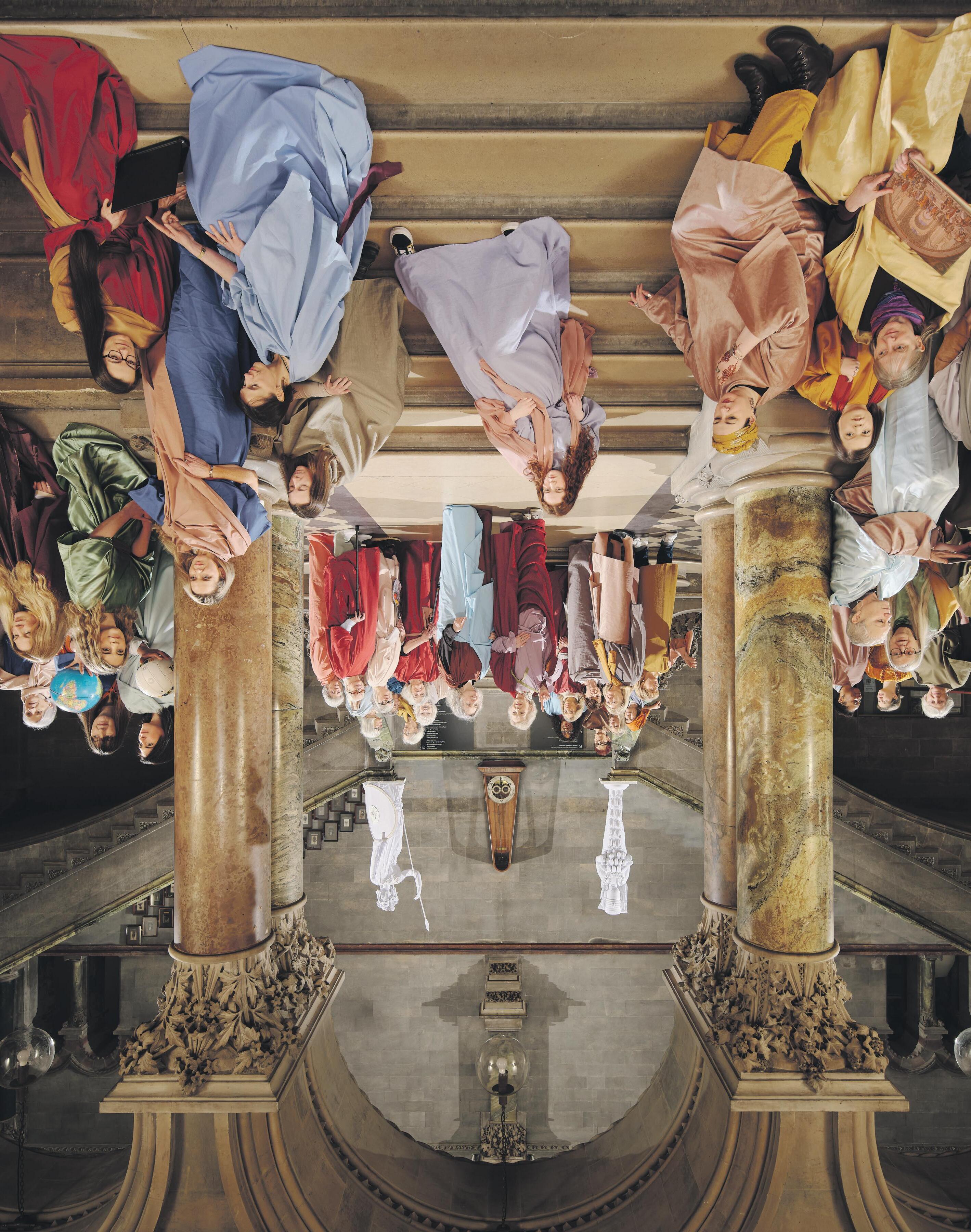
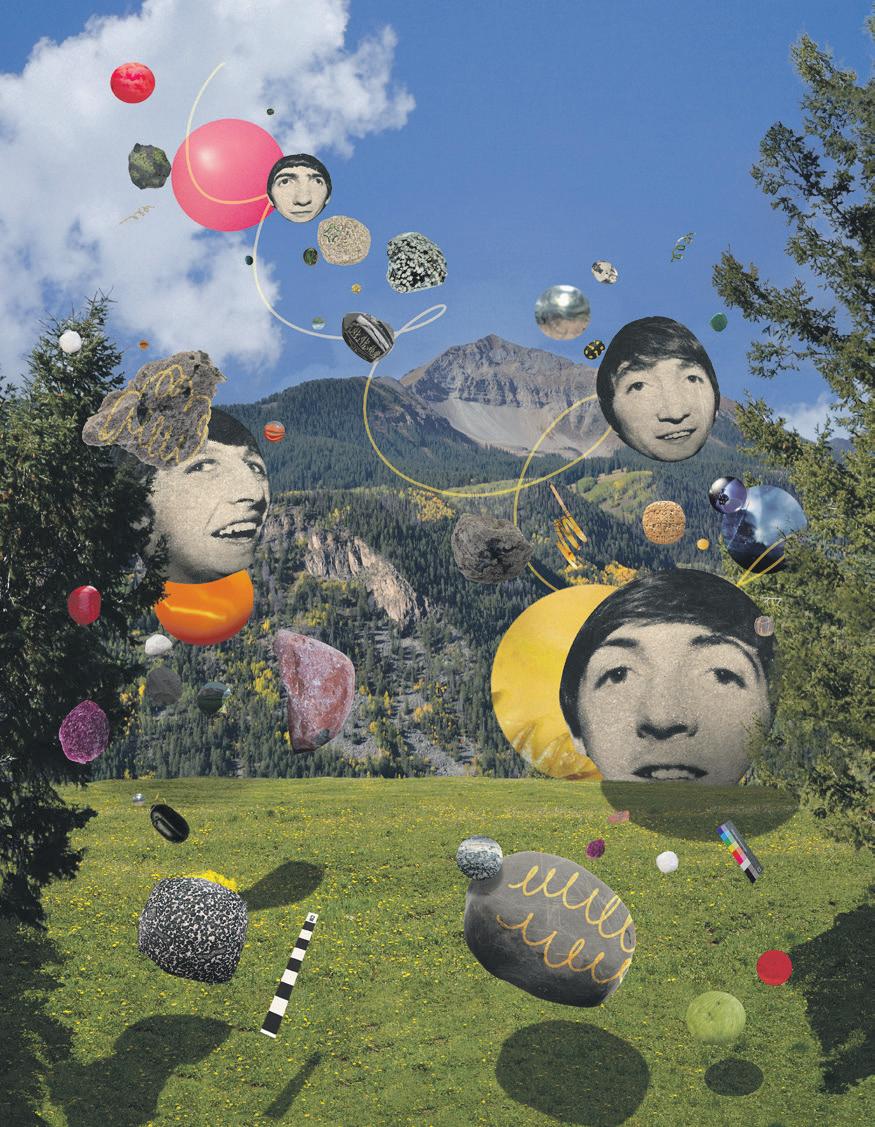
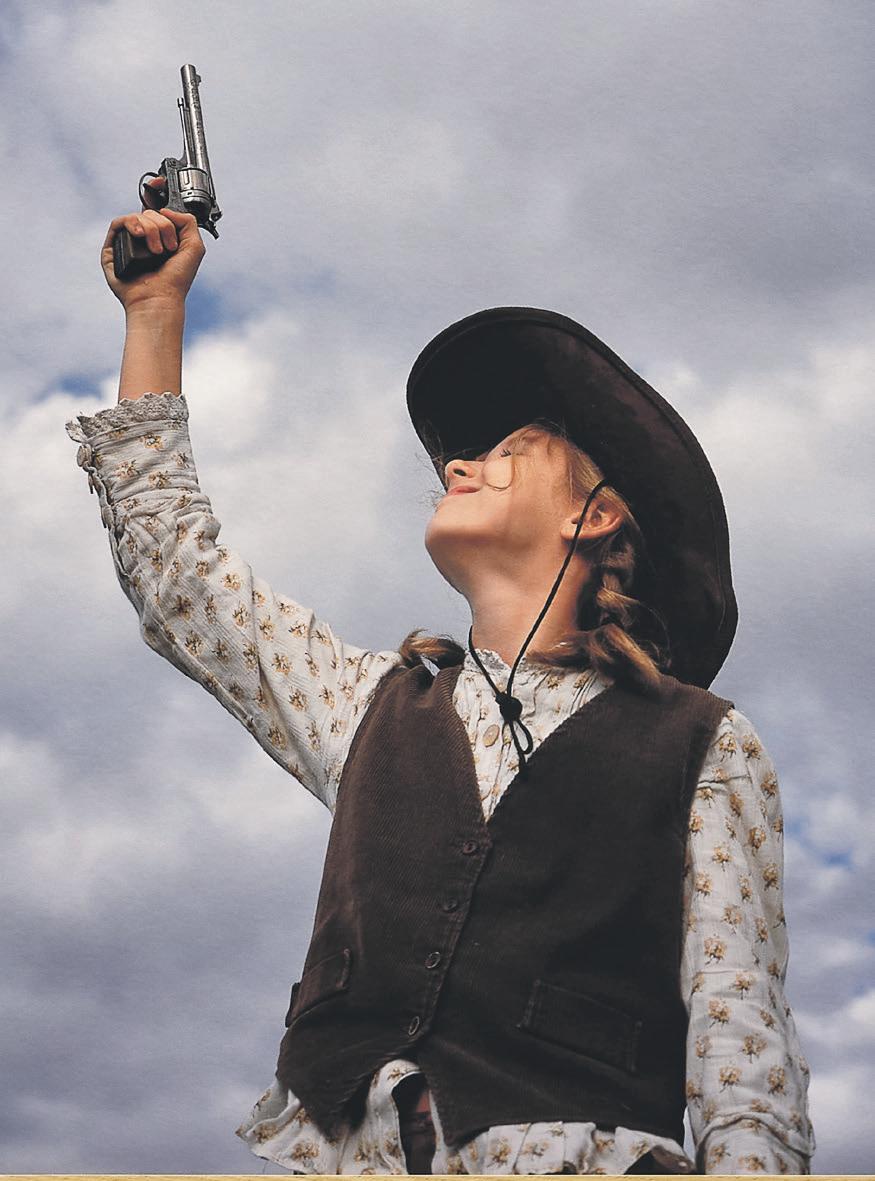
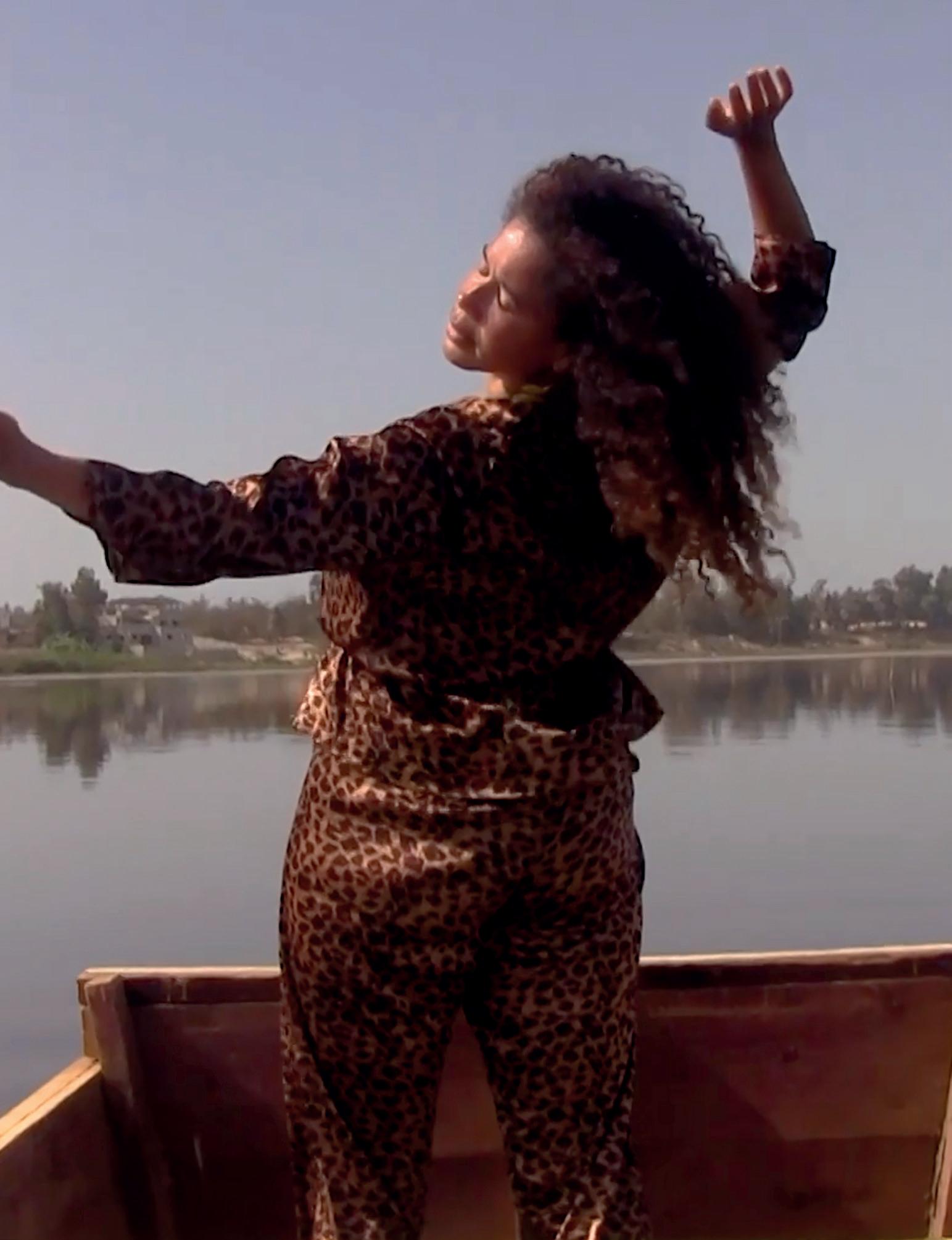
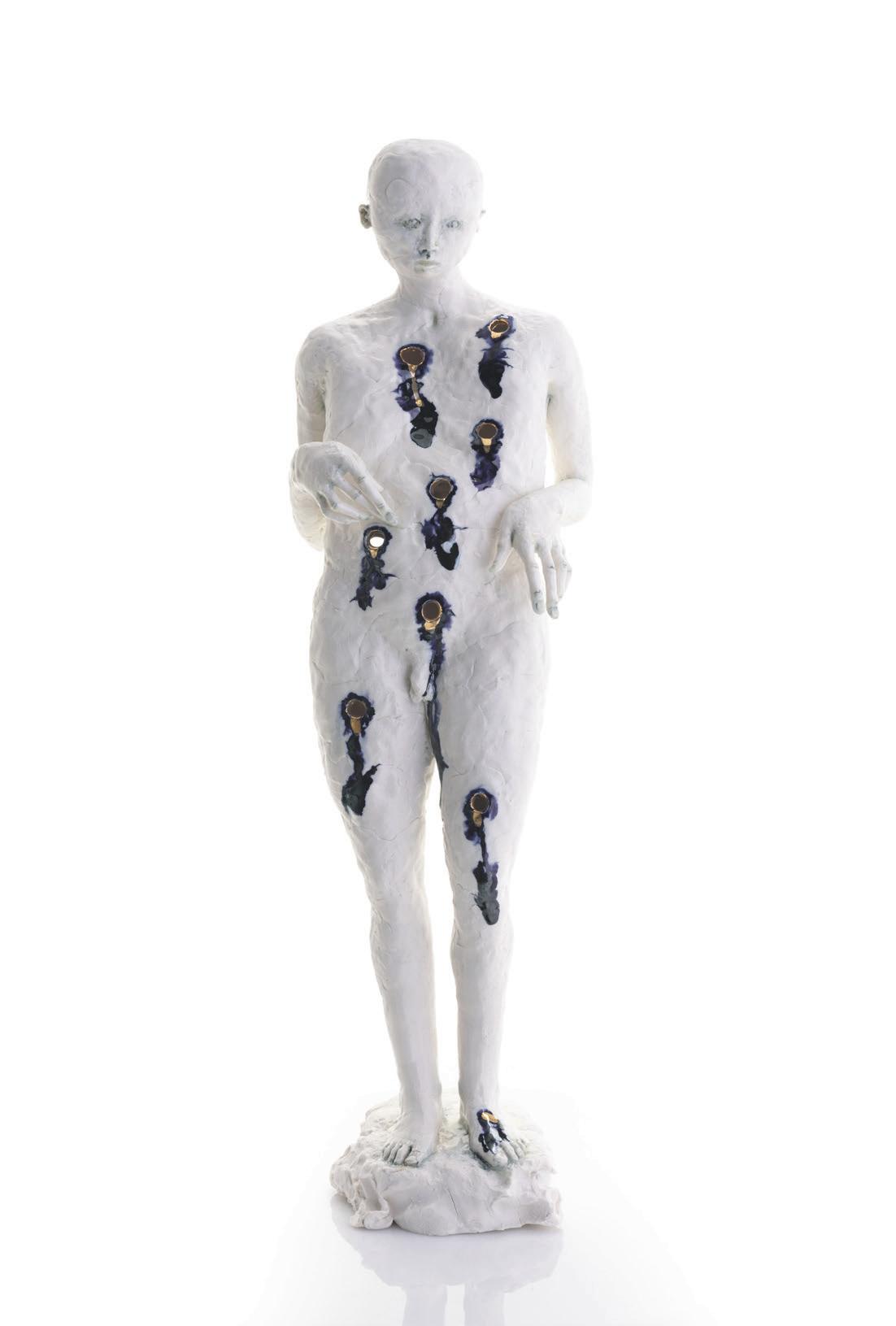
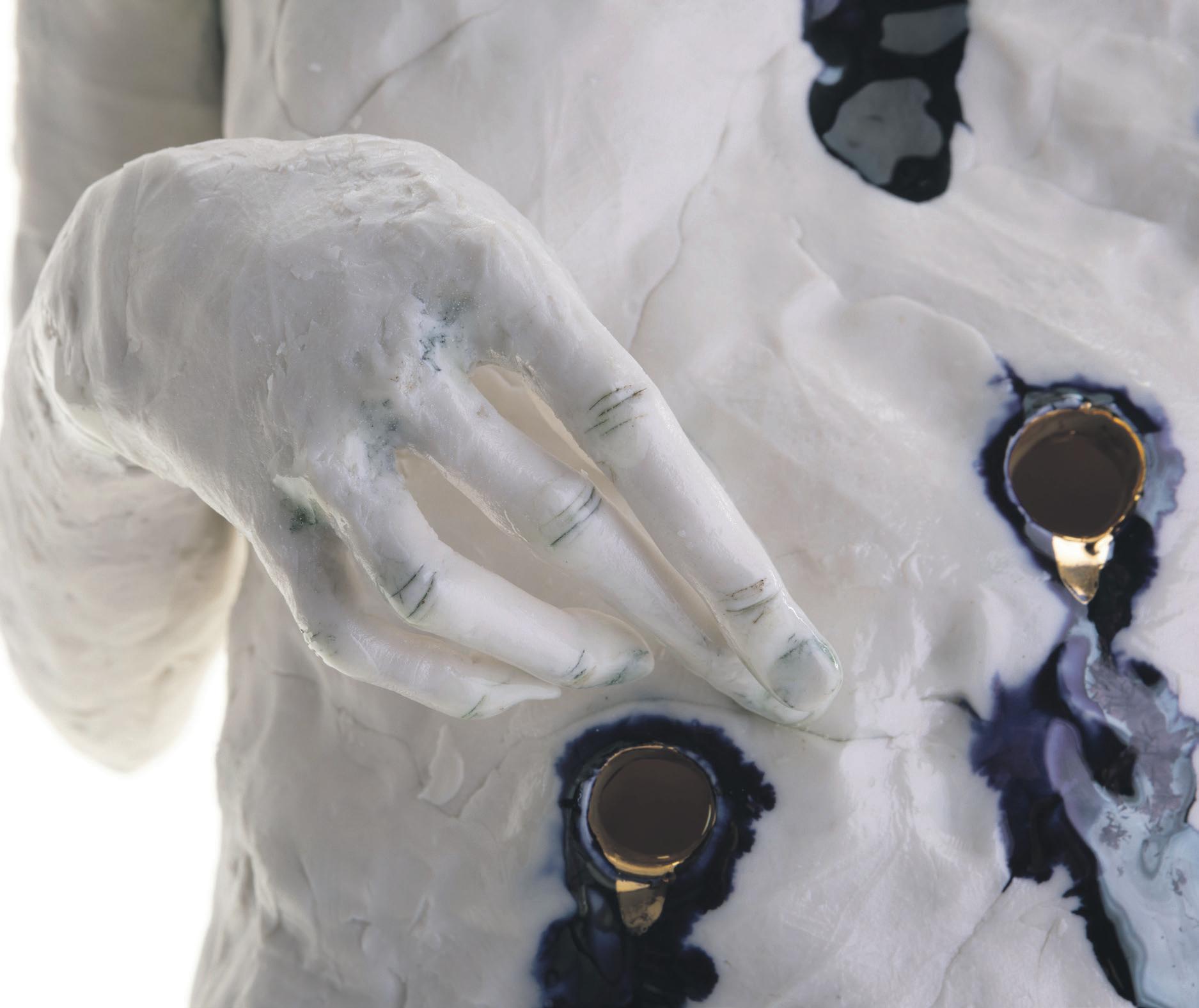
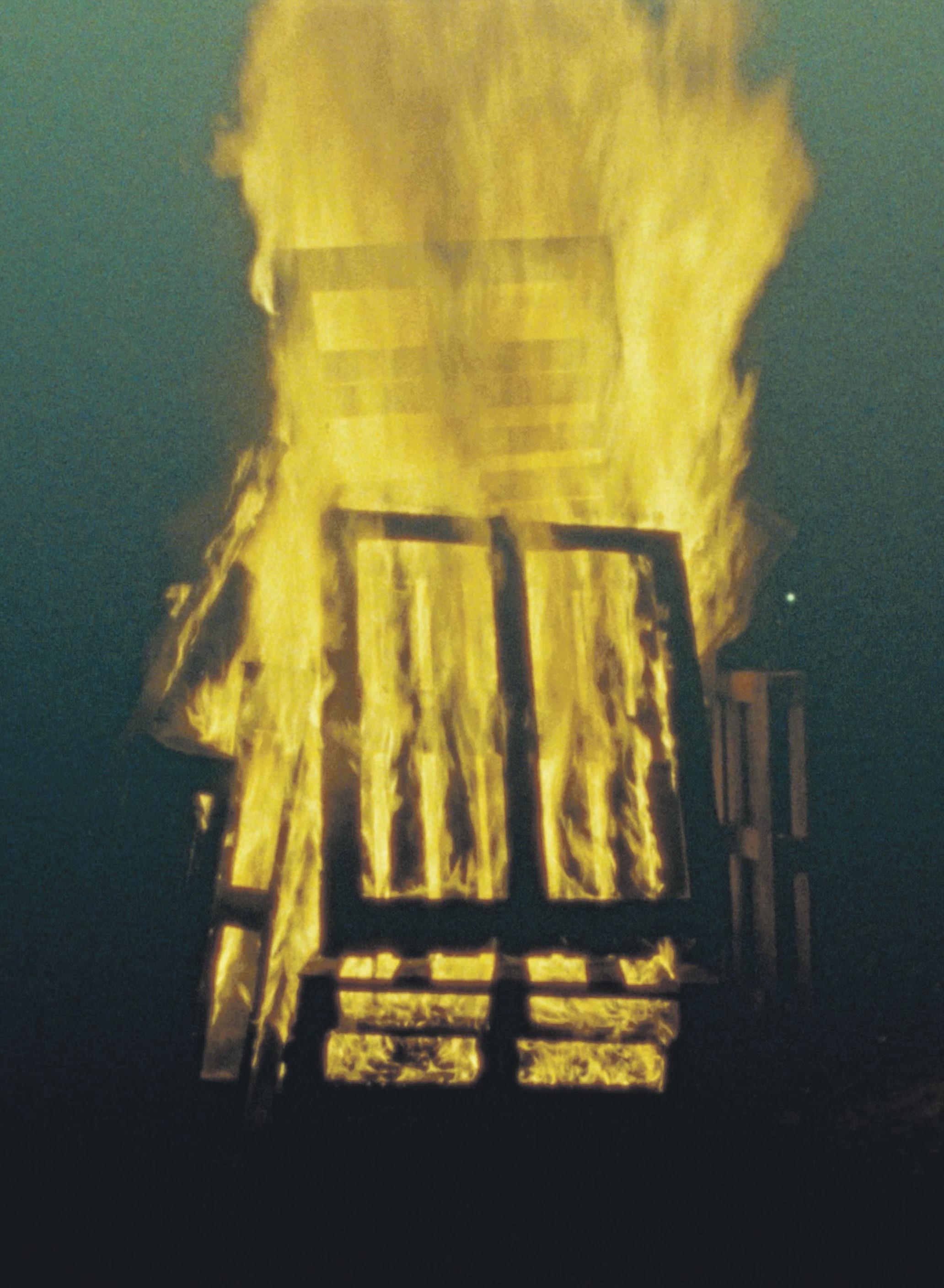
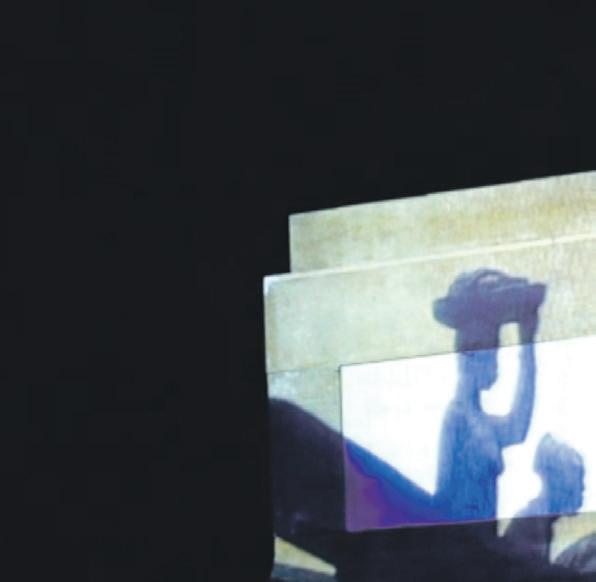
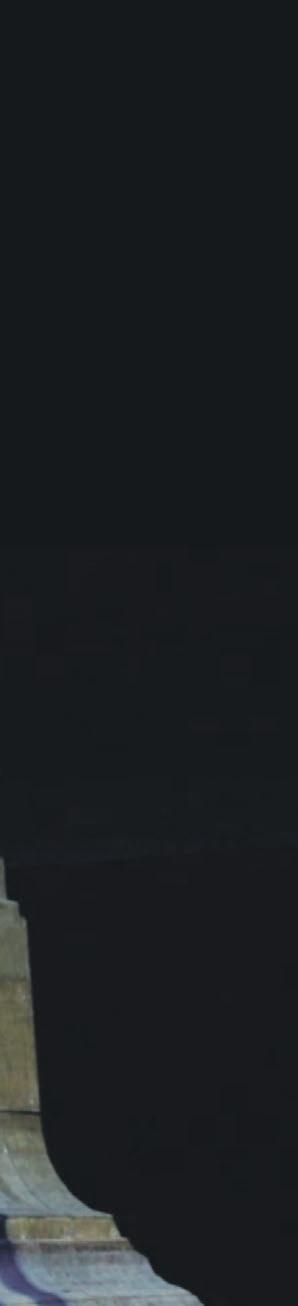
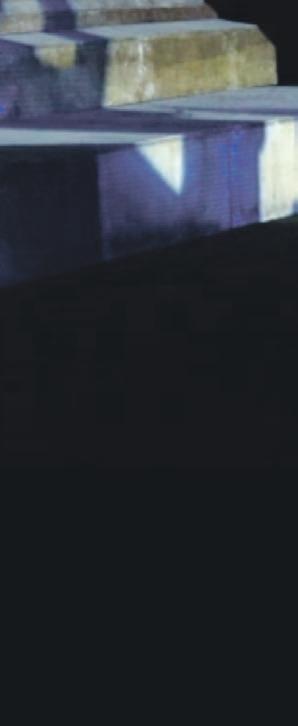
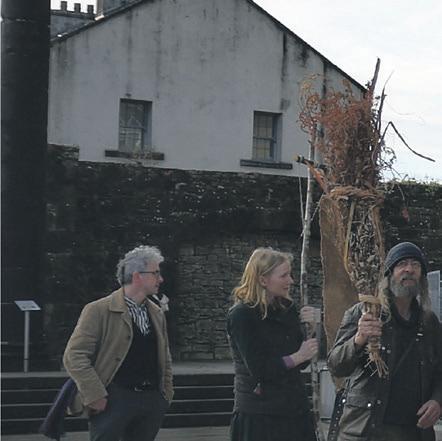
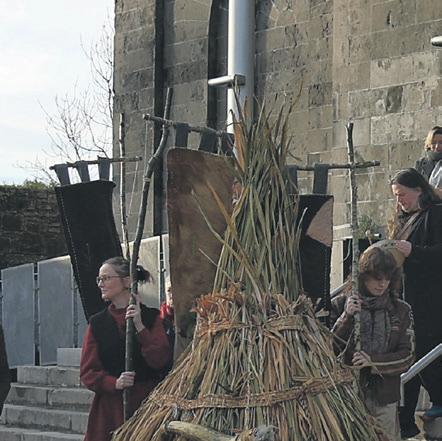
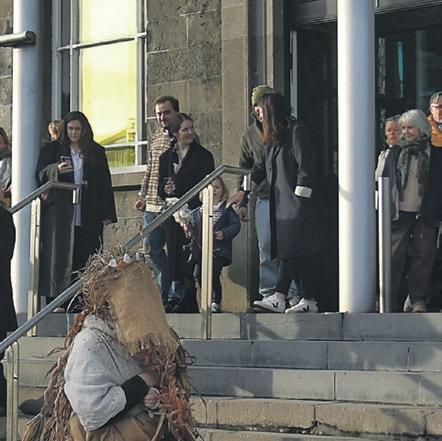
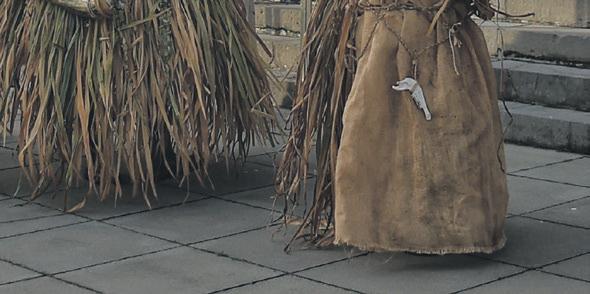
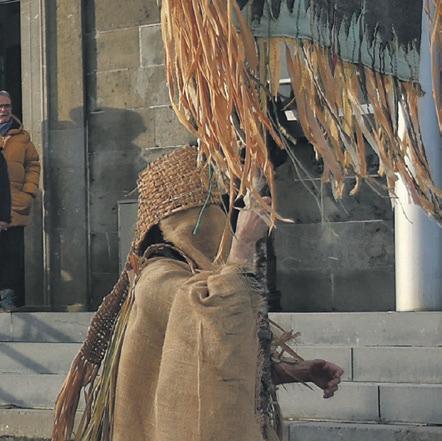
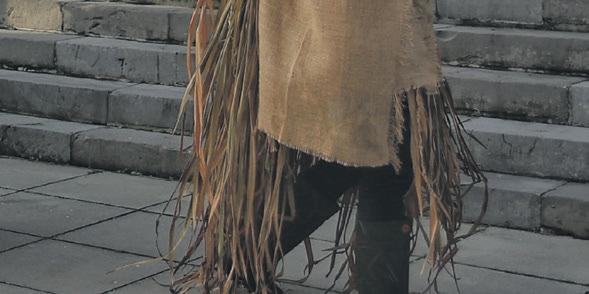
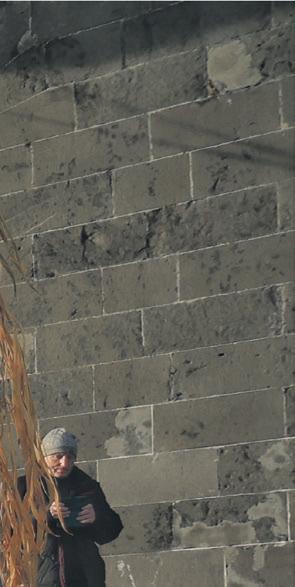
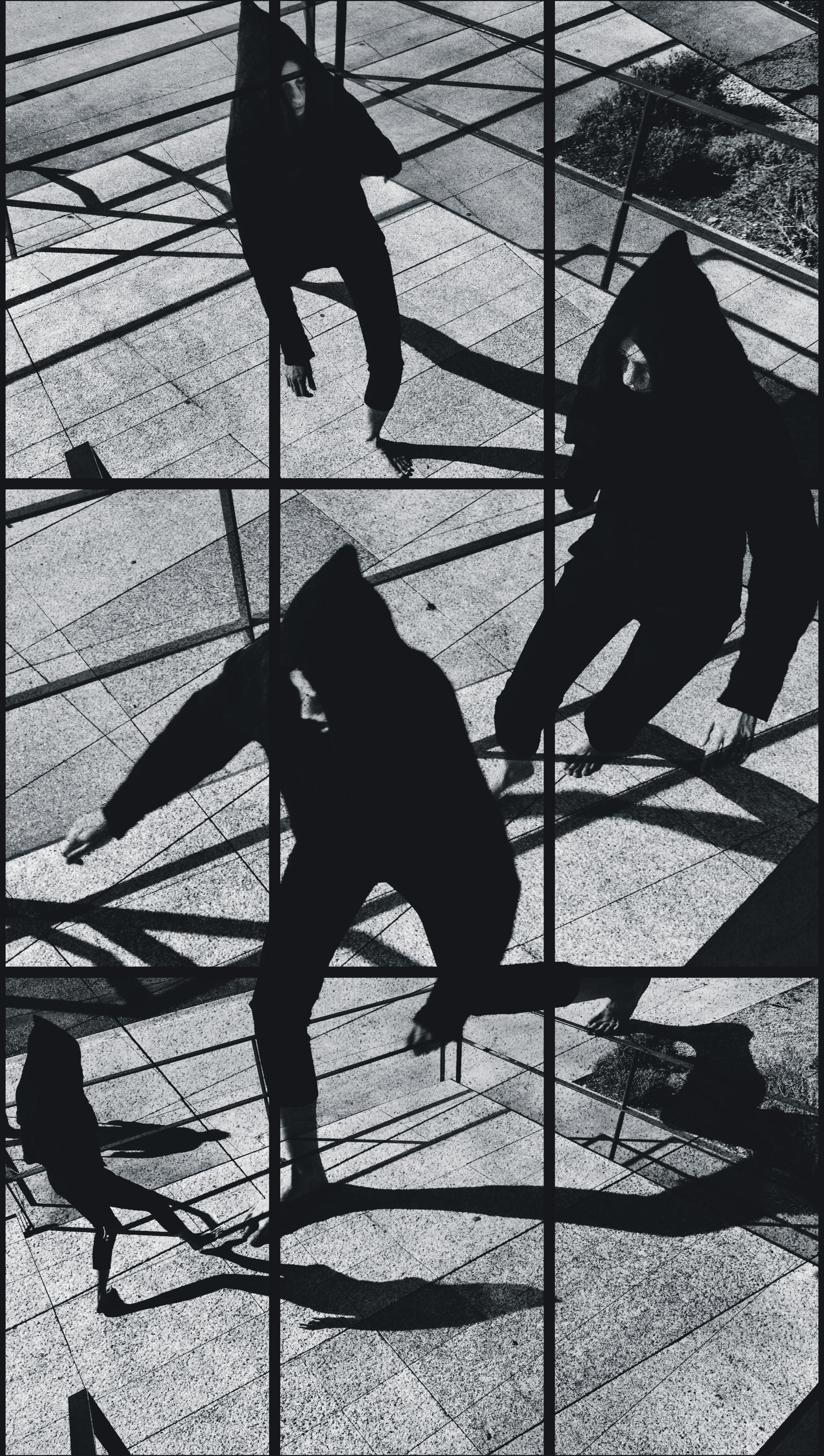
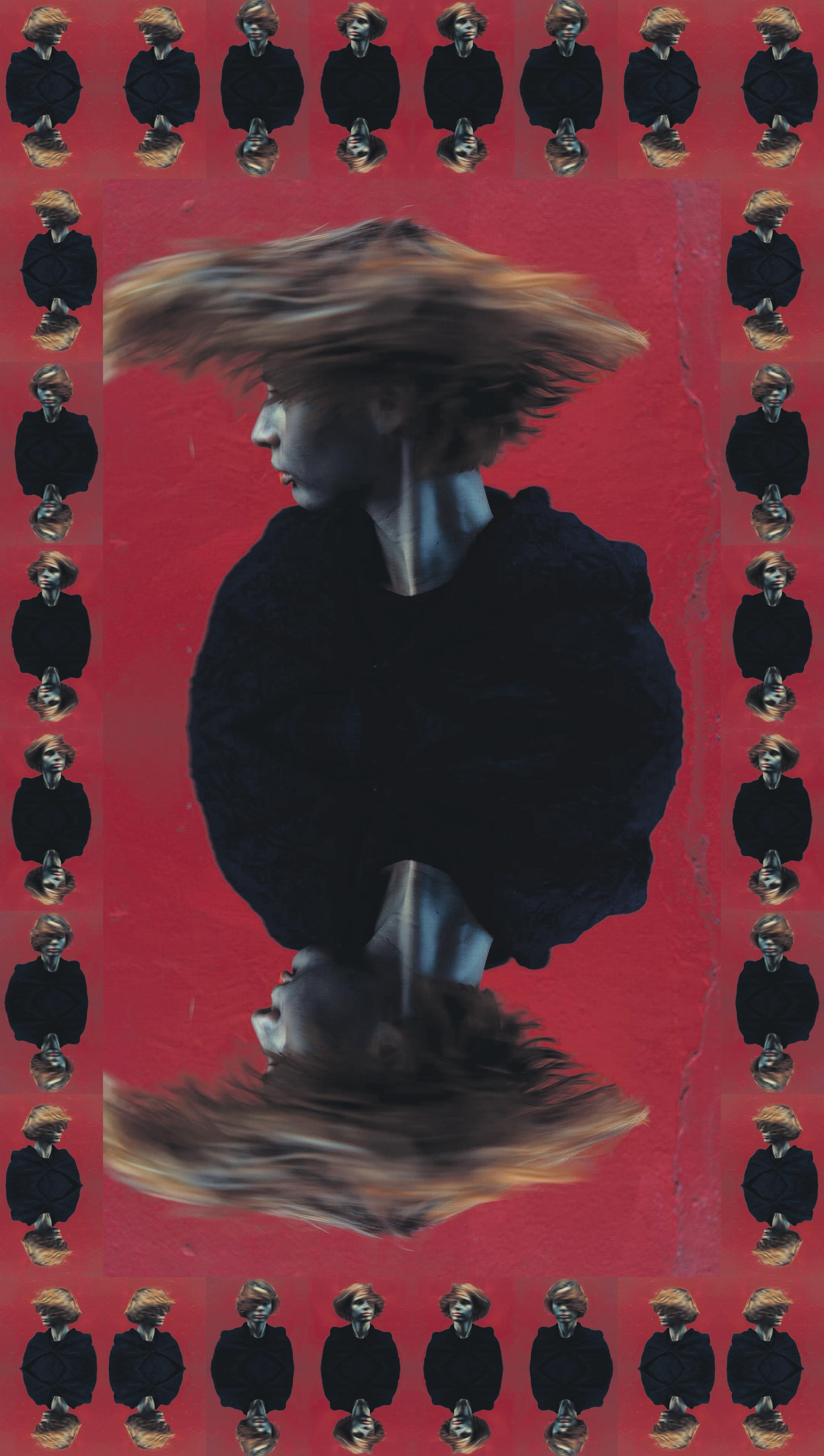
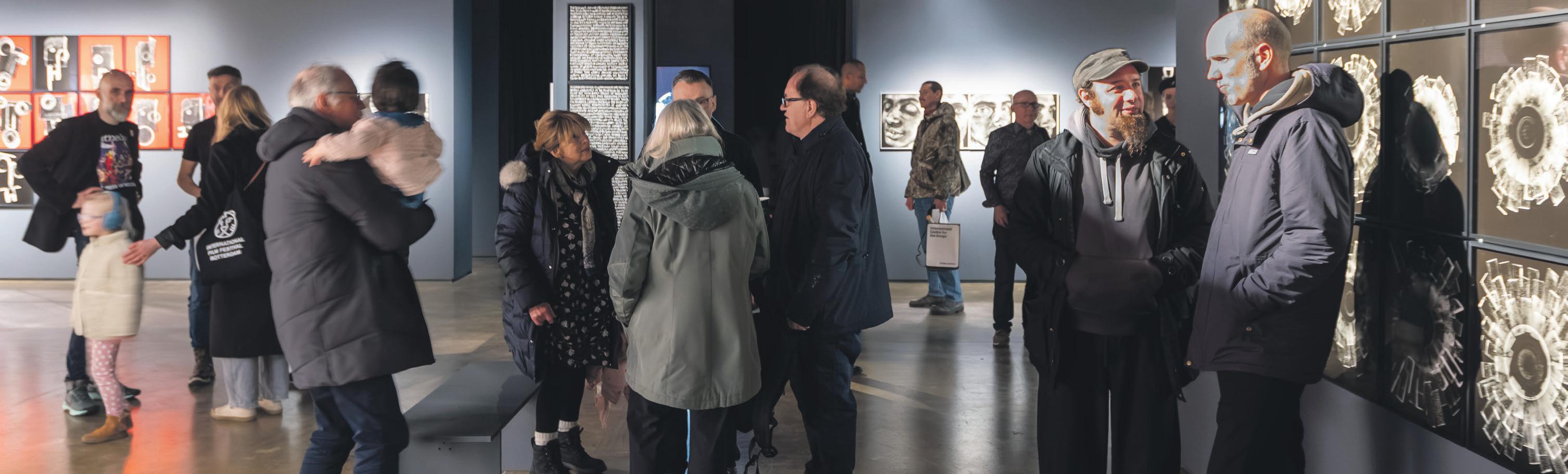
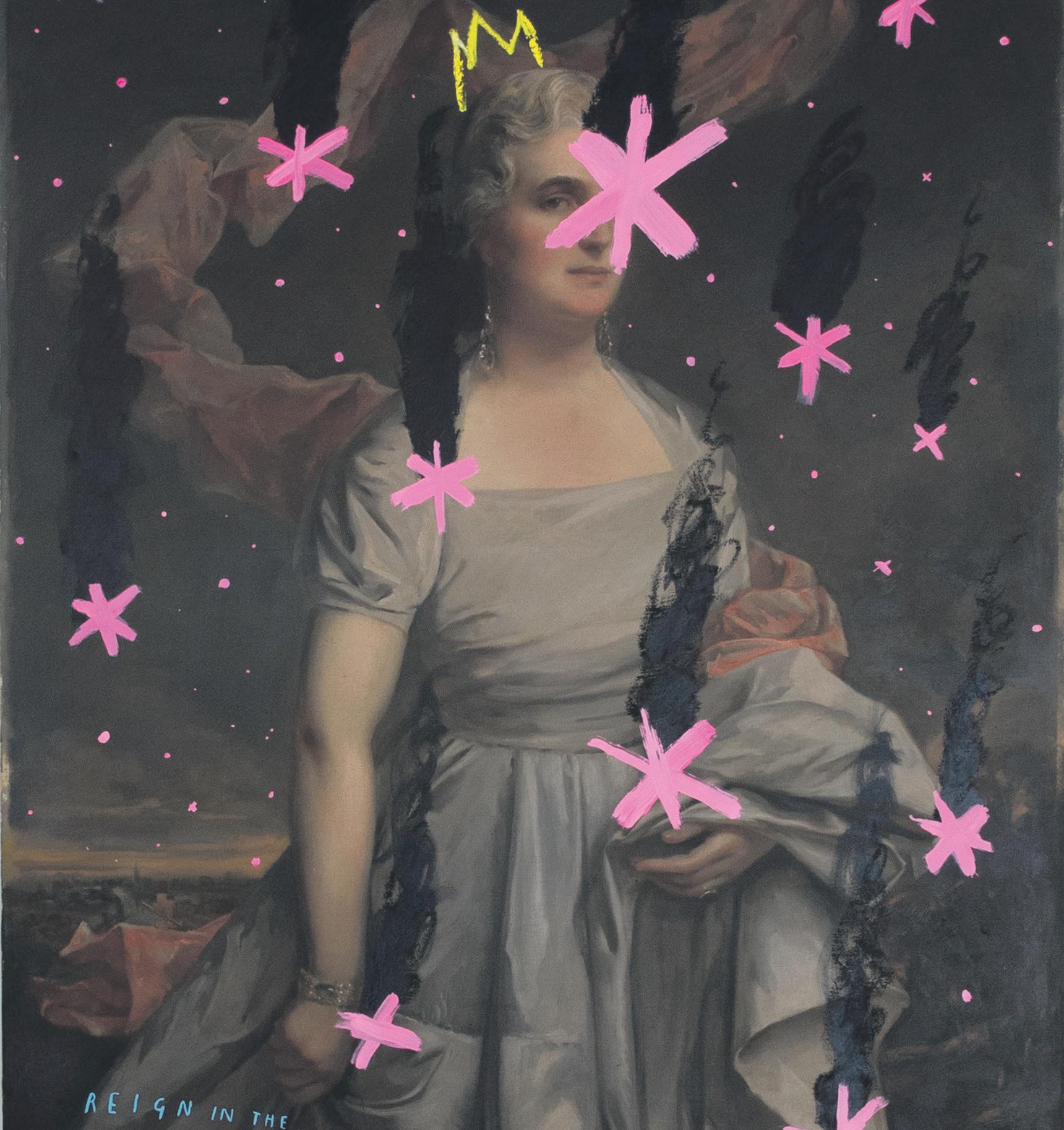
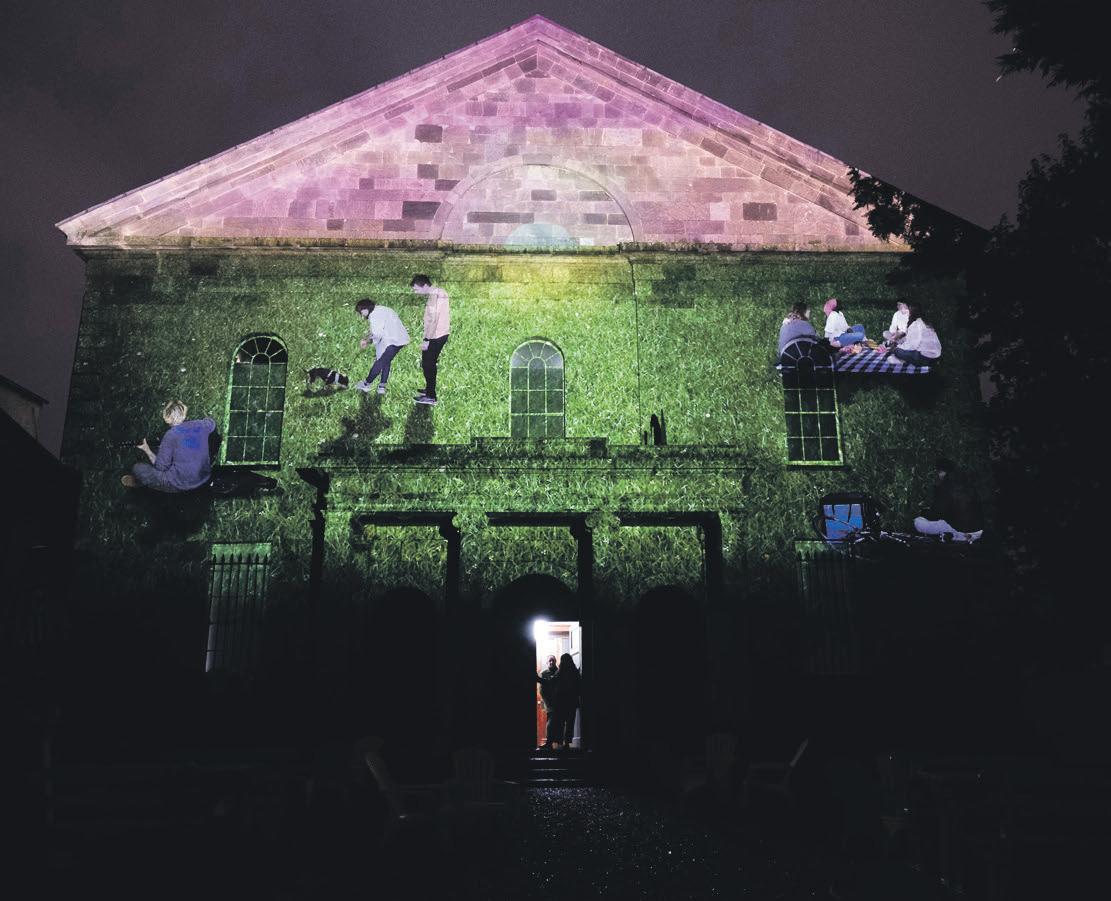
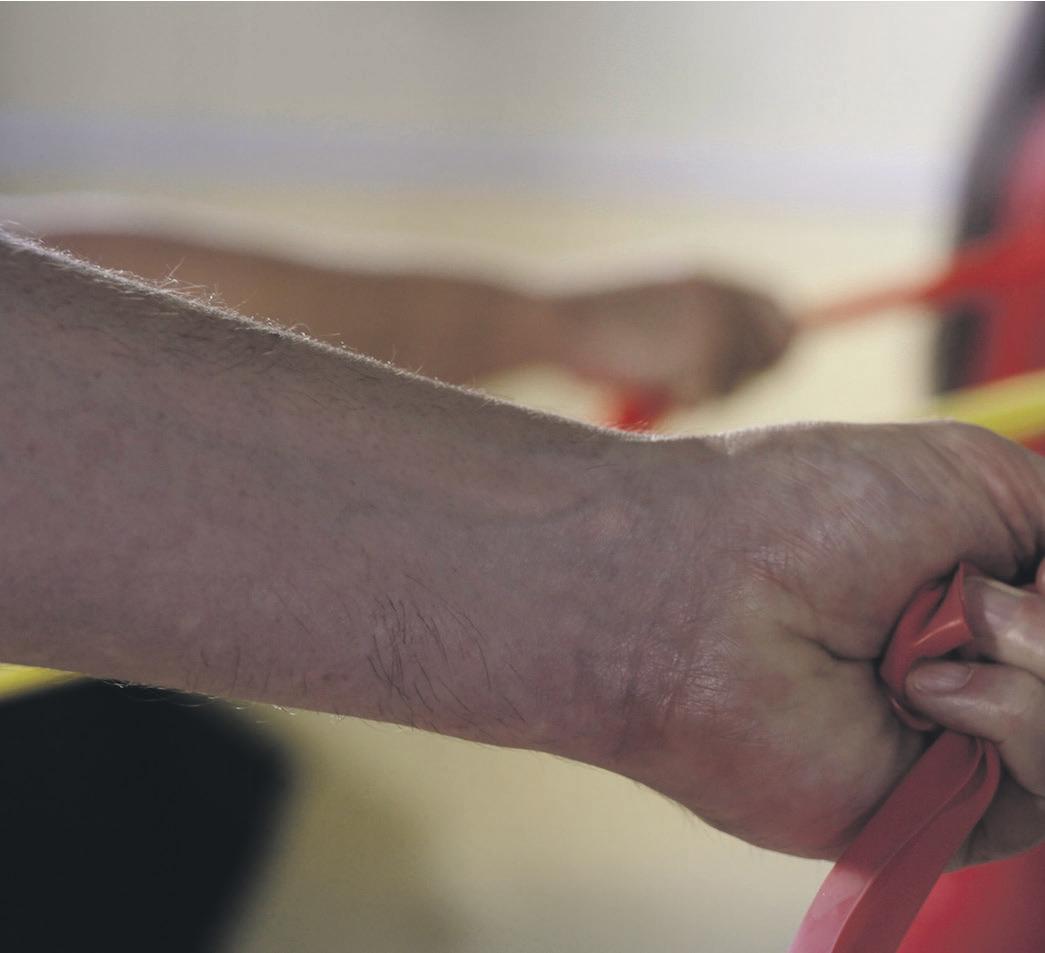
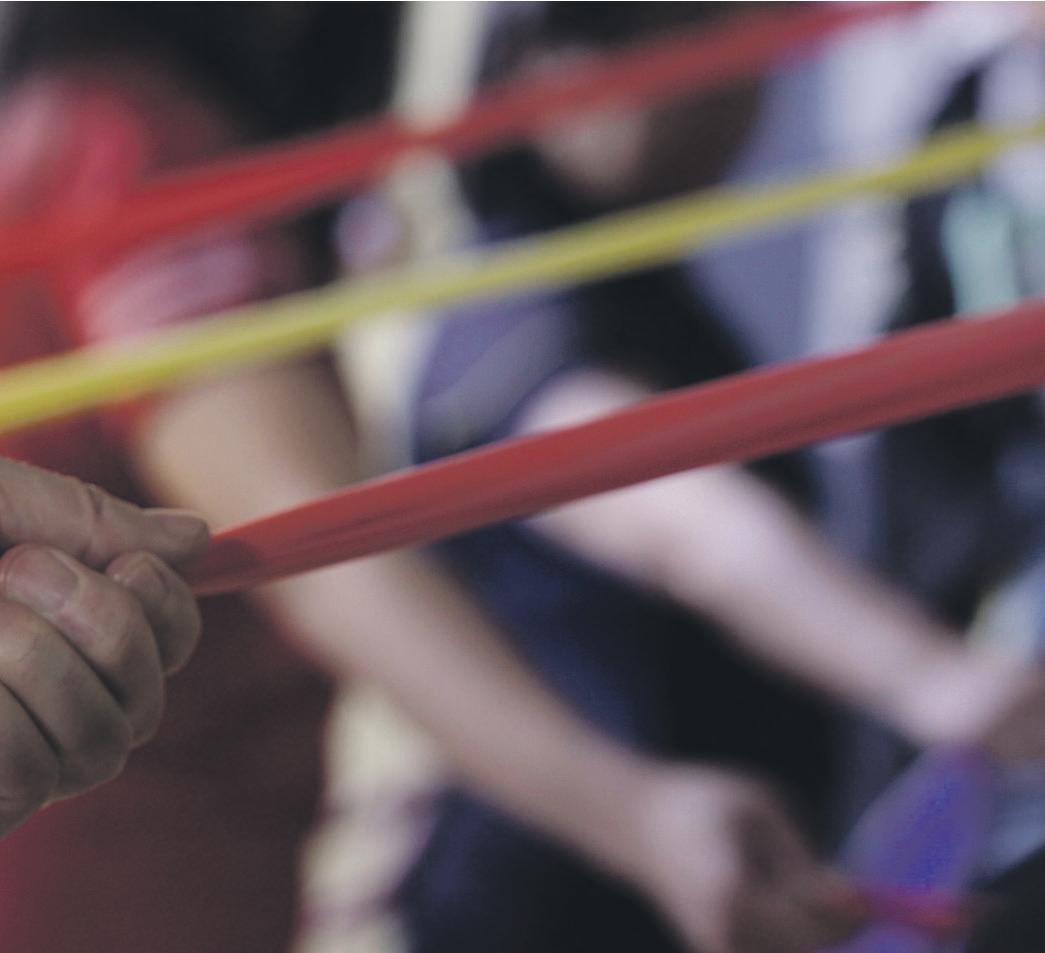
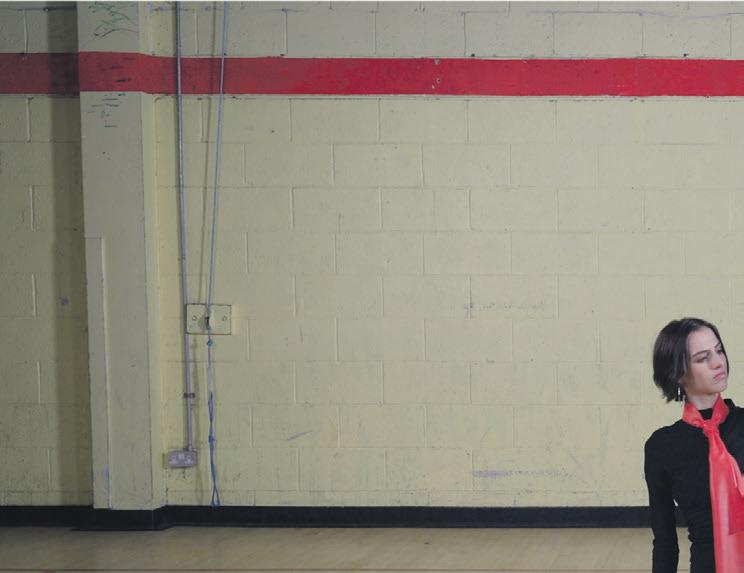
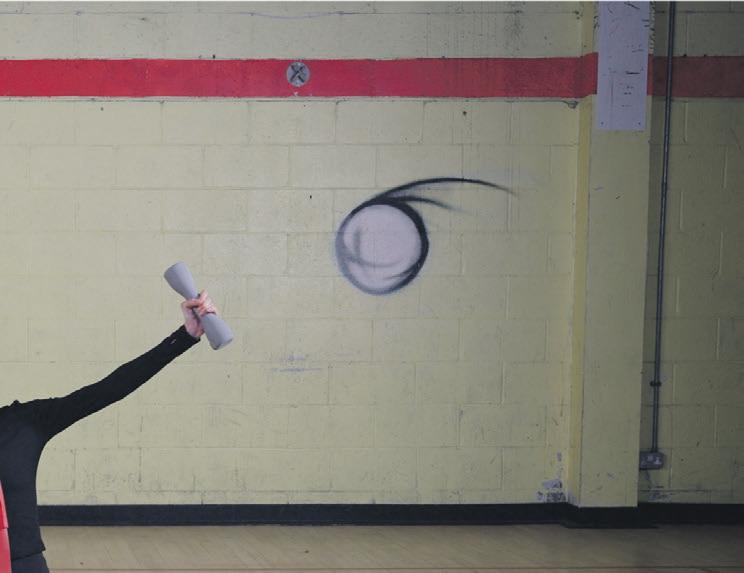
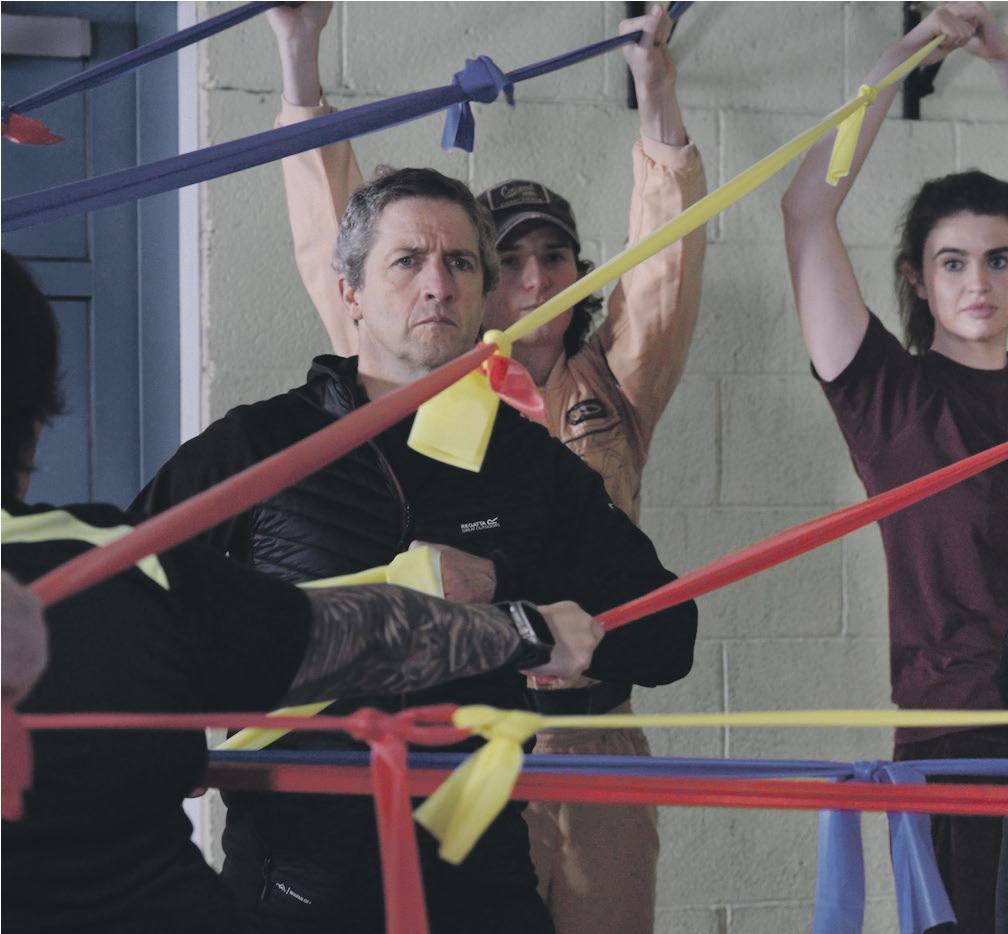
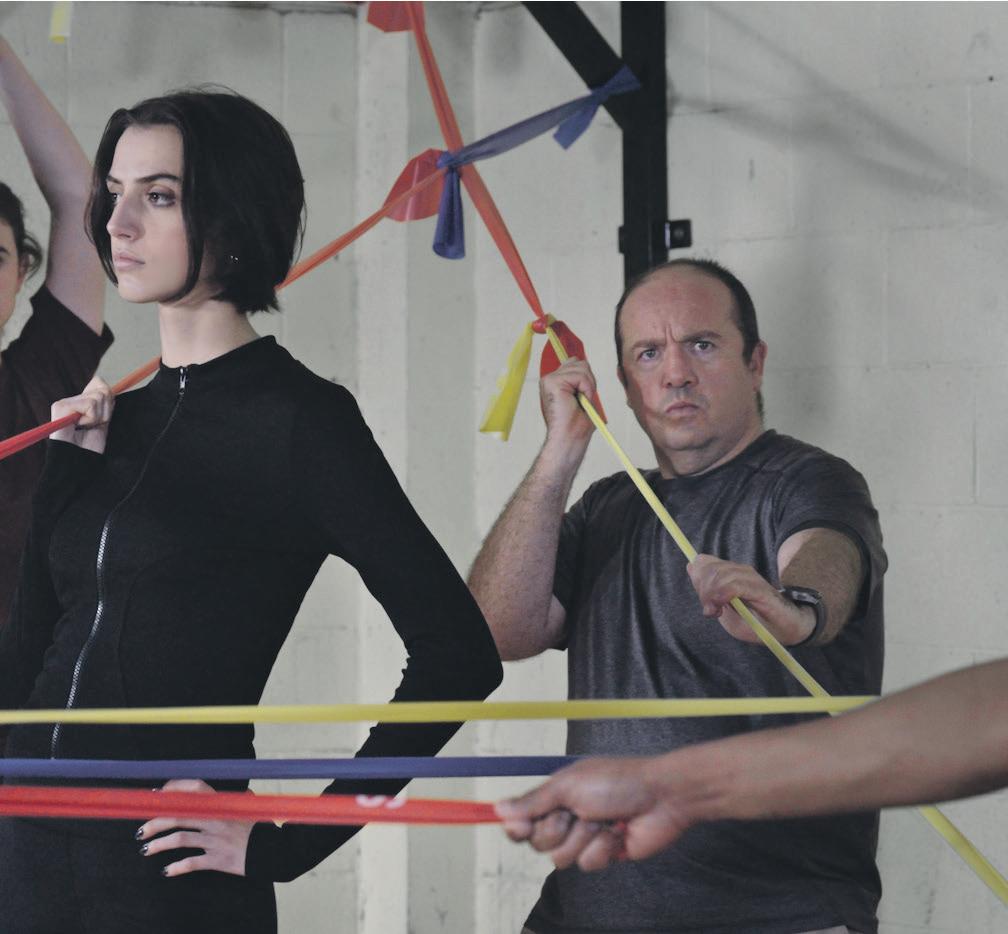
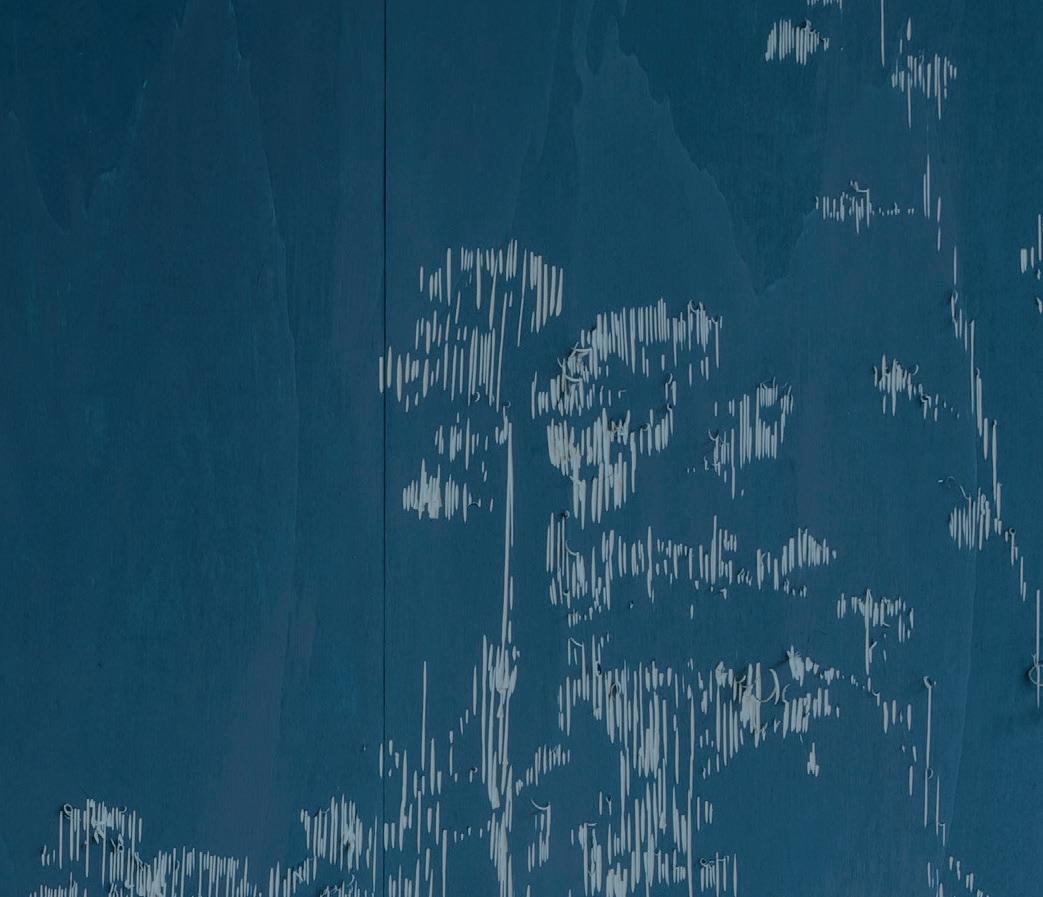
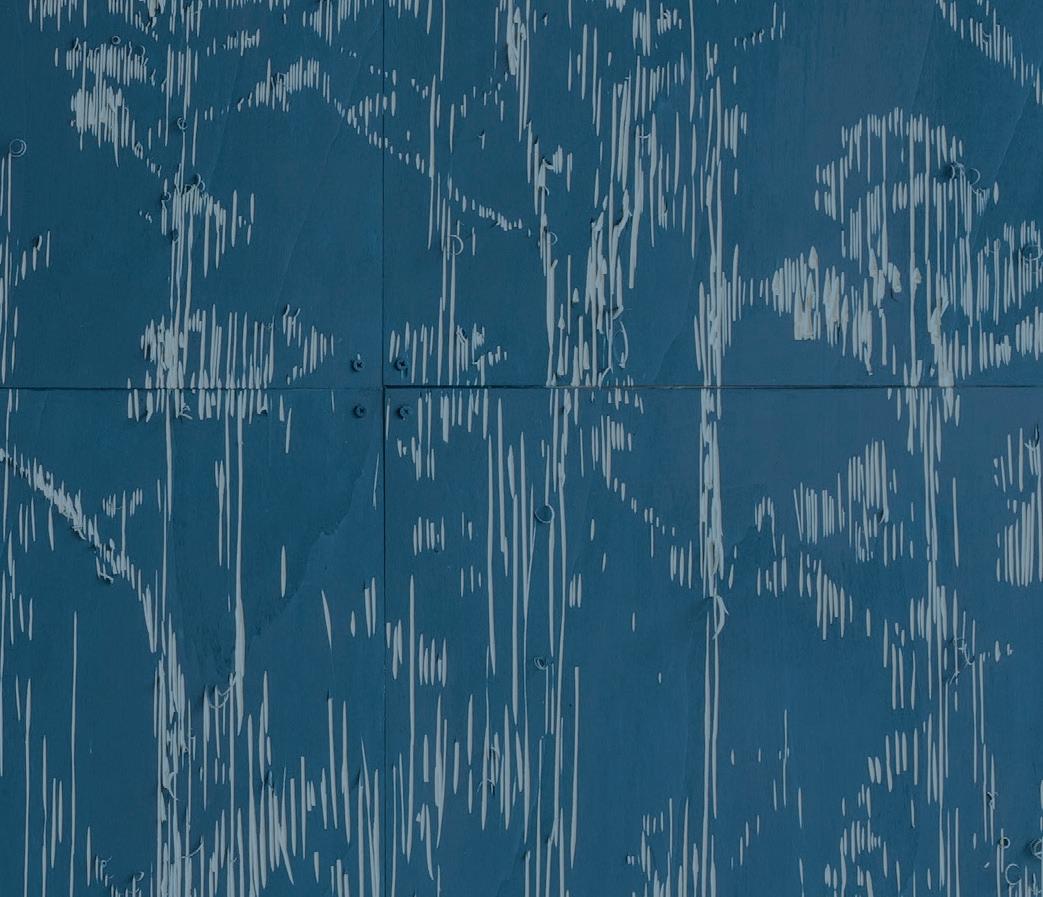
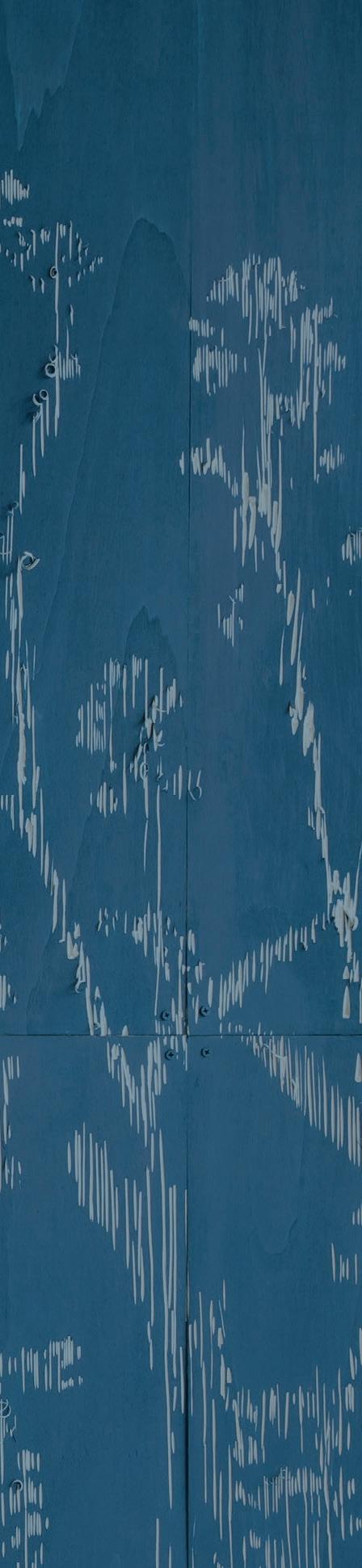
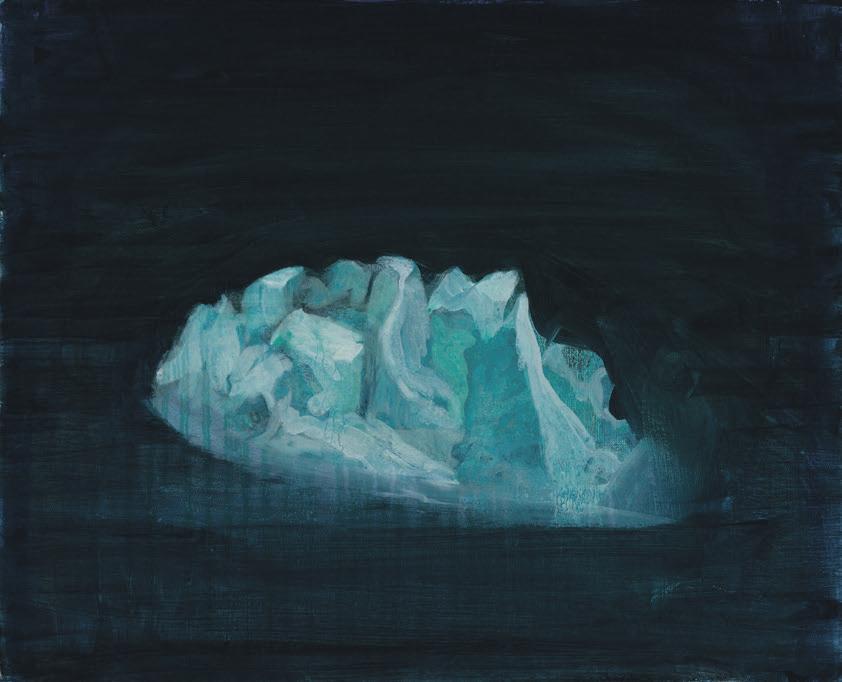
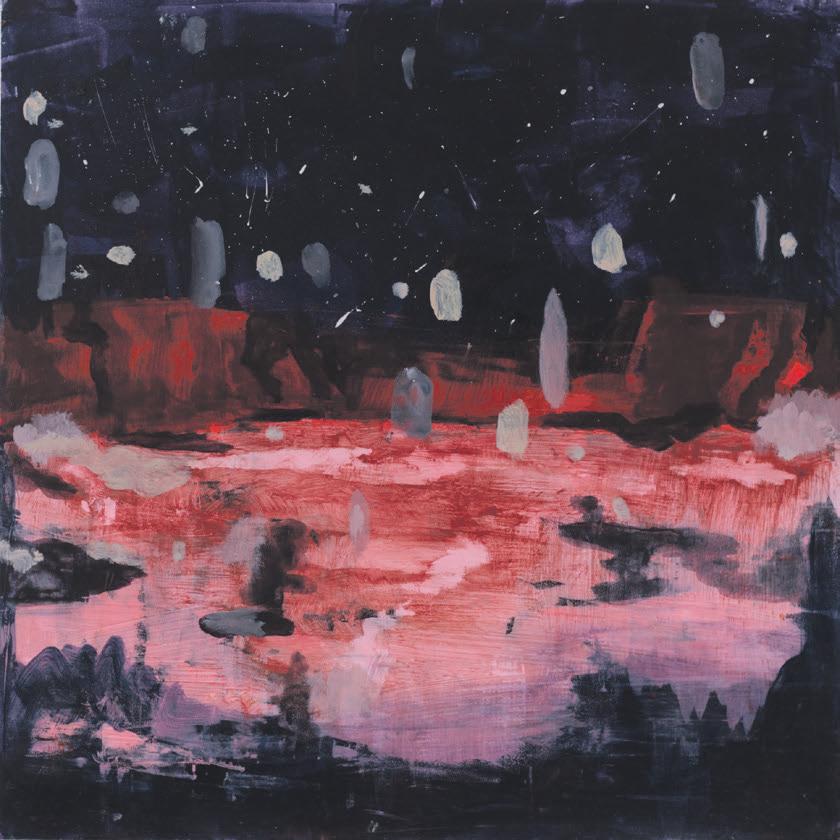
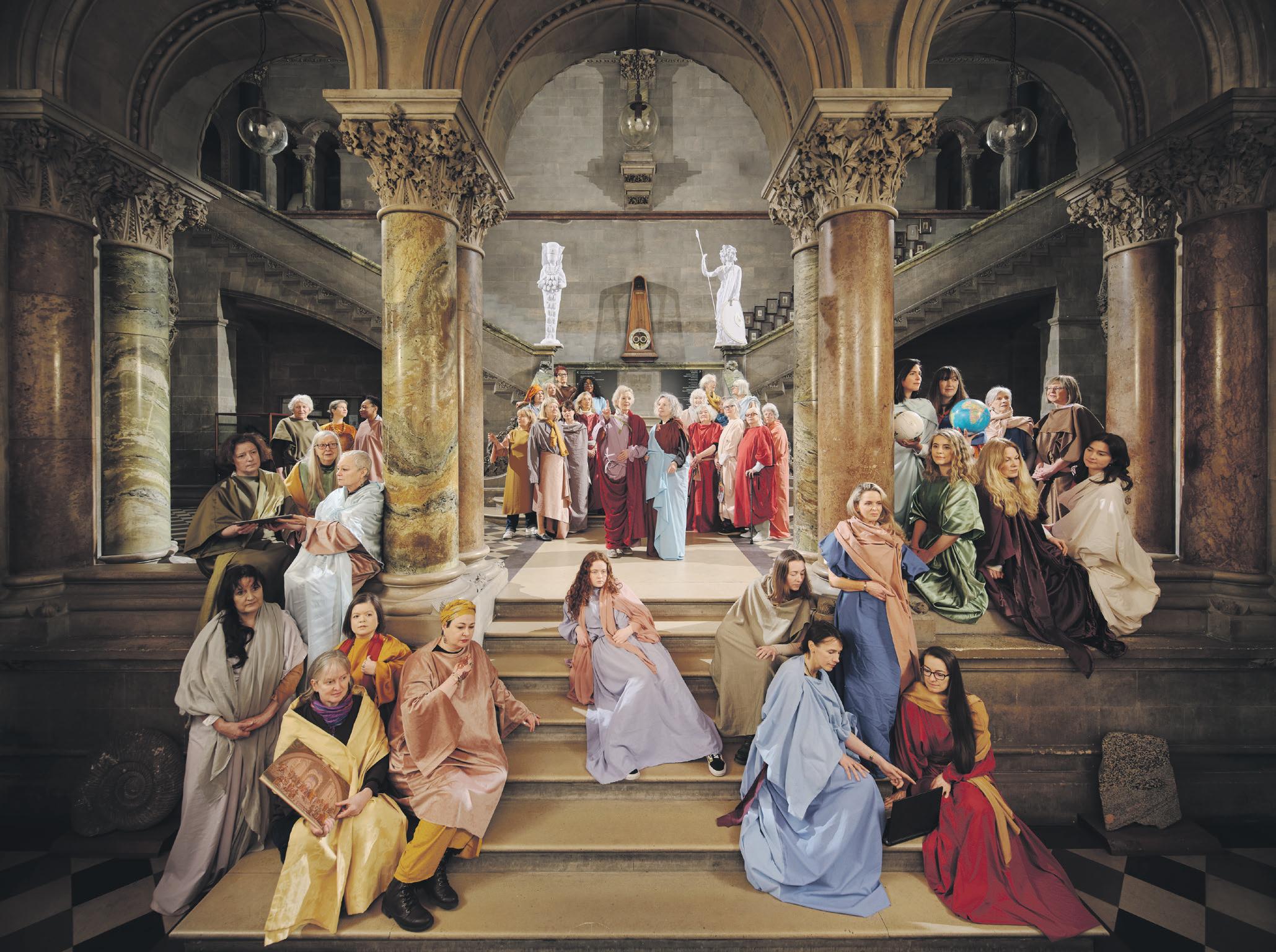
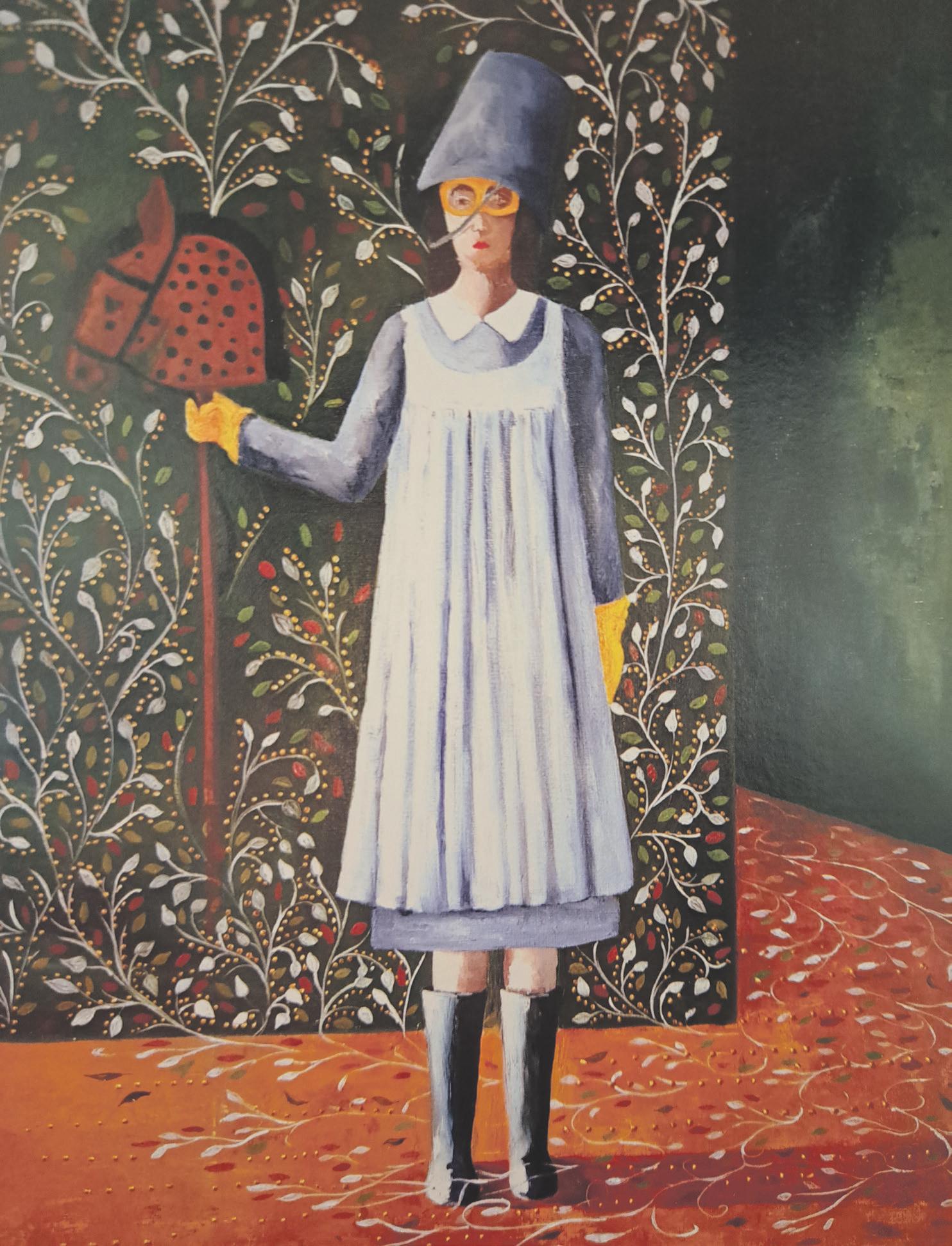
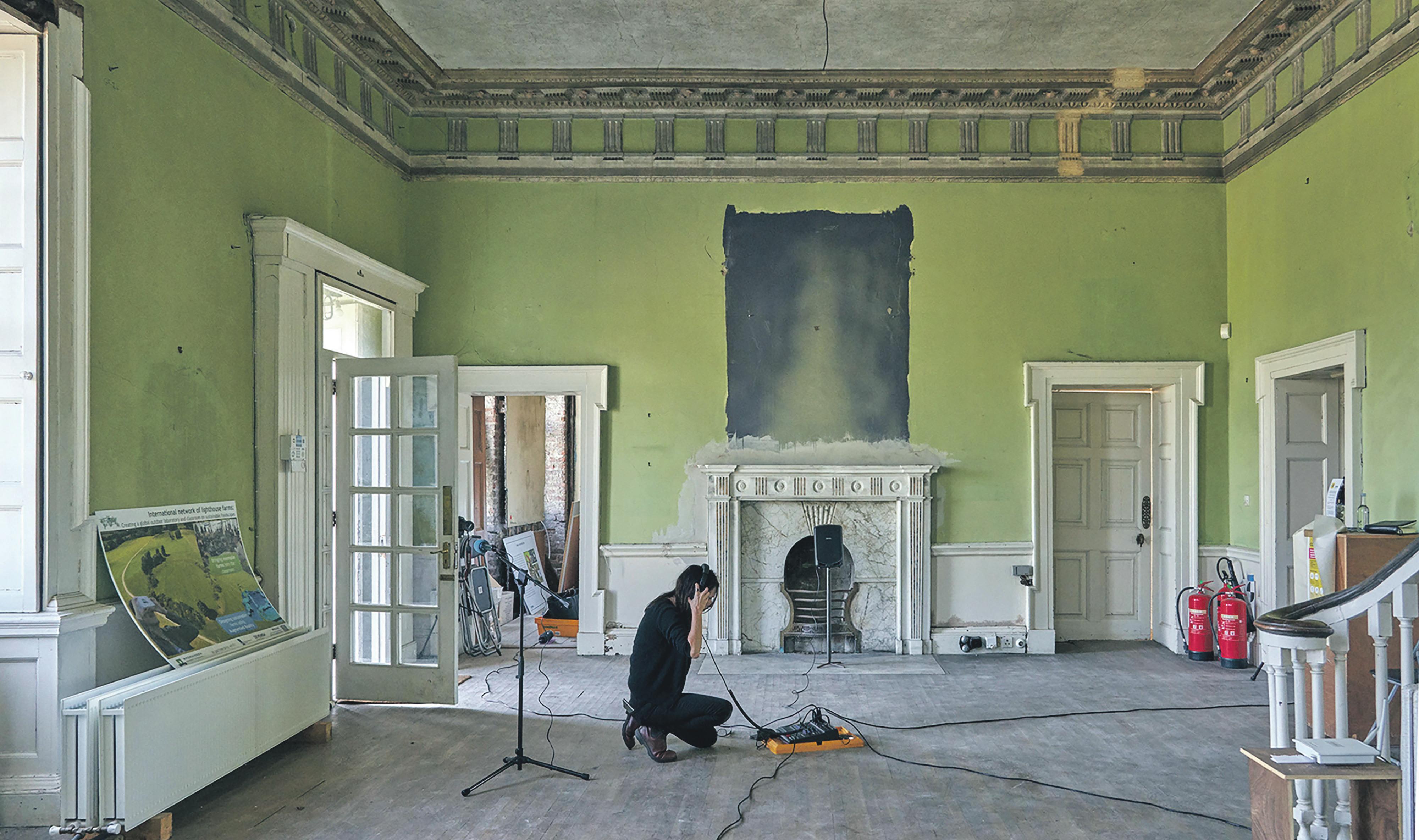
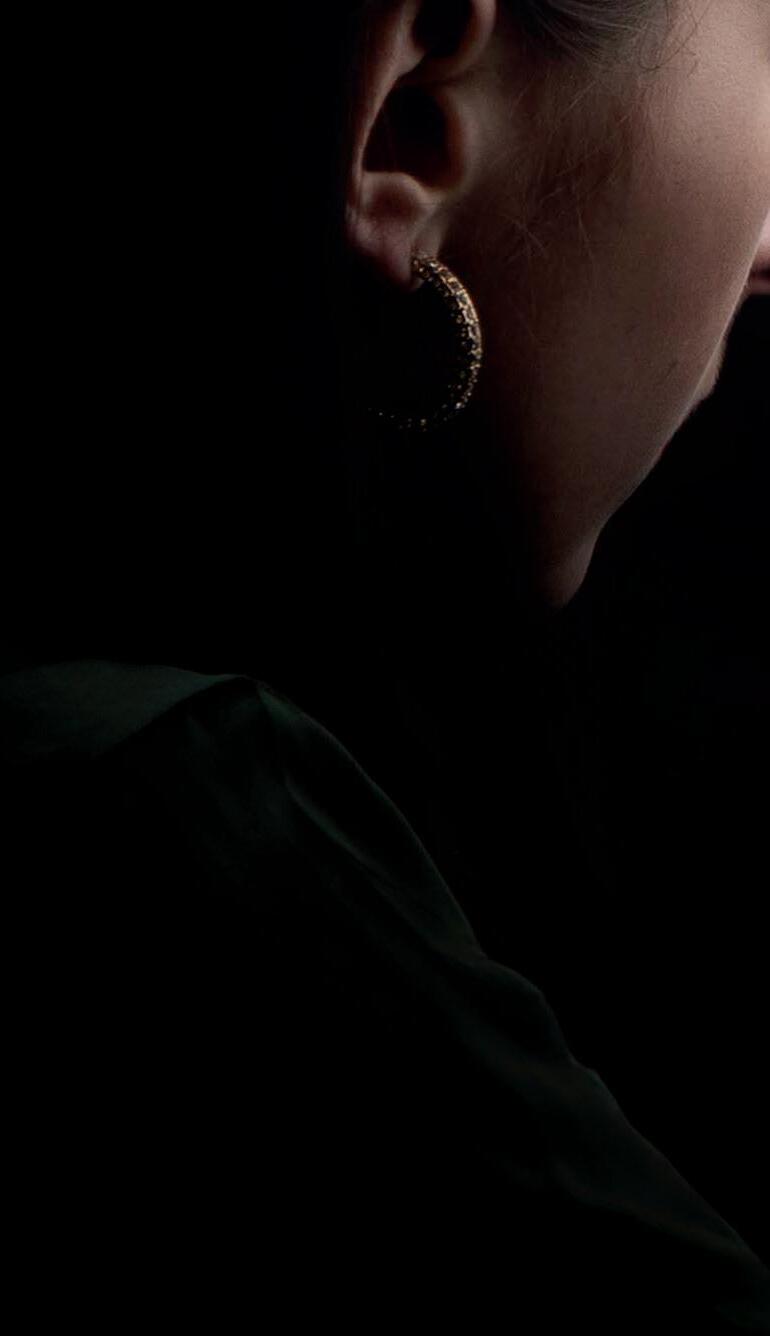
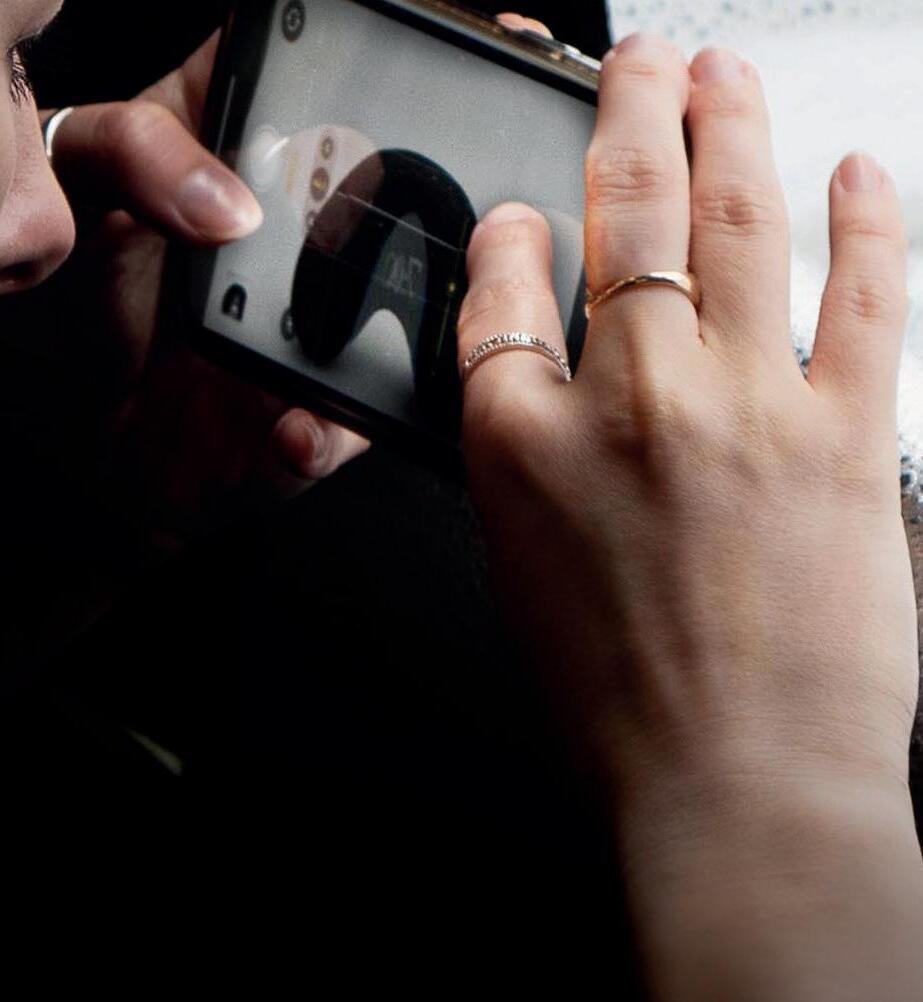
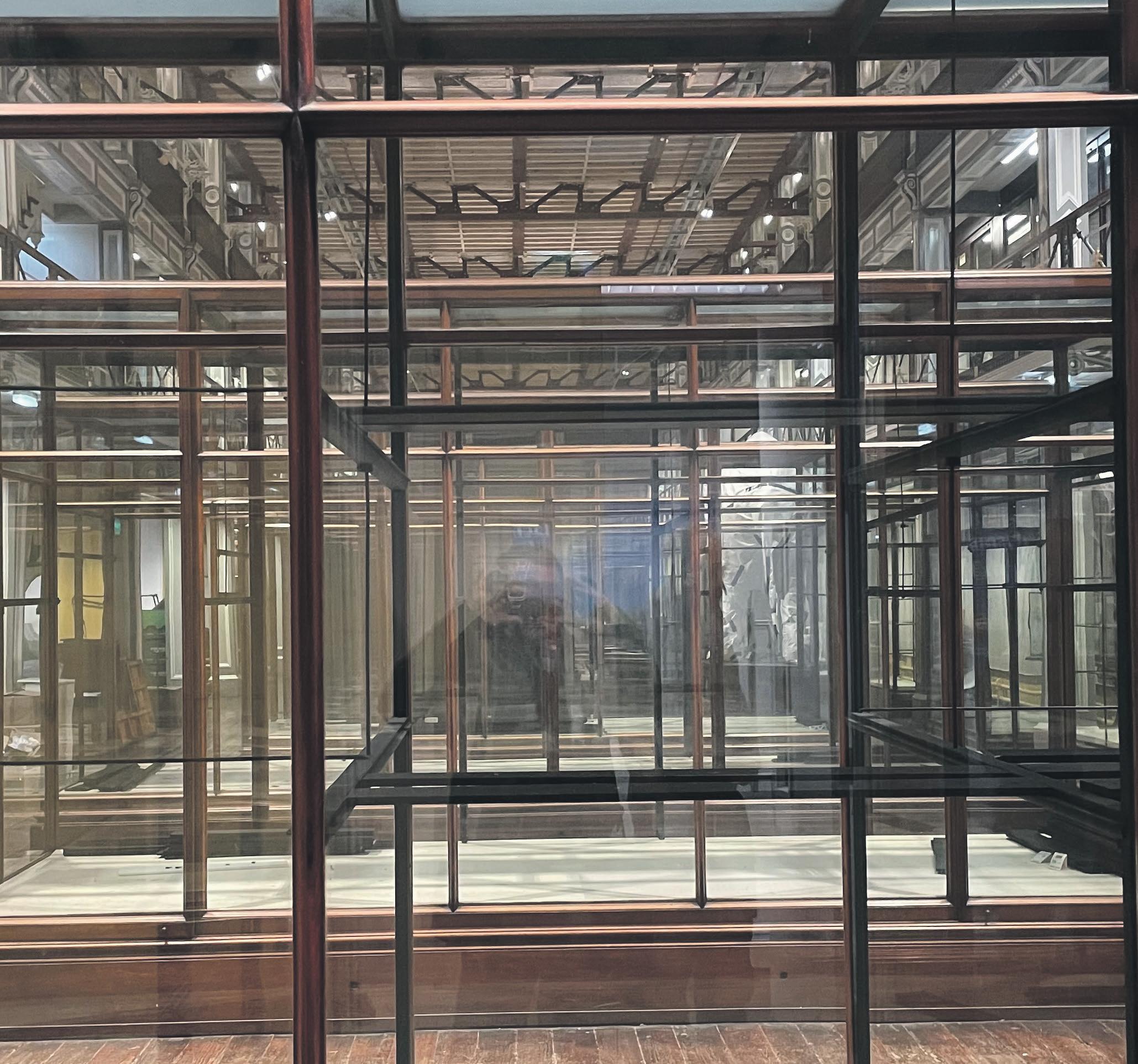
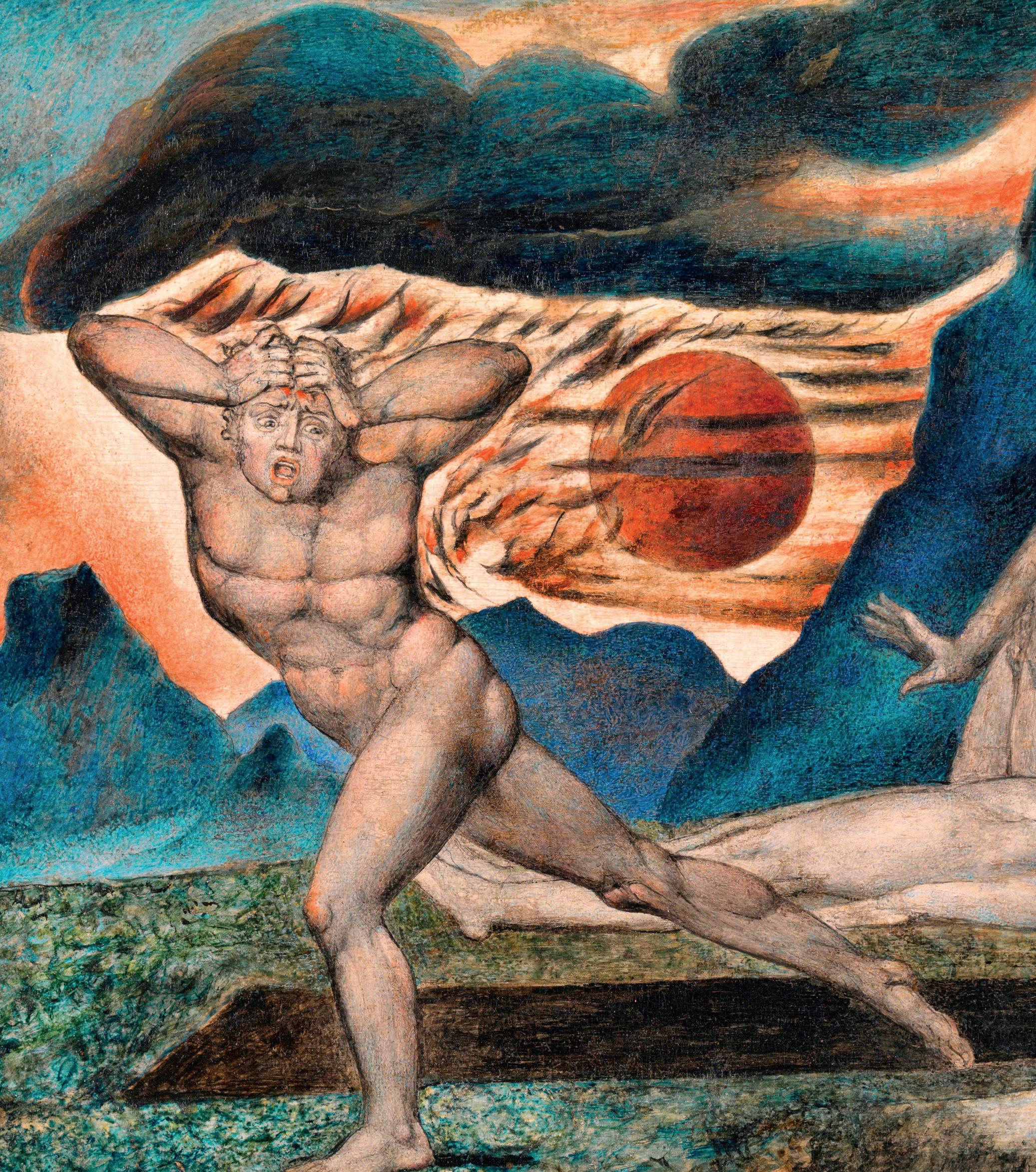
Na Cailleacha, The School of Hibernia (After Raphael), 2024 [detail], tableau staged in the Museum Building, Trinity College Dublin, 9 March 2024; photograph by Ros Kavanagh, courtesy of the artists and Trinity College Dublin.
COLUMNS
Close-Knit. Cornelius Browne considers the handcrafted patterns that bind him to his ancestors.
What Is A Creative Producer? Rachel Botha reports on a recent event at Mermaid Arts Centre.
10 Municipal Walker. Lian Bell discusses a monthly ritualised walk around Dublin as an act of civic care.
The Business of Art. VAI Advocacy Officer Brian Kielt outlines financial advice and resources for visual artists.
CAREER DEVELOPMENT
11 Between My Finger and My Thumb. Joseph McBrinn interviews Cardiff-based Irish artist Claire Curneen.
MOVING IMAGE
12 Desire Lines. Emma Battlebury outlines a screening programme organised by aemi.
SOCIALLY ENGAGED PRACTICE
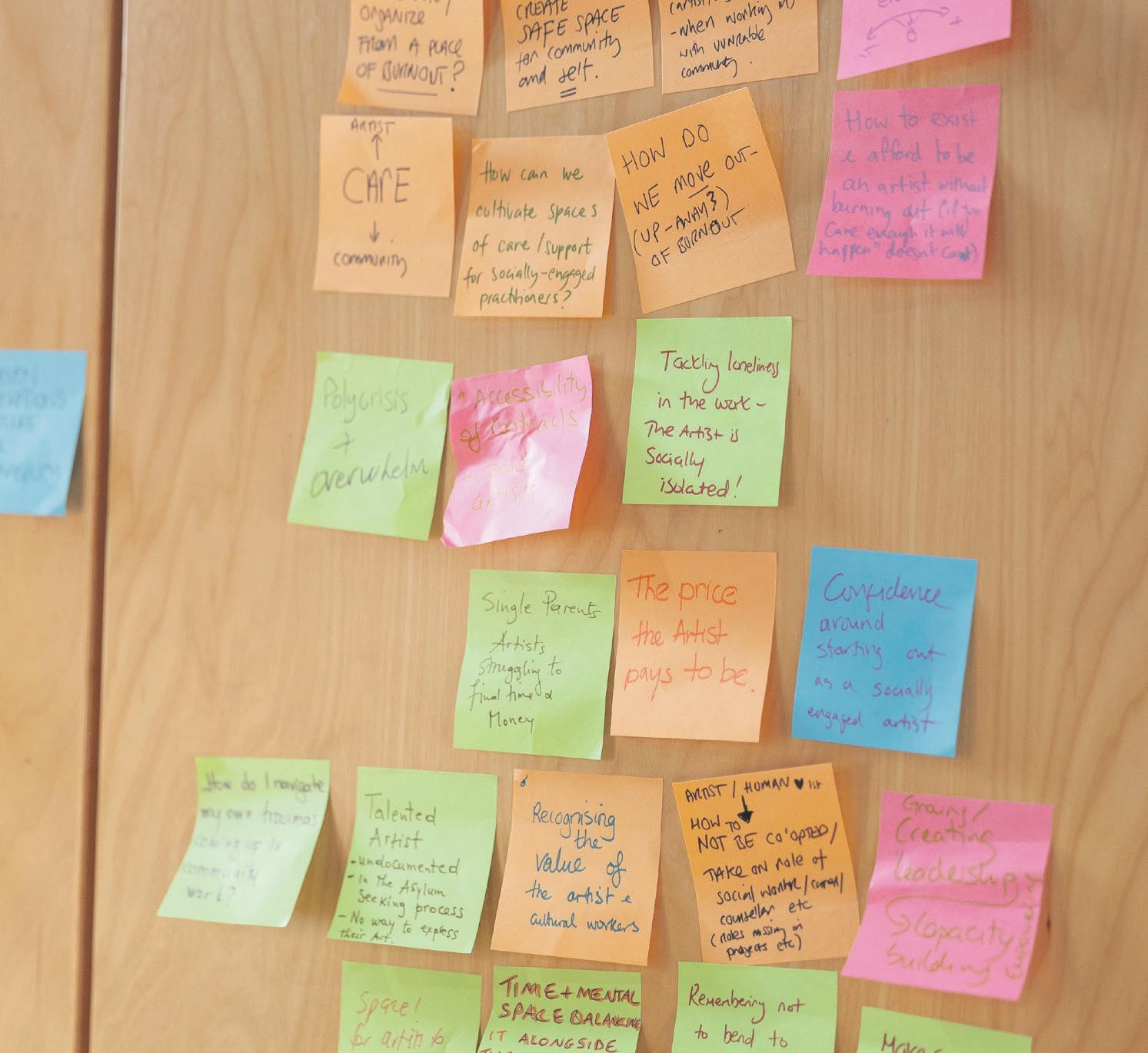
14 Lattices of Love. Sarah Browne describes a project by Workhouse Union exploring relational understandings of care.
ART COLLECTIVE
15 Waking The Land. The ÁIT Collective outline their collaborative ethos and recent activities.
PHOTOGRAPHY ROUNDUP
16 New Mythologies. Aengus Woods considers three recent photography exhibitions in Dublin.
CRITIQUE
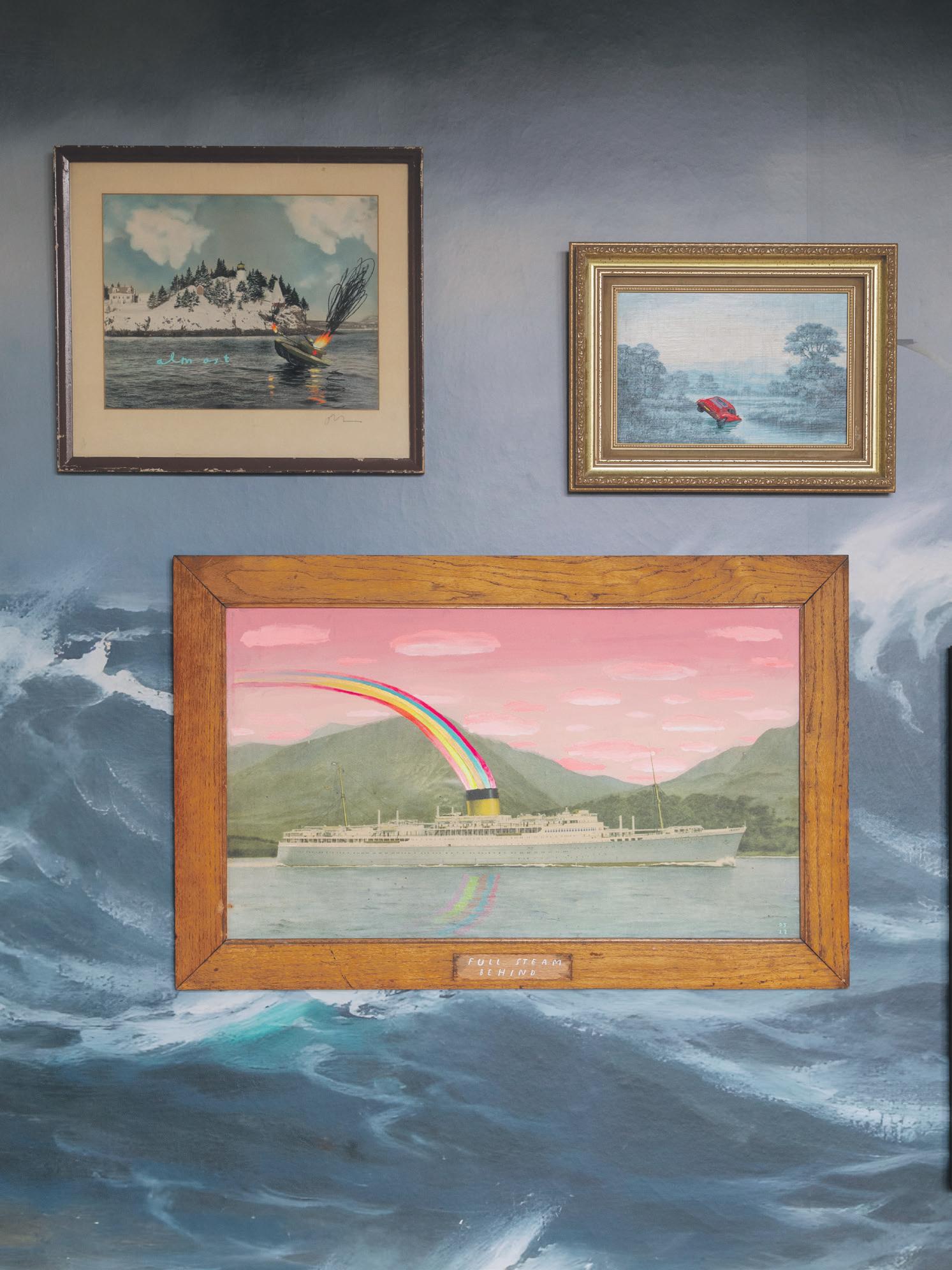
19 Oliver Jeffers, ‘Disasters and Interventions’, installation view, Naughton Gallery, December 2025.
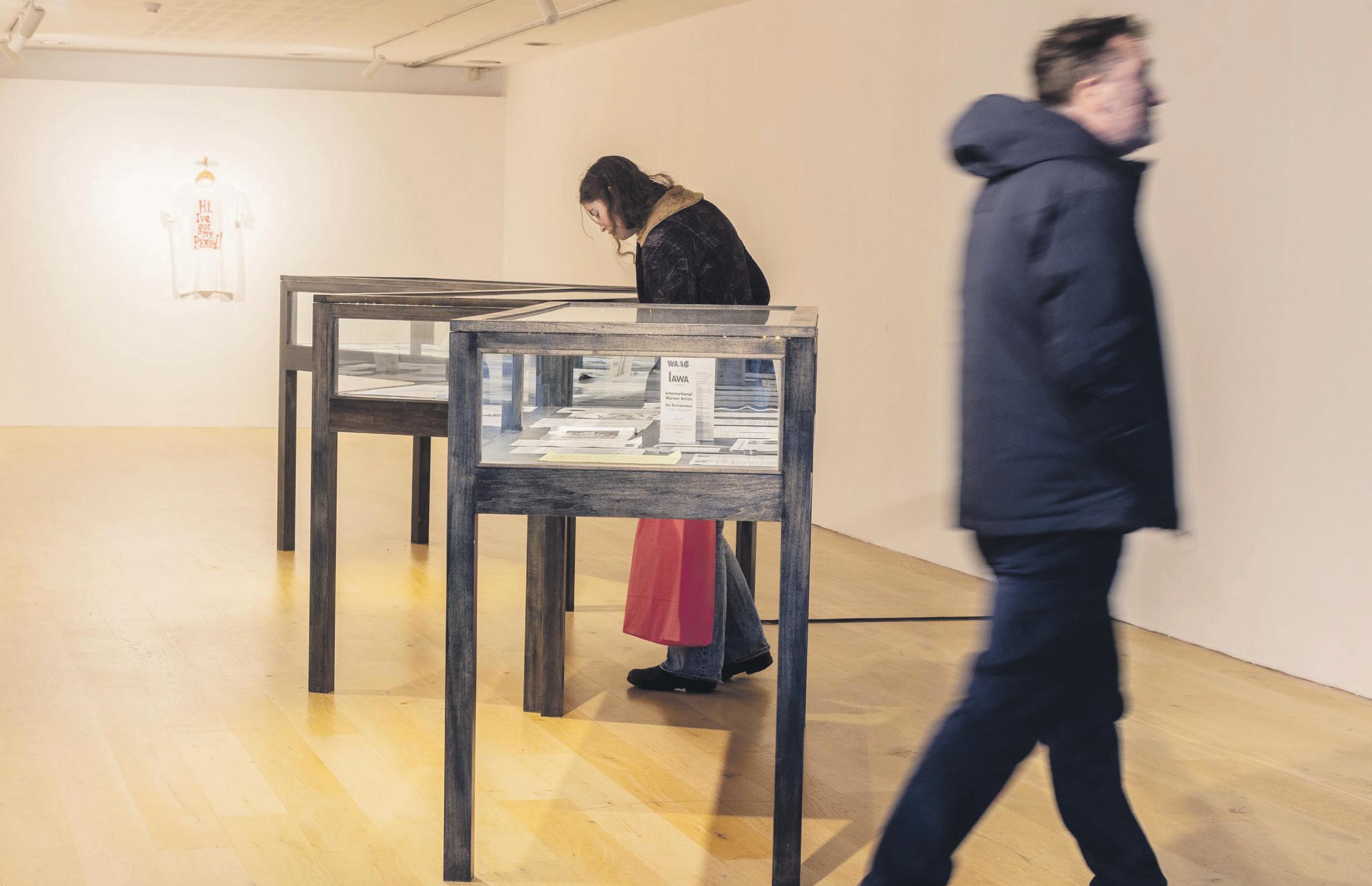
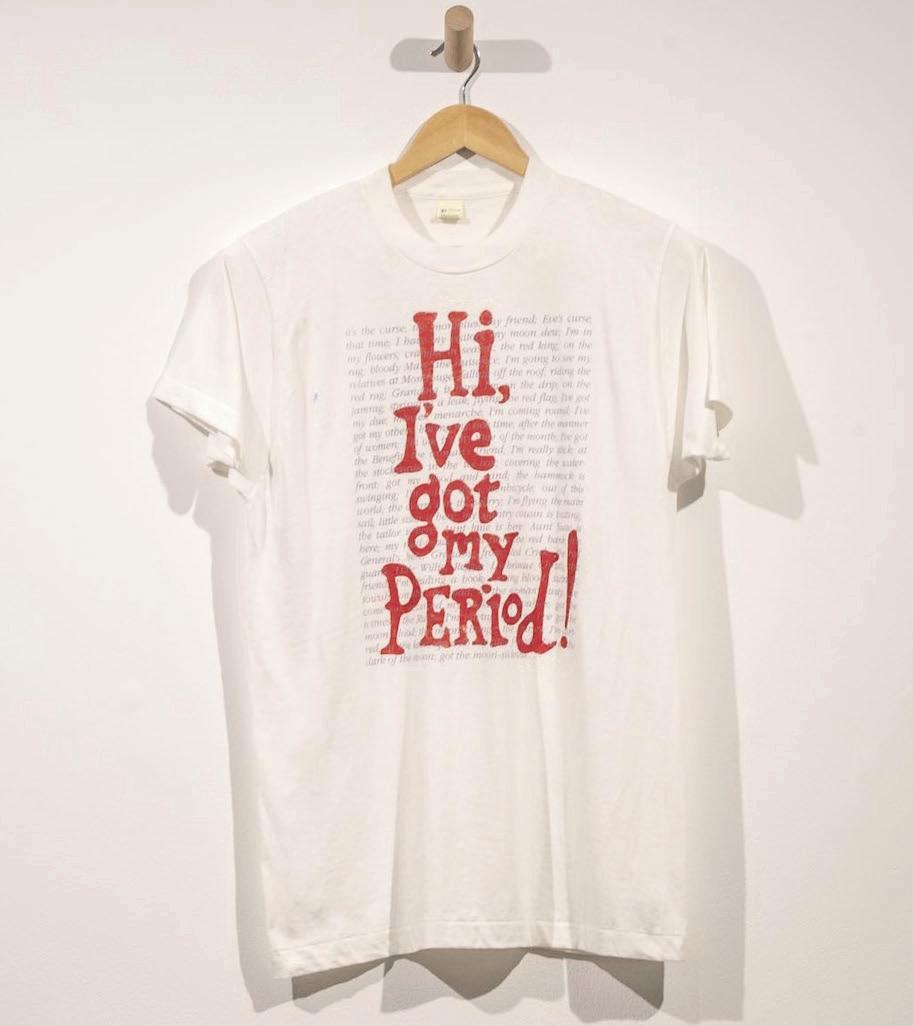
20 ‘WAAG: An Archive’ at Mermaid Arts Centre
21 Oliver Jeffers at Naughton Gallery
22 Elinor O’Donovan at Triskel and Sirius Art Centres
23 ‘It’s Not Clear from Here’ at CCA Derry~Londonderry
24 Naomi Sex at VISUAL FIRST PAGES
INTERNATIONAL
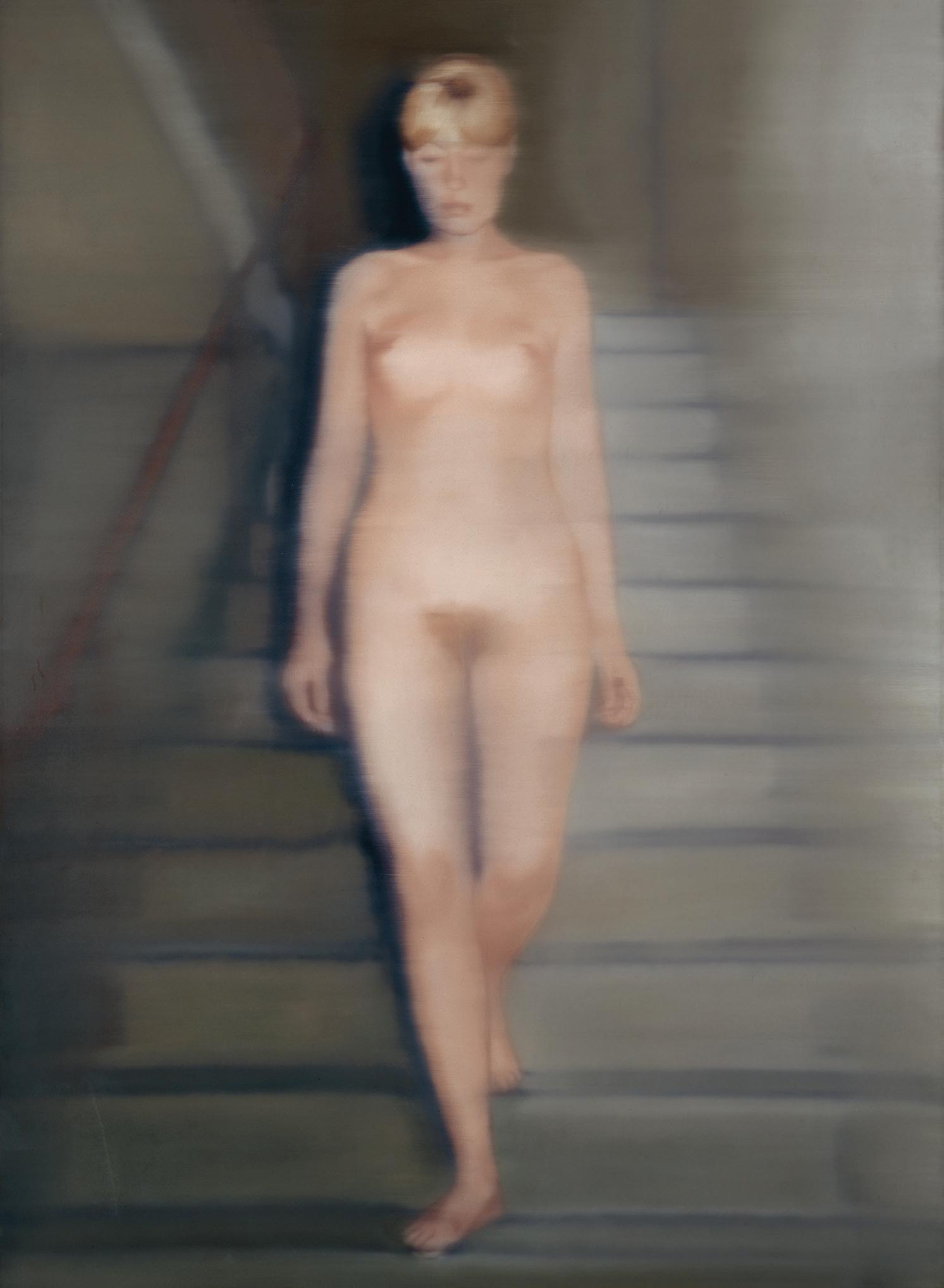
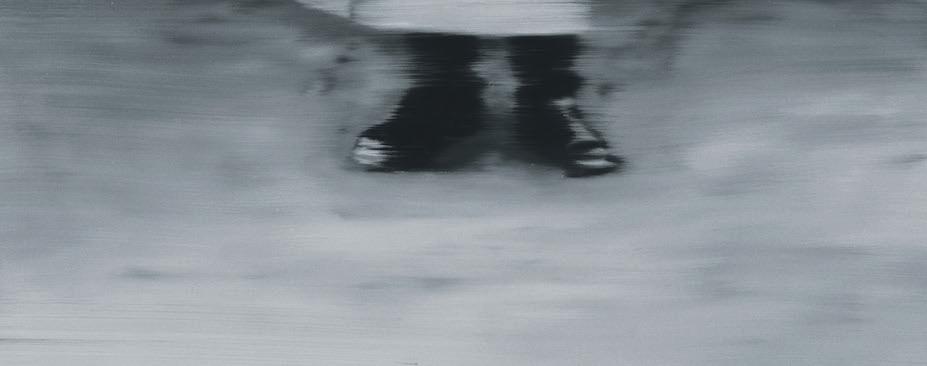
26 Post Mortem. John Graham considers the recent Gerhard Richter retrospective in Paris.
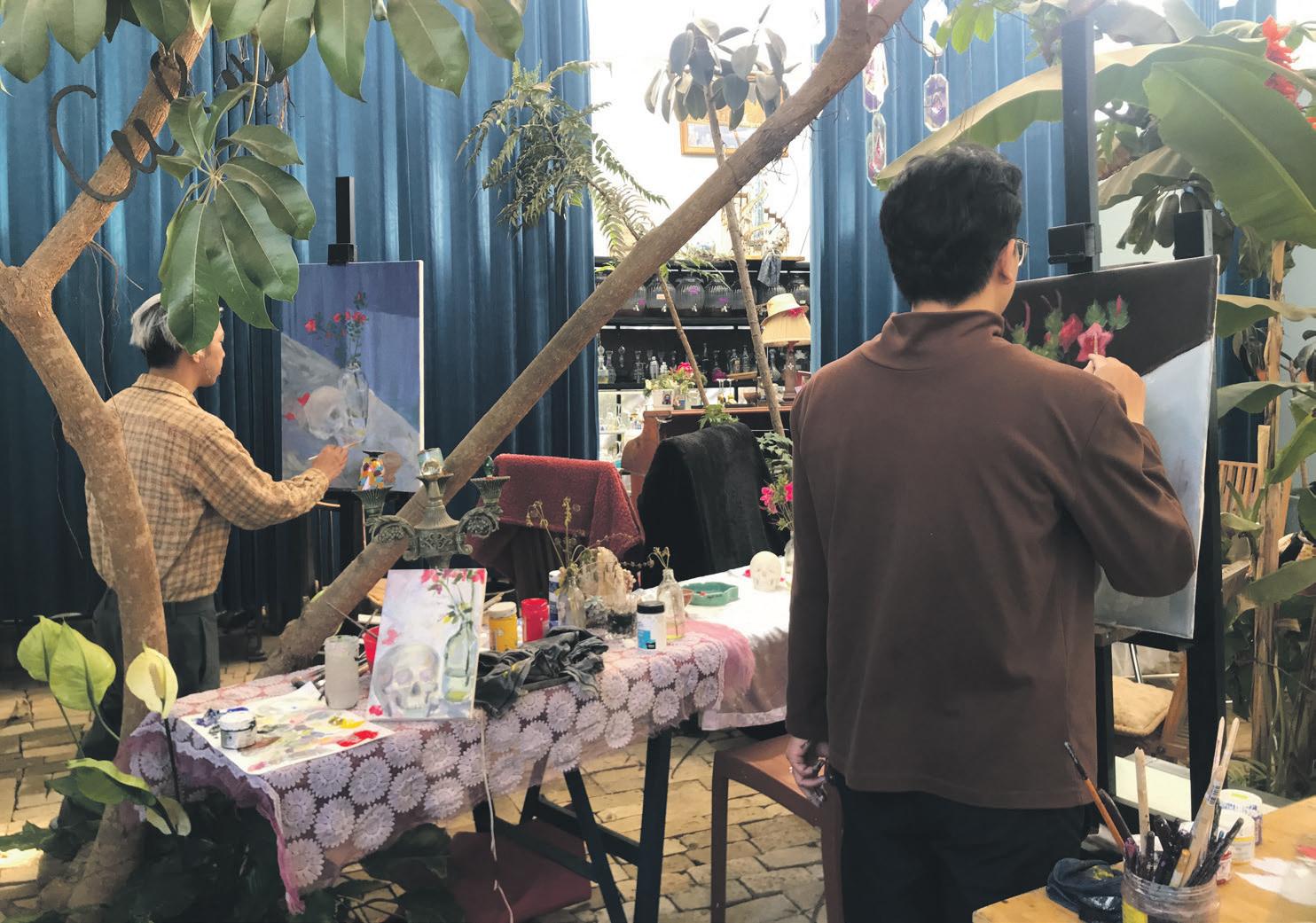
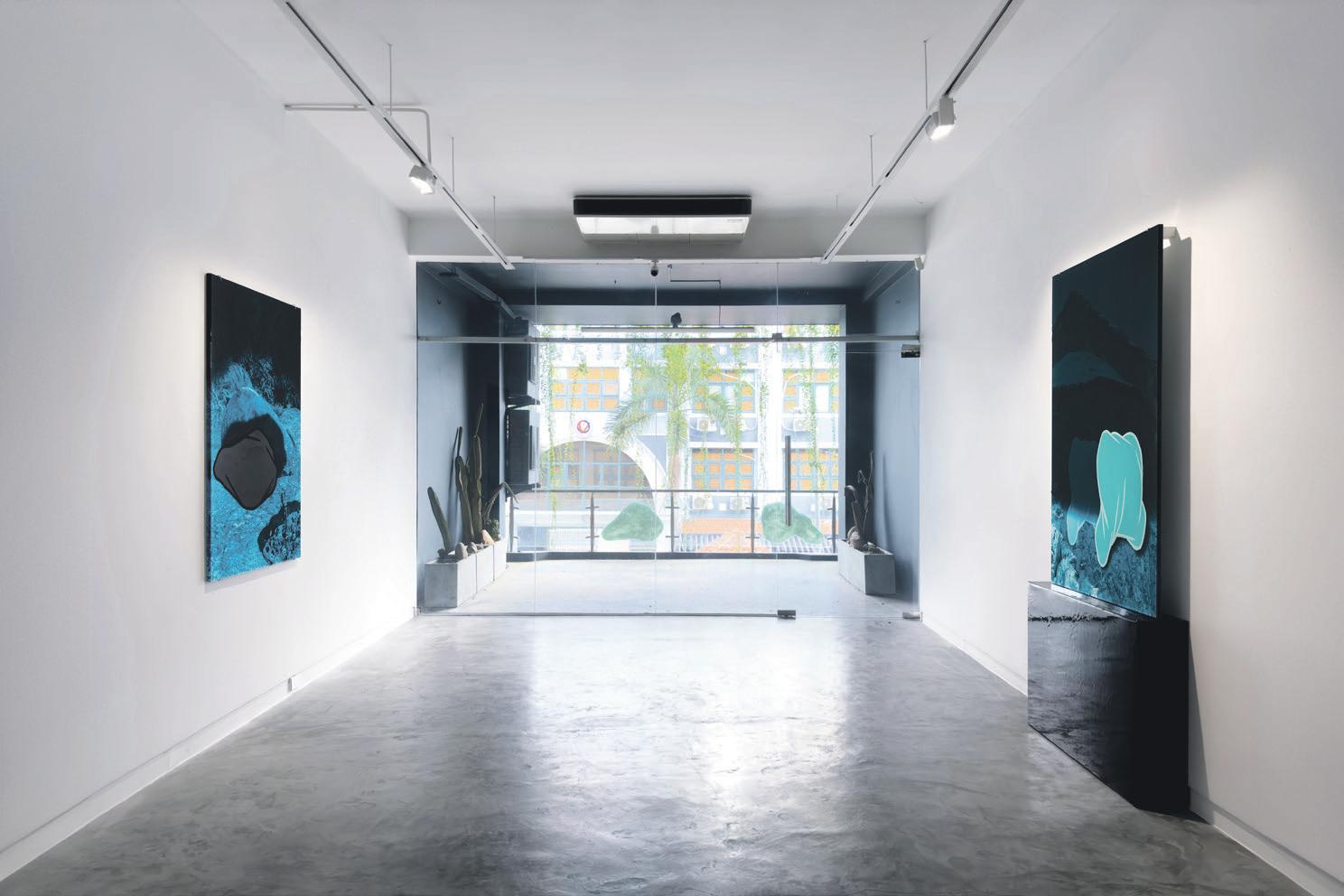
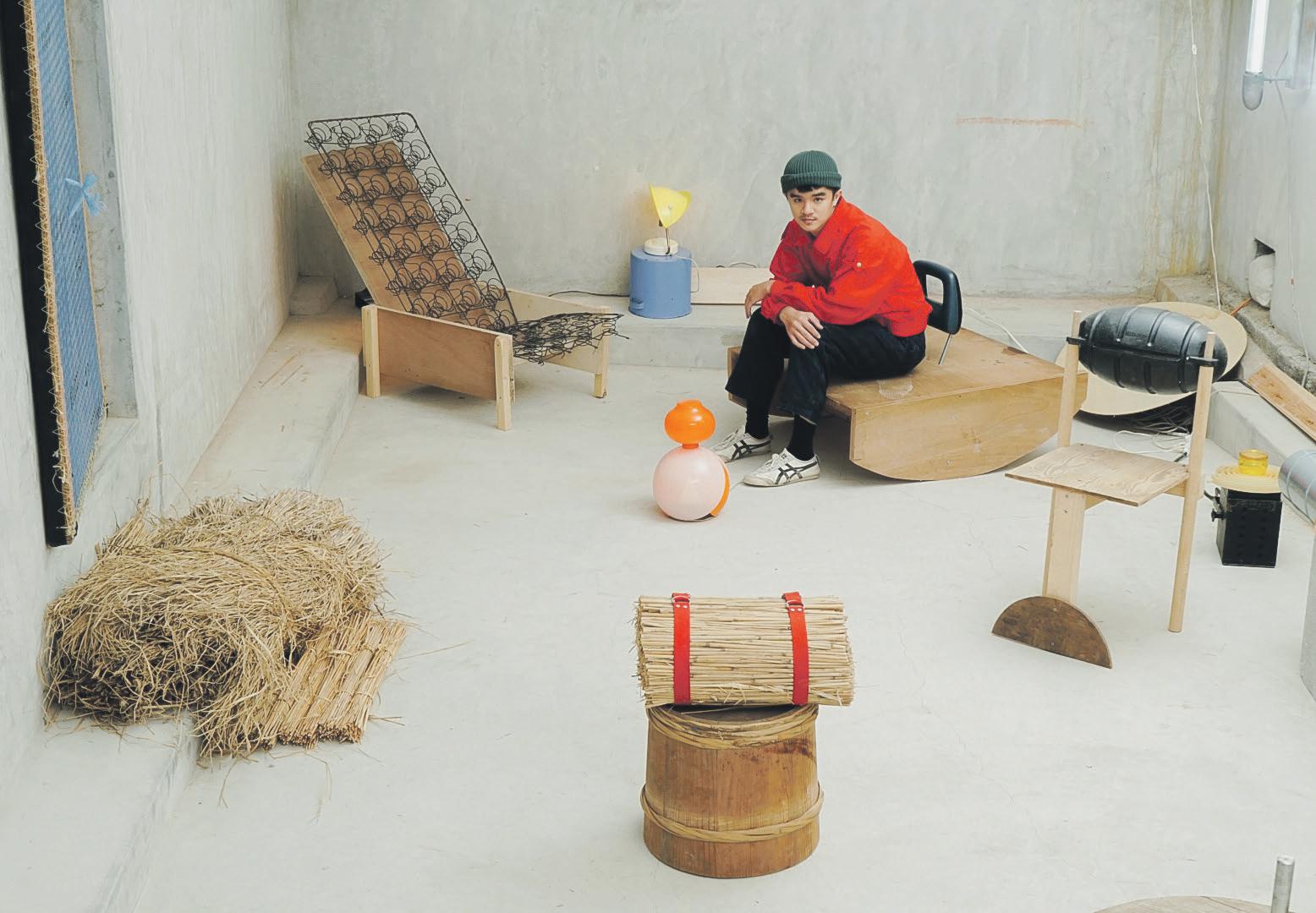
28 Thinspace. Cian Duggan discusses the art scene in Ho Chi Minh City, Vietnam.
29 The School of Hibernia. Brenda Moore-McCann reports on an event with Na Cailleacha for St Brigid’s Day.
ORGANISATION 30 STAC at 30. Helena Tobin reflects on the evolution of South Tipperary Arts Centre over the last 30 years.
EXHIBITION
32 Songs to the Siren. Phillina Sun reviews the current show at The Model in Sligo.
MEMBER
34 Spaces Between. Charys Wilson discusses developments in her art practice including recent shows in Belfast.
35 The Eccentricities of Identity. Brian Curtin discusses the evolution of Mary St. Leger’s painting practice.
36 Transformative Encounters. Marie Phelan outlines some recent developments in her multidisciplinary art practice.
6 Roundup. Exhibitions from the past two months. 8 News. The latest developments in the arts sector. LAST PAGES 37 VAI Lifelong Learning. Helpdesks, cafés, and webinars.
Editor: Joanne Laws
Production/Design: Thomas Pool
News/Opportunities: Thomas Pool, Rachael Gunning, Lewis Olivier
Proofreading: Paul Dunne
IRELAND
CEO/Director: Noel Kelly
Office Manager: Grazyna Rzanek
Artists & Members Support: Rachael Gunning
Advocacy & Advice NI: Brian Kielt
Services Design & Delivery: Emer Ferran
News Provision: Thomas Pool
Publications: Joanne Laws
Accounts: Grazyna Rzanek
Special Projects: Robert O‘Neill
Impact Measurement: Rob Hilken
Shared Island Advocacy: Brian Kielt
BOARD OF DIRECTORS
Deborah Crowley (Secretary), Michael Fitzpatrick (Chair), Lorelei Harris, Maeve Jennings, Gina O’Kelly, Samir Mahmood, Ben Malcomson.
REPUBLIC OF IRELAND OFFICE
Visual Artists Ireland
First Floor
2 Curved Street
Temple Bar, Dublin 2
T: +353 (0)1 672 9488
E: info@visualartists.ie
W: visualartists.ie
NORTHERN IRELAND OFFICE
Visual Artists Ireland
109 Royal Avenue
Belfast
BT1 1FF
T: +44 (0)28 958 70361
E: info@visualartists-ni.org
W: visualartists-ni.org
Aideen Barry and The Arts & Heritage Trust UK
The Merrion Hotel are delighted to launch the 2026 edition of our biennial contemporary art prize
The Merrion Plinth. Open to all forms of contemporary art, we are inviting professional artists to enter this open submission competition. As dedicated supporters of late 19th and early 20th century art, we aim to support living artists by sponsoring this prize honouring outstanding talent. Our aim is to provide a platform for artists to bring their work to new audiences and be seen alongside some of the great Irish artists of the last century. Our collection holds some significant artworks relevant to the history of Irish visual culture and our ambition is to promote the importance of visual art being made today.
€5,000 prize
The selected artwork will be exhibited in a dedicated area in The Merrion Hotel
Open to all professional artists resident in Ireland, Northern Ireland and the UK
Open to artists in all visual art forms that adhere to guidelines
Please visit www.merrionhotel.com for further information and to download the application form.
The closing date for entries: 17th April, 2026
CAMILLE SOUTER
ALBERTA WHITTLE
GALLERY presents
WESTMEATH ARTISTS’ EXHIBITION
MYTHOLOGIES OF THE PERSONAL AND THE LAND
10 February – 12 April
×× November 2024 – ×× February 2025
A group exhibition of works by Westmeath artists selected by guest curator, Benjamin Stafford, visual arts curator, Visual, Carlow
Tara Carroll Sian Costello Phelim Hoey Áine O’Hara Day Magee Rajinder Singh
Supported by Westmeath Arts Office and the Arts Council of Ireland
A group exhibition featuring work by Westmeath Artists selected by Guest Curator Miguel Amado
by Helena Tobin Exhibition runs 18 April - 20 June
southtippartscentre.ie
LUAN GALLERY
Luan Gallery in collaboration with Westmeath Arts Office presents
Photo: Chris Burke @wolfbaneviking
DUBLIN
BELFAST
dlr Lexicon
Dun Laoghaire-Rathdown County Council presented the group exhibition ‘Lucid Dreaming’ by artists who have studied in, are originally from, or are living or working in the county. Artists were invited to submit work on the theme of ‘lucid dreaming’. The exhibition was selected and curated by Royal Hibernian Academy Curator, Davey Moor. On display from 7 December 2025 to 15 February 2026.
dlrcoco.ie
Presented in Gallery 2 at the Kerlin Gallery from 27 January to 21 February, Dorothy Cross’s ‘Bloodlines’ series comprises unique works that layer archival photographs with hand-poured, red-veined glass. Taken by the artist’s father in the 1940s, these images reveal an inherited fascination with the sea –a personal history caught within a geological frame. As stated by the artist: “They are images of people that once existed, caught in time.”
kerlingallery.com
National Gallery of Ireland
‘Picasso: From the Studio’ highlighted the various facets and phases of Picasso’s art and life. It explored the key locations that defined him, from his arrival in Paris at the start of the twentieth century to his studio in Mas NotreDame de Vie (1961–1973) in Mougins. This exhibition ran from 9 October 2025 to 22 February 2026 and featured paintings, sculptures, ceramics, and works on paper, as well as photographic and audio-visual works.
nationalgallery.ie
Hillsboro Fine Art
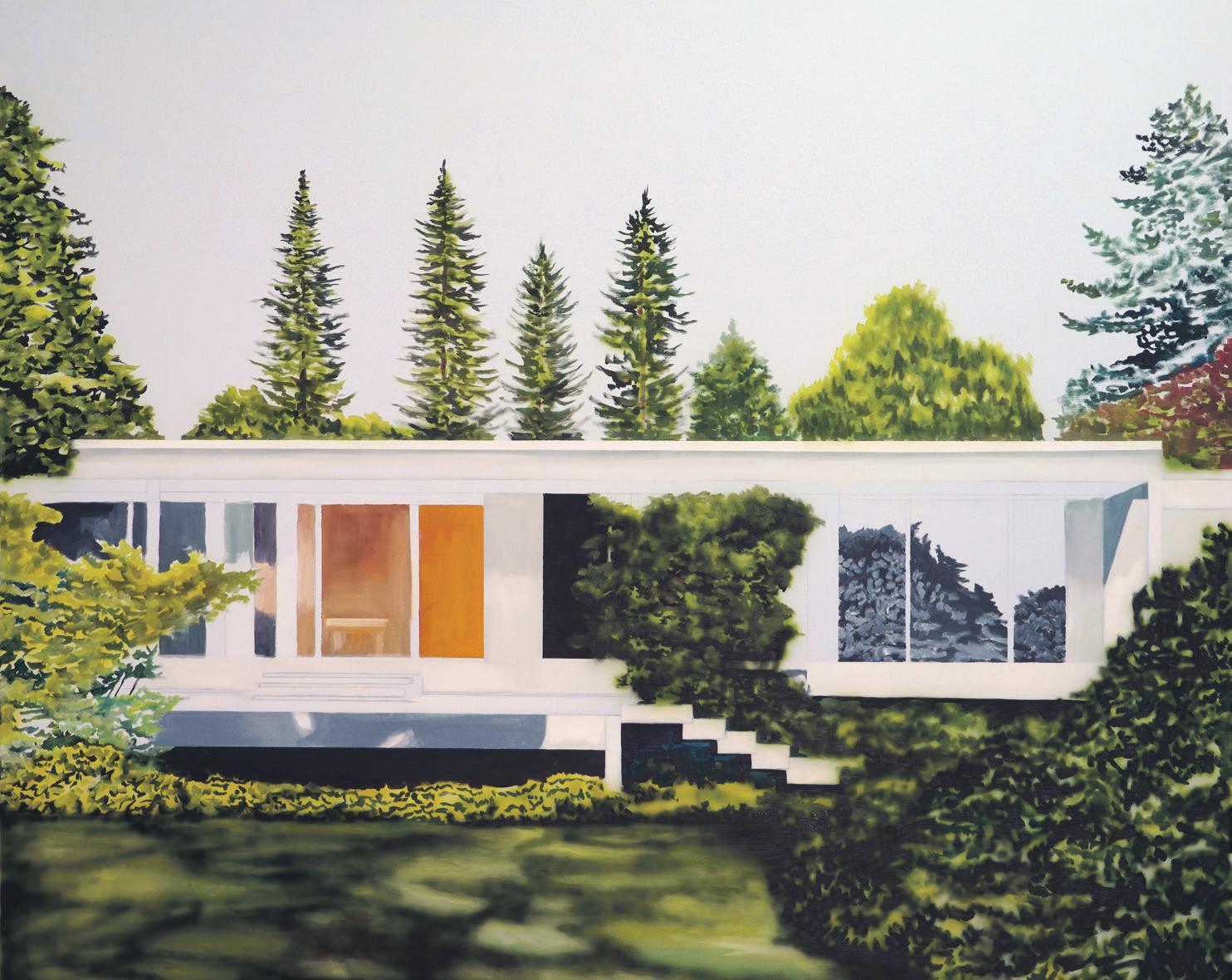
Hillsboro Fine Art presented ‘Studio, House, Museum’ by Eamon O’Kane from 5 February to 4 April. The exhibition includes paintings from O’Kane’s ongoing ‘Ideal Collection’ series alongside works made in response to visits to significant studios and houses associated with major artists, collectors and architects. This idealised museum expands to encompass the artist’s studio itself, foregrounding the intimate relationship between art-making, architecture, and personal history. hillsborofineart.com
Kevin Kavanagh Gallery
Diana Copperwhite’s solo exhibition, ‘The Only Thing is the Everything’, opened at Kevin Kavanagh Gallery on 12 February and continues until 14 March. Copperwhite’s work is frequently preoccupied with light and interested in what’s beyond the visible spectrum. For this exhibition, the artist cites an interest in the building blocks of the Fibonacci sequence, recognising that “while there’s structure and order in the universe, there is also chaos.”
kevinkavanagh.ie
The LAB Gallery
‘Passage: The Faddan More Psalter’, an event held on 19 February, brought together visual art, music, and archaeology, and centres on a remarkable medieval manuscript discovered in a bog in Tipperary twenty years ago. This event formed the starting point for a new collaboration between Siobhan McDonald and composer Mel Mercier, with the first soundings of the project shared publicly through words and music on the night.
dublincityartsoffice.ie
Atypical Gallery
The group show ‘twixt’ was presented from 14 January to 25 February. It showcased the work of 20 awardees of the d/Deaf and Disabled Artists Support Fund 2025 (DDASF), including Darlene Corry, Elly Makem, Emma Brennan, Eve Belle, Finn Nichol, Hana Abri Smith, Indigo Azidahaka, Jamie Baker, Jayne Cherry, Kate Guelke, Brian McAvera, Abby Oliveira and Liam Devlin. ‘Twixt’ included ceramics, painting, textiles, music, photography, digital art, spoken word and sculpture. universityofatypical.org
Cultúrlann McAdam Ó Fiaich
‘Past tense: f r a g m e n t e d’, a solo exhibition by multidisciplinary artist Claire Callinan, opened at Cultúrlann on 22 January. The exhibition tackles the personal loss of innocence as we transition through life and, inevitably, our inability to reclaim it. It also focuses on the loss of memory as one ages. While these stages are universal experiences, they can be entirely isolating moments. The exhibition continues until 5 March.
culturlann.ie
PS²
‘Silver Plough’ by Kirsty Bell was presented at PS² from 4 to 14 February. It was the first of two exhibitions to showcase Bell’s new body of work, marking the conclusion of her Freelands Studio Fellowship at Ulster University. The Freelands Studio Fellowship is an annual programme that places eight artists in studios within partner universities across the UK, fostering a symbiotic relationship between teaching and artistic practice.
pssquared.org
Catalyst Arts
The annual member show, ‘ALL YOU NEED IS LOVE WAS NOT TRUE’, ran from 5 to 26 February. This year’s open call asked members to respond to the relationship between technology and society. In an ever-evolving age of technological advancements, Catalyst Arts asks “what do we gain and what do we lose?” The rise of technology has led to societal disconnect rather than harmony. How do we navigate the future without losing ourselves in the process?
catalystarts.org.uk
Platform Arts
‘Saccharine Visions’ was a solo exhibition by Lorcan Cassidy that ran from 5 to 15 February at Platforms Arts’ new space in Bedford Street, Belfast. Cassidy is a visual artist based in Dublin. He graduated from NCAD with a BA (Hons) degree in Fine Art Sculpture and Expanded practices and is currently a member of BKB Visual Arts Studio in Glasnevin, Dublin. ‘Saccharine Visions’ presented an array of mixed-media sculptures and drawings.
platformarts-belfast.com
Queens Street Studios
The exhibition ‘sing me to where silence weeps’ by Patrick Hickey was a vital exploration of queer desire in Northern Ireland; an opportunity to “make visible the often-silenced stories of love, longing, and desire.” Through the lens of contemporary painting, this exhibition invited personal and collective reflection on “the complexities of queer existence in a region shaped by history, politics and culture.” On display from 15 January to 19 February.
queenstreetstudios.net
Right: Eamon O’Kane, Ronnie Tallon House, Dublin, 2026, acrylic on canvas, 100 x 120 cm; image courtesy of the artist and Hillsboro Fine Art.
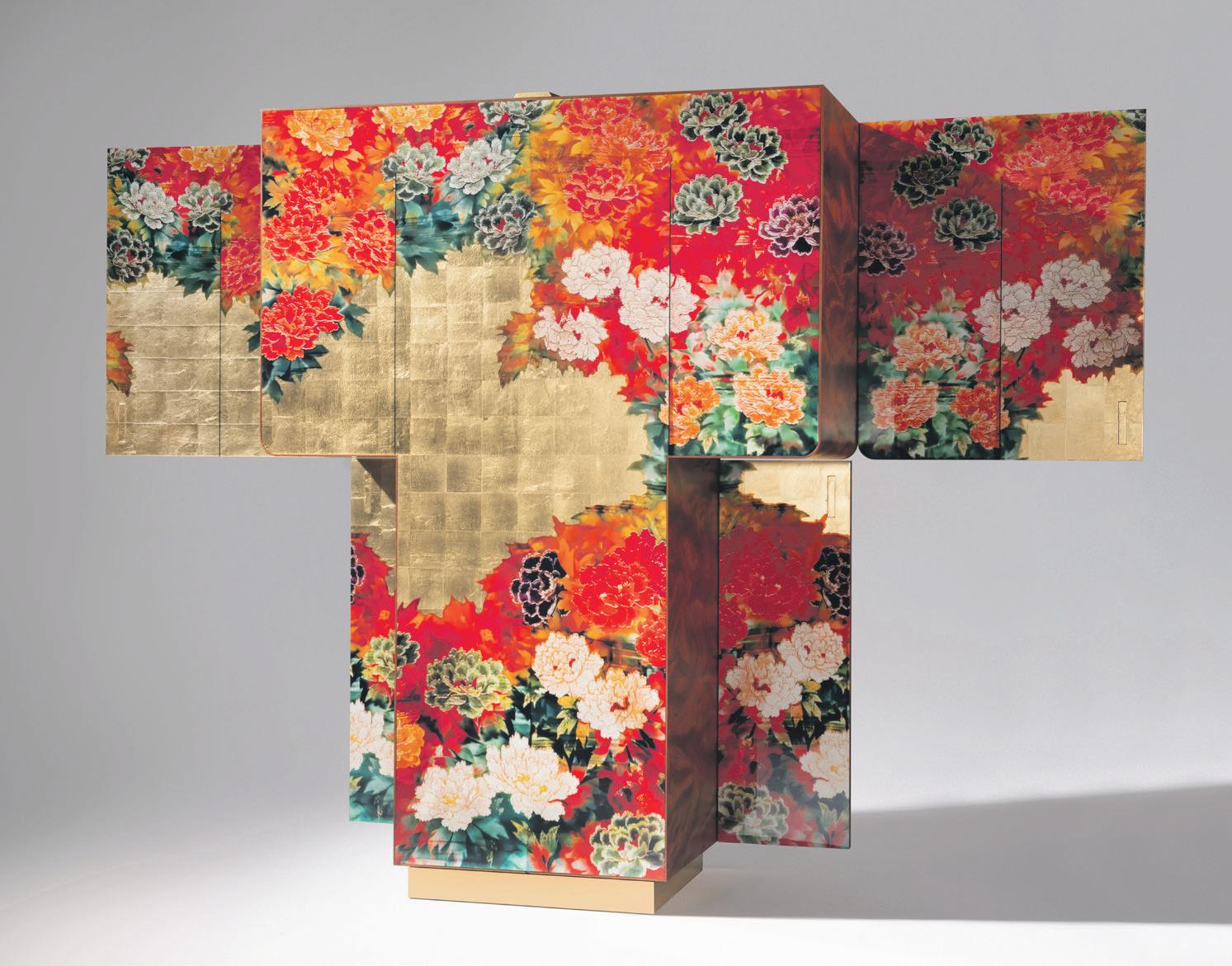
Left: Zelouf And Bell, Kimono with Peonies [back view], 2024; image courtesy of the artists and Design & Crafts Council Ireland.
Kerlin Gallery
REGIONAL & INTERNATIONAL
15 Beautreillis
Supported by Culture Ireland, ‘STREAM’, a solo exhibition by Irish artist Jack Hogan was on display in Paris from 15 January to 28 February. The video work, Stream (2025), cuts a slice of the free flow of mundane, magical life. Hogan recorded hundreds of commuting hours, in an attempt to use cracks between errands. Photographs and drawings are a sequence of black, white and grey details, gestures, formal interactions, body parts, patterns, masks and facades. 15beautreillis.com
The exhibition ‘Tether’ brought together Irish artists based in New York, exploring the invisible lines that bind us across distance, time, and place. Set in a city deeply entwined with Irish history, ‘Tether’ situates these practices within a global art context while remaining attentive to origin. The exhibition also honours the legacy of Brian O’Doherty, whose conceptual rigor and engagement with language and space continue to influence Irish artistic practice across generations.
gallerymc.org
Presentation Arts Centre
‘Walls Of Containment’, an exhibition of photography by David Killeen, ran from 10 January to 21 February at Presentation Arts Centre in Enniscorthy, County Wexford. This body of work documents 21 psychiatric hospitals. Constructed between 1814 and 1922, they represent one of the largest public programmes ever undertaken here. This body of work generates conversations about the function and use of these buildings, and their subsequent dereliction and demise. presentationcentre.ie
An Táin Arts Centre
‘In My Time’ by Denis O’Connor ran from 8 January to 21 February, presenting sculptural works which brought together different narratives. In part autobiographical, the sculptures explore references to loss, sadness and longing. They reflect on elements of his own cultural and personal histories from growing up in Ireland in the 1960s, to living in two countries and asking the question, ‘Where is home?’ with reference to emigration, adoption, memory, and landscape. antain.ie
Highlanes Gallery
‘Once Upon a Page’ by James Moonan ran from 19 January to 7 March. This is the artist’s first solo exhibition, featuring a combination of recent work alongside pieces made throughout his childhood. Growing up with autism, he drew creative inspiration from picture book illustration and children’s animation. This exhibition celebrates his artistic journey and the imaginative world of wonder that captures youth and childhood.
highlanes.ie
Solas Art Gallery
The 18th Junior Exhibition ran from 7 February to 4 March. This collaborative showcase between Solas Art Gallery and participating schools in County Leitrim celebrates close to 300 young artists who await opportunities to display their talent, stories, imagination and unique creative voices and skills. This joyful journey of self-expression is an authentic tribute to passion, teamwork and the powerful impact of giving young minds a platform to shine.
solasart.ie
Ards Arts Centre
The exhibition ‘Ensoulment’ presented the work of three artists – Sheena Devitt, Rozzi Kennedy, and Rosalind Lowry – investigating their moment of illumination through the processes of painting, sculpture, and installation. Rooted across the three counties of Antrim, Armagh and Down, and finding strength in the gentleness of slowing down, the artists presented their life stages, their inspiration, and their works of ensoulment. On display from 22 January to 21 February. andculture.org.uk
Lavit Gallery
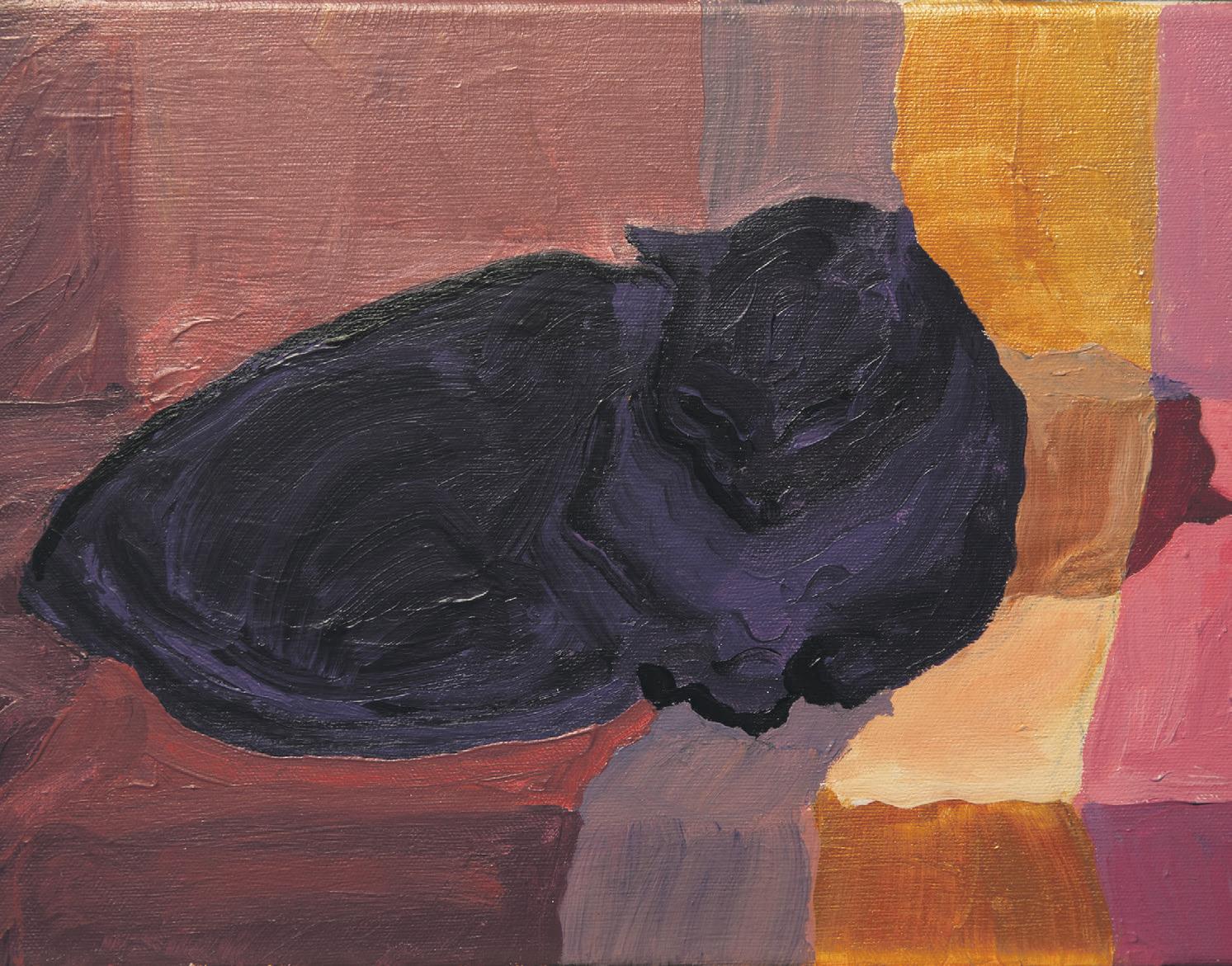
In collaboration with Backwater Artists Group, ‘Memorial Exhibition’ was presented from 5 to 14 February in memory of Cork artist Anna Barden, who passed away unexpectedly on 31 December 2024. The exhibition presented various finished works, studies, and archival material spanning Anna’s career, kindly provided by her family. This included an early series of equine pieces, cat paintings, self-portraits, and works on paper featuring text, drawing and embroidery.
lavitgallery.com
Solstice Arts Centre
‘TRACING ECHOES’, a major exhibition by Mark Francis, continues at Solstice Arts Centre until 14 March. Known for his dynamic and visually arresting paintings, Francis creates works charged with movement, sound, and rhythm. His practice combines intense sequences of colour within tightly gridded structures, generating a compelling tension between order and chaos. Francis will represent the Republic of San Marino at the 61st Venice Biennale in May. solsticeartscentre.ie
Collect 2026
Exhibiting work under the theme of the four seasons, 16 designer makers represented Ireland at Collect 2026, the leading international fair for contemporary craft and design. The Design and Craft Council of Ireland (DCCI) stated that: “Collect 2026 marks an exciting new chapter for Ireland’s vibrant design and craft community.” Presented by the Crafts Council UK and held in Somerset House, London, Collect 2026 ran from 27 February to 1 March.
somersethouse.org.uk
Linn Gallery
The group exhibition ‘Urban Canopy’ opened on 13 February at Linn Gallery in Clonmel, where it continues until 28 March. The exhibition explores the vital and often complex relationship between trees and our urban landscape. In a rapidly heating world, the role of trees has never been more critical. As we continue to develop our towns, we find ourselves in a paradox: the more we build, the more we rely on the resilience of trees to keep our streets cool and liveable.
linngallery.ie
The Glucksman
‘HAPPENSTANCE’, a solo show by Eilis O’Connell, opened at The Glucksman on 29 November 2025, where it continues until 12 April. O’Connell’s sculptural work often evokes states of becoming and transformation, reflecting her long-standing fascination between the organic and geometric in the natural world. This way of working melds irregularity and flow to the precise and mathematical, emblematic of a human relationship to nature.
glucksman.org
Gallery MC
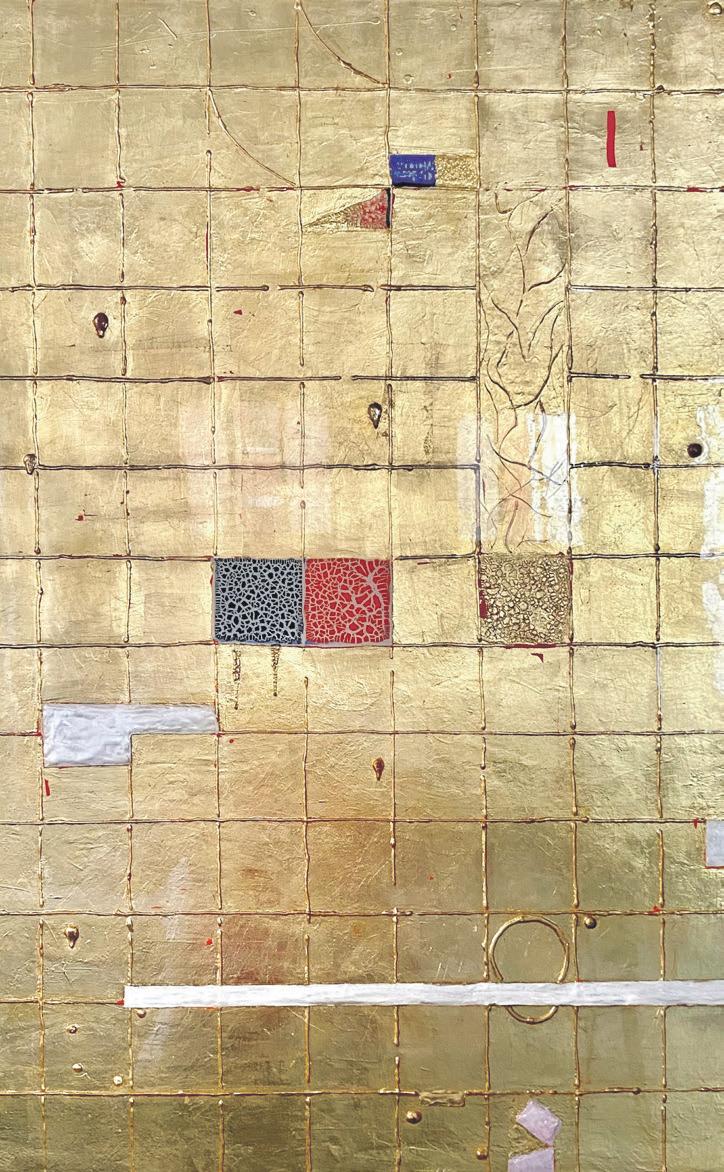
Left: Martin Mullin, Golden Book 2018, mixed media on linen; image courtesy of the artist and Gallery MC, New York. Middle: Mark Francis, PHASE 2025, archival pigment print, edition of 25; image courtesy of the artist and Solstice Arts Centre. Right: Anna Barden, Moon Cat (ii), 2021, oil on canvas, 35 x 25 cm; image courtesy of the artist and Lavit Gallery.
NEW BASIC INCOME FOR THE ARTS SCHEME
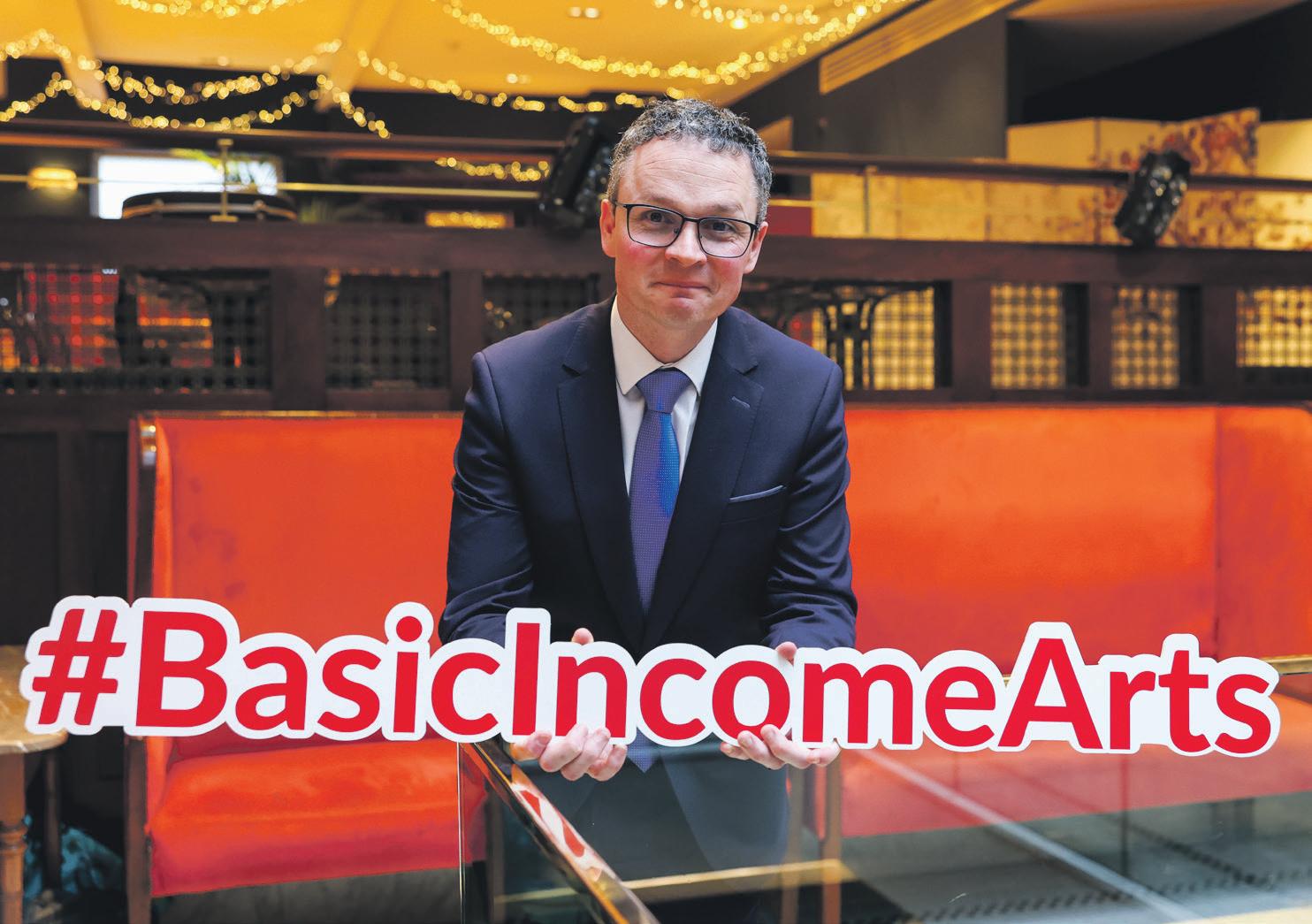
On 10 February, the Minister for Culture, Communications and Sport, Patrick O’Donovan TD, announced the successor scheme to the Basic Income for the Arts Pilot scheme.
Practicing artists based in the Republic of Ireland will be invited to apply for the scheme and 2,000 eligible artists will be selected to receive the payment of €325 per week. The payment will be for three years and will also feature a tapering-off period of three months at the end of the cycle.
The pilot was the first large scale Randomised Control Trial undertaken by the Irish Government and has provided a solid evidence base for the future policy direction of the scheme. Guidelines outlining details for application, eligibility criteria and proofs will be published in April 2026.
With a budget of €18.27m secured by the Minister in Budget 2026, the new BIA will
operate in three-year cycles, with artists being eligible for every three out of six years. This means that, if selected in 2026 – 2029 for the payment, an artist won’t be eligible for the payment in the next cycle, but may reapply in the cycle following that. Those who were on the Pilot who meet the eligibility criteria for the new scheme may apply for the BIA in 2026.
Research from the pilot scheme collected clear evidence of the consistent, positive impact that the payment has across almost all indicators. Artists in receipt of the support are typically able to: devote more time to their art; produce more pieces of work; experience a boost to their wellbeing through greater life satisfaction, experience reduced anxiety, [Cont. below]
Basic Income for the Arts [Cont.] and are protected from the precariousness of incomes in the sector to a greater degree than those who are not receiving the support. An external cost-benefit analysis found that for every €1 invested in the pilot, society received €1.39 in return.
Creative Climate Action Fund III
Taoiseach Micheál Martin, Minister for Culture, Communications and Sport, Patrick O’Donovan, and Minister for Climate, Energy and Environment, Darragh O’Brien, today announced a new €6.5 million Creative Climate Action Fund, which will support imaginative, large-scale creative, cultural and artistic initiatives that help communities engage with climate change and empower citizens to make meaningful behavioural change.
The Creative Climate Action Fund III is an initiative of the Creative Ireland Programme in partnership with the Shared Island Initiative and the Department of Climate, Energy and Environment.
The Creative Climate Action Fund III (2026-2029) will support ambitious, durational projects that bring together expertise from the arts and culture sector, climate science, and community engagement, and is delivered through a cross-Government partnership.
This Fund is seeking proposals that respond creatively to key national climate priorities, including those set out in the Climate Action Plan 2025, the National Dialogue on Climate Action, and the work of the Just Transition Commission.
As part of this overall investment, €1 million is being contributed for cross-border projects under the Shared Island strand of the Creative Ireland Programme, supported by the Shared Island Fund. The aim for Shared Island supported projects is to promote cross-border cooperation and deepen collaboration between communities and citizens engaging with climate change, in both jurisdictions, across the island.
Funding is aimed at organisations with experience in delivering public engagement projects at scale, proposing projects with extensive public participation over time. Grants of between €400,000 and €750,000 will be available for projects delivered over a
four-year period.
Applications are available at Creative Grant Call 2025 – Creative Ireland Programme and will close on 15 April 2026.
New Additions to National Collection Important works by Leonora Carrington, Cecilia Vicuña, Hilary Heron, Eimear Walshe, Alex Cecchetti, Patrick Hennessy, and Elizabeth Cope added to IMMA’s Collection.
The Irish Museum of Modern Art recently announced a series of important new acquisitions to the National Collection of Modern and Contemporary Art. These works represent a vital expansion of the Collection, ensuring that the IMMA Collection continues to reflect the richness, diversity, and innovation of modern and contemporary practice.
IMMA Director, Annie Fletcher, has brought a renewed focus to the Collection, recognising it as the keystone to establishing IMMA as a Global Learning and Research Centre for the study of Modern and Contemporary Art outlined in IMMA’s Strategy 2024–2028. Despite the absence of a dedicated annual acquisitions budget, the IMMA Collection has grown considerably over the past year, acquiring 67 artworks thanks to a combination of donations, bequests, assisted purchases, and support from the Department of Culture, Communications and Sport.
AICA Ireland Prize
AICA Ireland – the Irish national section of the International Association of Art Critics –recently announced the inaugural edition of the Annual Honorary Prize. Inspired by an initiative of the Belgian section of AICA, the award was established by a committee of eight members to award an artist and/or curator a symbolic prize for an outstanding exhibition each year.
This prize involves active contributions from AICA Ireland members across all four provinces of Ireland. This committee was made up of the following members: Alan Phelan and Brenda Moore McCann (Leinster); Áine Phillips and Michaële Cutaya (Connaught); Cristín Leach and Pádraic E. Moore (Munster); Jane Morrow and Marianne O’Kane Boal (Ulster.)
This prize draws attention to the potential
of AICA, and art writing in general, to bring visibility, advocate for, and support visual art in Ireland. In early 2026, the panel assembled a shortlist of outstanding exhibitions that took place across the island in 2025.
The winner of the inaugural AICA Ireland Annual Honorary Prize has been awarded to Aisling O’Beirn for her exhibition ‘We Lose Sight of the Night’ at The MAC in Belfast (17 April – 22 June 2025). This was the first in a series of exhibitions which address climate and environmental change. O’Beirn (born in Galway) is a Belfast-based artist whose practice explores the relationship between art and science and manifests variously as sculpture, installation, animation and site-specific projects. The exhibition curator Hugh Mulholland stated: “I cannot think of a more worthy recipient of this award than Aisling O’Beirn. ‘We Lose Sight of the Night’ was the culmination of many years of enquiry and collaborative partnerships Aisling has developed throughout her career. The MAC was extremely proud to have been able to present this significant body of work across our three galleries, recognising not only the importance of this work but Aisling O’Beirn’s immense contribution to the arts on this Island.”
RHA Awards
The Royal Hibernian Academy of Arts recently announced that artists Eileen Leonard Sealy and Daniel Coleman have been awarded the Hennessy Craig Award 2026, while artists Manar Mervat Al Shouha and Conor O’Connell have been awarded the Homan Potterton Award 2026. Both awards, the largest awards for painters in Ireland, were announced at a ceremony at the RHA Gallery on Thursday 12 February.
Since 2002, the Hennessy Craig Award has recognised exceptional talent among painters under the age of 35 who have studied at a recognised art college on the island of Ireland and exhibited in the open submission section of the RHA’s Annual Exhibition. Introduced in 2024, the Homan Potterton Prize was established through a generous bequest from the late Homan Potterton, former Director of the National Gallery of Ireland and one of the country’s foremost art historians. The prize honours a painter under 35 whose work reflects the enduring traditions of figurative or landscape painting.
This year, the Hennessy Craig / Potterton jury has selected artists from both the 2024 and 2025 Annual Exhibitions. Each shortlisted artist was invited to present two new works for this exhibition, with the final awards reflecting the artist’s overall practice.
The Hennessy Craig Award 2026, €20,000 – Bequest of the estate of Patrick Hennessy and Henry Robertson Craig. Awarded to: Eileen Leonard Sealy and Daniel Coleman (€10,000 each).
The Homan Potterton Prize 2026, €20,000 – Bequest of the estate of Homan Potterton. Awarded to: Manar Mervat Al Shouha and Conor O’Connell (€10,000 each).
These four artists, while different in their aesthetic and conceptual concerns, collectively demonstrate the enduring relevance of contemporary figurative painting. They each, in their unique way, push the boundaries of representation, inviting viewers to engage with questions about loss, identity, historic references, and the human condition.
This exhibition presents a rare opportunity to experience – and for discerning collectors, to acquire – the finest work from Ireland’s most exciting new generation of painters.
DIFF 2026
Dublin again became a city energised by cinema as the Dublin International Film Festival (DIFF) returned from 19 February to 1 March 2026 with an ambitious programme celebrating the very best of Irish and international filmmaking. Across 11 exhilarating days, the festival presented 83 films, including 17 world premieres and 53 short films, welcoming filmmakers, screen legends and new voices to the capital.
This year’s festival saw an exceptional lineup of screen talent travel to Dublin, with Paul Rudd, Bill Nighy, Colin Farrell, Chris Colfer, Nick Jonas, Ciarán Hinds, Colin Morgan, Dominic Cooper, Sarah Bolger, Katie McGrath, Clare Dunne, Calam Lynch, Alice Krige, Aidan Gillen and Éanna Hardwicke, among those on the red carpet.
Coverage of DIFF in The miniVAN from VAN Production and Content Editor Thomas Pool, as well as reviews by Paul Dunne and Caileigh Ryan, are available on: visualartistsireland.com
Image courtesy of the Department of Culture, Communications and Sport.
Plein Air
Close-Knit
CORNELIUS BROWNE CONSIDERS THE HANDCRAFTED PATTERNS OF WOOL AND STONE THAT BIND HIM TO HIS ANCESTORS.
MY MOTHER WAS envisaging her 85th Christmas, and recounting old festive vignettes, when her right foot started dragging. The breaths of three generations interweaving in crisp December air, we were walking the boreen that connects our home to the sea. Along this track, slow daily walks with infants, back when we had no car and could not afford bus fares, deepened my stitches to this land. I had not painted for two decades, not since art college had interrupted my flow, and it was these marvelling dawdles that reignited the flame; every painting was made on (or within view of) this grey ribbon. I held my mother, a gentle mystification entering her eyes, and we watched my wife and grown-up children hurrying to houses for help.
After midnight, weeks later, I opened the website for knitwear and design shop, Cleo of Kildare Street – among the oldest surviving family-run stores in Dublin. Repeatedly, I read the same lines, as I might enigmatic verse: “This could be one of our longest standing pieces, so we hope it’s as endearing to you as it is to us. The Peggy Cardigan is a classic Aran cardigan, handknit by one of our handknitters working for us since the 1960s. Her name is Peggy Browne”. I zoomed in on photographs, filling the screen with honeycombs, diamonds, and cables, until my vision blurred. She was there, in every stitch.
The hearse with its low-geared tail of mourners, navigating the narrow hilly road, decelerated further upon meeting a young woman on foot. My sun-blinded eyes momentarily dreamt her in antiquated garments, carrying a corded bundle. A century ago, every new moon, my mother’s mother blistered her feet along these sheep-verged miles, delivering ganseys, mittens, and caps to the handknitting collection station. When the hearse halted above the two-room ruin where my mother grew up with her five sisters, the stone-wall patterned landscape stretched intricately towards the ocean.
My mother’s father came from a lengthy line of dry-stone wall builders. The fields I
climb into with my easel were enclosed by the calloused hands that I dimly recall holding me aloft. Nowadays, post-and-wire fences only last a couple of decades; yet my grandfather’s walls will outlive him by hundreds of years. This is land art, crafted by someone who never heard tell of artists. Creating a dry-stone wall required an astonishing kind of embodied knowledge. Experienced builders knew how to use gravity and friction, just as their preternatural fingers found the right-shaped rock. Memories of her father constructing through sheets of Atlantic rain, wind whistling through his work-in-progress, stayed with my mother all her life.
Growing up poor, in cramped conditions, with little personal space indoors, meshed me with my family in ways that may not have happened had our lives been roomier. A dearth of material possessions meant the people I shared my life with were all I had. The music of my mother’s knitting needles gently clicking against each other stitched the seconds into minutes into hours into years. When in boyhood I started painting, I knew as much about art as did my grandfather. I had never seen a painting, but I had admired and studied a lifetime of Peggy Cardigans. Orthodox painting techniques (learned at NCAD) had unravelled by the time I resumed painting in middle age. On the tenebrous byroad between home and sea, I searched for an older thread. A painting style evolved, founded on hints of knitting patterns: cable, moss, blackberry and seafoam underpinning depictions of walled landscapes. Painting sheep on St Stephen’s Day, my long-handled paintbrushes bore a resemblance to knitting needles. Painting, building, and knitting, we are stitched together in a dwindling world, binding paint to paint, rock to rock, wool to wool, and life to place.
Cornelius Browne is an artist and writer based in Donegal.
Creative Producers
What is a Creative Producer?
RACHEL BOTHA REFLECTS ON A RECENT EVENT AT MERMAID ARTS CENTRE ORGANISED BY KUNSTVEREIN PROJECTS.
‘WHAT IS A Creative Producer?’ took place at Mermaid Arts Centre on Tuesday 3 February as part of Kunstverein Aughrim’s Creative Producer programme, which aims to investigate the need, benefit, role, and responsibilities of the Creative Producer within the visual arts in Ireland. As a group, we felt the need to critically examine this question by publicly consulting with the sector. The event was attended by visual artists, curators, arts administrators, and funders, with experts from different fields invited to share their professional experiences.
The day began with a series of short provocations. Creative producer and academic, Lizzie Crouch, joined online from Australia. She shared key findings from her PhD research and co-authored work, A Manifesto for Creative Producing (2021), emphasising that the creative producer must resist working within fixed guidelines, but rather reflect the characteristics of the environment they inhabit. Mechu Rapela and Ida Uvaas from Oslo collective, Tenthaus, see the work of a creative producer as conducting the ‘invisible labour’ of art production, managing timelines, governance, and partnerships, while assembling structures and securing resources. Sophie Mak-Schram, an art historian and educator based in Cardiff, discussed the need for creative production to overlap with individual practice. Bringing specific research, perspective, and tools, the creative producer takes the position of ‘convenor’, connecting people and building the scaffolding for practice to unfold.
As founding director of production and touring consultancy, COBA, Cian O’Brien understands his role as being in service to artists and overseeing logistics, while acting as a confidante, diplomat, and communicator. He stresses the need for inherent knowledge of the arts ecology to implement strategic communication, long-term vision, and partnership. Lynnette Moran is director of field:arts, an organisation that supports creative producers and artists across a range of disciplines. She sees creative producers as ‘alchemists’ who extract the ‘story of the artwork’ while contextualising it to audiences. They are acute listeners who build frameworks for the appropriate gestation of an artwork. Creative producers see potential and pre-empt the next steps of a project – whether pragmatic, relational or conceptual. Mark O’Gorman, curator at The Complex, also grappled with the creative producer term. In relation to the ‘curator’, it feels similarly loaded and hierarchical, but may offer slightly more ambiguity and porosity. However, he cautioned, if we over-define this new role and create rigid categories, we may need to deconstruct it later. He questions whether the creative producer is simply a new term for a freelance curator, and whether we risk losing the critical potential that comes with shifting roles and publics.
The day continued with a conversation between artist Sarah Browne and curator Iarlaith Ní Fheorais. Given the scale and
production demands of her work, Sarah has engaged creative producers for several previous projects including: Public Feeling (2019), an artwork about health and austerity, shaped by fitness culture and choreography; and Echoes Bones (2022) a public collaborative project with autistic young people in North Dublin, exploring Samuel Beckett through a neurodivergent lens. Sarah described a good creative producer as being curious, having the capacity to hold space, and manage relationships. Iarlaith also considered the role of the curator, who is traditionally tasked with institutional, reputational, and art historical ‘gatekeeping’.
After the break, curator and director of Fire Station Artists’ Studios, Sara Greavu, was in conversation with Kerry Guinan and Léann Herlihy – artists who develop largescale, ambitious, and multifaceted works. Léann discussed the need for durational collaborations with practitioners that are rarely supported by Ireland’s annual funding models and fast production cycles. Léann spoke about implementing a deep root of care within administration for production. For example, paid rest days allow collaborators to recover, take-stock, and allow ideas to come to fruition. In her capacity as curator of TULCA Festival, Kerry worked with a producer who managed the logistics, budgets and venues. Despite the inherent hierarchy of production within festivals, theatre, and film, there’s a tendency within the visual arts to consider authorship and to credit people extensively in projects.
After a nutritious lunch catered by artist Jennie Moran, we reconvened for the launch of the podcast series, Producing Strategies Hosted by Vaari Claffey and Francis Halsall, the podcast focuses specifically on overlooked aspects of production, and this edition invited London-based gallerist, Amanda Wilkinson, as special guest. To end the day, the audience split into break-out sessions to discuss questions around the perceived need, benefits, visibility, risk, values, working methods, relational labour, and responsibilities of creative production. We then reassembled in the auditorium, where reporters provided feedback during the closing session, convened by Maeve Connolly. Maeve’s final reflections concerned language (how we define and articulate the role, including its skillsets, values, responsibilities, and challenges); scale (whether the role seems is only essential for larger projects); and labour (encompassing emotional, relational, and collective work, as well as the precarious reality of freelance working conditions).
Rachel Botha is a freelance curator based in County Kilkenny. She is a participant of Kunstverein Projects’ Creative Producers Programme – an 18-month training programme to support the development of creative producers working in the visual arts. kunstverein.ie
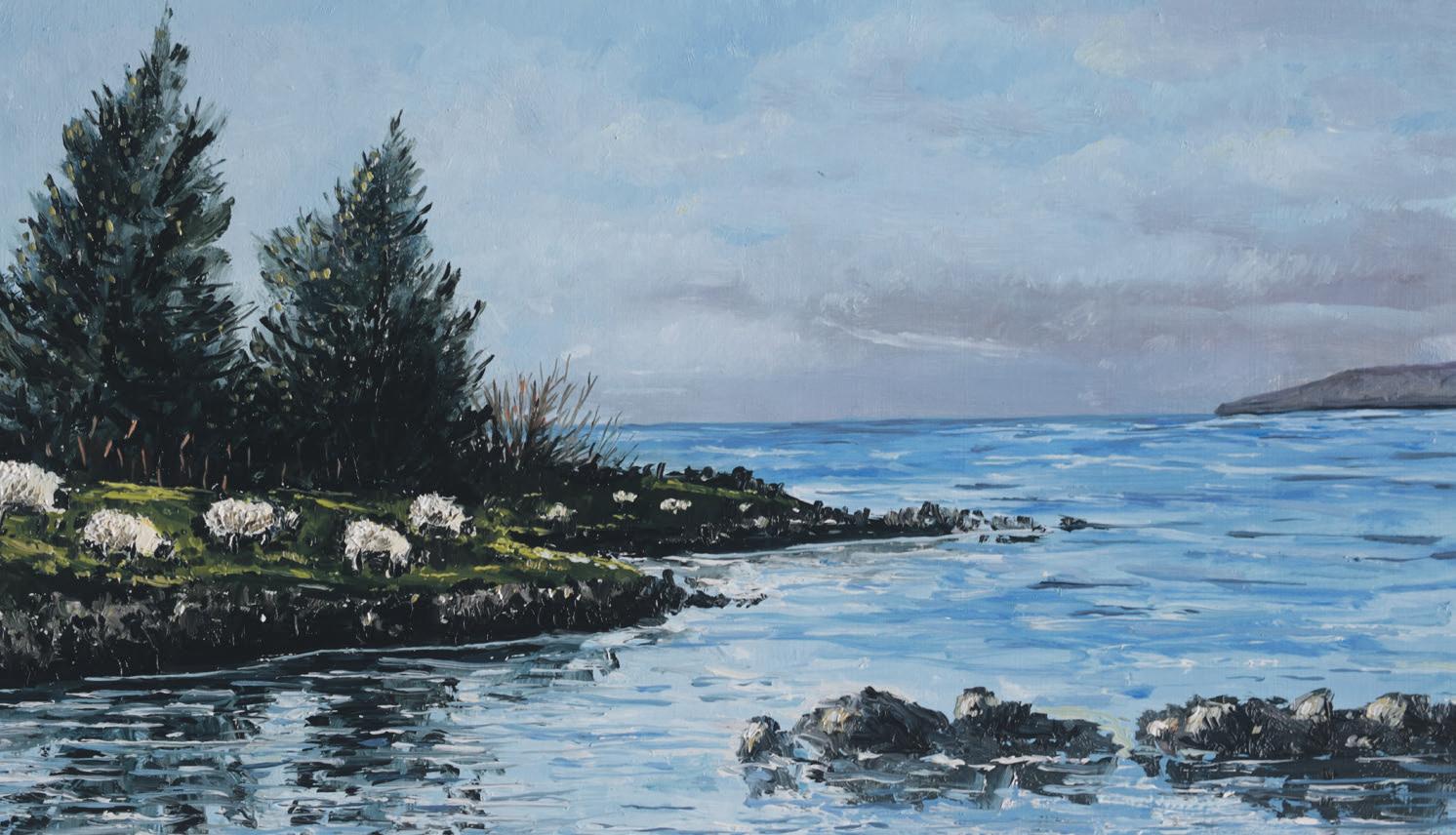
Cornelius Browne, Sheep on St Stephen's Day 2025; photograph by Paula Corcoran.
Art Work Municipal Walker
LIAN BELL DISCUSSES A MONTHLY RITUALISED WALK AROUND DUBLIN UNDERTAKEN AS AN ACT OF CIVIC CARE.
WHAT RESPONSIBILITY DO we have as citizens to the maintenance of our cities? What constitutes maintenance? In 1577, the Corporation of Dublin City decided that a man should be paid to ring a bell “in tyme of greate tempest and storms” to remind citizens to pray for their neighbours in danger on the seas. In the 1980s, a man called Derek Howe took it upon himself to wash Dublin’s parking meters, patrolling the streets with a bucket and rag until the Corporation gave him a job (or at least that’s how my mother told it). In September 2022, I began walking for the good of the city. I follow the same circular route once monthly, wearing a hi-vis vest, printed with a modified Dublin City Council logo and the words Municipal Walker | Fánaí Bardasach
Can walking patterns energetically impact a place? In 2018, I installed Work Walk, a largescale labyrinth, made of the red and white tape found around roadworks, in the courtyard of the Centre Culturel Irlandais, Paris. I was considering the patterned movements of generations of artists in residence, walking out from the building into the city and back again as they mulled over their work, highlighting the invisible labour always unfolding within an artist’s mind. Walking as work. Researching labyrinths and their myriad uses, I learned about those found across northern Europe, marked out with stones; fishermen walked them for good weather and a bountiful catch before setting out to sea. Walking to influence one’s environment.
The Municipal Walker’s monthly circumambulation of Dublin, maintained for the good of the city, follows the North and South Circular Roads, taking roughly 3.5 hours to complete. Over the years, the walk has accrued particular ceremonial and bureaucratic parameters (the hi-vis vest, certain stopping points, and actions en route), but the actual work remains the walk itself, through ritualised and durational repetition. Having resisted documenting anything for a long time, by early 2024 a mundane bureaucracy had evolved: the Municipal Walker now snaps a series of photographs at particular locations as she walks. Afterwards, she writes a short report on what was noticed – proof of each iteration of maintenance. It’s tedious, but it’s hard to stop now; what if the Council requested to see the notes?
Tuesday morning. Warm, grey, and windy Man on NCR picking individual leaves from the pavement to put in the gutter
Buddleia out everywhere
Nod from a DCC worker in a van
Kid and his mother in pyjamas on the front steps
Group of hi-vis people outside Mountjoy. Nod from woman
Smell of rancid bins in places all along the route
Oasis signage leftovers still near Croke Park Incongruous tourists walking towards Summerhill
A lot more rubbish and dogshit than usual
Half-recognised as a council worker –something not quite right, maybe – a greyhaired woman in yellow hi-vis attunes herself to the atmospherics of the city with sensitivity. What kind of person walks the streets in council uniform? What kind of labour gets overlooked? Sniffing the air, she wonders where does the city end and her body begin? What makes the city? The bricks, the dogs, the windows, the grey particles on the breeze, the litter, the drizzle, the fumes, the shout across the street, the concrete, the pigeons, the car tyres, the plants growing in cracks, the call of seagulls, the tarmac, the look on people’s faces, the wet leaves underfoot, the traffic lights; perhaps also the traces of those who walked the same pavements long before us.
In discussions with Jessica O’Donnell, Head of Education and Community Outreach at the Hugh Lane Gallery, a second Municipal Walk was created in 2024 as a technique of tuning into the artist Sarah Purser (1848–1943) and her exceptional legacy. Arguably, her most important work was ephemeral in nature. Strategy, conversation, badgering, hospitality, management, critique, championing, and diplomacy; the work that is too easily forgotten or disregarded. The Sarah Purser Municipal Walk, open to the public and maintained annually for three years, links sites of significance in Purser’s life. The Municipal Walker offers gentle tactics of noticing the city afresh, while we attempt to attune to how Purser’s body inhabited the city. We walk together with her, separated only by time.
After three years of simply walking each month, without sharing what I was doing publicly, I began seeding glimpses of the Municipal Walker practice in 2025. The hi-vis vest and a doctored DCC application form featured in the exhibition ‘Art Made by Walking’ at Axis Ballymun last April. The Dublin Inquirer published an interview. The Municipal Walker was shortlisted for the international Marŝarto Awards for walking art. The practice exists in the minds of those who have read about it, as well as who notice it on the streets: those very few who read the hi-vis and look up ‘Municipal Walker’ or the even fewer who stop her to ask questions. However you come across the work, you can rest assured that the Municipal Walker is doing good for the city every month. Whether or not you ever see her, the work continues.
Lian Bell is an artist and arts worker based in Dublin. lianbell.com
VAI Helpdesk
The Business of Art
VAI ADVOCACY OFFICER BRIAN KIELT OUTLINES SOME FINANCIAL ADVICE AND RESOURCES FOR VISUAL ARTISTS.
I’VE BEEN WORKING with VAI for nearly three years, in the role of advocacy and advice, delivering free, weekly, one-to-one helpdesks for artists. Looking closely at the diversity of topics raised during these sessions, it’s clear that the business of art – including self-employment status, taxation, and pricing – is a major source of anxiety. Finance related queries remain relevant to artists throughout their careers. In this column, I will offer some general advice and share some practical resources.
Tax and Self-Employment
When treating your art practice as a professional business, record-keeping is non-negotiable. Best practice involves registering with Revenue (RoI) or HMRC (NI) as soon as you begin earning. Maintain a dedicated folder for receipts – from studio rent and materials to travel and research books. Self-employment also allows access to tailored supports like the Artist’s Jobseekers Scheme (RoI) which recognises the unique nature of creative work cycles. If based in Northern Ireland, be aware that ‘Making Tax Digital’ (MTD) is moving to software-based self-assessment, which is being rolled out incrementally over the next three years. Using MTD-compatible software prevents deadline panic and ensures you are only paying tax on your actual profits.
Pricing Your Work
For pricing, use the VAI Payment Guidelines as a baseline and value your time and skill confidently. Many artists suffer from imposter syndrome when setting prices, often asking how to factor in gallery commissions or multiples, like print editions. As laid out in the VAI Knowledge Base, establish a ‘wholesale price’ first: (Labour x Time) + Materials + Overheads + 10% contingency + Profit = Wholesale Price. Your retail price then adds the commission (typically between 30 and 50%). Maintaining ‘price integrity’ – ensuring work costs the same in a gallery as it does from the studio – is vital for building trust and protecting your reputation.
VAT and Artists
VAT is a frequent point of confusion, particularly regarding mandatory registration thresholds. Artists often ask if they should register voluntarily even if their turnover is low. Thresholds have recently increased to €42,500 for services and €85,000 for goods. In NI, the threshold is currently £90,000. Monitor your 12-month turnover closely. While registration allows you to reclaim VAT on expensive inputs, like bronze casting or large-scale equipment, it also means adding VAT to your overall sales price.
Artist’s Tax Exemption
Learn the basics of the Artist’s Tax Exemption (Section 195 TCA 1997), which exempts up to €50,000 of income from original and creative works from income tax if officially determined by Revenue. Artists often ask whether
grants or residencies qualify. Generally, if the income comes from the creation of the work, it may be exempt. Apply to Revenue as soon as you have a body of work or a published or exhibited piece. Remember, even if your income is exempt, you must still file an annual tax return and pay PRSI and USC on the earnings.
Pensions
Pensions are often overlooked by self-employed artists until later in their career. The most common question is how to bridge gaps in social insurance contributions during lean years. Try to ensure you are paying Class S PRSI (RoI) or Class 2/4 National Insurance (NI) to maintain your entitlement to the state pension. Personal Retirement Savings Accounts (PRSA) can be highly tax efficient, as contributions are deducted from your gross income, reducing your overall tax bill while building a vital safety net.
VAI Resources:
Knowledge Base: Located on the VAI website, this is the definitive resource for professional visual artists. It covers everything from tax registration and allowable expenses to tax returns and VAT thresholds (visualartists.ie). Payment Guidelines Calculator: Use this tool to request fair fees for residencies, talks, and facilitation. It provides a transparent framework for calculating rates based on current industry standards, allowing you to present professional, itemised budgets. Finance Webinars: VAI regularly hosts webinars delivered by financial experts who address nuanced scenarios specific to the arts. Sign up to the weekly eBulletin for upcoming events, or access recordings of previous sessions in the Members Area of the VAI website.
Additional Support
For bespoke advice, consult websites such as: Revenue.ie, citizensinformation.ie, HMRC. gov.uk, adviceni.net, or nidirect.gov.uk. If your practice involves complex VAT scenarios, seek accountants specialising in the creative sector. Organisations like Chartered Accountants Ireland can provide directories of specialists. The high demand for financial advice underscores a clear truth: a sustainable art practice is an informed one. The VAI Helpdesk connects artists to the practical knowledge they need to flourish. By engaging with these resources, you can move beyond the studio to build a resilient, professional career. You don’t have to navigate alone.
Brian Kielt is VAI Advocacy and Advice for Northern Ireland and Shared Island Advocate.
Between My Finger and My Thumb
JOSEPH
MCBRINN
INTERVIEWS ARTIST CLAIRE CURNEEN ABOUT HER TOURING EXHIBITION.
Joseph McBrinn: Your new show might be described as a mini retrospective. Does it contain some sort of overview of your work to date, or is it more a contemplation and continuation of your longstanding thematic and material interests?
Claire Curneen: This exhibition brings together a collection of works since 2020 that have been in my studio. Some were made during lockdown, a time when I worked without much consideration for the outside world. The works lived in dialogue with each other. Now out of the studio and into the spaces of The Drawing School Gallery at Eton College, they create new narratives, each piece charged with a sense of its own identity, some precise, others vague. They are presented in an ordered manner, on tall pillar plinths of the same size, so that the viewer can move between them. In the other half of the gallery, five large, glazed, majolica terracotta trees are arranged in a group. They are uprooted with exposed roots, some branches becoming hands and fingertips. These works draw on the story of Apollo and Daphne, in which Daphne prays to the gods and is turned into a tree. Unlike Bernini’s sculpture of the same name, in which we witness Daphne’s bodily transformation, my sculptures are all tree and very little Daphne!
JMcB: The images of bodies in your work speak to a long art historical tradition of representing religious experience, from contemplation to ecstasy, especially in sculpture. However, perhaps you are drawing from a more personal iconography of saints and martyrs?
CC: Communicating the ineffable is what I strive for; I don’t want to explain everything. In fact, it’s the mystery of these things that interests and surprises me. Religious
devotion holds that kind of mystery for me, because it’s what makes us human. Making a piece of art is also an act of faith; I see them as similar paths. The church was a place where I discovered art when I was young. I remember two large marble angels in St. John’s Church in Tralee. You could run your hands all over them; they were intoxicating, almost sexy. The coolness of the marble resonated with me. It’s a bit like porcelain, which has this extraordinary way of holding light. It’s very powerful.
JMcB: Clay is a malleable but modest material. Why does it appeal to you?
CC: I love clay’s immediacy. I’m impatient and keen to get an idea happening quickly. This is followed by a drying time, when everything slows down, and I can model detailed areas like the hands and face. Then the figure begins to have presence and there is a moment when we confront each other. Terracotta has a down-to-earth quality (quite literally) while porcelain comes with its own historical baggage, and this rich history of ceramics weaves into the works. I’m trained in the studio pottery tradition and often refer to the vessel as a starting point. These bodies are made like pots, using the same terms: foot, body, belly, neck.
JMcB: The strategic placement of colour in your work is discernible. Your use of gold lustre, for example, on lips, fingers, and wounds, makes me think of Roland Barthes’ concept of the ‘punctum’ – a seemingly incidental detail in a work of art, like a kind of sting, cut, or bruise that elicits meaning and emotion in the viewer. CC: I often use gold and cobalt blue because of the melting properties, and how these feel, as though they are still
in a liquid state, suggesting that the figure is in flux or that something is moving within them. The glaze on the figure is brought to a high melting point in the kiln and held there. Blue and gold bleeds over the body from mouth, eyes, and wounds. In figures such as Empty Tomb (2020), porcelain is decorated in cobalt and gold motifs. Gold carries with it notions of value.
JMcB: The title of your exhibition, ‘Between my finger and my thumb’, comes from the opening couplet of Seamus Heaney’s poem, Digging, published in his first book, Death of a Naturalist (Faber and Faber, 1966). How do you see the line in relation to this body of work?
CC: I love the sound of the poem by Heaney, with terms like ‘rasping’ ‘cool hardness’ and ‘sloppy’. You would be tempted to think of clay in the hand, squeezing and forming, but I see in this title a nod to creative labour – an idea taking form through physical effort.
Dr Joseph McBrinn is an Irish art historian and Reader in Art and Design History at Belfast School of Art. ulster.ac.uk
Claire Curneen is an Irish ceramic artist who lives and works in Wales. Her solo exhibition, ‘Between my finger and my thumb’ continues until 15 March at The Drawing School Gallery, Eton College, Berkshire. It will then be presented at Ruthin Craft Centre in north Wales from 28 March to June. clairecurneen.com
Claire Curneen, Empty Tomb, 2020, porcelain, 78 x 28 x 30 cm; photograph by Dewi Tannatt Lloyd, courtesy of the artist.
Desire Lines
OUTLINES A SCREENING PROGRAMME
EXPERIMENTAL FILM ORGANISED BY AEMI.
‘DESIRE LINES’ IS a touring programme by aemi – a Dublin-based initiative that supports and exhibits moving image works by artists and experimental filmmakers – that premiered at the Irish Film Institute on 22 January. As stated by Sara Ahmed in Queer Phenomenology: Orientations, Objects, Others (Duke University Press, 2006), desire lines “describe unofficial paths, those marks left on the ground that show everyday comings and goings, where people deviate from the paths they are supposed to follow.” The aemi programme brings together the work of contemporary Irish and international practitioners exploring forms of deviation and resistance, both individual and collective.
The city of Paris provides a seductive patina for Irish artist Chloe Brenan’s short film, Verdigris (2025). A mercurial blue-green oxidises the city’s monuments; it is a colour, the film notes, that resists regulation. In palimpsest-like layers, Brenan isolates Parisian infrastructure, revealing how spatial order has been historically shaped. Beginning with French architect Hector Guimard’s standardised Métro interiors, the film rises to street level, where this logic of uniformity finds its precedent in Georges-Eugène Haussmann’s 1853 redesign of Paris, which imposed linear order and funnelled movement along controlled axes. The film situates Parisian space as historically contingent, referencing the 1961 curfew imposed on Algerian residents, including psychogeographer and Situationist International member, Abdelhafid Khatib. Brenan’s closely cropped shots accumulate with textural fluidity and conclude with a desire line in Porte Dauphine, located in the 16th arrondissement, which subverts Haussmann’s rigid vistas. While Verdigris traces the city’s circulatory systems, Morning Circle / Morgenkreis (2025) by Basma al-Sharif, a filmmaker of Palestinian heritage, turns inward. In the apartment he shares with his son Adnan, Mr Abrahayman is interrogated by a disembodied German authority, which questions his origins and compliance: “Are you Muslim? Have EMMA BATTLEBURY
Left: Eóin Heaney, Parish, 2024, 27 mins.; Right: Collectif Faire-Part, Speech for a Melting Statue, 2023, 10 mins.; all film stills courtesy of the artists and aemi.
you formed an attachment to our way of life?” The camera tilts with cloying surveillance as Abrahayman confronts an environment that conveys openness but denies expression, while Adnan experiences separation anxiety at school. The film climaxes with an emulsion-burned montage, blending footage of Gazans returning home with classroom scenes that dissolve into psychedelia, as Adnan escapes the kindergarten morning circle. The song Benhayyi Al-Baghbaghan (Salute the Parrot) offers a satirical nod to the obedience and mimicry of the exilic condition.
Speech for a Melting Statue (2023) by Collectif FairePart, an ensemble of Belgian and Congolese artists, unfolds across dual timelines, with two nations and a monument to King Leopold II eliciting opposing responses: a colonial history in stasis, and a Congolese refusal to sanction its commemoration. Located within walking distance of Matongé, a Congolese neighbourhood in Brussels, the statue undergoes a charged reappraisal amidst the Black Lives Matter protests of 2020. Meanwhile, footage shot in the early 2000s in Kinshasa (the capital city of the Democratic Republic of the Congo) shows another statue of Leopold II, long removed from public display, dangling from a crane. The film’s mise-en-abyme deepens geographically; near to Kinshasa lies a district called Matongé, after which the Brussels municipality is named. “Names usually travel in the other direction,” notes poet Marie Paule Mugeni, as she prepares a speech anticipating the statue’s removal. Archival footage of Kinshasa’s dismantled monument is projected onto the Belgian plinth – an act of quiet futurity, signalling that the colonial presence is no longer frozen in authority.
Irish artist Olivia Normile’s stop-motion animation, as above, so below (Limits and Demonstrations) (2025), presents a scaled-down world in which time is composed rather than captured. Cut-out shapes form shifting constellations, which multiply and disperse within the frame. This mediation between language and abstraction reappears in a second film by Normile, titled Body Diagrams (Limits and Demonstrations) (2025). Adopting a diptych form, a handwritten term appears on the right-hand side of the screen with a drawing on the left. Normile’s drawings reinscribe visceral experience, mapping embodied sensations and the limits of language.
In Eóin Heaney’s Parish (2024), the suburban landscape of Dublin’s Sandyford is rigged with psychological cues, revealing a republic stratified by religion, mythology, and imperial residue. Sites of previous Anglo-Irish authority sit in uneasy proximity to remnants of Republican violence, while folklore is punctured by accounts of contemporary crises. An ensemble cast “beats the parish bounds,” in a ritual used to conserve borders and memory. Flitting between Euro-trance and industrial soundscapes, the film’s dexterity of tone is held in tension through slippage between historical fact and pastoral surrealism. As the group surveys the land, history is activated. For one of the members, Pat, the journey becomes an excavation of memory, engulfing him in episodic dissociation. Ultimately, he finds solace in the group, just as Parish offers a detour from the privatised coping of modern life – less a lament for lost tradition than a reassertion of community.
Emma Battlebury is a multi-disciplinary artist and painter based in Dublin.
Top: Olivia Normile, as above, so below (Limits and Demonstrations), 2025, 3 mins.; Middle: Basma al-Sharif, Morning Circle / Morgenkreis, 2025, 21 mins.; Bottom: Chloe Brenan, Verdigris 2025, 12 mins.; all film stills courtesy of the artists and aemi.
Lattices of Love
SARAH BROWNE DESCRIBES WORKHOUSE UNION PROJECT EXPLORING RELATIONAL UNDERSTANDINGS OF CARE.
IN 2025, I was invited by Workhouse Union to be a respondent artist to the project Lattices of Love: Navigating Uncaring Structures, led by care activist Thom Stewart, and with a team including Workhouse Union creative director Rosie Lynch and producer Noortje van Deursen. Based in a former workhouse in Callan, County Kilkenny, Workhouse Union is a community co-design organisation that uses creativity to bring people together around complex needs and challenges. The organisation is deeply informed by the ethos of the Camphill communities – intentional communities established in the locality from the late-1970s to cultivate dignified forms of communal life for people with and without disability or support needs, living and working together. This relational understanding of care, as an embodied interdependence rather than a transactional service, continues to shape the practice of Workhouse Union. It also challenges who typically creates and participates in culture, collective decision-making, and the stewardship of land and housing in communities.
This context forms the backdrop to Lattices of Love. While ‘care’ has been a consistent thematic in visual arts and curatorial discourse in recent years, this project engages with care
more sharply as it is defined by governmental agencies, particularly within the health and disability services. Its focus is the crisis in the Irish care system. Social care academic Mark Garavan, also involved in the project, has identified this as the result of a shift from an institutionalised care paradigm that focused on confinement, to a professionalised care paradigm that focuses on commodity.1
Project lead, Thom, advocates for an approach to the concept and management of ‘mental healthcare’ that critiques the power relations structuring its spaces, through community action and the solidarity of peer support. Thom is invested in processes of co-production, that is, the active involvement of people who require support in choosing and designing what supports they actually need.2 He initiated the Galway Community Café on this basis, which has become Ireland’s first out-of-hours peer support centre for people experiencing mental health emergencies. This involved an arts-led, multi-stakeholder, codesign process, including a series of workshops within the café where HSE workers took on the role of incomers. These workers were then met by people who themselves had previous experience of presenting in crisis at Accident and Emergency. How can meaningful care
be provided, including in hospitals, in ways that respect the desires and choices of the person in need? How can quality care be provided within a neoliberal system in which professional and family carers are themselves burnt out and exhausted? These are some of the questions that Lattices of Love set out to explore.
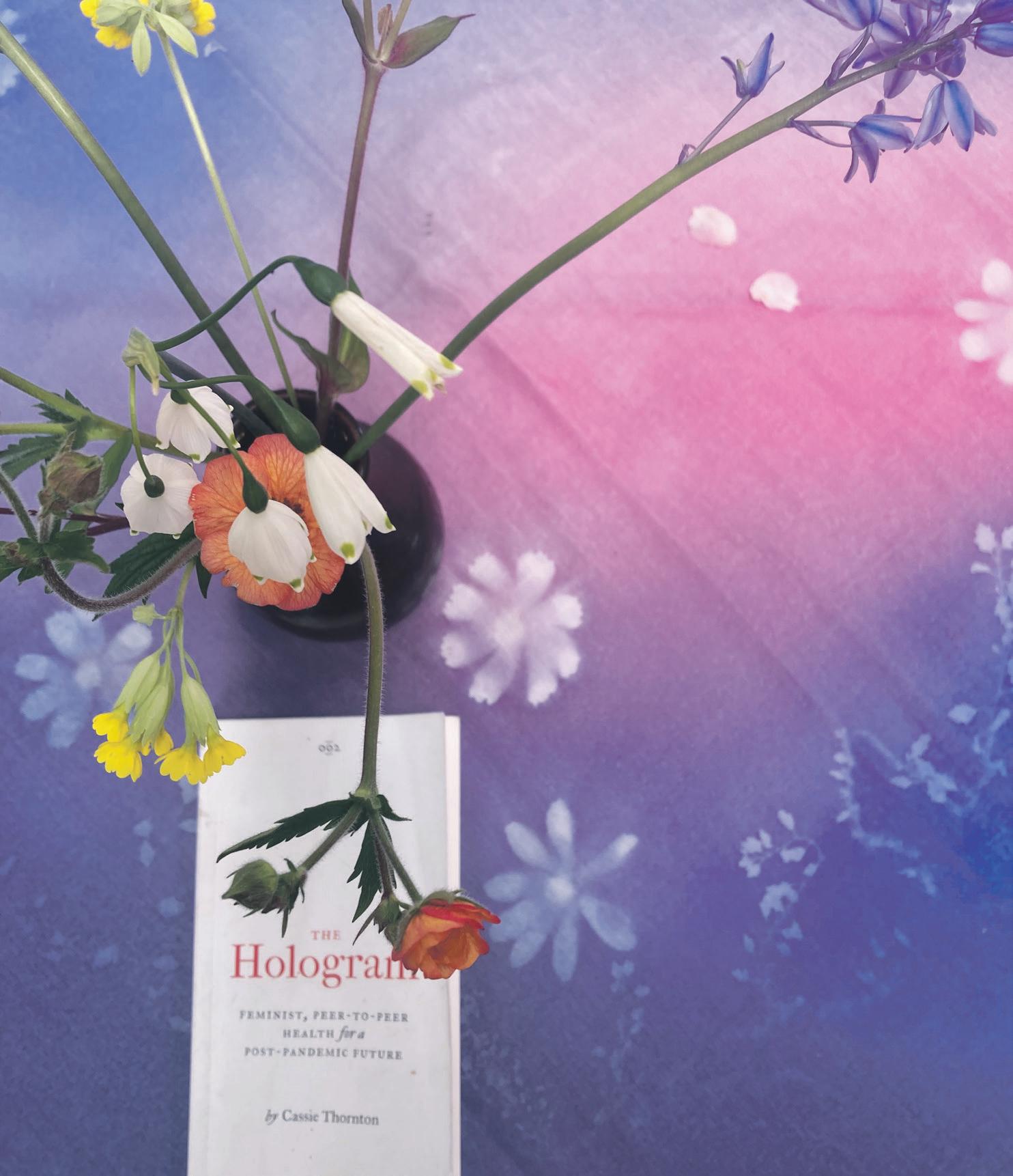
Thom invited artist Cassie Thornton to test how her project, The Hologram (Pluto Press, 2020), could inform the Irish context. Part artwork and part social technology, The Hologram is inspired by the Social Solidarity Clinic of Thessaloniki in Greece, where medics during the financial crisis organised to deliver free healthcare. In this model, incomers were met by a medical doctor, a psychologist, and a social worker simultaneously, in order to collectively plan a course of treatment. The Hologram takes on a similar configuration, but outside a clinical setting, where a ‘triangle’ of non-experts meets regularly to focus on the physical, emotional and social dimensions of health of the person requesting care (who is known as a ‘hologram’). Following a certain protocol, the core activity is the asking of curious questions, followed by offering reflections and in conclusion, a wish. In time, the triangle members are supported to each set up their own triangle, outside the group. In this way, the network replicates and expands, without any money changing hands.3
During our first in-person gathering in Callan last April, we agreed on the following roles for ourselves within the project: Thom as the lead sketcher, forager and glue; Rosie as the grounder and shaper; Cassie as the wizard; Mark as the storyteller; I the digester, fermenter; while Noortje ‘tends the container’ of the project. The main public focus of the year were two workshops held in Athenry and Galway, introducing the method of The Hologram through practical demonstration. These meetings brought together experts-by-experience and peer supporters, health and disability advocates, and people interested in care, community-building, or art as a medium for social change. Bridging personal and social experience, the workshops aimed to explore how different modes of questioning and witnessing could create a different imaginary of care, and ways of using these practices to deepen engagement with established systems and institutions.
In September, Thom and Rosie presented Lattices of Love at Casino for Social Medicine in Berlin at a gathering called On Mutiny and Federation: Pirate Care. Convened by Valeria Graziano, Marcell Mars and Tomislav Medak, it’s a transnational research project and a network of activists, scholars and practitioners who stand against the criminalisation of solidarity.4 In November, Thom presented the project at a conference in Cork organised by the Critical Voices Network Ireland, a coalition of people that advocates for a shift away from biomedical, individualising approaches to mental health that obscure the structural conditions underlying distress. Issues under discussion at the conference included
coercion, lack of treatment choices, abuse of professional power, discrimination, and inhumane physical conditions in hospital units.
Care-as-theme in the artworld can be invoked in softly moralistic, politically ambiguous ways. In Ireland, we should remember the cruelty that can be done in the name of care, and how it can be unwanted or coerced, particularly in institutional settings. Maeve O’Rourke describes how survivors of such abuses have, in certain legal processes, been deemed to be unreliable narrators of their own experience because “what they’re saying happened to them was torture within ostensibly a care setting… and that just is considered not actually possible.”5
The Mental Health Amendment Bill (2024), intended to update the Mental Health Act (2001), continues to raise concerns among advocacy and human rights organisations, such as those represented in Mental Health Reform. These concerns include the need for statutory rights to independent advocacy for those accessing services, and for stronger safeguards around the use of chemical restraint and involuntary detention.6
As Magdalena Jadwiga Härtelova says: “Reimagining is also a visual act. Part of the reason why social practice art, and with it The Hologram, choose to be ‘art’ (rather than, say, ‘social work’ or ‘education’) is because its practitioners are invested in the aesthetic beauty of ideas and relational practices.”7 While Lattices of Love is not straightforwardly an art or ‘arts and health’ project, artistic modes of engagement and imagination are central to the kinds of discussion and institutional access it requires. My fermentation process as a respondent artist will result in a text, published by Workhouse Union’s new imprint Prologue Press, joining another by Bridget O’Gorman responding to the theme of support, with both publications designed by Paul Bokslag and Kasia Kaminska. The next phase of the project will involve publishing Thom’s ‘playbook’, developed from learnings of the Galway workshops, which will be launched at a seminar in Callan in April (see workhouseunion.com).
Sarah Browne is an artist based in Cork working with spoken and unspoken, bodily experiences of knowledge, labour and justice. sarahbrowne.info
1 Mark Garavan, Care (Cork University Press, 2024) p20.
7 Magdalena Jadwiga Härtelova in Thornton, op. cit., p105.
Initial team meeting at Westcourt Living and Growing, Callan, April 2025; photograph by Noortje van Deursen, courtesy of Workhouse Union.
Waking The Land
THE ÁIT COLLECTIVE OUTLINE THEIR COLLABORATIVE ETHOS AND RECENT ACTIVITIES INCLUDING AN EXHIBITION AT THE DOCK..
THE ÁIT COLLECTIVE (previously ^) cultivates collaborative research, experimentation, and dissemination by working with the north County Leitrim community and landscape as mutual co-creators. To achieve this, we organise and host events in our workspace in the centre of Manorhamilton that we run together. This has taken multiple forms, such as social gatherings, symposia, rituals, workshops, walks, shared meals, and the exchanging of knowledge and stories.
Áit translates from the Irish language as ‘place’ or ‘position’. Our workspace is situated within a strong farming community, close to the border with Northern Ireland. It is ideally located to engage with audiences not usually reached by conventional art spaces. The collective was initiated by our outgoing member Shane Finan, and currently has four members: Tara Baoth Mooney, James Kelly, Laura McMorrow, and Sonya Swarte.
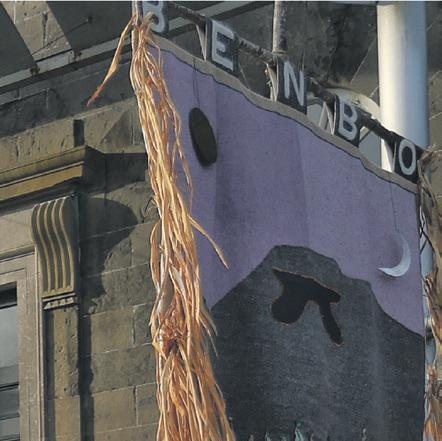
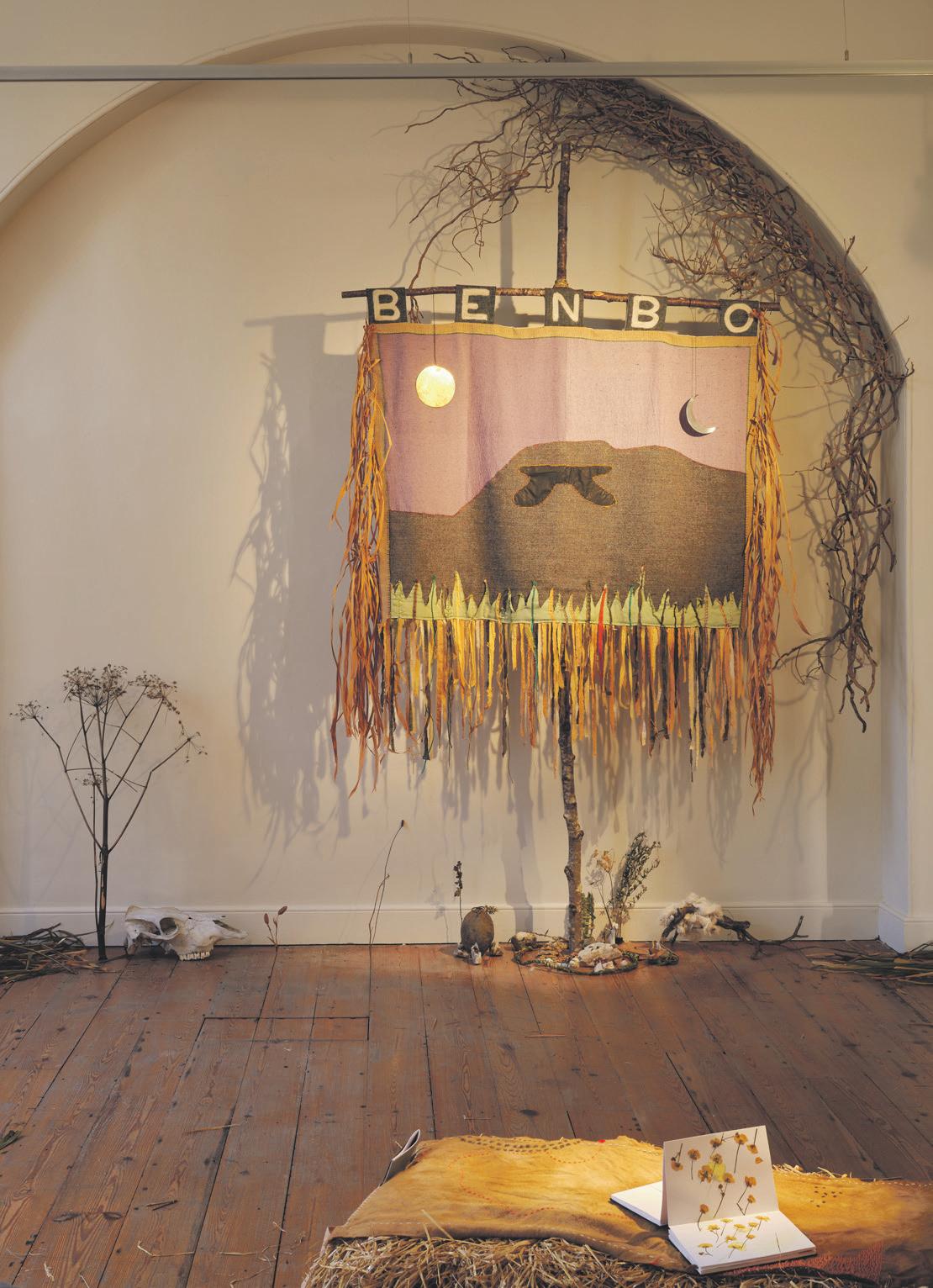
Our workspace is always in the shadow of Benbo Mountain – a constant, mutable presence in the town. The studio allows the collective members and community to explore art in a rural context. We believe that the creation of work rooted in place and the local landscape can enable innovative and meaningful collaborative work. The Áit collective is dedicated to creating collaborative works of art in the context of wildness. Our work within the space and beyond uses worlding practices that bring human and non-humans into community, conversation, encounter, and care.
Leitrim is distinct for its thriving ecosystems, supported by small-scale, low-impact farming and traditional land stewardship that allow wildlife and agriculture to co-exist. Meadows are the result of a very intentional balance of care between humans and the land. In comparison to other parts of Ireland, Leitrim has a much lower uptake of intensive farming practices, which has resulted in a unique habitat of semi-natural grasslands and rich biodiversity. However, due to the vulnerable nature of this land and the low population and rurality, Leitrim and surrounding areas have had to be defended over the years from hydraulic fracturing (fracking), immense wind turbines, overabundance of Sitka spruce forestry, and, most recently, gold prospecting in the Five Glens – distinct glacial valleys of the Dartry Mountain Range.
The work for our recent exhibition, ‘Waking The Land’ at The Dock in Carrick-on-Shannon (22 November 2025 – 14 February 2026), began with the potential loss of Benbo Mountain to extractive goldmining. We created a wake for the mountain to celebrate its life and liveliness and highlight its presence. We moved between ‘waking’ and ‘awakening’, presenting work that aimed to both wake and ‘waken’ the land and ourselves.
In ‘Waking The Land’, Áit collective honoured symbolic, spiritual, and poetic relations as much as material, ecological, and political ones. Our practice and discourse are shaped by this plurality, opening space for gestures that are not about solving or mastering, but about living-with, un-learning, and attuning to the more-than-human in all its complexity. The work was informed and led by encounters with Benbo Mountain, the meadow (five small meadow patches that we each tended and observed over the last nine months), and plant material from these different sites.
The main plant material used was Yellow Flag Iris, feileastram. Once used for fodder, bedding, dyeing and medicinal purposes, it is now relegated to the category of ‘weed’. It both thrives on and creates water-logged ground and reproduces quickly.
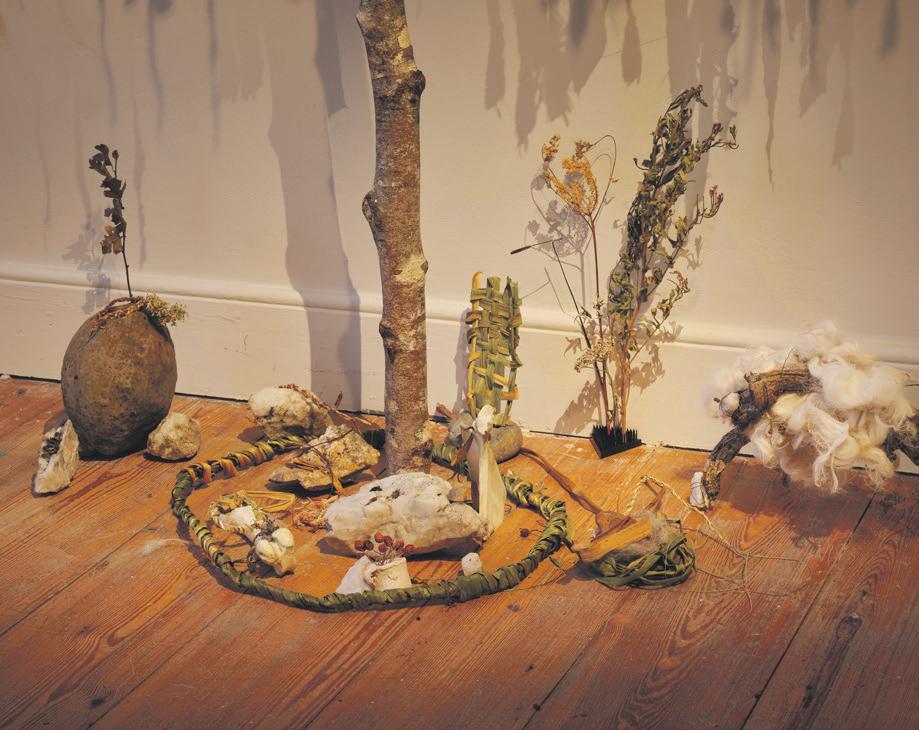
All of the materials used in the exhibition were found, collected or were already at hand. Wool was collected from the barbed wire fences; old bed sheets and a worn woollen
were dyed with yellow flag
root, and iron. A found piece of silk was presented as a mutable framing for the rhizome that dyed it. Hazel and Sally rods, a cow skull, rocks, seeds, plants, bones and other found entities accompanied us into the gallery space. The stitches in the banner bale covers follow the guidance of the materials themselves; the threaded paths are intuitive and purposely untethered from formal cartographic systems. In these gestures, land is reimagined as relationship rather than cartography, unfolding through tending and attention, as opposed to measuring and territory.
The outside world was invited inside to inhabit the former courthouse, a building once bound to order and judgement, now reimagined as a site of porous encounter. In this assemblage, we actively juxtaposed the building’s previous and current uses, co-locating histories of colonial order and classification with chaotic immediacy and unpredictable encounter.
An ‘opening ritual’ procession for ‘Waking the Land’ – acknowledged the potential loss of our beloved Benbo Mountain while also celebrating the reawakening of the vast life it breathes into our land.
The ÁIT Collective is based in Manorhamilton, County Leitrim. @wakingtheland
blanket
iris root, dock
‘Waking The Land’, opening procession and installation views, The Dock, November 2025; photographs by Anna Leask, courtesy of the artists and The Dock.
New Mythologies
AENGUS WOODS CONSIDERS THREE RECENT PHOTOGRAPHY EXHIBITIONS IN DUBLIN.
IN 1947, HAVING lived through the rise and fall of National Socialism, Theodor Adorno and Max Horkheimer posited that “myth is already enlightenment and enlightenment reverts to mythology.” The idea that science constituted progress or conversely, that the authenticity of cultural storytelling might provide some antidote to the scientific mindset, were both false in their view. The triumph of rationalism was just as much a tale as the wanderings of Odysseus, and both charted an equivalent obfuscation of lived experience by the forces of dogma. Put more simply, when myths run their course, we tend to just replace them with another.
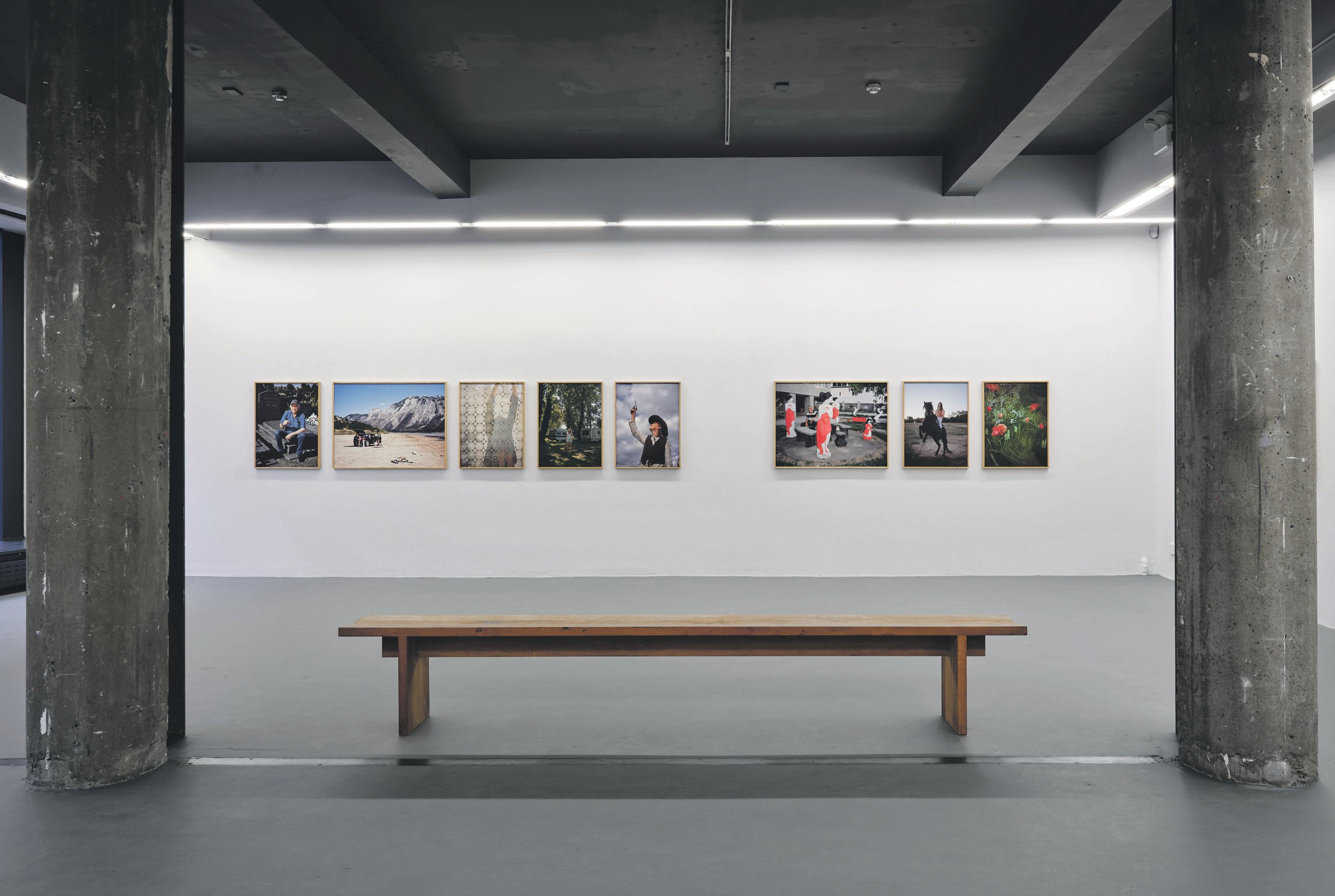
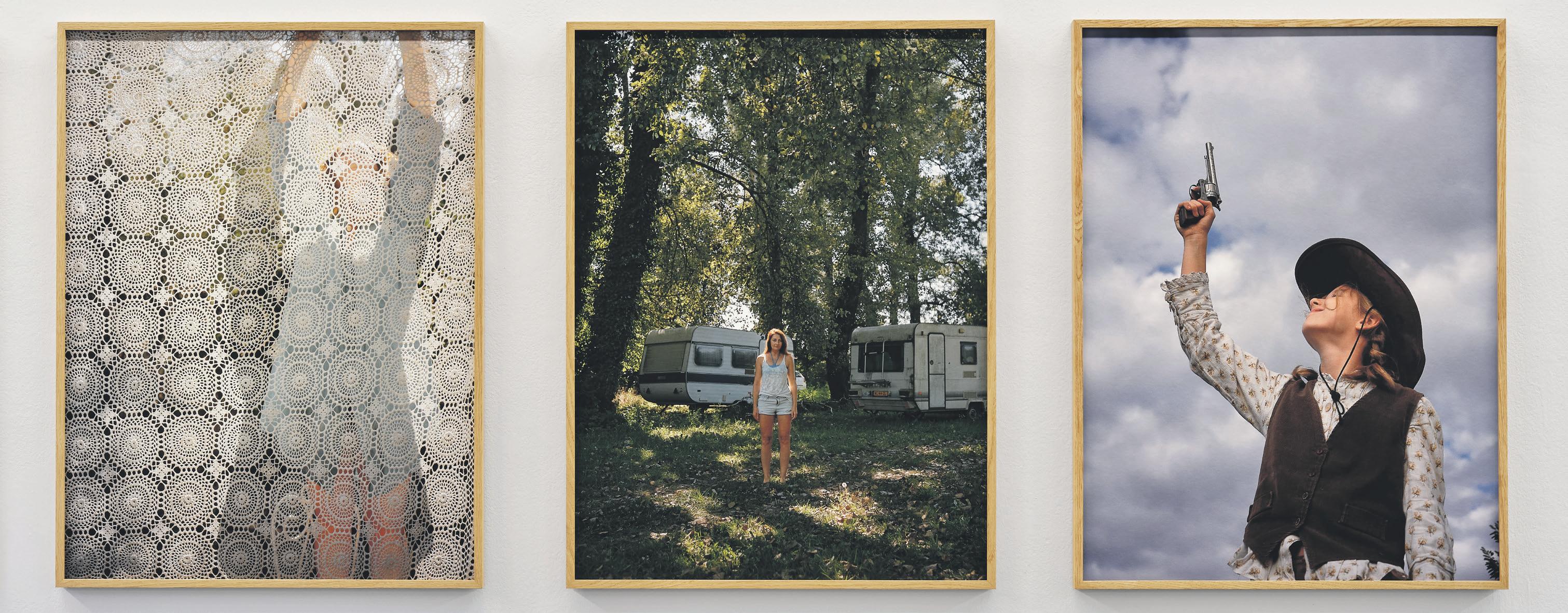
‘The Last Balkan Cowboy’, an exhibition of 23 photographs by Dragana Jurišić at Temple Bar Gallery + Studios (15 January to 1 March) seems to document scenes, locations, and characters connected to the artist’s larger project of the same name, a full-length documentary about the Yugoslavian filmmaker, Hari Džekson. A close friend of Jurišić’s father, himself a photographer, Džekson made eccentric cowboy movies in the wild landscapes of Bosnia and Herzegovina, in the manner of a Balkan spaghetti western.
Much as that filmmaker used local people as crew and cast, Jurišić populates her photographs with folk whose status as actors, locals, or passers-by are unclear. The artist herself, and also her father, appear in the images, giving us the sense that she is documenting a road trip while hunting for traces of the elusive filmmaker and the seeds of her own western mythmaking all at once. Yet there are also elegiac undertones, the sense that we are witnessing fragments of a Yugoslavia now committed to the pages of history, and in this, we see how mythologies can compete with each other – the myth of the nation and the myth of the rugged individual; country vs cowboy. Nonetheless that same history teaches us that both can perish and the remnants will look surprisingly similar. As the old Irish proverb goes: imíon na daoine
Dragana Jurišić, ‘The Last Balkan Cowboy’, Installation view, January 2025; photograph by Ros Kavanagh, courtesy of the artist and Temple Bar Gallery + Studios.
ach fanann na cnoc – people leave but the hills remain.
‘Urban Myth’ at Kevin Kavanagh gallery (8 January – 7 February) brings together a disparate set of photographic works, unifying them, albeit somewhat unevenly, under the idea that the unending flow of imagery from our devices constitutes a kind of real-time folklore – an incessantly shared record of human engagement whose very sharing seems to influence the trajectory of that flow.
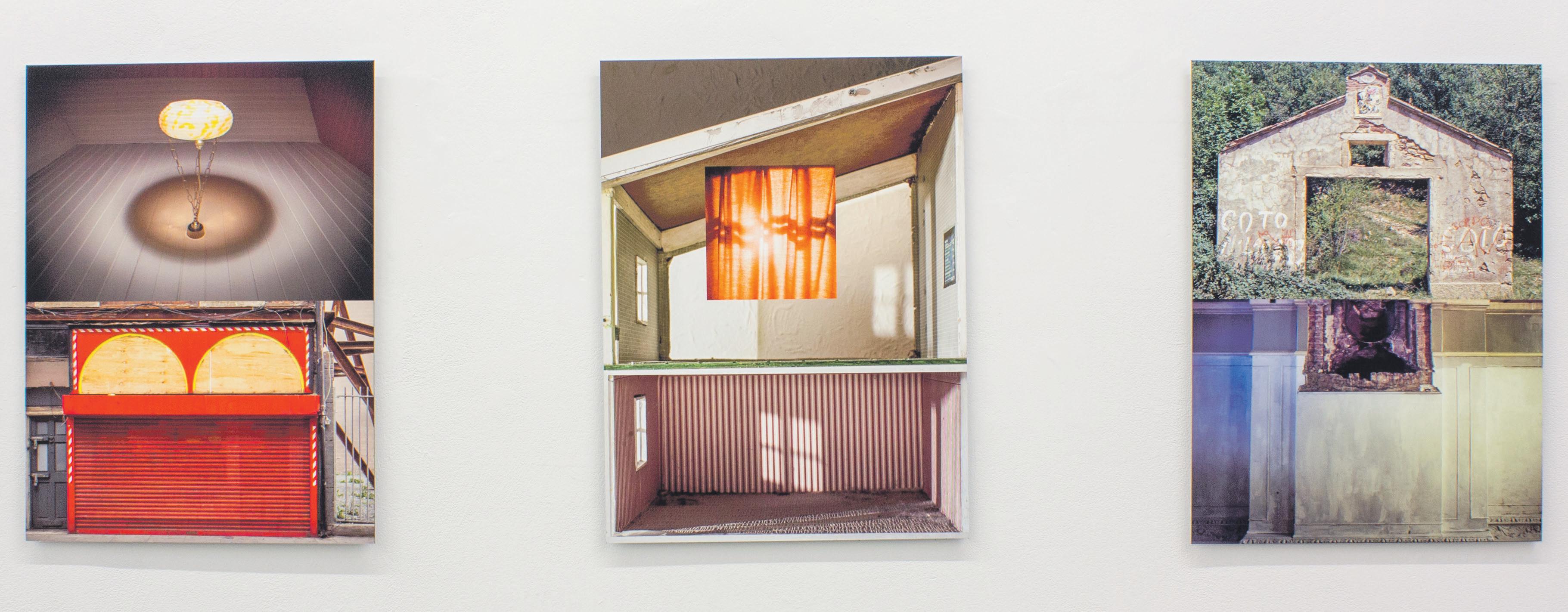
It’s a rich and provocative idea but in the context of this group exhibition, one feels that it might be more fruitfully brought to bear on a larger show that incorporated a broader range of image-making. Here, in an exhibit of tastefully presented photographs by professional practitioners, that sense of a new mythmaking seems to be confined to a general moodiness running through the works, as exemplified by the likes of Pine Needles (2021) by Adrian O’Carroll or Fog Vico Road (2005) by Gary Coyle. Nonetheless, an absorbing trio of works by Michael Boran are not so much photographic documents as they are
compositions created through precise manipulations of scale and juxtaposition of imagery.
As such, they point to those uncanny and unforeseen results of incessant image production where strange inlays, parallels and visual relationships appear on our screens constantly, combining and recombining ad infinitum
In the end however, it is another trio of photographs that sit most comfortably within the thematics of the show. Sean Lynch’s enigmatic works from his 2015 project, Adventure: Capital, present three views of a half-buried steel sculpture by John Burke. Originally commissioned for and located in a Cork housing estate in 1988, the sculpture, entitled Uniflow, was eventually removed from its site due to public concern over its apparent attraction of antisocial behavior. Its final location in a dumping ground was subsequently traced and documented by Lynch. The photographs presented here, offered with little in the way of explanatory material, are, like gossip and hearsay, wonderfully suggestive and mysterious, encapsulating both the end of one story and the start of a new one.
The most expansive exercise in mythmaking is offered by ‘AS IF’, a three-person collaborative show at the International Centre for the Image (6 February – 5 April). Eamon Doyle is a techno DJ and founder of D1 records, turned photographer, Niall Sweeney, is a designer and theatre-maker, while David Donohue is a composer in the broad field of electronic music. Weaving video, photography, animation, painting and text, they have created an immersive installation that is impressive in its scale and unified vision.
The viewer journeys through multiple rooms displaying large sets of framed and grouped gelatin prints, while multiple videos play, and numerous different sound sources bleed into each other. The imagery veers from stark abstractions to shots of human figures moving in restricted spaces and a series of grotesquely distorted faces. The sense of collaboration is strong, and the contributions of each artist come together in a remarkably seamless manner.
Drawing on Walter Benjamin and Guy Debord, the artists seem to present an uneasy
and foreboding vision of modernity, homing in on the tensions between individual creativity and the de-individuating forces within contemporary society. However, the whole show does seem to be packaged within a particular aesthetic, reminiscent (for this reviewer at least) of late 90s electronic music – The Designers Republic record sleeves, Chris Cunningham music videos, and minimal techno clubs. From this perspective, despite the exhibition’s tense and unsettling vision, it feels infected with a certain nostalgia. Sometimes the new stories just mask a hankering for the old. Nonetheless, as a collaborative installation by three artists displaying a fine sensitivity towards each other’s approaches, ‘AS IF’ is genuinely compelling and extraordinarily well achieved.
Aengus Woods is a writer and critic based in County Louth.
@aengus_woods
Dragana Jurišić, ‘The Last Balkan Cowboy’, Installation view, January 2025; photograph by Ros Kavanagh, courtesy of the artist and Temple Bar Gallery + Studios.
Michael Boran L-R: Strand Street Lullabye, 2025; The Annunciation, 2025; The Lake 2025, digital prints in aluminium; photograph courtesy of the artist and Kevin Kavanagh Gallery.
Eamonn Doyle, Niall Sweeney, David Donohoe, AS IF, 2026, film stills courtesy of the artists and International Centre for the Image.
Launch of ‘AS IF’, International Centre for the Image, 5 February 2026; photograph by Brian Cregan, courtesy of the artists and the International Centre for the Image.
CRITIQUE
Edition 84: March – April 2026
Oliver Jeffers, ‘Disasters and Interventions’, installation view, Naughton Gallery, December 2025; photograph by Jan McCullough, courtesy of the artist and Naughton Gallery.
CRITIQUE
Women Artists Action Group, ‘WAAG: An Archive’
Mermaid Arts Centre
17 January – 28 February 2026
AN ARCHIVE OFTEN results from fortuitous luck, foresight, or both, and its true value tends to emerge with time. Happily for posterity, a comprehensive collection of documents and ephemera relating to the Women Artists Action Group (1987 – 1991) is held at the National Irish Visual Arts Library (NIVAL). It was donated by chair and founding member of WAAG, Pauline Cummins. A selection of this material, which includes correspondence, newsletters, a draft constitution, catalogues, and media clippings, was recently on display for the exhibition ‘WAAG: An Archive’ at Mermaid Arts Centre. Its curator Helena Tobin commented, this material facilitates an understanding of “what happened, how it happened, who was involved” and gives “a sense of the time, the context, and the labour.”1
Formed in 1987, around a farmhouse table in Clonmel, County Tipperary, the group –made up of artists, art historians, critics and curators, including Breeda Mooney, Veronica Bolay, Jenny Haughton, Patricia Hurl, Patricia McKenna, Louise Walsh, Alice Maher, and Kathy Prendergast – was outraged by the hostile environment for women practitioners. Their bold determination and unshackled ambition were bolstered by a backdrop of growing feminist and queer activism in Ireland and overseas in the late 80s.
Encouraged by Medb Ruane at the Arts Council, the group’s first task was to assemble a slide library to show the extent and range of women artists in Ireland. In July of that year, 91 artists were represented in a slide exhibition at Project Arts Centre, as part of the Third International Interdisciplinary Congress on Women in Dublin. ‘WAAG: An Archive’ is a fresh iteration of an exhibition last year at South Tipperary Arts Centre (2 May – 21 June 2025), organised in partnership with NIVAL.
The exhibition curators, Helena Tobin and Iris Vos, attended the launch at Mermaid Arts Centre alongside core WAAG members. The opening took place on a cold and wet January evening but was enthusiastically attended. As with archives, activism also resonates through time, often with contemporary and far-reaching impacts. Among the crowd that gathered were diverse generations for whom the notion of a small collective taking on an obstructive establishment was inspiring and, in some cases, emotional.
WAAG members’ testimonies and the material on view recall an era when typewriters and photocopiers were the height of technology. But, more forcefully, they revisit what Pauline Cummins considers “a decade of horror” in which tragedies such as the ‘Kerry babies’ case, and Ann Lovett’s death had occurred.2 It was a time when, all too often, the responsibility – and the blame – for reproduction was foisted on women within a repressive patriarchal regime.
For older visitors, the exhibition was an occasion for reminiscing. One woman commented that it acted as a bridge to a different past. Veronica Heywood took part in the inaugural WAAG show at the Guinness Hop Store in 1987. [‘WAAG II: Art Beyond Barriers’ was held at the Royal Hospital Kilmainham in 1989]. She recalled having the chilling realisation that a Dublin gallery willing to show the work of a female artist was
the exception at that time. It was indignation at this kind of mindset, she said, that sparked a movement that burned very bright for its duration.
Incredulity at the scale of WAAG’s actions was tangible at the launch. Alannah Henry, who was using the collective as a case study in feminist action for a teaching placement, was delighted to be attending an event that highlighted the group’s tireless work and accomplishments. Summing up its legacy, she and a companion noted how much more accessible the art world is for women now, while stressing the need for ongoing vigilance and responsiveness to ever-changing times.
The group’s activity culminated with ‘Women Artists and the Environment’, an ambitious WAAG event in June 1991, hosted in partnership with the International Association of Women in the Arts (IAWA) to celebrate Dublin as European City of Culture. It included site-responsive works by artists from abroad and a symposium at IMMA that was opened by President Mary Robinson, with a keynote speech by renowned American art activists, the Guerrilla Girls.
From small beginnings, WAAG developed as an entity with international reach. With NIWAG as its Northern Irish branch, membership of IAWA since 1988, and links within the US, work was also shown and events held overseas. By the time the collective ceased activity in 1991, its primary aims had been achieved.
Susan Campbell is a visual arts writer, art historian and artist.
1 WAAG Symposium, Part 1: WAAG Legacy, Dr Sarah Kelleher in conversation with artists Pauline Cummins and Louise Walsh, South Tipperary Arts Centre,10 May 2025, youtube.com.
2 Ibid.
Top: ‘WAAG: An Archive’, installation view, Mermaid Arts Centre, January 2025; Bottom: Jane Daly, Mary Fitzsimon, Neasa Hardiman, Margaret Lonergan, and Olwen Weekes, Hi, I’ve got my period!, t-shirt courtesy of Pauline Cummins, originally made for ‘WAAG II: Art Beyond Barriers’, Royal Hospital Kilmainham, August 1989; photographs by Michael Durand, courtesy of the artists and Mermaid Arts Centre.
Oliver Jeffers ‘Disasters and Interventions’ Naughton Gallery
4 December 2025 – 29 March 2026
‘DISASTERS AND INTERVENTIONS’ is an exhibition at Naughton Gallery of over 50 works by visual artist, and hugely successful children’s book author, Oliver Jeffers. This is the first exhibition of his work to take place in his home city of Belfast in over 20 years. It features a series of painted and collaged interventions on different surfaces and found materials – a treasure trove of schlocky paintings, antique engravings, and vintage photo albums. Visually, the work is closest to Jeffers’ charming book, There’s a Ghost in this House (HarperCollins, 2021), in which the artist paints his child protagonist onto archival photographs as she goes in search of hidden ghosts (which appear periodically on translucent pages, overlaying them onto the background imagery).
In the exhibition, there are specific references from the author’s oeuvre, not least the Hergé-inspired red space rocket from his book, How to Catch a Star (HarperCollins, 2014). It makes an appearance in A Point of Light in the Dark (2012), embedded nose first, having crash-landed in a reproduction landscape painting, originally hoked out of a Chinatown trash can. The rocket reappears next to a lake in Down on the Range (2025) – another dramatic landscape of distant, snow-capped mountains that could have been lifted from National Geographic. The spacecraft is one of a litany of crashed vessels and machines that includes blimps, jets, cars, buses, unexploded bombs, and Sputnik itself. Their juxtaposition emphasises the incongruity and absurdity of chance encounters.
Some of the titles incorporate humorous statements like “just give me a minute…” (emanating from a burning
house); “I’ll be back in two min” (trailing from the cockpit of a flaming fighter-jet); or “I’m fragile right now” (next to a porcelain variant of the crashed rocket). These pithy one-liners are deliberately silly, funny, and inventive, serving to trivialise disaster while exemplifying a typical Northern Irish black sense of humour – or indeed, a coping mechanism.
There are local references too: a DeLorean car is depicted, and an old Belfast bus is partly submerged in a lake. The Titanic makes several appearances: sinking impossibly into a small stream in Lost at Snow (2018) and embedded in rolling hills that resemble undulating waves in Lost at Hills (2025). In one torn painting, a crash-landed Concorde peeks through frayed canvas. The disaster works are clustered together over a custom-print wallpaper backdrop, showing a blown-up detail of an ideal Italianate landscape at sunset, serving again to highlight the irony of Jeffers’ drastic intrusions.
In many pieces, there is a distinct sense of characters remaining oblivious in the face of the artist’s interventions. For example, in There’s Nothing to Worry About (2019), a father and son driving two horses through a stream take no notice of the fire blazing in the back of their trap.
There are instances where the superimposed disaster replaces the perceived focal point of the original image: a flying DeLorean plunges into the sea, perhaps replacing a shipwreck in Rescue the Future (2018); while skiers surround a crashed Sputnik in flames in Moscow, We Have a Problem (2025). Like many of the artist’s additions, the latter shows beautifully observed details, such as the
peachy-pink glow of the burning satellite being picked up in the tonality of the surrounding snow and skiers. Yet this trompe-l’œil illusion is sabotaged by deliberately cartoonish flames and scribbly smoke plumes.
This kind of contrast appears in Shoe Shopping (2023), where the source image – a black-and-white photograph of a smiling child, seated in a shoe shop – has been doctored so that her outstretched leg appears to be severed at the shin, leaving a neon pink cross-section, from which juts a classic cartoon bone. Other works include tiny details, such as radioactive cleaning products in a kitchen, or a smoking figure, oblivious to the burning lump of lava about to hit his house.
Overall, in ‘Disaster and Interventions’, there is a sense of the artist’s freedom from the usual constraints imposed by his young readership. However, Jeffers is not one to hold back on geopolitical commentary – from Gaza and Ukraine to Minnesota and Iran – with American imperialism critiqued through elliptical and blackly humorous references. In one scene, tiny figures peep, like inmates through prison bars, from the crown of the Statue of Liberty, which is submerged to the shoulders in a vast sea. The caption simply reads: “Send help.”
Jonathan Brennan is a multi-disciplinary artist based in Belfast. jonathanbrennanart.com
Oliver Jeffers, ‘Disasters and Interventions’, installation view, Naughton Gallery, December 2025; photographs by Jan McCullough, courtesy of the artist and Naughton Gallery.
CRITIQUE
Elinor O’Donovan, ‘Metametamorphosis’
Sirius Arts Centre
24 January – 14 March
EMERGING ARTIST ELINOR O’Donovan is a self-proclaimed digital native. Her work spans filmmaking, digital collage, installation, drawing, and sculpture. Across her current solo exhibition ‘Metametamorphosis’, curated by Miguel Amado at Sirius Arts Centre in Cobh, she permits herself intuitive freewheeling and playful association with disparate technologies, blending them with analogue aesthetics and cultural tropes to pose questions about knowledge, memory, myth and truth.
The exhibition includes a series of framed digital photographic collages, which are flanked by sketchy, almost fugitive unframed drawings, all mounted on black gallery walls. The installation feels cavernous and resembles a giant mind-map, clustering around a large, floorbased, plywood-mounted screen. O’Donovan’s process is to assemble a broad array of elements and to focus on their interconnectedness, exploring how stories can shape understandings of ourselves and our environment. She reworks the genre of landscape, countering a post-digital reliance on screens by hand-building surreal and utopian environments, full of child-like wonder. There is a sense of fun and enclosure within these landscapes, into which cultural tropes, museum artifacts, scribbles, thought bubbles, and sigils converse and circulate.
The digital collages and drawings were inspired by and extend the HD video Metametamorphosis (2024), which is 5 minutes and 34 seconds in length. It begins with the mischievous invocation of Gregor Samsa, cockroach and protagonist of Kafka’s 1915 existential novella, The Metamorphosis. Samsa awakes after a restless night to discover that he’s turned into The Beatles – all of them at once. John, Paul, George and Ringo are loosely profiled, their likeness simulated using deep-fake software, dance moves and location association.
The faltering narrative dissolves into a soundtrack of groans and humming, emerging finally into the strains of The Beatles song, Here, There and Everywhere, sung by busker Jules Avalon in Central Park, New York. The imagery glitches until the viewer is forced to contend with a four-channel screen. Simultaneously, we are in India, New York, and a bedroom in Cork. There is a sense of entropy as we flit between these microcosms, puzzling over real and imaginary elements. Meanwhile, shipping traffic from Cork Harbour, framed in the gallery’s beautiful Italianate windows, flows by and is drawn into the installation; it all feels equivocal in a post-modern world, shaped by hyper-connectivity and economic and political insecurity.
O’Donovan also created the installation Winter Sun (2024), currently projected onto the façade of the Triskel Arts Centre for the winter months as part of Island City – Cork’s Sculpture Trail. Funded by Fáilte Ireland, with support from the National Sculpture Factory, the sculpture trail was initiated by Cork City Council in 2023 to commission six temporary public artworks for Cork city centre.
Winter Sun is a moving-image work that projects – and seasonally extends – the intergenerational practice of communal sundown worship. It depicts city dwellers gathering for summer sunset high on Patrick’s Hill at Bells Field in Cork – described by the artist as an iconic place of respite, with the best views of the city. A painting by John Butts, A View of Cork from Audley Place (c.1750), depicts the same scene and was the inspiration behind O’Donovan’s projection. In both works, time collapses as figures lounge in the gloaming, analogous silhouettes dissolving into glorious pink, green and golden tones. It’s a spiritually uplifting scene which recalls both Michel Foucault’s enigmatic concept of ‘heterotopia’ and Martin Heidegger’s ideas on ‘poetic dwelling’ – to live deeply by finding hope, wisdom and beauty in one’s surroundings. In winter darkness, Cork citizens are thus enriched and can comprehend why art is vital to their lives.
Jennifer Redmond is a multidisciplinary artist and writer based in Cork. jenniferredmond.com
Elinor O’Donovan, Winter Sun, 2025
Triskel Arts Centre
4 November 2025 – 30 April 2026
Elinor O’Donovan, anticlockwise from top: ‘Metametamorphosis’, installation view, Sirius Art Centre, January 2026; photograph by John Beasley, courtesy of the artist and Sirius Art Centre; Winter Sun, 2025, light projection, Triskel Arts Centre, November 2025; photograph by Clare Keogh, courtesy of the artist and Cork City Council; Metametamorphosis, 2025, HD video, colour, sound, 5’ 34’’; video still courtesy of the artist and Sirius Art Centre; Elinor O’Donovan, Metametamorphosis III, 2026, inkjet print, 48 x 60 cm; image courtesy of the artist and Sirius Art Centre.
‘IT’S
NOT CLEAR FROM HERE’ CCA Derry ~ Londonderry
17 January – 14 March 2026
AS I EXPLORED the group exhibition, ‘IT’S NOT CLEAR FROM HERE’ at CCA Derry ~ Londonderry, I experienced a peculiar sense of nostalgia. It stemmed from seeing old technologies that were familiar from my childhood and early adulthood – such as overhead projectors, TV monitors, and slide carousels – installed in the gallery space. This sensation is not surprising when we consider research on the phenomenon of ‘tech-nostalgia’, which involves a fondness or longing for outdated technology.
Curated by Ashleigh Wilson, ‘IT’S NOT CLEAR FROM HERE’ features Thomas Hunter, Sabi Nicholson and Lucy Tevlin, whose work is presented across all three gallery spaces at CCA. The exhibition taps into shared associations with outmoded devices, while the artists’ adaption of archival and found materials creates subjective, often autobiographical, narrative threads. Through lens-based media, they explore the precarity of images, which are shaped by time, technology and the act of looking. Each artist brings analogue technologies to our attention by reanimating them within the gallery setting, which begins to function more like a testing laboratory. Wallbased artworks and film projections share the space with installations of TV monitors on metal shelves. In many contemporary exhibitions, the mechanisms and means of display are often hidden away; however, here, these devices assume a sculptural dimension, becoming a visible and active component of the art.
Thomas Hunter presents a two-screen installation that combines his own footage with archival newsreel footage from the later years of The Troubles. The artist grew up in Belgium, so his experience of Ireland was largely mediated through family trips and news reportage of conflict. His projections feature idyllic imagery of rural landscapes in Sligo and Connemara, layered with news material from the North of Ireland. For example, a bright vista of Benbulben mountain is interrupted by the changing imagery of a press conference. A series of small monitors on shelves, positioned centrally in the gallery, features archival reference material, accompanied by a singular screen of flickering static, placed at a low level. Through our experience of the installation, we become active participants in distorted understandings of history and memory.
Sabi Nicholson’s dynamic installation addresses the ecological crisis at Lough Neagh. Nicholson’s projection is akin to a large-scale science experiment in which warped imagery (sourced from archival fishing documentaries) is projected onto the gallery wall through a suspended glass vessel, containing contaminated lough water. The visual and sound effects echo that of an ultrasound, with nature treated as a patient requiring urgent medical intervention. Lumen prints, made using local flora, are also shown.
Lucy Tevlin’s projected acetates feature works titled ‘The structure of a second’. These are texts which the artist writes after she has ordered 8mm film online, and while anticipating its arrival, to chart her sense of expectation. These are poetically charged staccato phrases and short sentences, designed to activate our visual awareness; they are numbered 1 to 24 to signify the standard of 24 frames within a filmed second. “Light falls over buildings in the distance/ Cascading/ Cascading/ Cascading/ An arrangement/ An expansion/ Cracks of white snow/ Dark clouds…” Alongside these text works, Tevlin presents the unopened rolls of film, which are exhibited as a finished artwork, and serve to perpetuate the mystique of the analogue process.
‘IT’S NOT CLEAR FROM HERE’ transforms the gallery into a space of shifting personal and collective narratives. Across photography and film, the presented works harness dislocated and elusive imagery to address shifting technologies and environmental crisis.
Dr Marianne O’Kane Boal is a critic and curator based in Donegal. She is President of AICA Ireland.
All images: ‘ITS NOT CLEAR FROM HERE’, installation view, January 2026; photographs by Paola Bernardelli, courtesy of the artists and CCA Derry ~ Londonderry.
CRITIQUE
Naomi Sex, ‘DRILL’
VISUAL Carlow
31 January – 10 May 2026
The Digital Gallery at VISUAL Carlow presents ‘DRILL’, a newly commissioned exhibition of moving image and sound installation by Naomi Sex. The artist has written and directed a suite of scripted performances that unfold across six large monitors, dispersed throughout the darkened space. The screens are positioned so that viewers must move between them, navigating the room as if traversing a court. Anchoring the installation is a wall-length photograph of a badminton post, shot side-on. The image implies an invisible boundary, inviting the audience to imagine the net extended across the room.
The films are populated with the paraphernalia of sport: free weights, gym mats, rackets, branded sportswear, and resistance bands in primary colours. The artist works with a combination of professional actors and non-actors, whose performances oscillate between heightened theatricality and awkward naturalism. We observe them in conversation with one another and, occasionally, with themselves. The gym becomes a site of rehearsal in which speech and social comportment are subjected to the same rigorous repetition as a forehand swing.
Across a single cycle, the six screens drift in and out of synchronisation. Distinct but interrelated micro-scenarios unfold: a character hesitates before speaking; another argues that they are made to apologise too frequently; someone fixates on how exposed they feel in their gym outfit; others confess to a persistent awkwardness in social situations. The scenes are absurd and faintly comic, their dialogue looping and misfiring with a Beckettian cadence. Language is stretched to reveal its gaps. Exchanges falter, apologies proliferate, intentions are misunderstood. The humour is dry, but the undercurrent is one of vulnerability.
This precariousness of speech is juxtaposed with the confidence of bodies in motion. When the performers rally a shuttlecock or engage in a choreographed drill, their movements are assured and elegant. In contrast, when they stand face to face, attempting ordinary conversation, their gestures stiffen. Arms fold defensively; gazes slide away. In one vignette, a group stands in formation, pulling taut, yellow, red, and blue resistance bands between them. The bands create literal lines of tension, stretching and vibrating as the performers lean back with controlled force. The image operates as a diagram of social strain: connection is maintained, but only through pressure.
The dialogue in these micro-scenarios suggests a deficit in social fluency, prompting the question of whether these conversations are themselves drills: attempts to practise intimacy, apology, or confrontation. If so, the characters appear caught in a loop where rehearsal never quite becomes mastery. Sports sociologist Henning Eichberg posited that in the West, games have been so intensely codified in the form of sport that the playful impulse from which they sprang has almost been extinguished. Sex’s work may lead us to question whether the same has become true of human relations more broadly. In a society increasingly inclined to instrumentalise visual and verbal communication as a means of advancement, have we obscured the authentic self from which the impulse to communicate
first emerged?
The work also resonates with theories of speech acts articulated by J. L. Austin and later expanded by Judith Butler and Eve Kosofsky Sedgwick. Austin proposed that utterances do not merely describe reality but can enact it. He distinguished between locution (what is said), illocution (what is done in saying it), and perlocution (the effects produced by saying it). Butler and Sedgwick mobilised this framework to examine how language performs and regulates gender, sexuality, and social power. In ‘DRILL’, apologies, accusations, and confessions operate as tentative speech acts. The characters attempt to reshape their relational realities through language, yet the perlocutionary effects are unstable. Words are issued, but their consequences remain uncertain.
Sex’s installation situates bodies in close proximity, engaged in choreographed exertion, while simultaneously foregrounding the fragility of verbal exchange. The badminton net becomes a central metaphor. In itself the prototypical symbol of connection, the network, it nonetheless marks division between two sides. It is also the necessary structure that enables play. Similarly, the resistance bands require mutual tension to function; without opposing force, they slacken. ‘DRILL’ suggests that social cohesion may depend on a similar dynamic – an ongoing practice of negotiation, repetition, and strain. The exhibition leaves the viewer suspended between the promise of improvement through rehearsal and the recognition that some gaps in communication persist, no matter how diligently we train.
Ella de Búrca is an Irish visual artist and lecturer at SETU Wexford College of Art. elladeburca.com
Images: Naomi Sex, DRILL, 2026; production stills courtesy of the artist and VISUAL.
Visual Artists' News Sheet
16 April – 23 May 2026
The LAB Gallery
Curated by Margarita Cappock
www.thelab.ie
Artist in the Community Scheme funding 2026:
Awards, Residency, Artist Mentoring Award, Bursary Award, and support services. Read more: www.create-ireland.ie
26 February – 11 April 2026
The LAB Gallery Curated by Margarita Cappock
www.thelab.ie
Jane Hughes and Selma Mäkelä “Forward,” said granny in the snow “Eteenpäin,” sanoi mummo lumessa
28 March – 16 May
Curated by Paula Barrett
Top image: Selma Mäkelä, Fragment, 2024, oil on linen, 40 x 50 cm
Bottom image: Jane Hughes, Space Junk, 2025, acrylic on panel, 40 x 40 cm
Post Mortem
JOHN GRAHAM CONSIDERS THE GERHARD RICHTER RETROSPECTIVE AT THE FONDATION LOUIS VUITTON.
LEAVING HIS TRAINING in Socialist Realism behind him, Gerhard Richter moved from the Academy of Fine Arts in Dresden to the Kunstsakademie in Dusseldorf in 1961. Under the influence of American Pop Art, he called his new painting style ‘Capitalist Realism’, embracing western culture and poking fun at an old one he was glad to escape.1 The 275 works in his retrospective at the Fondation Louis Vuitton (17 October 2025 – 2 March 2026) are presented chronologically. Starting in the basement, you ascend to the numerous highs, but also the inevitable lows, of a practice always attuned to disaster. The German artist may have been influenced by Andy Warhol, but he has none of the American artist’s airy nonchalance. In the Frank Gehry building that seems to float above the Bois de Boulogne, Richter’s work carries a burden of melancholy.
In the first rooms of the exhibition (all 11 galleries are dedicated to the show), the vinyl wall text can seem as prominent as the artwork, but this impression diminishes as the act of painting itself becomes the artist’s principal subject. Grisaille paintings from magazine photographs, the earliest works here, include signifiers – painted borders, fragments of text – highlighting their origins as printed artifacts. Bomber (Bombers) (1963) includes the visible grid used to square-up from the photographic source. Toilet Paper (1965) introduces the blur of dragged oil paint, the ambiguous gesture of erasure and revealing synonymous with Richter’s oeuvre. A series of portraits, Eight Student Nurses (1966), renders murder victims ghoulish through this obscuring technique. In Large Curtain (1967), the same technique is applied to the folds of the eponymous fabric, to the entire painting in fact, since vertical corrugations of shadow and light are all there is to see here. With its implacable surface also suggesting Op Art vibrations, this painting is an early example of the artist making seemingly opposed qualities equally present. Dichotomies continue within individual
works and as an overall strategy, a dialectic of mimesis and abstraction, of mechanical and aleatory gestures, and of the continuance of memory and forgetting in an image-based afterlife.
Richter moves seamlessly between the personal and political, and with feelings of sadness, even when his subject matter seems premised on hope. A full-length portrait of his first wife, Ema (Nude on a Staircase) (1966), shows an undressed figure descending a gloomy stairwell. The mauves and soft pinks of the subject’s naked flesh contrast with the tawny background of the horizontal steps. The blonde figure appears luminous, but also vulnerable and exposed, as though moving towards us on an escalator, a mechanical messenger or ghost. Setting his press cuttings aside, the artist is painting from his own photographs here, as he does with his subsequent family portraits. The subject is personal (and even more so when you learn that Ema is expecting their first child) but also recalls art history and specifically Nude Descending a Staircase, No. 2 (1912) by Marcel Duchamp.2
The painting is provocative as a parody of sorts but also imbued with personal significance, and with a generic meaning – the expectant mother, so iconic in western painting – that might seem outdated or even kitsch.
Among Richter’s most familiar works, the group of 15 paintings known as October 18, 1977 (1988) are presented across two adjoining rooms of the gallery. Showing members of the Red Army Faction (RAF), painted from post mortem photographs (they died by suicide while on trial at the Stuttgart-Stammheim Prison), the series also includes a painting of a record player.3 Executed in a palette of deep blacks and metallic greys, the paintings vary in size from monumental (Funeral) to quite small (Dead) and include three depictions of RAF member, Ulrike Meinhof, showing side views of her face and upper body. While reminiscent of altar predellas depicting martyrs or saints, the different views also suggest an ocular device, coldly probing for something definitive. The record player belonged to RAF leader, Andreas Baader. The gun he used to shoot himself was hidden inside.
Within a tradition perennially mourned, Richter animates the corpus of painting while also being its most esteemed mortician. Like the bedsheet covering an invisible presence, his paintings represent what isn’t there or has been lost, none more pointedly than the late series of abstract canvases called Birkenau (2014). Colour in the four paintings is limited to red and green and the non-colour opposites of black and white, a chromatic cancelling commensurate with the artist’s method of paint application and erasure. Photographs taken by members of the Sonderkommandos at Birkenau are source material for the work.4 These harrowing images are presented in the same room as the vertical canvases, which in turn are shown directly opposite four similarly proportioned reflective panels, a device placing the viewer directly into the narrative.5 The rope barriers along both sides – not art, but the museum’s controlling apparatus – also become somehow implicated.
Though with lots of space in the exhibition itself, there’s only room here to quickly mention the grey monochromes that precede the more colourful abstracts, the sharpedged colour charts, the aerial city views, the memento mori candles and skulls, the other portraits et. al. Having seemingly done everything, the artist stopped painting in 2017, but recent drawings are presented in several
groups. In the series Foricano (2023), graphite smudges and spidery pencil lines breeze across the small sheets, while inky puddles bloom outwards towards their physical edges. Would these modest works seem remarkable if made by somebody else? Possibly not. But arriving at the end of this dark and grand parade, their delicate immediacy is moving.
John Graham is a Dublin-based artist and writer.
1 Richter was joined by Sigmar Polke and Konrad Fischer in this coinage. The cultural theorist Mark Fisher used the same play on words when titling Capitalist Realism: Is There No Alternative, published by Zero Books in 2009.
2 Duchamp’s painting, considered too Futurist by the Cubists and vice versa, was also operating on multiple levels, including referencing photography, specifically the chronophotographs of Eadweard Muybridge.
3 The Red Army Faction – also known as the BaaderMeinhof Group – were a far-left militant group active between 1970 and 1998. The circumstances of the prisoners’ deaths have been disputed, with some believing they were murdered by the German state. I’m using ‘post mortem’ here in its Latin sense of ‘after death’, rather than ‘postmortem’, the medical procedure carried out by a pathologist.
4 The Sonderkommandos were Jewish prisoners forced to work in the gas chambers and crematoria of the Nazi concentration camp system.
5 When the multi-part work was first shown at the Dresden Albertinum in 2015, it included same-size digital reproductions of the paintings.
IN 2017, I first travelled to Ho Chi Minh City – a place I love that inspires me. It has been home ever since. The city itself is a shapeshifting entity; the skylines morph while buildings appear, disappear, and reappear on a daily basis. Entire streets change. It is a beautiful sprawling city in a state of constant metamorphosis. During my time here, Vietnam has gone through a significant period of rapid economic development and growth.
From 17 January to 28 February, I presented my exhibition ‘THINSPACE’ at Galerie Quynh (galeriequynh.com). Founded by Quynh Pham and Robert Cianchi, Galerie Quynh is the longest running contemporary art gallery in the country, having just recently celebrated its 23rd anniversary. Curated by Anh Dao Ha, ‘THINSPACE’ is the first ever solo exhibition by an Irish artist at the gallery. The exhibition explores ideas central to my practice, including the unsettling of anthropocentric narratives and the blurring of boundaries between the real and fictional, the body, the environment, and the mutability of time. Specifically, this body of work uses the Celtic concept of “thin places” to look at modes of co-existence between the human, non-human, and more-than-human. These themes of thresholds, in-flux states, and non-linear modes of co-existence that I have long explored through my practice can also be found within the independent art scene in Vietnam. While the economy grows and investment in industry and infrastructure surges, the art scene here remains largely supported by private individuals and community-led initiatives.
A big reason for moving here was to better understand the contemporary cultural landscape and the kind of art being made by new generations of artists. I don’t believe you can be passive in this regard; you must go, be there, and be part of it. After a couple of months, I joined A. Farm – an international artist residency based in a repurposed factory in District 12 of Ho Chi Minh City. The residency programme was a collaboration between three organisations: the Nguyen Art Foundation (NAF), one of Vietnam’s largest contemporary collections (nguyenartfoundation.com); Sàn Art, an independent artist-founded space (san-art.co); and MoT+++, an artist-run space centered on sound, video, and performance (motplusplusplus.com).
I was initially meant to stay in Vietnam for three months, but it turned into six, and I’m still here today. Through my time here, I have connected with an artistic scene that feels particularly immediate, true, and vital to me personally. Integral to the scene is a ‘multiverse’ of interconnected artist-run spaces and initiatives. These aren’t just alternatives to a system; they are the system. Because there is little funding for contemporary art, the infrastructure is largely built on collaboration. It is a DIY scene in which physical spaces are often in flux. You can see this in the work of the Nhà Sàn Collective (NSC), for example, which evolved from the Nhà Sàn Studio – an artist-run space founded in 1998 in Hanoi.
NSC supports artist members to push experimental boundaries with or without physical space (nhasan.org).
In central Vietnam, A Sông in Quảng Nam-Đà Nẵng focuses on grassroot art and community-building, while in the central highlands of Đà Lạt, the Sao La collective runs Cù Rú – a hybrid art-bar, library, and garden that brings artists together with botanists and farmers (saolacollective.weebly. com). Other projects embrace impermanence by design, such as 3năm studio in Ho Chi Minh City, founded with a three-year lifespan to experiment with co-living and art-labouring (3namstudio).
You find this collaborative spirit everywhere, from the interdisciplinary poetry and sound happenings of Tắm Đêm (tamdem_ nightswim), to queer club collectives like Vấp Cục Đá (@vapcucda.sg), Gái Nhảy (@gai_ nhay.vn), and Bung Lon (@bung_l0n). Also in Ném is a studio run by artist Dương Gia Hiếu. Using upcycled objects, Ném focuses on rethinking the relationships between people, objects and space through design. Ném has a physical space, but one that is conceptually malleable. It is simultaneously Hiếu’s studio, a cafe, a cocktail bar, and a furniture store. It hosts workshops, screenings, talks, exhibitions, and even karaoke (nemspace.info).
While the independent scene is artist-driven, institutional and diplomatic support remains a key bridge for external funding. My exhibition at Galerie Quynh was supported by the Irish Embassy in Vietnam. It is a significant moment, coinciding with the 30th anniversary of diplomatic relations between Ireland and Vietnam, and serving as an example of how cross-cultural collaboration can create whole new meaningful connections.
In Vietnam, collaboration is a way of being and a deeply ingrained attitude: if it doesn’t exist, you make it; if it’s broken, you fix it. Waiting for someone else to do it is not an option. When the New York-based Montez Press Radio visited last year, they were struck by how collectives seem to be more prevalent across contemporary culture here, than in the west. As the global art world seeks new models of sustainability, the same questions of adaptability and togetherness are being asked here in Vietnam.
Cian Duggan is an Irish artist based in Ho Chi Minh City, Vietnam. ‘THINSPACE’ was supported by the Embassy of Ireland, Vietnam. cian-duggan.com
Middle:
Bottom:
Top: View of the Cù Rú artist residency space in Đà Lạt, run by the Sao La collective; image courtesy of the author and the Sao La collective.
Cian Duggan, ‘THINSPACE’, installation view, Galerie Quynh, Ho Chi Minh City, January 2026; images courtesy of the artist and Galerie Quynh.
Duong Gia Hiếu, ‘Ném Kobe House’, installation view, November 2023; photograph courtesy of the artist and Ném design studio, Ho Chi Minh City.
The School of Hibernia
BRENDA
MOORE-MCCANN DISCUSSES A RECENT EVENT
BY NA CAILLEACHA IN ROME FOR ST BRIGID’S DAY.
TWO SCHOOLS, TWO different times and sensibilities: The School of Athens (1509–11) by Raphael and The School of Hibernia (After Raphael) (2024) by the Irish art collective, Na Cailleacha. Ireland-Italy Projects was founded by Jane Adams and I in 2024 to promote cultural exchange. We saw Na Cailleacha’s project as an exciting, innovative and provocative artwork to bring to Rome, the site of Raphael’s famous fresco in the Vatican.1 While The School of Hibernia attracted much international and Irish media attention in 2024, there has been little written about its recent iteration in Rome.
The appropriation of well-known art from a different age is a well-established practice in contemporary art since the 1970s. While not as common in Irish art, there are some precedents, such as Robert Ballagh’s The Third of May (After Goya) (1970) and John Byrne’s Last Supper, Dublin (2004). The School of Hibernia follows Ballagh’s lead in using historical artworks to make a political statement – in this case, a feminist challenge to the patriarchy underpinning Western art and its history.
The original tableau vivant was staged in the Museum Building at Trinity College Dublin, with 41 women from all walks of Irish life, including art, music, medicine, art history, poetry, science, theatre, sport, politics, dance, film, and activism. The work exists now as a photographic print, brilliantly captured by Ros Kavanagh, that is simultaneously an image rooted in art history, and a group portrait of contemporary women of significance. They include Mary Robinson, Linda Doyle, and Caroline Campbell, respectively, the first woman President of Ireland, Provost of Trinity College Dublin, and Director of the National Gallery of Ireland. The print has since entered the collections of Dublin City Council, the Office of Public Works, the Royal Irish Academy, the Arts Council of Ireland, Trinity College Dublin, University College Dublin, University of Limerick, and the Contemporary Irish Arts Society.
Never intended as an exact replication of The School of Athens, in relation to the number of participants, The School of Hibernia referenced the original fresco in terms of colour palette, architecture, and antique costume, in order to point out an overarching difference – that all of the participants are high-achieving women. Their togalike outfits were recycled curtains bought in charity shops. Modern references included the substitution of Euclid’s geometrical instruments with a portable computer in the foreground, and trainers worn by the young woman sprawling on the front steps, the place occupied by the barefoot Diogenes in the original fresco.
In Rome, the work was presented through an eclectic range of events to mark Ireland’s female patron saint, St. Brigid. A symposium was held on 2 February in the beautiful crypt of the Chiesa Santa Brigida, located in the spectacular Piazza Farnese. It was organised by Ireland-Italy Projects and supported by Culture Ireland, the Embassy of Ireland in Rome, and Trinity College Foundation. The event included such distinguished speakers as Professor Arnold Nesselrath, former deputy director of the Vatican Collections; Catherine Marshall, art historian, Na Cailleacha member, and curator of The School of Hibernia; Professor Rachel Moss, Trinity College Department of Art History; Professor Emma Teeling, Zoologist and Director, Centre for Irish Bat Research, University College Dublin; and Caroline Campbell of the National Gallery of Ireland – all participants in The School of Hibernia
The talks were delightfully diverse, ranging from a revision of art history education to a comparison between The School of Athens and The School of Hibernia, and the various contexts for the creation of the latter. The symposium
Participants – clockwise from bottom left:
• Amel Yacef, community activist
• Rachel Moss, Associate Professor, History Of Art, TCD
• Sinéad Burke, Founder & CEO at Tilting the Lens
• Gráinne Mulvey, composer, professor, Head of Composition, Conservatoire TU Dublin
• Cindy Cummings, first woman choreographer in Aosdána
finished with a talk on women, science and bats – extraordinary ecological research furthering an understanding of human aging.
The second part of the event took place a short walk away in the Cinema Farnese Arthouse on Campo de’ Fiori. Here, the Irish-Italian connection was emphasised with a bilingual presentation of extracts from Articoli per Signore /Articles for Women, a one-woman theatrical show written, devised, and performed by actress and feminist Elisa Pistis, which wittily critiqued traditionally discriminatory accounts of women’s achievements by the Italian press. Prior to this, a wine reception, sponsored by Ireland’s Dunne & Crescenzi, was accompanied by background jazz music by Na Cailleacha member, Carole Nelson. An interview with director and Na Cailleacha member, Therry Rudin, by Irish-Italian filmmaker, Vittoria Colonna (a descendant of the eponymous muse of Michelangelo), was followed by the première of Rudin’s charming film, Rootstock (2024), a documentary charting the evolution of the School of Hibernia through participant discussions, interviews, fun and laughter.
Brenda Moore-McCann is a medical doctor, art historian and founder, with Jane Adams, of IrelandItaly Projects.
1 Ireland-Italy Projects’ first event in 2024 presented research on the work of long-neglected Renaissance painter, Suor Plautilla Nelli, at a symposium in Trinity College Dublin.
• Gráinne Humphreys, Executive Director, Dublin International Film Festival
• Eiléan Ní Chuilleanáin, poet, Fellow Emerita, TCD
• Catherine Rose, founding CEO, Age & Opportunity, founder Arlen House
• Caroline Campbell, first woman director of the National Gallery of Ireland
• Melatu Uche Okorie, writer, member of the Arts Council of Ireland
• Rita Fagan, Community Housing Activist
• Susan McKay, Press Ombudsman and writer
• Mary E. Daly, first woman President, Royal Irish Academy
• Sindy Joyce, Lecturer in Traveller Culture, University of Limerick
• Ailbhe Smyth, feminist, LGBTQ activist, former academic
• Orla Hardiman, Professor of Neurology, TCD and Consultant Neurologist
• Jennifer Okeke, Anti-trafficking Co-ordinator, member of the European Network of Migrant Women
• Mary Robinson, first woman President of Ireland, first woman Chancellor, TCD
• Linda Doyle, first woman Provost, TCD
• Na Cailleacha, Artist Collective
• Nora Stapleton, Sport Ireland, former Rugby international and Donegal footballer
• Sarah McCormack, Professor in Sustainable Energy, TCD
• Frances Ruane, economist, academic, former director Economic and Social Research Institute
• Aoife Gowen, Professor, UCD School of Biosystems and Food Engineering
• Emma Teeling, Full Professor of Zoology, UCD
• Philippa Ryder, LGBTQ+ activist, feminist, chair of the board of Dublin Pride
• Hannah Quinn Mulligan, farmer and journalist
• Caitriona Lally, Professor, Biomedical Engineering, School of Engineering, TCD
• Maria McNamara, Professor of Palaeontology, UCC
• Clara Fischer, Vice-Chancellor Illuminate Fellow, School of History, Anthropology, Philosophy and Politics, Queen's University Belfast
• Aoife McLysaght, Chair of Evolutionary Genetics, TCD
• Saoirse Exton, climate justice activist, Youth Advisor to the UN Secretary General
Na Cailleacha, The School of Hibernia (After Raphael) 2024, tableau staged in the Museum Building, Trinity College Dublin, 9 March 2024; photograph by Ros Kavanagh, courtesy of the artists and Trinity College Dublin.
THIS YEAR MARKS the 30th anniversary of South Tipperary Arts Centre (STAC). STAC has a rich legacy, and we think it is only right to celebrate how far we have come, but perhaps more importantly, to also look at where we are going. As a result, our anniversary programme doesn’t focus too heavily on nostalgia or the ‘rear view mirror’, but rather celebrates Tipperary’s wonderful artists and abundant cultural life.
STAC at 30
Launching in mid-April, the group exhibition ‘STAC at 30’ will showcase contemporary work from our national collections by some of the best-known artists connected to Tipperary. This includes Alice Maher, Aideen Barry, John Burke, Patricia Hurl, Austin McQuinn, Ursula Burke, Sheenagh Geoghegan, and Bridget O’Gorman. To narrow the selection process, the curatorial criteria focused on works from the 30-year period (1996 to the present) and on artists who worked with or were supported by STAC during this timeframe.
In July, we will see the results of a nine-month socially engaged project by Séamus Nolan in collaboration with members of the Clonmel Traveller Community. Continuing STAC’s development and support of socially engaged art practices, Séamus is working with local Travellers to build a small archive and map. Plans are also underway for a public workshop involving a broader section of the community, as well as other organisations from across the county. The project is funded by Creative Ireland and the exhibition will be delivered in partnership with Clonmel Junction Arts Festival.
Our September exhibition will focus on Coracle Press – a small publishing press, established in rural South Tipperary in 1996 by writer and artist Erica Van Horn and poet, artist and editor Simon Cutts. The exhibition will explore the influence of Coracle Press on artist-led publishing, the development of the artist book, and the book as art object. For Erica and Simon, the materiality of the book is everything
HELENA TOBIN REFLECTS ON THE EVOLUTION OF SOUTH TIPPERARY ARTS CENTRE OVER THE LAST 30 YEARS.
Broken Fields, ‘Art, what is it good for?’, social space at STAC in partnership with Clonmel Junction Arts Festival, July 2023; photograph courtesy of STAC.
and we plan to celebrate this through a series of associated talks and events.
As we move into the darker months, we aim to bring some joy, with the first solo exhibition of KCAT artist Eileen Mulrooney, who is from the area and lives in the Camphill Community in nearby Carrick-on-Suir. Working mainly from photographs, Eileen’s landscapes and portraits demonstrate a keen observation and communicate her emotional resonance with these places and people. What could be seen as mundane paintings of friends in a kitchen, swans by the river, or parked cars, become vibrant tableaux, brimming with vitality and movement. STAC is delighted to be working with KCAT once again for this exhibition.
The anniversary programme ends in March 2027 with ‘Conversing with Architecture’, an exhibition in which artists will be invited to respond to STAC’s rich architectural history. We will also be developing a special once-off STAC Commission responding to the building. A programme of STAC Residencies and STAC Talks, parallelling the main exhibitions, will take place in STAC Chapel, emphasising it as a space for ideas, development and experimentation. STAC Chapel will also continue to be a site for performances and ongoing partnerships with local arts festivals and organisations throughout the year. Our STAC Talks programme will centre around the question: What is an Arts Centre anyway?
STAC was originally established through years of hard work by members of the local community, who saw a definite need for a publicly funded arts centre in Clonmel. Newspaper clippings in our archive note initial misgivings about the suitability of the former Credit Union building and CIE bus station as an arts centre. Promises that it would only be a temporary solution were thankfully unfulfilled and the building remains STAC’s home. Officially opened in April 1996, STAC became a hub of arts activity and delivered an impressive programme of exhibitions and events, supported by Arts Council funding. However, this came to an end in 2010/2011 when, following the economic crash of 2008, the Arts Council slashed budgets. This period almost saw the loss of STAC, if not for the truly selfless work of a few committed local volunteers, who managed to keep the building open as a community arts centre, despite the lack of funding. It took over six years for STAC to reestablish some funding; this re-building phase has been ongoing since 2017 and continues to this day.
The resurgence of STAC as a cultural hub and provider of high-quality arts programming in the region over the past nine years or so has allowed us to work with a host of amazing artists and creatives, producing exciting and innovative exhibitions, installations, performances and events. The ongoing support and increases in public funding allow us to continue our mission to develop and support artists, engage audiences, and ignite conversations and imaginations.
While the current global situation seems somewhat unstable, we feel that this is exactly when the arts come into their own. At its best, art shines a light on where we are now, and asks questions about where we want to go, both individually and collectively as a society. Art helps to create community in a time of separation, spurs us into action, encourages kindness and empathy, and alerts us to the dangers of losing these values. We believe it is the role of art centres to nurture these ideas, to hold space for them, and to be a place where these ideas are shared.
Helena Tobin is Artistic Director at South Tipperary Arts Centre. southtippartscentre.ie
Top: Austin McQuinn, ‘Some signs are secret, some manifest’, installation view, STAC, March 2023; photograph by Dara McGrath, courtesy of the artist and STAC.
Bottom: Elaine Grainger, ‘Moving Through Things’, installation view and performance, STAC Chapel, December 2025; photograph by Kevin O'Donnell, courtesy of the artist and STAC.
‘SONGS TO THE Siren’ at The Model in Sligo (24 January – 22 March) features 27 established and emerging artists, including curators Paul Hallahan and Lee Welch. The presented works, in various media, span from the 1940s to the present day. According to the curators, what unites these works is that they “form a mood rather than a message, a field of quiet feeling rather than declaration.” This is a capacious exhibition, which sometimes fulfils that claim.
Songs to the Siren
PHILLINA SUN REVIEWS THE CURRENT EXHIBITION AT THE MODEL IN SLIGO.
Melancholy pervades the show. Sorrowful faces appear in LesleyAnn O’Connell’s Rockface (2025) and Christy Brown’s Self-Portrait (early 1960s). Recalling Lamentation over the Dead Christ (c. 1460) by Renaissance painter Andrea Mantegna, the supine figure in Sean Scully’s Male Nude Lying on a Bed (1964) is dramatically foreshortened, laid out as if on a morgue table, a pale ghostly body drawn in graphite, contrasting the houseplants and bedsheets in vividly coloured gouache. Pig (2008) by Daphne Wright is an elegiac sculpture of a trussed-up pig, composed of marble dust and resin, uniting connotations of the abattoir and the mausoleum. Zanele Muholi’s photograph, Babaza I, Philadelphia (2019), is a portrait of a Black woman; lit from behind, the darkness of her skin highlights the cool gaze of her eyes, which seems to assess the viewer.
Sometimes the mood is outright alienation. Joyce Pensato’s Buzzy (2014) is a churning vortex of black paint, applied in thick, visibly dripping swathes, from which cartoonishly wild eyes appear, as if super coked-up, drawn from some lower level of Dante’s Inferno. In Patrick Hall’s W.M. in a Striped Shirt (2005), the dark sombre background and simplified facial features seem to convey the profound isolation of the lone figure. Emma Roche’s Sally (2025) is a portrait in unravelling knitted paint, framed by a wallpaper of alternating up and down thumb-signals, that ubiquitous digital shorthand for choices and opinions, which now dominates Western culture at the expense of rich
All Images: ‘Song to the Siren’, installation view, The Model, January 2026; photographs by Lee Welch, courtesy of the artists, Hallahan & Welch, and The Model.
human expressiveness.
Genieve Figgis revisits the history of art to ghoulish effect. The Love Letter (after Boucher) (2025) subverts whimsical Rococo elegance with an exuberant painting style that transforms the original pastoral scene into a bizarre, even macabre, vision: idyllic fantasy becomes undone as frolicking shepherdesses and Neoclassical column melt under an agitated sky. The fantasy of Arcadian idyll has been inverted into a cosmic horror story.
In Mountain Window (1946) by Jack B. Yeats, thick daubs of paint suggest a cloud-obscured mountain, possibly Sligo’s Benbulben, framed by a window bordered by dense foliage. It is not quite a landscape painting, but a representation that might say something about our relationship to place or nature. The perspective is unclear, leading to a disturbing thought: is the mountain a reflection in the window, or is it seen from within a house now overrun with vegetation, in a state of implied ruin?
Images drawn from archival footage recur in Mark Leckey’s video, Dream English Kid 1964 – 1999 AD (2015): the moon, a highway underpass, a woman putting on makeup. The musical soundtrack continually changes, signalling the passage of time. Things fall apart: there are derelict buildings; the once-pristine underpass is covered in graffiti; and possibly nuclear ash is piled in irradiated streets. The dreamer is lost in modernity, a prone, unmoving bundle atop a dirty mattress in an abandoned building.
Given the curatorial focus on artworks that “resist resolution and embrace ambiguity,” I was perplexed by the inclusion of works by Banksy and Gordon Parks. In the public realm, Banksy is synonymous with visual resistance to the forces of war, state surveillance, and capitalism. Family Target (2003) presents a family holding hands, spraypainted in black on canvas. The man and the woman are perhaps smiling in beachwear, yet a red target has displaced the child’s head, placing the viewer in the shooter’s position. Parks documented American life and culture, highlighting racial and economic inequality.
At Segregated Drinking Fountain, Mobile, Alabama (1956) presents everyday life in smalltown America under segregation, complete with the arresting detail of a “WHITE ONLY” sign on a water fountain. Clearly both works convey powerful social messages, appealing to feeling, but also the impetus to act, even agitate, for systemic change.
Phillina Sun is an American writer based in the Northwest of Ireland.
Spaces Between
CHARYS WILSON DISCUSSES DEVELOPMENTS IN HER PRACTICE INCLUDING SOME RECENT SOLO EXHIBITIONS IN BELFAST.
FOR AS LONG as I can remember, I’ve had a deep fascination and appreciation for the natural world, which continues to underpin my visual art practice. When I first moved abroad, I chose Aberystwyth in Wales, drawn to its traditional Fine Art programme as well as its proximity to the sea. I majored in printmaking, taught by Andrew Baldwin and Paul Croft.
After my bachelor’s degree, I undertook a three-month residency with TAKT in Berlin. It was during this residency that I experienced Anthony McCall’s avant-garde film, Line Describing a Cone (1973). This was the first time I viewed light as a medium. The drawing series I created during the residency, titled ‘Still Life’, became part of my first solo show in Berlin, presented in TAKT’s gallery space in 2017.
In 2019, I returned to Belfast to study an MFA at Ulster University, and my practice began to shift. I realised the artforms I had found most memorable over the years were installations that create an experience for the viewer and remain as a feeling. This made sense, since I am pursuing art to create something that resonates with others, that possibly shifts something in their perspective, the way other artworks have done for me.
With the natural environment in mind, I choose to create works using recycled or biodegradable materials that reflect this concern. This can be restrictive at times, but necessary.
During the MFA, I was awarded the Alice Berger Hammerschlag award, shortlisted for the RDS Visual Art Awards, and was awarded solo shows from the Golden Thread Gallery and CCA Derry ~ Londonderry.
‘Spaces Between’ at the Golden Thread Gallery (3 June 2023 – 22 July 2023) was my first solo exhibition in Belfast. I thought about the space, the time of year, and the shifting natural light, and adapted my piece to enhance the overall experience. Using recycled wire, paper, cardboard, and clay, I recreated plants that were in bloom in the surrounding area. I view this slow process of making plants by hand as a form of meditation, in which I study them outside, and make them as lifelike as possible. The plants were placed within the gallery’s four windows and screened off. I worked with the shadows to give the illusion of reality. They were illuminated by sunlight streaming through the windows, shifting and changing on cloudy or sunny days, allowing the space to breathe, while creating an instant connection to the outside world.
Each installation I’ve created has influenced the next; I keep elements that work well and leave others behind. It’s an ever-changing process, but I always enjoy creating something ephemeral, experienced by those who took the time to see it. My most recent exhibition, ‘Half Light’ at the University of Atypical (13 November – 17 December 2025) was created specifically for the space.
I installed a wall of fabric in front of the gallery’s three arched windows. Inspired by a recent residency in rural Japan, I was thinking about shinrin-yoku or forest bathing – the
traditional practice of spending quiet, mindful time among trees to reduce stress and enhance wellbeing. I filmed shadows of dappled light in the summer and then projected this light onto the fabric. This light would shift, with shadows going in and out of focus as clouds passed, bringing summer light into the winter months. Viewers were encouraged to sit inside, but the piece was also viewable from the street.
I am directly inspired by experiences in nature; these moments hold my attention, ground me, and keep me present. In purposefully distilling elements down to light and shadow, I aim to produce immersive, contemplative works that highlight the intrinsic benefits of natural environments for our mental health.
Charys Wilson is a visual artist based in Belfast. charyswilson.com
Charys Wilson [Top]: ‘Losing Eden’, installation view, Berlin Weekly, November 2023; [Bottom Left]: Charys Wilson, ‘Losing Eden’, installation detail, Berlin Weekly, November 2023; [Bottom Right]: ‘Spaces Between’, installation detail, Golden Thread Gallery, June 2022; photographs by Jeremy Knowles, courtesy of the artist.
The Eccentricities of Identity
BRIAN CURTIN
DISCUSSES THE EVOLUTION OF CORK-BASED ARTIST
MARY ST. LEGER’S PAINTING PRACTICE AND CAREER.
IN HER EPIC monograph, Art in Ireland Since 2010 (Reaktion Books, 2013), Fionna Barber offers a smirk-inducing introductory comment about earlier writing on Irish modern art. She notes that commentators often pathologised certain artists’ works in terms of ‘Irish-ness’ – finding, for example, echoes of medieval labyrinth complexity in even geometric abstraction. Barber conceded that this effort to find a national essence was sincere (especially in view of Ireland’s long colonial history), but beyond a critical ridiculousness, could only flounder under the lack of coherence that any claim for Irish nationalism or heritage would suffer. And this particularly beset the impact of internationalism or cosmopolitanism on Irish art in the 1980s and 1990s. The indigenous tradition of expressionism, portrayals of stoic rural folk, and documentation of post-colonialism were not only falling away but re-figured by a fresh generation of contemporary artists.
Mary St. Leger was not part of that earlier generation, but was taught by some of its key figures. Emerging from the Limerick School
of Art and Design in the late nineties, she felt the weight of Irish history, yet also subversions of it. The works of artist-teachers, such as Jack Donovan and Charles Harper, framed nationalist interest as a problem and as a means of exploring a variety of concerns. Whether the former’s comical takes on the sexuality of bodies, or the latter’s diverse views of landscapes, figures, and religious iconography, both were probing and problematic, not succinct.
Mary’s mature work in painting is on a continuum with this play. Her imagery, which indeed features a labyrinthine complexity of patterns and plants – while populated by uniformed female figures, wandering animals, and glimpses of rural landscapes – nevertheless carries the gravitas of an exploration of identity profoundly impacted by an eccentric childhood in County Waterford. The only child of a single mother, who grew up in colonial Rhodesia, Mary’s surname carries the weight of imperial history – she has lived since her late teens (except for a sojourn to complete an MA in Birmingham) in the town
of her ancestral seat, Doneraile, County Cork. Growing up inside and outside the mainstream norms is hardly exceptional, but Mary’s experience has ensured a great ambivalence about the promises of nation and empire. Her paintings stage traditional and religious rhetoric, a retablo-like execution of fetishistic detail and ‘amateurish’ rendering that seems to express heartfelt sincerity or devotion. Sometimes, the paintings are baroque in their extravagant relationship between detail and whole. But there is always a subversive play with the performative: figures, including acrobats, dress up and play at masquerade; resonant symbolism, such as egg shells, is presented alongside theatrical props; and the eccentricities of nature always parlay existential questions.
This mature output continues to evolve as the artist’s career builds. Mary was included in the group exhibition ‘Bloodroot’ (22 January –5 February 2025) hosted at Pulchri Studio in The Hague. The exhibition was organised by the Embassy of Ireland in the Netherlands, in partnership with the Hamilton Gallery,
Sligo, and formed part of last year’s St Brigid’s Day cultural programme. It was inspired by the poetry of Annemarie Ní Churreáin and addressed Irish attitudes towards motherhood and childbirth.
Other major showcases of her work include the London Art Biennale 2023 and the Biennale Chianciano 2022 in Italy. All this while leading arts organising in her own town. A recent evolution in Mary’s paintings can be seen in how the patterns of vines are taking on a life of their own. Like the work of American portrait painter, Kehinde Wiley, these roots of identity are revealed as both comforting and pernicious.
Brian Curtin is an art writer and educator based in Bangkok, Thailand.
MARIE PHELAN OUTLINES SOME RECENT DEVELOPMENTS IN HER MULTIDISCIPLINARY AND SITE RESPONSIVE ART PRACTICE.
MAKING IS A way of thinking for me. Ideas emerge through contact with places and processes. Based between Carlow and Dublin, both the rural landscape and city affect how I work. My practice takes multiple forms, with transformation at its core. I find that this cross-media approach allows for movement; something can conclude in one state yet reappear in another.
I arrived at this point through a mixed educational background and sustained self-directed learning. A collaboration with multimedia artist Michael McLoughlin (from 2013–15) opened up new ideas and approaches to making and exhibiting. Since completing an MA in Art & Research Collaboration (ARC) at IADT in 2020, I have developed a practice that shifts between drawing, sculpture, digital media, performative action, and site activation.
I move between studio and site, seeing them as interdependent spaces. Drawing often forms an intuitive starting point and leads to other ways of making. Through automatic and meditative techniques, I look for knowledge that exists beyond the linear. This is supported through the investigation of historic magical practice and modes of esoteric thinking. Engaging with landscape is an important step in my process. I consider the land to be a source of power, and a repository of memory and truth. Since 2020, with funding support, I have carried out a number of site activations using audio, human voice, live participation, and film. Each body of work is individual and manifests in different ways.
In 2023, as part of the group exhibition, ‘Léargas’ at
Highlanes Gallery in Drogheda, my installation, Darkness (2023), filled the gallery space with vocalisations and the sound of wind in trees. This audio was recorded during a site activation at Dowth Hall, County Meath, two years earlier. Drawings extended the work visually, giving form to Dowth Hall’s layered history.
With digital media, outcomes can be manifested rather than constructed, shaped by intuition as much as intention. Allowing fragments to expand into other forms confronts scale and duration. In 2023, during a Digital Practice Award at Fire Station Artists’ Studios (FSAS), I found new ways for drawing to exist beyond the page.
A moment of synchronicity introduced conversations with performance artist Alastair MacLennan, exploring the subconscious and going beyond the self. From these exchanges, a performative collaboration developed, beginning at PS2 in Belfast in 2023 and continuing at The LAB Gallery and the RHA, Dublin, in 2024. Working directly onto gallery windows, we approached drawing as a threshold practice, revealing our relationship to the audience and the surrounding architecture.
Deep Calls (2023), a short film initiated during the FSAS residency, presents an exploration of the struggle between heritage and place. Drawing on mythological instruction, material resurrection, and a site-activation, the film engages with the landscape of the Hill of Allen in County Kildare – a mythological site being erased through quarrying. Deep Calls will be screened at Ormston House, Limerick, in May.
Audience encounter is an active consideration for me, whether invited, positioned, or excluded. My latest work, Me & You & Us & Them (2025), commissioned as part of Carlow Culture Night last year, involved a site activation situated at a rural junction, and visible only to passing traffic. This land-based artwork used film as a form of digital alchemy, engaging with a place marked by conflict – a 1798 rebellion battleground. A second edition of the film, transformed for public viewing, was subsequently screened in Carlow town in December. This is part of my ongoing investigation into the dismissal and erosion of past beliefs. The next steps will be shaped by research and chance encounter. Next year, I will undertake a residency at Interface Inagh in Connemara.
Marie Phelan is an Irish artist working across multiple platforms. mariephelan.ie
Marie Phelan, Site Activation@ Dowth Hall, Co. Meath, 2021, land-based artwork; photograph by Marie-Louise Halpenny, courtesy of the artist.
Lifelong Learning
Spring 2026
Webinars & Online Clinics
CONNECTED HORIZONS: ORGANISATIONS | SHOW & TELL
GALWAY | KERRY | MEATH | OFFALY | TYRONE
Date: Tuesday 3 March
Time: 2pm – 4:30pm
Places: Unlimited
Cost: €5 (Artists based in Galway, Kerry, Meath, Offaly, Tyrone); €5 (VAI Members); €10 (General Admission)
CONNECTED HORIZONS: PEER CRITIQUE SESSION
GALWAY | KERRY | MEATH | OFFALY | TYRONE
Date: Tuesday 10 March
Time: 2pm – 4pm
Places: Unlimited
Cost: €5 (Artists based in Galway, Kerry, Meath, Offaly, Tyrone); €5 (VAI Members); €10 (General Admission)
UNDERTAKING MAJOR PUBLIC ART COMMISSIONS
Date: Thursday 12 March
Time: 11am – 1pm
Places: Unlimited
Cost: Free (Kildare-based artists); €5 (VAI Members); €10 (General Admission)
CREATING DIY EXHIBITION
OPPORTUNITIES WITH ALICE QUINN BANVILLE.
Date: Thursday 26 March
Time: 11am – 1pm
Places: Unlimited
Cost: €5 (VAI Members); €10 (General Admission)
SUSTAINING & DEVELOPING MY MATURE ART PRACTICE
Date: Tuesday 14 April
Time: 11am – 1pm
Places: Unlimited
Cost: €5 (VAI Members); €10 (General Admission)
ARTIST TALK WITH KATHY TYNAN: DEVELOPING MY ART PRACTICE
Date: Friday 17 April
Time: 11am – 1pm
Places: Unlimited
Cost: €5 (VAI Members); €10 (General Admission)
DIGITISING MY ARTWORK WITH TONY MURRAY IMAGINING STUDIOS
Date: Thursday 23 April
Time: 11am – 1pm
Places: Unlimited
Cost: €5 (VAI Members); €10 (General Admission)
In Person Events
DUBLIN
ARTISTS AND CREATIVES NETWORKING EVENING – DUBLIN CITY LEO & VAI
Date: Thursday 5 March
Time: 5:30pm – 7:30pm
Location: VAI Main Office, First Floor, 2 Curved Street, Dublin 2, D02 PC43
Places: 25
Cost: Free for all with Dublin-based studios (please register through VAI website)
KILDARE
UNDERTAKING MAJOR PUBLIC ART COMMISSIONS
Date: Thursday 19 March
Time: 6pm – 8pm
Location: Riverbank Arts Centre, Newbridge, County Kildare, W12D962
Places: 25
Cost: Free (please register through VAI website)
DUBLIN
CONNECTED HORIZONS: 1-1 IN-PERSON CLINICS
GALWAY | KERRY | MEATH | OFFALY | TYRONE
Date: Wednesday 25 March
Time: 2pm – 4pm
Location: VAI Main Office, First Floor, 2
Curved Street, Dublin 2, D02 PC43
Places: 20
Cost: €5 (For Artists based in counties Galway, Kerry, Meath, Offaly and Tyrone)
TIPPERARY
ARTIST AND CURATOR CAFE
CLARE | LIMERICK | TIPPERARY
Date: Tuesday 21 April
Time: 11am – 4pm
Location: Nenagh Arts Centre, Banba Square, Nenagh, Tipperary, E45 CD52
Places: 30
Cost: Free for artists based in counties Clare, Limerick and Tipperary (Please register through VAI website)
VAI Helpdesks
HELPDESK WITH RACHAEL GUNNING
Date: Friday 6 March
Time: 10:30am – 1pm
Places: 5
Cost: Free
HELPDESK WITH RACHAEL GUNNING
Date: Thursday 12 March
Time: 2pm – 4:30pm
Places: 5
Cost: Free
HELPDESK WITH RACHAEL GUNNING
Date: Thursday 19 March
Time: 2pm – 4:30pm
Places: 5
Cost: Free
HELPDESK WITH RACHAEL GUNNING
Date: Thursday 26 March
Time: 2pm – 4:30pm
Places: 5
Cost: Free
HELPDESK WITH RACHAEL GUNNING
Date: Thursday 9 April
Time: 2pm – 4:30pm
Places: 5
Cost: Free
HELPDESK WITH RACHAEL GUNNING
Date: Thursday 16 April
Time: 2pm – 4:30pm
Places: 5
Cost: Free
HELPDESK WITH RACHAEL GUNNING
Date: Thursday 23 April
Time: 2pm – 4:30pm
Places: 5
Cost: Free
HELPDESK WITH RACHAEL GUNNING
Date: Tuesday 28 April
Time: 2pm – 4:30pm
Places: 5
Cost: Free
VAI NI Helpdesks
NI HELPDESK WITH BRIAN KIELT
Date: Monday 2 March
Time: 2pm – 4:30pm
Places: 5
Cost: Free
NI HELPDESK WITH BRIAN KIELT
Date: Wednesday 11 March Time: 2pm – 4:30pm Places: 5
Cost: Free
NI HELPDESK WITH BRIAN KIELT
Date: Wednesday 18 March Time: 2pm – 4:30pm Places: 5
Cost: Free
NI HELPDESK WITH BRIAN KIELT
Date: Wednesday 24 March Time: 2pm – 4:30pm Places: 5
Cost: Free
NI HELPDESK WITH BRIAN KIELT Date: Tuesday 31 March Time: 2pm – 4:30pm Places: 5
Cost: Free
NI HELPDESK WITH BRIAN KIELT Date: Wednesday 8 April Time: 2pm – 4:30pm Places: 5
Cost: Free
NI HELPDESK WITH BRIAN KIELT Date: Wednesday 15 April Time: 2pm – 4:30pm Places: 5
Cost: Free
NI HELPDESK WITH BRIAN KIELT Date: Wednesday 22 April Time: 2pm – 4:30pm Places: 5
Cost: Free
NI HELPDESK WITH BRIAN KIELT Date: Wednesday 29 April Time: 2pm – 4:30pm
Places: 5
Cost: Free
Information and Bookings
ROI Information and Bookings
To register a place or to find information on any of our upcoming Professional Development events in the Republic of Ireland, visit: visualartists.ie/ professional-development
Fees
NI Information and Bookings
To contact the NI Helpdesk or to inquire about upcoming Professional Development events in Northern Ireland, visit: visualartists.ie/ni-portal/ help-desk-advice
VAI members receive preferential discount of 50% on fees for all VAI training and professional development events.
The Point Of Origin
1 4 t h M a r c h - 1 8 t h A p r i l
The Source Arts Centre, Thurles, Co. Tipperary Gallery Opening Hours: Tues - Fri: 10am - 5pm | Sat: 2pm - 5pm thesourceartscentre.ie | @sourcearts
Fingal County Council Artist Residency Opportunities
Fingal County Council Arts Office invites artists to apply for four unique artists’ residency opportunities opening for application in April 2026.
To be eligible to apply, applicants must have been born, studied, or currently reside in the Fingal administrative area.
→ RHA School Studio Award 2026–2027
The RHA School Studio Award 2026–2027 provides one professional artist with a funded studio space in the RHA beginning at the end of October 2026. This award is open to professional practicing artists at all career stages working in Visual Art.
Applications open: Tue. 7th April
Application deadline: Fri. 1st May
→ Draíocht Studio Residency Award 2026
The Draíocht Studio Residency Award 2026 consists of the use of Draíocht’s Visual Artist’s Studio for a 4-month period above rent free. The residency includes a fee for the selected artists material costs are in addition. Artists are expected to make full-time use of the space.
Applications open: Tue. 14th April
Application deadline: Fri. 8th May
→ Loughshinny Boathouse Studio Award 2026–2027
The Loughshinny Boathouse Studio Award 2026–2027 is open to professional visual artists working in any medium. It offers a 9-month paid residency in Loughshinny Boathouse. The aim of the award is to enable artist(s) to research and develop new work in response to Fingal’s coastal environment, focusing on biodiversity and climate change.
Applications open: Tue. 21st April
Application deadline: Fri. 15th May
→ Ardgillan Castle Studio Award 2026–2027
For further information and to apply please visit www.fingalarts.ie or www.fingal.ie/arts
The Ardgillan Castle Studio Award 2026–2027 offers a funded studio space for professional artists. Included is full coverage of studio rental, utilities, and administration costs, offering artists an invaluable opportunity to develop their practice.