Visitors’ Site Guide
A Snapshot of Pembroke PEMBROKE, AN OVERVIEW Glorianne Borg Axisa
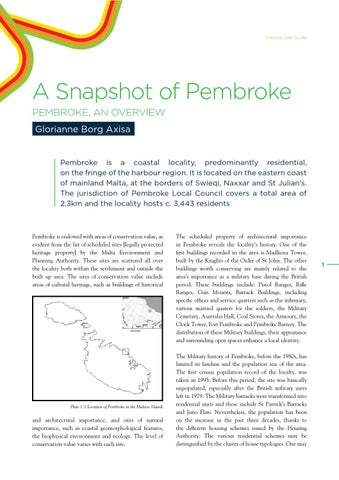
Pembroke is a coastal locality, predominantly residential, on the fringe of the harbour region. It is located on the eastern coast of mainland Malta, at the borders of Swieqi, Naxxar and St Julian’s. The jurisdiction of Pembroke Local Council covers a total area of 2.3km and the locality hosts c. 3,443 residents
Pembroke is endowed with areas of conservation value, as evident from the list of scheduled sites [legally protected heritage property] by the Malta Environment and Planning Authority. These sites are scattered all over the locality both within the settlement and outside the built up area. The sites of conservation value include areas of cultural heritage, such as buildings of historical
Plate 1.1 Location of Pembroke in the Maltese Islands
and architectural importance, and sites of natural importance, such as coastal geomorphological features, the biophysical environment and ecology. The level of conservation value varies with each site.
The scheduled property of architectural importance in Pembroke reveals the locality’s history. One of the first buildings recorded in the area is Madliena Tower, built by the Knights of the Order of St John. The other buildings worth conserving are mainly related to the area’s importance as a military base during the British period. These buildings include: Pistol Ranges, Rifle Ranges, Gun Mounts, Barrack Buildings, including specific offices and service quarters such as the infirmary, various married quaters for the soldiers, the Military Cemetary, Australia Hall, Coal Stores, the Armoury, the Clock Tower, Fort Pembroke and Pembroke Battery. The distribution of these Military buildings, their appearance and surrounding open spaces enhance a local identity. The Military history of Pembroke, before the 1980s, has limited its landuse and the population size of the area. The first census population record of the localty, was taken in 1995. Before this period, the site was basically unpopulated, especially after the British military users left in 1979. The Military barracks were transformed into residential units and these include St Patrick’s Barracks and Juno Flats. Nevertheless, the population has been on the increase in the past three decades, thanks to the different housing schemes issued by the Housing Authority. The various residential schemes may be distinguished by the cluster of house typologies. One may
1