Visitors’ Site Guide
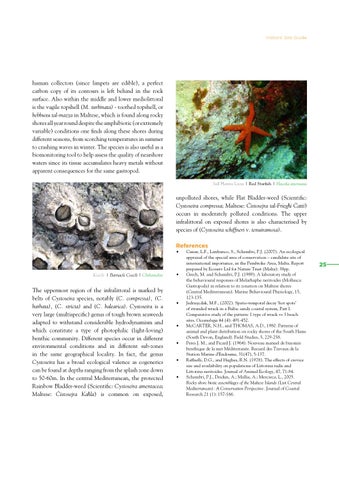
human collectors (since limpets are edible), a perfect carbon copy of its contours is left behind in the rock surface. Also within the middle and lower mediolittoral is the vagile topshell (M. turbinata) - toothed topshell, or bebbuxu tal-mazza in Maltese, which is found along rocky shores all year round despite the amphibiotic (or extremely variable) conditions one finds along these shores during different seasons, from scorching temperatures in summer to crashing waves in winter. The species is also useful as a biomonitoring tool to help assess the quality of nearshore waters since its tissue accumulates heavy metals without apparent consequences for the same gastropod. Still Óamra Lixxa | Red Starfish | Hacelia attenuata
unpolluted shores, while Flat Bladder-weed (Scientific: Cystoseira compressa; Maltese: Çistosejra tal-Frieg˙i Çatti) occurs in moderately polluted conditions. The upper infralittoral on exposed shores is also characterised by species of (Cystoseira schiffneri v. tenuiramosa). References sª
Koççli | Barnacle Coccli | Chthamalus
The uppermost region of the infralittoral is marked by belts of Cystoseira species, notably (C. compressa), (C. barbata), (C. stricta) and (C. balearica). Cystoseira is a very large (multispecific) genus of tough brown seaweeds adapted to withstand considerable hydrodynamism and which constitute a type of photophilic (light-loving) benthic community. Different species occur in different environmental conditions and in different sub-zones in the same geographical locality. In fact, the genus Cystoseira has a broad ecological valence as cogenerics can be found at depths ranging from the splash zone down to 50-60m. In the central Mediterranean, the protected Rainbow Bladder-weed (Scientific: Cystoseira amentacea; Maltese: Çistosejra Ka˙la) is common on exposed,
sª
sª
sª
sª
sª
sª
Cassar, L.F., Lanfranco, S., Schembri, P.J. (2007). An ecological appraisal of the special area of conservation – candidate site of international importance, in the Pembroke Area, Malta. Report prepared by Ecoserv Ltd for Nature Trust (Malta): 38pp. Grech, M. and Schembri, P.J. (1989). A laboratory study of the behavioural responses of Melarhaphe neritoides (Mollusca: Gastropoda) in relation to its zonation on Maltese shores (Central Mediterranean). Marine Behavioural Physiology, 15, 123-135. Jedrzejcdak, M.F., (2002). Spatio-temporal decay ‘hot spots’ of stranded wrack in a Baltic sandy coastal system, Part I. Comparative study of the pattern: 1 type of wrack vs 3 beach sites. Oceanologia 44 (4): 491-452. McCARTER, N.H., and THOMAS, A.D., 1980. Patterns of animal and plant distribution on rocky shores of the South Hams (South Devon, England). Field Studies, 5, 229-258. Peres J. M., and Picard J. (1964). Nouveau manuel de binomie benthique de la mer Méditerranée. Recueil des Travaux de la Station Marine d’Endoume, 31(47), 5-137. Raffaelli, D.G., and Hughes, R.N. (1978). The effects of crevice size and availability on populations of Littorina rudis and Littorina neritoides. Journal of Animal Ecology, 47, 71-84. Schembri, P.J., Deidun, A.; Mallia, A.; Mercieca, L., 2005. Rocky shore biotic assemblages of the Maltese Islands (List Central Mediterranean): A Conservation Perspective. Journal of Coastal Research 21 (1): 157-166.
25