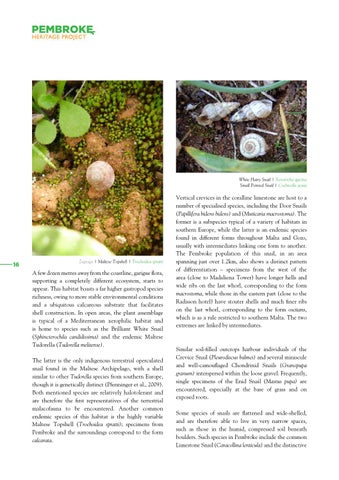
White Hairy Snail | Xerotricha apicina Small Pointed Snail | Cochicella acuta
16
Ûugraga | Maltese Topshell | Trochoidea spratti
A few dozen metres away from the coastline, garigue flora, supporting a completely different ecosystem, starts to appear. This habitat boasts a far higher gastropod species richness, owing to more stable environmental conditions and a ubiquitous calcareous substrate that facilitates shell construction. In open areas, the plant assemblage is typical of a Mediterranean xerophilic habitat and is home to species such as the Brilliant White Snail (Sphincterochila candidissima) and the endemic Maltese Tudorella (Tudorella melitense). The latter is the only indigenous terrestrial operculated snail found in the Maltese Archipelago, with a shell similar to other Tudorella species from southern Europe, though it is genetically distinct (Pfenninger et al., 2009). Both mentioned species are relatively halotolerant and are therefore the first representatives of the terrestrial malacofauna to be encountered. Another common endemic species of this habitat is the highly variable Maltese Topshell (Trochoidea spratti); specimens from Pembroke and the surroundings correspond to the form calcarata.
Vertical crevices in the coralline limestone are host to a number of specialised species, including the Door Snails (Papillifera bidens bidens) and (Muticaria macrostoma). The former is a subspecies typical of a variety of habitats in southern Europe, while the latter is an endemic species found in different forms throughout Malta and Gozo, usually with intermediates linking one form to another. The Pembroke population of this snail, in an area spanning just over 1.2km, also shows a distinct pattern of differentiation – specimens from the west of the area (close to Madaliena Tower) have longer hells and wide ribs on the last whorl, corresponding to the form macrostoma, while those in the eastern part (close to the Radisson hotel) have stouter shells and much finer ribs on the last whorl, corresponding to the form oscitans, which is as a rule restricted to southern Malta. The two extremes are linked by intermediates.
Similar soil-filled outcrops harbour individuals of the Crevice Snail (Pleurodiscus balmei) and several miniscule and well-camouflaged Chondrinid Snails (Granopupa granum) interspersed within the loose gravel. Frequently, single specimens of the Enid Snail (Mastus pupa) are encountered, especially at the base of grass and on exposed roots. Some species of snails are flattened and wide-shelled, and are therefore able to live in very narrow spaces, such as those in the humid, compressed soil beneath boulders. Such species in Pembroke include the common Limestone Snail (Caracollina lenticula) and the distinctive