Visitors’ Site Guide
Flora of Pembroke Garigue Heritage Project Jeffrey Sciberras and Luca Pisani
The natural site of Pembroke occupies roughly half the size of the entire area of Pembroke. The natural landscape of Pembroke consists of one of the few remaining karstlands found on the eastern coast of the island of Malta. This karstland is dominated by three types of habitat: coastal garigue; inland garigue and steppe; and some freshwater marshland. Pembroke also has several fallow fields and abandoned areas along the site, where a mixture of perennial indigenous species has recolonised. Along the border of the site, one can be sure to find expanses of the Crown Daisy (Chrysanthemum coronarium), Common Honeywort (Cerinthe major), Red Champion (Silene colorata), Boar Thistle (Galactites tomentosa), and so on. Where water trickles continuously, tall and broad-leaved grassy plants with red inflorescences, called Sorghum (Sorghum bicolor) will be easy to spot in autumn, accompanied by the contrasting dwarf plants, Wild Clary (Salvia verbenaca) and the Autumn Buttercup (Ranunculus bullatus) along the nearby path. The latter also cover pockets of soil in the garigue when in season. Here, one can also find large species such as the Tree Mallow (Lavatera arborea), Common Fennel (Foeniculum vulgare), and Wild Artichoke (Cynara cardunculus). Unoccupied patches are being claimed by Aloe vera and Chasmanthe bicolor, two invasive alien species. The coastal zone offers refuge for the ever salt-resistant Sea Samphire (Chritmum maritimum), Golden Samphire (Limbardia crithmoides), Coast Medick (Lotus cytisoides), Maltese Sea Chamomile (Anthemis urvilleana), and the Rock Crosswort (Crucianella rupestris). Accompanying
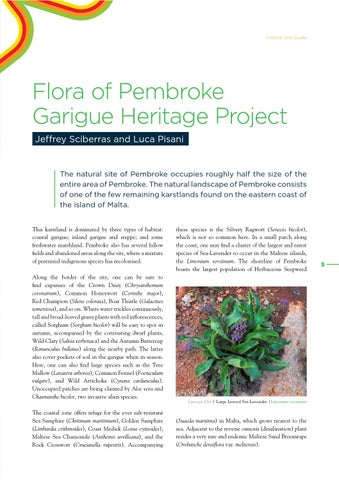
these species is the Silvery Ragwort (Senecio bicolor), which is not so common here. In a small patch along the coast, one may find a cluster of the largest and rarest species of Sea-Lavender to occur in the Maltese islands, the Limonium serotinum. The shoreline of Pembroke boasts the largest population of Herbaceous Seepweed
Limonju Kbir | Large Leaved Sea Lavender |Limonium serotinum
(Suaeda maritima) in Malta, which grows nearest to the sea. Adjacent to the reverse osmosis (desalination) plant resides a very rare and endemic Maltese Sand Broomrape (Orobanche densiflora var. melitensis).
5