Compendium Night Vision.qxd:Armada
11/26/14
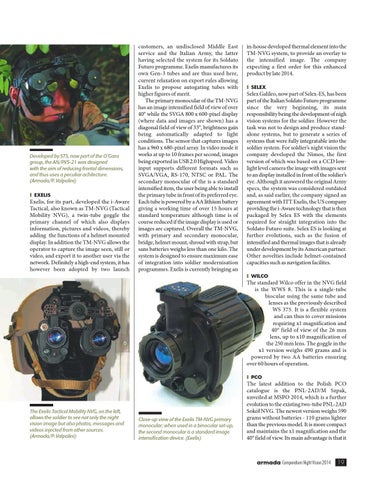
Developed by STS, now part of the O’Gara group, the AN/PVS-21 was designed with the aim of reducing frontal dimensions, and thus uses a peculiar achitecture. (Armada/P. Valpolini) I EXELIS
Exelis, for its part, developed the i-Aware Tactical, also known as TM-NVG (Tactical Mobility NVG), a twin-tube goggle the primary channel of which also displays information, pictures and videos, thereby adding the functions of a helmet mounted display. In addition the TM-NVG allows the operator to capture the image seen, still or video, and export it to another user via the network. Definitely a high-end system, it has however been adopted by two launch
8:28 PM
Page 19
customers, an undisclosed Middle East service and the Italian Army, the latter having selected the system for its Soldato Futuro programme. Exelis manufactures its own Gen-3 tubes and are thus used here, current relaxation on export rules allowing Exelis to propose autogating tubes with higher figures of merit. The primary monocular of the TM-NVG has an image intensified field of view of over 40° while the SVGA 800 x 600-pixel display (where data and images are shown) has a diagonal field of view of 33°, brightness gain being automatically adapted to light conditions. The sensor that captures images has a 960 x 680-pixel array. In video mode it works at up to 10 frames per second, images being exported in USB 2.0 Highspeed. Video input supports different formats such as SVGA/VGA, RS-170, NTSC or PAL. The secondary monocular of the is a standard intensified item, the user being able to install the primary tube in front of its preferred eye. Each tube is powered by a AA lithium battery giving a working time of over 15 hours at standard temperature although time is of course reduced if the image display is used or images are captured. Overall the TM-NVG, with primary and secondary monocular, bridge, helmet mount, shroud with strap, but sans batteries weighs less than one kilo. The system is designed to ensure maximum ease of integration into soldier modernisation programmes. Exelis is currently bringing an
in-house developed thermal element into the TM-NVG system, to provide an overlay to the intensified image. The company expecting a first order for this enhanced product by late 2014. I SELEX
Selex Galileo, now part of Selex-ES, has been part of the Italian Soldato Futuro programme since the very beginning, its main responsibility being the development of nigh vision systems for the soldier. However the task was not to design and produce standalone systems, but to generate a series of systems that were fully integratable into the soldier system. For soldier’s night vision the company developed the Nimos, the first version of which was based on a CCD lowlight level camera the image with images sent to an display installed in front of the soldier’s eye. Although it answered the original Army specs, the system was considered outdated and, as said earlier, the company signed an agreement with ITT Exelis, the US company providing the i-Aware technology that is then packaged by Selex ES with the elements required for straight integration into the Soldato Futuro suite. Selex ES is looking at further evolutions, such as the fusion of intensified and thermal images that is already under development by its American partner. Other novelties include helmet-contained capacities such as navigation facilites. I WILCO
The standard Wilco offer in the NVG field is the WWS 8. This is a single-tube biocular using the same tube and lenses as the previously described WS 375. It is a flexible system and can thus to cover missions requiring x1 magnification and 40° field of view of the 26 mm lens, up to x10 magnification of the 250 mm lens. The goggle in the x1 version weighs 490 grams and is powered by two AA batteries ensuring over 60 hours of operation. I PCO
The Exelis Tactical Mobility NVG, on the left, allows the soldier to see not only the night vision image but also photos, messages and videos injected from other sources. (Armada/P. Valpolini)
Close-up view of the Exelis TM-NVG primary monocular; when used in a binocular set-up, the second monocular is a standard image intensification device. (Exelis)
The latest addition to the Polish PCO catalogue is the PNL-2AD/M Szpak, unveiled at MSPO 2014, which is a further evolution to the existing two-tube PNL-2AD Sokół NVG. The newest version weighs 590 grams without batteries - 110 grams lighter than the previous model. It is more compact and maintains the x1 magnification and the 40° field of view. Its main advantage is that it
Compendium Night Vision 2014
19