artillery
comprehensive survey
What Is Artillery Today? More than ever, artillery is a complex ensemble. Indeed, delivering an explosive payload over a target at the right time and synchronising the fire action with all the other elements present on the battlefield involves more than just a gun. This begins with logistic and technical support, effective surveillance and target acquisition assets and procedures, followed by command, control and communication systems able to coordinate a firing action with the complex environment the ammunition will be travelling through before reaching its target, and finally by effective, reliable and accurate weapon systems. This being said, it is impossible to incorporate all the above elements into a single Compendium without turning it into something akin to a thick multiple-volume encyclopaedia. Quite apart from the fact that logistic and technical support are functions that are an integral part of the military and industrial system, target acquisition is entrusted to vehicles that are for the most part equipped with sensors that allow them to pinpoint a target and send coordinate grids up the command chain, not to mention drones, aircraft and, not to be overlooked, satellites! In this Compendium, and as far as target handling is concerned, we shall thus limit ourselves to handheld target acquisition binoculars and handheld laser designators (and there are many), although artillery-specific radars are worthy of attention. The command and control chain is mostly made up of multiple systems that are tightly interfaced, so here too we shall mostly provide a general description of what is nowadays required to clear a fire mission in a joint-combined environment. Weapon systems and their ammunition, on the other hand, constitute the core of this Compendium. They include self-propelled guns and howitzers (both wheeled and tracked), towed guns and howitzers, self-propelled heavy mortars as well as towed rifled mortars. The latter are now often ushered into artillery unit service as alternative systems. Rocket launchers close the march.
Greater Range and Accuracy What armies have always required for their artillery is greater range and increased accuracy—but today those two important elements that allow indirect fire to maintain its importance have to do so in scenarios where collateral damage has become a key issue of concern and where defining the whole area of responsibility is not always clear-cut. Time on target is another issue and, as volatile objectives have become the norm, the sensor-to-shooter cycle needs to be shortened as much as possible. In other words, the whole chain, from target designation to shell or warhead terminal effect, has tightened. Although western armies have ended up reducing their artillery arsenals compared to what they had in inventory during the Cold War era, other armies are contemplating massive investments. A main potential customer for artillery manufacturers in the coming years is definitely India—if and when, it must be emphasised, this nation finally manages to complete its long-awaited acquisition process. In November 2014, following years of requests for proposals and cancellations, the Indian Ministry of Defence approved the procurement of one of the elements of the Field Artillery Rationalisation Plan (a plan that dates back to 1999). This included 100 selfpropelled tracked howitzers, 180 self-propelled wheeled howitzers (with an option for 120 more), 814 truck-mounted guns, 1,580 towed howitzers and 145 light guns—all in 155 mm calibre. The first category to have won acquisition clearance is the truck-mounted 155/52. Because national production is a sine qua non, numerous international contenders have clinched deals with local companies as part of their bids. India, however, is not the only nation looking at investments in the field of indirect fire capability. Poland is looking at truck-mounted and self-propelled howitzers, new multiple rocket launchers, and even self-propelled heavy mortars. Asia and Latin America are also areas of interest for artillery salesmen. In addition to new systems being thrown on the market, it must not be forgotten that as a result of the above-mentioned downsizing of western forces, a considerable amount of hardware, including still state-of-the-art items, is hitting the second-hand systems list. Moreover, as said initially, artillery science grows well beyond the length of its barrels. Indeed new effectors will also mean new ammunition, new targeting systems, and a whole new string of rules and procedures.
CONTENT Technical data of main artillery systems are given in this Compendium’s centre foldout tables in pure Armada tradition. For ease of reference, this Compendium has also been divided into eight main sections: Target Location and or Designation Command and Control Howitzer Ammunition On Wheels On Tracks Towed Mortars and their Munitions Rockets
Page 04 Page 17 Page 18 Page 23 Page 33 Page 37 Page 41 Page 47 Compendium Artillery 2015
03
Finding the Target To generate the grid of a target, an acquisition system must first know its own position. From there it can establish the range of the target and the latter’s angle relative to the north. A sighting system, (preferably a day and night type), an accurate locating system, a laser rangefinder and a digital magnetic compass are the usual component of such a device. Its ability to identify a coded laser beam is also useful to confirm the target to the pilot and thereby increase safety and reduce communication traffic; this is the role of spot trackers. Markers, on the other hand, are not sufficiently powerful to guide weapons, but allow to mark the target for ground or airborne designators that in the end guide the munition’s semi-active laser seeker spot on target. Finally, artillery location radars allow to pinpoint enemy artillery positions even if, as often is the case, they are not in direct view. As indicated in the introduction, only hand-held systems are examined in this Compendium
J
ust to give an idea of what the services are after, let’s consider the draft requirements published by the US Army in January 2014 for its Laser Target Location Module II, which should in due time replace the LTLM currently in service. The Army is contemplating a 1.8 kg locator (but ultimately 1.6 kg), although the overall system, including base system, cables, tripod, and
04
Compendium Artillery 2015
Here seen in the hands of Italian Army 185th Target Acquisition Regiment operators, the Elbit PLDR II is in service with many customers, including the US Marine Corps where it is known as AN/PEQ-17. (Armada/Paolo Valpolini)
lens cleaning kit would tip the scales at 4.8 kg, possibly 3.85 kg. In comparison the current LTLM has a 2.5 kg base weight and 5.4 kg system weight. Threshold target error location requirement is 45 metres at 5 km,
the same as the LTLM, objective performance being 10 metres CEP at 10 km. For day operations the LTLM II will have both a direct view optic with a x7 minimum magnification, a 6°x3.5° minimum field of
view, a hard reticle with 10 artillery mil increments, as well as a colour day imager. The latter will provide a streaming video and in wide field of view mode, more than 6°x4.5°, ensuring a 70% probability of recognition at 3.1 km and of identification at 1.9 km in fair weather. Narrow field of view should be at least 3°x2.25°, better 2.5°x1.87°, with respective recognition ranges of 4.2 or 5 km and identification ranges of 2.6 or 3.2 km. The thermal channel would have the same objective fields of view, with 70% probability of recognition of 0.9 and 2 km, and identification at 0.45 and 1 km. Target data will be provided in UTM/UPS units, data and images being exported via a RS-232 or a USB 2.0 ports. Power will be provided by L91 lithium AA batteries. Minimum connectivity must be ensured with the Precision Lightweight GPS Receiver and the Defense Advanced GPS Receiver, as well as developmental GPS systems. The Army would however prefer a system that can also be interfaced with the Pocket Sized Forward Entry Device, the Forward Observer Software/System, the Force XXI Battle Command, Brigade-andBelow, and the Net Warrior. BAE Systems offers two target acquisition items. The UTB X-LRF is a derivative of the UTB X, to which a 5.2 km range Class 1 laser rangefinder has been added. Based on an uncooled thermal sensor with a 640 x 480 pixels focal plane array at 17 µm pitch, it can be fitted with a 40, 75 and 120 mm focal length optics, providing respectively x2.1, x3.7 and x6.6 magnification, and 19°, 10.5° and 6.5° diagonal fields of view, a x2 electronic zoom allowing to double the performance. According to BAE Systems 80% positive detection ranges on a 0.75 m2
Known in the US Army as Laser Target Locator Module, BAE Systems Trigr includes an uncooled thermal channel and weighs less than 2.5 kg. (BAE Systems)
Nato target are respectively 1,010, 2,220 and 2,660 metres. The UTB X-LRF is fitted with a 2.5 metre-accurate GPS and a digital magnetic compass. It also includes a visible and an infrared Class 3B laser pointer. Up to 100 images can be stored in uncompressed BMP format. Power is provided by four L91 lithium batteries, ensuring five hours of operational time, though USB port allows external power feed. The UTB X-LRF is 206 mm long, 140 mm wide and 74 mm high, and weighs 1.38 kg without batteries. Another BAE Systems product is the Trigr (for Target Reconnaissance Infrared GeoLocating Rangefinder). Developed in cooperation with Vectronix, BAE Systems provides the uncooled thermal channel base and the selective availability anti-spoofing module GPS with a government-provided Ground-Based GPS Receiver Application Module, while Vectronix provides the x7 direct view optic, the 5-km range fibre-based laser rangefinder, and the digital magnetic compass. According to the company the Trigr ensures a 45 metres CEP target location error at 5 km. Day recognition range is 4.2 km, or over 900 metres at night. It weighs less than
A derivative of the UTB X, the UTB X-LRF adds a laser rangefinder that allows it to become a full targeting location system. (BAE Systems)
2.5 kg, two sets of batteries ensuring a 24-hour mission endurance. The overall system, including the tripod, batteries and cables, weighs 5.5 kg. It is in use with the US Army as the Laser Target Locator Module; in 2009 a five-year indefinite-delivery/indefinitequantity contract was signed, the two latest orders being dated August 2012 and January 2013, respectively worth $23.5 and $7 million. Northrop Grumman Mark VII hand-held laser target locator was superseded by the Mark VIIE, the latter having a thermal imaging channel in place of the image intensified channel of the previous model. The uncooled sensor considerably improves vision at night and in difficult conditions, and features an 11.1°x8.3° field of view, the day channel being based on an x8.2 magnification direct view optic providing a 7°x5° field of view. A digital magnetic compass provides a ±8 mill accuracy, the electronic clinometer having a ±4 mill accuracy, position being provided by an embedded GPS/SAASM. The Nd-Yag laser rangefinder with optical parametric oscillation ensures a maximum range of 20 km with a ±3 metre accuracy. The Mark VIIE weighs 2.5 kg with nine CR123 commercial batteries, and is fitted with an RS232/422 data interface. The latest addition to Northrop Grumman’s portfolio is the HHPTD, for Hand Held Precision Targeting Device, which in less than 2.26 kg packs the typical sensors of such systems. Compared to its predecessors it has a colour daytime channel as well as a non-magnetic celestial navigation module that considerably increases accuracy, at the level needed by today’s GPS precision guided munitions. The development contract worth $9.2 million was awarded in January 2013, work having been conducted in cooperation with Flir, General Dynamics and Wilcox. Developmental testing was completed at the White Sands missile range in October 2014.
Compendium Artillery 2015
05
The Hand Held Precision Targeting Device is one of the latest developments from Northrop Grumman and has completed developmental tests in late 2014. (US Army)
Flir has a range of hand-held targeting devices in its portfolio and cooperates with other companies, providing the night vision element of such systems. The Recon B2 features a main thermal channel operating in the mid-wave band. Based on a 640 x 480 InSb cooled array, it provides a wide field of view of 10°x8°, a narrow one of 2.5°x1.8°, and is fitted with a x4 continuous e-zoom. It is equipped with auto focus, automatic gain control and digital data enhancement. The secondary channel can either be fitted with a day sensor (B2-FO) or with a long-wave infrared channel (B2-DC). The former is based on a ¼” colour CCD with a 794 x 494 pixel array and a x4 continuous digital zoom, and with two fields of view, similar to the previous. The secondary thermal channel is based on a 640 x 480 Vox microbolometer and provides a single 18° field of view, with a
x4 e-zoom. The B2 hosts a C/A code GPS; however, military GPS can be plugged in to increase accuracy, a digital magnetic compass, and a 20 km range laser rangefinder, as well as a Class 3B laser pointer operating in the 852 nm band. The B2 can store up to 1,000 jpeg images that can be downloaded via a USB port, but an RS232/422 interface is also available, as are NTSC/PAL and HDMI ports for video output. Weight is less than 4 kg including the six lithium D rechargeable cells that provide four hours of continuous operation or over five hours in power save mode. The Recon B2 can be fitted with a remote control kit including a tripod, a pan and tilt assembly, a power and communication assembly and a control station assembly. The Recon B9-FO is a lighter system featuring an uncooled thermal channel with a
The lighter target acquisition option from Flir is the Recon V, which includes a thermal cooled sensor, a rangefinder and the other typical sensors, packed in an 1.8 kg system. (Armada/Paolo Valpolini)
9.3° x 7° field of view and a x4 e-zoom. The colour camera has a continuous x10 optical zoom and a x4 e-zoom, while the GPS, DMC and laser pointer performances are similar to those of the B2. What makes a major difference is the rangefinder, which has a maximum range of 3 km. The B9-FO is dedicated to shorter range operations and is also much lighter than the B2, at less than 2.5 kg with the two rechargeable D cell batteries that provide five hours continuous operation. Even lighter, thanks to the lack of a day channel, the 1.8 kg Recon V (with batteries) provides a six-hour run time with hot sap capability. Its cooled 640 x 480 InSb seeker operates in the medium wave infrared band, and is equipped with a x10 optical zoom (wide field of view being 20° x 15°). Its rangefinder has a 10 km reach while a mems gyro adds image stabilisation. Sagem of France proposes three binocular solutions for day-night target acquisition, all featuring the same visible colour channel with a 3°x2.25° field of view, an eye-safe laser rangefinder with a 10 km range, a digital magnetic compass with 360° azimuth range and ±40° in elevation, and a C/S-type GPS with an accuracy of up to three metres CEP (it can also be linked to an external GPS). The main differences are in the thermal channel. At the lower end is the Jim UC, which features an uncooled 640x480 array with The Flir Recon B2 family has a main cooled channel, the B2-FO here pictured in the hands of Italian special operations personnel; it is fitted with a secondary day channel. (Armada/Paolo Valpolini)
06
Compendium Artillery 2015
Sagem’s Jim Long Range has been supplied to French infantrymen as part of the Felin package; here it is here seen mounted on Vectronix Sterna non-magnetic target acquisition system. (Sagem)
identical night and day narrow fields of view, while the wide field of view is of 8.6° x 6.45°. The Jim UC is fitted with a digital zoom, image stabilisation, internal photo and video recording; an optional image fusion between the day and thermal channels is also offered. It has a 0.8 µm eyesafe laser pointer, plus analog and digital ports. It weighs 2.3 kg without battery. The rechargeable battery provides over five hours of operational life. Then comes the Jim LR of which, incidentally, the UC is a derivative. It is in service among others with the French Army, being part of the Félin soldier modernisation suite. The Jim LR features a cooled thermal channel, with a 320 x 240 pixel sensor operating in the 3-5 μm band; the narrow field of view remains the same as the UC’s, the wide one being of 9° x 6.75°. A more powerful laser pointer is offered on option, increasing the range from 300 to 2,500 metres. The cooling system of course increases weight, the Jim LR standing at 2.8 kg without battery. A cooled sensor considerably increase performances though, detectionreconnaissance-identification ranges for a human target being respectively of 3/1/0.5 km for the UC and 7/2.5/1.2 km for the LR. Closing the march is the Jim HR with further improvements offered by a VGA 640 x 480 pixel array providing higher resolution. Vectronix, a subsidiary of Sagem, proposes two observation platforms that, coupled to Vectronix and/or Sagem systems, generate extremely accurate modular tools for targeting. The GonioLight is a digital observation station the digital magnetic compass of which provides an accuracy of 5 mil (0.28°). When fitted with the north-finding gyroscope, accuracy increases to 1 mil (0.06°). The gyroscope is installed between the head and
the tripod adding 4.4 kg to the assembly, the GonioLight and tripod coming at around 7 kg. If the gyroscope is not installed, similar accuracy can be obtained using embedded survey routines on known landmarks or celestial bodies. An embedded GPS and a link to an external GPS are also available. The GonioLight is equipped with an illuminated screen and has interfaces for computers, communications and other external devices. In case of failure it is fitted with auxiliary scales that allow to determine the direction and vertical angle. The system is designed to host daylight or night observation and rangefinding, such as the Vector rangefinder family or the Sagem Jim described above. Special mounts also allow to install two optronic subsystyems over the GonioLight head. Overall weight goes from 9.8 kg of the GL V configuration including GonioLight plus Vector, to the 18.1 kg of the GL G-TI configuration that includes GonioLight, Vector, Jim-LR and gyroscope. The GonioLight was made available in the early 2000. Since then over 2,000 units have been delivered to a score of countries, and have been used in combat in Iraq and Afghanistan. Lessons learned led Vectronix to develop the ultralight Sterna non-magnetic target acquisition system; while GonioLite aims at distances over 10 km, the Sterna is considered for targets at 4-6 km. Together with the tripod the system weighs around 2.5 kg, accuracy of less than 1 mil (0.06°) at any latitude being obtained when working using known reference points. This provides a target location error of less than four metres at 1.5 km. If reference points are not available, the Sterna is fitted with a hemispheric resonating gyroscope, jointly developed by Sagem and Vectronix, that provides an accuracy of 2 mil (0.11°) in north finding up to 60° latitude.
Setup and orientation time is less than 150 seconds, a ±5° rough levelling being required. The Sterna is powered by four CR123A batteries that ensure 50 orientation operations and 500 measurements. Like the GonlioLight, the Sterna is designed to accept different types of optronic systems. Still within Vectronix’s wares, the lightest option is the less than 3 kg PLRF25C, followed by the less than 4 kg Moskito. For more complex missions Vector or Jim packages must be added, but weight then increases to 6 kg. The Sterna has a dedicated interface for pintle installation on a vehicle although it can be quickly removed for dismounted operations. Numerous units have been sold for evaluation purposes. The US Army has ordered Vectronix hand-held systems and Sternas as part of the Handheld Precision Targeting Devices solicitation awarded in July 2012. Vectronix foresees a consistent increase of sales of its Sterna in 2015. In June 2014 Vectronix unveiled the Moskito TI featuring three vision channels, an optical daylight with x6 magnification and an optical low-light CMOS, both with a 6.25° field of view, and an uncooled thermal channel with a 12° field of view. A 10 km rangefinder with a ±2-metre accuracy, and a digital magnetic compass with ±10 mil (±0.6°) azimuth and ±3 mil (±0.2°) elevation accuracies are also part of the package. GPS is optional, though a slot for a commercial or military GPS receiver as well as Galileo or Glonass modules is included. Connection to
Vectronix developed the Sterna, an ultralight non-magnetic target acquisition system that deals with ranges of between four and six kilometres; it here seen fitted with a Sagem Jim-LR. (Vectronix)
Compendium Artillery 2015
07
The last addition to the Vectronix range of target acquisition devices is the Moskito TI, which features two daylight and one thermal channel. (Vectronix)
external GPS receivers is also possible, and a laser pointer can also be added. The Moskito TI is provided with RS-232, USB 2.0 and Ethernet interfaces, with Bluetooth on option. Powered by three CR123A batteries, it has over six hours of operational life. Last but not least, all the above holds in a 130 x 170 x 80 mm package weighing less than 1.3 kg. This new product is an evolution of the Moskito, which at 1.2 kg offered a day channel and an image intensified channel, a 10-km laser rangefinder, a digital magnetic compass, and as option a commercial GPS or a link to an external receiver. Thales offers a full suite of target acquisition systems. The Sophie UF is a 3.4 kg system that includes a x6 magnification optical day sight with a 7° field of view. The rangefinder reaches up to 20 km, a P(Y) code or C/A code GPS being integrated in the Sophie UF, which can be linked to a DAGR/PLGR external system. A magnetoresistive digital magnetic compass with 0.5° accuracy in azimuth and a gravity sensor inclinometer, with 0.1° accuracy, complete the sensor suite. Powered by AA batteries, it has an eighthour operational life. The system features fall of shot correction and target cueing modes, and is fitted with RS232/422 ports for exporting data and images. Among others, the Sophie UF is in service with the British Army as the Surveillance System and Range Finder (SSARF). Moving up, the Sophie MF features a 8-12 µm band cooled thermal imager, with 8°x6° wide and 3.2°x2.4° narrow field of view and a x2 electronic zoom. A 3.7°x2.8° field-of-view colour daylight channel comes on option, as does a 839 nm laser pointer working. It comes with a 10km range laser rangefinder, an integrated GPS, connection for an external GPS receiver and a magnetic compass providing 0.5° accuracy in azimuth and 0.2° in elevation. The Sophie MF weighs 3.5 kg a runs for over four hours on its set of batteries.
08
Compendium Artillery 2015
The Sophie XF is nearly identical to the MF, the main difference being the thermal sensor which operates in the medium 3-5 µm infrared band, with wide 15°x11.2° and narrow 2.5°x1.9° fields of view, a x6 optical zoom and a x2 electronic zoom. Analog and HDMI outputs are available for videos, the Sophie XF being able to store up to 1,000 photos or up to 2 Gb of videos. RS 422 and USB ports are also available. The XF has the same optionals and weight as the MF, although its operational life with a single battery pack is slightly longer at six or seven hours. Instro Precision in Britain, specialised in goniometers and pan-and-tilt heads, developed the MG-TAS, for Modular Gyro Target Acquisition System, based on a gyroscope allowing precision north finding. Accuracy exceeds 1 mil (being immune to magnetic disturbances), and a digital goniometer offers an accuracy of 9 mil depending on magnetic environment. The system also includes a lightweight tripod and a rugged PDA-based targeting computer with a full set of targeting tools. An interface allows one or two targeting sensors to be installed. Airbus DS Optronics proposes two targeting systems, both from its South Africa
The Thales Sophie XF allows one to determine target grids and features a medium-wave infrared sensor for night vision. (Thales)
production sites, the Nestor and the TLS-40. Originally developed for German mountain troops the Nestor went into production in 2004/2005. This 4.5 kg biocular system includes a day sighting channel with a x7 magnification and a 6.5° field of view, with a 5mil increment glass reticle, and a thermal cooled channel with a 640 x 512 pixel sensor that provides two fields of view, narrow (2.8°x2.3°) and wide (11.4°x9.1°). Target distance is provided by a Nd-Yag Class 1M laser rangefinder with a 20 km range and a ±5-metre accuracy, fitted with an adjustable range gate. Target direction and elevation are provided by a digital magnetic compass with a ±1° accuracy in azimuth and ±0.5° in elevation, measurable elevation angle being ±45°. A 12-channel L1 C/A GPS receiver is included, the Nestor being also interfaceable with an external GPS. A CCIR-PAL video
Developed for the German mountain troops, the 4.5 kg Airbus D&S Nestor features a cooled thermal sensor. It is in service with several customers around the world. (Airbus D&S)
output is available. It is powered by rechargeable Li-Ion batteries, an external 10-32 V DC external power supply being also usable. The cooled thermal sensor increases the system weight, but also its night performances. It is in service with several European forces, including the Bundeswehr, several European border guards as well as with undisclosed Near and Far East customers. The company is awaiting several major contracts for quite a few hundred systems 2015, but the new customers remain undisclosed. Leveraging experience gained with the Nestor, Airbus DS Optronics developed the lighter Opus-H with an uncooled thermal channel. First deliveries started in 2007. It
maintains the same day channel, while the microbolometer 640 x 480 array provides an 8.1°x6.1° field of view and a jpg snapshot capability. The other elements remain similar, including the single-pulse laser rangefinder which not only increases longrange measurement without requiring tripod stabilization but also detects and displays up to three targets at any range. It adds an USB 2.0 port the RS232 and RS422 serial interface ports of the previous model. Power is here provided by eight AA batteries. Weight saving is of about 1 kg, the Opus-H being also smaller (300 x 215 x 110 mm compared to the Nestor’s 360 x 250 x 155 mm. Opus-H military and paramilitary customers remain undisclosed. Due to the increasing need for lightweight and cheaper targeting devices, Airbus DS Optronics (Pty) developed the TLS 40 series, which weighs less than 2 kg with batteries. Three models are available, the TLS 40 with a day-only capability, the image intensification TLS 40i and the uncooled TLS 40IR. Their laser rangefinders and GPS are similar to the Nestor’s. The digital magnetic compass covers ±45° elevation angles, ±30° bank angles, and provides ±10 mils accuracy in
azimuth and ±4 mils in elevation. The biocular day optical channel, common to the first two models models, has a x7 magnification and a 7° field of view with the same reticle as the Nestor. The image intensified version ads a monocular channel, based on a Photonis XR5 tube, providing the same magnification of the day channel and a 6° field of view. The TLS 40 and TLS 40i have exactly the same physical characteristics, their dimensions being 187x173x91 mm. The TLS 40IR is bigger, 215x173x91 mm, albeit it maintains the same weight. It has a monocular day channel with the same magnification and a slightly narrower field of view at 6°. The microbolometer 640 x 312 array channel provides a 10.4°x8.3° field of view with a x2 digital zoom. The image appears on a black-and-white oled. All TLS 40 models can optionally be fitted with a day camera to capture jpg snapshots with a 0.89° x 0.75° field of view, and a voice recorder with a 10-second clip per snapshot capacity in WAV format. All are powered by three CR123 batteries or by an external 6 – 15 V power source, are fitted with a USB 1.0, RS232, RS422 and RS485 serial interfaces, can be fitted to external GPS, and feature a
Sagem’s Jim Long Range has been supplied to French infantrymen as part of the Felin package; here it is here seen mounted on Vectronix Sterna non-magnetic target acquisition system. (Sagem)
composite video output in PAL and NTSC output. The TLS 40 series has already been introduced in service by undisclosed customers, including African. Jenoptik of Germany developed the Nyxus Bird, a day-night recce and target location system which is available in medium and long range versions. The difference lies in the thermal channel, which in the medium range
The Nyxus Bird Gyro adds to the Nyxus Bird qualities a gyroscope for non-magnetic north finding , which considerably increases target coordination accuracy at long ranges. (Jenoptik)
is fitted with a 11°x8° field of view lens. Detection, recognition and identification ranges against a standard Nato target respectively stand at 5, 2 and 1 km. The long range version, with 7°x5° optics has greater ranges, respectively 7, 2.8 and 1.4 km. The 640x480-pixel sensor is the same. The day channel is a x7 magnification direct view job with a 6.75° field of view. The Class 1 laser rangefinder has a typical range of 3.5 km, the digital magnetic compass ensures 0.5° accuracy on 360° in azimuth and 0.2° on 65° in elevation. The Nyxus Bird features a series of measurement functions and can store up to 2,000 infrared images. Fitted with a GPS module, it can nevertheless be linked to a PLGR/DAGR system to further increase accuracy. There is a USB 2.0 port image and video transfer, while Bluetooth is on option. Including the 3.0 V lithium battery it weighs 1.6 kg, and is 180 mm long without the eyecups, 150 mm wide and 70 mm high. The Nyxus Bird is part of the equipment of the German Army IdZ-ES programme. The addition of a “Micro Pointer” tactical mission computer with full Geographic Information System considerably increases target location. Working on internal or external batteries, the Micro Pointer is fitted with RS232, RS422, RS485 and USB ports, and can be optionally fitted with an Ethernet port. Small (191 x 85 x 81 mm) it weighs only 0.8 kg. Another possible addition is a gyro system, which includes a gyroscope for non-magnetic northfinding, providing most precise azimuth information and precise target coordinates also over long ranges. The gyro head has the same ports of the Micro Pointer, can be linked to a PLGR/DAGR external GPS, and its four CR123A batteries ensure 50 orientations and 500 measurements. The head weighs 2.9 kg, and the entire unit with tripod tips the scales at 4.5 kg. From Finland comes the Lisa, a handheld target acquisition system developed by
10
Compendium Artillery 2015
Millog, which includes an uncooled thermal imager and an optical day channel able to detect a vehicle at 4.8 km, recognise it at 1.35 km and identify it at 1 km. It weighs 2.4 kg with batteries and has a run-time of 10 hours. It is entering service with the Finnish Defence Forces following receipt of a contract in May 2014. Developed some years ago for the Soldato Futuro Italian Army soldier modernisation programme by what is now Selex-ES , the Linx multi-functional day/night hand-held target locator has been improved and now features a 640 x 480 uncooled array. The thermal channel has x2.8 magnification with a 10°x7.5° field of view, but also includes x2 and x4 electronic magnification. Day viewing is via colour TV with two magnifications (x3.65 and x11.75 with respective fields of view of 8.6°x6.5° and 2.7°x2.2°). A programmable electronic reticle is injected in the colour VGA display. Ranging is available up to 3 km, position being provided by an integrated GPS while a digital magnetic compass provides azimuth indications. Image export is via USB. A further evolution of the Linx is awaited for mid-2015, and will include miniaturised cooled sensors and new functions. In Israel the military are looking at increasing their fire coordination capabilities. To this end each battalion will be provided with a team for coordinating air strikes as well as ground fire support instead of the single artillery liaison officer currently assigned at battalion level. The national industry is already providing tools for the task.
Elbit Systems is very active both in Israel and in the United States. Its cooled Coral-CR features a 640x512 InSb medium-wave detector, fitted with a 2.5°x2.0° to 12.5°x10° field of view optical zoom and a x4 digital zoom. A black-and-white CCD day camera operating in visible and near infrared operates between 2.5°x1.9° and 10°x7.5° fields of view. Images appear on a highresolution colour oled through an adjustable binocular. An eye-safe Class 1 laser rangefinder, an integral GPS and a digital magnetic compass with 0.7° accuracy both in azimuth and elevation complete the sensors set. Target coordinates are calculated in real time, and can be transmitted to external devices, and up to 40 images can be stored. A CCIR or RS170 video output is available. The Coral-CR is 281 mm long, 248 mm wide and 95 mm high and weighs 3.4 kg including the ELI-2800E rechargeable battery. It is in service with numerous Nato countries (as the Emerald-Nav in America). Lighter and cheaper, the Mars is an uncooled thermal imager based on a VOx 384x288 detector, but has target acquisition capability. Besides the thermal channel, with two fields of view, 6°x4.5° and 18°x13.5°, it features a colour day camera, with 3°x2.5° and 12°x10° fields of view, a laser rangefinder and built-in GPS and magnetic compass. Including the battery the 200 mm long, 180 mm wide and 90 mm high Mars weighs only 2 kg. Turning to Rafael, the Haifa based company developed two systems, the Pointer
Acquired by Finland, Millog’s Lisa is fitted with an uncooled thermal and a day channel; at only 2.4 kg, it has a detection range just short of 5 km. (Millog)
In Elbit’s full set of target location systems the Coral-CR is the high-end item with its cooled thermal channel. (Elbit Systems)
The Enhanced Joint Terminal Attack Controller Laser Target Designator (E-JTAC LTD) proposed by Elbit Systems of America is one of the lightest laser targeting/hand-off solutions available on the market. (Armada/Paolo Valpolini)
and the Micro-Pointer, which provide similar performances but at different weight. The assembly is designed for tripod use and features a top adaptor to install payloads such as day/night sighting binoculars. The systems are fitted with a digital magnetic compass, a GPS, and a mission computer. Angular accuracy is 1 mRad on both axis, position accuracy being 3-5 metres, while north finding accuracy is 1° via digital magnetic compass and 1 mRad via visual north finding. The computer has a fourinch colour touch-screen, a series of pushbuttons, some of them user-defined on the right, while two handgrips are used to orient the system and feature push-buttons for acquisition and payload control. To avoid detection the Pointer and Micro-Pointer use a patented advanced digital target acquisition
Rafael developed a passive target range measurement system based on geographical infrastructures that is implemented in its Pointer and Micro-Pointer target location systems. (Rafael)
technology that does not require a laser rangefinder, though rangefinders can be used if required. After finding the north and having established accurate position by GPS, the system uses geographical infrastructures (Digital Terrain Model and digital 3D Models for the area) to accurately calculate the target range optically, and thus remains totally passive. The system uses digital format maps for the georefercing process. RS232 and RS422 interfaces are provided for integration with C4I systems. The Pointer has a weight of 4.1 kg while the MicroPointer weighs 0.85 kg, both without batteries. They are in service in Israel and other nations, including a Nato member. Stelop, part of ST Electronics of Singapore, offers its Coris-Grande. This two-kilo system (including batteries) packs a day colour camera, a 640 x 480-pixel uncooled thermal sensor, a 1.55 µm Class 1M eye-safe laser rangefinder with a 2 km range, a GPS and a digital compass. Images are generated on an SVGA colour display, where a reticle can be injected, the system allowing to capture the scene and to download the picture to a PC via a USB 2.0 port; a x2 digital zoom is available. The Coris-Grande yields an accuracy of 0.5° in azimuth and a CEP of five metres; the system can provide MGRS or longitude-latitude grids. Data provided by Stelop indicate for the thermal channel a 90% detection probability range of over 1 km for a man-size target and 2.3 km for a light vehicle, with respective recognition ranges of 380 and 860 metres. The data for the day camera are 1.2 km and 3 km for detection and 400 and 1,000 metres for recognition. With a startup time of less than 10 seconds, the Coris-Grande is powered by a LiIon rechargeable battery pack ensuring over six hours of operation. It is combat proven, is in service with the Singaporean Army and has been exported to South Korea and Indonesia. In order to cope with longer range requirements Stelop developed an improved version of its Coris-Grande target acquisition system featuring a 5 km range laser rangefinder as well as a 35 mm focal length lens (instead of the original 25 mm) to increase detection and reconnaissance ranges. First units of the new version are already available for demonstration and Stelop is ready to provide them in six-eight months time after contract signature. Northrop Grumman’s catalogue contains two items that allow the JTAC or JFO (Joint Fires Observer) to confirm the targeted location. Both have a weight of less than 0.9 kg with batteries and can be used with a single
The Coris-Grande is the target acquisition device proposed by Stelop, the optronic company part of ST Electronics of Singapore. (Armada/Paolo Valpolini)
hand. The main difference between the Coded Spot Tracker (CST) and the MultiBand Laser Spot Tracker (MBLST) is that the former thermal seeker operates in long wave infrared while the latter operates in short wave. The CST is fitted with an uncooled 640x480 array, offers a wide field of view being of 25°x20° while a narrow field of 12.5°x10° is obtained with the x2 e-zoom. It can track up to three marker spots at the same time, three coloured diamond-shaped icons showing up on the 800 x 600 SVGA display, the red, green, blue icons corresponding to the PRF code shown on the bottom of the picture. The CST is powered by three CR-123 lithium batteries. The MBLST SWIR imager benefits from reduced atmospheric scattering and features pixel level laser pulse detection. Its 11°x8.5° wide field of view can be reduced thanks to the x2 e-zoom, an external x2 optical zoom being available as option. A semi-transparent coloured overlay is used to show the laser spot over the black and white image, with a marker around the spot to highlight it. The MBLST allows the JTAC to see the designator spot at ranges of over 10 km. The system is powered by four CR-123 or AA batteries, with a continuous run time of two hours. L-3 Warrior Systems produces the LA16u/PEQ Handheld Laser Marker, a pistolshaped device capable to emit Nato coded laser beams for marking targets, the beam being easily picked up by spot-tracker equipped platforms, reducing target handoff times from minutes to a few seconds. A mini red-dot sight is mounted over the pistol for aiming it at the target.
Compendium Artillery 2015
11
I LASER DESIGNATORS
In 2009 the US military started looking for a system to reduce the attack controllers’ workload and simultaneously improve their ability to acquire, locate, mark and designate targets for GPS-guided and laser-guided ammunition. The new system was known as Joint Effects Targeting Systems (JETS), which consists of two major subsystems, the Target Location Designation System (TLDS) and the Target Effects Coordination System (TECS). The TLDS is a hand-held target acquisition and designation system; draft performances required a day-night identification range greater than 8-4 km, a location error less than 10 metres at 10 km, rangefinding greater than 10 km, an infrared marker range greater than 4 km at night, a laser spot-tracker range greater than 8 km, and a designator range against stationary or moving targets greater than 8 km using Nato standard codes. The base system had to weigh less than 3.2 kg while the overall system, including tripod, batteries and cables, should not be more than 7.7 kg. The TECS interfaces with the TLDS and provides networked and automated communication capabilities, allowing planning, coordination and delivery of fire support, as well as terminal close support guidance. The system will be distributed to Army, Air Force and Marine Corps JTACs. In Q2 2013 two companies received a contract for a one-year programme aimed at the development of a prototype system, the choice falling upon BAE Systems and DRS Technologies that received respectively $15.3 and $15.6 million contracts. The two companies are designing and building prototypes as part of the fullscale development phase. First fielding of the JETS is forecast for late 2016.
For the JETS programme BAE Systems developed the Handheld Azimuth Measuring, Marking, Electro-optic imaging and Ranging—Hammer in short. Not much was unveiled, only that it includes day and night imagers, celestial compass, gyro compass, digital magnetic compass, SAASM GPS receiver, an eye-safe laser range finder, a compact laser marker and an open digital communications interface. The JETS version of the Hammer completed the U.S. Army’s Critical Design Review in February 2014, and according to BAE Systems it is not only half of the weight of current systems but it is also much less expensive. The two companies must deliver 20 prototypes each. Northrop Grumman Special Operations Forces Laser Acquisition Marker (AN/PEQ1C SOFLAM), used during operations “Enduring Freedom” and “Iraqi Freedom” by US special operations forces, JTACs and FACs, is a 5.2 kg system that includes a NdYag diode-pumped laser designator with passive cooling, capable to mark a target at over 10 km distance. It works on the 1.064 µm wavelength with an 80 mJ pulse energy, and is used not only for designating, with user programmable PRF codes, but also for ranging, its capacity in this role reaching 20 km The system input-output is RS-422 compatible. The day optic provides a x10 magnification with a 5°x4.4° field of view; three Picatinny rails allow to install a night vision system. Powered by a single BA 5590 battery, the SOFLAM is commercially known as the Ground Laser Target Designator III, or GLTD III, which is an evolution of the previous GLTD II, improvements mainly concerning the weight, 0.4 kg less, and power consumption, performances remaining the same.
BAE Systems does not say much about the Hammer except it has a celestial compass to increase accuracy. (BAE Systems)
12
Compendium Artillery 2015
Less portable, the Northrop Lightweight Laser Designator Rangefinder (LLDR) has an overall weight of 16 kg, and is made of two major sub-assemblies, the target locator module (TLM) weighing 5.8kg, and the Laser Designator Module (LDM) weighing 4.85 kg. The TLM includes a cooled thermal sight with a 640 x 480 array, providing a wide field of view of 8.2°x6.6°, and a narrow one of 3.5°x2.8°, the e-zoom allowing to reach a 0.9°x0.7° field of view. The day sight is based on a high resolution staring CCD and provides a 4.5°x3.8° wide field of view, a 1.2°x1° narrow one, a x2 e-zoom being also available. It also features a PLGR GPS receiver, an electronic clinometer, and an eyesafe Class 1 laser rangefinder with a 20 km
Known as the AN/PEQ-1C Soflam, for Special Operations Forces Laser Acquisition Marker, this system has been intensively used in operation both in Iraq and Afghanistan. (Northrop Grumman)
maximum range. The LDM Yag laser emitter can designate a target up to 5 km, using Nato Band I and II as well as A codes. It features an RS-485/RS-232 data interface and an RS-170 video interface. Power is provided by a BA5699 battery, a BA-5590 battery being used for TLM-only operations. A first evolutionary step came with the LLDR 2 which maintained the same TLM but added a new diode pumped laser module (DLDM). The latter was considerably lighter, weighing 2.7 kg, while providing the same range. A further step led to the LLDR-2H high accuracy targeting system which adopts a new target location module, the TLM-2H that weighs 6.6 kg, and a slightly modified DLDM module, at 2.8 kg; the whole system with tripod, battery and cables weighs 14.5 kg. The TLM-2H day channel is based on a high resolution CCD with 4°x3° wide and 1°x0.8° narrow fields of view, a x2 e-zoom being available, day recognition range being
of over 7 km. The thermal channel provides a wide 8.5°x6.3° and narrow 3.7°x2.8° fields of view, a x2 and x4 e-zoom allowing to increase magnification, giving a vehicle night recognition range of over 3 km. A 20 km laser rangefinder is included, as well as a GPS/SAAMS receiver, a digital magnetic compass and a celestial high accuracy azimuth device. Using the latter target location error is reduced to less than 10 metres at 2.5 km. The DLDM provides a day/night designation range of 5/3 km against stationary targets, and a 3 km day/night range against moving targets; the TLM-2H is capable of picking the designator spot at 2 km day and night. Power is provided by the same set of batteries for a 24hour mission. L-3 Warrior Systems–Advanced Laser Systems Technologies developed the Scarab TILD-A, a diode-pumped Nd:Yag laser target designator capable of generating 80 to 120 mJ of energy to illuminate targets at 5 km. It includes the designator, backpack, tripod, batteries and remote control. The direct view optics module fitted on the left side has a x7 magnification and a 5° field of view with mission data overlapped on the display. Compliant with Band I and II Nato codes, the Scarab ensures 60 minutes of continuous designation with a single battery. A thermal
The Lightweight Laser Designator Rangefinder is made of a target locator module and a laser designator module, and can designate a target at a range of 5 km. (Northrop Grumman)
The L-3 Warrior Systems Scarab Tild-A is a laser designator that can illuminate targets at ranges of up to 5 km. (L-3 ALST)
and see-spot add-on can be fitted via the Picatinny rail, adding less than 1 kg to the system. Based on an uncooled 640x480 cooled mid-wave infrared, it has a detection range of 5 km and a recognition range of 3 km against a standard 2.3x2.3 metres target. In late 2013 Warrior Systems-ALST bagged an export order from South Korea, for an initial value of 30 million US dollars, designators being aimed at the Air Force and the Marine Corps. Thales offers a less than 5 kg solution in the form of the Tyr, which provides an over 70 mJ output energy. Maximum ranging performance is 20 km, no designation ranges being available. It has a 2.5°x1.9° sight with reticle injected in the display. The Tyr is fitted with Picatinny rails and can be easily interfaced with other Thales observation and targeting systems. The LF28A is a slightly heavier solution, up to 6.5 kg, which ensures a 10 km designation range. It is fitted with an optic sight with a x10 magnification and 3° FoV, and is powered by Lithium or NickelCadmium batteries that snap onto the system. CILAS of France has developed a lightweight version of its DHY 307 ground laser target designator, the DHY 307 LW which, at 4 kg is half the weight of the earlier model and is more compact. Fitted with an internal spot camera, it can be coupled to high precision targeting goniometers as well as to thermal imagers, its performances being even higher than the original system, designation range shifting from 5 to 10 km, pulse energy remaining over 80 mJ. It can memorize Nato, Russian and Chinese codes. Elbit’s Rattler-G is a lightweight designator, with a version known as the Director-M in America. Aiming is done through a direct view x5.5 optic, an OLED
A British soldier ready to designate a target using a Thales TYR, here installed over a GonioLight digital observation station. (Thales)
overlay showing the PRF code, battery status and laser modes. The laser marker/designator has an energy of 27 mJ per pulse, pulse width being 15 ns and divergence being less than 0.4 mRad, target designation range being 3 km against a Nato target and 5 km against a building. Coded marking range is 6 km while pointing range is 20 km; the Rattler-G is fitted with a 0.8 W, 0.83 µm band and a 3 mW, 0.63 µm visible pointer. A Picatinny rail on top of the system allows to install other optical systems, which can be boresighted using the laser pointers. The Rattler-G weighs 1.7 kg including the CR123 rechargeable battery that ensures a 30 minute operation time at standard temperature. The Director-M maintains most of the characteristics of the Rattler-G but is slightly more powerful, over 30 mJ and a 1W pointer. The system is 165 mm long, without considering the single eyepiece, 178 mm wide and 76 mm high. To further reduce the soldier’s burden Elbit Systems developed the Rattler-H, a pistol-like designator with a 30 mJ energy pulse and similar ranges as the Rattler-G. Without any optical channel, an aiming sight is installed on top of the Picatinny rail, while an interface allows it to be installed on a tripod for long range targeting. The key advantage of the Rattler-H is its weight – just 1.3 kg with the CR123 battery. On a wholly different level comes the Portable Lightweight Designator/Rangefinder II, PLDR II in short. Here the head weighs 6.7 kg, designation performances increasing to 5 km against a tank-type target and 10 km against a building, with a laser pulse energy adjustable between 50 and 70 mJ. Aiming is done through a direct view sight with x8
Compendium Artillery 2015
13
The Opus-H retains many of the Nestor features, but is fitted with an uncooled thermal imager and is thus around one kilogram lighter. (Airbus D&S)
magnification and a 5.6° field of view (a 2.5° view laser spot camera is available with image shown on a 3.5-inch display. The PLDR II has built-in GPS, electronic compass and a tactical computer for target location calculations, two Picatinny rails for additional sensors such as a thermal imager. Designed for long-range designation, the system includes a pan and tilt head and a light tripod. In use in several armies, it has been acquired in 2011 by the US Marine Corps, where it is known as AN/PEQ-17.
The 1.3kg Elbit Rattler-H is able to mark a target to the benefit of airborne platforms. (Elbit Systems)
14
Compendium Artillery 2015
The Serpent, also from Elbit Systems, has even longer designating ranges, respectively 8 km for tanks and 11 for large targets, and a 20 km distance measurement capacity with a 5-metre range accuracy. Its sight characteristics are similar to those of the PLDR II, but here the laser spot camera is an option. The designator head weighs 4.63 kg, a pan and tilt head, light tripod, battery and remote fire switch being part of the kit. To ensure guidance to its laserguided ammunition Russian Rosoboronexport offers a portable automated artillery fire control system known as Malakhit, which is divided in three packs containing respectively the laser designator/rangefinder, the commander’s station and the radio station. Output energy is not provided but ranges are considerable, 7 km against tank-like targets in daylight and 4 km at night, and 15 km against large targets. The system is all but light, in day operation the overall weight, tripod included, being of 28.9 kg, which increase to 37.6 kg for night use, when the thermal imager is added. For positioning the Malakhit of course relies on the Russian Glonass rather than GPS. I MENSURATION
To reduce the overall error budget in a firing action the three main factors that have to be taken into consideration are target location and size, weapon and ammunition information and finally firing unit location error. Mensuration is one of the procedures used especially to improve accuracy in target location and size. According to the National Geospatial-Intelligence Agency target coordinate mensuration is “the process of measurement of a feature or location on Earth to determine an absolute latitude, longitude, and height. For targeting applications, the errors inherent in both the source for measurement and the measurement processes must be understood and reported. Mensuration tools can employ a variety of techniques to derive coordinates. These may include, but are not limited to, direct read from Digital Precise Point Database (DPPDB) stereo-pairs in stereo or dual mono mode, multi-image geopositioning, or indirect imagery correlation to DPPDB.” United States Special Forces use the Precision Strike Suite as mensuration
programme at unit level, not much being known of that system as it is classified. Artillery firing units deployed downrange have been provided with such a suite under certain conditions, such as the use of a secret internet protocol router network. This allowed mensuration time of 15-45 minutes of operations Iraqi Freedom and Enduring Freedom (when this capability was available at Corps level) to be cut to around five minutes now that battalion can do it autonomously. Similar capabilities are also available at higher echelons using systems such as BAE Systems’ CGS (Common Geopositioning Services) modular set of software geopositioning services capable of calculating accurate, three-dimensional geographic coordinates as well as SOCET GXP geospatial-intelligence software package by the same company. I RADARS
Finding a target might not need eyes, especially in an artillery system context. Counterbattery radars are essential actors, particularly in force protection missions where they provide warning to the troops and allow friendly effectors to react in near-real time. They also provide adjustment data to friendly artillery. In the US Army inventory the AN/TPQ36 Firefinder has been around for some time. Originally developed by Hughes, now part of Raytheon, the system is now produced by Thales-Raytheon-Systems. Installed on a trailer it is towed by a Humvee that also carries the operation control shelter. A second Humvee carries the generator and tows spare generator, while a third vehicle for reconnaissance and cargo duties completes the detachment. The Firefinder can locate up to 10 targets simultaneously, with ranges of 18 km for mortars, 14.5 km for artillery and 24 km for rockets. The most recent version, the (V)10, is fitted with a new radar processor that reduces the number of cards from nine to three and provides an unlimited growth potential. This processor is the same as the AN/TPQ-37’s. This is a longer range trailermounted radar pulled by a 2⅓-tonne truck. The latest version is the (V)9 also known as RMI featuring a wholly redesigned transmitter, now including 12 air-cooled power amplifier modules, a high power RF combiner and a fully automated transmitter control unit. A Humvee-borne new operations central with two consoles is also being introduced.
Initially known as the EQ-36 (E for enhanced), the AN/TPQ-53, or Q-53 for short, is a Lockheed Martin counterfire radar developed in 2007 in cooperation with SRC and quickly acquired and deployed downrange for force protection. Eighty-four such radars have been ordered to date by the US Army, Singapore having required six such systems through FMSS. The Q-53 can operate in 360° or 90° modes, the former providing a range detection of around 20 km against mortar, rockets and artillery. When used in the 90° mode it can pick firing positions at up to 60 km for rockets, 34 km for guns and 20 km for mortars. Mounted on a 5-tonne FMTV (which the energy station on tow), the Q-53 and its second truck carrying the control station and the spare generator, requires only four men compared to six for the Q-36 and 12 for the Q-37. American special forces also needed a counterfire radar, possibly compatible with airborne operations. Starting from the AN/TPQ-48 Lightweight Counter-Mortar Radar, SRCTec developed a more rugged version, the AN/TPQ-49 which is based on a non-rotating, electronically steered aerial with a 1.25-metre diameter that can be mounted on a tripod or on a tower. A warning is sent when an incoming round is detected, and as soon as sufficient data are collected to establish the point of origin this is sent to the C2 station. Heavier and installed on an Humvee, the AN/TPQ-50, also by SRCTec, maintains similar ranges but considerably increases accuracy, point of origin being located with a 50-metre error at 10 km, compared to the 75 metres at 5 km for the Q-49. A programme of record of the US Army, it has been deployed as a gap filler where bigger radars could not go.
The AN/TPQ-53 counterfire radar was developed in the late 2000s by Lockheed Martin and is in service with the US Army and Singapore. (Lockheed Martin)
The company is now proposing its AESA50 multi-mission radar with an electronically scanned array of over a 100 transmit/receive modules. Together with Lockheed Martin, SRC also developed the Multi Mission Radar (MMR), which currently is at prototype level. Capable of ±45° scan in azimuth and ±30° in elevation, and with an antenna rotation rate of 30 revolutions per minute, it can be used for air defence surveillance and air traffic control, fire control, as well as counterfire target acquisition. In the latter role the antenna is static, covering 90°, and can follow up to 100 projectiles simultaneously, providing a fire source location accuracy of 30 metres or 0.3% of the range. It can easily be installed on a Humvee-class vehicle. Both the Q-53 and Q-50 will be part of Army programmes that will run in FY14-18 to improve force protection. In late 2014 the US Marine Corps awarded Northrop Grumman a $207 million contract for low-rate initial production of the AN/TPS-80 Ground/Air Task Oriented Radar (G/ATOR). Fitted with an active electronically scanned antenna based on gallium nitride transmit/receive modules, the new S-band 3D radar will provide the US Marine Corps with multiple functions, as it will ensure air surveillance, air defence, ground weapon locating and air traffic control capabilities, replacing in due time three in-service radars and the functionality of two retired types, namely the AN/TPQ36/37 artillery locating radar, the other being related to air defence and air operations. The US Marine Corps plans to field it in three blocks, Block 1 as short-range air defence/surveillance radar, Block 2 addressing counterfire targeting missions, and Block 4 expeditionary airport
The AN/TPQ-49 is a counter-mortar radar based on a non-rotating aerial developed by SRC for US special forces units. (SRC)
An AN/TPQ-50 radar installed over a Humvee; this radar is mainly used as a gap filler to cover dead sectors where bigger radars cannot be deployed. (SRC)
surveillance. Block 3 will feature technical enhancements of the air missions. The radar consists of three major subsystems, the trailer-mounted radar equipment group towed by an MTVR which hosts the power equipment group. The communications equipment group on the other hand is installed on an M1151A1 Humvee. The late 2014 contract covers four systems with deliveries expected in 2016/17. Additional low-rate production contracts are anticipated, followed by multiyear, full-rate production items around 2020. On the other side of the pond one of the most popular counterbattery radars is the Saab Arthur. This has scored orders from at least a dozen customers including the Czech
Compendium Artillery 2015
15
Still a prototype, the Multi Mission Radar developed by SRC and Lockheed Martin is intended for artillery, air defence and air traffic control applications. (SRC)
Republic, Greece, Italy, Norway, South Korea, Spain, Sweden and the United Kingdom, with many deployed downrange. It has been integrated on different vehicles, Sweden and Norway deploying it on board the BV-206, other nations having chosen a sheltered version carried by a 5-tonne truck. Ready for action in less than two minutes it has demonstrated an availability of 99.9%. The aerial is made of 48 slotted ridge waveguides, which ensure redundancy if the antenna is partially hit by shrapnel or rounds. Another European system in that category, albeit much bigger, is the Cobra (Counter Battery Radar) developed in the late 1990s by a consortium known as EuroArt, which includes current Airbus Defense & Space, Lockheed Martin and Thales. Mounted on an 8x8, the radar comes as a selfcontained system that includes the active phased array antenna with 2780 transmitter/receiver modules, electronics, power supply and command and control
The Saab Arthur counterbattery radar is in service with numerous countries and integrated on different platforms, such as the BV206 shown in this picture. (Armada/Paolo Valpolini)
16
Compendium Artillery 2015
The Arthur screen, pictured during a mortar live firing exercise, allows one to see the impacts; in a defensive mode it is possible to track enemy incoming rounds to accurately extrapolate the firing position. (Armada/Paolo Valpolini)
station. Aerial rotation can extend coverage to 270°, up to 240 weapons being acquirable in less than 120 seconds. Run by a crew of only two, it is deployable in less than 10 minutes, can operate in stand-alone mode or networked with other sensors and command and control systems. A highly mobile system from IAI Elta of Israel comes in the form of the ELM-2138M Green Rock pulse-doppler tactical radar. This can be used both for C-RAM or fire location. Its two phased-array aerials, covering 90° each in azimuth and 90° in elevation, can be installed even on very small platforms such as ATVs. Declared range is 10 km. IAI Elta also developed the ELM-2084 multi-mission radar, which can be used both for air surveillance and artillery location. Also equipped with a flat electronically scanned aerial, in target location mode it operates in a fixed position providing a 120° azimuth and a 50° elevation coverage, with a range of around 100 km. Precision is 0.25% of the range, the radar being able to pick 200 targets every minute. Outside the western world, examples include the Chinese 704-1, with a maximum locating range of 20 km for 155 mm artillery and an accuracy of 10 metres under 10 km and 0.35% of range for higher distances. Fitted with an electronic scan aerial with a
The IAI Elta ELM-2084 S-band Aesa multimission radar can be used for artillery location, air defence, fire control and air traffic control. (Armada/Eric H. Biass)
sector of ±45° in azimuth and 6° in elevation, the antenna also rotates ±110° in azimuth and –5°/+12° in elevation. One 4x4 truck hosts the 1.8 tonne antenna-transceiver shelter assembly and the 1.10 tonne power supply unit, a second similar truck carrying the 4.56 tonnes operation control shelter.
Command and Control Finding the appropriate target, establishing its grids with the maximum possible accuracy, providing those grids to the command post, elaborate firing data considering target grids and effectors positioning as well as choosing appropriate effectors, transmitting firing data to the selected firing assets, and give the green light for firing, this is in simple terms the firing cycle that an artillery command and control system must manage.
The tactical command post of an Istar task force. Intelligence, surveillance, target acquisition and reconnaissance are all functions that contribute to the artillery targeting process. (Armada/P. Valpolini)
a certain way becomes part of the ATO, the Air Tasking Order, used by airmen to plan and deconflict air missions. The difference is that usually air strikes are planned well in advance, while artillery fire missions tend to be carried out in support of the ground manoeuvre, mostly to provide immediate support to troops that came into contact with the enemy. Also, compared to the past, accuracy and timing are key elements given the sensitiveness of collateral damage; indirect fire is often called upon to neutralise time-sensitive and even now mobile targets. Battle space management, dynamic synchronisation, prioritisation, deconfliction, coordination, and targeting cycle are all key functions that make an artillery fire mission much more complex than the simple shooting of a gun. All this has an impact on technical command and control assets as well as on personnel training, land indirect fire being one of the components of the Joint Fire Support. The complexity of the command and control issue does not allow to deal with that subject in this Compendium. Tools are continuously evolving, doctrines are adapted to new contingencies and assets, and it would thus be impossible to properly describe them. The aim of this short chapter is just to remind all of us that without the proper brain and computer work done at the numerous joint cells that deal with the aforementioned tasks, target acquisition assets as well as effectors suddenly become useless, at least among developed armies.
While they provide a considerable contribution to the targeting process, drones are also one of the elements that considerably complicate artillery C2 procedures, flying objects often being obstacles to timely fire. (Armada/P. Valpolini)
O
nce the target is hit damage assessment will eventually provide corrections for further firing action, either to hit the target with greater accuracy or to reiterate the mission as the desired effect had not been reached. However, what is described above is a very simplistic scenario that applies only when the sky is clean of the myriad of flying objects that nowadays tend to saturate the battlefield airspace: the presence of blimps, drones, helicopters, aircraft must be borne in mind before unleashing fire. This adds a further problem to the artilleryman, who in
Compendium Artillery 2015
17
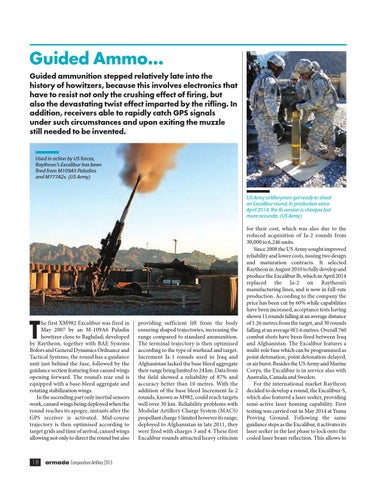
Guided Ammo... Guided ammunition stepped relatively late into the history of howitzers, because this involves electronics that have to resist not only the crushing effect of firing, but also the devastating twist effect imparted by the rifling. In addition, receivers able to rapidly catch GPS signals under such circumstances and upon exiting the muzzle still needed to be invented.
Used in action by US forces, Raytheon’s Excalibur has been fired from M109A5 Paladins and M777A2s. (US Army)
US Army artillerymen get ready to shoot an Excalibur round. In production since April 2014, the Ib version is cheaper but more accurate. (US Army)
T
he first XM982 Excalibur was fired in May 2007 by an M-109A6 Paladin howitzer close to Baghdad; developed by Raytheon, together with BAE Systems Bofors and General Dynamics Ordnance and Tactical Systems, the round has a guidance unit just behind the fuse, followed by the guidance section featuring four canard wings opening forward. The round’s rear end is equipped with a base-bleed aggregate and rotating stabilization wings. In the ascending part only inertial sensors work, canard wings being deployed when the round reaches its apogee, instants after the GPS receiver is activated. Mid-course trajectory is then optimised according to target grids and time of arrival, canard wings allowing not only to direct the round but also
18
Compendium Artillery 2015
providing sufficient lift from the body ensuring shaped trajectories, increasing the range compared to standard ammunition. The terminal trajectory is then optimised according to the type of warhead and target. Increment Ia-1 rounds used in Iraq and Afghanistan lacked the base bleed aggregate their range being limited to 24 km. Data from the field showed a reliability of 87% and accuracy better than 10 metres. With the addition of the base bleed Increment Ia-2 rounds, known as M982, could reach targets well over 30 km. Reliability problems with Modular Artillery Charge System (MACS) propellant charge 5 limited however its range; deployed to Afghanistan in late 2011, they were fired with charges 3 and 4. These first Excalibur rounds attracted heavy criticism
for their cost, which was also due to the reduced acquisition of Ia-2 rounds from 30,000 to 6,246 units. Since 2008 the US Army sought improved reliability and lower costs, issuing two design and maturation contracts. It selected Raytheon in August 2010 to fully develop and produce the Excalibur Ib, which in April 2014 replaced the Ia-2 on Raytheon’s manufacturing lines, and is now in full-rate production. According to the company the price has been cut by 60% while capabilities have been increased, acceptance tests having shown 11 rounds falling at an average distance of 1.26 metres from the target, and 30 rounds falling at an average 0f 1.6 metres. Overall 760 combat shots have been fired between Iraq and Afghanistan. The Excalibur features a multi-role fuse which can be programmed as point detonation, point detonation delayed, or air burst. Besides the US Army and Marine Corps, the Excalibur is in service also with Australia, Canada and Sweden. For the international market Raytheon decided to develop a round, the Excalibur-S, which also featured a laser seeker, providing semi-active laser homing capability. First testing was carried out in May 2014 at Yuma Proving Ground. Following the same guidance steps as the Excalibur, it activates its laser seeker in the last phase to lock onto the coded laser beam reflection. This allows to
The Multi Service-Standard Guided Projectile is a 127 mm naval ammunition which, fitted with a sabot, can also be fired by 155 mm howitzers to reach out to a mere 120 km with a 52 calibre gun. (BAE Systems)
Now in full production, the Excalibur IB aims at the international market. A laser guided version is under development. (Armada/P. Valpolini)
guide the ammunition with utmost precision onto its intended target, or a different target within the seeker field of view should the tactical situation change, or a moving target. No in-service date has been announced for the Excalibur-S, Raytheon awaiting a launch customer to finalise concepts of operation before starting the qualification process. Raytheon leveraged the Excalibur effort to develop a naval 127 mm guided ammunition, known as Excalibur N5 (for Naval 5-inch) that exploits 70% of the 155 mm round technology and 100% of its guidance and navigation system. According to Raytheon the new round will more than treble the range of the Mk45 naval gun, the company stating that testing “has provided Raytheon the data needed to progress to a live fire guided flight test in the near future.” BAE Systems MS-SGP (Multi ServiceStandard Guided Projectile) is part of a joint programme aimed at providing both shipborne and ground artillery with a long range guided artillery ammunition. The new round is a 5-inch (127 mm) affair which in a land version would be known as a saboted round. The guidance system leverages experience acquired with the LRLAP (Long Range Land Attack Projectile), the 155 mm developed for the Zumwalt-class destroyers and fired by BAE Systems 155 mm Advanced Gun System. The guidance system is based on GPS and inertial systems, an uplink allowing re-targeting the round in flight (time of flight to 70 km being three minutes
and 15 seconds). The MS-SGP rocket motor has been tested and a round performed a guided flight test from a naval Mk 45 gun, reaching a target at a range of 36 km with an error of only 1.5 metres and an angle of 86°. BAE Systems is ready to manufacture test projectiles for ground platforms; the challenge here is to verify the correct functioning of the breech block with the 1.5 metre long and 50 kg round (16.3 kg of which represent the HE warhead). According to BAE Systems the accuracy and angle of fall overcompensate the reduced lethality of the under-calibre ammunition, which also allows to reduce collateral damages. Another key role of incoming tests is to verify the performances of the retention device used to keep front canard guidance wings and rear wings closed until the round has come clear of the muzzle brake, a problem that does not exist on naval guns. The angle of fall, which can reach 90° compared to the typical 62° of a ballistic ammunition, allow the MS-SGP to be used in “urban canyons” hitting relatively small targets, which until now required to be neutralised by much more expensive weapon systems—the round is said to be well below the $45,000 mark. BAE Systems is gathering additional test data that allowed to refine the MS-SGP maximum range estimates. Based on our current test data maximum range is 85 km fired from a 39 calibre gun with Modular Artillery Charge system (MAC) 4 and 100 km with MAC 5 (which increases to 120 km from a 52 calibre gun). As for the naval version it has a 100 km range when fired from a 62 calibre gun (Mk 45 Mod 4) and 80 km from a 54 calibre (Mk 45 Mod 2). According to BAE Systems and US Army data, 20 MS-SGPs can achieve what requires 300 current 155 mm shells on a 400x600metre target. In addition the MS-SGP should reduce to one third the number of artillery battalions. A spiral programme is foreseen to give the MS-SGP increased performances, with a low-cost EO/IR seeker being envisaged to cope with moving targets. The US Navy plans to initiate an acquisition programme for the 127 mm guided round in FY2016, while the Army should follow at a later date. The Oto Melara Vulcano family of ammunition was developed with a view to increasing land and naval gun range and accuracy. Following an agreement between
Germany and Italy, the programme is now carried out jointly with Diehl Defence since 2012. While naval developments were carried out with 127 mm, and later 76 mm calibres, land variant work focussed on 155 mm. Three versions of the Vulcano 155 mm are in the last development stage: an unguided one known as the BER (for Ballistic Extended Range), a GLR (for Guided Long Range) available with IMU/GPS terminal guidance, and an additional variant with semi-active laser guidance (a far-infrared seeker is also foreseen but will be limited to naval rounds). The guidance section is located at front with four canards ensuring steering. Increasing range while keeping internal ballistic, chamber pressure and barrel length unchanged meant improving external ballistics and therefore reducing drag. A 155 artillery shell has a diameter to length ratio of about 1:4.7. A subcalibre option was thus adopted, bringing the ratio to about 1:10. A roll-decoupled tail section was also adopted to improve the
A mock-up of Oto Melara’s 155m Vulcano round that comes in extended range and guided versions, with respective ranges of 50 and 80 km when fired from a 155/52 mm gun. (Armada/P. Valpolini)
aerodynamic aspect and reduce sensitivity to lateral wind. The only downside came from the sabots, which require a relatively wide safe frontal area. The Vulcano BER is fitted with a purposely developed fuse which, for the 127 mm calibre, features four modes: impact, proximity, time, and height of burst. For the 155 mm the proximity mode is dropped. In the height of burst mode a microwave sensor allows to feel the distance from the ground, activating the exploding chain according to the programmed height. The fuse is programmed through electric
Compendium Artillery 2015
19
contacts, a portable programming device being available when the gun system is not fitted with an integrated programming system. Programming is used also for time and impact, as for the latter function a delay can be set to optimise terminal effects. As a safety measure, at impact the proximity fuse will always be activated to avoid duds. Vulcano IMU/GPS rounds feature a fuse similar to that of the 155 mm BER, with a slight difference in shape. As for SAL/IR Vulcano rounds, these are obviously equipped with an impact fuse only. Leveraging work on those fuses, Oto Melara developed the new 4AP (4 Action Plus) fuse to be used with full-calibre 76, 127 and 155 mm ammunition, and which has all four modes described above. The 4AP is in its very final stages of development, qualification trials being expected in the first half of 2015. Oto Melara expects first production batches to be delivered in Fall 2015. Vulcano rounds have a high-performance preformed-fragmented warhead with defined tungsten splinters of various sizes and insensitive munition characteristic. This, together with the optimised fusing mode programmed according to the target, ensures a terminal lethality that Oto Melara declares is twice that of a conventional grenade, even if the warhead dimension is smaller due to the smaller calibre. The BER round is fired ballistically, and can reach up to 50 km when fired from a 52 calibre barrel. The GLR Vulcano is programmed via a fire command unit (portable or integrated in the gun system). After firing, its thermal battery and the GPS receiver are activated and the munition is initialised with pre-programmed data. Once the apogee is reached the GPS/IMU midcourse guidance/navigation system flies the shell towards the target. In case of a SAL
The sub-calibre body of the Oto Melara Vulcano ballistic extended range ammunition, which production should start in late 2015. (Armada/P. Valpolini)
20
Compendium Artillery 2015
The semi-active laser version of Oto Melara’s Vulcano ammunition is developed together with Diehl Defence, the latter providing the laser sensor. (Diehl Defence)
munition the semi-active laser seeker picks the laser coded beam for the final phase. The GPS/IMU guided GLR can reach 80 km if fired from a 52 calibre barrel, and around 55 km from a 39 calibre, the GPS/IMU/SAL round having a marginally shorter range due to the least aerodynamic shape of the laser seeker head. The 155 mm Vulcano has been selected by the Italian and German armies for their PzH2000s. In July 2013 demonstrations were carried out in South Africa, showing that the BER version landed well within the 20 metres CEP of the 2 x 2-metre target, while the GPS/SAL hit the plate located at a range of 33 km. A complex test programme was started in January 2015 and will last until mid-2016 to complete qualification. This is jointly carried out by Germany and Italy in firing ranges in the two countries as well as in South Africa. Oto Melara, which remains the main design authority for the Vulcano programme, wants to deliver its first rounds to the Italian Army in late 2016/early 2017. Other countries have shown interest in the Vulcano, with the United States particularly looking at the naval round. With the acquisition of ammunition manufacturers Mecar (Belgium) and Simmel
Difesa (Italy) in Spring 2014, Nexter of France is now able to cover 80% of all munitions standards, from medium to heavy calibre and from direct to indirect fire. The 155 mm business remains the responsibility of Nexter Munitions, whose portfolio features one existing guided ammunition and one under development. The former one is the Bonus Mk II designed for anti-armour engagements as it deploys two 6.5 kg submunitions each fitted with an infrared seeker. After being ejected the two submunitions descend at 45 m/s speed, spinning at 15 revolutions per second, scanning a 32,000 m2 surface each. Once the target is detected, an EFP is generated at the ideal above-target height to penetrate the vehicle’s top armour. In service with France, Sweden and Norway, the Bonus Mk II has recently been acquired in small quantities by Finland. In addition its compatibility with the Polish Krab SP howitzer has already been demonstrated. In cooperation with TDA, Nexter is now busy with the preliminary and feasibility studies of a laser guided munition aiming at a CEP of less than one metre. Known as 155 mm MPM, for Metric Precision Munition, it will be fitted with a strapdown semi-active laser seeker, canard controls and an optional mid-course navigation. Without the latter range will be limited to 28 km instead of 40 km. The round will be shorter than one metre and will be compliant with JBMoU 39 and 52 calibres. The MPM demonstration programme was concluded as planned in 2013; this should have been followed by the development phase, which has been postponed to 2018. The French DGA has however provided funds to pursue work on GPS-based navigation, thus confirming a future need for the MPM.
The Nexter Bonus shell carries two smart submunitions designed to attack heavy armoured vehicles from the top. It has been adopted by France and Scandinavian countries. (Armada/P. Valpolini)
Nexter and TDA are working on a 155 mm Metric Precision Munition which, as its name indicates, should provide a CEP of less than one meter. (Nexter)
In Russia KBP of Tula has been working on laser-guided artillery ammunition since the late 1970s. In the mid-1980s the Red Army adopted the Krasnopol, a 20 km range ammunition capable of reaching a target moving at a maximum speed of 36 km/h with a 70-80% hit probability. The 1,305 mm long 2K25 152 mm weighed 50 kg, with 20.5 kg accounted for by the HE-fragmentation warhead and its 6.4 kg of explosives. Midcourse inertial guidance directed the round over the target area, where the semiactive laser seeker was activated. A 155 mm version, the KM-1, is also available, with very similar physical characteristics. These ammunition required not only a designator but also radio sets and synchronisation aids, designation being effective at ranges of 7 km against static targets and 5 km on mobile targets. To make things simpler, an updated version has been developed for export, the 155 mm KM-1M. Slightly shorter at 1,200 mm and heavier at 54.3 kg with a 26.5 kg warhead and 11 kg of explosives, it has a maximum range of 25 km, with a hit probability against a moving tank increased to 80-90%. It is guided by the Malakhit artillery fire control system, which includes the laser designator. Norinco in China has developed its own version of the Krasnopol. I … GUIDED KITS…
Alliant Techsystems’ Precision Guidance Kit (PGK) is battle proven. Some 1,300 kits were been delivered to Afghanistan in the Summer of 2013 to US Army and US Marine Corps units. This led to the first export contract, Australia requesting over 4,000 kits, followed by 2,000 more in FY14. Self-powered, the PGK is screwed on the artillery shell in place of the fuse, the kit itself acting as proximity or point detonating fuse. Being 68.6 mm longer than US Multi-Option Fuze, Artillery (MOFA) the PGK is only compatible with deep intrusion projectiles. Starting from the back we find the MOFA booster, the M762 safe and arm device, then comes the thread
A few years ago, KBP developed a 155mm calibre version of the Krasnopol fitted with a French laser spot seeker. (Armada/Eric H. Biass)
ensuring the interface with the projectile. The first external part hosts the GPS (SAASM) aerial, followed by four canards and by the height of burst sensor of the proxy fuse. The gun crew screws the PGK on the shell, keeping the cover in place as this also doubles as the interface to the fuse setter. The Epiafs (Enhanced Portable Inductive Artillery Fuze Setter) is the same as the one used for the Raytheon Excalibur and comes with the platform integration kit that allows to plug it into a fire control system or into a DAGR GPS receiver. The setter is positioned above the PGK nose and allows to switch on power and to insert all necessary data such as gun-target location, trajectory information, GPS crypto keys, GPS information, exact time and fuse setting data. The cover is then removed before loading and ramming the shell and going through the standard firing procedures. The kit has a single moving part, the canard assembly, which can only rotate along the longitudinal axis, the wings having a fixed cant; two couples of opposite wings have the same direction and thus provide lift, while the two despin wings provide counterrotation. The assembly being coupled to an alternator, counter-rotation produces electrical power and initiates the battery. The system then acquires the GPS signal, and navigation is then established, thus starting the 2-D guidance with the GPS comparing the shell position to the reference ballistic trajectory. This is ensured by the despinning of the canard assembly, which starts producing lift; the signals coming from the guidance unit rotate the assembly in order to orient the lift vector for 2-D control, guidance continuing until the impact takes place within the required 50 metres CEP. Should the round lose the GPS link or get off course due to wind anomalies, the PGK would automatically make it inert, dramatically reducing collateral damages. ATK developed the final version of the PGK, which works with the new M795 round with insensitive munition fill. This version passed the performance and safety First Article Acceptance Tests at Yuma Proving Ground in January 2015; fired from M109A6 Paladin
and M777A2 howitzers, it easily passed the 30-metre CEP test, most of the rounds falling within 10 metres of the target. The PGK is now approved for low rate initial production and the company is expecting a production contract by mid-2015. To increase the potential users base, the PGK was fitted to German artillery shells in October 2014 and fired from a German PzH 2000, a first from a 52 calibre barrel, with some rounds fired in the multiple rounds simultaneous impact mode: many shells fell within five metres from the target, well under the forecast CEP. BAE Systems is developing its own 155 mm kit, the Silver Bullet. Guidance is based on GPS, the kit coming as a nose add-on with
The Norinco GP155A laser guided ammunition is derived from the Russian Krasnopol and has a range of between 6 and 25 km. (Armada/P. Valpolini)
ATK’s Precision Guidance Kit is here seen fitted on two different ammunition, a 105 mm artillery shell (left) and a 120 mm mortar round (right). (Armada/P. Valpolini)
Compendium Artillery 2015
21
The PGK seen here separated from the round clearly displays its rear shape, which is only compatible with projectiles fitted with deep intrusion fuse cavity. (Armada/P. Valpolini)
The Raytheon Epiafs allows numerous time fuses to be set, like the M762/M762A1, M767/M767A1 and M782 Multi Option Fuze, as well as the PGK guidance kit and the M982 Excalibur guided round. (Armada/P. Valpolini)
four moving canard wings. The shell is still unpowered when it leaves the muzzle, then during the first five seconds the head is stabilised; after eight seconds navigation is activated to correct the path all the way to the target. The declared accuracy is less than 20 metres; however BAE System’s goal is a 10metre CEP. The kit can be used in conjunction with other additional devices such as rocket-assisted projectile or base bleed elements, to add accuracy to longer ranges. The Silver Bullet is considered at TRL 6-7. It has already been demonstrated, and the next step is environmental testing and qualification. BAE Systems expects it to be ready in two years from now. Although it cannot be described as a true guidance system, Nexter’s Spacido is a course correction system that considerably reduces range dispersion, which is usually much greater than lateral dispersion. Developed in co-operation with Junghans T2M, it is installed in place of the fuse, since the Spacido has its own fuse; when fitted on an HE round the Spacido is equipped with a multimode fuse working in preset time, point detonation impact, delay time and proximity mode, while when used for cargo ammunition the Spacido is available with preset time mode only fuse. When the round is fired, the radar installed on the weapon system tracks the round during its first 8-10 seconds of flight, establishes the round speed, and sends out a radiofrequency coded signal to the Spacido. This signal contains the time at which the three Spacido discs will rotate to increase drag and thereby ensure that the shell will drop onto the target. The system is currently at TRL8, Nexter seeking a firing range where testing at maximum ranges would be possible. Final qualification tests should be carried out in Sweden during 2015. A very similar system was launched by Yugoimport in the recent past, full development being still on hold awaiting funding from the Serb ministry of defence.
I … AND CONVENTIONAL AMMO
22
Compendium Artillery 2015
BAE Systems is developing the Silver Bullet precision kit, which should be available in a couple of years time. (Armada/P. Valpolini)
New developments do not concern only guided ammunition. The Norwegian Army and the Norwegian Defence Logistics Organisation contracted Nammo for the development of a wholly new family of insensitive 155 mm munitions. The High Explosive – Extended Range is a 100% Nammo product and can be fitted before loading with either base bleed or hollow base element, respectively yielding a 40 km and 30 km range when fired from a 52 calibre barrel. The warhead contains 10 kg of MCX6100 IM multicast explosive provided by Chemring Nobel, fragments being optimised for damaging vehicles with 10 mm RHA armour. The Norwegian Army’s plan is to have a round that can partly cover the effect of the now forbidden bomblets. It is currently being qualified and a pilot lot is expected by mid2016 with first deliveries planned for late 2016.
The second round is an Illuminating – Extended Range, developed with BAE Systems Bofors. In fact two rounds are being developed, using the Mira technology, one producing white light and the other infrared illumination. The round will open at a 350-400 metres height (reducing cloud and wind problems) and flare up immediately with constant burning intensity and followed by abrupt cut-off. Burning time for the white version is 60 seconds, while the lower burning rate of the IR composition allows a 90- second illumination. The two rounds are ballistically very similar. Qualification should be completed by July 2017, with a pilot lot available in January 2018, deliveries being expected in July 2018. The smoke round, which also involves BAE Systems, will run six months later. It contains three canisters, currently filled with red phosphorus, Nammo looking for more effective compositions. When leaving the shell canisters open six petal-like brakes that have different effects:
Developed by Nexter, the Spacido kit allows to considerably reduce range dispersion, which is one of the main causes of inaccuracy in artillery fire. (Armada/P. Valpolini)
Still under development, the Yugoimport course-correction system awaits national funds to move on to production status. (Armada/P. Valpolini)
they limit the speed at which they hit the ground, acting as aerodynamic brakes, they ensure that the burning surface remains on the upper side, and they ensure that the canister does not penetrate deeply in soft snow, something important for a northern country. Last but not least the Training Practice – Extended Range, mimicking HE-ER round timing, is being developed in dumb or spotter charge configurations. The new ammunition family is being qualified in the M109A3, but the company plans to fire it also with Swedish Archer guns; Nammo is also in talks with Finland to shoot them with the K98, and hopes to achieve trials with the PzH 2000. Rheinmetall Denel is close to deliver the first production batch of its M0121 Insensitive HE ammunition in 2015 to an undisclosed Nato customer, the qualification of the whole Assegai family of ammunition being expected within 2017. The same customer will then receive the upgraded version of the M0121, which will feature the deep intrusion fuse
Hell on Wheels Basically, wheeled artillery comes in two forms: bare truck-mounted guns and turreted guns on armoured chassis, each with their own priorities. In the first instance, it will be mobility, although lower cost is also a good selling argument. In the second, protection is afforded during firing operations. While many of the manufacturers that had developed artillery systems in Soviet calibres are now converting to Nato standards, the Czech Dana M1 still retains its 152 mm calibre. (Armada/P. Valpolini)
T Nammo has developed an entirely new family of insensitive 155 mm ammunition for 52 calibre guns that will become available between late 2016 and 2018. (Armada/P. Valpolini)
cavity allowing to accommodate coursecorrecting fuses or ATK’s Precision Guidance Kit (PGK), which are longer than standard fuses. According to Rheimetall the Assegai will be the first complete family of 155 mm ammunition specifically designed for 52 calibre guns to receive Nato qualification, in IHE, visual Illumination, IR Illumination and Red Phosphorus smoke versions, all ballistically matched and with interchangeable base-bleed and boat tail.
he need to improve strategic mobility and mobility on roads is something that acquired importance in recent asymmetric operations. This has led to the development of numerous systems in the two above mentioned categories. Many are in operational service while some developments are still at prototype stage, the financial crisis and consequent budget cuts being one of the reasons behind many delays. Truck-mounted systems currently seem to be the most trendy types, the Indian decision to start with this type in its artillery rationalisation plan means that all main manufacturers of such systems will do their very best to chalk up the contract for 814 units. The market seems a bit cooler for true SP wheeled howitzers due to the higher costs involved. I MEDIUM CALIBRE SELF-PROPELLED SYSTEMS
During the past three decades, the first country to have believed in the virtues of
wheeled medium-calibre self-propelled artillery was probably Czechoslovakia, whose 152 mm Dana was first spotted by western observers in 1980. Produced since 1977 and also known as the ShKH-77, the Dana is based on an 8x8 truck chassis fitted with an armoured cabin. It is still in service in various countries, Poland having deployed it to Afghanistan in 2008. Following the split of the country into the Czech and Slovak republics, the defence industries of the two newly formed nations took over the Dana design, and used it as a starting point to develop two quite different solutions. Although the Dana was originally developed in the Slovak part of the former nation, the Dana name actually remained in the Czech side, with an upgraded version being developed by Excalibur Army. The Slovakian Konstrukta Defence on the other hand developed the Zuzana. In the Czech Republic the evolution of the Dana did not lead to a Nato-standard system. Indeed, the Dana-M1 CZ developed by Excalibur Army is still equipped with the
Compendium Artillery 2015
23
original 152mm ordnance. This choice is mostly explained by the need to upgrade part of the more than 600 existing Dana M-77s still operating in the Czech Republic, Libya, Poland, and Georgia. Mobility, ergonomics and command and control are the three areas addressed by the upgrade. More power was gained with the adoption of new turbochargers and intercooler on the original T3-390 engine. This in turn commanded a new gearbox (a 430 Sachs), while a central tyre inflation system is added to provide variable pressure to the new 14R20 tyres. The driver has a new armoured windscreen and a better power assisted steering. Independent heating and air conditioning are also now available in the cabin. The weapon has a new fire control system with a new navigation system to reduce deployment time. The new commander’s computer and its smart terminal now allow missions to be prepared in advance, further decreasing time to shoot. Partial qualification was expected by 2014, but no news has been released by the company. Konstrukta Defence developed the Zusana 2000, replacing the old 152 mm ordnance with a new 155/45 mm manufactured by ZTS Speciál. Sixteen such systems are in service with the Slovak Army while 12 more have been exported to Cyprus. The Slovak company is currently offering the latest versions, the Zuzana A1 and Zuzana 2, the difference between the two being the powerpack: the A1 has a MAN D28 76 LF supercharged 453 hp engine coupled to an Allison HD 4560 PR transmission, while the Zuzana 2 has a 442 hp Tatra T3B-928.70 coupled to a Tatra 10 TS 180 transmission. Compared to the original Zuzana, the A1 and 2 models feature a 52-calibre ordnance, also
Konstrukta Defence has initially installed a 155/45 mm ordnance on its Zuzana, then a new 155/52 one, the system being now proposed with two different power solutions. (Armada/P. Valpolini)
24
Compendium Artillery 2015
Designed according to Serbian Army requirements, Yugoimport Nora K-I is still awaiting a first order from the national customer. (Yugoimport)
manufactured by ZTS Speciál. The ordnance fires all Nato standard ammunition. Forty of them along with 40 charges are stored into conveyers, which can host rounds up to 1,000 mm long. A fuse setter allows programming electronic fuses before ramming. Up to six rounds can be rammed and fired in the first minute of action, or 16 rounds in the first three minutes. A manual backup firing mode is available, at two rounds per minute. A radar provides muzzle speed measurement to increase accuracy, the Zuzana A1 and 2 being able to carry out multiple-round simultaneous impact firing. With Extended Range Full Bore Base Bleed shells the maximum range is over 41 km. Another major improvement is the adoption of an auxiliary power unit to operate the turret even when the engine is stopped. The crew is heavily protected, the front cabin ensuring Level 4 protection on the frontal arc. In 2014 the Zuzana 2 completed the firing and mobility qualification trials and is now awaiting a first order from the national customer. Yugoslavia had also developed a wheeled howitzer—the M84 Nora A with the 152/45 mm gun mounted on a truck flatbed. In the early 2000s Yugoimport decided to develop a system aimed at the export market. The Nora B-52 K0 was thus armed with a 155/52 mm ordnance installed in an open turret. The K1 followed, which mainly differed in having a Russian Kamaz 63501 8x8 chassis (replacing the original Serbian FAP 2832), a semi-protected turret for the crew, a full automatic loading system with semiautomatic breech block, and a full automatic navigation and fire control system. Twelve rounds were kept ready to fire while further 24 were stored into a magazine behind the front cabin. Sixty seconds were required to fire the first round, automatic laying and electric deployment of spades helping to reduce time.
The K1 is still part of Yugoimport portfolio and has been exported at least in two countries, Myanmar and Kenya, each having ordered 30 systems. The latest version available is the B-52 K-I, which features a fully enclosed turret, completing the transition from a truckmounted gun to a true self-propelled wheeled howitzer. This third-generation Nora has been redesigned in many features, to improve the reliability of the artillery system itself, the accuracy thanks to a new fire control system, improved navigation system, and a muzzle velocity radar. Hydraulic spades have been equipped with shock absorbers, while the crew has been reduced to four members. The maximum range is of 41.2 km using ERFBBB grenades, and of 56 km range expected with RA/BB ammunition. Providing rapid response forces with a self-propelled howitzer was the aim of Yugoimport when in 2011 it proposed a system based on the D30J 122 mm gun. Leveraging the Nora concept the Serb company worked on a FAP 2228 6x6 truck chassis with level 1 front protected cabin and artillery turret in the rear, which gave birth to the Soko SP RR 122. The four-man crew is split in two, with the driver and commander in the cabin and the gunner and loader in the turret. Maximum range is 17.3 km with HE grenades and 21 km with HE/BB rounds, the gun also allowing use of the laser-guided Kitolov-2M to engage moving targets. An electro-hydraulic resting system and semiautomatic loading mechanism with pneumatic rammer allow quick loading of shells and charges. Quick reaction time is ensured thanks to the adoption of hydraulically operated spades and of a fire control system that can be integrated in a battle management system. In the late 1970s Denel of South Africa
developed the G6 SP howitzer, based on a purpose-designed 6x6 chassis. Its turret is armed with the same 155/45 mm ordnance as the towed G5. Acquired by the South African Army and exported to Oman and the UAE, the original G6 was manually loaded. Its crew included four artillerymen and one driver. In 2003 Denel Land Systems launched the G652, with a 52-calibre gun, which carried a smaller amount of rounds (40 versus 50), but contained in two carousels in the turret rear, one with projectiles and one with charges ensuring the autoloader a six-round-perminute firing rate, and cutting crew size to three in the process. The G6-52 is fitted with an INS/GPS navigation system and with the AS2000 advanced artillery target engagement system, allowing the gun to shoot within 60 seconds from receiving the fire mission. The turret was installed on an upgraded version of the original G6 chassis, but can be installed on other chassis, mostly tracked. The G6-52, also known as Renoster, has not yet scored any export orders. How much New Dehli’s lift of ban on Denel will allow it to return to the fight is anybody’s guess. The system in the T6 turret configuration might also be used to generate a tracked SP howitzer based on a national chassis base (the Arjun-based Bhin proposed years ago). In the mid-1990s studies were launched to develop the Bofors FH77 B05 52 into a wheeled self-propelled howitzer, the Archer. A modified Volvo A30E 6x6 rugged articulated vehicle was chosen to ensure maximum mobility in snow-covered northern European countries. Key features included full system automation (the Archer is operated by a crew of three from inside the protected cabin), multiple-round simultaneous impact of up to six rounds, quick reaction time for a call-forfire while on the move (less than 30 seconds),
The G6/45 in service with the United Arab Emirates; the 52 calibre version is in advanced prototype stage and is currently awaiting a launch customer. (Armada/P. Valpolini)
Although Norway decided to drop out of the programme, BAE Systems still has a contract for 48 systems signed with the Swedish FMV which was the contracting authority. (Armada/P. Valpolini)
and protection against ballistic and mine threats. Air-transportable by A400M, its range is of 40 km with conventional ammunition and over 50 km with guided projectiles such as the Excalibur. In 2007 Norway joined Sweden in the programme, the system being officially known as the FH 77 BW L52. The first of 24 Archers ordered in 2010 was delivered to the Swedish Defence Materiel Administration (FMV) in late September 2013, but three months later Norway, who had signed an order for 24, decided to pull out of the programme. The decision was based on undisclosed failures to meet Norwegian requirements. This led to the signature of an amended contract between the FMV and BAE Systems Bofors to modify delivery schedules solely for Sweden. The last deliveries are now planned for early 2016. No details about possible cancellation penalties have been divulged to date. The Archer is a possible contender for the Danish M109 replacement programme. Leveraging experience gained with the PzH 2000 gun and its Unterlüß-made barrel,
Rheinmetall developed an autonomous turret armed with the same 155/52 mm gun capable of ranges of 42 km with improved ERFB basebleed projectiles and over 52 km with rocketassisted V-LAPs. The automatic loading system affords a rate of fire of six rounds per minute, or 75 rounds per hour of sustained fire. Up to five rounds can be fired in multiple round simultaneous impact mode. Using a specialised re-supply vehicle the 40 rounds and charges can loaded in five minutes. With its ring laser gyro with GPS, and a fully automatic laying system, command and control being provided by the AS4000 Artillery Target Engagement System, it can fire a first round within 60 seconds from halt, and require only 30 seconds to get out of action. Rheinmetall declares CEP of 0.6% of range in the lower trajectory. The turret was clearly developed with the Indian artillery contract in mind, and to that end it was installed on a South African G6 chassis, giving birth to the RGW52 (for Rheinmetall Wheeled Gun), but like other companies Rheinmetall was blacklisted by India. Currently the programme is stalled, but Rheinmetall is ready to restart it should a customer show some interest. Being autonomous, the turret can easily be installed on wheeled or tracked chassis. Initiated thanks to two research programmes partly financed by the Italian MoD, the development of the Oto Melara Centauro 155/39 LW is currently on hold, due to the scarce financial resources of the Italian Army. Unveiled at Eurosatory 2012, the system is based on a turret armed with a lightweight 155/39 mm ordnance mounted on a Centauro 8x8 chassis, although a serial system would be installed on the Centauro 2 chassis. The barrel length was chosen in relation with the fact that the gun would essentially use the Vulcano ammunition (q.V.) that will maintain a range of some 55 km with the guided ammo type. A fully automated loading solution was adopted, 15
Using the Enigma developed by Emirates Defence Technology as the base vehicle, BAE has studied a peculiar solution to allow an easy integration of its M777 ultralight 155/39 mm howitzer with that 8x8. These model show the gun in travel and firing position. (Armada/P. Valpolini)
Compendium Artillery 2015
25
The Artillery Gun Module is a stand-alone module that can be installed either on a wheeled chassis, such as the Boxer in the photo, or on a tracked chassis. The system is discussed in the SP tracked entry. (Armada/P. Valpolini)
rounds being located in the rear of the turret while corresponding charges are held in the chassis. The system chooses automatically the type of round and the charge according to commander or gunner inputs. An eightround-per-minute firing rate is ensured, the system being able to fire up to four ammunition in multiple round simultaneous impact mode. Using guided ammunition allows to limit consumption; however using a munition carrier equipped with a conveyor reloading the full complement of shells and charges can be done in less than 10 minutes. The gun features a pepperbox muzzle brake that considerably reduces recoil forces; simulations show that use of spades might not be necessary. Tests carried out so far involved the gun, the ammunition, charge and primer automatic loading system. Oto Melara is ready to restart the development, even for integration on a different chassis should an export customer show up. I MOUNTED 155
In the early ‘90s Giat Industries, now Nexter, started developing a truck-mounted artillery system that remained at prototype stage until the late ’90s when the French Army decided to test it. Eventually known as the Caesar, (CAmion Equipé d’un Système d’Artillerie, truck equipped with an artillery system), it finally became the subject of an order involving five units with a view to boosting the national industry. The French Army was not too enthusiastic about the concept at the time but ten years later things changed considerably: today the French Army, which ordered 72 further Caesars in late 2004, has deployed them in Afghanistan and in Mali, and is now fully convinced of the virtues of the mounted gun solution. In Afghanistan
26
Compendium Artillery 2015
the 155/52 mm gun of the Caesar allowed to cover the whole French area of responsibility, 15 x 40 km, operating from Nijrab in the north and Gwan in the south. Their air transportability was also instrumental in their deployment, as was their accuracy. The first long range fire mission requires only two rounds to adjust fire in a 100-metre CEP, followed by 10 rounds for the fire for effect mission. While in Afghanistan Caesars were operating from forward operating bases. In Mali tactical mobility was the key element. Operating in two couples, Caesars were based in Gao from where they could reach any place in the area of operation within two days, when operations were mounted. Fully digitised, a Caesar unit can quickly split, be ready to fire within one minute, fire six rounds in a minute, and be ready to move 45 seconds later. The French Ceasars are mounted on a Renault Truck Defense Sherpa 5 6x6 truck chassis, their cabins being optionally protected with add-on kits. Caesars so far exported are based on a Soframe/Unimog 6x6 chassis. This configuration was adopted by Saudi Arabia (a customer that never was disclosed by Nexter, but an open secret) for the 100 units ordered for the National Guard. Part of these was assembled locally. Saudi Arabia also acquired 60 Bacara (BAlistic Computer ARtillery Autonomous) fire control systems, as well as six Caesar simulators. Thailand ordered six Caesars, and Indonesia ordered 37 in 2012 to equip two artillery battalions. In November 2014 Saudi Arabia funded a rearmament programme for the Lebanese Army; the deal signed with France includes the delivery of 28 Caesars. Nexter is obviously eyeing the Indian Mounted Gun System programme, the
French company having teamed up with Larsen & Toubro and Ashok Leyland Defence to offer the Caesar installed on an Ashok Leyland 6x6 Super Stallion chassis. Another agreement was signed with Avibras in Brazil to integrate the Caesar on chassis used for the Astros 2020. Beside the integration on new platforms to widen export chances, the Caesar is undergoing qualification with guided ammunition such as Nexter’s Spacido and Raytheon’s Excalibur also described in an earlier chapter of this Compendium. Improvements in crew protection with addon armour on cabins, as well as an increase in the number of on-board rounds (currently 18 ammunition) are also under consideration; some of these solutions might hamper air transportability, but some potential customers do not require this capability. Besides India, Nexter considers the Far East and the Middle East the most promising areas for its Caesar, which might also bid for the M109 replacement in Denmark. With the acquisition of Soltam, Elbit inherited the 155 mm truck-mounted Atmos. Further development work was carried out to improve the loading system, performance and accuracy. Currently Elbit proposes the 155/52 mm version, the gun being fitted with a horizontal sliding breech and a semi-automatic loader. The platform can be either a 6x6 or an 8x8 truck, with first round fired within 20-30 seconds from pulling the handbrake. The ordnance is fitted with an integrated muzzle velocity radar to ensure maximum accuracy. The Israeli company is also ready to provide the Atmos with a 39-calibre ordnance. The Atmos D30 version was developed to provide a mobile solution for those countries that still had the 122 mm gun system of Soviet origin in their inventory. Unlike the 155 mm, the 122 can fire on all 360° (due to lower recoil forces) and features a semi-automatic loading system. Recent successes for the 155 mm Atmos include an undisclosed African country and a Far East nation; the latter has been identified as Thailand, which chose a 39calibre ordnance on a 6x6 truck. According to available information, following the prototype production in Israel, the remaining five guns are being produced and assembled in Thailand. Elbit Systems is very actively promoting its Atmos. The system is the base for the Polish Kril developed with Huta Stalowa Wola. A modified gun system has been adapted to a Jelcz-6x6 truck chassis purposely developed for the Kryl that will ensure C-130
Unveiled in 2012, the Oto Melara Centauro 155/39 LW leverages the experience of the company both in land and naval artilleries. Due to the Italian Army budget reductions the programme is currently on hold. (Oto Melara)
transportability. The dry weight of the system weighs around 19 tonnes and the first units are scheduled for delivery in mid-2015. Currently 24 production Kryls are on order (a battalion set, formed by three eight-gun batteries) with first deliveries expected in 2017. For the Indian bid Elbit Systems teamed with Bharat Forge, but like all the other competitors is awaiting the publication of the request for proposals. The Atmos is already in use in Romania as the Atrom, but installed on a Romanian 26.360 DFAEG 6x6 truck chassis; 18 such systems are currently in service, prime contractor being Aerostar SA of Romania. Apparently not adopted by the Israeli Defence Forces, the Atmos is in service in various countries, with Azerbaijan deploying five, Cameroon 18, Uganda six and Thailand six with chances for further orders. Considering the success of the truckmounted formula Chinese Norinco developed its own 155 mm product, the SH1 unveiled in 2007. It is based on a 6x6 chassis with a huge hydraulically operated rear spade. It is fitted with an autonomous orientation system, a muzzle velocity radar and an automated fire control system, and a semi-automatic loading system. Developed mostly for the export market, it has not so far bagged a production order. I LIGHT MOUNTED GUNS
The development of truck-mounted 105 mm calibre artillery systems started for different reasons: a need for special and airmobile forces integral indirect fire support was identified on the one hand, and on the other a need to increase the number of mobile artillery systems within limited budgets emerged. In the United States the Mandus Group considered the first option, developing a
hybrid soft recoil technology: in its gun a hydraulic system moves forward the suspended mass before firing, allowing to reduce the recoil on trunnion from around 13 tonnes, typical of 105 mm guns, to only 3.6 tonnes. This, plus the gun’s lighter weight, offers wide variety of viable platforms; in April 2013 the system was test fired from a Ford F250, using four collapsible outriggers. For the time being the system, known as the Hawkeye, is fitted with a 105/27 mm barrel, that of the M102 gun, the company being ready to adopt different barrels should a customer require it. With the M102 barrel the Hawkeye has a range of 11.5 km with conventional ammunition and 15 km with RAP rounds, and can also be used in direct fire mode. Sustained rate of fire is six rounds per minute, maximum being between 10 and 12. The gun offers a 360° field of fire, its elevation arc being –5°/+72°. A major advantage over other guns is its extreme simplicity, as it is made of only 200 parts, around 10 times less than the L119/M119 Light Gun. The Hawkeye is fitted with a digital fire control system that electronically controls elevation and azimuth. The Mandus Group operated together with Mack Defense in the US to produce a light mounted solution using its gun on board a Sherpa chassis. A module mounted behind the crew cabin hosts 24 rounds, the whole system weighing less than nine tonnes, which means that it can easy be transported even by helicopters. Firing tests, carried out in 2012, have shown that the Hawkeye/Sherpa system can fire even without spades, allowing deployment in 15-20 seconds. In 2012 the Mandus Group launched a new development aiming at producing a top carriage and recoil system capable to accept 39- and 52-calibre 155 mm barrels, recoil reduction allowing for installation of such artillery systems on a five-tonnes truck chassis. Mandus is currently working on a number of projects which should soon materialise, but no details were available at time of writing.
Elbit Systems ATMOS is available with guns in different barrel lengths and installed on various trucks; here a gun on a 6x6 chassis during firing. (Elbit Systems)
The acquisition of Soltam brought Elbit Systems in the artillery business, the company finding synergies with its electronic division that now integrates its products into guns such as the ATMOS SP wheeled howitzer. (Armada/P. Valpolini)
The prototype of the Kryl exhibited by Huta Stalowa Wola at Milipol 2014; the artillery system is that of the ATMOS by Elbit Systems, installed on a Polish 6x6 truck chassis. (Armada/P. Valpolini)
One of the first companies to use a 105 mm towed howitzer in a truck-mounted configuration was Yugoimport in the form of the M09. It is based on a 6x6 chassis fitted with a front armoured cabin providing Level 1 protection to the five-man crew. The artillery segment is a derivative of the company M56A1 improved towed howitzer, which is no more in production and features a 105/33 mm barrel; this allows to fire all
AH-1
TOWED HOWITZERS
Norinco, China
Calibre Barrel length Weight L/W/H (travel) Firing sector Elevation Max rate of fire Crew Engine power Road speed (auton) Road speed (tow)
Norinco, China
Calibre Barrel length Weight L/W/H (travel) Firing sector Elevation Max rate of fire Crew Engine power Road speed (auton) Road speed (tow)
Denel Land Systems, South Africa
Calibre Barrel length Weight L/W/H (travel) Firing sector Elevation Max rate of fire Crew Engine power Road speed (auton) Road speed (tow)
Denel Land Systems, South Africa
Calibre Barrel length Weight L/W/H (travel) Firing sector Elevation Max rate of fire Crew Engine power Road speed (auton) Road speed (tow)
AH-2
TOWED HOWITZERS
G5-45
STK, Singapore
105 mm 52 cal. 3.8 t 6.9/2.02/2.1 m ±20° -5° / +75° 6 rpm 5 – – 100 km/h
BAE Systems, UK
Calibre Barrel length Weight L/W/H (travel) Firing sector Elevation Max rate of fire Crew Engine power Road speed (auton) Road speed (tow)
Nexter, France
Calibre Barrel length Weight L/W/H (travel) Firing sector Elevation Max rate of fire Crew Engine power Road speed (auton) Road speed (tow)
155 mm 52 cal. 13.5 t 10.95/2.8/2.55 m ±20° -3° / +70° 6 rpm – 75 hp 16 km/h 80 km/h
105 mm 37 cal. 1.98 t 4.87/1.78/1.37 m 360° (±5.5°) -5.5° / +70° 6 rpm 6 – – –
TOWED HOWITZERS
LG1
105 mm 30.5 cal. 1.94 t 4.87/1.78/1.37 m 360° (±5.5°) -5.5° / +70° 6 rpm 6 – – –
TOWED HOWITZERS
M46/96
Yugoimport, Serbia
TOWED HOWITZERS
Calibre Barrel length Weight L/W/H (travel) Firing sector Elevation Max rate of fire Crew Engine power Road speed (auton) Road speed (tow)
BAE Systems, UK
Calibre Barrel length Weight L/W/H (travel) Firing sector Elevation Max rate of fire Crew Engine power Road speed (auton) Road speed (tow)
L119
155 mm 45 cal. 13.75 t 9.5/2.5/2.3 m ±32.5° -3° / +75° 3 rpm 5 80 hp 16 km/h 90 km/h
TOWED HOWITZERS
FH2000
TOWED HOWITZERS
155 mm 52 cal. 14 t 10.65/2.75/2.3 m 30° left, 40° right -5° / +72° 3 rpm 6 110 hp 20 km/h 90 km/h
TOWED HOWITZERS
G7
L118
155 mm 45 cal. 13 t 9.85/2.68/2.25 m 30° left, 40° right -5° / +72° 3 rpm 6 110 hp 20 km/h 90 km/h
M777
105 mm 30 cal. 1.6 t – ±18° -3° / +70° 6 rpm 5 (3) – – –
TOWED HOWITZERS
Calibre Barrel length Weight L/W/H (travel) Firing sector Elevation Max rate of fire Crew Engine power Road speed (auton) Road speed (tow)
155 mm 45 cal. 8.42 t 11.17/2.4/2.65 m ±25° -2.5° / +45° 2-3 rpm 8+1 – – –
TOWED HOWITZERS
BAE Systems, USA
Compendium Artillery 2015
Calibre Barrel length Weight L/W/H (travel) Firing sector Elevation Max rate of fire Crew Engine power Road speed (auton) Road speed (tow)
155 mm 39 cal. 4.22 t 9.3/2.77/2.26 m ± 22.5° -2.4 / +71.7° 5 rpm 5-8 – – 88 km/h
A COMPENDIUM OF TOWED, WHEELED PEGASUS
TOWED HOWITZERS
STK, Singapore
Calibre Barrel length Weight L/W/H (travel) Firing sector Elevation Max rate of fire Crew Engine power Road speed (auton) Road speed (tow)
GDELS, Spain
Calibre Barrel length Weight L/W/H (travel) Firing sector Elevation Max rate of fire Crew Engine power Road speed (auton) Road speed (tow)
SIAC
TOWED HOWITZERS
T-155 PANTER
MKEK, Turkey
ARCHER FH77
BAE Systems, UK-USA
ATMOS
Elbit Systems, Israel
155 mm 52 cal. 33 t 14.3/3.0/3.4 m Auto 21/21 ± 85° -1° / +70° 3 round/15 sec 3-4 6x6 338 hp 70 km/h 500 km
WHEELED HOWITZERS
Calibre Barrel length Combat weight L/W/H Loading Rounds ready/total Firing sector Elevation Max rate of fire Crew Chassis Engine power Max speed Endurance
DANA –M1 CZ
155 mm 52 (39) cal. 29 t 9.5/2.55/- m Automatic 18/18 ± 25° 0° / +70° – – 6x6 or 8x8 – 80 km/h –
WHEELED HOWITZERS
Calibre Barrel length Combat weight L/W/H Loading Rounds ready/total Firing sector Elevation Max rate of fire Crew Chassis Engine power Max speed Endurance
Excalibur Army, Czech Rep.
Denel Land Systems, South Africa
Calibre Barrel length Combat weight L/W/H Loading Rounds ready/total Firing sector Elevation Max rate of fire Crew Chassis Engine power Max speed Endurance
HAWKEYE 105
Mandus/Mack Defense, USA
KRYL
155 mm 52 cal. 17.7 t 10.0/2.55/3.7 m Manual 18/18 ± 16.5° 0° / +67.5° 6 rpm 5-6 6x6 – 100 km/h 600 km
WHEELED HOWITZERS
Calibre Barrel length Combat weight L/W/H Loading Rounds ready/total Firing sector Elevation Max rate of fire Crew Chassis Engine power Max speed Endurance
G6-52
155 mm 52 cal. 18.0 t 11.6/3.3/2.6 m ±20° -3° / +65° 4-6 rpm 5 148 hp 20 km/h 60 km/h
WHEELED HOWITZERS
Calibre Barrel length Combat weight L/W/H Loading Rounds ready/total Firing sector Elevation Max rate of fire Crew Chassis Engine power Max speed Endurance
Nexter, France
155 mm 52 cal. 13.5 t 10.35/2.08/2.2 m ±40° -5º / +68º 10 rpm – 106 hp 18 km/h ** km/h
TOWED HOWITZERS
Calibre Barrel length Weight L/W/H (travel) Firing sector Elevation Max rate of fire Crew Engine power Road speed (auton) Road speed (tow)
CAESAR
155 mm 39 cal. 5.4 t 10.0/2.75/2.4 m – – 4 rpm 6-8 28 hp 12 km/h 70 km/h
152 mm 33.3 cal. 29.25 t 9.91/3.0/3.53 m – 24/24 – -4° / +70° 5 rpm 5 8x8 355 hp 80 km/h 600 km
WHEELED HOWITZERS
152 mm 52 cal. – – Automatic 20/40 – -5° / +75° 6 rpm 3-5 6x6 – 85 km/h –
WHEELED HOWITZERS
Calibre Barrel length Combat weight L/W/H Loading Rounds ready/total Firing sector Elevation Max rate of fire Crew Chassis Engine power Max speed Endurance
105 mm 27 cal. 9t – Manual 24/24 360° -5° / +72° 8-10 rpm 3 4x4 215 hp 110 km/h > 1,000 km
WHEELED HOWITZERS
HSW/Elbit Systems
Compendium Artillery 2015
Calibre Barrel length Combat weight L/W/H Loading Rounds ready/total Firing sector Elevation Max rate of fire Crew Chassis Engine power Max speed Endurance
155 mm 52 cal. 23 t 10.3/2.55/3.44 m Automatic 18/18 ± 25° forward 0° / +70° 6 rpm 5 6x6 320 hp 80 km/h 500 km
AND TRACKED HOWITZERS - 2015 M09
WHEELED HOWITZERS
Yugoimport, Serbia
NORA B52 K-I
Yugoimport
SH1
Calibre Barrel length Combat weight L/W/H Loading Rounds ready/total Firing sector Elevation Max rate of fire Crew Chassis Engine power Max speed Endurance
105 mm 33 cal. 12 t 6.85/2.3/3.15 m Manual 60/60 ± 25° aft -3° / +65° 6-8 rrpm 5 6x6 – 90 km/h 450 km
WHEELED HOWITZERS
Calibre Barrel length Combat weight L/W/H Loading Rounds ready/total Firing sector Elevation Max rate of fire Crew Chassis Engine power Max speed Endurance
155 mm 52 cal. <33 t 11.2/2.95/3.82 m Full auto 12/36 ± 30° forw/aft -5° / +65° 4 rpm 4 8x8 536 Hp 90 km/h 800 km
WHEELED HOWITZERS
Norinco, China
SH2
Calibre Barrel length Combat weight L/W/H Loading Rounds ready/total Firing sector Elevation Max rate of fire Crew Chassis Engine power Max speed Endurance
155 mm 52 cal. 22 t – Semi-auto 25/25 – 0° / +70° – 6 6x6 315 hp 90 km/h –
WHEELED HOWITZERS
Norinco, China
SH5
Calibre Barrel length Combat weight L/W/H Loading Rounds ready/total Firing sector Elevation Max rate of fire Crew Chassis Engine power Max speed Endurance
122 mm 33 cal. 11.5 t 8.50/2.5/2.95 m Manual 24/25 ±22.5° 0° / +70° 6-8 rpm 5 6x6 215 hp 90 km/h 600 km
WHEELED HOWITZERS
Norinco, China
Calibre Barrel length Combat weight L/W/H Loading Rounds ready/total Firing sector Elevation Max rate of fire Crew Chassis Engine power Max speed Endurance
105 mm 37 cal. 10 t – Manual 40/40 ±30° 0° / +70° – 4 6x6 215 hp 90 km/h 600 km
SHARIFA-1
WHEELED HOWITZERS
MIC, Sudan
SOKO SP RR 122
Yugoimport, Serbia
T5-52
122 mm – 20.5 t 9.06/2.67/3.49 m Manual 45/45 ±40° forw -5° / +70° 8 rpm 5 6x6 260 hp 90 km/h 450 km
WHEELED HOWITZERS
Calibre Barrel length Combat weight L/W/H Loading Rounds ready/total Firing sector Elevation Max rate of fire Crew Chassis Engine power Max speed Endurance
122 mm 42 cal. 17 t 8.39/3.09/3.18 m Semi-auto 46 (+5 HEAT rounds) ± 35° forw/aft 7° / +75° 6 rpm 4 6x6 279 hp 100 km/h 600 km
WHEELED HOWITZERS
Denel Land Systems, South Africa
ZUZANA A1 (2)
Konstrukta
AKATSIYA
Calibre Barrel length Combat weight L/W/H Loading Rounds ready/total Firing sector Elevation Max rate of fire Crew Chassis Engine power Max speed Endurance
155 mm 52 cal. – – Semi-automatic 27/27 ±40° rear -3° / +75° 6 rpm 4 8x8 – – –
WHEELED HOWITZERS
Calibre Barrel length Combat weight L/W/H Loading Rounds ready/total Firing sector Elevation Max rate of fire Crew Chassis Engine power Max speed Endurance
155 mm 52 cal. 32 t 14.2/3.02/3.52 m Automatic 40/40 ± 60° -3°30’ / +70° 6 rpm 4 8x8 453 hp (442 hp) 80 km/h 600 km
TRACKED HOWITZERS
Russia
Compendium Artillery 2015
Calibre Barrel length Combat weight L/W/H Loading Rounds ready/total Firing sector Elevation Max rate of fire Crew Chassis Engine power Max speed Endurance
Calibre Barrel length Combat weight L/W/H Loading Rounds ready/total Firing sector Elevation Max rate of fire Crew Engine power Max speed Road Range
152 mm 27 cal. 27.5 t 8.4/3.25/3.05 m Manual 46/46 360° -4° / +60° 4 rpm 4 520 hp 63 km/h 500 km
DONAR
MSTA-S
TRACKED HOWITZERS
KMW – GDLS, Germany, Spain
Calibre Barrel length Combat weight L/W/H Loading Rounds ready/total Firing sector Elevation Max rate of fire Crew Engine power Max speed Road Range
Samsung Techwin, South Korea
Calibre Barrel length Combat weight L/W/H Loading Rounds ready/total Firing sector Elevation Max rate of fire Crew Engine power Max speed Road Range
HSW, Poland
Calibre Barrel length Combat weight L/W/H Loading Rounds ready/total Firing sector Elevation Max rate of fire Crew Engine power Max speed Road Range
K9
155 mm 52 cal. 35 t 10.3/2.8/3.0 m Automatic 30/30 360° 0° / +70° 6 rpm 2 720 hp 60 km/h 500 km
Russia
PLZ52
TRACKED HOWITZERS
KRAB
155 mm 52 cal. 47 t 12.0/3.4/2.73 m Automatic 48/48 360° -2.5° / +70° 6 rpm 5 1,000 hp 67 km/h 480 km
BAE Systems, USA
M109A7
BAE Systems, USA
155 mm 52 cal. 52.1 t 12.05/3.58/3.13 m – 29/40 360° -3.5° / +70° 6 rpm 4+1 838 hp 60 km/h 650 km
TRACKED HOWITZERS
Calibre Barrel length Combat weight L/W/H Loading Rounds ready/total Firing sector Elevation Max rate of fire Crew Engine power Max speed Road Range
155 mm 39 cal. 28.85 t 9.6/3.9/3.6 m Semi-automatic 39/39 360° -3° / +75° 4 rpm 4 440 hp 61 km/h 344 km
TRACKED HOWITZERS
Calibre Barrel length Combat weight L/W/H Loading Rounds ready/total Firing sector Elevation Max rate of fire Crew Engine power Max speed Road Range
155 mm 39 cal. 36.29 t 9.7/3.9/3.3 m Automatic – 360° -3° / +75° 4 rpm 4 675 hp 61 km/h 300 km
152 mm – 42 t 7.15/3.38/2.99 m Automatic 50/50 360° -4° / +68° 6-8 rpm 5 840 hp 60 km/h 500 km
TRACKED HOWITZERS
Norinco, China
TRACKED HOWITZERS
M109A6 PALADIN
TRACKED HOWITZERS
Calibre Barrel length Combat weight L/W/H Loading Rounds ready/total Firing sector Elevation Max rate of fire Crew Engine power Max speed Road Range
PRIMUS
Calibre Barrel length Combat weight L/W/H Loading Rounds ready/total Firing sector Elevation Max rate of fire Crew Engine power Max speed Road Range
155 mm 52 cal. 43 t 11.6/3.4/3.6 m Automatic – 360° -3° / +68° 8 rpm 4 1000 hp 65 km/h 450 km
TRACKED HOWITZERS
STK, Singapore
PZH2000
KMW, Germany
T-155 FIRTINA
MKEK, Turkey
Compendium Artillery 2015
Calibre Barrel length Combat weight L/W/H Loading Rounds ready/total Firing sector Elevation Max rate of fire Crew Engine power Max speed Road Range
155 mm 39 cal. 28.3 t 10.21/3.0/3.28 m Automatic 22/26 360° -5° / +75° 6 rpm 4 550 hp 50 km/h 350 km
TRACKED HOWITZERS
Calibre Barrel length Combat weight L/W/H Loading Rounds ready/total Firing sector Elevation Max rate of fire Crew Engine power Max speed Road Range
155 mm 52 cal. 57 t 11.7/3.5/3.4 m Automatic 60/60 360° -2.5° / +65° 8-10 rpm 3+2 987 hp 60 km/h 420 km
TRACKED HOWITZERS
Calibre Barrel length Combat weight L/W/H Loading Rounds ready/total Firing sector Elevation Max rate of fire Crew Engine power Max speed Road Range
155 mm 52 cal. 47 t 12.0/3.4/3.43 m Automatic 48/48 360° -2.5° / +70° 6-7 rpm 5 1000 hp 65 km/h 360 km
Following the trend of truck mounted howitzers, Norinco of China developed the SH1, which apparently has not yet succeeded on the export market. (Armada/P. Valpolini)
ammunition developed for the US M101 howitzer, with a maximum range of 15 km with the HE ER round and 18 km with the HE ER-BB grenade. Loading is manual, as well as the deployment of the two main jacks located in front of the two rear axles and of the two secondary ones at the back. A shield provides the gun crew with partial protection from ballistic threats. Ammunition is contained into two armoured boxes installed behind the cabin. A fire control system ensures short reaction time. Overall the M09 weighs 12 tonnes in combat order. Unveiled in late 2011, the South Korean EVO-105 system prototype was developed by Samsung Techwin using the upper part of the US M101 towed howitzer. The 105/22 mm weapon system fires in the rear sector. The mounted gun system is fitted with the same fire control system as the tracked K9 Thunder’s. According to the latest information the Republic of Korea Army intends to acquire 800 EVO-105s mounted on KM500 6x6 five-tonne trucks. First deliveries are expected in 2017. At SOFEX 2014 Jordan KADDB unveiled a similar system, but based on the M102 gun which features a longer 32-calibre barrel, yielding a maximum range of 11.5 km. This was installed on a two-axle DAF 4440 and fitted on a baseplate that allows it to be fired rearwards on a ±45° sector. The baseplate is controlled by an electro-hydraulic system (with manual back-up) that also controls elevation over an arc of -5°/+75°. Behind the truck cabin a box contains 36 rounds; in firing position two outriggers located just behind the first axle are used, while the sides and back of the truck are lowered in order to increase the working space for the three-men gun crew. A GPS/inertial/odometer navigation system is fitted, and during the
32
Compendium Artillery 2015
The Mandus Group is proposing its very low recoil 105 mm solution installed on a Mack Defense chassis; Mandus is currently working on a series of new programmes, among which a very low recoil 155 mm ordnance. (Mandus/Mack)
first firing tests, the system was deployed in three and a half minutes and left the deployment area 45 seconds after the last shot was fired. Phase 1 should now be completed, with the delivery of the prototype to the Royal Jordanian Army for evaluation. Phase 2 should see the system installed on a pallet for quick shifting from one platform to another, as well as the integration of a fire control system. An increase in the number of onboard ammunition is also foreseen. Norinco of China SH2 and SH5 are two light systems based on the same 6x6 truck, the first one fitted with a 122 mm D30 gun while the second, intended for the export market, is armed with a 105/37 mm gun. The crew, located in the forward protected four-door cabin, operates the gun from the rear platform.
Exhibited at SOFEX 2014, this truck-mounted solution allows to improve the mobility of the old M102 105 mm towed gun. A phased development programme is underway. (Armada/P. Valpolini)
Fitted with automated navigation and gun laying systems and with automated hydraulic spades at the rear, the SH2 and SH5 can be quickly put into action (for fire and leave position, a 40-second figure is given for the 105 mm version). The SH2 has a maximum range of 27 km with base-bleed rocket assisted ammunition, hollow base range being 18 km, while the SH5 reaches 15 km with HB rounds and 18 km with BB ones, the system being able to use American M1 ammunition up to ranges of 12 km. To improve tactical mobility the chassis is fitted with steering front and rear axles. The SH2 should be aimed at the Peoples Liberation Army, although it is unclear if it has already been adopted, while the SH5 is clearly a low-risk, low-cost, export operation, although it is still looking for a customer.
Hell on Tracks The tracked self-propelled howitzer remains the key artillery element of heavy formations, and only few nations have decided to do away with them, even if their overall importance has decreased in many armies, including those first tier armies that have acquired an increased expeditionary role. The protection they offer their crews is also second to none. An Italian PzH 2000 during a firing exercise; many countries, Italy included, now have a limited need for such howitzers, and as a consequence a number of these are available on surplus markets. (Armada/P. Valpolini)
I
n America the replacement of the M109 has been a top priority in many of the ground vehicle programmes that have been cancelled in the past years. At AUSA 2014 Col. James Schirmer, Project Manager Armoured Fighting Vehicles at US Army Program Executive Office Ground Combat Systems, again underlined the importance of the armoured indirect fire component. May 2014 saw the induction into low rate initial production of the M109A7, previously known as M109A6 PIM (Paladin Integrated Management). US Army Heavy Brigade Combat Teams will rely on the umpteenth upgrade of a system that started rolling off the lines in 1962, although not many of its original components are left in the newer iterations. The new artillery system also includes upgrades to M992A2 Field Artillery Ammunition Support Vehicle, which in the renewed version is known as the M992A3 CAT (Carrier Ammunition Tracked). Compared to the original M109 the A6 version, also known as Paladin, incorporated many improvements (larger turret, the M284 155/39 mm fitted with a semi-automatic loading system, an automatic fire control system with integrated navigation and
inertial positioning system, etc). Some Paladins are also fitted with modification kits to fire the M982 Excalibur. Fielded in 1994, the last production system left the production line in 1999. The M109A7 includes numerous automotive components taken from the Bradley fighting vehicle, some elements borrowed from the defunct NLOS Cannon, as well as new components. Among the latter is a new chassis for a maximum combat weight of 45 tonnes which, importantly, improves protection as it adds ground clearance and includes provisions for mine blast kit as well as for add-on armour. A common modular power system was adopted, which includes a 600V, 70kW integrated starter generator with 600V-28V bi-directional conversion. This was as sine qua non to the replacement of hydraulics with the three electric subsystems taken from the NLOS Cannon, namely the electric rammer, the elevation drive and the traverse drive, all running on 600V. In addition, the new power system also provides considerable growth potential in terms of new powerhungry subsystems. Borrowed from the Bradley are the 675 hp engine, the HMPT
800-3ECB transmission, the final drive and the power take off, while a new cooling system was added. Road and arm stations, torsion bars and 485 mm wide tracks were also taken from the Bradley, but with new rotary dampers. Most of the driving compartment is Bradley-derived, some elements having already been integrated into the Paladin, with the exception of the so called driver’s vision enhancer. While most of the electronics remained unaltered, a blue force tracking system was added. In terms of performances, maximum range is unchanged since the gun is the same (the M109A7 can reach 24 km with standard ammunition, 30 km with RAP shells, and 40 km with Raytheon’s Excalibur). The firing rate is also the same, the A7 being fitted with an improved semi-automatic projectile rammer taken from the NLOS-C/Crusader, but not with an automatic ammunition loading system. Following the October 2013 one-year contract that started the M109A7 and M992A3 low-rate initial production, BAE Systems received a follow-on contract to continue LRIP in November 2014. This is the first of three option year contracts to produce an additional 18 vehicle sets, LRIP aiming at the production of 66.5 vehicle sets plus spares. A team effort between Anniston Army Depot, Alabama, and BAE Systems, final production is taking place at BAE System’s Elgin facility. The delivery of the first systems is planned for April 2015. Full production of 450 additional vehicles is planned, budgets allowing. First Unit Equipped is currently scheduled for February 2017, following completion of the post-LRIP testing. Funding for FY16 will support final developmental testing and the acquisition of 20 systems, these including
The US Army fielded its M109A6 Paladin in the mid-1990s; because numerous attempts to replace it with new tracked howitzers failed, it will remain the backbone of US Army artillery for another few years. (US Army)
Compendium Artillery 2015
33
Known for some time as the M109A6 PIM and now M109A7, it exploits numerous elements of the Bradley and some parts of the defunct NLOS-C Crusader. The first units should be delivered in mid-2015. (BAE Systems)
The KMW PanzerHaubitze 2000 fitted with a Rheinmetall 155/52 mm ordnance from Rheinmetall, is definitely the most advanced self-propelled tracked howitzer currently on the market. (Armada/P. Valpolini)
one howitzer and one ammunition supply vehicle. According to the US Army a decision on full rate production should be taken in January 2017. BAE Systems is pursuing a first export order; M109 users worldwide have models up to M109A5 standard, which feature a smaller turret. But since an upgrade to A7 is impossible, an entirely new system is being offered. The viability of the option remains to be seen considering that the M109A7 retains a 39-calibre barrel against the 52-calibre offered by the competition, albeit at a higher cost. It will probably be a case-by-case matter, which will also depend on FMS contracts. Many M109 upgrade solutions are available around the world. The reduced dimensions of the turret however affects the use of some new ammunition; the Italian Army for example seems ready to scrap its M109s as it cannot accommodate the kit required for the new Vulcano ammunition. Italy already gave ten surplus M109Ls to Djibouti in 2013. Numerous second-hand M109s might also become available due to further force reduction programmes, mostly in Europe, Austria having for example announced a reduction from 136 to 106 of its M109A5 fleet while Denmark is also looking at a replacement for its M109A3. On the other hand Brazil seems interested in acquiring surplus M109A5s through the FMS programme and to upgrade part of its M109A3s. In early December 2014 Chile received 12 M109-A5 taken from US Army surplus via the US Army Security Assistance Command’s foreign military sales programme. Chile received 24 M109A3 in the mid-2000s and 12 more, fitted with the M284 39-calibre gun and M182 gun mount, in 2013. Old Europe can come up with a better weapon system than America, as instanced by the PzH 2000 developed and produced by Krauss Maffei Wegmann with the contribution of Rheinmetall Defence for the
gun. It is by a long shot a more modern and effective system, fitted as it is with a 52-calibre ordnance that gives it a much longer range. This, coupled to the superior crew protection, allowed the PzH 2000 to be successfully deployed in the Afghan theatre of operation by the Netherlands and Germany. It is also used in Greece and Italy, and has been produced under license by Oto Melara. Overall some 400 PzH 2000 have been produced, as original numbers for Germany and the Netherlands have been cut due to force reductions. Its automatic electrically driven and digitally controlled ammunition loading system allows an eight to 10 round-perminute firing rate to be achieved, with multiple round simultaneous impact capability. Together with the considerable amount of rounds available on board—up to 60—sets it head and shoulders above all the others in terms of barrelled artillery firepower. As for the range, the PzH 2000 reaches 30 km with standard ammunition and over 40 km with base-bleed ammunition. This allowed the systems deployed to Afghanistan to cover a huge amount of ground. Two of the users, Italy and Germany, having teamed for developing the new long range Vulcano ammunition, the PzH 2000
34
Compendium Artillery 2015
Put in simple words, the Artillery Gun Systems is in fact a light version of the PzH2000. It uses the same gun but lighter armour. (Armada/P. Valpolini)
will soon acquire a much greater range as well as pinpoint accuracy. In Italy Oto Melara is developing the kit that allows to adapt the loading system to the new rounds, which require to modify the loading rail and the rear floor, and the removal of the fuse setter. The development should be completed by late 2015. Like the M109, the PzH 2000 is also available as surplus from the stocks of the user countries. Germany ordered 450 howitzers but only kept 260 in service. Italy activated two out of the three planned regiments, each with 18 guns, and therefore some 20 PzH 2000 have been mothballed and should be sold once the Italian Army reorganisation plan receives final approval. The Netherlands had ordered 57 howitzers, but deployed only 39 leaving a surplus of 18. The last member of the PzH 2000 club is Croatia, which signed a deal with Germany for 12 systems in two batches, to be delivered respectively by 2015 and by 2016. Denmark is also considering the KMW howitzer as a possible M109 replacement, with a requirement of between 15 and 30 units. With a weight of 55 tonnes in combat order and 49 tonnes in transport configuration the PZH 2000 is not an easily deployable howitzer, especially by air. KMW thus developed the Artillery Gun Module, AGM in short, that uses the same ordnance but has a transport weight of 12 tonnes. A lot of weight saving comes from the reduced armour since the AGM is remotely controlled. It has a fully automatic charge portioning station and charge loading system that complements the automatic ammunition loading system—a derivative of that used in the PzH 2000. The weapon can fire three rounds in 15 seconds or six rounds in less than one minute. Its standard ammunition complement is of 30 rounds. Fitted with a digital fire control system and an integrated hybrid INS/GPS navigation system, it has multiple round simultaneous impact capability. The AGM has been shelved for some time, but was revived at Eurosatory 2014 installed on a Boxer chassis, firing trials being scheduled for Fall 2014. It can be installed on an infantry fighting vehicle tracked chassis: such a solution, known as the Donar, is proposed by KMW together with General Dynamics European Land Systems using the Ascod chassis, with a transport weight of 31.5 tonnes, which is well within the limits of the A400M Atlas. Another fully autonomous artillery turret is expected to emerge in Israel. Following the acquisition of Soltam, Elbit Systems has
invested in its new activity, adding new capabilities via in-house electronics and improving some existing systems, but is also working on new developments mostly based on existing building blocks. One of those is focused on an Israeli requirement for a fully autonomous artillery turret for wheeled or tracked chassis. Elbit Systems already has the required barrel, recoil system, loading system, fire control system and electric actuators on hand. The engineering effort is underway to develop a prototype, which was said to be at a “very advanced” stage by Elbit officials at Eurosatory 2014, who plan to test it by late 2015. In the late 1990s the British Army decided to increase the range of its 1980s vintage AS90, and launched the development of a 52 calibre version known as Braveheart. This retains the automatic loading system which allows it to fire three rounds in less than 10 seconds, or six rounds a minute for three minutes (the sustained rate of fire being two rounds a minute), but all actuators are electric. Main engine off operation is allowed by an auxiliary power generator, considerably reducing fuel consumption and thermal signature. The upgrade also includes the adoption of the Selex ES Linaps (Laser Inertial Artillery Pointing System), which provides the gunner with the exact bearing and elevation of the gun barrel as well as with the system position. The all-welded steel turret ensures Level 4 protection for the crew. The Braveheart’s firing range is typical of 52calibre barrels, namely 30 km with standard rounds, 40 km with base-bleed types and over 50 km with rocket assisted projectiles. Not all the British Army AS90s have been updated—only 96 of the original 179 as a result of force reductions in the mid 2000s, and further cuts could even reduce that number to slightly more than 60. The AS90 did not score any export order. However, in 1999 a licence agreement was signed with Poland for the production of AS90 turrets by Huta Stalowa Wola, to be fitted with a 155/52 gun. The turret was to be installed on a Polish-made chassis, a derivative of the mine-clearing Kalina tracked vehicle developed by Bumar-Łabędy with the components of the PT-91 tank. However, the plan to deliver 24 such howitzers, known as the Krab, by 2015 was halted due to structural defects in the chassis. Interestingly, the first eight barrels were provided by Nexter, but the following 18 were built-to-measure by Rheinmetall in Unterlüss. The Krab hosts 40 rounds, 29 in the shell and 11 in the chassis.
The Donar is made up of the Ascod II chassis and the Artillery Gun Module developed by KMW by taking elements of the PzH 2000; the Artillery Gun Module can also be installed on wheeled platforms. (GDELS)
In December 2014 a contract for the manufacture and customisation of the South Korean Samsung Techwin K9 chassis was signed. A first batch of 24 chassis will be delivered in 2017 from Korea to cover the needs of a first battalion. Turret integration is carried out in Poland. The remaining 96 chassis will be manufactured locally at the Gliwice production facility and by 2022 five artillery battalions will be equipped with the new Krab. Data of the Krab are missing in the table as available figures only refer to the earlier version. South Korea garnered quite some experience with the licence production of over 1,000 M109A2s— known as K55—the subsequent mid-90s upgrades to the K55A1 standard and the associated K56 ammunition supply vehicle. In the early 1990s South Korea developed a new 155/52 mm artillery system that started being delivered just before the turn of the century. The K9 Thunder came with an automatic ammunition resupply vehicle known as the K10 based on the same chassis. The K9 is fitted with an automatic shell handling and ramming system, an automatic gun laying system, and an automatic fire control system with inertial navigation system. These allow a quick into-action time as well as a high rate of fire, three rounds in 15 seconds in standard mode or in multiple round simultaneous impact mode. Normal rate of fire is six rounds per minute, sustained rate being two rounds per minute. No precise data are available on production, although South
Seen here in model form, the South Korean K9 Thunder has not been exported as such, but is the core of the Turkish Firtina, while its chassis is being adopted for the new Polish Krab. (Armada/P. Valpolini)
Korean press sources recently stated that 850 K9s have been delivered to the Army out of a considered requirement of 1,200. The first export customer for the K9/K10 tandem was Turkey, where it is known as the TUSpH Firtina or T-155 K/M Obus. The Turkish version is produced by Makina ve Kimya Endüstrisi Kurumu (MKEK) and features considerable differences especially in the turret and the electronic components, the T-155 being fitted with a fire control system developed by Aselsan. The initial Turkish requirement was for 350 howitzers, but it is unclear if all of these have been manufactured, or whether production stopped at around 180 howitzers. MKEK also produced 70 ammunition resupply vehicles. Developed by Aselsan, these reload 48 rounds and corresponding charges in 20 minutes, from an on-board stock of 96 rounds.
Locally produced by MKEK, the Turkish Firtina is a derivative of the K9 produced by Samsung Techwin in South Korea. (Armada/P. Valpolini)
Turkey managed to sign an export contract for 36 Firtina systems with Azerbaijan in 2011, but had to solve the German embargo on for the delivery of the MTU engine. An alternative powerpack meant a partial redesign of the engine compartment and consequent delayed deliveries, which were supposed to start in 2014. Mobility issues in Singapore required a lightweight self-propelled howitzer to replace M109s. In the mid-1990s Singapore Technologies Kinetics (STK) was thus tasked with the development of a 30-tonner with a width of less than three metres called the Primus. To speed up development and reduce costs STK based its new system on the United Defense (now BAE Systems) Universal Combat Vehicle Platform, which featured an aluminium armour. The artillery component was developed leveraging FH2000 experience, and kept at 39 calibres for
Compendium Artillery 2015
35
A model of the PLZ52, the latest development by Norinco. It features a 52-calibre gun, and its launch customer on the export market might well be Algeria. (Armada/P. Valpolini) The Firtina resupply vehicle is a Turkish adaptation of the South Korean K10; the tandem operates in the same way as the M109 – M992 pair. (Armada/P. Valpolini)
weight reasons. To improve the rate of fire STK developed a 22-round magazine with automatic loading and ramming, allowing it to fire three rounds in 20 seconds and to maintain a sustained fire of two rounds per minute for half an hour. Thanks to the automated fire control system and to the navigation system, the Primus can fire the first round within 60 seconds from stopping. The first of 48 Primus were delivered to the Singaporean Army in 2002. For its export market, Russia proposes two self-propelled tracked howitzer, the Akatsiya and the Msta-S, both of Cold War vintage. Russia sticks to its 152 mm calibre and made very few attempts to develop a155 mm option for export. The 2S3Akatsiya is fitted with the 27calibre D-22 gun and has a maximum range of 18.5 km with conventional ammunition, increased to 24 km with rocket-assisted projectiles. In service in many countries, for the most part delivered during the Soviet era, the Akatsiya chalked up some post-Iron Curtain export orders from Algeria, Libya, Syria and Ethiopia, with Ukraine having selling a few to Azerbaijan. A 155 mm version was developed, but apparently not marketed. Outgunned by other 155 mm systems, it remains however in the Russian export catalogue and over 1,000 such SP howitzers, part of them upgraded, remain in service with the Russian Army. The 2S19 Mtsa-S is a much heavier affair, and though its barrel length was never revealed it is estimated to be around 40 calibres. Declared ranges on the other hand are 24.7 km with standard HE rounds and 30 km with base bleed ammunition. It is fitted with an automatic loading system that works at any elevation angle. When firing from a prepared position a conveyor allows to fire externally supplied ammunition, at a rate of 67 rounds per minute. Charges are loaded with
36
Compendium Artillery 2015
a semi-automatic system. As for exports, 18 were delivered to Azerbaijan in 2012-13, 20 to Ethiopia in 1999, 48 to Venezuela in 201113, some former Soviet republics having retained SP howitzers of that type in their arsenals following the split of the USSR. The latest customer for this howitzer should be Morocco, which received its first systems in 2014. A later 2S19M2 was fitted with an upgraded fire control system and a new signature control system and entered service in 2013 with the Russian Army. China switched over to 155 mm calibre in the late 1990s, adding new systems to its fleet of 152 mm calibres of Soviet origin. Norinco developed the PLZ45, a self-propelled howitzer armed with a 45-calibre barrel. The system carries the usual tracked architecture, with driver and engine at the front and a huge turret at the back housing crew and ammunition. The PLZ45 comes with the PCZ45 ammunition support vehicle, which carries 90 projectiles and charges, that is three full complements. Twenty-four projectiles are carried in a semi-automatic loader, charges being loaded manually, which allow a fiveround per minute firing rate to be achieved. A muzzle velocity radar feeds data into the fire control system to improve accuracy. Firing range is between 24 and 39 km, depending on the ammunition used. In service with the Peoples Liberation Army, the PZL45 has been exported to Kuwait and Saudi Arabia. A further development, the PZL52, was unveiled in 2012. Very similar to the previous model, it nevertheless has a modified chassis and a new powerpack to cope with the nearly 10-tonne weight increase. It is obviously fitted with a 52-calibre barrel to considerably increase the range, up to 53 km. It retains a semi-automatic loading system, Norinco declaring an eight-round per minute firing rate as well as a multiple round simultaneous impact capability. It is not clear if the PZL52 is already in service with the PLA. A photo taken in Algeria in 2014 showed a howitzer moving on a tank transporter that very much looked like a PZL although it is impossible to determine
its barrel length, but at any rate it could well indicate a first export success for the type. In the Far East Japan developed a 155/52 mm SP howitzer in the mid-1980s. Known as the Type 99, it was produced by Mitsubishi Heavy Industries in cooperation with Japan Steel Works. A 40- tonne system, it is in service with the Japanese Ground Self-Defence Force. Until 2014 Japan was not exporting defence equipment, but now that a Parliamentary vote allowed Japanese companies to consider export opportunities, another potential competitor might enter the fray.
Developed by India's DRDO, probably as an interim solution, the Catapult II consists of an Arjun Mk1 chassis fitted with an M46 130/ mm gun. (DRDO)
India’s Catapult II Defining the Catapult II as an SP tracked howitzer might be right or wrong, the system being in fact a tracked mounted howitzer, if we maintain the categorisation adopted for wheeled systems. Unveiled at Defexpo 2014 by India’s Defence Research and Development Organisation, it consists of an Arjun Mk 1 tank chassis mounting an M46 130/ mm gun. A similar operation was carried out in the past with a Vijayanta tank chassis and was called the Catapult, 170 of which were built for the Indian Army. A solid roof protects the crew from splinters, no lateral ballistic protection being provided. The M46 Soviet field gun has a 58.5-calibre barrel and a maximum firing range of 27.15 km, elevation arc being –2.5° / +45°; traverse is also limited to ±14°. In August 2014 India decided to acquire 40 such mounted howitzer, which should be considered an interim solution awaiting a bid for a modern SP howitzer to be launched.
The Towed Option How much towed artillery is still a viable option very much depends on the scenario. In airmobile operations ultralight 155 mm or light 105 mm guns remain the alternative to heavy mortars, ammunition supply remaining a key issue. Although no longer in production the Light Gun is in service in many armies as the L118, the US Army deploying the L119 version that can fire the M1 ammunition. (BAE Systems)
T
o cope with airmobility weight limits 155 mm systems are usually fitted with 39 calibre barrels, which means that their range with standard ammunition is slightly in excess of 20 km, well enough for such operations. Last generation towed gunhowitzers are fitted with 52-calibre barrels, which give them a longer range. How much the towed solution is still viable when confronted to truck-mounted systems with similar ordnance is matter for conjecture, some armies having given up the gun plus truck solution to put the gun over the truck itself. Numerous 155/39 mm systems remain in service, even in first tier armies and in most cases limited budgets are the main reason behind that choice. The Indian overarching need for artillery includes also a towed gun-howitzer. Two 155/52 mm systems took part in trials that ended in fall 2014: the Nexter’s Trajan and the Elbit Systems Athos. Meanwhile a shorter barrel competitor, an evolution of the Bofors FH77B developed in India and featuring a 45-calibre barrel with a 38 km range, also carried out its latest trials following technical problems encountered in 2013. The Indian Army ordered 116 such guns from the Ordnance Factories, to which 300 more guns
might be added. The TGS (Towed Gun System) segment will be the bigger slice of the field army rationalisation plan, as some 1,580 systems should be acquired by Delhi. India recently lifted the ban on various defence contractors, among which is Denel of South Africa, another artillery producer, although
this company was more involved in heavier systems. Besides the need for “heavy� field howitzers, Delhi also planned to acquire 145 M777 ultralight howitzers; the programme was delayed motivating BAE Systems to close the ULH production line, which together with the increasing value of the US dollar considerably increased the potential budget for that operation. However, in January 2015 BAE Systems offered to transfer the entire M777 assembly line from the United States to India to partly overcome those issues and to ensure an even higher customisation of the howitzer. How much this will allow to restart the acquisition process remains to be seen. The M777 was developed to provide airmobile 155 mm artillery to the US Army and US Marine Corps, complementing the former and much heavier M198. The weight limit was placed at 10,000 lbs (4,218 kg), and to remain within that weight titanium and aluminium alloys were used. Given that the M777 has not been provided with an autonomous propulsion system; it can be sling-carried by CH-53E and CH-47D helicopters, the MV-22 Osprey and on board C-130s. A Humvee is sufficient to locally tow a howitzer, though a heavier vehicle is required for longer distances. The M777 can fire five rounds per minute for up to two minutes, sustained fire rate being two rounds per minute. The initial M777 version was fitted with an optical fire control, the A1 configuration adding on-board power to feed a digitised suite that included an INS/GPS navigation
A Canadian M777 lifted by a CH-47 Chinook; BAE systems 155/39 ultralight howitzer was can also be airlifted the CH-53s used by the US Marine Corps. (Canadian Army)
Compendium Artillery 2015
37
and positioning system, a radio, a gun display unit and a section chief assembly. To make the M777 compatible with the Excalibur guided ammunition the M777A2 was developed, which added the Enhanced Portable Inductive Artillery Fuze Setter as well as a software upgrade. The howitzer is in service with the US Army, the Marine Corps, the Australian and Canadian armies. Deployed to Afghanistan since 2006, the M777 had fired tens of thousands of rounds, including Excalibur rounds. Further improvements might include a new release of the fire control system as well as a laser ignition system, the aim being to handle the Modular Artillery Charge System. Besides the Indian customer, the Brazilian Marines have recently shown some interest for a small number of howitzers, but budgetary constraints have led them to shelve this choice. Another lightweight 155/39 mm howitzer is the Pegasus, developed in the early 2000 by the Singapore Armed Forces, the Defence Science and Technology Agency and Singapore Technologies Kinetics. Weight limit was put at 5.4 tonnes: barrel and carriage are made of titanium and aluminium alloy, an auxiliary power unit was adopted to move the howitzer on cross-country terrain. Once the gun is deployed the APU is also used to power the autoloader, which gives the Pegasus a burst rate capacity of three rounds in 24 seconds. A new recoil system allowed forces to be cut down to a third of those of a standard 155 mm system. The new howitzer was introduced in service in October 2005, replacing the French LG1 105 mm light gun. No information about export orders have ever surfaced. In the Far East another nation, China,
The Elbit Autonomous Towed Howitzer Ordnance System, or Athos, has recently been ordered by the Philippines. (Elbit Systems)
developed an ultralight, the AH4 155/39 mm of about four tonnes, but not many details are available. Shifting to the “heavies”, the Trajan uses Nexter’s experience with 1980’s towed howitzers and with the Caesar (q.v.). The Trajan, purposely developed for the Indian bid, and currently at prototype stage, is based on the oscillating mass and aiming system of the Caesar, fitted onto an evolved TR-F1 carriage. Fitted with an ammunition handling crane and an automatic shell loading and ramming system, it can fire six rounds per minute. Hydraulically operated deployment procedures through the auxiliary power unit allow the gun to be put in action in less than 90 seconds with a six-man crew. The APU ensures good autonomous mobility, with a 5 km/h off-road speed. Nexter is currently awaiting the Indian RfP, the French company having set up a
consortium with Larsen & Toubro in 2011 for local production. The Athos, for Autonomous Towed Howitzer Ordnance System, was developed by Soltam (now Elbit Systems) as a carriage and oscillating mass capable to accommodate barrels of different lengths, including state-of-the-art 52 calibre types. This is currently offered to India, in cooperation with Bharat Forge Limited with which a joint venture was formed to produce the Athos locally. Fitted with an automated loading system, it can fire three rounds in 30 seconds, intense rate being 12 rounds in three minutes, while sustained rate allow to fire 42 rounds in one hour. Equipped with digital navigation, fire control and laying systems, it can be used also for direct fire up to 1.5 km range. Its APU powers a hydraulic system driving its two main road-wheels that provide autonomous shoot-and-scoot capability. The Athos has obtained a recent success in the Philippines, Elbit Systems having received a contract for 12 systems worth nearly €7 million in March 2014. Another 52-calibre system comes from General Dynamics European Land Systems, originally developed by Santa Barbara of Spain and known as the 155/52 APU-SIAC (Sistema Integrado de Artillería de Campaña). Compared to other systems of that category the Spanish gun has a carriage with four main wheels, two more being on the spades and raised during firing. The howitzer is fitted with ballistic computer, muzzle velocity radar, chamber temperature Developed to take part in the Indian towed artillery competition, the Nexter Trajan was brought straight to prototype stage, but awaits a launch customer. (Nexter)
38
Compendium Artillery 2015
The 155/52 APU-SIAC howitzer originally developed by Santa Barbara, is in service with Spain and Colombia and might also be acquired by Brazil. (GDELS)
sensor, recoil meter sensor and effective full charge round counter. Thanks to this and to its auxiliary power unit it can be deployed in two minutes and leave the firing position in one and a half minute, shooting three rounds in 11 seconds, four rounds in 20 seconds, or 10 rounds in one minute, sustained fire rate being two rounds per minute. It can be programmed for multiple round simultaneous impact up to four rounds. The howitzer is also in service with Colombia in the 155/52 APU-SBT configuration. The SIAC is also being eyed by the Brazilian Marine Corps. In the Far East Singapore Technologies Kinetics developed a 52-calibre gun starting from its FH-88 155/39 mm howitzer, keeping the same four main wheels carriage architecture. Known as FH2000, it is fitted with a semi-automatic breech and a hydraulic rammer that allow to maintain a rate of 6 rounds per minute for three minutes. Adopted by Singapore, Indonesia also uses the FH2000. This gun was used as the basis for the Turkish T-155 Panter towed howitzer, STK providing assistance to MKEK in the system development. Heavier than the original FH2000 and equipped with a more powerful auxiliary engine, the Panter is in service in the Turkish Army in a few hundreds, Turkey having also exported the system to Pakistan which has also produced locally some dozen howitzers. Once known as GC45 and now as AH1, Norinco’s 155/45 mm towed howitzer had the typical four main wheel carriage, with two smaller wheels under the trails. It is derived
from the PLL01, the first 155 mm artillery in service with the PLA, and reaches targets at 39 km using base bleed ammunition and 50 km with rocket assisted projectiles. Fitted with a pneumatic rammer, it reaches three rounds per minute rate of fire. The AH1 is in service at least with an export customer, Algeria. A 52-calibre version has been developed, known as AH2, which weight is increased by one ton compared to the AH1. Ethiopia seems to be among the first customers, even if the contract has never been officially announced. I THE TRULY LIGHT ONES
While many nations replaced their 105 mm light guns with lightweight 155 mm types, those that could not afford them or that operate helicopters that cannot lift them still rely on smaller calibre systems. Another issue is ammunition supply, considering how heavy can be a resupply of 155 mm projectiles and charges. Probably considered now a niche market, it remains however a market. Nexter’s 105 LG1 can be definitely airlifted by a medium size helicopter thanks to its weight of only 1.6 tonnes. One of the latest customers is Colombia, which developed interesting usage concepts. The LG1 is used as assault artillery being easily deployed anywhere within range of the area of operation providing a rugged and simple fire base. To ensure quick action time the LG1 is equipped with a GPS/INS navigation and orientation system; however lessons learned in Colombia showed the necessity for each single gun to be able to compute its
The advantage of 105 mm howitzers, here a Nexter LG1 being air-lifted by a Cougar, also lies in the lighter weight of ammunition in terms of logistics. (Nexter)
own firing data based on target data supplied by the army network. Nexter thus developed the prototype of a light firing computer, the Toplite, which is currently in the very last development stage. The Toplite exchanges data via WiFi with the digitised gun, reducing errors and speeding up action. Nexter has not yet scored an order for that system, but Colombia has obviously shown great interest. Late winter 2014 saw the first operational use of the M119A3 digitised light gun by the US Army 101st Airborne Division (Air Assault) artillerymen. This is the latest version of the L118/M119 Light Gun produced by BAE Systems. It is fitted with a digital fire control system that includes inertial navigation unit, GPS, digital gunner’s display, and digital communication between each gun and the Fire Direction Centre guidedprecision system technology and other features that give the weapon the ability to determine its precise geographical location on its own. The digitised system allows the
Compendium Artillery 2015
39
Firing the Nexter LG1 light howitzer is made easier with the Toplite light firing computer. (Nexter)
first round to be fired in two to three minutes, as opposed to the 10 minutes of the previous M119A2. The software has 90% commonality with that of the M777A2, which in turn is very similar to that of the M109A6 Paladin, simplifying routines for artillerymen while saving development money. The gun retains all the A2 features, which allowed soldiers downrange to switch to manual mode when digital systems went down in a few situations. The M119 is the American production version of the L118 Light Gun, originally developed in the mid 1970s by Royal Ordnance (now BAE Systems). Light gun digitisation has also been implemented by other nations. The British Army adopted Selex ES Linaps for its L118,
The British Army has upgraded its Light Guns with the Selex ES Linaps system. BAE Systems is offering similar upgrade programmes on the export market. (British Army)
40
Compendium Artillery 2015
and by Canada, the United Arab Emirates, Oman, South Africa, Malaysia and Thailand for use in conjunction with various types of guns. New Zealand was one of the most recent customers, having installed it on the L119 Light Guns. The Linaps features a muzzle velocity radar, a FIN 3110L inertial navigation unit, a gun laying unit, a battery power module, and a detachment commander’s data terminal, a ruggedized tablet computer with multi-layer map capacity. The most recent versions feature a DRS Technologies display and control unit with a 10.4-inch screen. The Linaps INS/GPS navigation system provides a 10-metre CEP in horizontal and vertical positions, heading accuracy being under one mil.
Turning to the Denel G7, this is quite a peculiar gun as its barrel is a 52-calibre, which gives it a considerable range—some 32 km with base-bleed ammo. This comes at some weight penalty, the G7 currently tipping the scales at around 3.8 tonnes. However, weight reduction measures are already being looked at to reduce this by at least one tonne. Any further action probably depends on a launch customer.
The FH-70 is an ageing system, but some nations, awaiting better times, are planning to upgrade it before replacing it with lighter 155 mm guns. (Armada/P. Valpolini)
FH-70: a diehard gun The tri-national Cold War-era 155/39 mm field gun is definitely getting old; however it is not much willing to retire. Probably helped by the deep cuts in defence budgets, it remains in service in various countries, although nearly all the original producing countries have shelved it. The exception is Italy, which plans to keep it in service for 10-15 more years. An upgrade programme is currently underway: Phase 1 includes the development of a prototype which can be interfaced with the Italian Artillery SIF (Integrated Fire System) C2 suite, the upgrade of three more guns at that standard, and that of an Astra artillery tractor. The main upgrades include a new diesel auxiliary power unit, the adoption of the Selex-ES Linaps artillery pointing system, and the acquisition of an Astra artillery tractor. The prototype should be available for trials in June 2015. Phase 2 will include the upgrade of 74 more FH-70s, and the acquisition of new tractors. Another key issue is that Oto Melara is developing a kit to allow the FH-70 to fire Vulcano ammunition.
Heavy Mortars and Ammunition When range is not a key issue and high attack angles allows it to hit targets on reverse slopes or targets protected by urban canyons, the mortar becomes a choice. Heavy mortars have often become a secondary armament even within artillery units. Vehicle mounted variants even provide organic indirect fire to motorised and mechanised infantry units.
T
DA, (formerly Thomson Brandt Armements), the Thales subsidiary specialised in mortars, many years ago developed the MO 120 RT rifled 120 mm mortar, which is in use by many infantry and artillery units. Towable by a light vehicle and easily sling transportable by medium utility helicopters, the 622-kg mortar has a maximum range of 8.1 km with standard ammunition. The two-metre long rifled barrel provides good accuracy, and range increases to 13 km with rocket-assisted projectiles. Deployable in less than three minutes, its rate of fire can reach 18 rounds per minute. The MO 120 RT can be split into three loads—barrel, base plate and carriage (the latter being the heaviest at 285 kg)—and deployed by parachute. The MO 120 RT is in use in 24 countries, including Belgium, France, Italy, the Netherlands, Turkey and the United States, where it is deployed by the Marine Corps in the Osprey-transportable Expeditionary Fire Support System (EFSS). From this mortar TDA developed the 2R2M (Recoiling Rifled Mounted Mortar). This is a 1,500 kg system that can be mounted
in the rear compartment of 10- to 15-tonne tracked or wheeled armoured personal carriers, thanks to its recoil brake that absorbs up to 75% of the forces. Its computerised fire control cum land navigation system allows it to fire the first round in less than a minute from vehicle stop. The semi-automatic muzzle loading ensures a 10 round per minute rate of fire. The 2R2M can be connected to a fire management system, which magnifies platoon effects and provides automatic data transmission between mortars, command post and the forward observer. The elevation arc is +45°/+85° while traverse is ±220°, ballistic performances remaining identical to those of the MO 120 RT. The number of ready rounds depends on the carrier but is usually around 35. The 120 2R2M has been adopted by Italy, installed on the Freccia 8x8 chassis (the first of 12 mortar carriers were delivered in late 2014), by Malaysia on board the ACV-19 in a solution also adopted in undisclosed numbers by Saudi Arabia, and by Oman on 6x6 VABs. The 2R2M should be installed on the Griffon, the new 6x6 currently under
Firing from an M113 with Elbit Systems Cardom 120 mm mortar; the system can also accept 81 mm tubes and is in service with Israel and Spain. (Elbit Systems)
TDA's 2R2M 120 mm automatic mortar system has been integrated on various chassis, among which the VAB 6x6 and the Piranha 8x8 seen here. (TDA)
A close view of the Elbit Cardom 120 mm mortar; originally developed by Soltam, the system now draws on Elbit’s experience with electronics. (Armada/P. Valpolini)
Compendium Artillery 2015
41
development for the French Army to equip its light and medium units. Another automated vehicle-mounted mortar is the Cardom developed by Soltam, now part of Elbit Systems. It can be armed with a 120 mm or an 81 mm smoothbore mortar and is fitted with electric drives for automatic laying, state-of-the-art embedded fire control system, inertial navigation system and on-board ballistic computer which can be integrated in a battle management system which enables it to shoot a first round within 30 seconds of taking position. The 120 mm version has a maximum range of 7,000 metres, and a rate of fire of 16 rounds per minute (the number of rounds depends on vehicle type). The Cardom has a 360° traverse, and the mortar can also be used dismounted. A multiple-round simultaneous impact mode is available to further improve effectiveness. It has been adopted by the Israeli Defense Forces armed with the 120 mm barrel (two contracts signed in 2011 and 2013) as well as by the Spanish Army, but with the 81 mm barrel. The Cardom is also the basis of the RMS6-L system installed by the Mistral Group in 324 Strykers (known in US Army parlance as the M1129/M1252 Stryker Mortar Carriers). An evolution of the work carried out by the Marvin Group is the XM-905, fielded in early 2014 by US Special Forces. The programme was launched as a Joint Urgent Operational
Need to fill a gap in base protection in Afghanistan. Also known as Automated Mortar Protection System (AMPS), it is based on a round base-plate with three spades and stakes on which the RMS6-L is installed. The electric drive system is linked to the fire control system to minimise the time to target, the plate being able to rotate on 360° in both directions. The fire control system is able to find accurate firing solutions even when the system is deployed on a slope. The March 2013 contract awarded to the Mistral Group following that of January 2012 adds to the previous the Enhanced Mortar Target Acquisition System (EMTAS), nine of which were deployed in spring 2011 to Afghanistan. The US Army intends to widen the user community by also supplying it to the Green Army. Providing infantry with a high-mobility big calibre indirect fire capability was the aim of Elbit Systems’ designers when they started working on the Spear. They worked on a new recoil system to reduce recoil forces under a 10-tonne threshold and thereby allow the Spear to be installed on Humvee-class vehicles without needing stabilising spades. The system weighs less than one tonne without ammunition, the ammo complement being 36 rounds with charges. The range and rate of fire remain those of the Cardom, ammunition loading being the only manual action required from its crew of two. It is
Elbit’s laser guided mortar ammunition is based on a seeker derived form that of the JDAM and is obtained by adding a kit to a standard 120 mm mortar bomb; on the ledt the kit installed on the ammunition while the right picture shows the separate elements of the kit. (Armada/P. Valpolini)
42
Compendium Artillery 2015
In America the Mistral Group developed the RMS6-L mortar system. Based on Elbit Systems' Cardom, it has been installed on the Stryker. (US Army)
equipped with a computerised navigation and aiming system with north finding system and clinometers. Thus fed, the fire control system (which can be integrated into most battle management systems) allows the electric drives to exactly position the mortar barrel in azimuth and elevation. A Spear-equipped vehicle can enter in action within 60 seconds from stopping and fire with a 30-metre accuracy. The Spear opens up the possibility to provide heavy calibre mobile mortar fire to infantry units equipped with light vehicles, enabling to deploy the same type of vehicle to cover troop transport, direct and indirect fire roles. The Israeli Defence Forces have expressed their interest and Elbit confirms that a few potential export customers have already lined up. About 15 years ago Ruag in Switzerland developed a vehicle-mounted 120 mm smoothbore mortar known as the Bighorn. A hydraulic powerpack ensured gun laying and semi-auto loading, while an inertial navigation and positioning system provides accurate weapon position and mortar alignment independently from GPS availability, accuracy being 0.5% distance travelled in x- and y- grids and 0.25% in altitude. Azimuth range was of ± 190° (adding a slip-ring a 360° continuous traverse is available as option) while elevation arc covered +45°/+85°. The semi-auto loader ensured a burst rate of four rounds in less than 20 seconds, an intense rate of 8-12 rounds per minute, and a sustained rate of
Ruag's Cobra is the most recent addition to vehicle-mounted 120 mm mortar systems; equipped with all-electric actuators, it is largely based on the former Bighorn. (Armada/P. Valpolini)
four rounds per minute up to 150 rounds. Maximum range was in excess of 9,000 metres, depending on ammunition. The programme was eventually shelved, but in February 2015 the Swiss company unveiled the Cobra—a fully modernised version of the Bighorn. In addition to a modern “bodywork”, the Cobra essentially sees all its hydraulics replaced with electric drives and a modern firing management system. The recoil force is of 30 tonnes and only lasts 30 milliseconds meaning that a two-axle truck suffices to operate it, according to the company. The wholly new ballistic computer and fire control system can be easily integrated with any artillery command and control system. With its semi-automatic loader the Cobra can shoot four rounds in less than 20 seconds (a safety system prevents double loading). According to Ruag a Cobraequipped vehicle can take position, fire six to ten rounds (the first one leaving the barrel within 60 seconds) and scoot in less than two minutes. The two-metre barrel (a 1.6-metre barrel can also be had in case of limited volumes) accepts any current smoothbore ammunition, even the longer guided ammunition. The Cobra also features an embedded training facility as well as the already mentioned 81 mm barrel insert providing a train-as-you-fight capability reducing ammunition cost and firing range
requirements. In terms of weight some savings were obtained, the Cobra weighing 1,200 kg without the loading system and 1,350 with it. Ruag has already started firing trials required to confirm the new architecture (the artillery components taken from the Bighorn had already fired over 2,000 rounds). The Cobra has been integrated on a Piranha (it is mainly proposed for 8x8 platforms). Discussions with several countries are underway. The ST Engineering of Singapore Super Rapid Advanced Mortar System (Srams) 120 mm smoothbore mortar system is in service with Singapore and the UAE, respectively on the Bronco all-terrain vehicle and on the RG31 mine protected vehicle. The mortar has a 1.8-metre long barrel, and is fitted with a 10-round per minute semi-automatic loader. Maximum range is 9 km with RAP ammunition, elevation arc being +40°/+80°, while the platform rotates ± 28° from the center line. The overall weight of the system is less than 1,200 kg, recoil being less than 26 tonnes (it has been integrated on the company’s Spider as well as on the Humvee). In the Singaporean Army configuration it is mounted on the rear section of the Bronco, while on the RG31 it is installed on the flatbed. A first batch of Srams was delivered to the UAE and integrated on the RG31 Mk5 by the International Golden Group; this assembly is known as Agrab 1. A second batch of 72 is being integrated on the RG31 Mk6E as the Agrab 2 with deliveries well underway. The latter version is fitted with a Selex ES FIN3110 navigation system and, like the Agrab 1, with Denel Land System’s Arachnida fire control system. Another type of mortar solution for vehicles is the one that includes full protection for the crew, that is, turreted
STK Engineering of Singapore has exported its Srams to the UAE where it has been integrated on the RG-31 to become the Agrab 1. (Armada/P. Valpolini)
mortars. Constraints on vehicles dimensions are obviously more stringent due to the weight, while first round can usually be fired quicker, as there is no need to set up the mortar when the vehicle stops, but only to adjust direction and elevation. In the late 1990s Patria Hägglunds Oy, a joint venture between Patria and BAE Systems Hägglunds, developed the Amos turret to provide an indirect firepower solution for wheeled or tracked armoured personnel carriers and fast combat boats. With a weight of 3,600 kg the Amos turret is armed with two three-metre long 120 mm smoothbore breach-loading mortars on hydro-pneumatic recoil system. Traverse is 360° while the elevation arc covers –3°/+85° (laying is electric). The firing position is automatically reached by the fire control
The Amos twin 120 mm breach-loading mortar turret produced by Patria of Finland is in use by the national army installed over a Patria AMV chassis. (Patria)
system, followed by first firing less than 30 seconds later. Loading is semi-automatic, allowing the first four rounds to be fired in five seconds. Maximum rate of fire is 16 rounds per minute while maximum continuous is 10 rounds per minute. The long barrel provides a range of over 10 km, and the fire control system has a simultaneous impact firing capability of up to 10 rounds. Following the development contract signed in 2003, 18 Amos-equipped Patria AMVs were finally ordered in December 2010 by the Finnish Armed Forces followed by initial deliveries in 2013. In 2006 Patria further developed the turret into the lighter single-barrel Nemo. It maintains the same barrel and most
Compendium Artillery 2015
43
characteristics in terms of elevation arcs, laying and loading systems, while of course the highest rate of fire is reduced to three rounds in 15 seconds. Maximum rate of fire is of 10 rounds per minute and sustained six per minute. The Nemo weighs 1,700 kg, which is less than half the Amos, making it compatible with 6x6s and lighter vessels. The launch customer is an undisclosed Middle East service, understood to be the Saudi Arabian National Guard, which under a 2010 FMS contract, ordered 36 Nemo-equipped LAV IIs equipped from GDLS-Canada. Naval orders are also said to have been chalked up. According to Patria interesting opportunities for the Nemo are arising in Europe, the Middle-East and in Northern America. In 2012 Patria introduced the Nemo Plus concept, integrating a Kongsberg Protector Super Lite remotely controlled weapon station in the turret, as well as a situational awareness system. Moreover, in 2014 Patria unveiled a mortar system gunnercommander training simulator that can be used from basic to advanced training, typical platoon configuration including three gunner-commander stations and one instructor-operator station. In early 2015 Patria and Kongsberg announced a teaming agreement to pursue together a major combat vehicle and weapon system programme somewhere in the Middle East. Leveraging experience with the 2S1 Gozdzik self-propelled howitzer of Soviet origin, Huta Stalowa Wola (HSW) of Poland developed a turreted mortar system known as the RAK 120. It is armed with a single 120 mm mortar the 3,000 mm long smoothbore barrel of which gives it a maximum range of 10 km. Aiming can be fully automatic, the Polish configuration featuring the Topaz
After the Twin barrel turret, Patria developed the Nemo. a single-barrel light mortar turret. (Patria)
44
Compendium Artillery 2015
The RAK is a 120 mm turreted mortar system developed by Huta Stalowa Wola of Poland that can be installed on tracked or wheeled armoured vehicles. (HSW)
integrated communications and fire control system, or manual via a joystick (a fully manual back-up is available). Vehicle position is provided by a Talin 5000 inertial navigation system coupled to a GPS and an odometer, ensuring navigation even in GPSdenied situations. Elevation arc is –3°/+80° while traverse is 360° and all actuators are electric. The automatic system allows ammunition to be loaded at all elevations, 20 ready-to-use rounds being hosted in the turret bustle, while 40 more are stored in the vehicle rear compartment. Rate of fire is between six and eight rounds per minute, the system ensuring multiple rounds simultaneous impact with at least three rounds. The turret can also be used to deliver direct fire up to 500 metres. Time into action is estimated at less than 30 seconds, the vehicle being manned by a crew of two or three and the turret fitted as standard with a Level 1 protection. Poland selected the RAK 120, but orders came in slowly, a first batch of eight being installed on the Rosomak 8x8. In 2013, however, the Polish MoD ordered a further batch of Rosomaks, 80 of which should be armed with the turreted mortar while the other 43 should be outfitted as command posts and forward observer vehicles. HSW also installed its turret on a Marder, which was exhibited at MSPO in 2013 and 2014 to attract export orders. In the early 1980s the Soviet Union started developing a turret armed with a 120 mm breech-loaded 2A60 rifled mortar for
The RAK 120 seen here is installed on a Rosomak 8x8 armoured personnel carrier; the system has been ordered by the Polish Army. (Armada/P. Valpolini)
wheeled or tracked light armoured chassis like the BTR-80 and the BTR-D air assault vehicle. Traverse is limited to 70° while elevation arc covers –4°/+80°. The tracked version, known as the 2S9 Nona, is apparently no longer offered on the export market quite unlike the wheeled 2S23 Nona SVK and the towed Nona-K that are actively marketed. A maximum rate of fire of 10 rounds per minute can be reached, sustained fire not exceeding four rounds per minute. Maximum range is 8.8 km with conventional ammunition and 12.8 km with rocket assisted projectiles. Still in service with many of the former Soviet republics, the most recent export success seems to be with Venezuela for 18 systems. A further evolution
At IDEX 2015 the Military Industrial Complex of Sudan exhibited a 120 mm mortar carrier based on the Khatim-2 chassis, a very spartan solution for the African market. (Armada/P. Valpolini)
is the BMP-3 carried 2S31, which adopts the longer barrel 2A80 mortar. Range leaps out to 13 km with standard rounds. China quickly developed similar systems, largely based on reverse engineering. The first one is the PLL-05 based on a WMZ 551 6x6 chassis with the mortar-armed turret mounted at the back. Here the turret could however be traversed on all 360°. Semi-automatic loading system was fitted, five different types of rounds being available, among which a HEAT round for direct fire up to 600 metres. A version based on a different chassis, that of the Type 07P 8x8 personnel carrier was developed, mostly for export purposes. Named the Type 07PA, the launch customer appears to be Tanzania, a usual customer of Chinese military hardware. I RHEINMETALL WIESEL MORTAR
The German Army’s decision to stop the procurement of the lePzMrs (leichter Panzermörser, light armoured mortar system) also known as Mortar Fighting System based on the Wiesel 2 light tracked vehicle has de facto put the system supposed to equip the German light infantry on ice. The German Army keeps the single system acquired, which is made of eight Wiesel mortar vehicles, two Wiesel command vehicles, four Mungo ammunition carriers and some 6,000 newgeneration rounds. The system is fitted with the Adler DVA Streitkräftegemeinsame Taktische Feuerunterstützung command and information system. According to the latest information the system might be used by the
The German Government's decision to stop procurement of the Wiesel 2 probably reflects that nation's desire not to be too deply involved in current confilcts.
Artillery from 2015, infantry units being standardised on 81 mm mortars. The Wiesel 2 mortar is based on the Tampella (now Patria) 120 mm smoothbore mortar already in use by the German Army. The barrel is reinforced to withstand higher pressures yielded by the new ammunition. Barrel, cradle, recoil device and yoke are all mounted on a pivot; the fire control system allows fire in less than 60 seconds from halt. Of the overall 310 kg, 180 kg are accounted for by the traversing mass. Oriented forward, the mortar can be traversed ± 30°, elevation arc being +35°/+85°. The 1,700 mm long barrel and the new ammo performances combine into a range of eight kilometres. Rate of fire is three rounds in 20 seconds and 18 rounds in 180 seconds, a total of 25 rounds plus two guided ammunition being carried on board. Loading is manual, the barrel coming to a horizontal position for doing so; hence it’s relatively short length. The crew of three military operate under armour and two stabilising hydraulic jacks automatically extend at the back of the vehicle prior to firing. The Wiesel 2-based mortar system was aimed at equipping the German Army airmobile brigades and was thus designed to be air-lifted inside the CH-53 helicopters in service with the German Army Aviation. The Mortar Fighting System remains in Rheinmetall’s export items portfolio. The company is evaluating options to mount it on other vehicles, and is open to cooperate with other vehicle manufacturers.
increasing the accuracy of 120 mm mortar bombs fired from smoothbore tubes with crossed hairs trained on the US Army’s Accelerated Precision Mortar Initiative (AMPI). The MPK, as it is known to reflect Mortar Precision Kit, retains the fixed canard nose assembly, but adds a tail subsystem with fold-back fins to increase flight stability. Both
I AMMUNITION
ATK's Mortar Precision Kit was fielded in Afghanistan, however as no major order followed the company is now seeking an international partner to expand its market. (US Army)
Using its experience with the GPS-based Precision Guided Kit (PGK), Alliant Techsystems developed a similar kit aimed at
Compendium Artillery 2015
45
are installed on an M934 high-explosive 120mm projectile body. APMI requirements called for a CEP of less than 10 metres, compared to a CEP of 136 metres for 120 mm smoothbore mortars at their maximum range, which can be reduced by 50 metres when using advanced precision position and pointing systems. AMPI munitions are programmed, like the PGK-equipped artillery shells, with the Enhanced Portable Inductive Artillery Fuze Setter. The MPK was fielded in March 2011 in Afghanistan, the first round being fired one month later. However, no major contract was placed by the US Army since, and ATK is thus looking for international partners to expand the market of its munition. ATK is also involved, together with General Dynamics Ordnance and Tactical Systems, in the Precision Extended Range Munition (Perm) programme. The aim is to provide the Marine Corps with new ammunition that increases the range of their Expeditionary Fire Support System on the one hand, and considerably increases accuracy on the other (objective requirement calling for a CEP of less than 20 metres at 18 km range). The other competitor is a team composed of Raytheon and Israel Military Industries. The latter developed its Guided Mortar Munition (GMM120) for 120 mm smoothbore mortars, a 9-km range ammunition that is currently equipped with GPS guidance. The projectile features four canard wings that pop-out in the aft section once the round has left the barrel, guidance inputs from the Pure Heart GPS/Inertial navigation and control unit steering the wings to bring the round as close as possible to the target (10-metre CEP according to IMI). A nose-mounted seeker semi-active laserguided version of this round might also be developed for a CEP of less than 1.5 metres. In February 2014 Israel Military Industries announced that the GPS version of its GMM120 guided mortar bomb was undergoing qualification with the Israel Defence Forces. Another Israeli company, Elbit Systems, developed a 120-mm mortar ammunition the laser guidance kit of which is derived from the laser JDAM. The kit includes power, electronics, steering canard wings and seeker. Weighing less than 3 kg, it ensures a wide field of view, is compatible with all Nato designators and provides a one-metre accuracy. Elbit Systems is however looking at further improvements; one weak point of mortar laser guided bombs is the fact that
46
Compendium Artillery 2015
Produced by KBP of Russia the Gran 120 mm laser guided mortar bomb operates in conjunction with the Malakhit laser designator; in the background is the 155mm Krasnopol artillery guided round. (Armada/P. Valpolini)
they need a designator to illuminate the target, while very often mortars are used to neutralise targets which are not in direct view. Designation from a flying platform is the best option; however, infantry has no such assets. The idea is thus to use hand-launched drones to provide target illumination. Weight then comes into play, the payload of such drones being limited. Hence the need to develop improved seekers with much higher sensitivity that would allow to terminally guide the ammunition with a much weaker target signal reflection. The Israeli company is actively working on that, the integration of a GPS guidance system being also on its way. One must remember Elbit’s heavy involvement in the drone discipline and its Skylark 2 could be an optimal designator.
MTC Industries & Research Carmiel of Israel produces the CAS-0313 canard actuation steering system for 120 mm mortar bombs and 122 mm rockets. (Armada/P. Valpolini)
The fact that Israeli companies are extremely active in the 120 mm mortar ammo should not come as a surprise knowing that the Israeli Defence Forces have decided to replace all their 81 mm mortars with the larger calibre, deploying one platoon of four tubes per battalion. At AUSA 2014 another Israeli company, MTC Industries & Research Carmiel, unveiled its CAS-0313 canard actuation steering system in which each surface is controlled by a separate electric direct current motor. The angular position of each wing is measured by a potentiometer and the spin rate of the motor is determined by an electronic controller (not being included in the kit). The unit is 212 mm long, has a diameter of 119 mm, the wingspan being of 370 mm. The wings are deployed after launch. The system is also proposed for 122 mm rockets. KBP of Russia developed the Gran laser guided 120 mm ammunition. Fired by smoothbore mortars, it has a maximum range of 9 km. The 27 kg round is 1,200 mm long, has an 11.2 kg high explosivefragmentation warhead containing 5.3 kg of explosive, and is designed to defeat single and group, stationary and moving, armoured and soft-skinned targets. Its lethal range is given as 150 metres against unprotected targets. Target illumination is provided by the Malakhit portable automated artillery fire control system. Once the target is acquired the Gran is launched. The rear fins deploy soon after launch, after which the sustainer rocket motor ignites; the gyroscope is then activated, and the nose section separates once it starts to orient itself towards the target area with its canards.
Rockets, From Saturation to Precision Range and accuracy also are two points of major concern also for rocket system developers, the other being the improvement of in-action time and the reduction of resupply time through the use of podded designs. Here too accuracy improvement comes through the addition of guidance kits, which de facto turn dumb rockets into missiles.
Aerospace Long March International of China proposes a series of 301 mm rockets with ranges of 100 to 290 km. (Armada/P. Valpolini)
I
n the west Lockheed Martin’s Cold War era Multiple Launch Rocket System (MLRS) has been in service for years; yet retirement is not even being discussed since the United States expects to extend its operational life to 2050. While the main operator still remains by large the US Army, numerous other countries adopted it, like France, Germany, Greece, Italy, the Netherlands, Norway, Turkey and the United Kingdom. The Netherlands and Norway have phased out theirs, while Denmark sold its launchers to Finland. Israel, Egypt, Saudi Arabia, Bahrain, South Korea and Japan also deploy the rocket system. As for the lighter version, the Himars, it is operated by the Army and the Marine Corps in the United States, Jordan, the United Arab Emirates and Singapore. Sensibilities on submunitions has led many countries to get rid of their M26 rockets, each containing 644 M77 Dual-Purpose Improved Conventional Munitions as well as the M26A1 and M26A2 in favour of unitary warheads. In addition the need to reduce collaterals has oriented new acquisitions towards the GMLRS, the guided version of the 227 mm rocket featuring a GPSaugmented inertial guidance that provides a CEP of 10 metres. The initial M30 GMLRS warhead was still based on submunitions, the
following M31 GMLRS-Unitary having been extensively used by US Army, Marine Crops and British Army MLRS/HIMARS launchers (latest available reports {October 2013} quoting over 3,000 such rockets fired in operation). Nearly all US Army GMLRS-U were fired in urban-counterinsurgency scenarios. Over 25,000 GMLRS have been produced by Lockheed Martin, Lot 9 rockets to be delivered from the Camden (Arkansas) company facility in April 2015 to the US Army, the Marine Corps and the Italian Army. Italy, Germany and France upgraded their M270 launchers to a European standard that includes the GMLRS-U-compatible European Fire Control System. The European upgrade follows the American 2002 initiative which had similar aims being based on the Improved Fire Control System and the Improved Mechanical Launch System, modified launchers being known as M270A1. A further contract in 2012 included new armoured cab and more updates to the FCS, with deliveries starting in 2015. The British Army adopted the same upgrades. Although the United States did not sign the Convention on Cluster Munitions, the operational use of cluster munitions warheads was suspended since 2003. However the use of unitary warheads for area denial missions
The British Army is equipped with the GMLRS and has used it with its MLRS launchers during the Afghan deployment in the Helmand valley. (British Army)
A HIMARS launching a 227 mm rocket; this system was developed to provide high mobility forces with the same firepower as heavy forces equipped with the MLRS. (US Army)
required a much higher number of rockets, increasing time and cost. A GMLRS Alternative Warhead Program was thus launched, with three competitive prototypes tested in 2010 from which ATK emerged as the winner. Engineering development flight tests were carried out in 2013. The ATK approach was to maintain a unitary warhead, while considerably increasing its lethal radius. To do so it applied its Lethality Enhanced Ordnance (LEO) technology, based on the use of tungsten
Compendium Artillery 2015
47
For the GMLRS Alternative Warhead ATK is exploiting its LEO technology; a production contract is expected soon. (Armada/P. Valpolini)
spheres of different diameter, mixing them in an appropriate pattern to maximise damages. The new warhead should match the lethality of previous submunitions warheads, and should be fitted with a fuse with two different altitude settings as well as with a point detonation function, although no precise information is available on those matters as well as on lethality. One of the aims was to reduce risks of uncontrolled reactions in the warhead if this was hit by bullets or fragments. The new warhead has now completed qualification, and Lockheed Martin and ATK expect a production contract in summer 2015. The US Army should maintain in service only the new Alternative Warhead rocket, discontinuing the production of the current Unitary rocket. Israel is definitely a target for rockets. By late 2014 over 25,000 rockets had been fired since 2001 into that nation. Being often on the receiving end does not mean that Israeli defence industry is not active in this field. The national champion is Israel Military Industries, which has gradually improved its offer, especially in terms of ammunition, which now have increased range and accuracy. IMI has developed the Lynx, a launcher that can fire five types of rockets. Usually mounted on a 6x6 truck, it is fully autonomous as it is equipped with an advanced inertial navigation system, a fire control system and a C4I system. Rockets being contained in two pods, ensuring a high availability on the field, it can be reloaded in less than 10 minutes and turned back into firing position. The simpler rocket is the standard 122 mm Grad free-flight rocket, capable of carrying a 20 kg warhead to 20/40 km (and each pod carries 20). IMI then developed the LAR, a 160 mm free flight rocket carrying a 45 kg warhead up to a range
48
Compendium Artillery 2015
of 45 km, with each pod carrying 13. To improve accuracy IMI developed the Accular, for Accurate LAR, with a view to putting together long range, accuracy and economy to challenge the cost of guided 155 mm artillery grenades. The Accular carries a 35 kg warhead at 40 km, the guidance system being based on GPS. The maximum official CEP is 10 metres, but IMI say it is actually between two and three metres. It has been adopted by the IDF as well as by an undisclosed overseas customer. The Lynx can accommodate 10 Accular in each pod. To allow land forces to be independent from the air force in terms of long range strike, IMI developed the Extra (Extended Range Artillery) which is a 306 mm rocket that carries a 120 kg warhead to a range of 150 km. Guidance is based on a GPS-inertial system, while the rocket is steered by canard wings that ensure maximum CEP of 10 metres. Each Lynx pod can accommodate four Extras. It has been adopted by two undisclosed foreign customers, deliveries with a fragmentation warhead having reached the 500 mark. Israel also has the Extra, though in a version that remains classified. The rocket can also be equipped with submunitions, the same being true of most of the aforementioned munitions, but Israel has stopped using cluster bombs. This being said, IMI is developing very advanced cluster ammunition for the IDF, which will generate an amount of duds that is much lower than 1%, tests indicating 0.02% as a realistic figure. Each of them weighs 1.2 kg and is equipped with three different types of self-destruction mechanism. These will be deployed with rockets and 155 mm artillery shells. The fifth ammunition of the Lynx (LAR and Accular are considered to belong to the same category) is the Delilah-GL. It is definitely difficult to define it as a rocket, since it is the ground-launched version of the Delilah missile. With a 330 mm diameter, the Lynx can only carry two pods, each with one missile. Carrying a 30 kg warhead to a range of 180 km, its precision is less than one metre thanks to its INS/GPS navigation system and to its advanced electro-optical seeker. The ground-launched version features a rocket booster that accelerates the Delilah to a speed at which its turbo engine can take over. Thanks to the man-in-the-loop concept, realtime video imagery is relayed to the operator. The Delilah-GL can loiter for some time over the area of interest to enable its operator to positively identify the target or to shift to a more valuable one. Attacking usually is
An Italian Army MLRS launcher belonging to the 5th Artillery Regiment; like many nations, Italy is upgrading its MLRS to make them GMLRS compatible. (Armada/P. Valpolini)
performed with a dive trajectory that adds kinetic energy to the explosion, the missile reaching around Mach 0.85 in the dive. Let’s switch to what might soon be added to the current IMI portfolio. In Q1 2014, under the pressure of two customers looking for a 250 km range rocket, IMI started working on a very long-range rocket, known as the Predator Hawk, the development of which should be completed by mid-2016. The new weapon weighs 800 kg, has a 370 mm diameter, and carries a 200 kg unitary warhead. Its guidance is based on GPS/Glonass-inertial, and according to IMI ensures a 10-metre CEP. Both the warhead and the guidance system are derived from the Extra. IMI aims at putting the Predator Hawk to other good uses, like coastal and island defence. Cost are reined by the lack of seeker since guidance is ensured by two Elta radars that triangulate the target, while a one-way data-link will provides target data updates to the rocket until the last moment. Thus sea targets can be neutralised at a much lower cost than with conventional surface-tosurface missiles. IMI is close to sign a contract with an Asian country for such a system, while a second potential customer from that same geographic area is standing in line. The company is now contemplating the use of the principle against ground moving targets. Turning to Israeli MLRS improvements, IMI developed the Trajectory Correction System (TCS) which adds a guidance rocket motor, located in the forward part of the rocket, between the warhead and the nose cone. It is activated by the TCS ground control unit, which is located in the battery command post and can simultaneously
A Himars at Lockheed Martin’s Missiles and Fire Control plant in Dallas; compared to the MLRS the lighter system can accept only one rocket pod instead of two. (Armada/P. Valpolini) In the Slovak Republic Konstrukta-developed the RM-70/85 M modernised rocket launcher is fitted with a new navigation and fire control system, and the Modular version can also be used to fire 227 mm rockets. (Armada/P. Valpolini)
control up to 24 rockets. Rocket steering is carried out in the mid part of the flight, and allows to considerably reduce the rocket’s CEP. Fully in service with the Israeli Defence Forces since the early 2000, the TCS is not dependent on the GPS and is an automatic, all-weather system, with no man-in-theloop. IMI produces the systems that are integrated into rockets acquired from Lockheed Martin. To date no export customers have yet materialised. Roketsan of Turkey is one of the most active companies in the rocket field, its products ranging from 107 mm rockets and launchers (typical Chinese rocket calibre) though 122 mm systems typical of Soviet era, to 300 mm systems. Starting with ammunitions, the TR-107 rocket has a range of 3-11+ km with a launch weight of 19.5 kg and an HE warhead of 8.4 kg that has an effective radius of 14 metres. Two types of 122 mm rockets are available, the TR-122, with 16-36 km range (21-40 at 600 metres altitude), weighing 65.9 kg, 18.4 of which represent the HE warhead with a lethal radius of 20 metres. Both rockets have point detonating fuses. The TRB-122 has the same physical data, but carries a proximity-fused HE-fragmentation warhead with 5,000 steel balls, which increases lethality to 40 metres. The same applies to the TR-300, the bigger of the family, which comes in two versions, the TR-300E with a range of 65-100+ km, and the TR-300S, attaining 40-60 km. Both weigh 590 kg, and
carry the same 150 kg HE plus steel balls warhead, but have a lethal range of 70 km. To offer maximum flexibility to its customers Roketsan developed a series of modular systems that use more than one type of rocket at the same time. The TR-107 being particularly light, a trailer-mounted 12-tube pod is available for airborne and airmobile troops; it is equipped with steel tubes and can thus be reloaded. The trailer system without rockets has a weight of 385 kg. Vehiclemounted 107 mm pods are also available in single-use configuration, insulated and with composite tubes, the T-107 SPM being fitted with 2 x 12 tubes. Compared to the original eight-kilometre range Chinese 107 mm rockets the Roketsan types leap further out by nearly 50% to 11 km. Transitioning to the 122 mm calibre, Roketsan proposes the T122 launcher which carries two 20 steel tubes clusters in four rows of five tubes, or two thermally insulated composite pods each with 20 rockets, which have a 40 km range versus the 20 km to the original Russian types. The launcher can be oriented ± 110°, elevation arc being 0°/55°. The system is installed on a 6x6 or 8x8 truck, fitted with a 15 tonne-crane for reloading and with a hydraulic stabilisation system with four jacks. To ensure quick reaction time the launcher is fitted with an INS/GPS navigation, an automatic laying system, a weapon management system, and a voice/data link. Less than five minutes are required to fire the first rocket, with a minimum firing interval of 0.5 second. Overall the system has an indicative weight of 23 tonnes. Ballistic protection for the crew is available on request. A smaller truck, such as a 4x4, can be equipped with the T-107/122 cradle; this can accommodate three single-use 107 pods
Roketsan of Turkey is developing guided versions of its 122 and 300 mm rockets, which can both be launched by the company’s T-122/300 multi-calibre system. (Armada/P. Valpolini)
When fitted with 122 mm rockets, the Roketsan T-122/300 can accommodate 40 rockets contained in two 20-rocket pods. (Armada/P. Valpolini)
Compendium Artillery 2015
49
side by side, or one 122 single-use pod with 20 tubes fitted longitudinally, 122 mm rockets pods being three metres long. It is to note that 107 mm rockets can be launched also with a negative elevation, which allows one to perform direct fire from a vantage point. Another two-calibre launcher is the T122/300 which can carry two 20 tubes 122 mm single-use pods or two two-tubes sealed 300 mm pods. All multi-calibre cradles automatically detect and identify the type of rocket-pod loaded. To further improve its offer Roketsan is developing guided versions of its 122 mm and 300 mm rockets. Different versions will be available, either with INS/GPS guidance or with semi-active laser guidance. According to the company these models will have a range increased by around 20% compared to non-guided versions. At IDEX 2013 Jobaria Defense Systems, a joint venture formed by Tawazun e Al Jabed Land Systems, both from Abu Dhabi, unveiled the Behemoth multiple rocket launcher. This enormous vehicle, clearly developed for operating in desert areas due to its dimensions, is based on an Oshkosh 6x6 HET tractor towing a five-axle trailer on which four launchers are installed, this monster being four metres wide, 3.8 metres high and 29 metres long! All four launchers are trainable and each of them hosts three 20tube 122 mm rockets pods, for a total of 240
Huta Stalowa Wola of Poland has developed long range 122 mm rockets and two launchers, one based on a 6x6 truck which is known as Langusta 40, the other, the Langusta II, is mounted on an 8x8. (HSW)
rockets. The Behemoth is equipped with GPS/INS navigation, meteorological data sensors and is linked by voice and data to the artillery field command. The commander can programme fire missions depending on targets and effects required, the system being able to shoot all 240 rockets in ripples against a single target or to take out multiple target with a reduced number of rockets, operational range being of 16 to 40 km. Rockets are provided by Roketsan of Turkey and are of the HE type, with a prefragmented warhead fitted with steel balls and a proximity fuse. According to available data the Behemoth is in service with the Emirati Army, although the number of systems acquired is undisclosed. Huta Stalowa Wola of Poland has been producing 122 mm multiple rocket launchers for years. In its current catalogue two such
The Behemoth was developed by Jobaria Defense Systems of the UAE in cooperation with Roketsan of Turkey and carries four trainable launchers each with three 20 122 mm rocket pods, for a total of 240. (Armada/P. Valpolini)
systems are available, both fitted with the same artillery component. The launcher can host forty 122 mm free flight rockets, which can be fired within 20 seconds; HE rockets have a 42 km range while cargo ones can fly up to 32 km. Maximum elevation is 50°, while minimum is 0° which becomes 11° if firing forward, due to the cabin. Traverse is 70° right and 102° left from centreline. The fire control system is made of a WB Electronics DD9620T terminal, a Honeywell Talin 5000 navigation system, and a Radmor RRC–9311 AP capable to transmit voice, data and IP packet transmission in secure mode. When installed over the Jelcz P662D.35-M27 6x6 truck the system becomes the Langusta WR40, while when mounted on a Jelcz P882D.43 8x8 truck it becomes the Langusta II. The latter truck allows to take on board one reload package with 40 rockets, that can be automatically reloaded into the launcher, providing a greater firepower. The Langusta WR-40 is aimed at replacing legacy BM-21
RM-70 (based on the BM-21 122 mm rocket launcher) reloading is quick thanks to a spare rocket load transported behind the 8x8 truck cabin. (Excalibur)
launchers, the 122 mm calibre for rockets being one of the very few standards of the Cold War era that will be retained in Warsaw forces inventory, due to the very strong production base of those rockets existing in the country. The Polish Army is also looking for a new system, compatible with MLRS rocket pods; this should be based on the new Jelcz 663.32 6x6 truck, which is also being used for the company Kryl mounted 155 mm howitzer. HSW should be the prime contractor and integrator, Lockheed Martin having signed an agreement with Mesko of Poland during MSPO 2013 on rocket and missiles development. The system will be known as WR-300 Homar, 300 indicating the maximum range reachable, which would be attained when using an ATACMS missile
50
Compendium Artillery 2015
ARTILLERY ROCKET LAUNCHERS AR3
Caliber Number of rockets Combat weight L/W/H Firing sector Elevation Crew Chassis Max road speed
300 mm/370 mm 10/8 42.5 t – – – 4 8x8 60 km/h
MLRS
Caliber Number of rockets Combat weight L/W/H Firing sector Elevation Crew Chassis Max road speed
300 mm 12 39.6 t 12.0/3.05/3.05 m ±30° fwd 0° / +55° 3 8x8 60 km/h
OGANJ 2000 ER
Caliber Number of rockets Combat weight L/W/H Firing sector Elevation Crew Chassis Max road speed
122 mm 40 17.1 t 8.60/2.54/2.74 m 70° right / 102° left 0° / +55° – 6x6 85 km/h
RM-70
122 mm 40 + 40 23.5 t 10.50/2.55/3.33 m 70° right / 102° left 0° / +55° – 8x8 85 km/h
TYPE 90B
HSW, Poland
Caliber Number of rockets Combat weight L/W/H Firing sector Elevation Crew Chassis Max road speed
227 mm 6 10.9 t 7.0/2.4/3.2 m ±140° fwd -2°/+60° 3 6x6 85 km/h
WM-120
Lockheed Martin, USA
Caliber Number of rockets Combat weight L/W/H Firing sector Elevation Crew Chassis Max road speed
Norinco, China
BM-30 SMERCH
Splav, Russia
LANGUSTA 40
HSW, Poland
LANGUSTA II
HIMARS
Caliber Number of rockets Combat weight L/W/H Firing sector Elevation Crew Chassis Max road speed
227 mm 12 25 t 6.85/2.97/2.59 m ±140° fwd -2°/+55° 3 Tracked 64 km/h
Yugoimport
Caliber Number of rockets Combat weight L/W/H Firing sector Elevation Crew Chassis Max road speed
122 mm 50 22 t 10.7/2.5/3.2 m ± 61° 0° / +58° 3 8x8 90 km/h
Excalibur Army, Czech Rep.
Caliber Number of rockets Combat weight L/W/H Firing sector Elevation Crew Chassis Max road speed
122 mm 40 24 t 8.80/2.5/2.9 m 70° right / 125° left 0° / +55° 4 8x8 85 km/h
Caliber Number of rockets Combat weight L/W/H Firing sector Elevation Crew Chassis Max road speed
122 mm 40 + 40 23 t 9.32/2.5/3.03 m ±102° 0° / +55° – 6x6 85 km/h
Caliber Number of rockets Combat weight L/W/H Firing sector Elevation Crew Chassis Max road speed
273 mm 8 38 t – ±20° +27° / +56° – 8x8 80 km/h
Lockheed Martin, USA
Norinco, China
Norinco, China
which pod is compatible with the six-rocket pod hosting 227 mm munitions. Homar should be made available in 2017. In the Czech Republic, Excalibur Army still has the RM-70 in its catalogue. This entered service in 1972 with the then Czechoslovak Army. It is based on the BM21 forty-122mm rocket launcher fitted onto an adapted version of the Tatra T813 ‘Kolos’ 8x8 truck, which carries also a 40-rocket reload pack and an automatic loader. Following current trends, Yugoimport developed a self-propelled multitube modular rocket launcher which is based on a rotating platform with a cradle hosting two disposable modules each containing 12 rockets. The launcher can accept modules loaded with different types of rockets, in the 107 mm, 122 mm and 128 mm calibres. Among those the M06 107 mm extended range capable to deliver a 1.25 kg fragmentation warhead at 11.5 km, the Grad 122 mm with a 19.1 kg warhead at 20.1 km, improved versions with the same warhead reaching respectively 27.8 km (Grad-M) and 40 km (Grad-2000), the M77 Oganj 128 mm rocket with its 19.5 kg warhead and 21.5 km range, and the short range M87 Plamen-D delivering a 3.3 kg warhead at 12.6 km. The launcher is fully automated and relies on an integrated fire control system with INS/GPS navigation, meteorological sensors and automatic platform levelling system, which reduce the inaction time to less than 60 seconds, the launcher being ready to leave its position 30 seconds after the last rocket has been fired. The adoption of ammunition modules allows easy reload, a resupply truck with a light crane being sufficient to quickly replace expended modules. Yugoimport’s modular rocket launcher can be easily fitted onto a 4x4 truck. Russian Rosoboronexport offers the latest derivatives based on its Smerch 300 mm rocket family, which depending on the model and warhead have a maximum range of 70 or 90 km. Submunition, antitank mine cluster, HE-fragmentation, thermobaric, HEpenetration, shaped charge-fragmentation, and sensor-fused submunitions warheads are available. The 12-tube LV 9A52-2 can fire all rockets in 40 seconds, firing the first within three minutes from stop thanks to the fully automated navigation, fire control and tube laying systems. With a three-man crew operating from a protected cabin the LV 9A52-2 is quite a heavyweight at over 43 tonnes in combat order. A lighter six-tube launcher was developed, the LV 9A52-4. It offers similar ballistic performances but
52
Compendium Artillery 2015
Indonesian Astros rocket launchers; Avibras of Brazil is currently working on the Astros 2020 programme for the Brazilian Army, which includes new systems and upgrades. (Avibras)
reduces combat weight to around 24 tonnes. In its various forms the Smerch has been exported to numerous countries such as Algeria, Azerbaijan, Belarus, India, Kazakhstan, Kuwait, Syria, Turkmenistan, Ukraine, the UAE and Venezuela. Russia is still proposing its 122 mm Grad rocket system, in the basic 40 tubes configuration. Avibras developed the Astros (Artillery Saturation Rocket System) in the 1980s, and has since continued to evolve the system. The current standard is the Astros II Mk6. Compared to the Mk3 in service with Brazil the last version is fitted with an up-armoured cabin, new digital navigation and communication equipment, while the Contraves Fieldguard radar is replaced by a new tracking radar. The multiple rocket launcher and the other components of the system are being installed on Tatra T815-
790R39 6x6 and T815-7A0R59 4x4 high mobility trucks, the original Mk3 being based on a Mercedes Benz 2028A 6x6. Brazil has already acquired a first batch of nine Mk6s, the first having been delivered in June 2014. A further contract should bring the acquisition to a total of 60. In the meantime Brazil is upgrading its Mk3 to Mk3M, which includes most of the upgrades adopted in the Mk6, with the exception of the new chassis. A multicalibre system since its inception, the Astros can be fitted with a pod containing a different number of rockets depending on calibre, 32 SS-30 127 mm, 16 SS-40 180 mm or four SS60/80 300 mm, with respective ranges of 33, 40, 60 and 90 km. To improve accuracy and increase range the Astros 2020 programme includes the development of a guided version of the 180 mm rocket, the SS-40G, the new and upgraded systems being also able to launch the AV-TM 300 tactical cruise missile, two of them being carried by the launcher. The Astros II is in service in six foreign countries, Angola, Bahrain, Malaysia, Iraq, Qatar and Saudi Arabia, Indonesia being the last customer, with 36 launchers. How much the financial crisis that is hitting Avibras will influence the future of the Astros remains to be seen. The South Korean Army is currently receiving the first batch of Chun-Mu rocket launchers. The system is based on a Doosan 8x8 chassis. The firm also provides the cradle and the launcher and acts as prime contractor and system integrator. The rockets, for their
Norinco AR3 launcher can be fitted with 300 or 370 mm rockets that can reach targets at a range of 280 km. (Armada/P. Valpolini)
part, are developed and made by Hanwa. The launcher accommodates two pods with six 239 mm rockets each. These can be either free-flight or guided types. While a variety of warheads are available, only HE are offered for export (the other are probably cluster warheads; South Korean is amongst the nations that did not sign the ban on such types of weapon). The range of the system has not been disclosed, but estimates put it at around 80 km. China definitely does not lack rocket launcher manufacturers. At least three companies are active in this field, namely North Industries Corporation (Norinco), China Precision Machinery Import Export Corporation (CPMIEC), and Aerospace Long-March International (ALIT). They all have developed launchers and rockets. Starting with Norinco, the most common type is the Type 90B, a 122 mm system with 40 tubes mounted on a North-Benz 2629 6x6 chassis, which carries the launcher cradle and loaded tubes as well as a reload package. A canvas can be quickly drawn to make the whole unit inconspicuous. The most advanced 122 mm rockets have a range of 50 km, but Norinco plans to add an INS/GPS guidance to those rockets. The 120km-range WM-120 is much bigger and fitted with two pods of four 273 mm rockets each. The WM-120 is the evolution of the WM-80, also based on a TA580 8 Ă— 8 cross-country truck chassis. It won an export order from Armenia in the late 1990s. This carries 80-km range HE, HEI or cargo rockets, though the new guided rockets add 40 km to their range. The 8x8 AR1A carries two pods with five 300 mm rockets each, which is a calibre of Soviet Smerch age.
The latest rocket developments at Norinco of China are the various Dragon guided rockets, developed in different calibres. (Armada/P. Valpolini)
China has considerably improved the rocket family: two four-rocket pods can also be installed, with 370 mm rockets. Three types of 300 mm rockets are available, the BRE2 (190 kg HE warhead, lethal radius of 100 metres and range of 60 to 130 km), the BRC3 cargo rocket (623 submunitions capable to penetrate up to 50 mm steel armour, with a range of 20 to 70 km), and the BRC4 (480 submunitions and 60 to 130 km range). The AR1A is a development of the AR1, which is fitted with two fourrocket pods, the export version being the A2 which was sold at least to Morocco. A further development is the AR3, which can carry two five 300mm rocket pods or two four-370mm rocket pods. In the latter calibre the Fire Dragon 280 guided rocket can reach 280 km, its guidance system being based on an inertial system coupled to a satellite positioning system, which can be GPS, Glonass or the Chinese Beidou, to achieve a CEP of 30 metres. The 300 mm guided rocket is the Fire Dragon 140, which has a similar guidance system and a range of 130 km. Norinco also developed a modular MLRS which can use either 122 or 220 mm rockets, the SR-5. The 122 mm pod houses 20 rockets while the 220 mm one accepts a maximum of six. These are of the Fire Dragon 60 type with a 70 km range; they use the guidance system of the other Fire Dragon rockets with the addition of a semi-active laser terminal guidance to ensure metric accuracy. The Alit WeiShi (Guardian) family of rockets is developed in free-flight, guided (with a simple inertial guidance) and
precision guided (with INS/satellite guidance) versions. The 122 mm WS-15, the 300 mm WS-1 and WS-1B free-flight rockets have respective ranges of 45, 100 and 180 km. The WS-1B carries a 150 kg HE prefragmented warhead at a maximum speed of Mach 5.2, with a dispersion between 1 and 1.25%; a submunition warhead is also available. The WS-22 is the guided version of the WS-15, keeping the same range, while the WS-2 is a 400 mm guided rocket with a 200 km range. Turning to precision guided rockets, the WS-32 is the guided WS-1 while the WS-33 is a 200 mm rocket with respective ranges of 150 and 70 km. The WS-3 is the precision version of the WS-2, the WS-3A being a longer range version reaching out to 280 km. Alit also developed the 301 mm Aseries, where the A100 is guided and the A200 and A300 are precision guided. The figure in their designations is supposed to reflect their ranges in kilometres although the last one is just shy of 300 at 290. The CPMIEC M12 accommodates two 600 mm missiles, each weighing 2,070 kg with 450 kg blast or blast-cluster warheads. Launched vertically, they have a range of 50 to 150 km with a CEP of 80-120 metres with INS and 30-50 metres with INS/Satellite guidance. Eighteen minutes are needed to deploy the system and fire the first missile, the second following three to five minutes later. Two other CPMIEC launchers are armed with the SY400 and SY300 guided rockets that can be fitted with INS giving them a CEP of 250 metres or an INS/GNSS
Compendium Artillery 2015
53
artillery
An SR-5 model; this multiple rocket launcher developed by Norinco of China accepts 122 and 220 mm rockets, both also produced as guided rockets. (Armada/P. Valpolini)
to reduce this to 50 metres. The SY400 is a 400 mm affair which is 4.8 metres long. It has a launch weight of 1,175 kg with 200 kg accounting for the warhead, which can be HE, fuel-air explosive, or cluster. The smaller SY300 has a 300 mm calibre over a length of 6.518 metres for a weight of 745 kg, including a 150 kg warhead which can be integral blast fragmentation, integral fuel-air explosive, integral blast fragmentation combustion, or anti-armour fragment cluster. It has a range of between 40 and 130 depending on warhead. Both the SY400 and SY300 are vertically launched. Chinese rocket launchers and rockets have won numerous export successes and can be found in Armenia, Bangladesh, Pakistan, Sudan, Tanzania, Thailand, Turkey and Venezuela.
54
Compendium Artillery Supplement to Issue 2/2015 Volume 39, Issue No. 2, April-May 2015 INTERNATIONAL
is published bi-monthly by Media Transasia Ltd. Copyright 2012 by Media Transasia Ltd. Publishing Office: Media Transasia Ltd., 1205 Hollywood Centre, 233 Hollywood Road, Sheung Wan, Hong Kong. Tel: (852) 2815 9111, Fax: (852) 2815 1933
AUSTRIA, BENELUX, SWITZERLAND
Cornelius W. Bontje Ph: +41 55 216 17 81, cornelius.bontje@armada.ch
FRANCE
Promotion et Motivation, Odile Orbec Ph: +33 1 41 43 83 00, o.orbec@pema-group.com
GERMANY
Sam Baird Ph: +44 1883 715 697, sam@whitehillmedia.com
ITALY, NORDIC COUNTRIES
Emanuela Castagnetti-Gillberg Ph: +46 31 799 9028, egillberg@glocalnet.net
SPAIN
Vía Exclusivas, Macarena Fdez. de Grado Ph: +34 91 448 76 22, macarena@viaexclusivas.com
UNITED KINGDOM
Zena Coupé Ph: +44 1923 852537, zena@expomedia.biz
The South Korean Chun-Mu rocket launcher is based on the 239 mm rocket developed by Hanwa which can be fitted with high explosive or submunition warheads. (Armada/P. Valpolini)
RUSSIA
Alla Butova, NOVO-Media Ltd, Ph: (7 3832) 180 885 Mobile: (7 960) 783 6653 Email: alla@mediatransasia.com
EASTERN USA – EAST OF THE MISSISSIPPI RIVER
Margie Brown, Ph: (540) 341 7581, margiespub@rcn.com
360°, elevation being from 0° to 55°, the weight of the system being 4.9 tonnes, thus installable on a light-medium vehicle.
WESTERN USA – WEST OF THE MISSISSIPPI RIVER
Diane Obright, Ph: (858) 759 3557, blackrockmediainc@icloud.com
ALL OTHER COUNTRIES Vishal Mehta, Mob: +669 8252 6243, (91) 99 999 85425 E-Mail: vishal@mediatransasia.com Jakhongir Djalmetov, Mobile: +668 1645 5654 E-Mail: joha@mediatransasia.com
Annual subscription rates: Europe: CHF 222 (including postage) Rest of the World: USD 222 (including postage)
C2 C3
Compendium Artillery 2015
did not strictly speaking pioneer the concept of the light, post-Cold War purpose howitzer on wheels, it certainly paved the way to the practical, easily deployable, powerful - it is a 155/52! - 6x6-mounted field weapon system - one that does not require police escorts on public roads and can drive through motorway tolls. Many tried to gild the lily, but with mixed results. (Armada/Eric H. Biass)
Advertising Sales Offices
I INDEX TO ADVERTISERS ATK DSA
ON THE COVER: Although the Nexter Caesar
Editor-in-Chief: Eric H. Biass Regular Contributors: Roy Braybrook, Paolo Valpolini, Luca Peruzzi, Peter Donaldson, Doug Richardson Chairman: J.S. Uberoi President: Xavier Collaco Sr. Manager International Marketing: Vishal Mehta Manager Marketing: Jakhongir Djalmetov Sales & Marketing Coordinator: Atul Bali Asstt. Art Director: Ajay Kumar Production Manager: Kanda Thanakornwongskul Group Circulation Manager: Porames Chinwongs Chief Financial Officer: Gaurav Kumar
Superlight systems Agencija Alan from Croatia promotes the Heron M93 A2, a 70 mm rocket launcher with two pods of 20 tubes each. Mounted on a trailer, it can be readied for fire in two minutes; its elevation arc is –1° to +46° while in azimuth it can be oriented ±15°, 360° being available as option. It is filled with TF M95 rockets which carry a 3.7 kg warhead at a maximum of 10 km. With a loaded weight of less than 1.3 tonnes, the system can also be installed on a vehicle. From Asia comes another 70 mm system, developed by Hanwha of South Korea. Installed on a 4x4 utility vehicle, the launcher hosts 34 rockets, these being available in three different types: HE, with a 1 kg warhead and point detonation fuse, multipurpose submunition, with nine submunitions and electronic time delay fuse, and flechette, containing 1,200 3.9 grams projectiles and also with an electronic time delay fuse. Fitted with a fully automated navigation, fire control and laying system, it can fire at a maximum rate of four rounds per second, in direct or indirect fire mode, up to 8 km (multipurpose), 7.8 km (HE) or 6 km (flechette). The launcher is fully trainable on
nsive comprehey surve
ELBIT SYSTEMS IAI
C4 9
Controlled circulation: 25,029 (average per issue) certified by ABC Hong Kong, for the period ABC 1st January 2013 to 31st December 2013. Printed by Media Transasia Thailand Ltd. 75/8, 14th Floor, Ocean Tower II, Soi Sukhumvit 19, Sukhumvit Road, Klongtoeynue, Wattana, Bangkok 10110, Thailand. Tel: 66 (0)-2204 2370, Fax: 66 (0)-2204 2390 -1 Subscription Information: Readers should contact the following address: Subscription Department, Media Transasia Ltd., 1205 Hollywood Centre 233 Hollywood Road, Sheung Wan, Hong Kong. Tel: (852) 2815 9111, Fax: (852) 2851 1933
NEW TOOLS FOR NEW RULES
Creating Land Superiority Elbit Systems' Land and C4I offers a comprehensive range of fully Integrated, modular artillery and mortar solutions. These incorporate C4I, Fire Control Systems (FCS), platform upgrades and ammunition. Elbit Systems' combat-proven, platform adaptable and customer tailored solutions, have seen extensive use by the U.S. Army, NATO, the Israel Defense Forces (IDF) and several armed forces around the world.
N
E
X
T
I
S
N
O
W
www.elbitsystems.com
速