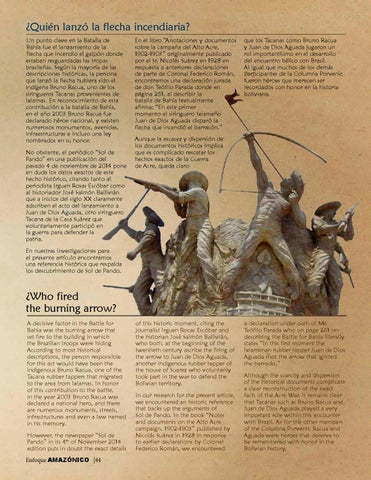
¿Quién lanzó la flecha incendiaria? Un punto clave en la Batalla de Bahía fue el lanzamiento de la flecha que incendio el galpón donde estaban resguardadas las tropas brasileñas. Según la mayoría de las descripciones históricas, la persona que lanzó la flecha hubiera sido el indígena Bruno Racua, uno de los siringueros Tacanas provenientes de Ixiamas. En reconocimiento de esta contribución a la batalla de Bahía, en el año 2003 Bruno Racua fue declarado héroe nacional, y existen numerosos monumentos, avenidas, infraestructuras e incluso una ley nombrados en su honor. No obstante, el periódico “Sol de Pando” en una publicación del pasado 4 de noviembre de 2014 pone en duda los datos exactos de este hecho histórico, citando tanto al periodista Irguen Rosas Escóbar como al historiador José Salmón Ballivián que a inicios del siglo XX claramente adscriben el acto del lanzamiento a Juan de Dios Aguada, otro siringuero Tacana de la Casa Suárez que voluntariamente participó en la guerra para defender la patria.
En el libro “Anotaciones y documentos sobre la campaña del Alto Acre, 1902-1903” originalmente publicado por el Sr. Nicolás Suárez en 1928 en respuesta a anteriores declaraciones de parte de Coronal Federico Román, encontramos una declaración jurada de don Teófilo Parada donde en página 261, al describir la batalla de Bahía textualmente afirma: “En este primer momento el siringuero Ixiameño Juan de Dios Aguada disparó la flecha que incendió el barracón.”
que los Tacanas como Bruno Racua y Juan de Dios Aguada jugaron un rol importantísimo en el desarrollo del encuentro bélico con Brasil. Al igual que muchos de los demás participantes de la Columna Porvenir, fueron héroes que merecen ser recordados con honor en la historia boliviana.
Aunque la escasez y dispersión de los documentos históricos implica que es complicado rescatar los hechos exactos de la Guerra de Acre, queda claro
En nuestras investigaciones para el presente artículo encontramos una referencia histórica que respalda los descubrimiento de Sol de Pando.
¿Who fired the burning arrow? A decisive factor in the Battle for Bahia was the burning arrow that set fire to the building in which the Brazilian troops were hiding According to most historical descriptions, the person responsible for this act would have been the indigenous Bruno Racua, one of the Tacana rubber tappers that migrated to the area from Ixiamas. In honor of this contribution to the battle, in the year 2003 Bruno Racua was declared a national hero, and there are numerous monuments, streets, infrastructures and even a law named in his memory. However, the newspaper “Sol de Pando” in its 4th of November 2014 edition puts in doubt the exact details Enfoque AMAZÓNICO |44
of this historic moment, citing the journalist Irguen Rocas Escóbar and the historian José Salmón Ballivián, who both, at the beginning of the twentieth century ascribe the firing of the arrow to Juan de Dios Aguada, another indigenous rubber tapper of the house of Suarez who voluntarily took part in the war to defend the Bolivian territory. In our research for the present article, we encountered an historic reference that backs up the arguments of Sol de Pando. In the book “Notes and documents on the Alto Acre campaign, 1902-1903” published by Nicolás Suárez in 1928 in response to earlier declarations by Colonel Federico Román, we encountered
a declaration under oath of Mr. Teófilo Parada who on page 261 on describing the Battle for Bahia literally states “In this first moment the Ixiamenan rubber tapper Juan de Dios Aguada shot the arrow that ignited the barracks.” Although the scarcity and dispersion of the historical documents complicate a clear reconstruction of the exact facts of the Acre War, it remains clear that Tacanas such as Bruno Racua and Juan de Dios Aguada played a very important role within this encounter with Brazil. As for the other members of the Columna Porvenir, Racua and Aguada were heroes that deserve to be remembered with honor in the Bolivian history.