learning LOVE OF
ADVANCED HUMAN DEVELOPMENT PROGRAM
learning the skills to become mentors
students as
teachers
By Cait Hubbard, English and Human Development Teacher, and Mara Garcia, Upper School Counselor and Director of Human Development
T
EACHERS EXPERIENCE countless moments of joy throughout our days: connecting with students, witnessing the fulfillment of their potentials, exploring subjects that strike us deeply – and the list goes far beyond these few. Academically, it is endlessly fulfilling to see that students have mastered material, and more importantly, truly made it their own. THIS FALL, WE BEGAN teaching Viewpoint’s first of two Advanced Human Development courses. It is entitled Skills, and combines direct instruction with experiential learning to cultivate exactly that: students’ skills in communication, goal setting, cultural competency, and group facilitation. This final unit aims to ensure that by the time students finish the course, they are capable of conducting a class on their own.
OVER THE COURSE OF THEIR 50-MINUTE BLOCK, Trey and Sarah illustrated their understanding of group facilitation as they 1) asked the group open-ended questions, 2) defined distinctions between colloquial experiences and formal diagnoses, 3) addressed stereotypes and dilemmas of anxiety, then finally 4) introduced habits to combat anxiety. Beyond the well planned structure of their lesson, this team maintained a truly ideal environment for student involvement. Everyone in the room came away with an increased sense of closeness to the others in the group, as well as a fuller understanding of the subject matter. The two of us came away feeling as though our students truly had “become the teachers.”
THE STUDENTS WHO TOOK the Human Development: Skills course have now moved into the next course of the program, Human Development: CONSEQUENTLY, IT WAS WONDERFUL, in December, to watch our Mentors. Beginning in February, they will enter Ninth Grade Human students co-teach classes to their peers. While all of the groups facilitated Development classes to serve as assistants for the teachers, and mentors adroitly, one pair in particular, Trey Spellman ’18 and Sarah Eicher ’17, for the younger students. As they conclude preparing to enter these moved the class through a powerful conversation about anxiety, both in classes, they are also preparing to facilitate workshops during Viewpoint’s general and in the Viewpoint community. Diversity Day – and have consistently surpassed our expectations by Trey and Sarah began class with one of the attitudes most characteristic of illustrating the strength of their communication abilities, and the lifelong teachers: an authentic, inclusive tone. Together, they evidenced their multidimensionality of their contributions to our community. It is a true own willingness to share personal experiences, and when their classmates pleasure to see that our students have mastered the skills requisite for were ready to share as well, they passed the conversation along. mentoring, and of course, are very much making the roles their own.
26
V I E W P O I N T
M AG A Z I N E
The expansion of Viewpoint’s Upper School Human Development program has been modeled after a similar program that has been running at Punahou School in Honolulu, Hawaii for the last 25 years. Mara Garcia, Viewpoint’s Upper School Counselor and Director of Human Development, attended Punahou for high school and was enrolled in their Peer Helping Program. Mara was passionate about starting a similar program at Viewpoint because of the role Punahou’s program played in her life. She feels that adolescents develop strengths in a number of ways and that an important element of an independent school are the resources to prioritize programming that meets the strengths of individual student interests. The Mentors Program at Viewpoint provides course offerings and experiences for students who are interested in exploring the social sciences. It also, of course, explicitly teaches students skills to prepare them for more meaningful and effective communication with people from backgrounds that differ from oneself. The Human Development: Skills course is singlesemesters elective prerequisite to the Human Development: Mentors course. Students learn a specific communication model to guide a conversation toward meaningful exploration, and when appropriate, conflict-resolution. Students are given direct instruction on observation of social dynamics that surround them daily, such as noticing trends in an individual’s language, conflicts between verbal and non-verbal communication, and the practice of listening to hear the subtexts of a conversation. Students set and consistently reevaluate their progress surrounding personal goals. The class goes on to explore the subtleties of implicit bias, privilege, and institutionalized oppression – as well as how these concepts connect to relational conflicts, emotional responses, and their influences on one’s sense of self. Students end the semester by co-facilitating a class period; they are responsible for presenting a topic, engaging the group in exploration of it, and guiding other students toward specific goals.
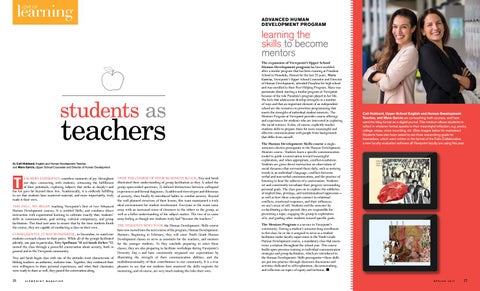
Cait Hubbard, Upper School English and Human Development Teacher, and Mara Garcia are co-teaching both courses, and have used the blog format as a digital journal. This medium allows students to reflect in whatever format speaks to their meaningful reflection, e.g. poetry, collage, essay, voice recording, etc. (See images below for examples.) Students have also been asked to set three overarching goals for themselves, which were written in the format of the Folio Collaborative, a new faculty evaluation software all Viewpoint faculty are using this year.
The Mentors Program is a service to Viewpoint’s community. During a student’s semester-long enrollment in this class, he or she is assigned to serve as a student facilitator under faculty supervision in the Ninth Grade Human Development course, a mandatory class that meets twice a rotation throughout the school year. This course builds upon previous training in individual communication strategies and group facilitation, which are introduced in the Human Development: Skills prerequisite – these skills are put into practice through classroom discussions and activities dedicated to self-exploration, decision-making, and reflection on topics of equity and inclusion. ■ S P R I N G 2 017
27