HEALTH Profile
MEDICAL
Twinges in the Hinges
EXPERT
ADV I S OR
Dr. Jeff Leary Fact Checks 4 Knee and Hip Replacement Myths By Rhonda L. Rivera, photos by Dan Epstein
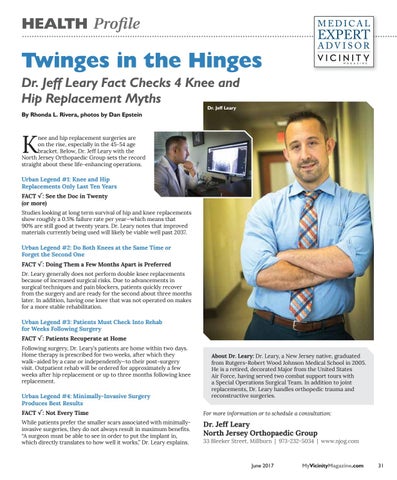
Dr. Jeff Leary
K
nee and hip replacement surgeries are on the rise, especially in the 45-54 age bracket. Below, Dr. Jeff Leary with the North Jersey Orthopaedic Group sets the record straight about these life-enhancing operations.
Urban Legend #1: Knee and Hip Replacements Only Last Ten Years FACT √: See the Doc in Twenty (or more) Studies looking at long term survival of hip and knee replacements show roughly a 0.5% failure rate per year—which means that 90% are still good at twenty years. Dr. Leary notes that improved materials currently being used will likely be viable well past 2037.
Urban Legend #2: Do Both Knees at the Same Time or Forget the Second One FACT √: Doing Them a Few Months Apart is Preferred Dr. Leary generally does not perform double knee replacements because of increased surgical risks. Due to advancements in surgical techniques and pain blockers, patients quickly recover from the surgery and are ready for the second about three months later. In addition, having one knee that was not operated on makes for a more stable rehabilitation.
Urban Legend #3: Patients Must Check Into Rehab for Weeks Following Surgery FACT √: Patients Recuperate at Home Following surgery, Dr. Leary’s patients are home within two days. Home therapy is prescribed for two weeks, after which they walk—aided by a cane or independently—to their post-surgery visit. Outpatient rehab will be ordered for approximately a few weeks after hip replacement or up to three months following knee replacement.
Urban Legend #4: Minimally-Invasive Surgery Produces Best Results
About Dr. Leary: Dr. Leary, a New Jersey native, graduated from Rutgers-Robert Wood Johnson Medical School in 2005. He is a retired, decorated Major from the United States Air Force, having served two combat support tours with a Special Operations Surgical Team. In addition to joint replacements, Dr. Leary handles orthopedic trauma and reconstructive surgeries.
FACT √: Not Every Time
For more information or to schedule a consultation:
While patients prefer the smaller scars associated with minimallyinvasive surgeries, they do not always result in maximum benefits. “A surgeon must be able to see in order to put the implant in, which directly translates to how well it works,” Dr. Leary explains.
Dr. Jeff Leary North Jersey Orthopaedic Group 33 Bleeker Street, Millburn | 973-232-5034 | www.njog.com
June 2017
MyVicinityMagazine.com
31