TE TIRA AHU IKA A WHIRO
Summer has finally arrived, and with it comes the holiday season — a time many of us look forward to. For some, Christmas can feel like a whirlwind before we truly get the chance to slow down and enjoy time with family and friends. If you can, take a moment to pause, breathe, and reflect. These breaks are precious, and they don’t come often.
One of the things I value most in my role is meeting veterans and hearing their stories. In this issue, you’ll find Brian Kennerly’s journey of overcoming PTSD (page 10). His courage is inspiring, but it’s also a reminder that too many veterans hesitate to reach out for help. If you’re living with a health condition you believe is connected to your service, please know that Veterans’ Affairs is here for you. Asking for support is not a weakness — t’s a step toward wellbeing.
The Veterans’ Affairs magazine is published by Veterans’ Affairs – Te Tira Ahu Ika A Whiro. To the best of our knowledge the content in this magazine is accurate. The views expressed in Veterans’ Affairs are not necessarily those of Veterans’ Affairs or the New Zealand Defence Force.
If this magazine has been sent to the wrong address or if you no longer want to receive this can you please email veterans@nzdf.mil.nz to let us know the correct address or to have it stopped being delivered.
ISSN 2816-1327
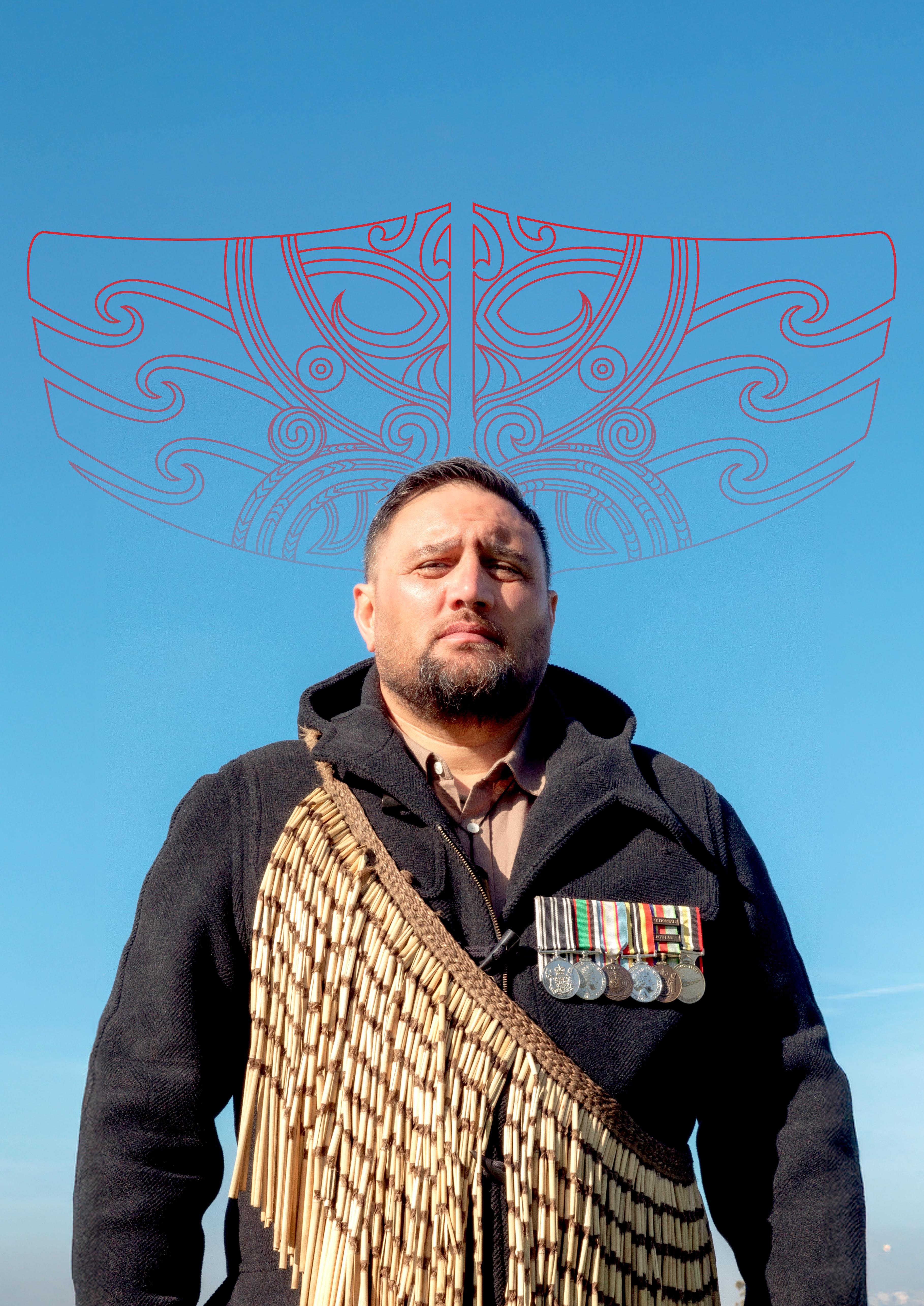
Cover image: Of Anaru Watson, who features in the Veterans’ Affairs video, “Finding our way back to ourselves.” Anaru is wearing a Piupiu gifted by his Grandmother.
Photographer: Steve Baker, Bakery Collective
veterans@nzdf.mil.nz
0800 483 8372
(Freephone New Zealand)
1800 483 837
(Freephone Australia)
+64 4 495 2070 (rest of world)
On that note, we recently launched a video called Finding Our Way Back to Ourselves. In it, three veterans — Jared, Ange, and Anaru — share their experiences of deployment and recovery. Their honesty and strength will, I hope, encourage others to seek the support they deserve. To Jared, Ange, and Anaru: thank you for your bravery in telling your stories.
This year’s Client Satisfaction Survey (page 14) gave us valuable insights from a broader range of veterans than ever before. I’m proud to share that our satisfaction rating remains high at 95%, and our Net Promoter Score — how likely clients are to recommend us — rose to 77.4%. For a government agency, that’s exceptional, and it speaks to the dedication of our team.
We also hosted Te Arataki Symposium, bringing partners, organisations and NGOs together to set priorities for 2026 and beyond. While Te Arataki framework is not mandated, its influence is growing. Agencies like Health NZ, Corrections,
Internal Affairs, Stats NZ, and NZDF are embedding veteran needs into their plans. I believe Te Arataki will become a cornerstone of veteran support in New Zealand.
As Christmas approaches, I hope all our service people — whether at home or overseas — find moments of peace and connection. If you’re away from family this season, please know you’re in our thoughts. Meri Kirihimete ki a koe me tō whānau — wishing you and your loved ones a safe and happy holiday.
Finally, I want to acknowledge the passing of Wayne Lindsay — a veteran and tireless advocate for his peers. Wayne’s commitment and compassion touched many lives, and his legacy will not be forgotten. Our thoughts are with his whānau and all who knew him.

Alexander Brunt Acting Head of Veterans’ Affairs
We are sorry to advise our loyal readers that we will be ceasing publication of the Veterans' Affairs Magazine next year, with the last issue coming to you in April 2026. This decision has been made because of the ever-increasing cost of postage and distribution. But you can still keep in touch with Veterans' Affairs and the veteran community. We suggest you subscribe to our monthly email newsletter at this link, www.va.mil.nz/newsletter. That way you'll always be up-to-date with all of our news.

As we approach Christmas and the summer break, many of us will be taking time to rest, to reconnect with family, and to look back on the year that has been. For our veteran community, the Christmas season often brings an opportunity for reflection and gratitude. Whether you are spending the holidays at home, at the beach, or with your local veterans’ group, I hope it is a time of peace and good company.
This year has seen real progress in recognising and honouring those who have served New Zealand. A major step has been the development of the Veteran Recognition Bill, which will extend the symbolic use of the term “veteran” to all former New Zealand Defence Force personnel who have received medallic recognition. The Veterans’ Support Act already gives “veteran” a specific legal meaning and remains important for determining eligibility for certain entitlements.
However, many who have served with dedication have felt their contribution is not fully acknowledged because the term cannot legally be used to describe them. The Bill also includes a covenant, modelled along the lines of various overseas' equivalents, which the community indicated several years ago it wished to see in law.
Alongside the new Bill, the Government will establish a National Day of Tribute, marked each year with a Veterans’ Service Awards ceremony celebrating those who continue to serve their communities and uphold the values of military life.
Work has also continued on the Anzac Day Bill. The Anzac Day Act ensures that we honour those who served, but because it does not recognise conflicts after 1966, many New Zealanders who have served with courage in the decades since are not formally included in Anzac Day commemorations. Updating the legislation will bring the law in line with the way New Zealanders have long observed Anzac Day, ensuring that all who have served are acknowledged.
I’m pleased to note that the additional funding provided to VA, $1 million a year over four years, is already helping reduce the backlog of claims awaiting consideration. By November, the number of pending claims had fallen to just over 2,000, down from nearly 3,000 in April 2024. This is encouraging progress, and I look forward to seeing the backlog shrink even further in the year ahead.
Meanwhile, as we have more time to ourselves over summer, I encourage any veteran who has not yet made a claim to contact Veterans’ Affairs. Whether it is assistance with health and wellbeing, financial support, or connecting with other ex-Defence Force personnel, these services exist to make a real difference in your life. Reaching out is simple, and the team at Veterans’ Affairs is ready to guide you through the process.
Thank you all for your service, and for the comradery and support you continue to show one another in the veteran community. I wish you and your families a happy Christmas and every good thing for 2026.
To encourage veterans to apply for support, Veterans’ Affairs has produced the strong and emotional video, “Finding our way back to ourselves”.
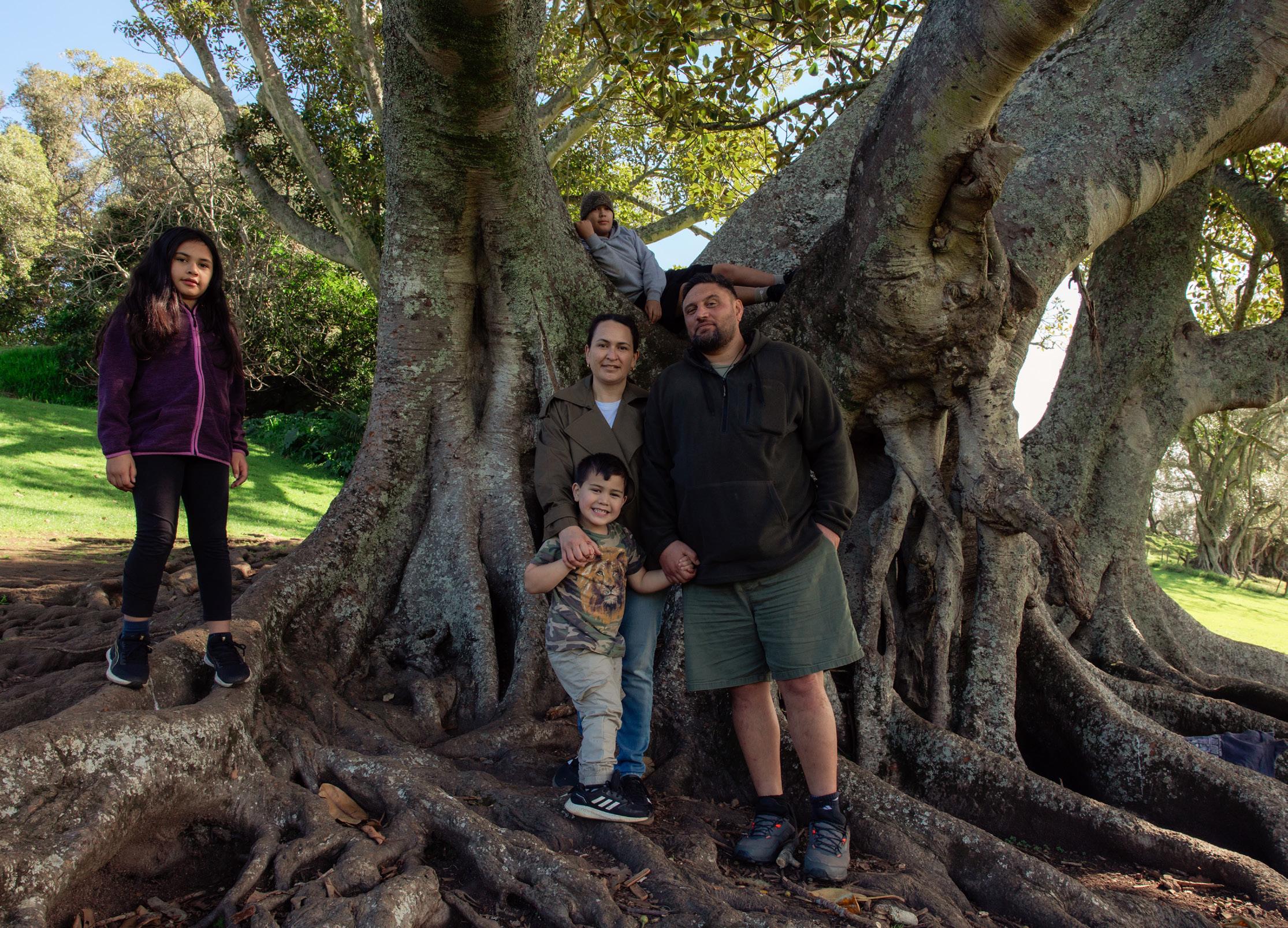
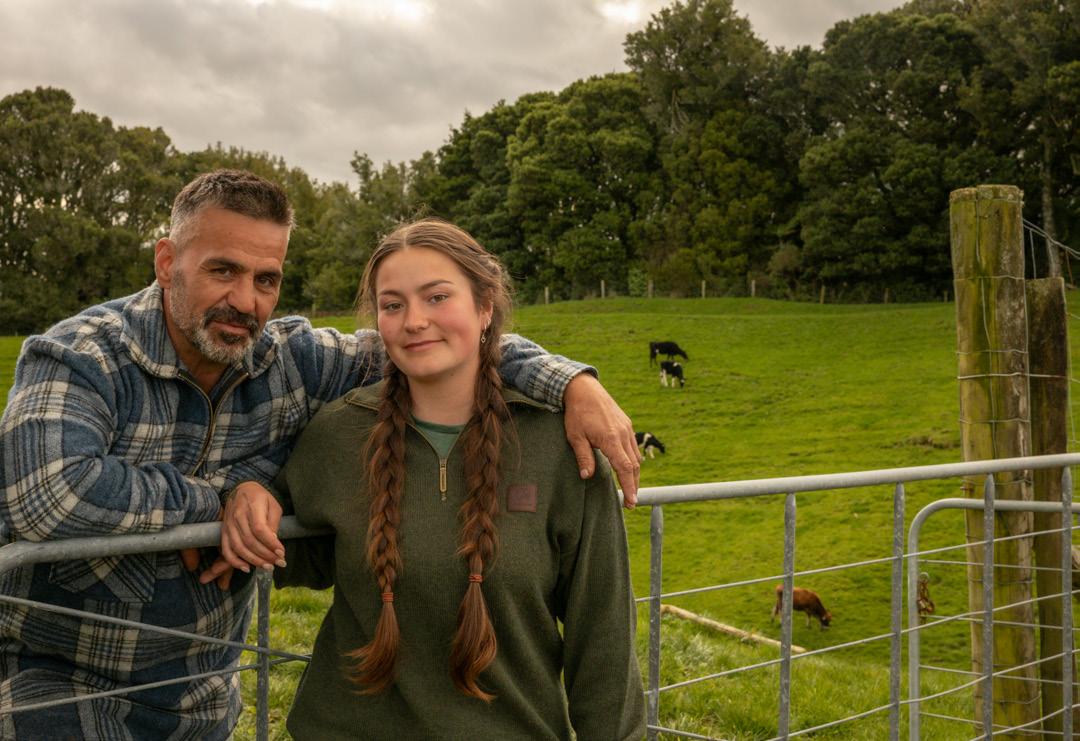
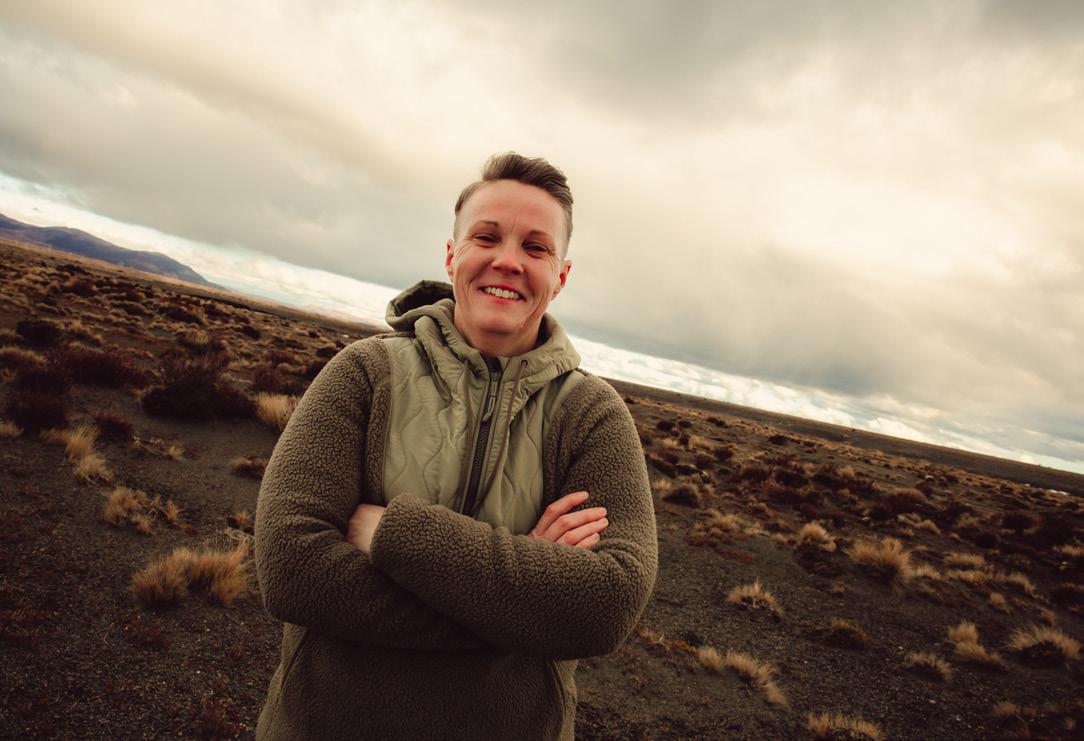
It features three veterans who deployed to Afghanistan and East Timor, and they share their experiences of coming home, the support that they received from Veterans’ Affairs and where they are now.
Directed by Steve Baker of the Bakery Collective, the video was important and personal project for him.
“I wanted to bring a very honest and open conversation to this film. By revisiting our past, we can help change the future told through the experiences of service. It became clear through my connection with Ange, Anaru, and Jared that each veteran's journey to civilian life is unique and nonlinear.”
Shot in Papamoa, Te Puke, Turangi, on Mt Ruapehu, and in Auckland, Steve aimed to show their individual journeys and where each had arrived at.
“We set out to create something that not only shows where the core issues began but also how far each of them has come on their own personal journeys.”
Steve had previously worked with Veterans’ Affairs on the 2023 video called “Coming home” which was part of the launch of Te Arataki (the Veterans Wellbeing Strategy).
“It was a true honour to create this piece for our Veterans of Aotearoa and something I will not forget. More importantly though I want to thank Ange, Anaru and Jared for doing this as I know how hard it was.”
By featuring veterans from more recent deployments and the success of their treatment and support Veterans’ Affairs hopes to encourage veterans from those deployments to contact Veterans’ Affairs and to learn about the range of support that might be available to them.
Please help us reach more veterans by sharing or showing this video to other veterans who may not be in contact with Veterans’ Affairs.

Progress has been made this year on two pieces of legislation that will be of interest to veterans.
The Anzac Day Amendment Bill was introduced to Parliament in April 2025. After its first reading it was referred to the Foreign Affairs, Defence and Trade select committee for consideration. The committee has now reported back to Parliament, and the Bill is awaiting its second reading. It is expected to be passed before Anzac Day 2026. This Bill will amend the Anzac Day Act 1966, to broaden the coverage of those who are commemorated under the Act.
It would designate Anzac Day as a day to commemorate all those who have served New Zeland (civilian and military) in time of war or warlike conflicts.
It covers a broader group of personnel than at present, including civilians who have given non-military service, such as the Home Guard during the World Wars, and medical personnel; those serving in other allied forces or in multi-force missions such as UN peacekeeping; and members of the armed forces who may have died in while serving in peacetime.
It also recognises all allied troops who took part in the first landing at Gallipoli in 1915, including not only the ANZACs from Australia and New Zealand, but also troops from the United Kingdom, France and India.
The Minister for Veterans has introduced a Bill into Parliament that will recognise as veterans a broader group of service personnel than those currently defined as veterans in the Veterans’ Support Act 2014.
The Veterans’ Recognition Bill will define as veterans all former NZDF personnel who have received any medal or award, including:
• the New Zealand Defence Service Medal, which recognises service of at least three years, including reserve force personnel
• operational service or campaign medals
• honours or decorations awarded through the royal honours system
• medals for bravery or excellence awarded by the New Zealand government.
The legislation will include a covenant, or kawenata, which will formalise the relationship between the Government and veterans and act as a national promise to treat veterans with respect and dignity.
The Bill will not change existing entitlements under the Veterans’ Support Act.
Minister for Veterans Chris Penk said that, while the definition within the Veterans’ Support Act remains appropriate for determining eligibility for support entitlements, it has unfortunately left many who have loyally served New Zealand feeling excluded.
“This distinction may appear small but is significant. For those who have worn military uniform, the word “veteran” carries profound personal meaning. It speaks to identity, pride, and a recognition of service and sacrifice.
“It’s more than a title – it's about knowing that your country understands your contribution and acknowledges the sacrifices you made while wearing the uniform.
“We already commonly refer to many former service members as veterans in everyday speech, and I believe it’s time that our law reflected this culturally shared understanding”.
The Bill is at present awaiting its First Reading in Parliament.
The VAB provides advice directly to the Minister for Veterans. They usually work in response to a request from the Minister for advice on a particular issue he or she is considering. Its members all have a particular interest in veteran matters and some are veterans themselves.
At the moment the VAB is reviewing Te Arataki (the Veteran, Family and Whānau Mental Health and Wellbeing Policy Framework). They have been tasked with examining what has been achieved through the current Te Arataki work programme, and the areas where they consider future interagency work would offer the most value. Over the past year, the VAB has also provided the Minister with advice about the proposed Veterans’ Recognition Bill, a Veterans’ Day, and veterans’ awards.
The Veterans’ Support Act 2014 set up three statutory Boards and Panels. All of them are independent of Veterans’ Affairs, with members appointed by the Minister for Veterans; and they all have important roles to play for veterans in New Zealand.
The VHAP advises the Minister on matters relating to veterans' health. Their work programme involves regular meetings to consider Statement of Principles, which are a tool developed in Australia, based on international scientific and medical research, which Veterans’ Affairs uses to guide its decisionmaking on veteran claims. The Veterans’ Support Act requires the VHAP to consider any new or revised Statements of Principles which are issued in Australia, to assess whether they should also be applied in New Zealand. Their recommendation is passed to the Minister for Veterans and agreed changes come into force through regulations.
The Panel also commissions veteran-related research, using funds available to it through the Veterans’ Medical Research Trust Fund.
Most of the Panel’s members have expertise in health related matters and in research.
One of these bodies has a standing work programme, and the other two meet from time to time as required. Veterans’ Affairs provides them all with secretariat support, managing their meetings, correspondence, and travel arrangements.
The VEAB is an independent tribunal which determines appeals against review decisions made by Veterans’ Affairs.
If a veteran disagrees with a decision Veterans’ Affairs has made about their claim, and that decision has been reviewed and remained the same, they are entitled to make an appeal to the VEAB. The Board will then consider their case afresh, seeking submissions from both the veteran and their advocate, if they have someone supporting them, and also from Veterans’ Affairs.
The Board has four members, two lawyers (one of whom is the Chair) and two medical practitioners. It meets as required when there is an appeal to consider. Their decisions are all published on the Veterans’ Affairs website.
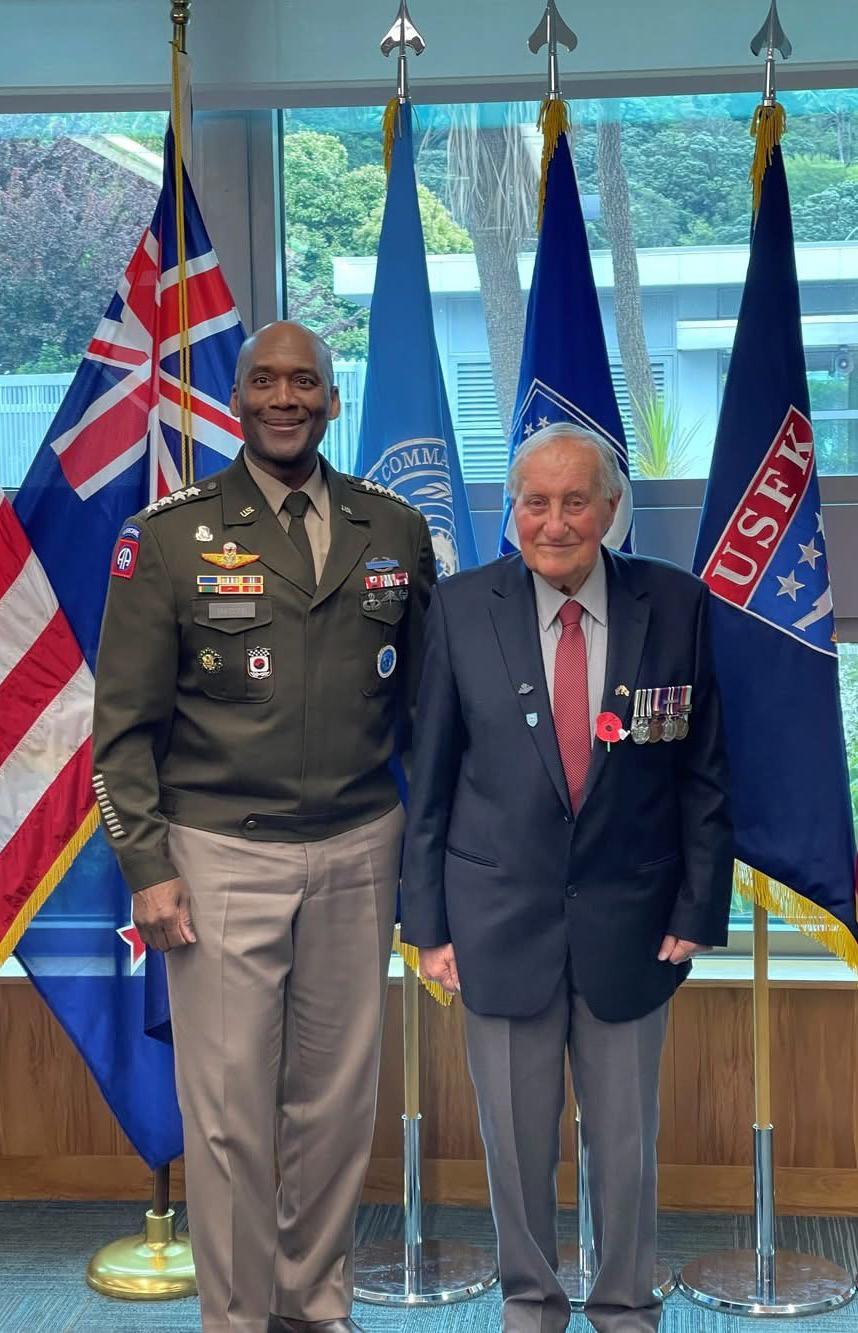
Phil Wallace (90 years), of Miramar Wellington, who served in Korea (Kayforce) in the New Zealand Army between 1955 and 1957, was recently invited to meet with GEN Xavier T. Brunson at the US Embassy recently.
GEN Brunson commands United Nations Command (UNC), which maintains the 1953 Korean Armistice Agreement and was in Wellington to hold high-level discussions with the New Zealand government.
To honour the 75th anniversary of the establishment of United Nations Command (July 7, 1950) and the start of the Korean War (June 25, 1950), GEN Brunson asked to meet with a veteran of the Korean conflict. Phil was a member of 10 Transport Company, Royal New Zealand Army Service Corps and he served there just after the conflict had ended.
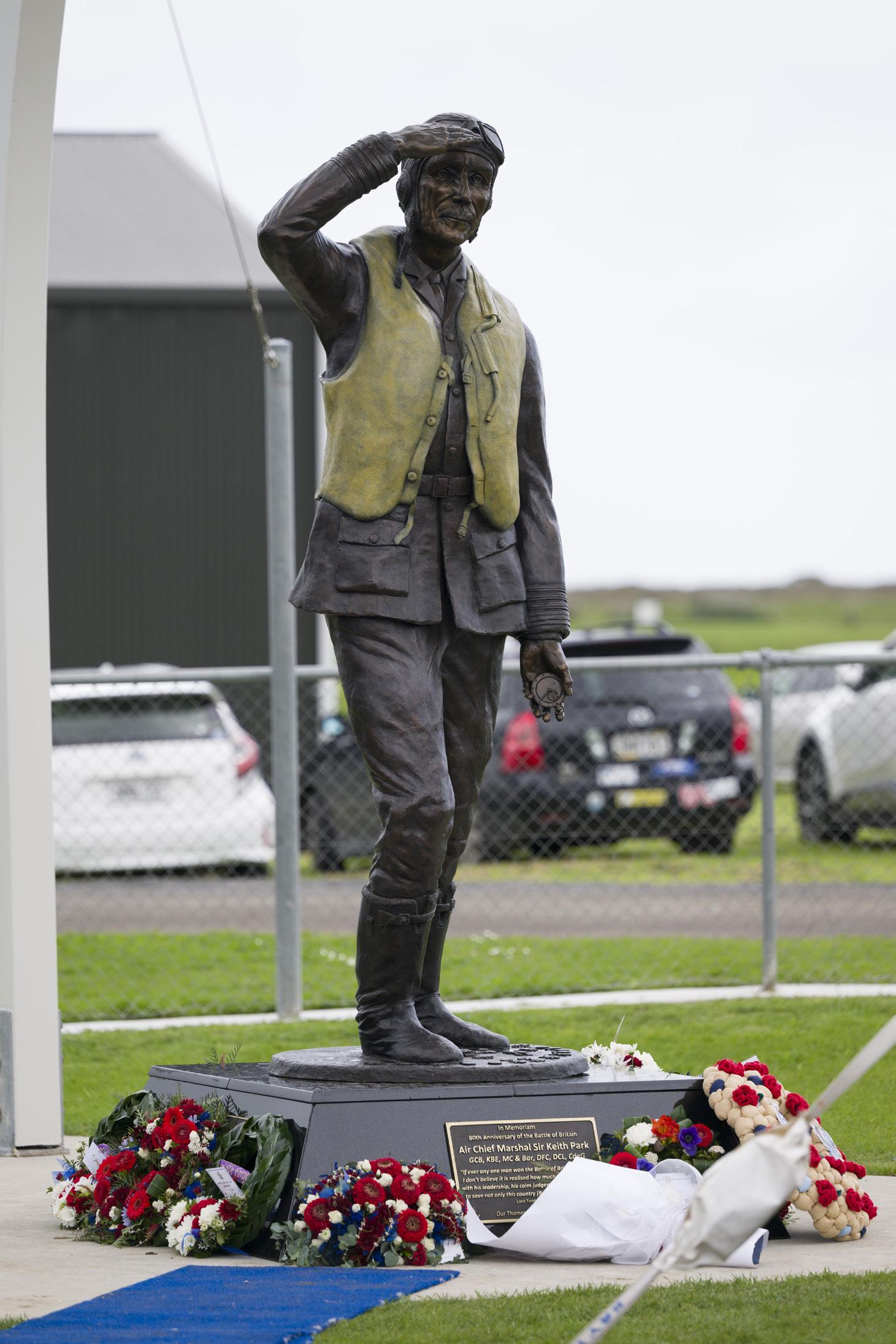
A statue of Air Chief Marshal Sir Keith Park, the New Zealand aviator who played a pivotal role in the Battle of Britain was unveiled in Thames on Sunday 14 September. It marked the 85th anniversary of the Battle of Britain.
Born in Thames, Sir Keith fought in First World War at Gallipoli, and the Battle of the Somme. He transferred to Royal Flying Corps and became a flying ace on the Western Front. Following the First World War, he remained with the RAF and in 1940 was given command of the No.11 Group. Between the July and October of 1940, No.11 Group bore the brunt and ultimately withstood the German Luftwaffe’s offensive and winning the Battle of Britain.
Sculptured by Joanne Sullivan, the 2.3 metre bronze statue was the culmination of years of dedicated effort by Geoff Furkert and the Sir Keith Park Memorial Airfield Inc Society.
Veterans’ Affairs were able to contribute to this project through our commemorative project fund. This fund supports New Zealand-based projects that recognise veterans' sacrifice. The fund can support reunions, public memorials and statues. If you have a project that you think might fit this criteria, please visit our website: www.va.mil.nz/ commemorative-project
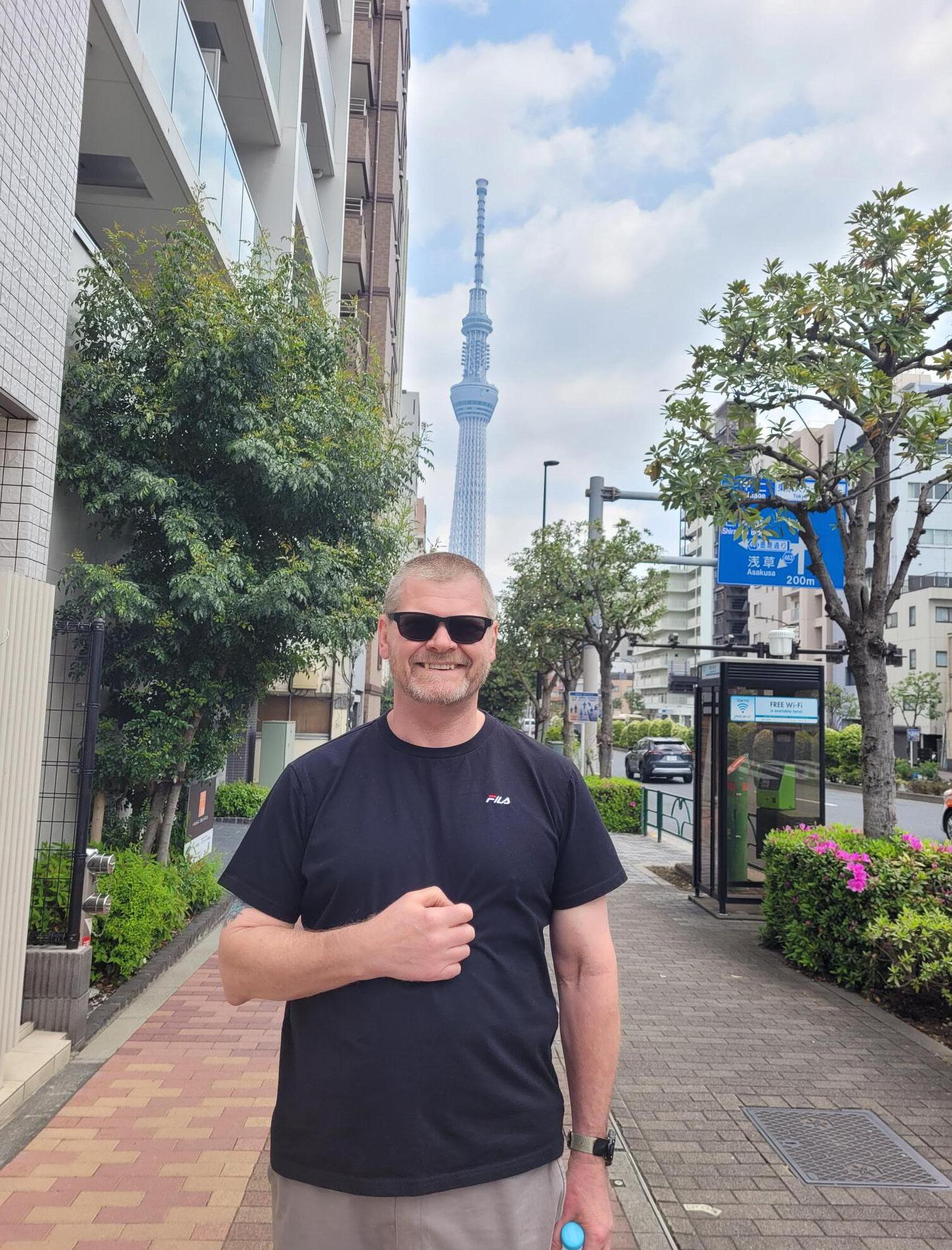
He is currently being supported by Veterans’ Affairs for Post-traumatic Stress Disorder (PTSD).
Brian had initially refused to acknowledge that he had a problem.
“I thought that I was being weak and I tried to manage my own mental decline until I finally realized that couldn’t do it anymore.”
He believes that he had been living with PTSD for twenty years. His family and marriage were suffering and he considered suicide.
“I’d never considered myself a veteran and had never thought of contacting Veterans’ Affairs.”
When he did call Veterans’ Affairs he was contacted back by a case manager who explained to him that if his condition was related to his qualifying service Veterans’ Affairs could support him, and encouraged him to put in a claim. He did – his claim was approved and support began soon afterwards.
“My case manager was very supportive. She soon had a treatment plan in place, and then she arranged for our lawns to be mown, the house to be cleaned and ensured that I was supported at home.”
The rehabilitation team that Veterans’ Affairs put together for Brian included a psychologist, exercise physiologist, occupational therapist and a rehabilitation co-ordinator.
All the professionals made Brian feel safe and secure enabling him to make the most of each session. The exercise physiologist helped Brian out of the house. Previously he reluctantly left home in case something triggered him. She met him at his home and encouraged him outside for a walk. Eventually, Brian joined a gym and the exercise physiologist attended the first session with him. He now goes to the gym 3 times a week by himself.
The occupational therapist, also came to his house for sessions and introduced him to mental health and cognitive exercises.
“This provided me with a good base from which I could begin to recover.”
As well as his physical and mental rehabilitation, Veterans’ Affairs paid for a consultant to provide vocational support and Brian is now cleared for part-time work.
It was extremely challenging for Brian, but he made great progress.
“In just one year of rehabilitation, I went from severe PTSD to almost none. My depression is gone, and I never took any anti-depressants.”
Just as important to Brian, his family is also in a good space.
"I was fortunate to have the support of my wife, family and friends, who took it on themselves to help me on my journey. With their love and support and the professional help given to me by Veterans’ Affairs, I’ve made my recovery.”
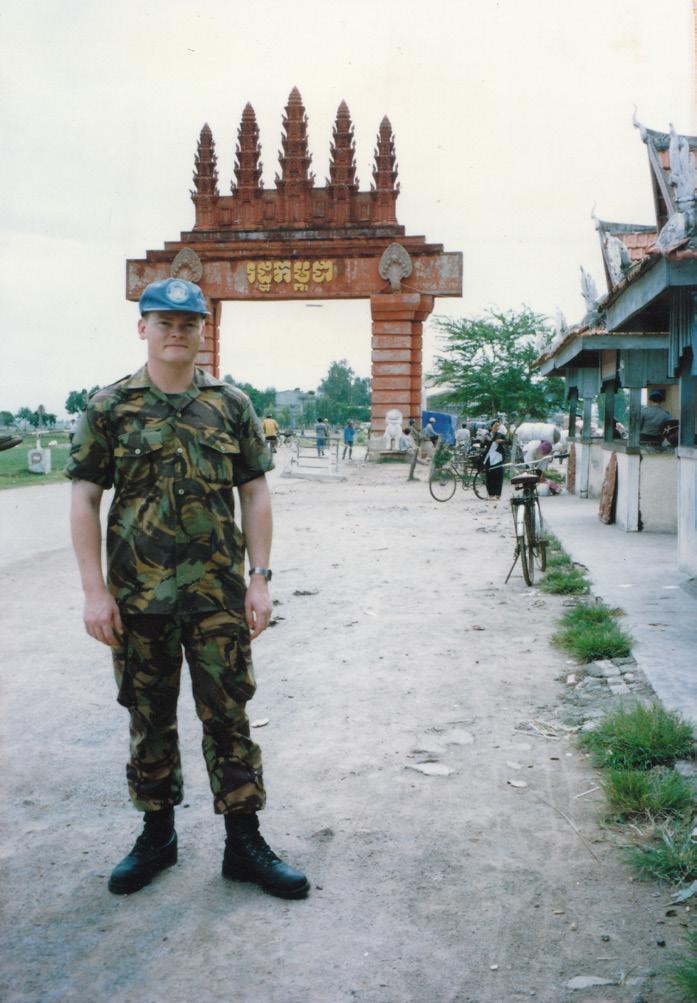
“Don’t wait like me. If you are in a bad place get in touch with Veterans’ Affairs.”
If you are an eligible veteran and have a condition that you believe is related to your service, give Veterans’ Affairs a call at 0800 483 8372
BRIG (rtd) Howie Duffy served as a United Nations Military Observer between Aug 1992–Aug 1993, in the former Republic of Yugoslavia.
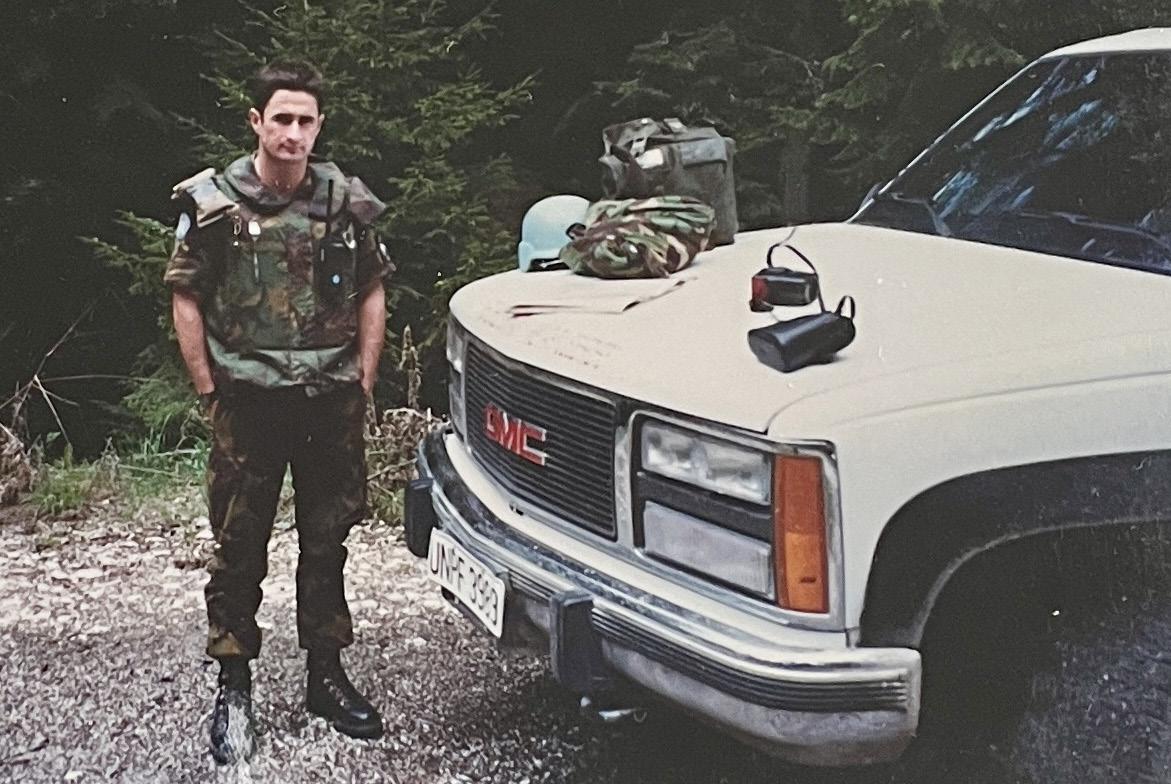
This mission was UNPROFOR. A small deployment of 4 officers before larger contingents arrived.
During his 12-month deployment, he experienced a range of emotions and was exposed to the brutal realities of a civil war. It included being sieged inside Sarajevo for 4 months and leading the first UN mission into the Muslim enclave of Zepa.
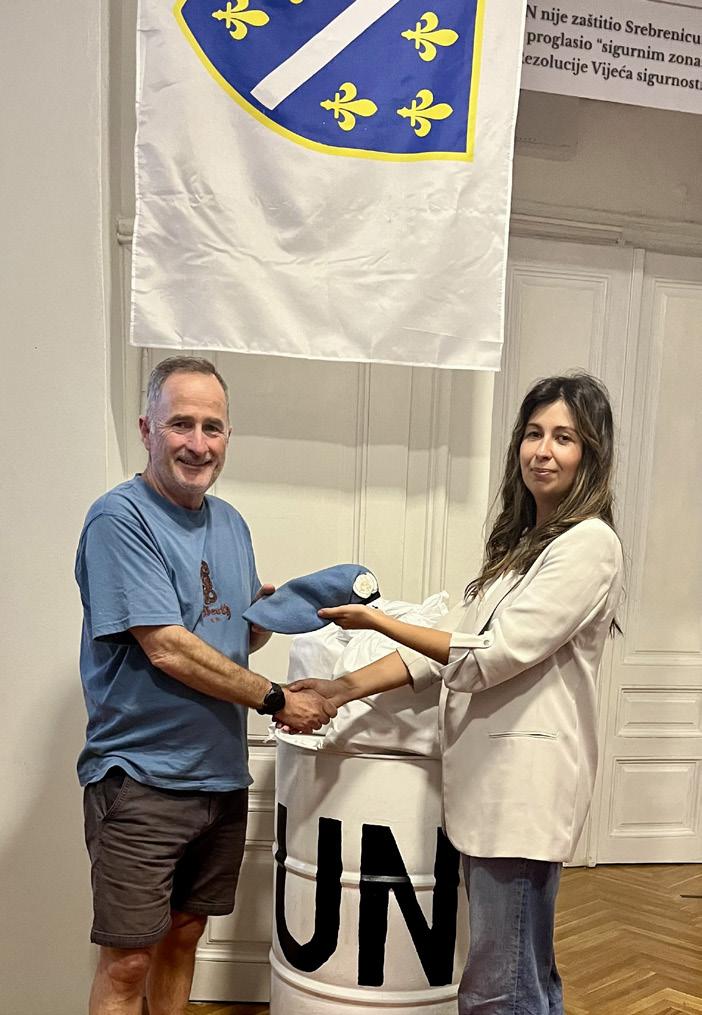
Howie wanted to return to Sarajevo and Zepa to bring closure to these life changing experiences for himself and to show his wife (with whom he wrote to regularly during his deployment) where he served. He visited the
‘Mandate of Memories Museum in Sarajevo, where he presented his UN beret and other memorabilia. He recommends a visit to the Museum for anyone who served in the Balkans. Howie received support from the Veterans’ Affairs’ Commemorative Travel Fund. We might be able to help you return to the place of your qualifying service.
For more information check out our website at https://www. veteransaffairs.mil.nz/ a-z/commemorativetravel-contribution/
The following is Howie’s description written in 1993 (now abbreviated for this article) of his mission to Zepa.
Captain Howard Duffy, New Zealand, UN Military Observer, 1993
I spent nine months in the former Yugoslavia, and a key moment for me was when I led the first United Nations Military Observer (UNMO) team to enter the Muslim enclave of Zepa. Zepa is in eastern Bosnia, and it had been under attack from Serb forces. Reports described the town as under intensive artillery fire and in flames. It was agreed that a UNMO team would be sent into Zepa.
I was given five hours to get a team together and deploy. It then took us five days to reach Zepa. We were held up at Pale for a few days while the Bosnian Serb parliament discussed but failed to agree a peace plan. Another night was spent outside a Serb checkpoint waiting for clearance from General Mladic to let us through.
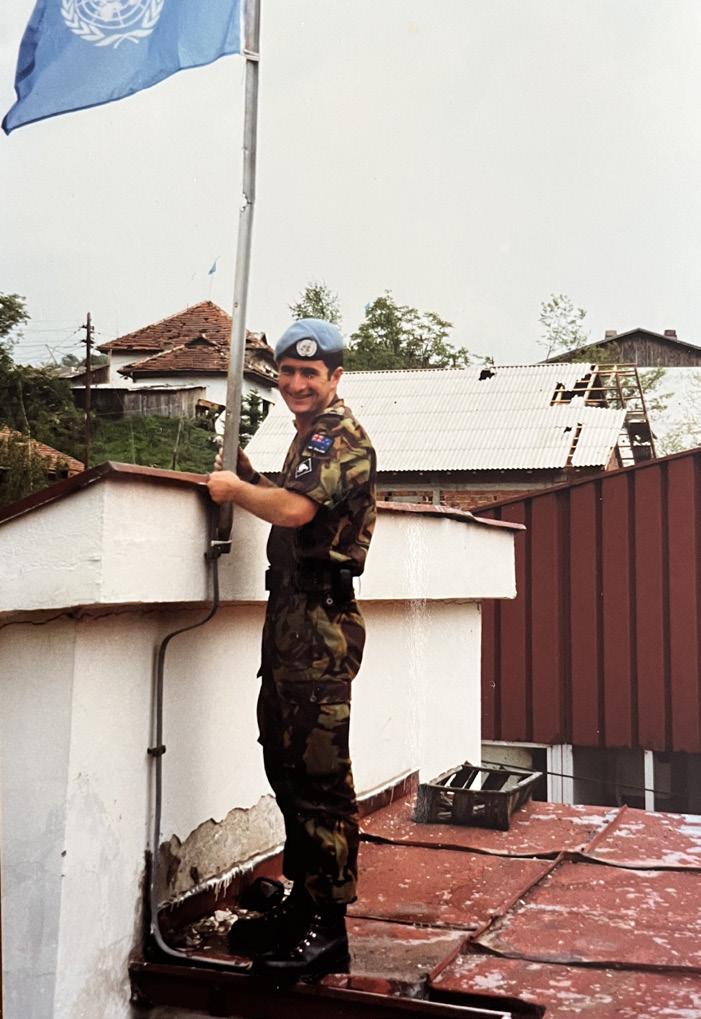
Following his approval, a Serb patrol escorted us to their position on the outskirts of Zepa, where they left us to proceed through no-man's land towards the Muslim positions. Trees had been felled across the road to block Serb tanks, so we got out of our vehicles and walked towards the Muslim frontline with only a blue helmet as protection. Every time we thought we were close, we called out "UNPROFOR" to avoid getting shot. Instead, we met some very happy Muslim soldiers. They’d been expecting us for some time. They helped us into Zepa. Our arrival was very emotional. Grown men cried and old people kissed us in gratitude. During the five days it had taken us to get there, the heavy shelling had continued.
We saw dead bodies in a mosque which had taken a direct impact through the roof.
We saw people living in caves and in makeshift shelters in the forest. They slowly came down from the mountains and back into their village.
Then the ‘real’ UNMO work began. We set up meetings between the factions and negotiated a demilitarised zone (DMZ). We conducted dead body exchanges and prepared for the arrival of the Ukrainian company, which was going to be responsible for the overall demilitarisation of the area.
From 6 June to 30 June 2025, the independent research company
This year PublicVoice endeavoured to speak with younger veterans and more Māori veterans.
Their sample was:
PublicVoice contacted a selection of Veterans’ Affairs’ clients by telephone to ask for their feedback on a range of topics. This survey is carried out every year. The 2025 overall results show: From
The survey measures veterans’ satisfaction with our performance, and their willingness to recommend Veterans’ Affairs. Age % N
Under 20 0% 0
20–29 0% 2 30–39 2% 11
40–49 3% 15
50–59 9% 45
Ethnicity
Application Process
Areas Requiring Attention
Refusing to let a mate fade into the background is a crucial part of looking out for each other. Connection is a powerful antidote to loneliness.
In service, you’re part of a team, day in and day out. The camaraderie is constant. But life after the uniform can be different, and for some, the quiet can be deafening. Have you found yourself wondering what happened to a mate who seems to have dropped off the radar?
When things get heavy, a common response is to withdraw. It’s not personal—it’s not that they don't want to see you—it's often a sign that they are struggling and don't have the energy to pretend everything is okay. This is more than just needing some alone time; it's a pattern of isolation that can signal significant distress and deep loneliness.
Think about a mate you haven't heard from in a while. Does this sound familiar?
• They consistently turn down invitations they'd normally jump at.
• They take days to reply to a text message, or don’t answer calls at all.
• They've stopped participating in hobbies or sports they used to enjoy.
• When you do catch up, they seem distant or disengaged, like they're not really there.
Reaching out to someone who is actively pulling away can be hard. It might even feel like you're bothering them. But your persistence is a powerful reminder that they are not forgotten.
You don't need a grand plan. A simple, low-pressure text can be a lifeline:
“Been a while, mate. Thinking of you.”
Suggesting something easy can also help:
“I'll be driving past your way on Saturday, can I drop in for a quick cuppa?”
Veterans’ Affairs can help. Call
You don’t have to have it all figured out to make the call.
The Christmas holidays are all about family, sunshine, and celebration. Unfortunately, it’s also a time when spending can snowball. With all the gifts, gatherings, travel and summer activities, December often brings extra pressure to your finances.
Taking a little time now to plan can help you stay in control. The Force Financial Hub recommends that you create a simple holiday budget.
You should list your expected costs, set realistic spending limits, and track it as you go. Remember that generosity does not mean extravagance.
Thoughtful gestures, homemade gifts, and shared experiences often mean more than what is on the price tag.
“Financial Wellbeing isn’t about having more; it’s about making what you have work for you”
Hub for financial wellbeing
The Force Financial Hub has a range of financial resources from budgeting and insurance to KiwiSaver, wills and investments and more – all in one place! Whether you’re managing your day-to-day costs, planning for retirement, or preparing for major life changes, the Force Financial Hub can help you. For example:
• Discounted Home, Contents, Vehicle, Landlord and Boat Insurance from Tower (learn more about it at nzdf.tower.co.nz).
• Estate Planning Services Wills and discounted Power of Attorney services for Veterans’ and family members* see more on the Wills and Other Services page of the Force Financial Hub (link in the box).
• Funeral Plan Cover for those aged 50 to 80 Learn more on the Member Insurance Benefits Page on the Force Financial Hub (link in the box).
*Please note the Free Will is provided by Perpetual Guardian. This is free for a Veteran when Perpetual Guardian is the sole executor and trustee.”
Your holiday gift to yourself
This Christmas, take time to celebrate what matters most, but also take a few moments to protect your finances, because peace of mind today means freedom tomorrow.
Supporting the financial wellbeing of the NZDF community now and in the years ahead.
Visit the Force Financial Hub
www.force4families.mil.nz/ force-financial-hub

Died 30 November 2025
We are very sorry to hear of the passing of Wayne Lindsay. Wayne was a New Zealand Viet Nam veteran, having served in Viet Nam with Whiskey 1 (W1) Company, 1st Battalion Royal New Zealand Infantry Regiment, from December 1967 to November 1968.
Wayne was a passionate and longterm advocate for veterans. He was a War Pensions Advocate, for both New Zealand and Australian Vietnam Veterans since 2002, and was recently involved in Disability Pension advocacy for Timor Leste and Iraq veterans. He was a long-term resident of Australia. His work was recognised in 2018 by the RNZRSA with a certificate of appreciation for his work with exservice personnel and their families, the New Zealand Vietnam Veterans’ Association, and he was awarded an honorary Order of Australia Medal on Australia Day 2022, for services to the Australian and New Zealand veterans’ community.
Our thoughts are with his wife Janet, and his wider whānau, including the many veterans he has assisted over the years.
Ka maumahara tonu tātou ki a rātou. Lest we forget.
If you have an accepted service-related health condition some costs associated with treatment of that accepted condition are automatically approved, these include:
GP visits.
Medicines for approved treatment if on PHARMAC's list of subsidised medicines.
Diagnostic x-rays and scans up to $1,000 each, if linked to approved treatment. All MRIs need prior approval.
Prior approval also must be sought for all other treatment requests associated with an accepted condition on your treatment card.
Veterans’ Affairs is not responsible for paying or contributing towards treatment or services that have been incurred without prior approval.
Please contact your Case Manager if you require treatment for an accepted condition. They will work with you to arrange prior approval.
We’re pleased to advise that Veterans’ Affairs have now agreed with Stats NZ to have more de-identified veteran data added to Integrated Data Infrastructure database – called the IDI.
This will enable a range of research to be undertaken which will ultimately benefit all veterans.
The need for more research on Kiwi veterans has been known for a long time. The development of Te Arataki policy framework highlighted this problem, because of the gaps in research from New Zealand, it was largely based on studies from overseas.
Veterans’ Affairs looked carefully into the privacy issues before agreeing to take this step, and we’re confident all this data is safe and that no one’s private information will be compromised because no personal information goes into the IDI. It is all de-identified. This means that all names and addresses are deleted.
Once veteran data is in the IDI, researchers can take a closer look at things like how veterans engage with government agencies, what their
needs might be, and the impacts of their deployments. The Veterans’ Medical Research Trust Fund sponsors researchers to use IDI as one of reference tools. Their reports could influence planning and future veteran support policies.
It has proven to be a very powerful tool to understand how groups fare in our society and will provide valuable insights into veteran wellbeing and the support that they receive. Veterans’ Affairs has previously supplied the IDA with deidentified data about our Vietnam Veteran clients.
For more information about our plans and the IDI you can go to this webpage of our website: www.va.mil.nz/IDI
To claim for support you need tell us about how your health condition is related to your qualifying service. Most of the claims will require information from your GP, so it is a good to discuss your claim with them before you send it in to us.
To make a claim follow these steps.
1.1 There are two main claim forms
The right form to use depends on when your qualifying service took place. If it took place before 1 April 1974 or in Vietnam, then please use the Disablement Pension application form to claim for support.
If it took place after 1 April 1974, then please use the Veteran Support application form to claim for support.
You can download them from our website, or you can call us, 0800 483 8372, and we can post either one out to you.
1.2 All our forms are available on our website
If you have a different requirement, for example perhaps you are looking for help around the home, all of the Veterans’ Affairs forms are available on our website here www.va.mil.nz/forms
Please phone 0800 483 8372 or, if you're outside New Zealand, +64 4 495 2070 or email us at veterans@nzdf.mil.nz to find out which form you should use and if there is anything else that you might need to do to claim.
The Veterans’ Affairs forms are in PDF file format. They can all be printed off.
Some of our forms have editable fields, and these enable you to type your answers into the form. If you do this, you can either save them and print them off, or save them and email them to us (after they have been completed).
Please use the checklist on the form to see what steps to take and what documents to include. Please also make sure that you complete all of the required sections – attach documents and copies of identification (if required) and don't forget to sign the form. We can process your claim more quickly if we have all the information we need.
Before you begin you need to find out if you are eligible for support, that is, whether you have qualifying service or not. You can do this on our website at www.va.mil.nz/check
You can either email us a digital version of your application or post a paper copy of your form with all the supporting information.
3.1 To email us a digital version of your claim
To send us an attachment, email us directly at veterans@nzdf.mil.nz
Make sure your attachment follows our guidelines. In particular, the total size of the files in your email must be under 15MB.
3.2 To post us a paper copy of your claim
Send the form and any supporting documents to:
Veterans' Affairs PO Box 5146
Wellington 6140 New Zealand
We receive and acknowledge your claim
We check your claim for all the required information
If any information is missing from your claim, we will contact you, your GP, or other health provider to get the information we need.
We make a decision on your claim
Once we have all the necessary information, we will make a determination on your claim.
Once you have sent us your claim, you should continue to get any treatment you need through your medical practitioners. Keep receipts for any treatment you pay for during this time. We may be able to reimburse you for some treatment costs if your claim is accepted.