Once that meeting is complete, he locates a free spot, pulls his laptop out of his backpack, and spends the half hour before his next team meeting doing a wide variety of things, including chatting with half a dozen friends about their party plans for the weekend. At the same time, he sends an e-mail to one of the TAs for the chemistry course, asking for clarification of an assignment. He also browses the Web, zeroing in on a Web site at another college that is relevant to his anthropology course work, as well as seeing if the latest CD from his favorite band is available through the Music Store. In a few minutes, he has purchased several tracks from it and downloaded them onto his computer. Martin checks the time again. It’s 10:00 p.m., and there’s still a great deal to get done. He divides his time across several course assignments, numerous chat sessions, and reading (both from paper and from his computer screen). After a time, feeling drowsy, he goes to the Midnight Café, buys a soda and some chips, and returns to his work. At 11:30 p.m., Martin packs his gear and heads to another part of the commons, the Media Studio, which offers a number of stations for students to use for more advanced work with video and audio. Martin is working with a team of four other students on an assignment for a film studies course. Their task is to find clips from a set of films that illustrate a particular filming technique and to explain why it is
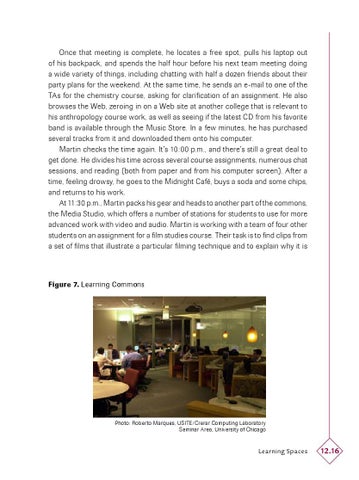
Figure 7. Learning Commons
Photo: Roberto Marques, USITE/Crerar Computing Laboratory Seminar Area, University of Chicago
Learning Spaces
12.16