Sports Cape Town’s legacy – what now?
Page 15
24 August 2010 Volume 69: Number 9 021 650 3543
varsitynewspaper.co.za
twitter.com/varsitynews
SRC candidate’s reputation questioned Sibambo under scrutiny following violent conduct
In This Issue Opinions
All roads lead to Rome
Page 6
Features
This is Africa! Or is it?
Page 8 & 9 SRC – Open to all? Brian Sibambo (right) and Alex Spoor (left) of Students for a Democratic Society (SDS) address students on Jammie Plaza last week. Photos by Simone Millward
Olivia Walton Natasha Nel
and
The election campaign of SRC candidate Brian Sibambo has been complicated by questions and allegations regarding a violent incident earlier this year. Sibambo allegedly hit a female student outside Graca Machel Hall and was subsequently removed from his position as Deputy Head Student of Kopano by a University Student Disciplinary Tribunal (USDT). No charges beyond those from the University were laid against Sibambo. The female student’s name has not been released. Sibambo was also arrested on Friday 13 August for riotous behaviour. Sibambo is running as a member of the Students for a Democratic Society (SDS), together with Alex Spoor. At an interrogation on Tuesday 17 August at Clarinus, an audience member asked Sibambo why he was running for SRC election when he “clearly had no respect for students and clearly had no respect for women.” Sibambo began by apologising for his previous behaviour,
saying that he had learned from it. However it is alleged that he then began to speak aggressively, accusing the student of conducting a “smear campaign” and attempting to “sabotage his campaign”. Sibambo allegedly insinuated that the student he was found guilty of hitting earlier this year “got what she deserved”, and that the case had only gone so far as to remove him from office in Kopano because her father is a member of Parliament. In a VARSITY interview, Sibambo claimed that he did not instigate either of the two incidents. The girl involved in the first incident allegedly punched Sibambo and kicked him in the groin before he fought back. Both parties were under the influence of alcohol at the time. The most recent incident allegedly occurred when Sibambo approached a group of seven men to ask for a cigarette and they became aggressive. “They were drunk, I defended myself and when the police arrived they said they had to take somebody in, so they arrested me.”
SDS campaign partner Alex Spoor has come to the defence of Sibambo: “It hasn’t been easy for Brian to adapt to UCT. Some students have had harder lives than others. Between the two of us, we represent a diverse group of students, from the highly privileged to the working class. The fact is, these things happen. This is not an isolated incident. Any young man has had a similar experience, and any political figure has been involved in a drunken incident of this kind at some stage.” According to Shannon Bernhardt, current SRC Secretary-General, no specifications were made during Sibambo’s USDT against him running for student office. There are also no rules in the SRC Code of Conduct prohibiting students who have been found guilty of any crime running for office. However recently drafted SRC legislation prohibits any student “found guilty of fraud or violent crimes either in a South African court of law or a university court from running for student office”, said Bernhardt.
new rules will only come into effect next year. Spoor feels that this law is deeply flawed, stating: “A student should not be limited because of an incident like this. We wouldn’t have Mandelas and Bikos if this law was in place.” According to Chief Electoral Officer for the SRC Elections Jerome September, “It was clarified by the legal counsellor that [the UCT Tribunal] judgement did not prevent Mr Sibambo from standing for another student leadership position”, according to Section 4 of the SRC Constitution. According to Spoor, SDS calls students to “think outside of the box. We need to start thinking radically if we are going to solve the radical problems we are facing. Student governance is in crisis, and we need a long-term solution.” He explains that SDS intends to do this through the empowerment of students, broader participation in bodies like student assembly, and greater transparency.
This has no bearing on Sibambo’s potential election however as the
Varsity, the official student newspaper since 1942, is committed to the principles of equality and democracy.
Cape Week
Town
Fashion
Page 12 The VARSITY QR Code To scan a QR code using your phone, point your mobile browser to get.geetagg.com (or use scanlife.com), point and shoot your phone at our block of squiggles using the mobile app, and you’ll be automatically directed to the VARSITY website.
2
News
The voice of positive living parents, Sithole enrolled at UCT. “If I am going to die, let me die with people, students my own age,” she said.
OliviaWalton “Sexually Responsible Community: Protective Gear at Play”, the SRC’s latest campaign to raise student HIV/AIDS awareness, was conducted on campus last week. Run by Safety and Security head Michell Mpike, the campaign saw SRC members handing out free condoms and pamphlets about sexual concurrency and ended with an address by an HIV-positive student.
Sithole described her first year at UCT as “the most heartbreaking experience.” She was often met with rejection or distaste when she told people her status. Since then she has begun to speak openly of living with the virus in an attempt to change UCT students’ attitudes. Key to this shift was the discovery that her biological sister was also living with HIV/AIDS. Sithole has access to numerous specialist doctors and is able to live the kind of lifestyle that is best for an HIV-positive person. Her sister, however, has access only to a clinic.
Phindile Sithole spoke to a large group of students and staff in Molly Blackburn Hall on Friday. Sithole began by saying that she is “trying to re-brand HIV/AIDS so it’s more familiar” and went on to talk about living with HIV and the importance of support and acceptance. Born in Baragwanath Hospital, Sithole’s parents both died when she was a child. After living with an aunt and uncle for a few years, she was adopted at age 12. She “has always been a sickly child” but as her adoptive parents preferred homeopathic medicines, she did not have a full blood test until she was in her gap year. After a number of stints in hospital Sithole was diagnosed with full-blown AIDS at age 19. It was discovered that she had been born with the virus, and that her CD4 cell count was 2.
“I realised it’s bigger than me,” said Sithole. “We need support... It goes beyond just taking medication.”
Re-branding HIV/aids - Phindile Sithole shares her experiences as an HIV-positive student. Photo by Simone Millward A healthy adult CD4 cell count is around 800, and Sithole said, “I should’ve died. No one has survived having a CD4 count of 2.”
have AIDS. Sithole’s CD4 count is now 900, and she stressed the importance of medication and support in her recovery.
According to Aids.org, an online HIV/AIDS prevention campaign, once an HIV positive person’s CD4 count has dropped below 200 they are considered to
“The ARVs definitely help, but it’s the friends, the family, the people who are there no matter what, who really help.” Despite the warnings of her
Sithole claims that stigma is still a huge problem. Her biological father’s family, with whom she maintained contact after her adoption, refuses to accept her or her sister because of their HIVpositive status. The message to students was clear: HIV-positive people are not different or separate, and they not only deserve support and acceptance, but need it. Also part of the SRC campaign was a panel discussion held on
Pasqua Heard and Olivia Wainwright
On 19 August, Dr Mark Ellyne presented his speech, “Does Africa need the IMF [International Monetary Fund]?” at UCT’s Hiddingh Hall. The talk formed part of the Great Texts/Big Questions Public Lecture Series hosted by the Gordon Institute for Performing and Creative Arts. Approximately 100 people, including members of the public as well as UCT students, attended the hour-long talk. Dr Ellyne, who worked as an economist for the IMF for 23 years before retiring in 2009, began by explaining the role of the IMF, which is “to promote global and macro-economic stability”. He presented a brief discourse of how the IMF works, explaining that it is a lender of last-resort financing and it provides technical assistance, external policy advice and public information on all economies. The IMF, according to Ellyne, is made up of 184 shareholder countries (of these, 21 are excutive directors) and “some 1 000 PhD economists”. Dr Ellyne went on to explain Africa’s economic problems, which include “bad government policies”, “excessive government regulations” and “a tendency for governments to print money, leading to inflation”. Africa’s under-development relative to the rest of the world was shown in the following statistics: “In 2009 the top five failed states were in Africa...21 of the 37 failed states were in Africa.” The IMF tried to solve these problems before the 1980s with Structural Adjustment Programs (SAPs) which failed. It then
changed its approach to solving global economic problems by creating the Poverty Reduction and Growth Facility in 1999 and offering debt relief for the first time to many African, central American and Asian countries in 2006. Dr Ellyne gave a list of the pros and cons of the IMF, presenting an unbiased view of the organisation. He mentioned various accounts of scholars who presented different views on the IMF, including that of Joseph Stiglitz, who attacked the Washington Consensus. Kenneth Rogoff, who worked for the IMF, however, provided a counterargument. Dambisa Moyo and her book Dead Aid provided an argument that saw business, rather than aid, as the solution to Africa’s economic problems. However, Jeffrey Sachs’ The End of Poverty: Economic Possibilities for Our Time argued that more aid is needed to conquer Africa’s economic problems. Although Dr Ellyne stated his view – “I think if you didn’t have the IMF you would want something like it” – he allowed for the audience to make its own decision. The talk ended with three questions which Dr Ellyne posed to the audience: “Is the IMF a conspiracy to undermine the economies of low income countries?”, “Are Africa’s problems a result of discrimination, bad advice, or poor policy implimentation?” and “Should the IMF be replaced – and with what?” The next Great Texts/Big Questions Public Lecture, presented by Cóilín Parsons. takes place on Thursday, 26 August.
“HIV-positive people...not only deserve support and acceptance, but need it.” During the pamphlet campaign Mpike was approached by people questioning the SRC’s decision to promote condom use rather than abstinence, often claiming that abstinence was “the best”. In an interview with VARSITY Mpike stated that her response was “Yes, we’d like people to abstain but we have to be realistic... What’s the cost of promoting ‘the best’?”
Photo courtesy of UCT Ju-Jitsu
Does Africa need the IMF?
Wednesday with members of HAICU, the SRC, and speakers such as Ernest Darkoh of BroadReach Helthcare, an HIV/AIDS research and management organisation. The topic of discussion was the recent HIV/AIDS prevalence survey at UCT, in which it was announced that the infection rate in the UCT community is 0.2%. The panelists stressed the importance of not misusing this information; Darkoh used the term “smart-idiocy” to describe the problem of people misusing valuable information so that it harms rather than benefits them. An example given was the problem of students adjusting their behaviour to life outside campus, where the infection rate is far higher.
Ju-Jitsu Prize Winners at the 50th anniversary celebration of the formation of the tokyokai bu-jitsu club Muya Koloko – 2nd Dan Black Belt, Best UCT Ju-Jitsuka Kate Davies – Best Female Ju-Jitsuka Graeme Paul – Orange Belt, Best Pupil Thakane Ntholi – Best Newcomer, Most Determined Ju-Jitsuka
Annual CDP Career Fairs bustling Stephanie Venter The second Career Fair organised by UCT’s Career Development Programme (CDP) took place on Wednesday 18 August in Jameson Hall and featured a range of corporates vying for student attention. Described by CDP Acting Director Cathy Sims as a “culmination of all our offerings”, the Career Fair’s aim was to provide final-year students with knowledge about postgraduate employment prospects and the graduate labour market. Each Career Fair (the first was held on Monday 2 August) featured different companies to ensure students are exposed to a wide range of choices and information. In both cases, a jampacked Jameson Hall played host to many big-name companies with
well-informed recruiters ready to answer questions and give tips to interested students. Companies also came wellstocked with an assortment of free gifts to attract students, and while some had the standard free pens and rulers, others got more creative with satchels, cups of coffee, and Magnum ice creams. Big names seen at the Careers Fairs include Absa, the Unilever Group, British American Tobacco, Nestlé, and Hewlett Packard. The response to the Career Fairs has been “overwhelmingly positive,” says Sims, adding that the CDP actively researches students’ wants and needs every year to ensure the relevancy of their services. Sims said that the
CDP is “delighted” with UCT’s recent acclaim as having both the best career service and best career fair in the country, according to research conducted in April 2010 on behalf of the South African Graduate Recruiters Association (SAGRA). Wednesday’s event was the last of this year’s Careers Fairs, which also included two specialised Career Fairs – one in Accounting and another in Law – which were held on Tuesday 3 August, and Friday 13 August, respectively. Specialised presentations by individual companies are also part of the CDP’s programme, and will run until 30 September. A schedule for these presentations is available on the CDP website (www.careers. uct.ac.za).
3
News
Poof! They’re gone
Photos by Zakareeya Pandey
Lyndall Thwaits A slightly earlier-than-expected demolition of the Athlone Cooling Towers which have marked Cape Town’s landscape for over 50 years finally took place on Sunday 22 August. The 88-metre-tall twin towers were imploded using explosives strategically placed around the towers to ensure that the demolition would be safe and effective. Residents flocked to points around the city to witness the destruction of the towers and say farewell to the structures which have been distinctive Cape Town features for years. Popular viewpoints included
UCT campus, Rhodes Memorial and the Clyde Sports Centre in Pinelands, where the public and media were positioned beyond the 300-metre exclusion zone. Cape Town Mayor Dan Plato had the honour of pushing the button which set off the explosives. The towers completely collapsed in less than 30 seconds. Security was on high alert, with police and traffic officials out in full force in the nearby areas keeping the public at a safe distance. There was a slight confusion with the timing of the demolition, which occurred about three minutes earlier than expected. The reasons for this are unknown at present.
Plato stressed to the crowd gathered at the Pinelands Sports Center that although we have lost a great landmark, “it is time for change and we should be positive about the upcoming developments”. As yet, no official decision has been announced on what will be done with the space once it is cleared of debris. The City of Cape Town has said that the remains of the building will be cleared and recycled into bricks. In the mean time residents, communities and government will be holding various forums to decide what to do with the area.
SRC campaign week round-up Lyndall Thwaits and Stephanie Venter
to object to a nomination, the presentation of nominees to the university community on Jameson Plaza before campaign week, and candidate interviews on UCT Radio. Publicity for the elections was generated through a banner at the Lower Campus shuttle stop, a mural at the subway just below the rugby fields en route to Middle Campus, posters on campus, and on Vula.
Elections for the 2011 SRC kicked off last week Monday 16 August with candidates campaigning in full force. During the course of campaign week candidates visited residences for interrogation sessions, which gave them the opportunity as the potential leaders of the student body to voice their objectives for the future. Their role, if elected, will be to ensure that the SRC will work for and with the student body to make changes within the university, and to provide a student voice on campus. Elections will take place from Monday 23 to Friday 27 August, with the SRC Election Office hoping to announce provisional results on Monday 30 August. Interrogation sessions were generally well attended at residences, taking place during the evenings at two residences each night. Candidates were split between the residences each night, allowing the interrogation process to move more smoothly. Although the atmosphere was positive, tensions did arise when
Packed - Jammie Plaza was full to capacity as the SRC candidates presented their views.
Photo by Simone Millward
candidates spoke for longer than their allocated time or strayed off topic, with the crowd not afraid to show their disapproval.
residence catering; equal opportunities between faculties; high exclusion rates; and financial assistance.
Some issues that arose during interrogations included: the lack of SRC presence and communication on both Medical and Hiddingh campuses; better integration of satellite campuses into the UCT student body; the inconvenience of Jammie Shuttle timetables;
Interrogation sessions at night were a problem for some students, with one day student commenting that she “felt less inspired to vote” in the elections because campaigning appeared more focused on residences. Chief Electoral Officer Jerome
September said that Thursday 19 August’s question-and-answer session during meridian on Jameson Plaza was introduced this year to give “especially day students the opportunity to interact with the candidates”. According to September, a number of other improvements were introduced this year by the SRC Election Office. These included giving students an opportunity
On behalf of the SRC Election Office, September wished all candidates “the best in the process of participatory democracy” and encouraged all UCT students to go and “make their mark”. Votes can be cast during voting week either online on Vula or at an election booth, until 20h00 on Friday 27 August. Each student is allowed to vote once for up to ten candidates; candidate manifestos can be found on the SRC 2010 Vula page. Irregularities and/or voter harassment should be reported to Jerome September in writing as soon as possible. He can be contacted via e-mail (jerome. september@uct.ac.za), or at his office on Level 7, Steve Biko Students’ Union.
4
Editorial
VARSITY NEWSPAPER BLOGS Reader discretion advised: anything goes at the VARSITY Newspaper blogs...
Plain speak on crime
Reasonable Doubt
Ever since I took started writing this column, I have received both praise and criticism. Apparently I have as many admirers as I have haters. Some think I am too abstract in some of my pieces, that I’m too verbose, that I am too political and (my personal favourite) that I love controversy. I have never been one to go for popular opinion and never really mind who I upset with my column; I just write what I think. Contrary to popular belief I do not have a proclivity for controversy and I do not say things just to provoke responses; I say it because I mean it and if that upsets some people then I’m glad I said it. The topic of discussion nationally of late has been the appointment of Bheki Cele as National Police Commissioner. I abhor criminals and have rather strong views on crime and how it should be handled; thus I was happy to see the new Commissioner talking tough and stating his intention of amending a section of the Constitution that prohibited the use of force by police unless it was necessary, i.e., until a criminal had endangered their lives or the lives of those around a crime scene. Once a person commits a crime or contravenes a section of the law, they lose their right to be treated fairly. Tatenda Goredema is the Deputy Editor of VARSITY newspaper.
Read more at www.reasdoubt.blogspot.com
Trust & Believe
Corruption is contagious Manzana. Pomme de terre. Appel. Whatever you might call them, apples undoubtedly carry a host of health benefits and can be used in numerous applications. Some little-known facts about apples: the average person eats 65 apples per year; China produces more apples than any other country; and apparently, the more apples one eats, the lower their risk of developing lung cancer. But my favourite apple fact (albeit annoying and expensive) is that one rotten apple will affect the entire bunch. That’s because apples rotting release ethylene, which speeds up the ripening process of the other apples. A crisp, fresh apple is delicious, but an apple that has passed its prime – or starts life good, but goes off – disappoints every time. In the same way, one nefarious member of an organisation can jeopardise the entire group – whether it’s a publication, a governmental or religious body, or a company. It’s obvious on this campus that leaders will hold each other accountable and are quick to identify the more toxic among us. Make no mistake: if it turns out that you’ve really just asbestos in our cooling towers, we will blow you up. Nkosiyati Khumalo is the Copy Editor of VARSITY newspaper.
Read more at www.trustbelieve.blogspot.com
newsgathering
next newsgathering Tuesday, 24 Augst 2010, Meridian, LS2D
2010 collective
editor Rémy Ngamije deputy editor Tatenda Goredema copy editor Nkosiyati Khumalo sub-editors Cayleigh Bright, Karen Froneman dtp editor Danni Liang finance team Tina Swigelaar & Odwa Sihlobo images editor Simone Millward photographers Nico Gous, Andrecia Ramnath, Zakareeya Pandey, Lorna Rae Daniels news Olivia Walton & Natasha Nel opinions Sarah Jackson & Martin Mendelsohn features Nyasha Kadandara & Tiffany Mugo sport Dominic Verwey & Edward Sellier human resources Tariro Nyamakura & Aleeshah Sayyideena advertising Odwa Sihlobo marketing team John-Ross Hugo, Andrew Ehmke & Mathabatha Sexwale IT manager Irfaan M Imamdin web Wei Mao, Yue Mao staff writers Aimee Dyamond, Berndt Hannweg, Thabang Letheo, Craig McKenzie, Calvin Scholtz, Tarryn Steenekamp, Stephanie Venter, Lyndall Thwaits
“Just tick here, here, here and here...” The start of the “SRC-ing” season as I like to call it guarantees two things. The first thing that is a certainty at this time of year is that you will be bombarded by a copious amount of Facebook group invitations from SRC hopefuls. Groups will “popcorn and mushroom” – that is my new favourite term by the way – left right and centre. Of course, as a concerned UCT student, I consider the invitations in the same manner I consider other Facebook friend requests: if you look like a horse’s knee, the “ignore” button will be clicked reflexively. Needless to say, I have joined few groups. My system of sifting through the groups is infallible. I am always left with the most dim-witted, aesthetically pleasing candidates that the campus has to offer. What better way to choose the people who are supposed to carry my interests and concerns to management structures of UCT? Brains. Who needs them? Goals, interests, qualifications and all of those other trifle things that candidates put on their election manifestos – all useless in this job. The only requirements are a pretty or handsome face and you are in. At least, it used to be that way. It seems the name of the game has changed somewhat. This year’s SRC candidates, following last year’s strain, seem a little brighter. Not too bright, but brighter nonetheless – they could power a small desk lamp for two minutes with all of the brain activity that seems to register when they are asked questions at interrogations. They seem to know what they want, what they intend to do and how they plan on going about it. Of course, this view does not extend to all candidates – there always those that are a step slower than others, those that need to be placed in an SRC ADP program. You know the ones. They usually have CVs that include strange things, like “dining hall monitor”, or “can apply make-up properly”. It would not be a proper campaigning season unless some random entity from the margins of student leadership and university involvement ran – there would be no twisted sense of pleasure to course through my veins as I read the final election results and saw them languishing at the bottom of the polls. The majority of candidates, though, have experience, political ambitions and goals that deserve some merit and serious consideration. Issues that seem to have been prevalent in the UCT student body have been carefully picked up by the candidates and promises to solve them have been made by the candidates. All that remains to be seen is whether such promises will be delivered once the respective members are elected. A question that will always come up time and time again at this time of year is whether it is better to vote for individuals or politically affiliated candidates. Though I do not favour political parties in any way, I do acknowledge that they are better than weak independent candidates. Just because Pick ‘n Pay might be out of my favourite Ouma Rusks does not mean I won’t take the No Name stuff. Going hungry out of a blind sense of loyalty is not an option. As far as the SRC elections are concerned, I will not champion blind voting, whether by party lines or by independent candidates – I encourage reading between the lines, educating oneself, separating the doers from the faders, the hard workers from the bimbos – the wheat from the chaff. I hope that Election Week brings us closer to informed voting from the student body. Student apathy is rife on campus. While some may call it a reaction to the lack of adequate candidates that represent the campus, it is not a one-sided affair - the student body needs to recognise that it actively needs to participate in issues that affect it. Too many people go home, insulated by their privileged social and economic dispositions to really know what is happening on the UCT campus. This surely cannot continue. Factors in South Africa are coming into play that affect all students – black, white, rich, poor, priviliged and previously disadvantaged alike. These factors are slowly creeping into UCT and it is time that the student body started becoming involved in its own affairs before it is too late. August is always riddled with elections, whether it is within the SRC or other student bodies and societies. Fresh talent is scouted, the old gives way to the new and change continues. At this time of year, everything is susceptible to change. VARSITY is no exception. A new editor-in-chief and deputy editor were recently elected by the collective. I would like to congratulate Nyasha Kadandara and Nkosiyati Khumalo on their respective appointments. I am more than confident that they have what it takes to make sure that VARSITY takes the next step forward. Applications for positions within the collective are still open – they close next Friday, 3 September. If you are interested in joining a dynamic group of students who work in media, please feel free to apply. It is a ride worth taking. Academics tend to kick it up a notch at this time – graduation is in sight for many and progress to a new year is on the cards for others. I hope that you weather the rest of this term well and that you keep the goals you set out to pursue first and foremost in your daily calendar. Keep well and remember, “don’t fuck it up”. Rémy Ngamije
Contact details
external contributors Roy Borole, Gina Edmonds, Pasqua Heard, Timothy Lester, Lauren Midgely, Kathryn Mitchell, Simon Spoor, Alex Tarr, Olivia Wainwright, Nicole Wilcox
news@varsitynewspaper.co.za opinions@varsitynewspaper.co.za
Tel: 021.650.3543
features@varsitynewspaper.co.za
Fax: 021.650.2904
sports@varsitynewspaper.co.za hr@varsitynewspaper.co.za
Level 5, Steve Biko Students Union Building North Lane, Upper Campus
ads@varsitynewspaper.co.za
Know your status.
Please recycle VARSITY.
Don’t drink and drive. Drink responsibly.
Reduce energy emmission.
5
Opinions
Striking against economic inequality
country, and non-striking workers have, in some cases, been afraid to come to work lest they be assaulted by their striking co-workers.
In scenes that might remind older generations of images taken during the 1980s in this country, South African workers are at war again. This time the aim is an economic rather than legal revolution. The strikes that have taken place throughout the month of August have been some of the most violent strikes in South Africa’s post-1994 history. Nurses and doctors have prevented ambulances from pulling into hospitals, children are dying in hospitals and scholars have been left without teachers a few weeks before matric finals are set to start. Sporadic violence has been reported throughout the
It might be hard to feel sympathetic towards the strikers who are rejecting government’s offer of a 7% pay rise and are sticking to their demands for an 8.6% increase, which government is insisting it cannot afford. Indeed, the courts have chosen not to be understanding, with rulings made throughout the country last week that prohibited the continuation of the strike and ordered them back to work – rulings which the spokesperson of the Young Communist League of SA was disappointed with, saying, “We view this as antagonistic affirmation that the state still serves and protects class interests of an elite few to the detriment of our people; some of which are enjoying the life of luxury within the public sector itself...” While it might be difficult for one to feel sympathetic towards nurses and doctors who are leaving sick patients without the necessary medical care, stories are arising of surgical nurses – trained and educated professionals – who are expected to get by on a monthly salary of R9 000 and a R500 housing allowance, leading one to reconsider whose side they are on. I doubt I would find many unemployed UCT students whose
expenditure, including rent, food, petrol and alcohol allowance, would equal less than R9 000. Additionally, the government has slammed the strike and played the victim by claiming they cannot possibly afford the increase. This is interesting, considering a report done in 2005 which estimated that public sector corruption costs South Africa between R50 and R150 billion per year – it sounds like that might be enough to cover the wage increase. Another report, mentioned in Zwelinzima Vavi’s “Ruth First” lecture claimed that the top 20 paid directors of companies on the Johannesburg Stock Exchange earned 1 728 times more than the average South African worker.
“What was originally a wealthgap between South Africa’s workers has become a wealth chasm.” Two of the largest London-based mining companies, Lonmin and Anglo American, are battling the government over a decision it made to award their mining rights to small, politically connected
companies with no prior mining experience. The news has been saturated with stories of tenderpreneurs, nepotism and corruption on the part of parastatal executives and politicians who pay themselves enormous salaries and then attempt to talk workers into accepting increases that are barely above inflation. What was originally a wealth-gap between South Africa’s workers has become a wealth chasm. Once articles abounded claiming that rocking your child clockwise to Mozart would increase their intelligence; now researchers are finding that children whose parents have degrees are more likely to succeed academically. These children go to better schools, have extra lessons and in the end earn higher salaries. Thus, it appears that no amount of court interdicts and harsh government statements are going to solve this issue by putting a plaster over the crack in the wall. Rich children are going to have to stuff up pretty badly to become poor, and poor children are going to have to go up against momentous odds to succeed – clearly, something has to change. Realistically, security guards, construction workers and police are battling to deal with a very hostile working regime. Rising elite believe that it is their time at the trough and South Africa has entered into an era of entitlement
and greed. While the world watched proudly as South Africa navigated its way out of what was once a bloody revolution and into a peaceful negotiation, many workers may now believe that a revolt that overthrew the economic structures of Apartheid may have been necessary. In order for our society to deal with social issues in a manner that is sustainable, we may have to turn our attention from shaking our heads unsympathetically at the strikers, and insist that the elite live more circumspectly, be it through paying higher taxes or ensuring our resources are not squandered. Image courtesty of zahira.co.za
Trivial Pursuit By Sarah Jackson
What they deserve Public servants find it harder every day to make ends meet.
Religious tension in the Middle East IS Religion guiding politics, or is politics guiding religion in the Middle East today? The saying “familiarity breeds contempt” has never seemed more apt. How do such small countries continue a war of attrition over such a long period of time? Where do they find the energy? Israel has been in the news a lot recently, and maybe it’s just me, but I’m beginning to think things were better off in the times of the Crusades. At least everyone involved had the excuse of being ignorant, “blinded by faith” extremists. These days it seems that the entire region is on slow burn; a tree stump inexorably turning to ash. Arab extremists cite religious commands to slay unbelievers. Israel protests and vigourously defends its claim to the Holy Land. Iran may or may not be building nuclear weapons. Nobody quite knows what the United States and its mates are up to, but it doesn’t really seem to be working. The Freedom Force has turned Iraq from an oppressive dictatorship into a military.
Afghanistan (still 100% Osamabin-Empty) is, by our standards, a medieval society where the right to govern is currently being contested between the pro-American warlords and the anti-American warlords.
Image courtesy of 100treaties.com
Berndt Hannweg
You’ve probably heard the joke about the man and the genie he finds on a deserted island.“I am the genie of the lamp,” the Genie says, “for releasing me you may be granted anything you desire.” “Genie,” the man says, “I have been trapped on this island for many weeks. I command you to build me a highway to the mainland.” “Listen buddy,” the Genie says, “that mainland is hundreds of kilometres away. I don’t have the time or energy to do that.” “Well then,” says the man, “if I cannot help myself I shall help others. Genie, I command you to bring peace to the Middle East.” The Genie is silent for a moment and then asks, “Did you want two lanes or four?” There are just too many things going wrong in the Middle East for there to be one easy solution, and
non-kosher - Are Israel’s military actions in the Middle East justified? that includes financial sanctions or military action. Israel seems to me to be the worst offender – with Iran coming a close second. I realise that simply stating “I don’t think Israel is the super-nicest country there is” is just begging to be labelled an out-of-touch antiSemite, but I think that it is possible to take a persecution complex too far. Since the early 1950s, Israel has been on a hair-trigger (not too
surprising considering what Jews have endured throughout history), but now the joke is wearing thin. You need only look at the disproportionate reaction in the Second Lebanon War, where the death of roughly 160 Israelis was matched with the deaths of over 1 250 Lebanese. The British author
and atheist Richard Dawkins frequently cites the Middle East as an example of religion acting as a negative force on humanity, and, from the outside looking in at the countless groups persecuting each other based on their religion and heritage, one has to wonder whether he is right to do so.
disclaimer The Varsity Opinions section is a vehicle for expression on any topic by members of the university community or other related parties. The opinions within this section are not necessarily those of the Varsity Collective or its advertisers. The Opinions Editor expressly reserves the right to edit or shorten letters. Letters should include the name and telephone number of the writer, and must be received by 17h00 on the Wednesday before publication. They should not exceed 350 words, and will not be published under a pseudonym or anonymously.
Email articles to opinions@varsitynewspaper.co.za
6
Opinions
Lifestyles of the rich and the famous Images courtesy of www.flickr.com
Gina Edmonds The money, the mansions, the cars; travelling around the world to stay at the most exotic and sought-after destinations; partying it up where the Cristal and Johnny Blue are flowing; being above the law and not having to serve a full jail sentence – it seems that money and fame can buy you just about anything, including a disregard for justice and accountability.
The City of Angels is soon going to be known as the place where the rich girls go to jail. The fact that celebrities are caught and sentenced is one thing. However, it is another when they are released from prison after only serving, on average, a third of their sentence.
The pictures of the very disgruntled and “inconvenienced” yet perfectly coiffed supermodel Naomi Campbell in the War Crimes Tribunal at The Hague a few weeks ago are a sure-fire indication of this lack of liability. Campbell was summoned to court after it was discovered that her actions 10 years ago implicate her with former Liberian president Charles Taylor, a philistine man who has been convicted for various war crimes and crimes against humanity. Campbell claims that she was given a bag of “dirty stones” by two unknown men, yet does she realize that these “dirty stones” would have cost thousands of lives? No, she wouldn’t – no sense of shame could pierce that weave. This is not the first time that the feisty model has had run-ins with the law, with a number of accusations of attacking her former employees and police officers under her belt. However, this does
for young Hollywood. From Paris to Kourtney, Britney – and let us not forget poor old Lindsay who has been the most recent star spotted in the bright orange jumpsuit. Los Angeles prisons are soon not going to have enough room for the hardened criminals as they become the local hangout for the stars.
Of all the things that money can buy, it seems that evasion of the law is the most useful. Lohan has recently been whisked out of jail to a drug rehabilitation centre that is likely to resemble some kind of spa only 13 days into her 90-day sentence. There is no doubt that this is preferential treatment of one kind or the other, or simply another warped PR event as the attention on these girls firmly remains. Folsom Prison Blues - Celebrity status is always handy when trying to avoid jail time. not change the fact that the world remains in awe of the woman. Apart from a bruised assistant and the bludgeoned police officers who have felt Naomi’s wrath, there is a myriad other self-indulged and
“entitled” celebrities who have scraped past the law in one or more ways. DUIs, addictions, break-ins, breaching parole and reckless driving offenses are the “it” thing
Hollywood will always need a train wreck to talk or “tweet” about and it is quite frightening how young stars eventually fall into this mould. The intrigue of the media with the fall of these celebrities seems greater than it ever is with more positive stories. This leaves us,
as the lesser human beings, to only sit back and watch as one celebrity after the next becomes the latest epitome of drunken and drugged-up behaviour, or even the odd dealings with an ex-warlord responsible for murder, rape and torture. The fascination remains, even when the ugliness of the inside becomes more evident than the beauty that’s made these stars famous.
“Of all the things that money can buy, it seems that evasion of the law seems the most useful.” One would like to think that every person should be held accountable for their actions and that no matter how famous or how wealthy one is, we are equal before the law. However, the disregard for authority that is displayed by celebrities does make one question this fact. Money can buy you just about everything these days, except, perhaps, a conscience.
Images courtesy of www.flickr.com
Do all roads lead to Rome? Gosia Podgorska Unfortunately, Catholic priests and allegations of sexual abuse have become the stuff of bad jokes these days. Still, a joke (be it good or bad) normally stems from something that is popular and regarded as holding some form of truth (no matter how exaggerated). So when another Vatican-versusSex-Abuse-Victim story was released six years ago, people took notice and negative press spread, well, like a bad joke. The story goes like so: In 2004, a case was filed in the American town of Louisville by three men who claimed to have been abused by Catholic priests. The plaintiffs claimed that the US bishops should be considered employees of the Vatican, and thus the lawsuit aimed to subpoena Pope Benedict XVI in connection. This was the first case in the US to come directly to the Vatican regarding alleged abuse. On 10 August this year, the case was dropped. Should something more be done about the situation, or is it simply a matter of stuffing old worms back into their rusty can? Let’s consider the plaintiffs’ options here. Firstly, in order to win the case, the three men would have to “prove that the Roman Catholic bishops in the US were acting as Vatican ‘employees’ and carrying out the will of their employer by covering up the abuse”. This was not likely to happen. Additionally, the Vatican also argued that its US bishops act independently, control their own budgets and are not employees of the Holy See. Good point.
Scot-free - Many wonder if the Vatican will be held responsible for its actions. Also, the Catholic Church ensured they weren’t neglecting the abused, when Jeffrey Lena, an attorney for the Vatican, pointed out that “although the case has nothing to do with the Vatican, the plaintiffs’ actual complaints of abuse will not be immediately dismissed”. So, one can’t argue that the Church is disregarding the situation completely.
“Those three men were done wrong, and its unfortunate that they chose to fight a very powerful institution.”
Ultimately, the case from the plaintiffs was narrow, and they had to acknowledge that they were up against some “insurmountable hurdles”, seeing as the Vatican would be immune from most of the lawsuit due to its status as a sovereign nation.
pretty ambitious when there isn’t a whole lot of evidence to back up the claim. Since then, the US Supreme Court has refused to reconsider the ruling. So it should be done and dusted, and that’s how most people have seen it – as another by-gone media scoop.
Now the fact is, we can’t act too surprised – suing the Vatican is
However, when one takes a moment to consider the bias of it
all, it can take on another shade. The fact that the case was dropped is good news for the Vatican, since it has lasted six years and brought on more negative public opinion. However, the unhappy plaintiffs still have to deal with the fact that it’s difficult to get justice in a world of power. One can’t even imagine that admitting sexual abuse, and attempting to stand up for yourself by approaching the law, is a very difficult step to take. Those three men were done wrong, and it’s unfortunate that they chose to fight a very powerful institution. While the case may be over, the issue is very much still on-going. Even if the Vatican has nothing to do with the 2004 case, they should
begin taking some responsibility for the link between sexual abuse, paedophilia and Catholic priests. They have the power, which is exactly what the plaintiffs were missing. Judging by the amount of sexual abuse cases in connection with the Catholic church over the past decades, something is wrong with the system. Celibacy may have worked a thousand years ago, but in this day and age, it’s clearly a practice that is becoming outdated and highly harmful. And while the topic may have turned into a bad joke, no one is laughing anymore.
7
Opinions
Lies and socks
Image courtesy of www.flickr.com
Alex Tarr It’s hard to say what’s natural these days. Tomatoes? No, they’re genetically modified. Cars? They aren’t part of nature, but human beings are, and we made them in the same way birds make nests. See what I mean? There’s a pretty fine line. What about lying? Is lying natural? Yes. Not all the time obviously, but a little bit of lying, well, that’s pretty much ok. It isn’t moral, but it’s definitely natural. You see, there’s a certain kind of lying that human beings are just programmed to do. White lies are an example, such as telling your parents you can’t talk because you’re in the library – sound familiar? Then there’s exaggerating stories around people you want to impress – never let the truth get in the way of a good yarn. But the kind I want to focus on is far more common and far more important than either of those. It’s the lie we tell when we shave in the morning, or spend an extra half hour getting our outfits right before we go to class. Even putting on matching socks. That’s a lie. Socks are pragmatic and their purpose isn’t really impacted by their colour. But some people assign them a different purpose. Somehow, the “matchness” (real word) is a “window into our souls”. Ask a Hiddingh Campus student – they’ll tell you. Only someone with a truly tortured soul and loneliness to rival that of Bella from Twilight could wear two socks that are completely different colours and lengths at the same time. So of course if you feel you are utterly misunderstood and unique, it’s only natural to wear mismatching socks to your History of Post-Modern Feminism in Music class (HST3019; it changed my life forever). But how different is that from the very thing you’re protesting
The poverty of student life Simon Spoor
breast.
“You don’t need a weatherman to know which way the wind blows” – Bob Dylan, Subterranean Homesick Blues
We are all living in poverty but rather than revolting against this poverty we disavow it entirely and prefer to imagine events around us as fundamentally inconsequential, not our concern, not our responsibility. And how is our apathy sustained?
Student passivity is only the most obvious symptom of a general state of affairs, for each sector of social life has been subdued by a similar imperialism. For the student, what is unforgivable isn’t the actual misery, but complaisance in the face of the misery of others. The student really knows how miserable will be that golden future which is supposed to make up for the shameful poverty of the present. In the face of that knowledge, he or she prefers to dote on the present and invent an imaginary prestige for himself.
mismatched or misunderstood? - How far do we go to fit in? “natural” that they inevitably end against: the ones who dress like up being completely unnatural. Miley Cyrus in her latest video, or a duplicate of the Men’s Health That’s the irony as I see it. fashion spread? You know – or Because it isn’t natural to dress are – the type: the ones that go so far out of their way to fit in, with their polo shirts or peroxide hair or “There’s a certain Ugg boots or wife-beaters or the pre-torn jeans. I’m talking about breed of lying the people who couldn’t stand out that human from the crowd if they wanted to because they are the crowd. They beings are just try so hard to fit in, but isn’t that programmed to just a little better than trying so do.” hard to fit out? What exactly is my point? It’s hard to rant succinctly but I’ll try. The guys and girls that dress the way they “should” and talk the way they “should” and go out to the “cool” places: they’re unnatural. We were all born with different hair styles and body shapes, and sexual orientations. It isn’t natural to be like everybody else. But that’s not the worst. The worst is the other people, the ones who go so far out of their way to be
and act exactly how society tells you to and it’s even less natural to dress and act exactly the opposite of how society tells you to. We’re all a little different but mostly the same. So just face it and be who you are. Because at the end of the day the most natural thing to do is to lie just the right amount and put on socks that were specifically made to be worn as a pair.
After all, there will be no magical compensation for present drabness: tomorrow will be like yesterday, lighting fools to a dusty death. Not unnaturally, students take refuge in an unreal present. We share with our new family, the university, a belief in a curious kind of autonomy. Real independence, apparently, lies in a direct subservience to the two most powerful systems of social control: the family and the state.
The total poverty of ancient societies produced the grandiose compensation of religion. The student’s poverty by contrast is a marginal phenomenon: we search for compensations among the most down-at-heel images of the ruling class. We stubbornly cling to out-of-date ideologies fed to us in the lecture theatres, failing to challenge the fairytales our lecturers have us recite – fables that were already ridiculous 30 years ago. A mechanically produced specialist is now the goal of the education system. A modern economic system demands the mass production of students who are not educated, and have been rendered incapable of thought. The university has become a society for the cultivation of ignorance; “high culture” has taken on the rhythm of the production line.
In our officially sanctioned representatives, the student organisations and leaders, we have little faith. Why should we? Much less than being a manifestation of our collective power, to the authorities, the SRC is merely a well-behaved child, and like the submissive child, too anxious to please.
In 1966 France, at a highpoint of youth and student apathy, with the background of a society in the grips of a recession, high unemployment, and deteriorating working conditions, the above sentiments were put forward by the SRC of the University of Strasbourg to its constituents. What followed was nothing short of a social revolution.
Rather than expressing our indignation and contempt at the obscenities permeating our organisation and society, our leadership bows down before the values and mystifications of the system, devouring them with all the eagerness of the infant at the
Underpinned by the largest general workers strike in European history, student actions set society in motion through demands for equality, human rights, free expression and sexual liberation, with the demand for a freer and more participatory democracy as the guiding force for all society.
“There will be no magical compensation for present drabness...” It was a rebirth of culture and of enlightenment values, and as much a testament to the power of social consciousness in the hands of the youth as a genuine threat to the defenders of the status quo and ruling powers everywhere. What can we learn from such events in history? Above all, reflecting on such events compels us, as society’s most advanced section, to start asking some very difficult yet unavoidable questions – about ourselves, the way we live, the democracy we allegedly have, who is driving our society, and where it’s going.
There’s no point fighting it ... piracy is wrong! Please respect copyright law
If this means that we should abandon all faith in the infallibility of the system and become disillusioned with all things as they stand, then so be it - better to be without illusions altogether. Pretending it’s not raining doesn’t get us any dryer.
8
Features
Africa by numbers
A numerical overview - Statistics reveal some of the most interesting facts and stereotypes of Africa. Designed by Rémy Ngamije. Statistics and data from www.worldmeters.org; www.statisticsafrica.org; www.un.org; www.wikipedia.com
9
Features
What does it mean to be an African?
Edna Sibanda, Mahlatse Phathela Bus. Sci. Finance, 3rd year “Not being on time and never getting enough of fried chicken.”
Simeon Spieringshoek Bus.Sci. Finance 4th year “My lack of awareness and ignorance. Being from Cape Town I haven’t been anywhere outside of Cape Town, but I need to have the African experience.”
Nathanael Mauritz
Caroline Dos Santos
Law, 4th year
B.Soc.Sci , 2nd year “It’s a feeling; being born under the same experiences, we’re all linked – we go through the same suffering.”
“Africa means spirit, community, camaraderie. It’s not about individuality. With the people, for the people, by the people.”
Tapiwa Tevera Bsc. Hons
Thandiwe Ngueni
“Being part of my heritage, especially as a Zimbabwean. As Africans we have decided that the epitome of success is working for big international companies and living in the Western world. Recognising my true value by using my talents, education and experiences to contribute to Africa.”
B.Soc, 3rd year “Patriotism – never losing what I’ve learnt about my culture. Wherever I go, Africa is my home. Embrace Africa!”
Josephat Kustaa PGDA, 4th year “It’s an accident, a geography.”
matter
of
Thomas Hendricks Engineering, 4th year
Tanya Hodgson
Ntando Sokuyeka
BSC, 1ST year
Bcom Economics and Finance, 2nd year
“The ability to be accepted no matter what your background is.”
“Hating Louis Suarez. He put our hands on our balls – not acceptable.”
“If you want to be an African you have to open minded.”
Martin Mendelsohn BA Linguistics, 3rd year “To be an African doesn’t necessarily mean you were born here, or raised here, its about subscribing to a culture, a way of life, and anyone that subscribes to that way of life is an African.”
Cecin Collendovello, Johan Ismaia Bus.Sci Act Sci; Bus.Sci Finance 1st year Daniel KaGame B.Com Economics and Finance, 3rd year “Exploiting the potential that the Western world doesn’t see.”
Chloe Adams BA Film, 4th year “It means home.”
“Vibrancy, music, a different way of life. Living in Africa is warm weather and enjoying the African sun.” Photos by Nyasha Kadandara
10
Features
Front Row The director’s cut
Waiting for Godot Images www.flickr.com
When the biggest-grossing movie of all time, Avatar, was released on DVD a few months back, I was shocked to discover that there was only a one-disc edition available. There were no special features to cover the making of this incredible film. Of course, this is not a new ploy by studios to milk customers for more money. Often they will release a single-disc edition of a movie, which everyone runs out and buys, only to find a “special edition” on shelves a little later. However, with the global success of Avatar, rumours abounded that an extended version would soon follow, and I cannot describe the joy I felt the other day when I learned that the rumours were true! Not only that, but this new, longer Avatar would be screened at cinemas, again in 3D, for fans to enjoy a second (or third, etc.) time, and for those few people who haven’t seen it yet to experience the eye-popping CGI on the big screen. It will release here on Friday 27 August.
Confusing - At times, the play is lacking in clarity.
Aimee Dyamond As a fairly new addition to Cape Town’s arena of theatre sports, The Fugard Theatre has established itself as host to a number of top-class productions over the past few months. The internationally acclaimed Waiting for Godot is no exception. Like many curious audience members I was drawn to the big names thrown around in the hype generated by this play. Sir Ian McKellen, who most of our generation knows as Gandalf, delivered a skillful performance that was both blundering and articulate, alongside charismatic Roger Rees in what is considered one of the most prominent works in the Theatre of the Absurd. The pair of celebrated actors took to our local stage in an eccentric rendition of Samuel Beckett’s play under the fine-tuned direction of Sean Mathias. In what reminds me of a melancholic Laurel and Hardy episode, Rees and McKellen provide empathy within their misplacement. With childlike delight and ironic moments, these characters unravel a “tragicomedy” that extends beyond their clowning around in a stark, elementary landscape. They remain in perpetual waiting, of human consciousness and of
time, and delayed in any true understanding of the meaning of love. Instead this fringed pair of vagrants wanders the timeless space that is staged by the play’s raw naturalism. As soon as the interval lights went on I wandered out of the first half of Godot feeling perplexed and a little frustrated. It was enough having seen Sir Ian McKellen in the flesh, but the play itself had also just about enough existential pondering to last any intellectual or critic a lifetime, let alone the average theatre-goer looking for a good piece of weekend entertainment. By the end I had questions. Many. As a play conceived so essentially and stripped down to its purest theatrical elements, it is no wonder that it can be interpreted in a myriad of social, political and religious takes.
Imagine my disappointment when, after a bit more research, I read that the length of the new, extended scenes in Avatar would amount to only eight minutes! Now, there have been a number of films re-released with a similar amount of new footage edited in – like Black Hawk Down and Peter Jackson’s King Kong – but this has always been done straight through the medium of DVD. I know that Avatar is a special case, but it seems more like greed than good filmmaking to me.
Waiting for Godot was famously described as “a play in which nothing happens, twice”. That’s the point: there barely is one. The true “point” of Godot is to make you feel uncomfortable in your cushiony seat of being, to challenge your existence and to ask things. There is so much room for interpretation, but maybe a degree in English Literature or Philosophy might help you to leave more satisfied with your understanding of Waiting of Godot’s crafty philosophic innuendos.
There has only ever been, as far as I know, one other time that an alternative version of a film was re-released at the cinema, and even then it was a limited release. That was on the eve of 17 December 2003, the night before The Lord of the Rings: The Return of the King came out. A handful of cinemas worldwide screened extended versions of the first two films in the trilogy, which had previously been released on DVD. The extended Return was never shown in theatres. The extended versions of all three Lord of the Rings films are, for me,
Images www.flickr.com
‘Kisses’: a sweet tale of two lovers
Roy Borole Kisses is a sweet, edgy coming of age film set on a tough housing estate in Dublin. The narrative follows two youths, Kylie and Dylan, in their ambitions to escape their abusive, caustic, foulmouthed domestic environments. Aided by Dylan’s furious and
Images www.flickr.com
Calvin Scholtz
abusive father, the two escape the slums to find Dylan’s brother and run away to the city with no plans, no direction and a wad of money. Their reasoning – like their appearance – is sweet and met by the colourful smorgasbord that is Dublin. They set off on a magical, dark journey, but the magic is short-lived as Uncle Tickles and the gang arrive and the rainbow goes dark blue; the money runs out
and it gets a wee bit cold – forcing Dylan and Kylie to rely on each other and suck face. The film is very dark and sweet – kind of like a pitbull in a Dior coat. The city of Dublin pulsates against the innocence and naiveté of Dylan and Kylie, making their journey more fascinating and terrifying. It’s a sweet romance decorated with the harsh realities of postmodern Dublin sprawling with disturbing characters, spaces and consequences; yet there’s a sincerity to it which makes it wholly enjoyable and engrossing. Lance Daly does a superb job as director and uses a colour saturation motif which works phenomenally to colour the two different worlds of the housing estate and Dublin, making for a cinematic delight which pulls at both your hearts strings and testicles.
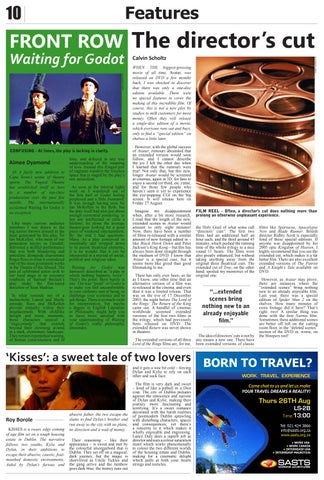
Film reel - Often, a director’s cut does nothing more than prolong an otherwise unpleasant experience. the Holy Grail of what some call “directors’ cuts”. The first two films had an additional half an hour each, and the third around 45 minutes, which pushed the running time of the whole trilogy to a nice round 11 hours. The films were also greatly enhanced, but without taking anything away from the original three theatrical cuts. The extended cut of Troy, on the other hand, spoiled my memories of the original one.
“...extended scenes bring nothing new to an already enjoyable film.” The idea of directors’ cuts is not by any means a new one. There have been extended versions of classic
films like Spartacus, Apocalypse Now and Blade Runner. British director Ridley Scott is especially fond of these special editions. If anyone was disappointed by his 2005 epic Kingdom of Heaven, I highly recommend that you see the extended cut, which makes it a far better film. There are also excellent extended versions of The Patriot and A Knight’s Tale available on DVD. However, as Avatar may prove, there are instances where the “extended scenes” bring nothing new to an already enjoyable film. Last year, there was a special edition of Spider Man 2 on the shelves. How many minutes of extra footage did it have? That’s right: two! A similar thing was done with the first Narnia film. Sometimes, these additional scenes are better off left on the cutting room floor, in the “deleted scenes” section of the DVD or, worse, on the bloopers reel!
11
Features
Image courtesy of www.flickr.com
My god, my accessory Berndt Hannweg Are celebrities treating their holy devotions like Paris treats her Chihuahuas, or are the media simply overly-focused on this aspect of the stars’ lives?
What do people see in these religions? A quest for meaning? The answers to life’s imponderable mysteries (spoiler: it’s 42)?
Quickly, if you can: What religion is Tom Cruise devoted to? What spiritual teachings does Madonna follow? How many pop and movie stars have personally thanked God for their awards?
Celebrities are pros at playing us like three-stringed fiddles. No news, they say, is bad news, so anything that can get a celeb into the papers must be a good thing. The problem comes when we must tell the faithful from the posers. How much of this stuff do celebrities believe in, exactly? And when did it start to become fashionable?
The answers, if you really didn’t know, are, respectively: Scientology, the Kaballah, and a hundred and seventy gazillion. It’s hard to tell whether celebrities are really flaunting their religions, or if we (the paying public) are simply gobbling up whatever the media throws at us, but certain celebrities seem inextricably linked with certain faiths.
Religion is a lifestyle choice. Most people would say an important lifestyle choice. If Tom Cruise wishes to believe that we are descended from irradiated aliens and that clinically-proven medicine is the work of Xenu, then good luck to him. If Madonna wants to open up her spiritual side by indulging in The Bible Code, well, power to her reading arm, I say.
“Religion is a lifestyle choice.” The biggest and brightest star has to be Scientology, the religion that leaves stars breathless and the public confused. Tom Cruise is its poster boy, and he is joined by a long list of celebrities (not least John Travolta, Katie Holmes and Isaac Hayes, aka South Park’s “Chef”). Its basic premise is that we are all thetans, immortal souls who are at heart omniscient,
places emphasis on numerology and “interpreting” the hidden meanings behind sacred texts. It starts getting a little more esoteric when practitioners indulge in clairvoyance, divination and the ever-popular cancer-curing water.
Fashionable Faith - Wearing your religion on your sleeve has become an increasingly popular trait amongst celebrities and plebs alike. immortal beings who created the universe. Having become slightly tarnished by this reality, we are constantly reborn in our bodies, doomed to enlighten ourselves by
spending vast amounts of wealth as “donations” to have access to the religious teachings written by a science fiction writer 58 years ago.
Compared to what must be the most successful con since Jim Jones, Kaballah comes off a little light. Based on Jewish teachings and study of the Torah, Kaballah
Religion is already a group identifier that splits seemingly rational people apart simply based on who they think is living up there, looking down upon us. Let’s not turn it into a fashion fad as well.
Kathryn Mitchell WAITING until you are married to have sex seems, in our sexually saturated culture, a rather oldfashioned, even idealistic, concept. In Western culture, moral standards seem to have slackened as more and more people are engaging in acts of copulation for recreation as opposed to procreation. Every sperm is no longer sacred! As people embrace their sexuality and desires, the practicality of our moral code is called into question. Why wait until marriage to discover the joys of sex? The principal reasons for pledging purity are religious – to a sworn atheist, this seems absurd. There is no one biblical verse condemning sex before marriage; Christians suggest instead that this message can be inferred. In Deuteronomy 22:13-22, for example, it is clear virginity when getting married is expected and sex before marriage is termed “a disgraceful act”. This is just one of many examples and the message is pretty clear. What the Bible fails to do, for me however, is provide adequate reasoning.
people’s attitudes towards sex changed radically. The church pushed its no-sex-before-marriage agenda hard and it to started win its battle. Telling people they will die from disease if they have too much sex doesn’t work. We all need to believe that we will never die; that it can never happen to us, otherwise we would never be able to leave our houses.
No sex without a ring - Is an anti-premartial sex approach still relevant in modern society? The only legitimate reason I can see for keeping sexual partners to a minimum is the risk of AIDS and sexually transmitted diseases. STDs are almost a symbol of promiscuity – the price of pleasure. And there is a belief that if everyone behaved responsibly the epidemic would end. So the church has made it its mission to ensure that everybody behaves. In 1495, a new disease started appearing all over Europe and its symptoms were terrifying. A doctor at the time described it as “Boils that stood out like Acorns,
from whence issued such filthy stinking Matter, that whosoever came within the Scent, believed himself infected. The Colour of these was of a dark Green and the very Aspect as shocking as the pain itself, which yet was as if the Sick had laid upon a fire.” Such was the explosive birth of syphilis. Christopher Columbus and his crew have been accused of bringing the disease back with them from the Americas to Europe where it raged its way through the population, killing millions of people. During this period
“The moralistic preaching about sex before marriage has no place in our postreligious society.” However, if you make something deplorable, you attach stigma to it, and ensure that those who indulge in it will be ostracised; in this way people feel as though they can lose something tangible, something real. I am suggesting that the church has transformed pre-marital sex into a sin in order to protect its flock from real diseases, not hell. Once this disease was syphilis, now it is AIDS.
The moralistic preaching about sex before marriage has no place in our post-religious society. There is something profoundly wrong with telling people sex is dirty, therefore you must save it for marriage. Sex is not dirty. Image courtesy of www.flickr.com
Image courtesy of www.flickr.com
You may now kiss the virgin
Holding out - Is sex an activity that should only be conducted after the wedding cake has been purchased? For most of us, we have enough insecurities when it comes to the fuzzy tinkle times without having to worry about whether God is watching us and enjoying the show or not. This mindset imposed by the church had created guilt even when having sex with a steady partner. This is wrong. Sex is about freedom, choice and exploration – and to be cheesy and romantic, love. And there is nothing wrong with that. Just use a condom.
12
Features
Cape Town Fashion Week Cayleigh Bright Thursday night's shows at 2010 Cape Town Fashion Week began and ended with a bang thanks to the talents of Suzaan Heyns and designing duo Malcolm Klûk and Christiaan Gabriёl Du Toit. Suzaan Heyns' show was special not only because the clothes brought otherwiselacking structure to the evening's showings, but also because of its beautifully executed production. There was footwear that did its part in creating the fashion Voortrekker look, and narration that kept things entertaining – even for those in the audience not fascinated by fashion – with often-funny snippets about the models. The soundtrack, like
the clothes, took the very traditional and made it very new. But let's get to the clothes. Heyns' collection featured collars, pleats, tailoring and a harmonious blend of beiges and various pale colours, with Vintage metal embellishments added a touch of precision that made the garments even more wearable.
with the help of a little girl in a gorgeous white dress, a four-poster bed, a doll’s house, and a ceilinghigh forest scene backdrop. A fairytale theme ran throughout the garments, props, and music, so the fact that the fabrics and styles ranged from delicate lace to the boldest of florals and animal prints simply added to the overall effect of enchantment.
The Good show merits a mention for gorgeous accessories and some great styling, while the floral dresses from Coppelia's show are likely to become summer staples – but the showstopper of the evening, unsurprisingly, was the Klûk/CGDT show. The title was “A few of our favourite things”, and was beautifully conveyed
Overall, Fashion Week 2010 got off to a great start as cameras flashed, guests mingled and exchanged thoughts on the clothes, and free refreshments flowed for the VIPs. Enthusiasm from audience and designers alike seems to be a good sign that South African fashion is on the up-andup.
Photos by Juliete Oscar, Nyasha Kadandara
I hate going to fashion shows Nyasha Kadandara I hate going to fashion shows. I come home feeling depressed and hating my image, wanting to set my closet alight – then proceed to rob a bank (preferably avoiding capture), then raid the shopping malls in search of this new image I feel I cannot live without since watching my future wardrobe on a ramp. Photos by Juliete Oscar, Nyasha Kadandara
My soul was broken on 14 August as I watched the show.
Designer Stefania Morland gave us the best of fashion, and a plat as a goodie bag to go with. Her experience has given her that edge that distinguishes her from most female designers. Young emerging designers such as Black Coal and Suga Suga came to town with their designs in the Woolworths show, proving to be fearful entities in the future. The men were certainly not left behind on Saturday night. If you are a man who likes to look good, who wants to be the one that everyone
notices when he walks into the room – the one that leaves with the girl – then you have to have checked out Viyella’s line. Based on how to dress from Cape to Cairo, Viyella presented a line that only the finest gentlemen would fair. Subsequently, I’ve been forced to look at men that I’m attracted to and pose the question, “Will he be able to afford Viyella one day?” From here on, me, my broke self and my man will be headed for Milan for yet another glamourous – but costly – experience.
Dr Thandeka Kunene - What can I do with . . . ?
What can I do with my degree, is a question that Career Advisors are often asked by students who are studying towards ‘non-vocational’ degrees, such as a general BSc or BA. Dr Thandeka Kunene, [MSc (Industrial Mathematics), BSc (Hons) and BSc (Mathematics and Applied Mathematics)] is a UCT graduate who could certainly put two and two together. Thandeka is the Founder and Managing Director of House of Hemp Pty Ltd. For her PhD in Entrepreneurship at the University of Pretoria,Thandeka completed a dissertation entitled, A critical analysis of entrepreneurship & small business skills in Small and Medium Enterprises in the textile and clothing industry in Gauteng. Through this study, she developed a mathematical model of the skills critical for starting, running and growing SMEs in South Africa. She also obtained an MBA with distinction at Richmond, the American International University in London.
Thandeka shares her career journey with Varsity:
whilst having a big heart and passion for poverty alleviation initiatives.
Careers calender
How did you find your niche in your current area of work?
How do you ‘make use’ of your qualifications and in which ways does it relate to your work, whether directly or indirectly?
Careers Education (Hoerikwaggo, 13h00 – 14h00)
I was driven by a passion to “save the world,” by eradicating poverty through economic development initiatives. I found hemp to be one commodity/ plant that spans across a variety of products, by-products and value added goods. The value chain of the hemp industry touches the lives and hands of the most remote rural communities, and the travellers in the Air Bus and Boeing! Can you provide a brief background of your business, House of Hemp? The House of Hemp business processes the hemp plant into fibre and oils to supply to other industries for further processing into fabric, household insulation, cosmetics, paper, automotive industry interior and a variety of other products. We found that the limiting factor in the use of hemp was the lack of supply of raw material. We therefore assist small scale farmers to grow the hemp plant, which we then purchase from them for processing. In addition we have contracted other commercial farmers as growers. Which factors ignited your interest in this type of venture? The diverse nature of the produce that spans from agriculture to high tech was pretty intriguing for me – having studied engineering and mathematics,
Knowledge of business development was gained directly from my entrepreneurship qualifications; Mathematics and Engineering helps me in solving problems, in the modelling of the business venture and in crafting the production and process requirements. Which skills have contributed to your success thus far? Resourcefulness; identifying key skills in others, to structure a working team; planning financial resources and drawing up a feasible business plan. These skills were strengthened through practice, hours of failure and never giving up. Thandeka’s work experience is diverse – while at UCT, she was a Junior Lecturer in Effective Numeracy, and founded UFUNDO, a student fundraising organisation. At present she is also the Programmes Co-ordinator for the Raymond Ackerman Academy for Entrepreneurial Development, to establish their Soweto campus. Thandeka advises students to choose a path; focus on it, and never to give up. Business is tough – no – very tough, but it is fun!
25 Aug: Preparing for Interviews, 13h00 in LT2, Hoerikwaggo 26 Aug: Rethinking your Degree, 13h00 in Rm 3C, Hoerikwaggo 6 Sept: CV Development, 11h00 in LT1, Hoerikwaggo 7 Sept: Rethinking your Degree, 11h00 in Rm 3C, Hoerikwaggo 8 Sept: Cover Letters & Application Forms, 11h00 in LT1, Hoerikwaggo 8 Sept: Preparing for Interviews, 13h00 in LT1, Hoerikwaggo 9 Sept: Researching Careers: where to begin, 11h00 in LT1, Hoerikwaggo 13 Sept: Preparing for Interviews, 13h00 in Classroom 12, Menzies 15 Sept: CV Development, 13h00 in LT2, Hoerikwaggo
Careers Fairs (Jameson Hall, 09h00 – 15h00) 2 Aug: General 3 Aug: Accountancy 18 Aug: General
Graduate Recruitment Programme
14 Sept: Nedbank TOPP, 13h00 in LS 3A 15 Sept: Clicks2Customers, 13h00 in LS 3A 16 Sept: Mars Consumer Products Africa, 13h00 in LS 3A 20 Sept: Toyota SA, 13h00 in LS 3A 21 Sept: Mazars Moores Rowland, 13h00 in LS 3A 21 Sept: CCUSA, 13h00 in LS 3B 22 Sept: Auditor-General of South Africa, 13h00 in LS 3A 22 Sept: SASTS Working Adventures, 13h00 in LS2B 27 Sept: Glenrand MIB, 13h00 in LS3A 29 Sept: Chilli Adventures Work & Travel, 13h00 in LS 2B
Company Showcase
25 Aug – Procter & Gamble 26 Aug – KBR
Hot opportunities Looking for a bursary/scholarship, vacation or graduate opportunity for 2010? Visit www.careers.uct.ac.za/careerportal Over 100 opportunities available online now.
Features
13
Nicole Wilcox
Breaking news! A clip on YouTube shows South African comedian Trevor Noah mocking cell phone networks. He ridicules Cell C service by saying, “They’re like the worst network...they don’t even have their own network – they piggy back off Vodacom. If Vodacom is ANC, Cell C is like Cope. That’s just disastrous. Cell C drops more calls than Jacob Zuma drops people’s underwear!” While the whole country laughed Cell C hit back with a letter of apology in the Sunday Times on 1 of August. Cell C’s response was unbelievably fast and people are left speculating whether this was a setup from the very beginning.
Cell C is notorious amongst its users as a very poor service provider and Trevor Noah, as Oubaas from 7deLaan would say, “kom asof hy gestuur” is to become Cell C’s hero. He has been given the title of CEO (Customer Experience Officer) and has a “Tell Trevor” website where he deals with Cell C’s customer complaints. His initial ridicule of Cell C’s service now seems as if it was the beginning of a sneaky marketing gimmick as Cell C recently launched a new image under the expertise of Ogilvy, South Africa’s biggest advertising agency. The Cell C website boasts the release of BlackBerry cell phones with
Images courtesy of www.cellc.co.za
Cell C rolls out Trevor Noah their network, and conveniently advertised on the site is a Facebook invite to become one of Trevor Noah’s “closest friends”. New Cell C adverts heard on the radio also feature clips from Trevor’s stand-up and fans are not too happy, because it appears that Trevor has sold himself out. Heartbreaking news! From Simba chips to YouTube clips to Cell C fibs, Trevor Noah seems to be a jack of all trends. As a fan, one could understand the letdown in being hoodwinked by yet another scheming corporate marketing ploy. Trevor Noah should leave comedy and rather work as a presenter on Brand Power.
Res4Res - A true visual festival A tough act to follow The showcase of the best thespians our residences had to offer was, as usual, quite the spectacle. It was a mixture of music, dance, vernacular and of course, acting. From the Dreamgirlsinspired numbers from Fuller, to the emotionally charged College House piece, the vast array of plays meant there was something for everyone. The first play I watched was Groteschuur. A substantial amount of the play was in Xhosa and I had to make use of my very own translator. The play had a lovely dance number, one that I feel can be described as Dirty Dancing meets Umoja. Baxter’s production was Scandal meets the State of the Nation address. This play had everything: murder, adultery and an all-female parliament. Despite all this there were times when it was evident that members of the cast were not fantastic actors. This play left a dramatic
space open for College House to fill with an intense and emotionally wrenching piece performed in a variety of languages. This play commanded acute silence and rapt attention, and left much of the audience feeling somewhat melancholy. On a more humorous note there was Marquad boys in dresses. Need I say more? The show was hilarious and with a bit of entrepreneurial ambition they could easily take it on the road. Fuller kept things upbeat and were out to have fun with their play, which can only be described as Dreamgirls in a shebeen. Ma Ruby stole the show; she could easily be the understudy to Generations’ Ma Ruby and no one would be able to tell the difference. That was not the only play set within a shebeen, as another play by Forest Hill depicted the story of a “model c” girl looking for the “kasi experience”, which was good for a laugh. A monologue by a Smuts man included such an array of
A+ for ‘A Team’
SA’s own Sharlto Copley stars in the big-screen adventures of the infamous team of four
Timothy Lester One of the most popular and successful television series to have come out of the ‘80s, The A-Team focused on the exploits of a team of four Vietnam veterans who, sentenced by a military court for a crime they didn’t commit, head underground and become soldiers of fortune. The team acted on the side of good, whilst trying to clear their names. Acclaimed filmmaker Joe Carnahan knew it had a devoted following and recognized the challenges in bringing The A-Team to the big screen. When Carnahan came on board, he and writing partner Brian Bloom redrafted the action to take place during the impending troop withdrawal from the Middle East. The opening scene introduces the viewer to Col. Hannibal Smith, played by Liam Neeson, who is bound to a chair with a gun barrel pressed to his temple. His McGuyver-like escape sets the scene for the adrenaline-pumping plot. We are then introduced to the other lead characters: the iconic B.A Baracus played by UFC champion fighter Quintin
characters it made me wonder where he got the energy. He had the crowd in stitches and displayed his great ability to change wigs very quickly. A more serious play by Rochester tried to tackle the issue of rape and others faced by today’s youth. This was not received the way it was intended – audiences laughed while a girl relived her trauma and her family tried to deal with it. Tugwell’s play was based in poetry and was a truly beautiful exploration of a woman’s emotional turmoil. And who can deny girls the chance to dance and scream on stage? It was The Vagina Monologues meets abstract art; artistic and memorable, the mixture of dance, poetry and drama earned them a standing ovation. All in all, the Res4Res festival was a smashing success. It was a whirlwind of dance, poetry, language, costumes, light and energy. It did what it set out to do – showcase the hidden talents lurking in our various residences.
Image courtesy of www.collider.com
Tiffany Mugo
“Rampage” Jackson; the multitalented ladies man, Templeton “Face” Peck, played by Bradley Cooper; and the aerial maniac H.M. “Howlin’ Mad” Murdock played by South Africa’s very own Sharlto Copley (District 9). What makes the movie interesting for South African viewers is seeing one of our local acting talents playing such a huge role in a Hollywood blockbuster. A-Team producer Jules Daly was struggling to cast the part of Mad Murdock and it was Sharlto’s role of Wikus van der Merwe that caught her eye. Explains Sharlto, “I loved The A-Team growing up, and Mad Murdock was my favourite character, so to be cast as your favourite television character of all time was a dream come true”. Sharlto explained that when he received the script, he hated the way they had portrayed the character saying that it was too conservative. “I decided to shot a video of all the things that could happen to Murdock in a hotel room. I edited it together and it turned out to be eight minutes of me improving with stuff in the room, and just
Outstanding - The A-Team explodes onto cinema screens. being Mad Murdock they way I see him. When Joe saw it he was sold”. With action, suspense, betrayal, romance, comedy and mind blowing special effects, this movie has the whole package. Sharlto delivers a stunning performance, 70% of which he admits to being improvised, which only adds to his characters texture and depth. You don’t want to miss this movie.
Lauren Midgley There is a special kind of performer who lurks among you. Unlike Theatre and Performance students, these actors are not immediately identifiable. That is part of their artistry. They are the closet thespians, who slog away doing their B.Coms or their Med degrees – but who deep, deep down wish that they could throw off the shackles of a suit and tie, and dedicate their lives to the (pause for effect) Theatre. Where can we locate these undercover Hamlets? I have found that the best place to start is amateur, low-cost student productions, where pretty much anyone is welcome, and talent is more of a “nice-to-have” than an actual requirement, such as Res4Res. For those of you who witnessed the plays, you will agree with me that most of what we saw was, well, shit. But, that aside, I couldn’t help but marvel at the actors on stage. Not the legitimate T&P stars, who deliver authentic performances. I mean the other people on stage.
still be digesting home-cooked meals (whew, no pulse!) instead. Another skill is their resourcefulness. Whilst “real” actors, such as those in Performing Arts, are taken seriously, Res4Res actors are not. This means that the budgets for production are budgeted, and you’re more likely to get your full R17.27’s worth from a meal voucher than get into the Prop Room. So, when a scene requires a terrifying dagger, a Res4Res actor craftily steals a bread knife from the dining hall. When a car is required for the dramatic death scene, a Res4Res actor doesn’t whinge about the lack of a steering wheel or licence plate – all they need is a cardboard box and a few pieces of gum, and they’re good to go. As you can imagine, the sight of someone heading off to commit murder with a breadknife will draw some rowdy laughter from the ever-perceptive audience.
What sets these Res4Res actors apart? I believe that it is their unique array of skills, which only a precious few possess.
This brings me to my final point: Res4Res actors are seemingly made of steel. Imagine this: there you are, on stage, sobbing over a fellow actor’s “dead body”, or trying to deliver a weepy monologue about crackaddiction, and your audience just won’t stop laughing.
Firstly, they have mastered the fine art of what is known in the theatre world as “corpsing”. This is a fascinating technique involving laughing on stage at completely inappropriate times – usually when your character should be showing signs of horror or rage.
The ordinary human being would simply give up and bolt from the stage in humiliation. But no. The Res4Res actor, ever the (pseudo)professional, just waits patiently for the audience to settle, before delivering their next woeful line (followed instantly be further howls from the crowd.)
Naturally, “corpsing” kills any illusion of your character the audience may have (hence its nasty title). Such determined displays of this I have never seen before; true commitment to one’s art is rare to behold.
Seeing as how the plays are painful to watch, you may find yourself pitying the actors on stage. But don’t; the strangest thing of all is that, in the midst of all that carnage – where tragedies are comical and comedies are tragic – those actors are actually having the time of their lives. And they’ll be back again next year.
There was just something, dare I say, magical about them.
Secondly, Res4Res actors must have either abnormally strong stomachs, or Herculean amounts of courage. This is because they are required to return to UCT a week early from the July vac to start rehearsing. That’s right, people. These bold youths endure a whole extra week of Res “food”. It’s a small act of heroism to face a chicken that’s still twitching, when you could
Don’t worry if you can’t understand these strange individuals. Even I can’t figure them out – and I’m one of them. Sure, we may not have the traditional idea of “talent”, but we sure got a lot of moxy.
Sports 14 DOM-INAT-ED The roaming sports journalist Ed Sellier discusses the challenges for anyone investigative
Differentiate One of the most strenuous paths you take as a fledgling anything is one to find that which will differentiate you from the rest. As every market becomes saturated with products, services and even people, so too it becomes harder
Sport is the most subjective theme on the planet and constructs supporters and enthusiasts out of us all. The Internet and its multitudinous conduits of communication make my opinion publishable. The key is to treat these channels with respect and not be slapdash about the way you engage with them, managing each in a way that suits and constructs the audience with which you communicate. Currency So how do I distinguish myself as a sports journalist within the tradition of sports journalism? Well I am young, fresh, untainted and intact in the working environment, surrounded by opinions (none of which scare me). I am articulate – I am captivated by all different media (TV, radio, online and print) and know that if I work hard enough, I can make it in any of these. An editor told me
that hard work is a currency and I would certainly not contest that. Enough of it buys your way to the proverbial destination. Drive (intentional ambiguity) My youthful vigour, my impassioned tongue and my fanatical relationship with sport, made possible by language, is what drives my salad days and what will ultimately distinguish me. That brand equity thing that everybody thinks is an imploding concept in the Information Age is not. Get your mind around it and you're almost there. Experience My experience working as a journalist for SuperSport gave my career a serious jump-start. I was surrounded by pervasive professionalism while covering the World Cup. Editors and producers get nowhere near the credit they merit, but they work because they simply love sport. The reward is in witnessing the final product and it’s an example we should take note of.
voice is leading the bulletin; the next it is old news and you need to find a new story. What compels you to keep on creating is your love for the subject you write about. Trust SuperSport boasts world-class studios, trailblazing equipment and an infectious energy, while everybody has free reign to work as they please. There is an intricate system of trust, where the producer will trust the editor and the editor will trust the journalist to do the job that only they are capable of. I trust the editors, because I trust their expertise. It is a rare thing, but excellence emanates throughout every studio, every office and every boardroom.
Back yourself The ability to brand yourself as something different in the tradition of sports journalism is a true test, as it is in any profession. But instead of responding to a story, go out and find one. This is what continues to differentiate writers, journalists and broadcasters: they prove themselves by roaming the field to find their perfect story and backing themselves to craft it in their own way. The Internet will always let people publish brainwaves and responses to generic stories. The true test for any journalist is capturing the story first and conjuring the response.
Beating the competition – Being a sports journalist requires opportunism and an eye for the story. Image courtesy of www.goal.com
I am a sports journalist. Since I can remember all I wanted to do was talk about sport and naturally as I grew into my passion, so I felt that this was where my career would lie: sports journalism. Right now I find myself between studying and employment and I know where I would rather be – I aspire to delineate the way I get there, showcasing a personal grasp of my hobbyhorse along the way.
to differentiate yourself. Take the sports journalist market – there are so many journalists today (both professional and amateur) because everybody has a publishable opinion about something. It’s a sport in itself and we’re all competing to be heard first and read the most.
One of the most important lessons you learn as a young journalist or broadcaster is that you should never get attached to your work. One minute what you script and
WP defence is key Thrilling football as Barclay’s begins
Craig McKenzie Western Province have started this Currie Cup where they left off in the Super 14 earlier this year, as they have continued to be the best defensive outfit in the competition. Though labelled boring at times, the Cape side’s style of rugby is effective and ultimately successful, which has seen them taking the points in every encounter to date this year and, in doing so, snatching top spot on the log. The WP boys have had their line breached just 6 (one try a game on average) times thus far – compared to that of the Sharks, who occupy second spot on the table and have the second best defensive record this year, and have scored 23 tries of their own. The Cape Town team also finished the Super 14 with the least points against, least tries against, and best points difference overall (stats correct as of 18 August). Jacques Nienaber, Province’s defensive coach, is the man responsible for his side’s outstanding defensive record. Nienaber’s work hasn’t gone unnoticed, as he was recently called upon to help out the Springboks in Johannesburg ahead of their Tri Nations clash against the All Blacks. There is a genuine belief amongst head coach Allister Coetzee’s men that the boys from the Cape can go the distance this year, after a lengthy absence from the winner’s podium. In years gone by, Western Province has struggled with no Springboks present. However this year, through the help of some exciting youngsters, the side has yet to feel the effects of their absence. With no less than nine Boks out of selection (and a few stars applying their trade overseas), Province put away defending champions The Bulls
in an old-fashioned dog fight last weekend at Newlands. In earnest, the home side should have racked up a bigger win deficit. It will be interesting to see how Province performs when they come up against The Sharks in Durban, who will arguably pose as their toughest opponent to date. The Sharks are hot on the heels of Anton Van Zyl’s men, just one point behind and with only one loss to their name (a thriller against Griquas in Kimberly on the opening weekend of the competition), and will be looking to repeat their winning performance which saw them prevail against the Cape side in this year’s Super 14. A win for either side will secure them top spot on the log. Capturing the cup this year will cap off, undoubtedly, the most successful year in the history of the franchise for the Cape-based outfit, after they made it to their first Super Rugby final just a few months ago. With the risk of jumping the gun, the Western Province train has seemingly been steered back on track after it had been derailed in recent years; as the coaching staff and the rugby structure seems to have hit their strides. In addition to the senior team, both youth sides – the under 19s and 21s – are also unbeaten to date in their respective junior Currie Cups. All bodes well for the remainder of the tournament. Western Province, historically the most successful team in the competition with 29 titles, have not lifted the coveted cup in nine years since winning it back to back in 2000 and 2001. Western Province was also the first team to capture the title in the inaugural competition in 1889.
Thabang Letheo
The best league in the world, the English Premiership, restarted on the weekend, and as usual there were surprises, excitement, dubious decisions, and most importantly, entertainment provided to global football fans by the players of the Barclay’s English Premier League. It all began at White Hart Lane as Tottenham Hotspurs did battle against high spenders Manchester City. The whole world was expecting Man City to dominate and probably even embarrass Spurs, but it was the complete opposite as the Spurs’ midfield, led by Luka Modric, dominated the game. Throughout the game Man City failed to live up to expectations, as new signings Yaya Toure and David Silva failed to produce a display worthy of their high price tags. If it wasn’t for the heroics of goalkeeper Joe Hart, Tottenham would have won by a more than comfortable score line. The first game showed that money cannot guarantee success in this league; making it through the season relies on tactical organisation, teamwork, and camaraderie within a team. Despite that, Man City continue to fill their transfer basket, as they roped in Mario Ballotelli and James Milner. The reigning champions Chelsea showed their rivals that they will not let go of their title easily, as they thrashed newcomers West Bromwich Albion 6-0. Last season’s top goal scorer, Ivorian striker Didier Drogba, looked sharp and lethal as always with a hat-trick, which was followed by a brace by Florent Malouda. Liverpool were extremely unlucky, as a Pepe Reina blunder allowed Arsenal to equalise at Anfield, after they had taken the lead through David Ngog. Joe Cole was unfortunate to have his Liverpool debut marred by a red card he received for a lunge on Laurent Koscielny, who also received a
Image courtesy of www.goal.com
Every individual fears uncertainty. It's the worst imaginable abstraction: not knowing. I'm sure there are many of you who are entering a transitional period in your lives – transience, staying in one place for a short space of time, not committing to one thing because you're dead scared that it might fail. EPIC FAIL – how many times will we hear this annoying catchphrase that has somehow found its way into humankind's vocabulary of convenience. LOL.
To the richest go the spoils? - Big guns kick off for another season.
red later in the game. Liverpool really showed their fighting spirit as they kept the lead for the bulk of the second half, despite having a player sent off. If they can regroup and draw the positives from this near-victory, they can also stake a claim for the title. It was a surprise to see the Arsenal starting line-up without influential captain Cesc Fabregas – one wonders why he was not even on the bench. In spite of this, however, it was a pleasure seeing Arsene Wenger blood youngsters such as Jack Wilshere. At Villa Park, James Milner said goodbye to the Aston Villa fans by scoring their third goal as they beat West Ham 3-0, showing that despite the departure of manager Martin O'Neill, things are still in place at Aston Villa. The question remains whether Villa can find a suitable replacement for O'Neill? News from Upton Park is that Benni McCarthy will be fined R430 000 (one week’s wages) if he fails to lose a kilogram within seven days. Blackburn shocked Everton at Ewood Park in a 1-0 victory courtesy of a goal by Nikola Kalinic. The biggest shock of the weekend was definitely Blackpool’s surprise 4-0 victory over Wigan Athletic, as new signing Marlon Harewood grabbed a brace. Newcomers Blackpool were definite candidates
for relegation before the start of the season, but with this victory they showed that they will not be pushovers as they fight for their place in the EPL. The Red Devils showed their class as they calmly defeated Newcastle 3-0 at Old Trafford, as veterans Scholes and Giggs showed the world why their contracts were renewed for an extra season. Sir Alex Ferguson is mixing a blend of youth and experience to challenge for their record nineteenth title. Early indications suggest that Chelsea are favourites for the title, closely followed by Man United. Manchester City have failed to live up to expectations, but certainly cannot be written off after a single game. Liverpool, Arsenal and Tottenham are all dark horses for the title. West Ham are certainly relegation candidates, along with West Brom and Wigan Athletic, as all these teams were defeated convincingly in the first week without a fight – this could prove to be a another tough season for West Ham manager Avram Grant. Without shocks and surprises this would not be the English Premier League. Davids are bound to beat Goliaths, there will be bad refereeing decisions, managers will get sacked and goals will continue to flurry. After all, this is the most entertaining league in the world!
15
Sports
A new era for soccer in Cape Town?
Firstly they have retained the services of their coach Carlos
South African football’s finest.
With the countdown to the 2011 Rugby World Cup in full swing, questions surrounding South Africa’s ability to retain the competition title are rapidly beginning to surface. Will the Boks have the willpower to restore their previous World Cup-winning form or will South Africa say farewell to a revered international rugby presence? A few months ago South Africa was dominating every front of the rugby fraternity. Relentlessly claiming the Tri-Nations trophy, dominating in the British and Irish Lions tour, achieving World Cup supremacy as well as flawlessly representing in the Super 14, South African rugby seemed unshakable. Sadly, the tables have started to turn, with the Springboks lacking composure in pre-season internationals as well as achieving less than impressive results in this year’s away leg of the TriNations. Countless excuses have been offered for the Boks’ poor performances abroad. Initially, travel fatigue and post-Super 14 exhaustion were blamed for their unacceptable losses. Referees and referee assistants were also accused of making unprofessional and biased calls and outrageous conspiracy theories surrounding a global rugby vendetta against South Africa emerged. The time
If Ajax can continue to develop young stars, soccer in the Mother City will definitely be heading in one direction – to the top. Ajax are by far Cape Town’s best bet to lift the ABSA Premiership; with the return of stars such as Moon and Fanteni, the team has acquired much-needed experience, which
These are surely the ingredients for success for football in the Mother City. The only thing needed now is for each and every one of us football fans to taste this recipe of wonderful football. The party starts at the Cape Town Stadium on 27 August, so be a part of the action!
Abandoned - What purpose will our stadiums serve in the future? Das Neves – continuity is always a recipe for success for newly promoted teams. Secondly, they have been very active in the transfer window by acquiring the services of many experienced PSL players, such as Lebogang Mothibantwa, Joseph Kamwendo (the Malawian midfielder on loan from the Pirates with a remarkable passing ability), Excellent Walaza (the former under-23 and Bafana star who was once tipped by Carlos Alberto Pareira to fill the boots of Benni McCarthy in the Bafana Bafana squad), Manqoba Ngwenya (the former Sundowns fan favourite who has battled for game-time in recent years), and last but not least Sibusiso Zuma (former Bafana Bafana captain who was recently voted Danish player of the decade for his amazing contribution while playing for FC Copenhagen a few years ago). After the acquisition of players with the experience and hunger
required to survive a season in the PSL, Vasco Da Gama mean business. Are they capable of causing upsets? We can only wait for 27 August when they battle the mighty Buccaneers. The Urban Warriors are by far the best team with regards to development in South Africa. Ajax Cape Town continue to mould young football talents from the streets and turn them into world-class stars. Over the years they have produced Everton star midfielder Steven Pienaar and alltime leading Bafana goal scorer Benni McCarthy. More recently, the breeding of the likes of Shameeg Doutie, Daylon Classen and Thulani Serero – all at the u20 World Cup last year – allow for the next golden generation of SA football. Both Serero and Doutie are currently on a ten-day trial at Ajax Cape Town’s mother club Ajax Amsterdam. This season Ajax have recalled former Bafana striker Terror
Springbok blues Tarryn Steenekamp
Fanteni, and Bryce Moon is on the verge of signing a loan deal for them from Greek club Panathinaikos.
Santos have been the most quiet of the Cape teams during the offseason as they have only signed Peter Mponda and Sekou Camara from Black Leopards and Jomo Cosmos respectively, but that is no reason to write off the “Peoples’ Team”. Santos are coached by one of South Africa’s best coaches, Boebie Solomons. Last season they shocked the local football community as they came fourth in the PSL on a tight budget. Santos have never been a flamboyant team, but they always grind out results, and with star striker Erwin Isaacs staying, inspiration of his teammates to continue from where they left off last season seems to be the only result.
has come for the Springbok players and management to accept the facts and resolve prominent team issues before the 2011 Rugby World Cup kicks off in New Zealand, a mere twelve months from now. The Boks’ 2010 failures can only stem from two concerning dilemmas. Either our national coaches don’t have the intellectual rugby ability to successfully steer the Bok ship or the senior players have reached the point where comfort has replaced their desire. While team management were to blame for poor team selections, all of those guilty of ill discipline on the tour were senior Springbok players. The chaos is alarming, as it proves senior players have become too comfortable in the Bok environment in which they, and not the coaches, call the shots. Recently criticised for his inadequate fitness levels, captain John Smit has been one of many underperforming Springbok veterans. South Africa’s primary asset of the last five years was a liability on tour, further complicating the search for a solution, just a year out from the World Cup. If the likes of Smit, Matfield and Habana are to make it to next year’s competition, the way they are managed will need to be drastically improved. Smit recently played his 100th Test at Soccer City and Matfield is only one match away from the same
milestone. Unfortunately, it seems that sentiment will suffocate the logic of picking fresh legs, and even fresher minds, for the endof-year Grand Slam tour when these influential players should be allowed a time for physical and mental recuperation. Realistically, De Villiers will remain national coach until the World Cup has been played. It is unlikely that he will veer away from his investment in Smit as captain and Matfield and Habana as senior team leaders. This, however, does not mean there can’t be immediate changes to protect these significant investments. Short-term change will bring long-term gain and the Boks are desperate for a youthful injection in several positions. South African rugby players have the skill, they can play with pace and they know how to use the width of the field. Proof of their dexterity alone can be found in the South African Rugby Union’s trophy cabinet – envy of every opposing rugby union on the planet. The fact is that we have become accustomed to success and, after experiencing such satisfaction from South Africa’s players in the past, we will never willingly accept the mediocrity of the last six weeks. Results should be considered secondary to welcoming expansion in players and playing ideas over the upcoming months.
Images courtesy of www.psl.co.za
Vasco Da Gama took the entirety of South Africa by surprise as they gained automatic promotion to the PSL, and they have an even tougher road ahead as they now prepare to do battle in the top flight of SA football. What makes Vasco different?
will help as they try to dethrone Supersport as champions.
Our country’s talents square up against each other for glory.
UCT Radio makes waves at Muizenberg Natalie Jansen On Saturday 14 August, UCT Radio’s members headed out to Muizenberg Beach for some funin-the-sun with kids of the Palama Metsi Surfing Development Academy. Volunteers from the radio station rolled up their sleeves by sprucing up the clubhouse, while others enjoyed a mini soccer match with some of the younger surfers on the sand. The daring Jonathan Duguid (host of the “Lifestyle Show”) and Benjamin Overmeyer (Programme Manager) “took one for the team” by donning figurehugging wetsuits and joining the beginners class. In previous years UCT Radio has supported various educational projects, one of which a shelter for abandoned children in Mitchell’s Plain. “This time we wanted to do something different,” a reprsentative said. “With the focus this year being development, but at the same time avoiding the soccer clichés, we chose surfing.” Palama Metsi (“water riders”) serves the youth of Muizenberg and surrounding areas. It was founded in 2008, and gives free
surfing and water safety lessons to the previously disadvantaged. PMSDA also sponsors, coaches and supports team members participating in competitions locally and internationally. A spokesperson for the school said, “We use surfing as a medium to promote positive, healthy living – but more than just surfing is needed to better these kids’ lives. We attempt to provide food, clothing, life-skills programmes, and basic medical assistance.” After two hours in the water, our proud beginners emerged slightly bruised but smiling, happy to reach standing positions. The radio crew handed out milkshakes and chips, while Deen Brandreth from the PMSDA committee accepted a donation of food, stationery and training equipment. “We’d like to thank UCT Radio for its support of PMSDA, first as a media sponsor and now with these donations. We encourage the public to come down to the beach, see what we do, and find out whether they’d like to get involved. We especially need help with administrative tasks like proposals so that we can concentrate on our main task – coaching.” Images courtesy of www.psl.co.za
The PSL season is starting off in flamboyant style. On Friday 27 of August, all eyes will be on the majestic Cape Town Stadium as it hosts a double-header involving the newly promoted Vasco Da Gama as they do battle against Sowetan giants the Orlando Pirates. This will be followed by the Urban Warriors, Ajax Cape Town, doing battle against Bloemfontein Celtic on the night regarded as “Football Friday”. What will this mean for Cape Town Soccer? Can the legacy created by the World Cup build the standard of football in the Cape?
Images courtesy of www.ajax.co.za
Thabang Letheo
The UCT Football appeal
Sports bites
Newcastle, Arsenal and Chelsea drum six of the best
Monday Night Football - Bright lights illuminate the Kopano Field as the UCT Football team takes to training. Photo by Alessandro Fiorotto
Ed Sellier and Rémy Ngamije The modern sporting world is proof that some level of financial stability is required for building success. Manchester United, Chelsea, Barcelona, Real Madrid and Inter Milan all prove that a good financial backbone helps to bring a measure of success both on and off the pitch. These football powerhouses also boast a fanatical following, propelling the clubs to greater heights in European football. A perennial concern for the UCT Football Club and its members is that the university management does not provide enough funding and institutional assistance. The lack of mainstream support from the rest of the student body is also another alarming issue. A club that is currently progressing significantly in comparison with recent years demands consistent levels of support to continue thriving. UCT Football is a widely enjoyed sport with over five teams spread between the local men’s and women’s leagues. Members feel that in order to consolidate themselves as a professional club, they require adequate financing, a comprehensive marketing plan inside and outside the university as well as the support of football lovers on the campus. Bureaucracy Students grapple with the numerous levels of bureaucratic administration during their UCT experience – it is no different when it comes to managing a sports club. “The process of requesting funds is too dense,” said the men’s first XI head coach Mangosuthu “Gugu” Siso. “The requests have to go through four levels of admin.” Sufficient funding ensures that kits, training equipment, transport to away fixtures and coaches’ salaries are catered for. Players often have to fund their own travels when competing in another province – even when they are representing UCT. Initial funding amounted to R20 000 from UCT Sports Administration but this was later bumped up. An injection of capital would help to improve the structure and performance of the club significantly.
“We would like the university to appreciate us and support us. UCT needs to become more involved in the football,” said Jonah Wamani, a first team central defender since 2007. His sentiments were echoed by Alessandro Fiorotto, the UCT Football Club committee chairman and first team midfielder for the past four years. The strain of securing sufficient financial backing brings about a range of problems that inhibit the management of the club. The construction of the new Kopano football field has also allowed the UCT Football team to perform better on the pitch. They are given first preference when it comes to booking training sessions and matches. This administrative advantage allows their training sessions to flow seamlessly, reducing the potential stress that they might experience in this regard.
“The administration is more on point now,” said Gugu, who has been involved with UCT football for the past eight years mostly as a player and recently as a coach. “When I first began, there was no manager and the coach had to deal with everything, which was a huge burden. Players would come with different issues which the coach should not have had to deal with.” The differentiation of the coaching and managerial roles sees more relevant issues being brought to the respective parties. Although the roles are clearly defined, there is a shortage of qualified coaching staff. With the demand for competitive football on the rise, the football club simply needs more experienced coaches and managers to ensure that UCT can field as many teams as possible.
Winston Zeederberg, the men’s second XI coach, emphasised the pressure this takes off the coaching staff. “It is more viable with a manager and a coach – the coach has a clear head and more time to analyse and suss out opponents before big games,” he said.
“UCT Football is still being run like a society instead of a professional body,” Madiba added. Fiorotto confirmed that in order for the club to improve on its current status, a new shift in the approach to UCT football needs to be adopted. “Either there needs to be more funding from the university, or we need to be given the licence to act independently.” Marketing and longevity In order to establish a successful football club, a proficient marketing scheme needs to be implemented to encourage greater participation, both from within the university and outside. There is great longevity within the system with many students devoting themselves as players for as long as five years.
Loeb wins in Germany
“We need to attract our own alumni who will return after graduating to help fund, promote and assist the club in its management,” said Dustin Holohan, first XI left-back, committee member and third-team coach. This would certainly help in aiding the club to work as a private body.
First XI - The first eleven pose for a picture in their brand new kits. Coaching and management Since 2007, there has been some progress in the coaching department, with the club being able to separate the roles of coaching and managing staff. This sees managers concerned with the daily requirements of the teams, while coaching staff work with the players, determining team tactics, formations, selection and leading training sessions.
for us to be able to compete with the likes of Tuks and Wits.”
Individuals within the club also find themselves performing multiple roles; football players also serve as committee members, coaches and other administration staff – surely, along with their academic endeavours, they find themselves overstretched. Development Throughout the last few months, members of the club have increased their efforts to establish a bedrock for football development at UCT. Men’s first team captain and right winger Mpho Madiba highlighted that although they were not at the same stage of development as Gauteng-based clubs, they had started the process. “The Western Cape sides are improving but much more hard work is required
Looking ahead The club is certainly not lacking in hunger and drive for success – UCT Football wants to cement itself firmly amongst the established clubs in South Africa. Aside from funding and marketing, the most important attribute any successful club has is an enthusiastic and passionate following. There is enormous potential to progress to Cape Town’s top flight, the UCT First team. UCT is currently fifth in the province and is six points off top spot, which will secure promotion and qualification to compete with the top 16 university teams in the country at the national tournament held at Rhodes University. Tomorrow night sees the team face table-toppers Northlink College in an 8.30pm kick-off on the Kopano Field. This is the perfect opportunity for the student body to familiarise itself with the university’s budding footballers and voice the type of support that will boost the team to meet its potential.
Dan Carter to have surgery
United drop points as Nani misses penalty