2
Friday 12th October 2018
News F E AT U R E S
Black History Month: Daniella Adeluwoye reflects Page 18-19 ▶ I N T E RV I E W
Who is The Sunday Times’ Middle East correspondent? Page 7 ▶ OPINION
Don’t tell me words can’t hurt, they have been an assault on my identity Page 20 ▶
vulture Magazine The show I’ve been waiting for: Killing Eve Page 28 ▶
editor Noella Chye editor@varsity.co.uk deputy editors Merlyn Thomas & Catherine Lally deputyeditor@varsity.co.uk magazine editor Vivienne Hopley-Jones magazine@varsity.co.uk digital editor Joe Cook digital@varsity.co.uk business manager Mark Curtis business@varsity.co.uk news editors Rosie Bradbury & Stephanie Stacey (Senior); Isobel Griffiths & Millie Kiel (Deputy) news@varsity.co.uk senior news correspondents Jess Ma, Alexandra Giannidi, Sarah Orsborne, Kiran Khanom, Elizabeth Haigh, Amy Batley, Maria Stragapede investigations editor Jack Conway investigations@varsity.co.uk opinion editors Maia Wyn Davies (Senior); Dan Wright, Nick Harris, Priya Bryant, Tom Nixon (Deputy) opinion@varsity.co.uk science editors Joseph Krol & Gesa Sophia Borgeest science@varsity.co.uk features editors Isobel Bickersteth & Jess Tan features@varsity.co.uk arts editor Nick Collin arts@varsity.co.uk film & tv editor James Dickinson filmandtv@varsity.co.uk music editors Miles Ricketts & Alice French music@varsity.co.uk fashion editor Julia Davies fashion@varsity.co.uk theatre editors Iris Pearson & Niamh Curran theatre@varsity.co.uk lifestyle editor Ella Jones lifestyle@varsity.co.uk sport editors Marcus McCabe (Senior) & William Ross (Deputy) sport@varsity.co.uk violet editor Devarshi Lodhia violet@varsity.co.uk interviews editors Belle George & Oliver Rhodes interviews@varsity.co.uk long reads editors Jamie Hancock & Nick Chevis longreads@varsity.co.uk head of video Cordelia Lam video@varsity.co.uk sub-editors Vivi Way (Chief); Aimee Wragg, Gabby Handberg, Helen Grant, Helena Mackie, Emily Kilner, Imogen Childs, Jasmine Phull, Naomi Hayes, Poppy Kemp, Ruth Moss, Allison O’Malley-Graham, Phoebe Harris, Shannon Phillips subeditor@varsity.co.uk engagement editors Abdullah Shah switchboard presenter Raphael Korber Hoffman website developer Edwin Bahrami Balani online@varsity.co.uk varsoc president Caitlin Smith president@varsity.co.uk associate editors Reuben Andrews, Felix Peckham, Anna Hollingsworth associate@varsity.co.uk varsity board Dr Michael Franklin (Chairman), Prof Peter Robinson, Dr Tim Harris, Michael Derringer, Caitlin Smith, Noella Chye
© VARSITY PUBLICATIONS LTD, 2018. All rights reserved. No part of this publication may be reproduced, stored in a retrieval system or transmitted in any form or by any means electronic, mechanical photocopying, recording or otherwise without prior permission of the publisher. Varsity, 16 Mill Lane, Cambridge CB2 1RX. Telephone 01223 337575. Varsity is published by Varsity Publications Ltd. Varsity Publications also publishes The Mays. Printed at Iliffe Print Cambridge – Winship Road, Milton, Cambridge CB24 6PP on 42.5gsm newsprint. Registered as a newspaper at the Post Office. ISSN 1758-4442.
Bridget Kendall talks Putin, politics and Peterhouse Adam Rachman speaks with Peterhouse’s first female master about changing Russian-Western relations
I
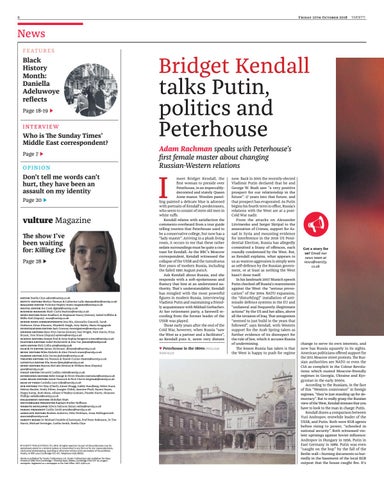
meet Bridget Kendall, the first woman to preside over Peterhouse, in an impeccablydecorated and stately Queen Anne manor. Wooden panelling painted a delicate blue is adorned with portraits of Kendall’s predecessors, who seem to consist of stern old men in white ruffs. Kendall relates with satisfaction the comments overheard from a tour guide telling tourists that Peterhouse used to be a conservative college, but now has a “lady master”. Arriving in a plush living room, it occurs to me that these rather sedate surroundings must be quite a contrast for Kendall. As the BBC’s Moscow correspondent, Kendall witnessed the collapse of the USSR and the tumultuous first years of modern Russia, including the failed 1991 August putsch. Ask Kendall about Russia, and she responds with a soft-spokenness and fluency that hint at an understated authority. That’s understandable; Kendall has mingled with the most powerful figures in modern Russia, interviewing Vladimir Putin and maintaining a friendly acquaintance with Mikhail Gorbachev. At her retirement party, a farewell recording from the former leader of the USSR was played. Those early years after the end of the Cold War, however, when Russia “saw the West as a partner and a facilitator”, as Kendall puts it, seem very distant ▼ Peterhouse in the 1800s (WILLIAM WINFIELD)
now. Back in 2001 the recently-elected Vladimir Putin declared that he and George W. Bush saw “a very positive prospect for our relationship in the future”. 17 years into that future, and that prospect has evaporated. As Putin begins his fourth term in office, Russia’s relations with the West are at a postCold War nadir. From the attacks on Alexander Litvinenko and Sergei Skripal to the annexation of Crimea, support for Assad in Syria and mounting evidence for interference in the 2016 US Presidential Election, Russia has allegedly committed a litany of offences, each roundly condemned by the West. But, as Kendall explains, what appears to us as wanton aggression is simply seen as self-defence by the Russian government, or at least as nothing the West hasn’t done itself. In his landmark 2007 Munich speech Putin checked off Russia’s resentments against the West: the “serious provocation” of the 2004 NATO expansion, the “disturb[ing]” installation of antimissile defence systems in the EU and “unilateral and frequently illegitimate actions” by the US and her allies, above all the invasion of Iraq. That antagonism “seemed to just build in the years that followed”, says Kendall, with Western support for the Arab Spring taken as further evidence of its disrespect for the rule of law, which it accuses Russia of undermining. The lesson Russia has taken is that the West is happy to push for regime
1979
Got a story for us? Email our news team at news@varsity. co.uk
change to serve its own interests, and now has Russia squarely in its sights. American politicians offered support for the 2011 Moscow street protests. The Russian authorities see NATO or even the CIA as complicit in the Colour Revolutions which ousted Moscow-friendly regimes in Georgia, Ukraine and Kyrgyzstan in the early 2000s. According to the Russians, in the face of this “Western connivance” in foreign regimes, “they’re just standing up for democracy”. But to really grasp the Russian view of the West, Kendall stresses that you have to look to the man in charge: Putin. Kendall draws a comparison between Yuri Andropov, erstwhile leader of the USSR, and Putin. Both were KGB agents before rising to power, “schooled in national security”. Both witnessed violent uprisings against Soviet influence: Andropov in Hungary in 1956, Putin in East Germany in 1989. Putin was even “caught on the hop” by the fall of the Berlin wall—burning documents so hurriedly in the basement of the local KGB outpost that the house caught fire. It’s