Friday 27th November 2015
19
News
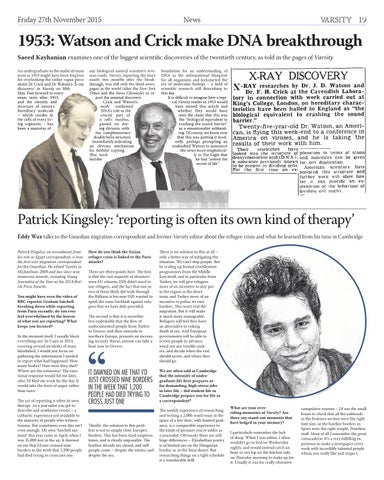
1953: Watson and Crick make DNA breakthrough Saeed Kayhanian examines one of the biggest scientific discoveries of the twentieth century, as told in the pages of Varsity any biological natural scientist’s revision cards. Varsity, reporting the story nearly two months after the breakthrough, was still only the third newspaper in the world (after the New York Times and the News Chronicle) to report the seminal discovery. Crick and Watson’s work confirmed DNA’s role as the crucial part of a cell’s nucleus, passed on during division, with the complementary double helix structure immediately indicating an obvious mechanism for faithful copying. This work laid the
MATERIAL SCIENTIST
An undergraduate in the midst of exam term in 1953 might have been forgiven for overlooking the rather vague piece about Dr Crick and Dr Watson’s ‘X-ray discovery’ in Varsity on 30th May. Fast forward to every exam term after 1953, and the identity and structure of nature’s hereditary molecule – which resides in the cells of every living organism – has been a mainstay of
foundation for an understanding of DNA as the informational blueprint for all organisms and kickstarted the era of molecular biology – a field of scientific research still flourishing to this day. It is difficult to imagine how a typical Varsity reader in 1953 would have viewed this article and whether they would have seen the claim that this was the “biological equivalent to crashing the sound barrier” as a sensationalist subheading. Of course, we know now that this was putting it modestly, perhaps prompting an unabashed Watson to announce the news more emphatically in The Eagle that he had “solved the secret of life”.
NATIONAL CANCER INSTITUTE
Patrick Kingsley: ‘reporting is often its own kind of therapy’ Eddy Wax talks to the Guardian migration correspondent and former Varsity editor about the refugee crisis and what he learned from his time in Cambridge Patrick Kingsley, on secondment from his role as Egypt correspondent, is now the first ever migration correspondent for the Guardian. He edited Varsity in Michaelmas 2008 and has since won numerous awards, including Young Journalist of the Year at the 2014 British Press Awards. You might have seen the video of BBC reporter Graham Satchell breaking down while reporting from Paris recently; do you ever feel overwhelmed by the horror of what you are reporting? What keeps you focused? In the moment itself, I usually block everything out. In Cairo in 2013, covering several incidents of mass bloodshed, I would just focus on gathering the information I needed to report what had happened. How many bodies? How were they shot? Where are the witnesses? The emotional response would hit me later, after I’d filed my work for the day. It would take the form of anger, rather than tears. The act of reporting is often its own therapy. As a journalist you get to describe and synthesise events – a cathartic experience not available to the majority of people who witness trauma. But sometimes even this isn’t even enough. My own ‘Satchell moment’ this year came in April, when I was 35,000 feet in the air. It dawned on me that I’d just crossed nine borders in the week that 1,200 people had died trying to cross just one.
How do you think the Syrian refugee crisis is linked to the Paris attacks? There are three points here. The first is that the vast majority of attackers were EU citizens; ISIS didn’t need to use refugees, and the fact that one or two of them likely did walk through the Balkans is because ISIS wanted to spark the same backlash against refugees that we have duly provided. The second is that it is nevertheless undeniable that the flow of undocumented people from Turkey to Greece, and then onwards to northern Europe, presents an increasing security threat; anyone can take a boat now to Greece.
IT DAWNED ON ME THAT I’D JUST CROSSED NINE BORDERS IN THE WEEK THAT 1,200 PEOPLE HAD DIED TRYING TO CROSS JUST ONE
Thirdly: the solution to this problem is not to simply close Europe’s borders. This has been tried umpteen times, and is clearly impossible. The borders already are closed, and still people come – despite the winter, and despite the sea.
There is no solution to this at all – only a better way of mitigating the situation. We can’t stop people. But by scaling up formal resettlement programmes from the Middle East itself, and in particular from Turkey, we will give refugees more of an incentive to stay put in the region in the shortterm, and Turkey more of an incentive to police its own borders. This won’t end the migration. But it will make it much more manageable. Refugees will feel they have an alternative to risking death at sea. And European governments will be able to screen people in advance, weed out any trouble-makers, and decide when the rest should arrive, and where they should go. We are often told at Cambridge that the intensity of undergraduate life here prepares us for demanding, high-stress jobs in later life – did student life in Cambridge prepare you for life as a correspondent? The weekly experience of researching and writing a 2,000-word essay in the space of a few days, with limited guidance, is a comparable experience to the kinds of pressure you’re under as a journalist. Obviously there are still huge differences – Elizabethan poetry is of limited use on the Hungarian border, or in the Sinai desert. But researching things on a tight schedule is a transferable skill.
S
What are your overriding memories of Varsity? Are there any stand-out moments that have lodged in your memory? I particularly remember the lack of sleep. When I was editor, I often wouldn’t go to bed on Wednesday nights, and would instead catch an hour or so’s kip on the kitchen sofa on Thursday morning to make up for it. Usually it was for really obsessive
A UR
A JM
AN KW
A
compulsive reasons – I’d use the small hours to check that all the subheads in the Features section were the right font size, or the hairline borders in Sport were the right weight. Pointless stuff. Most of all I remember the great camaraderie. It’s a very fulfilling experience to make a newspaper every week with incredibly talented people whom you really like and respect.