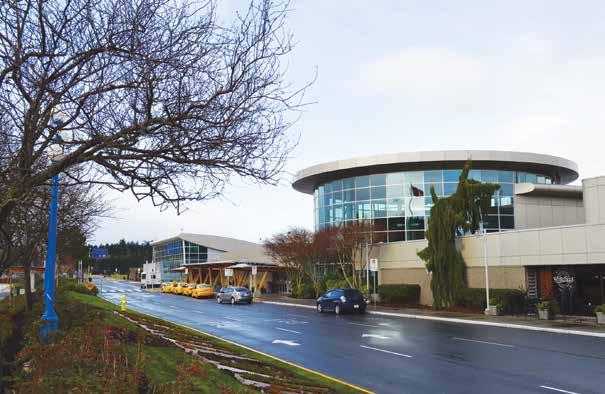
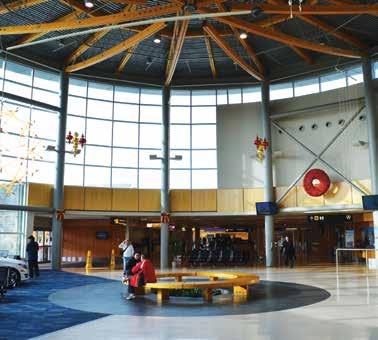
How the Victoria International Airport supports CONSTRUCTION, COMMUNITY, and BUSINESS
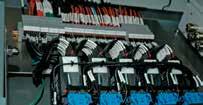
Sparks fly at award-winning John Hart Generating Station
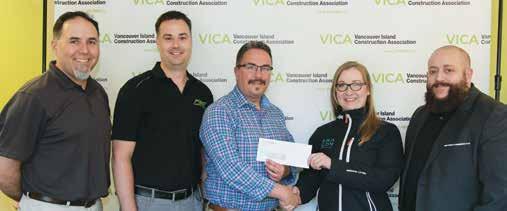
INDUSTRY COLLABORATION
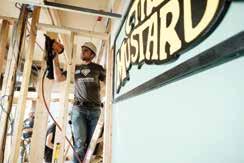
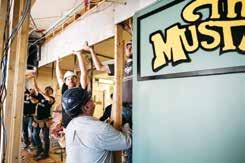
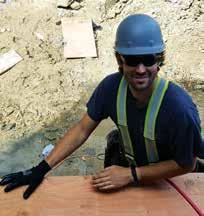
HeroWork team leaps into action with Mustard Seed Church Dignity Market project
Cover photo courtesy of
SINCE 1964, CAMPBELL CONSTRUCTION HAS BEEN MAKING VANCOUVER ISLAND
A FINER PLACE TO LIVE, WORK, LEARN AND PLAY. IN FACT THE HUNDREDS OF PROJECTS SUCCESFULLY COMPLETED BY OUR COMPANY FORM THE VERY HEART OF VIBRANT ISLAND COMMUNITIES.
•
•
•
250.475.1300
•
• PRIVATE RESIDENCES
• LIBRARIES
• WAREHOUSES
KELVIN ROAD | VICTORIA BC V8Z 1C4 | INFO@CAMPBELLCONSTRUCTION.CA
Camosun College is the largest trades educator on Vancouver Island providing excellence in foundation and apprenticeship training in:
• Automotive Service Tech
• Carpentry
• Electrical
• Fine Furniture
• Heavy Mechanical Trades
• Horticulture
• Nautical
• Plumbing & Pipe Trades
• Professional Cook
• Sheet Metal & Metal Fabrication
• Welding
Building on over 40 years of trades training experience, Camosun’s expanded capacity is great news for our region. Camosun will train over 2,200 trades and apprenticeship students each year in our new Centre for Trades Education and Innovation and the refurbished and expanded trades shops at the Interurban campus.
Whether you’re looking to hire new preapprentices or sending your apprentices for training, Camosun is here for you.
our Vision: To be a leading advocate and the premier member-based association serving the construction sector on Vancouver Island.
our Mission: Our mission is dedicated to promoting the interests of the Vancouver Island Construction Association’s members as it provides its members with exceptional services and benefits.
Guiding Principles: VICA’s actions and decisions will be guided by the following principles:
Member Value: We are committed to ensuring the services and activities of VICA directly support the well-being and success of our member companies.
Corporate Sustainability: We are committed to ensuring that VICA remains viable through a strong membership base that is reflected in both the quality of its membership and the number of members.
Financial Sustainability: We are committed to planning and managing our finances in a financially responsible and transparent manner while focusing on prudent investments that benefit our membership and corporate health.
Industry Advocacy: We are committed to act in the best interest of our members and the construction industry, its stakeholders and people, and to ensure our industry remains safe, resilient and sustainable.
The contents of this publication may not be reproduced by any means, in whole or in part, without prior written consent of the publisher.
Publications mail agreement #40934510
Return undeliverable Canadian addresses to: DEL Communications Inc. Suite 300, 6 Roslyn Road Winnipeg, MB R3L 0G5
Email: david@delcommunications.com
While every effort has been made to ensure the accuracy of the information contained in and the reliability of the source, the publisher and/or the Vancouver Island Construction Association in no way guarantees nor warrants the information and is not responsible for errors, omissions or statements made by advertisers. Opinions and recommendations made by contributors or advertisers are not necessarily those of the publisher, its directors, officers or employees.
prInted In CAnAdA | 05/2019
WHO WE ARE & WHAT WE DO
As the Vancouver Island Construction Association (VICA), we serve our construction community: the institutional, commercial, industrial, civil and multi-family residential construction sectors on Vancouver Island, the Gulf Islands and other coastal areas of British Columbia. With roots that date back to 1912, we're one of the oldest construction associations in Canada.
As leaders in the industry, we believe in collaborating, sharing knowledge and making it more profitable to do business on Vancouver Island. We do this through advocacy and representation on regional, provincial and national policy and regulatory issues, and through spearheading formal and informal dialogue with local governments and the construction community at large.
WE bElIEVE IN bUIlDING AN INDUSTRy FoR A STRoNG FUTURE.
At VICA, we value diversity within the construction sector and are proud to be the association of choice for 450-plus small and large companies from the southern tip of the island to the northern point. We are a community of skilled professionals — from owners, general contractors and trade contractors to manufacturers, suppliers and purchasers of construction services — looking to connect, grow, learn and save. Through our courses and workshops, events, conferences and our Under 40 (U40) and Women in Construction (WiC) networks, we bring the industry together to create business opportunities while promoting industry excellence.
INDUSTRy REPRESENTATIoN AND ADVoCACy ThAT SPANS CoAST To CoAST.
We are proud to be a part of the BC Construction Association (BCCA) and the Canadian Construction Association (CCA), giving our industry members a national voice on issues and opportunities that affect everyone in the construction sector.
The Vancouver Island Construction Association supports and promotes the principles of fair, open and transparent procurement processes. Guided by ethical standards and practices, we strive to foster growth and economic stability for our members across Vancouver Island, British Columbia and Canada. We share this vision with our regional, provincial and national partners.
A VICA MEMbERShIP IS MoRE ThAN jUST bEING PART oF AN ASSoCIATIoN.
To be a VICA member is to be a member of a diverse community that shares the same vision: to build up this dynamic industry we are all proud to be a part of. Our goal at the Vancouver Island Construction Association is to connect you with the training and education, project and business development opportunities and labour you need to grow your business while saving you time and money.
Our broad membership base — comprised of women, men, young and old — brings unique skills and experience to the workforce. By coming together, we form a collective voice while contributing to the thriving construction industry on Vancouver Island.
VICA connects you with a broad network of skilled professionals, provides you with industry-specific training and education, gives you access to project opportunities and business intelligence that create success. As your island association, we’re here to serve your needs of today and tomorrow so that you can prosper for years to come. Connect, grow, learn and save with us and the construction community of Vancouver Island.
CoNNECT WITh VICA
VICA events offer opportunities for you to expand your network, meet industry leaders and learn about issues and opportunities specific to the Vancouver Island construction sector. Our Capital Project Plan Series connects contractors with owners and offers business intelligence that is exclusive to VICA members.
Our Under 40 (U40) and Women in Construction (WiC) networks in Victoria and Nanaimo are our boots on the ground, so to speak. Through them, we promote and support the career paths of both young professionals and women looking to grow within the Island’s industry. Each network has a mandate of mentorship and community involvement, extending our reach beyond our industry.
GRoW WITh VICA
Companies large and small benefit from VICA's work in procurement and issues management, as they do with the project opportunities and bid results available through BidCentral. In addition to unparalleled, one-on-one support from our Project Services team, our members receive 24-7 access to project opportunities, a weekly project bulletin in their inbox, pre-bid notifications, downloadable plans and specs and more.
lEARN WITh VICA
VICA offers a robust training and education program fit for everyone in the construction industry, from seasoned project managers and estimators to new and aspiring leaders and administrative staff. Through online and classroom courses, we’re here to help you achieve your professional goals while obtaining your CPD Points and Gold Seal Credits. Every year, we add new courses and workshops to adapt to our industry’s needs. Grab a copy of our Training and Education Catalogue to get started!
We are also proud to be your resource for Vancouver Island construction industry data. Members have access to quarterly construction reports and regular construction sector business intelligence updates to keep you informed with industry data and trends. In 2018, we launched our PreBid Report. In 2019, we’re introducing a fresh look and feel to our quarterly reports!
SAVE WITh VICA
VICA has identified strategic partnerships that result in immediate savings for members, from discounts on office supplies and fuel to preferred pricing on hotels and flights. These savings add up quickly to benefit your bottom line; in many cases, covering a large portion of your membership investment. VICA members also enjoy complimentary statutory declaration services, significantly reducing lawyer and notary fees.
BCCA Employee Benefits provides VICA members with traditional group benefits, hour bank plans, executive reimbursement plans and critical illness insurance. Designed specifically for the construction industry, our benefits plan ensures that you’re taking care of your biggest asset: your employees.
Aa message from the VICa Ceo RORy KulmAlA
s a member-based organization, the Vancouver Island Construction Association (VICA) has served the construction industry for over 105 years. This makes VICA one of the oldest, if not the oldest, construction associations in Canada.
As I reflect on the century behind us — as an industry practitioner and now VICA’s CEO — there is one theme that continues to ring as true today as it did when we were first established in 1912: the outstanding work industry members do to build necessary infrastructure across Vancouver Island. From commercial offices to malls, universities to schools, multi-family homes to highways, airports and terminals, the hard-working men and women from our member companies continue to contribute to the Island’s growth.
From our humble beginnings as the Victoria Builders Exchange (VBE), located in Bastion Square, we became a venue for purchasers
of construction services to drop off building plans for contractors to view and prepare their bids; thus, the creation of the Plan Room
Since then, the VBE has undergone some significant changes to become the Vancouver Island Construction Association as we know it today.
A notable change came in 1970 when the Construction Association of Victoria (CAV) was created to address a changing political and economic era. CAV was designed to have influence with all levels of government, school boards, architects and engineers, and to build growth through membership. At this time, similar regional associations formed to advocate for the construction sector, while also providing a Plan Room to facilitate the bid process.
As the industry evolved, so too did the association and the Plan Room. In 2009, two years prior to the Mid Island Construction Association (MICA) and VICA merger, the Plan Room went digital. For members that used the physical Plan Room for business development, this change was rather unsettling. For VICA, this move was a game-changer as we shifted one of our core operations from the physical world into the digital realm. We continue to facilitate the bid process, in a much more modern way.
Today, VICA is uniquely positioned to encourage and facilitate cross-island communication and collaboration on key member and industry issues, while providing integrated member services, a full suite of relevant and accessible education programs, and regular networking opportunities. Couple this with our affiliations with the BC Construction Association (BCCA) and the Canadian Construction Association (CCA), and the reach and influence that we — and you, as industry members — have for addressing construction issues and opportunities is both broad and comprehensive. Recognizing that there are both provincial and national matters that impact our industry, we leverage our relationships with the BCCA to focus on matters of provincial jurisdiction and the CCA for those that are of a federal mandate.
Our mission at VICA has been, and will continue to be, dedicated to promoting the interests of all our members by providing exceptional services and benefits to ensure you can continue to serve the needs of our Island’s communities through much-needed infrastructure from the top to the bottom. Led by our guiding principles, as identified on our Vision and Mission page, we proudly represent and advocate for the construction industry of Vancouver Island. n
Buyers notice stylish natural gas appliances and will enjoy the comfort and energy efficiency of gas for years to come.
You’ll appreciate the valuable rebates we offer – plus, we’ll work with you every step of the way.
That’s energy at work.
Find an Energy Solutions Manager in your area at fortisbc.com/energyteam Connect with us
AA mEssAgE fROm THE cHAiR roger Yager,
VICe PresIdent, KnaPPett ProjeCts
s my term as the Chair of the VICA Board of Directors commences, having spent many years serving the membership as a director, I want to reflect on our recent history, our current state of affairs and our goals for the Association moving forward.
In the past couple of years, the Vancouver Island Construction Association has undergone a significant transition. Our previous long-serving CEO retired in 2017, and we hired an excellent replacement in Rory Kulmala. Our staff has become more secure despite having also dealt with the departure of Rosie Manhas, our unwavering Director of Operations who gracefully stepped into early “retirement” at the end of 2018.
Today, the Association is in a great position within the industry. Rory has been at the helm for two years and is hitting his stride working with a diverse set of members, tackling issues and opportunities as they arise and collaborating with
industry partners throughout British Columbia. The VICA staff is dedicated, continuing to provide excellent service and value to our membership. Through their efforts and resiliency in times of change, the Association has maintained a positive fiscal position while securing the role of the “go-to” advisor for industry issues by owners, consultants and local government. Vancouver Island’s construction community is experiencing one of the longest periods of significant activity and growth in all sectors and I expect this trend will continue for the next couple of years. It is in cycles like this that VICA members can and will prosper. All the while, we must be wary that this level of activity has a finite duration and plan accordingly for the future. It is important that our members are informed and resilient to not only the great opportunities that present themselves but the inevitable challenges that are an integral part of both a robust and weak economy.
As we face both increased activity and looming labour shortages, our focus must be on bringing youth and other underrepresented groups into the industry by making construction a career of choice. We also need to facilitate the training of our members’ existing staff and represent the best interests of our industry through advocacy work.
During this period of growth, we must also engage our members island-wide to ensure we are providing services that meet their ever-changing needs. Rory and the VICA staff have done an excellent job of engaging members through networking events and the U40 and WiC committees but there is room for improvement with our other committees and councils to extend our reach within the industry. My personal goal for the Association for the coming year is to increase this level of engagement — to help serve our members even better and to continue our trajectory of growth. n
ushering a new era of banking: credit union launches new design
By melanie Franner
The days of boring financial institutions may very well be behind us. On January 8, 2018, Coastal Community Credit Union (CCCU) unveiled what the future of banking could like at the official opening of their newest branch in Eagle Creek Village in View Royal. The 2,500-square-foot facility, in the mixed-use hub adjacent to Victoria General Hospital, has been designed to offer a more intimate and welcoming banking experience with the added benefits of the latest in banking technology.
“The branch was designed on the premise that we would move away from a transactional environment of teller lines to one that promotes conversation,” explains Kel Koutecky, senior manager, premises, CCCU. “We want to create an environment that encourages the development of more meaningful relationships with our members.”
TECh-SAVVy
The Eagle Creek Village location is the latest addition to CCCU’s growing list of 24 credit union branches throughout Vancouver
Island and the Gulf Islands. This full-service branch offers customized advice in personal and business banking, insurance and wealth management and innovative solutions that help members and clients improve their financial health.
“One of the more interesting features inherent in the new model is the replacement of traditional teller stations with defined areas,” says Koutecky. “We’ve incorporated Wi-Fi into the premises to provide our experts with the flexibility to move around the space more freely with their tablets, and still access the banking system.”
A series of smaller but still defined spaces are scattered throughout the open space, which is outfitted with a central concierge desk. “We’ve used acoustic insulation and barriers which provides a high level of privacy to our members and clients when meeting with our employees to discuss their financial and insurance needs,” adds Koutecky.
Another innovative element of the design is the interactive teller machine. The ITM operates as an ATM but also offers two-way video, which connects members to an expert based in CCCU’s Relationship
Centre in Nanaimo. It is through the ITM that they are able to provide extended hours of person-to-person banking.
The new banking model design is the collaboration of several CCCU stakeholders.
“The design was developed in conversation and co-operation from all levels of Coastal Community with a design committee comprised of representatives from our retail, insurance, wealth and commercial service departments,” states Koutecky. “Our premise department summarized the design committee’s wish list and consolidated them into a work-space plan, ready to send to the architect for the completion of construction drawings.”
INTo REAlITy
Raymond de Beeld Architect Inc. was the company charged with transforming the design layout into working construction drawings.
“We’ve done a few CCCU branches now,” says Raymond de Beeld, owner of the firm. “There has been a general progression over time. But this one is quite different.”
The architect’s initial reaction upon seeing the workspace plan was positive.
“The banking industry has been pretty stale,” he explains. “CCCU is pretty progressive in that regard so I was happy to see that they have progressed even further with this latest iteration.”
One of the more complex elements in the new design, according to de Beeld, was the floating ceiling. It called for the firm to source new lightweight materials. The same held true for the acoustic barriers.
“We had a bit of work to do but Kel played a key role in the project,” says de Beeld. “He was involved throughout so we can’t take all the
credit for it.”
Brenric Construction Ltd. handled the general contracting responsibilities for the new branch. It was their third project with the company, the first being a new build and the second a renovation.
“There were some similarities between the branches that we’ve worked on in the past, but each one is a bit of a different design to reflect the community and surrounding neighbourhood,” explains Jeff Mitchelmore, who was Brenric’s project manager for this job.
“This one was different in that it featured a vaulted ceiling with a lot of wood trellis detail. There was also a lot of millwork walls instead of conventional drywall walls, along with a rock wall. The other big difference was that there was no conventional T-bar ceiling area.”
Brenric Construction started on the project in mid-September 2017 and was done by the official opening in January 2018.
“Things ran fairly smoothly, thanks to our great team of subtrades and consultants,” says Mitchelmore. “But there was a lot of work that went into it from the wood trellis detail that required some structural upgrades to the roof, to the feature walls and built-in benches instead of conventional seating.”
The space has been designed to offer a more intimate and welcoming banking experience. The new design and added technological capabilities have received positive feedback from members so far, leading one to believe that visitors of the Eagle Creek Village branch may just be looking at the banking model of the future. n
Passive House: a glimpse of what’s to come
By melanie Franner
The building of the Nanaimo Passive House is a significant step on several fronts, not the least of which it is the first multi-family, affordable-housing certified Passive House facility in all of Canada. Passive House construction is slowly emerging as a potential building method of the future. It is reported to achieve 80 to 90 per cent energy savings over traditional construction methods.
FoRMIDAblE FIRST
The Nanaimo Passive House project called for the construction of three blocks of ground-oriented suites, arranged around an open courtyard. This enables all of the 25 suites to have cross-ventilation and solar access. The simplicity of the building system reduces maintenance costs and energy consumption.
The Nanaimo Passive House project was designed by DYS Architects for the Nanaimo Aboriginal Centre. It was funded by BC Housing, providing affordable suites for youth, elders and families of the local aboriginal community in Nanaimo.
Chris Beaton, executive director, Nanaimo Aboriginal Centre, cites average monthly energy costs in the building as not exceeding $20 month for a three-bedroom townhouse. The building also includes bachelor, one-bedroom and two-bedroom units.
“The decision to seek Passive House Certification was clientdriven,” explains Karl Binder, project manager, Saywell Contracting Ltd. “The client weighed the benefits of lowered maintenance and utility costs with the slight increase in construction costs. Other factors that were considered were the health benefits to the occupants; the total absence of natural gas to the site; being able to prove that affordable housing for families could be built to the higher standard; and ease of maintenance with the finished buildings.”
In preparation for the undertaking of its first Passive House project, Saywell’s superintendent completed the Passive House Tradesperson Training Course — Building Envelope Specialization at the BCIT High Performance Lab.
ThE DIFFERENCE IS IN ThE DETAIlS
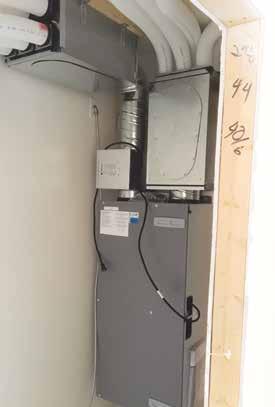
According to Binder, there are several key differences in this emerging type of construction. These include the use of two-by-four framing members for cost savings; the application of insulation on the outside of the building — to a reduced depth of 6-inch batt insulation; all air/vapour/moisture protection on the exterior of the framing (to allow for interior and exterior finishing to occur simultaneously and to reduce the potential for mold, mildew and rot); superinsulation of the foundation; heat recovery ventilators (to retain the gathered heat of the day, while bringing in a constant supply of fresh air at low volume); triple-paned, thermal gathering, over-insulated windows; and multiple pressure tests of the building to ensure air changes per hour were under the required threshold of 0.6ACH for Passive Certification).
Dean Doney, project manager, Waywest Mechanical Ltd., got to experience the differences in Passive House construction firsthand. The company’s scope for the project included the plumbing and HVAC.
“I think this is the direction that our industry is going,” states Doney. “I think the industry will eventually have to move toward a ‘pay-forward’ model, where the cost to build is a little more but the result is less of a burden on our resources.”
According to Doney, the notable difference in the plumbing was the use of Sanden split heat pump water heaters. This was complemented by low water-consumption and water-efficient fixtures.
On the HVAC side, Doney cites the use of plastic distribution piping — three iches in diameter — and a move away from the use of rigid 90-degree angles used in conventional construction.
“This allows the easy flow of air to each room for both heating and air exchange, which is very important when your building is air-tight,” he explains. “The HRV for this project was a Zehnder ComfoAir 200, one of the most efficient HRVs on the market.”
Doney adds that the smaller piping and use of the non-angular layout provides an inherent design for easy air flow without restrictions, which means increased air flow without the need for more power.
The electrical work for the Nanaimo Passive House building was awarded to Osprey Electric Ltd.
“We were tasked with the complete electrical component for the
project,” says Ken Kaktins, project manager, Osprey Electric. “The work was not too different from conventional projects; it was more a matter of the techniques that were used. For example, the project used heat pumps instead of conventional heating methods, like baseboard heating.”
One of the elements that did differ for the company, adds Kaktins, was that the floor systems were considered part of the building envelope.
“We had to mitigate the amount of penetration into the floor system as a result,” he says. “It took a bit more co-ordination but was easy to accommodate.”
Osprey had about four crew members on site for most of the job, supplementing them with another crew of that size when the work required it.
“I think that we will see more people moving towards this type of emerging construction,” notes Kaktins. “It is a new style right now but will eventually become the norm.”
AN ExAMPlE FoR All
/ Misc
(Seismic, Industrial,
Hoskins Pat Hoskins Pat Hoskins 1345 Fisher Road, Cobble Hill, BC V0R 1L0
COLIN MANN Cell: 250-857-0525 Evening Calls: 250-658-0284
“The building also became a teaching and touring site throughout the construction,” concludes Binder, who cites the visitors as including MPs, MLAs, mayors, city council members, Regional District of Nanaimo managers and inspectors, representatives from the Real Estate Board, architects, students and the heads of five indigenous housing corporations. “It was a very interesting project to work on — one that provided good learning opportunities and one that attracted a great deal of attention.” n 0827746 BC Ltd. (DBA)
DON MANN EXCAVATING LTD. Radio Dispatched Excavators Stoneslingers, Trucks & Backhoes www.donmann.com • Complete Subdivision Development • Rock Breaking • Equipment Rentals • Pipe Laying • Contract Management • Land Clearing • Demolition • Stoneslingers
construction claims: How to avoid common pitfalls
Acompany’s approach to construction claims management processes could have a dramatic effect on insurance costs. Insurers are increasing their focus towards insureds’ claims performance and a proactive approach to losses is crucial.
Insurers have always placed weight on a client’s claims experience as their insurance program approaches renewal. In particular, their large and complex claims record will be scrutinized. You need to demonstrate that losses, when they happen, are appropriately managed and lessons are learned.
STEPS To A SMooThER ClAIMS PRoCESS
In the event of a claim, contact your specialist construction broker as soon as possible. They’ll ensure your insurance carrier is notified, allowing you to maximize your settlement and finalize the claim in the most expedient manner. Consider the following:
1. UNDERSTAND yoUR CoVERAGE AND oblIGATIoNS
Putting effective plans into place now is the key to getting the payment you expect should the worst happen. Ask your construction broker for advice on development of claims protocols.
Claims protocols: It’s crucial to establish and document the process and responsibilities of all parties in the event of an incident or loss. Doing so will provide clarity and structure for those involved. Protocols normally cover the following: initial steps, the information that will be required, the means by which it will be gathered and documented and the individual responsible for these processes.
2. hAVE AN INTERNA l Sy STEM T h AT CAPTURES T h E DATA To SUPP o RT yo UR C l AIM
Businesses need systems in place that inform insurance managers of claims or related circumstances. Devise protocols for ensuring claims are reported to those individuals and that they are made aware of incidents.
You will have to provide evidence to support your claim to ensure all relevant information is collected and the initial actions do not prejudice your case. It’s best practice to ensure the insurance manager oversees all communications in relation to the loss.
Develop and deliver education programs around what is covered under the insurance program and what to do in the event of a claim. Making claims protocols easily accessible throughout the business will support your approach.
You need to be able to provide evidence of the claim effectively and efficiently. A defined data capture procedure eases this process. It will enable you to work with your broker, insurers, and appointed experts to help confirm the cause and quantum of any loss and to facilitate the payment process.
3. K N oW AND C o MP ly WIT h P ol ICy TERMS AND C o NDITI o NS , PARTICU l AR ly C l AIMS C o NDITI o NS
It is important to know the obligations you must comply with to avoid jeopardizing your right to recovery under a construction insurance policy. It’s vital that this is understood not only by your company’s insurance team but by those onsite who are likely to be the first responders.
Typically claims conditions will include:
• Your obligations regarding the notification of a claim
• Your obligations regarding the notification of a circumstance
• Time limits regarding the notification of claims or circumstances
• The nature of the information that must be provided
• To whom the notification must be given
• The insurers’ rights in respect of a claim
Note that all relevant provisions are clearly identified as Claims Conditions. Also, be aware that they might appear in other parts of the policy such as the Insuring Clause or the Definitions. Developing a compliant list of first actions for those on site - and making this information readily available - will help ensure your rights of recovery are not put at risk.
h oW A C o NSTRUCTI o N b R o KER CAN h E l P
Large and complex claims are rare, but having a process in place is a crucial element of managing construction risk. A mismanaged process could have a significant financial impact. Ensure your broker has the expertise needed to prepare and settle claims successfully. At JLT Canada, our team provides a seamless claims management system, including the coordination of insurers and loss adjusters, as well as access to a specialist team in the event of a major loss. Contact our construction team at ClientFirst@jltcanada.com for further information on our product and service offerings. n
Reducing the risk of serious injury in the construction industry
In British Columbia, about 160,000 workers earn their living in the construction industry, with sectors including general construction, heavy construction and road construction and maintenance. There are approximately 42,000 employers, with 90 per cent being small businesses. The industry has a serious injury rate three times higher than other industries in the province and last year, 7,723 workers were injured in the construction industry. Over 1,200 of those workers were injured in a fall from an elevation, many suffering serious, lifealtering injuries.
While much has been accomplished and much has improved in health and safety in construction work sites around the province, these numbers show us that there is still much more that needs to be done.
WoRKSAFEbC’S CoNSTRUCTIoN hIGh RISK STRATEGy
We work with employers and workers every day throughout the province to reduce workplace injuries and eliminate traumatic deaths caused by occupational diseases. In the construction industry, we are helping to reduce the serious injury rate through
the Construction High Risk Strategy — the implementation of risk-reduction tactics directed toward supervision and high-risk work activities that combine awareness, training, inspection, and enforcement.
The Construction High Risk Strategy identifies sectors and subsectors with a high risk of serious workplace injury and significant contribution to the serious injury rate.
AREAS oF FoCUS FoR 2019
Our three areas of focus for 2019 are: • Asbestos — residential and commercial:
Commonly used in homes and commercial building until the early 1990s, asbestos is the cause of the highest number of deaths in the construction industry. Workers exposed to it can develop and die from lung diseases such as asbestosis and mesothelioma. Workers exposed to asbestos three decades ago are showing the effects years later, and workers performing maintenance, repair, and renovation work today are also at risk.
• Falls from heights: Falls are a leading cause of serious injury in construction; including falls from ladders, scaffolding and other raised platforms. One of the areas of focus under this strategy is to help prevent falls from heights in residential construction where we are increasing awareness and education among residential prime contractors and general contractors around the proper installation and use of roof anchors.
• Crane operation: With approximately 250 tower cranes being operated in B.C.,
The industry has a serious injury rate three times higher than other industries in the province and last year, 7,723 workers were injured in the construction industry.
crane operators are working on sites that are becoming busier as the density of construction increases. Incidents involving cranes include contact with other cranes, with structures, and high-voltage overhead power lines. In addition, all repairs, modifications or upgrades must be approved by the original manufacturer or professional engineer, but this doesn't always happen.
BC Crane Safety has been working for two years on a new crane operator certification framework that includes being ISO 17024 certified. BC Crane Safety explains this change as the crane operator “right to title” and “right to practice.” The new BC Crane Safety crane operator certification framework will be fully implemented in 2020.
Our high-risk strategy enables us to
work with industry to help demonstrate the importance of employers’ and workers’ roles and responsibilities for workplace health and safety, specifically training and supervision and developing safe plans and procedures before beginning work.
Through industry partnerships with stakeholders such as the BC Association for Crane Safety and the BC Construction Safety Alliance, we are developing resources to support these initiatives. Inspections will focus on these areas, and prevention officers will provide guidance and recommendations for improving health and safety.
For more information on the Construction High-Risk Strategy, and to find resources to help reduce risk and injuries in construction, visit worksafebc. com/construction. n
Falls are a leading cause of injury on B.C. construction sites.
A new, improved, award-winning John Hart generating station
By Cindy Chan
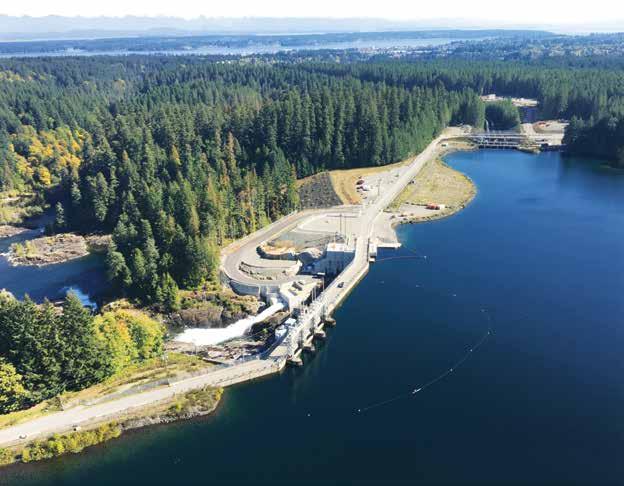
The John Hart Generating Station has had a well-deserved upgrade after many decades of service.
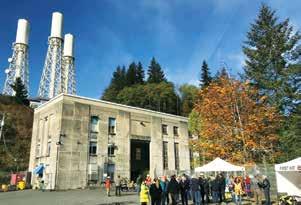
Operating since 1947, the existing John Hart Generating Station, based in Campbell River next to Elk Falls Provincial Park, has been completely
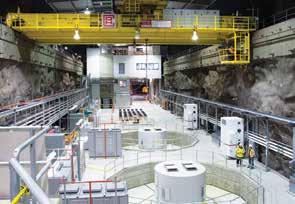
replaced with a new underground facility. The main components of the replacement project include a new, ten-storey underground generating station, constructed about 500-600 metres up the penstock corridor from the old powerhouse; a new 2.1 kilometre
underground tunnel system replacing three 1.8 kilometre woodstave/steel penstocks; a new water intake at the John Hart Spillway Dam; and a new water bypass facility within the powerhouse.
The John Hart Generating Station is one of three generating stations
near Campbell River. Combined, they generate and supply about 12 per cent of Vancouver Island’s peak electricity demand. With the new facility, residents are expected to experience increased capacity, reliable energy and improved environmental performance. The new facility will be able to provide power to approximately 80,000 Vancouver Island homes.
According to Shawn Crucil, COO of F&M Installations Inc. (FMI), the old facility has not yet been demolished.
“The old facility has roughly 1.8 kilometres of aboveground wood and steel penstock that runs down to an existing powerhouse with six generators,” Crucil says. “The powerhouse is along the edge of the Campbell River.”
In 2007, BC Hydro said the facility needed to be upgraded. Construction officially began on the $1.093-billion John Hart Generating Station Replacement Project in 2014. The new facility was operationally in service in November of 2018, with project completion just over a month later — it was reportedly on schedule and on budget. Decommissioning work to remove the old facility will run until summer 2019.
One of the major differences between the old facility and the new facility is that it went from aboveground to underground. According to Chad Saunders, the site manager for FMI for the John Hart Generating Station, the benefit of having an underground generating station is increasing the seismic capacity of the powerhouse.
PEOPLE, PRODUCTS, PRIDE SINCE 1905
550 Cuduthel Street
Victoria, BC V8Z 1G1
PH: 250-475-6272
FX: 250-475-6282
TF: 888-545-6111
927 Dunford Avenue
Victoria, BC V9B 2S4
PH: 250-391-3050
FX: 250-475-6200
TF: 866-551-6789
2350 Dorman Road
Nanaimo, BC V9S 5G2
PH: 250-751-2622
FX: 250-751-2621
TF: 877-751-2622
L40 portal face.
“People can expect a more reliable water management system for Campbell River,” Saunders says.
To date, FMI has worked 204,000 manhours with zero lost-time injuries and no recordable incidents, which is significant considering the complexity of the job. The overall project has exceeded 3.5 million person-hours of work without a losttime accident. A lot of the work occurred underground in a mine-like atmosphere, and some later tasks involved working in proximity to high-voltage equipment. FMI used specialized cable-pulling equipment to pull high-voltage cables from the substation to the powerhouse. This equipment included an advanced winch system with multiple shivs and rollers placed in strategic locations, therefore reducing installation time as well as manpower requirements for the task.
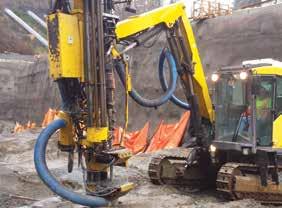
Western Grater installed rock support anchors and drilled and blasted surface rock on the first phase project. Dustin Krizsan, project manager at Western Grater, says Emil Anderson completed the surface blasting for the second phase of the project. However, they didn’t have underwater expertise like Western Grater, according to Jared Wells, Western Grater General Manager. Krizsan managed the first phase of surface blasting, which was required for excavation of the two adit ramp entrances necessary for subsequent tunnelling works, while Wells managed the underwater drilling and blasting portion at the intake plug blast at the end of the project.
“The tricky part was vibration control,” Wells says. “We were close to the old penstocks on the surface; they’re very old and they can’t experience too much vibration for risk of damaging them.”
Western Grater utilized cutting-edge technology for drilling and blasting, such as electronic detonators and specialized drill tooling, allowing for precise execution of the complex blasting plan required for this project. As a result, they successfully blasted two long, deep trenches with exacting backline control requirements. After the rock was blasted, they stabilized the backline with rock anchors.
“The industry leading explosives we employed were environmentally conscious and utilized the most current technology,” Wells says. “They let us be in complete control of our vibration.”
As John Hart Reservoir also serves as the drinking water for the City of Campbell River, environmental specifications were rigorous. It included a double silt curtain placed around the work area at the John Hart Dam and within the reservoir. Not
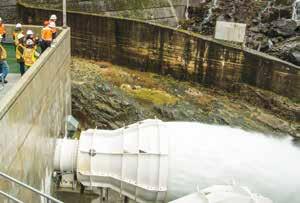
Low-level outlet works just downstream of the John Hart dam.
Drill, side view.
one water quality incident occurred. All equipment also had to be free of leaks as well as operating environmentally friendly lubricants.
The John Hart Generating Station won the Outstanding Project Award from the Canadian Hydropower Association for the John Hart Generating Station Replacement Project. The Tunnelling Association Canada also recognized John Hart as its Innovation Project of the Year. Saunders believes one of the reasons they received such accolades was the challenge of drilling from lakebed to powerhouse underground, as well as their commitment to being more environmentally friendly. Because the project is now underground, there is no need for the three penstocks and old station aboveground, turning the vacant space into a forest setting and therefore reducing the project’s environmental footprint.
“It just speaks to how well the project evolved since 2007 and how we consulted with First Nations and how we engaged the community,” Stephen Watson of BC Hydro, communications lead of the project, says. “Our contractor and their subcontractors did a great job. We peaked at 500 people working at the site in June 2017, and over 100 Vancouver Island companies worked as either a subcontractor, a supplier or a service provider. We’re all proud of the project. It’s safe and reliable, but also benefits the environment. To have the facility underground allows it to fit in with the aesthetics of Elk Falls Provincial Park.” n
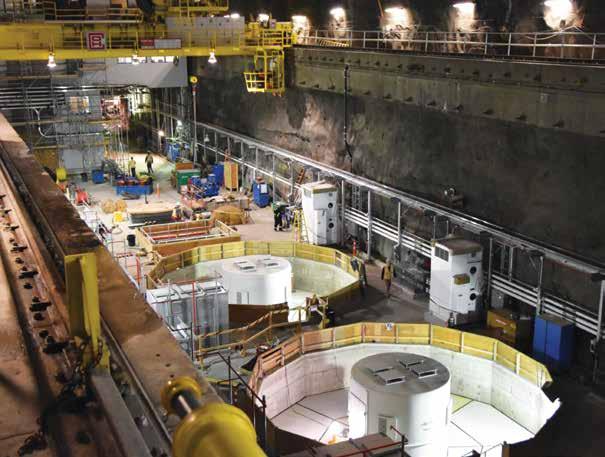
Underground powerhouse.
View of the new water intake works at the John Hart dam.
Weeding out the excess: The straight talk on cannabis
By melanie Franner
October 17, 2018 marked a very special occurrence in Canada. It was the day that cannabis became a legal substance. Many were expecting the sky to fall in as a result. In actual fact, the event proved to be a mere blip on the radar.
“I think we all thought it was going to be significant,” says Mike McKenna, executive director for the B.C. Construction Safety Alliance (BCCSA). “In reality though, it wasn’t such a big deal. There was this notion, as we were ramping up to the date, that we were going to see a huge influx of users. But it ended up that those who were using were still using, and those who weren’t didn’t make a beeline to get their supply.”
According to Tom Brocklehurst, director of prevention practices and quality at WorkSafeBC, the legalization of cannabis didn’t do much to change the status quo.
“The use of cannabis in the workplace isn’t new,” he says. “It has existed for quite some time, especially in B.C. There has been a noticeable increase in the use of cannabis in the last decade or so. And we know it’s present in the workplace.”
Dave Earle, president and CEO for B.C. Trucking Association, has years of experience in dealing with cannabis in his prior life as vice-president of human resources services in government relations with Construction Labour Relations and as an employer representative responsible for administering the Organized Sectors Substance Testing Program.
“One in five people in B.C. self-report on using cannabis at least once a month,” he says. “It’s one in seven for the rest of Canada. B.C. is the only province that has a higher use of cannabis than tobacco.”
WhAT NoW?
Although the legalization of cannabis makes it now legal to use recreationally, it is still banned from the workplace.
“We talk about cannabis in the workplace but we really need to talk about impairment,” says McKenna. “We should really be worried about how people present on site.”
McKenna compares cannabis use to alcohol use.
“We don’t tolerate an employee having alcohol over lunch,” he says. “And we won’t tolerate someone toking over lunch, particularly in this industry where safety is paramount.”
Earle concurs.
“In my opinion, we should be using the legalization of cannabis as an opportunity to engage employees about their responsibility to be ‘fit to work’,” he says. “The law requires employees to report impairment of any cause, be it from herbal remedies, alcohol, fatigue, etc. The law has been on the books for 20 years. It’s just that nobody has acted upon it.”
Earle states that the other part of this law requires an employer to be vigilant and inquire if there is any suspicion of employee impairment.
Although not new, this two-part law can be given new life by using the recent introduction of cannabis to engage employees.
“Don’t make it about cannabis,” advises Earle. “Talk about impairment in general. Construction is a high-risk environment. If someone is impaired, that person is a risk.”
Earle adds that employees need to know that they have a responsibility to be in fine form when they show up at work.
“It’s all about engaging our workforce,” he says. “This is where we need to focus our efforts.”
FIT To WoRK
As an employer, it is your responsibility to communicate your company’s guidelines.
Mike McKenna, ED, BCCSA
Arthur Chung, CEO, BCCA EBT
Dave Earle, CEO, BC Trucking Association
“Employers need good workplace policies and procedures around the issue of impairment,” says Brocklehurst. “They also need to ensure that employees are well-trained in them and that the policies and procedures are enforced.”
According to Brocklehurst, solid policies and procedures are also key to maintaining a safe workplace in a way that balances the need to take into account their workers’ legal rights, including their privacy or human rights.
Arthur Chung, CEO of B.C. Construction Association Employee Benefit Trust, can’t over-emphasize the importance of having these types of policies in place.
“The policies for cannabis should be similar to those that the employer has in place for alcohol and even prescription opioid use in the workplace,” he says. “It is really important that employers have specific policies in place, in the event someone is injured due to an impairment, so that a response can be dealt with appropriately.”
BUILDING SOMETHING BETTER
MNP Real Estate & Construction Services
At MNP, we believe in being your partner in business. That’s why more than 500 clients from all sectors of the real estate and construction industry on Vancouver Island rely on MNP for industry-specific expertise and services that go beyond traditional accounting and tax. Our team is dedicated to keeping a pulse on the issues that matter most to you and can assist with:
• Arranging equipment and project financing
• Due diligence for business acquisitions
• Indirect tax consulting (GST, PST, PTT)
• Technology reviews and software selection
• Succession and estate planning
• Structuring your real estate investments
• Hiring a controller or key manager
• Increasing the value of your business
We look forward to being your partner in business and having the opportunity to build something together you can truly be proud of.
Contact Doug Tyce, B.C. Leader, Real Estate and Construction Services, at 250.734.4368 or doug.tyce@mnp.ca.
The B.C. Construction Association Employee Benefit Trust recently put together a “Fit to Work” policy in conjunction with its Employee Handbook, not specifically to deal with cannabis but to create a more robust policy in general regarding an employee’s fitness to work.
“Some of the advice we provided was that the employer has a duty to accommodate, in the event of medicinal cannabis, but the employer also has a right or duty to inquire if necessary,” says Chung. “It’s just like if someone is off on disability. You have a right, as an employer, to inquire so that your operations are not disrupted, and contingencies are in place for business continuity.”
So, if and when an employee selfreports impairment, what can an employer do?
“What steps you take and how you implement them is up to how you handle your workforce,” explains Brocklehurst. “And that should be based on your employee policies and procedures manual.”
hElP AVAIlAblE
In response to the growing interest in the legalization of cannabis — and the ensuing opportunity to engage people in the issue of impairment — VICA has partnered with Cannabis Learning Series (CLS).
CLS is a pre-packaged, turn-key, learning and education system that will provide everything you need to effectively roll out a cannabis awareness campaign across your entire organization. It easily integrates existing guidelines and will help to inform updates to your drug and alcohol policy.
CLS is available in three different packages for the construction industry — managers and supervisors, employees, and fit-for-duty training.
“My hope is that we use the legalization of cannabis toward making progress on the issue of impairment,” concludes Brocklehurst. “Before this, cannabis was illegal. Now, it’s legal. Let’s use this as an opportunity to bring everything above board and to bring the issue of impairment out into the open.” n
APEX STEEL & GAS LTD.
534
Butler Brothers Supplies Ltd. is a family run company that has been supplying South Vancouver Island with building supplies since the early 1930’s, along with Ready-Mix Concrete since the 1950’s. Today our focus is primarily on concrete, sand and gravel supply. We currently operate 3 gravel pits, alongside 3 concrete batch plants, with a large fleet of concrete trucks for prompt delivery. Today we are capable of supplying all 13 municipalities and the outlying areas of the CRD also extending our service over the Malahat and into the CVRD. We have a large portfolio of mixes designed to meet your project’s needs along with a wide variety of washed or crushed sands and stone.
snaw-naw-as marketplace: Nanoose first Nation’s first major commercial project
By Samantha Sommerfield
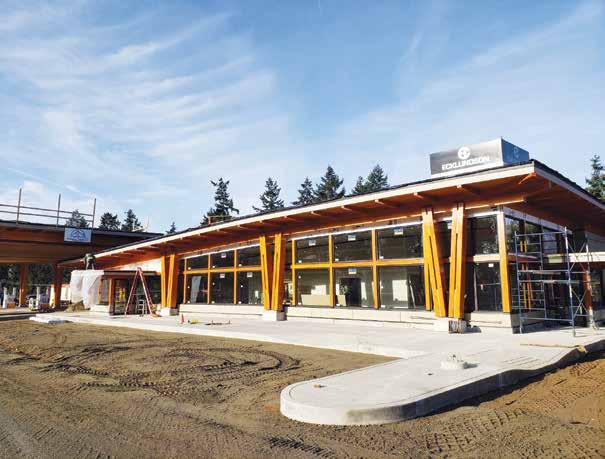
The first shovel broke soil in May of 2018 to start construction of Nanoose First Nation’s first major commercial project, the SnawNaw-As Marketplace. However, even though construction just started, this project has been a vision for many years for the Nanoose First Nation.
“We had an official ground-breaking ceremony at the start of the project. There was an impressive turnout from the community; it was quite the eyeopener,” says Drew Fisher of Ecklundson Construction Ltd. “We are dealing with an ownership group who is very
invested in the project and organized. It feels good to see their response as things start coming together.”
The team joining Ecklundson in the project has become an effective group consisting of Nanoose Economic Development Corporation, Snaw-NawAs First Nation, Iredale Architecture, Fraser Wood Industries, Fenrick Construction, Osprey Electric, Western Oil Services, Corgan Mechanical, Atlas Truss, Insulpro Insulation, McGregor & Thompson Hardware, Mid Island Glass, Van Berg Painting, AME Consulting Group, McElhanney, Muir Engineering
and AME Consulting Group.
“Getting to work with this group has been very rewarding. For Snaw-Naw-As, it has been 25 years of getting things in motion, so to see it happening and be able to play a role is great,” says Fisher.
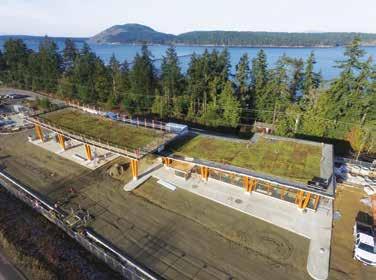
The Snaw-Naw-As Marketplace is located on a main transportation vessel in the community, and is something that will positively represent the community, and will cater to upwards of 30,000 motorists who pass by every day. It will provide motorists a stop that includes shopping, a restaurant, gas fillup, electric vehicle charging, pumpout for RVs and
outdoor seating with a children’s play area next to the restaurant. With such a high-profile area, and something for every motorist passing by, a main goal of this project was to complement the natural surrounding area.
Some of the ways to achieve this natural “West Coast” look was by utilizing a lot of wood in the project. The project team was able to design a clean look through Pitzl fasteners and the use of 3D modelling and precision cutting with a CNC machine.
“The original design had a lot of steel that was exposed at the wood connections, so if you can imagine a window wall, each individual section would have had four big black steel brackets,” says Fisher. “We thought we could find some efficiencies here with the Pitzl connections. So now it reflects that clean wood line for that overall “West Coast” look.”
The Pitzl connections are two-part anodized aluminum connections that work by being fastened to the end of each member you are working with, and then allow for the members to slide in with typical “male and female” piece. They go together similar to how a dove-tail joint would. This creates a clean appearance with all hidden connections.
Making the connections seamless was one way to achieve the “West Coast” feel to the building, but to make sure the design and unique aspects to the building had a smooth installation the use of the 3D modelling and precision cutting with a CNC machine proved to be beneficial.
“The entire structure was shop fabricated by Fraserwood Industries. We 3D-modelled the entire project so we were able to see how different members were going to interact with one another. Then the package was cut and detailed by using a CNC machine,” says Fisher. “It was basically created in a controlled area, so when the pieces show up on site they are able to get sorted off the truck immediately and get placed properly without any worry of being a fraction of an inch off.”
On the surface, innovative technology
was used to achieve the overall look and feel of the building. This continued below the surface with a different approach to the project’s gas pumps, with the goal being to save on cost without losing any quality.
“We asked on many projects to look for those cost savings approaches in partnership with consulting team without losing design intent, and we were able to get them the same product but with a slightly different approach,” says Tyler Cody, general manager at Osprey Electric. “It is definitely going to be the most beautiful gas station on the island. It is
pretty impressive.”
Overall, not only has the Snaw-Naw-As Marketplace been an important piece of continuing the trend of thinking in an innovative way within the construction industry, but also, it’s innovative for the surrounding community.
“This has been an investment for the Snaw-Naw-As First Nation,” says Fisher. “This is their corner piece and a keystone project to their economic development and something that Ecklundson is very proud to be a part of.” n
Imagine yourself facing criminal charges and the stigma of a criminal conviction, or serving jail time and paying a hefty fine. Could you have done something differently to avoid such consequences?
This article chronicles five decisions where criminal convictions were handed down for workplace accidents since a broader regime of criminal liability under the Criminal Code was brought into force in 2004. The operation of the Criminal Code is independent of provincial regulatory schemes for occupational health and safety. Therefore, an organization may be prosecuted under the Criminal Code while also being charged for a violation of British Columbia's Occupational Health and Safety Regulation
Prior to the enactment of the 2004 amendments to the Criminal Code, corporate criminal liability had to be established through the actions or omissions of the corporation's directing minds (i.e. policymakers). This made it difficult to successfully prosecute in circumstances where operational decisions were to blame. The 2004 Criminal Code amendments sought to address these shortcomings by providing new rules for attributing criminal liability to organizations, their representatives and those who direct the work of others. The impetus for these changes was the 1992 Westray coal mine accident in Nova Scotia where 26 miners were killed by a methane gas explosion. Despite serious safety violations and employee concerns, the owners of the Westray mine failed to implement changes. The operating philosophy throughout the company
prioritized profits over workers' safety. Notwithstanding the apparent culpability of the owner, Westray was acquitted of all criminal charges and prosecution of its managers was ultimately abandoned.
The central sections of the Criminal Code that are now used to find criminal liability for workplace accidents are Section 219 and Section 217.1, which operate together to overcome the limitations of the former legislation. Section 219 establishes the offence of criminal negligence by providing that "everyone is criminally negligent who, in omitting to do anything that is his duty to do, shows wanton and reckless disregard for the lives or safety of others", whereas Section 217.1 establishes the duty of care by requiring that "everyone who undertakes, or has the authority, to direct how another person does work or performs a task is under a legal duty to take reasonable steps to prevent bodily harm to that person, or any other person, arising from that work or task". If convicted, corporations and their representatives may face hefty fines while representatives may also be subject to imprisonment. A conviction of criminal negligence causing death faces a maximum sentence of life in prison.
The 2008 decision in R. v. Transpavé i Inc. marks the first time that a sentence was handed down under the new Criminal Code provisions. In this case, a 23-year worker was fatally crushed as he tried to clear a pileup of stones on Transpavé’s production line. The machine being used was equipped with a safety mechanism intended to prevent this very sort of accident; however, the motion detector for the safety switch had been turned off. The company pleaded guilty and was
sentenced to a fine of $100,000. In settling on a seemingly low fine, the judge observed that since the accident Transpavé had spent more than $750,000 to upgrade safety standards and make other health and safety improvements.
Another early case tried under the new provisions is R v. Metron Construction Corp. ii This case involved the death of four workers and injuries to another worker after all of them fell over 30 metres when a swing stage they were riding collapsed while being lowered from a high-rise construction site. The swing stage was equipped with two safety harnesses, although only one of the workers was properly tethered. The company pleaded guilty to one count of criminal negligence causing death and was sentenced to a fine of $200,000, which was later increased to $750,000 on appealiii by the Crown.
By a separate actioniv, Metron's project manager, Vadim Kazenelson, was charged with four counts of criminal negligence causing death and one count of criminal negligence causing bodily injury. At trial, the judge found that Mr. Kazenelson had the authority to direct the workers on the swing stage and knew beforehand that safety harnesses were not available yet did nothing to rectify that situation. He had also permitted the workers, and himself, to board the swing stage even though he had no information regarding its load capacity. The court determined that Mr. Kazenelson had breached his duty to take reasonable steps to prevent bodily harm to the workers and was charged under section 219 of the Criminal Code and sentenced to three and a half years in prison. Mr. Kazenelson's appeal of the jail sentence was dismissed.
In 2016, a B.C. employer was found guilty of criminal negligence causing death and sentenced to pay a fine of $100,000. In R. v. Stave Lake Quarries Inc.v , Kelsey Kristian was killed on her second day of employment with Stave Lake Quarries ("SLQ"). She was given a brief orientation of the rock quarry and cursory instruction on the use and operation of a rock quarry haul truck of which she had no previous training or experience in operating. No additional safety training or supervision was provided. During a break in activity, Ms. Kristian turned off and parked the truck near the top of a slope. She did not engage the parking brake nor chock the tires (none were provided in the truck). The truck remained in its position on the slope until its air brakes had bled down to a level that caused the truck to start rolling. Ms. Kristian was standing on the truck's running board at the time and was fatally crushed when the rock hauler lost control and rolled over. SLQ acknowledged its lack of a formalized training system and its failure to provide training and supervision to Ms. Kristian. In addition to providing a general deterrence, the court’s sentencing of SLQ was intended to deter both SLQ and others from conducting unsafe practices and to not be seen simply as the "cost of doing business".
Most recently in R. v. Fourniervi, the owner and operator of an excavation company in Quebec was convicted of manslaughter for failing to protect the health and safety of his workers. Mr. Fournier had been working with his employee, Mr. Levesque, on a sewer line replacement within an eight-metre deep, near-vertical trench that had not been properly shored. Additionally, the soil excavated from the trench was stockpiled too close to the trench opening, further causing instability to its walls. These factors caused the trench to collapse, burying Mr. Levesque and partially burying Mr. Fournier. Mr. Fournier was injured but survived. Mr. Levesque suffered a traumatic brain injury that ultimately led to his death. Mr. Fournier was charged with both criminal negligence causing death and manslaughter. He was convicted of the more serious charge of manslaughter and
was later sentenced to serve 18 months in jail and two years of probation after the prison term expires.
The impacts of a serious workplace accident are far reaching. The changes to the Criminal Code that have more easily enabled convictions for workplace injury are relatively recent but are be putting to use. As the cases discussed here show, a corporate culture that fails to prioritize workplace safety or to implement rigorous systems for hiring, training and supervision can no longer take refuge behind legislative shortcomings.
AboUT
Sonia Sahota, LLB, P.Eng, is a partner at Civic Legal LLP, a British Columbia law firm with expertise in municipal law, land development, construction, procurement and complicated contract matters. Visit www.civiclegal.ca for contact and additional information. n
i 2008 QCCQ 1598
ii 2012 ONCJ 506 (CanLII)
iii 2013 ONCA 541 (CanLII)
iv 2015 ONSC 3639 (CanLII)
v 2016 BCPC 377 (CanLII)
vi 2018 QCCQ 1071 (CanLII)
Procurement
team of collaborative lawyers combining legal experience in commercial real estate, construction and local government law to provide owners, builders and developers with focussed legal services to guide their projects, from concept to completion.
cameo: A star cinema sequel
A small-town movie theatre is redesigned into a six-storey, multi-unit development
By Samantha Sommerfield
For those who grew up in the Saanich Peninsula, a lot of fond memories may revolve around Star Cinema: a local movie theatre in small-town Sidney by the Sea. This independent theatre has been a staple of the area since the mid-1990s. As the years pass in the developing neighbourhood, it continues to hold its ground — literally. Community movie theatres that have a strong support behind them are a rare find these days, and this one is something the locals are deeply proud to have and hold within their community.
“It’s one of those things where the people who work there have worked there forever, and people stop in just to chat and
say hello. It’s almost a hybrid between a movie theatre and a hangout place,” says Margie Shenduk, director of operations at Casman Properties. “There is a certain draw to this theatre that the people who live here have. Even people who grew up in this area and moved away will make the drive to bring their children here to watch a movie, because of that nostalgia.”
So, when the land was bought by Casman Properties to start construction of the Cameo development, a deal needed to be agreed upon — purchase this land with the caveat that the theatre needs to stay. It was then that the Cameo development became an even more interesting project.
“Everything about this building is
unique,” says Shenduk.
The building breakdown starts at the main floor with the much-admired Star Cinema and two commercial spaces. As you ascend the six-storey building, you will soon find condominiums that cater to a variety of residents from micro-suites and one-bedroom units to moderatelysized two-and three-bedroom units and luxury penthouses.
“You could have multiple demographics of people who will coexist in this building, but other than riding the elevator together they won’t notice or hear each other very much in their day to day,” says Shenduk.
To break up those demographics within a single building posed an interesting
design and structural challenge. However, since inception there has been nothing cookie-cutter about this building.
“We had to actually approach many experts to see how to go about certain things, and it forced us to get creative. You can’t build a condo building with the same rules that apply to a movie theatre and we can’t build a movie theatre with the same rules that apply to a condo building,” says Shenduk.
One of those consultants was RJC Engineers.
“What is unique about this project is the need for a mix of different unit types. Unlike a typical five- or six-storey woodframe building where you have the same unit type throughout, this building steps back quite a bit,” says Cameron Marshall, project engineer at RJC Engineers. “It was a very challenging wood frame to work on,
as we had limited opportunity to provide an efficient seismic system, with shear walls aligning through the building.”
To help with this challenge, they used a high-performance acoustic floor assembly system in lieu of a more traditional concrete topping; at six storeys, the weight of concrete would be too much for the Cameo.
“We have done this on a few projects where instead of using concrete toppings we would use an acoustic mat which would reduce the weight of the woodframe portion of the building by 30 to 40 per cent,” says Marshall. “This reduces the seismic loads considerably, and also reduces the weight of building supported by the level-two suspended slab.”
The RJC team had to think unconventionally as they explored design options that would reduce weight while maintaining the integrity of the wide-
The community of Sidney is an absolute gem of Canada that I don’t think a lot of people know about.
open space that a movie theatre requires.
“I’m amazed by the team and the coordination that happened. It was a fun design challenge, and I am really happy with where it is right now,” says Marshall. It is widely known that every project comes with its own set of challenges. As with the case of the Cameo development, the solution will always present itself if put in the hands of the right team. To bring attainable housing to the community of Sidney while reinvigorating the local theatre, Casman Properties knew that an innovative approach was needed to help keep memories of the Star Cinema living on for generations to come.
“The community of Sidney is an absolute gem of Canada that I don’t think a lot of people know about. When you are there you realize its beauty and accessibility,” says Shenduk. “I am excited to be a part of the energy in that town. It is going through a shift and we were able to bring a new, high-quality building in but still respect that town charm that they love.” n
making the most out of modulars
Modular construction is quickly gaining traction on Vancouver Island — but what is it and why is it so popular?
Modular construction, according to modular.org, is a “process in which a building is constructed off-site, under controlled plant conditions, using the same materials and designing to the same codes and standards as conventionally built facilities — but in about half the time.” Buildings are “produced in ‘modules’ that, when put together on site, reflect the identical design intent and specifications of the most sophisticated site-built facility.”
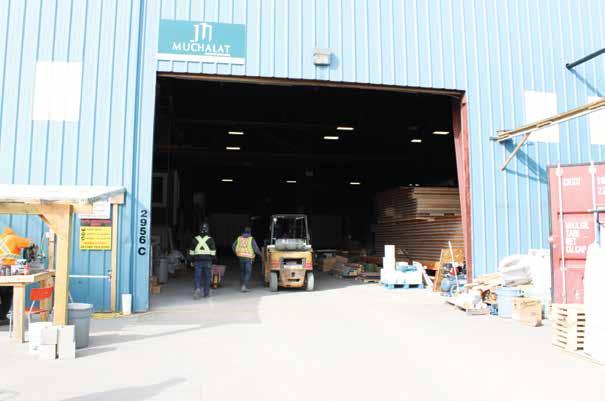
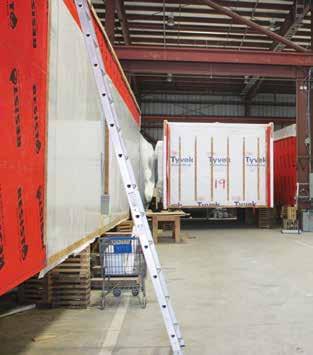
Muchalat Group of Companies, located in the Comox Valley on Vancouver Island, offers construction management services for commercial and multi-family residential construction, as well as suspended slab application, seismic upgrades, and building envelope remediation. While they’re reputable on many fronts, they’re widely known for their Modular Factory, which is where we’re told the magic really happens.
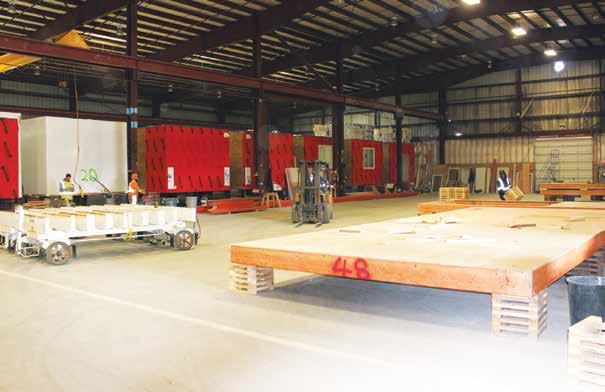
The Factory, located at 2956 Ulverston Avenue in Cumberland, is where Muchalat’s modular units are constructed, painted, tiled and finished. According to Tania Formosa, co-owner of Muchalat, the Factory is a one-acre building with three bays in
which modular units are constructed for various projects across the Island. Once complete, they simply need to be attached and installed to the foundation and utilities on site.
“Because we build them to transport, they can withstand movement and are very structurally sound,” says Formosa.
Once the modular units are installed, it is hard to tell that they are, in fact, modulars because they make seamless transitions into their environments, she adds.
“Our modulars are made of wood-frame construction. The exteriors can be a hardy plank or hard metal siding. It can be made of anything, but we design them so that it doesn’t look like we put it on a site and slapped it together — because we didn’t,” says Formosa.
She adds that modulars are just as good as, if not better than, traditional builds in terms of durability and process.
“Everything is built in a dry environment, which works well in our area because we live in a rainforest,” Formosa says. “Our materials never get wet so we can move forward without being delayed due to weather restrictions.”
Another reason why modular construction is being touted as an effective modern-day building method is the shorter project schedules due to the work occurring in one location —
supported by the lack of weather-related delays. This also allows for less traffic disruption.
“It eliminates a lot of the pressure on local roads. We have less people on site for a shorter duration, so we’re not interrupting the roads as much,” Formosa says. “As a result, there’s less driving around, which is more environmentally friendly.”
One of Muchalat’s recent projects, the Port Alberni Shelter, was built using modular construction methods. The shelter is a 29,500-square-foot, wood-frame construction facility with 30 supportive housing units and 20 shelter spaces. It stands three stories tall on the former site of the West Coast General Hospital. Our Home on 8th, as it is known, officially opened its doors on March 1, 2019.
Formosa says the shelter will include men’s, women’s and gender-neutral sleeping units.
“They have a commercial kitchen, dining room, multipurpose rooms and a lounge space downstairs,” Formosa adds. “There are also administration office spaces, medical treatment rooms and counselling rooms.”
The $7.4-million modular project was provincially funded and will support those in the surrounding area experiencing homelessness. The Vancouver Island Health Authority owns the land and has leased the site to BC Housing to support the supportive housing initiative, which is much-needed according to numbers released in a province-wide homeless count. n
Waste not, want not: Why lean and Bim are needed in construction
By Cindy Chan
When in the middle of a project, nothing is more frustrating than unexpected bumps in the road. However, Lean and Building Information Modeling (BIM) are principles and ideas that aim to reduce the amount of wasted time and energy in the construction industry.
According to leanipd.com, Lean Integrated Project Delivery “combines lean management principles with a collaborative aligned team and contract structure to improve the outcome of construction projects.” Lean itself is the process of eliminating waste from the manufacturing process.
“Lean first came into play as a method from the manufacturing industry to increase efficiency and decrease waste,” Keir Lewis, owner of Lewis Sheet Metal,
says. According to Lewis, the eight wastes in manufacturing are overproduction, over-processing, excess inventory, defects, transportation, wasted motion, waiting time and unused employee genius. However, the two that occur most in construction are wasted motion and waiting time.
“When you look at a construction job site, you would find the average construction worker is doing the work they’re supposed to be accomplishing 37 per cent of the time,” Lewis says. “The rest of the time is not necessarily purposely wasting time, but they are spending that time looking for the things they need to do their job — the power tool, the key to the job box, etc. There’s a lot of walking and wandering and trying to assemble all those things needed for a construction worker to
just do their job. Our focus is to try to get rid of that so the productive work can flow.”
“The construction industry is an incredibly wasteful one in general,” Gavin Chamberlain, owner and operator of Heritage Masonry Limited, says. “Lean, to me, is all about efficiency.”
For Chamberlain, he and his team often employ the pull planning method, one of the principles of Lean, in their work. Pull planning involves working from a target completion date backwards. This way, tasks are already predetermined, defined and sequenced.
“We would find out when the project would need to be completed by, then figure out how many weeks it will take to be completed, where the materials will come from and so on,” Chamberlain explains.
Heritage Masonry also uses Lean by keeping an organized yard. Every piece of equipment is assigned a proper place, so when someone needs to use a tool, they need to sign it out by recording their name, date and the job site to which they are taking the tool. Afterwards, the tool needs to be returned in its original location as recorded.
“We also have an ordering system that requires all materials that are required for the whole project need to be delivered and on site before the project starts,” Chamberlain adds.
Chamberlain attended the Vancouver Island Construction Association (VICA) Lean Bootcamp workshop in the late fall of 2018. Chamberlain recalls one exercise in which he and the other participants built a house out of building blocks.
Lean first came into play as a method from the manufacturing industry to increase efficiency and decrease waste
“We did it with the same level of organization as a general job site might have. We had deadlines and penalty clauses for errors. We did a horrible job!” he says. “Then we learned all these processes and did the same exercise with the proper scheduling and organization. I think we were 75 per cent better and quicker.” The next VICA Lean Project Delivery Bootcamp is taking place May 14, 2019.
BIM is another method of reducing wasted time and materials. Lewis says BIM involves drawing everything in a 3D virtual environment before building and installing.
“It’s something that’s near and dear to me as a ventilation contractor, because the product that I have to install in a building is large and cumbersome,” Lewis says, adding Lewis Sheet Metal is the only sheet metal company on Vancouver Island that uses BIM.
“BIM is helping us plan better,” Lewis adds. “There’s a lot of co-ordination involved. ‘This is how big the duct is. There’s no way to make it any flatter. How will we twist it around that beam and still have your ceiling height?’ We have many conversations like that.”
On several recent projects, Lewis says he and his team installed hangars in the building before concrete was poured. They placed little nailed-down inserts before pouring concrete, and they used their 3D model to locate them.
“We have a robotic total station that translates a point file that comes from the model. Those points are then located in real space on the deck. Once it’s been given its gridline, it extrapolates every point on the deck — very quickly,” Lewis explains. “Once the initial setup is done,
it quickly goes from point to point. You just keep hitting ‘next’ and it gives you the next one. The advantage of it is that you reserve your spot. Other trades are able to see where we plan to be before we pour the concrete.”
BIM is still not widely used and accepted by most of the construction industry, but Lewis has fully embraced the concept.
“I love the idea of figuring out all the issues with a job earlier,” he says. “There are always co-ordination issues with every job before we actually go to build. There is nothing more satisfying than preplanning and pre-coordinating a job so well that the installation just flows, with no mistakes, and no interruptions. That’s what I’m passionate about. That’s what’s driven me to go about it this way.” n
5 drills working to accelerate schedule for completion of the Eastern
raising the roof at 1515 Douglas street
By Cindy Chan
Enviable views, thoughtful architecture and urban design — 1515 Douglas Street has all of that and more.
Located in Victoria, B.C. across from Victoria City Hall, this new commercial build consists of two parts, a 13-storey building tower in the back and a six-storey low-rise building in the front, all sitting on a shared parkade. Kevin Bisgrove, senior estimator and project manager for Campbell Construction, adds that there are two levels of underground parking.
Construction on the 111,428-squarefoot building began in June of 2015 and wrapped up in February 2018. The tower in
the back consists of a fitness facility in the parkade, bike storage areas and some CRU spaces, as well as a lobby with a security desk and feature elevator lobby.
“From there, heading up the tower, there are two fully glazed glass elevators from which you can look across the city,” Bisgrove explains. “The building has five elevators in total, and two are the feature elevators, while the others are the grate elevator and two passenger elevators.”
Levels two to 13 in the tower are BCIMC (British Columbia Investment Management Corporation) offices. Bisgrove says the seventh floor has an amenity patio.
Meanwhile, the low-rise building
showcases the rotunda area — the crown jewel of the whole project. The 20-metre, atrium roof structure is seven storeys off the ground floor, consisting of six radial boomerang-shaped glulam beam columns, connected by a three-metre steel ring beam in the centre, with 30-millimetre tension rods below each one.
“There was a desire for the structure to have depth to optimize the relationship between the rotunda and its height,” Bruce Johnson, managing director for RJC Engineers, says. Johnson adds he and the architect considered various options for the rotunda. “There are three scale models in my basement, and we chose the one
which minimized materials and optimizes sunlight.”
“I think the roof structure is a showcase for the city of Victoria,” Bisgrove adds. “It’s a very unique building in terms of its aesthetic. You don’t see too many buildings with the same caliber.”
In addition to the unique rotunda roof, Bisgrove says another feature that separates 1515 Douglas Street from other buildings is the radiant panel heating system. The radiant ceiling panels were brought from Italy.
“Water runs through them, and we get both heating and cooling,” Bisgrove says, adding 1515 Douglas Street is the second building in British Columbia to include this feature. “That was one of the biggest challenges on the job — getting all the components and pieces on time from Europe.”
The first floor of the building includes retail spaces, a restaurant, a coffee shop and a security desk. Commercial tenants, many of whom are from the technology sector, occupy each floor upwards from that point.
Western Grater drilled and blasted approximately 24,000 cubic metres of urban bedrock for the underground parkade, according to Jared Wells, project manager for the project. They also provided shotcrete and tieback shoring around the perimeter where the rock was below streetlevel.
“We always do great work, but we were extra diligent because city hall was next door,” Wells laughs. “It went well. The vibrations were good. There weren’t major complications.”
Alpine Insulation provided the insulation services for the build, says coowner David Lewis.
“We did a variety of insulation applications throughout the two buildings including the circular atrium at the top of the building. The work done in the parkade is particularly pleasing as our highly experienced crew did an exceptional job,” Lewis explains.
For more information, visit https://www. jawlproperties.com/jawl-properties/1515douglas-st. n
Tie-back drilling works for the shoring operations.
sAmA jIm CAzIAn photogrAphy.
A dynamic year in British columbia’s construction industry Skilled workforce shortage still the No. 1 issue
By Chris Atchison, president of the British Columbia Construction Association (BCCA)
It’s been another busy year for British Columbia’s industrial, commercial and institutional construction sector.
The opportunities have come thick and fast, as have the challenges: all largely due to a complex political and economic environment shaped by local and international forces.
Emerging issues are plentiful — steel and aluminum tariffs, small business taxes, Community Benefits Agreements, deteriorating public procurement practices and lack of prompt payment legislation in B.C., to name a few — but according to employers, the No. 1 issue is still the over-arching shortage of skilled workers.
In BCCA’s 2018 industry survey, 68 per cent of employers — regardless of labour affiliation — say finding skilled workers is their biggest challenge. In addition to the hunt for tradespeople, they can’t find enough trained and experienced managers to replace the old guard that’s retiring.
Interestingly, in the same survey, many of B.C.’s skilled tradespeople identified an “old-school mentality” as a problem they experience, with this theme running through their concerns about diversity and the adoption of technology.
B.C.’s projected skilled trades gap shrunk about 50 per cent in the last five years to a projected shortage of 11,700 workers, according to a September
2018 report from BuildForce Canada, but there are persistent cultural and economic challenges that threaten to make the problem increasingly difficult to solve:
• The male-dominated construction industry has a long way to go. At only 4.7 per cent women, it will take a concerted effort before construction employers can consistently and successfully attract and retain tradeswomen. While 90 per cent of the 700-plus BCCA survey respondents think more diversity is a good idea, 21 per cent of male respondents said industry should not do anything more to support women.
• Construction trades are still not a preferred choice for most youth, who are often discouraged by parents under the influence of post-war stereotypes. Too many of our youth head off to university for a degree without a sensible career plan, and the post-secondary education industry is often not as innovative or flexible as today’s job market demands.
• Government and the media continue to misrepresent statistics about the rate of opioid deaths in construction: while even one death is too many, exaggerating the numbers puts an unfair stigma on construction.
• B.C. is reporting the lowest unemployment rate in a generation — all industries are competing hard for B.C.’s best and brightest talent,
making it even tougher to tempt the stars away from industries like technology.
• Youths aged 17 to 24 are 51 per cent less likely to be unionized now than they were a generation ago. Today’s construction industry is barely 15 per cent unionized, but B.C.’s new Community Benefits Agreement mandates union participation for all workers on designated public projects: this conscription message risks our ability to attract and retain younger workers.
• Many apprenticeship level courses are full, with potential participants waiting up to a year for a spot or relocating to another area of the province to find one. This makes it harder to complete training, which slows the entry of new journeypersons to train the next generation.
BCCA’s strategy has long been to provide meaningful recruitment and retention programs and services for employers and apprentices, while shining a bright spotlight on the value of our industry and the modern career opportunities it affords. We are the only provincial organization representing employers of all labour affiliations, and we take that role seriously.
Initiatives like Construction Month, which BCCA debuted in April 2018 and is bringing back even bigger and better in 2019, help to showcase the
important role our industry plays in B.C.’s communities and economy.
BCCA programs like the Skilled Trades Employment Program, Hard Hats and Hockey Sticks, LNG Canada Trades Training Fund, LNG Canada Connect, TransCanada Coastal Gas Link Connect and Incoming Newcomers all provide resources and services that connect job seekers to construction jobs, support training, reduce barriers and improve diversity and on-the-job experience for all.
In 2019, BCCA is expanding its suite of health and well-being services like the Employee Benefits Trust to include
Employee Retirement Savings Program and a Retirement Benefit Plan for the construction workforce.
Co-funded by the Ministry of Advanced Education, Skills and Training, BCCA is leading a strong coalition of industry partners including LNG Canada, the ITA and WorkSafe BC on a new project to improve retention of women in B.C.’s construction trades. The details of this new Construction Workforce Equity Project are coming in the new year. A highlight will be the availability of human resources advisors (at no cost for the period of the pilot program) to employers looking for
assistance in managing diversity.
There are many bright spots ahead: important projects in the global spotlight, investments in social housing, infrastructure and green building and a booming provincial economy projecting a $1.35BN surplus. We must work together to fairly and responsibly flow the spoils towards the initiatives that will benefit as many British Columbians as possible. B.C.’s construction industry, at nearly 10 per cent of B.C.’s working population and 8.6 per cent of the GDP, is a great place for government to focus efforts, especially if the effort is grounded in business, not politics. n
The new standard Charter Telecom Headquarters will be one of the first office buildings meeting the Passive House standard
By Samantha Sommerfield
The desire to be on the cutting edge is a standard practice for telecommunication companies. The race to be the first to know or implement the newest technology is something that’s always strived for. So it’s no surprise that Charter Telecom took this ideology and implemented it in the building plans for their national headquarters in Langford.
Making their office a highperformance building was a pillar of conversation early on while talking with Graeme Verhulst and Will King from Waymark Architecture. Knowing its importance to the company Waymark Architecture and Road’s End Contracting Ltd. developed a thorough plan to ensure the client’s goal was achieved. And as of spring 2019, Charter Telecom’s
headquarters will be known as Western Canada’s first Certified Passive House office building.
“One of the hopes for the building early on was to make it something that would set a tone for how the surrounding area would redevelop. They also wanted to demonstrate their commitment to creating an excellent environment for their staff,” says Verhulst. “Achieving the Passive House standard is a good way to do both those things.”
As per the Passive House Institute, to achieve Passive House standards, there are detailed requirements to be met, all relating to five basic principles for construction: good thermal insulation, high-quality windows, heat recovery ventilation, airtightness and thermal bridge reduced design.
Currently in British Columbia, there are only a few buildings that meet this standard, and those are almost entirely within the residential sector.
“We haven’t seen it yet primarily with offices because of industry knowledge. It is relatively new (being around for just 10 years) and some design teams aren’t quite ready yet, as you do need training,” says Mark Bernhardt, president at Bernhardt Contracting. “But we are slowly seeing it being picked up.”
Bernhardt was brought on to the Charter Telecom project because of their many years of experience with producing high performance buildings in British Columbia.
Another reason why contractors may be hesitant taking Passive House to office buildings is the fear of increased cost and materials required.
As for the materials, Bernhardt says, “I get these questions from clients all the time: ‘Is adding all this extra insulation worth it?’ and ‘Does it just wipe out the gains of the building?’ And the answer to that is quite simply no. The materials are very low-carbon materials and adding the extra is quite often paid off very quickly through the highperformance of the building.”
This Charter Telecom project becomes considerable to adding to the square footage of high-performance buildings found in British Columbia, as it is a 16,000-square-foot building. The size of the project and the envelope produced for this building will only be less than a few percent of the overall budget.
This building has become an important piece in the continuation of the industry’s high-performance building conversations going forward.
“It is not just the right thing to do environmentally; it is also the right
efficiency out of the project but you also get comfort in air quality and thermal comfort, and that is part of the motivation for the client to go this route,” says Verhulst.
There are a lot of key stakeholders in any project, and high-performance buildings provide benefits for them all.
“Building users deserve to be healthy and comfortable; building owners deserve to have an affordable, durable, and low-maintenance building. And the public deserves real solutions to climate change, and I think Certified Passive House buildings delivers on all of those,” says Verhulst.
Charter Telecom has plans on programming and managing a data collection system that will monitor and report the energy performance of the building in real time. The data collected and knowledge acquired from this is substantial for further development and case study research. It is also something
been focusing Waymark Architecture's mission around.
“As a designer, I am really excited to see the data and how closely it matches the modelling we have been doing. That will be really solid proof of concept,” says Verhulst. “It is this kind of project that got me into this industry to be a part of something that is exciting, innovative, intellectually stimulating, but also something that encourages sustainability and is a tangible
Graeme Verhulst, Principal, Waymark Architecture.
Hear today, gone tomorrow:
the importance of hearing tests
By Cindy Chan
Hear ye, hear ye — Connect Hearing works to ensure people’s ears are at their best for a long time.
Connect Hearing has been called many things in the past. It was once Island Acoustics, then Island Hearing. Now it is Connect Hearing, a company that offers hearing tests and solutions for people on Vancouver Island, the lower mainland and, more recently, Alberta and Saskatchewan.
According to Bob Casmey, manager of the industrial division, Connect Hearing has four — and soon to be five — trucks that visit job sites to perform mobile hearing tests on anyone who works around noise over 85 decibels. In fact, says Casmey, getting one’s hearing tested is the law for those who work in such loud conditions.
“We also do noise level surveys, in which we’ll go to specific locations of a company, whether stationary or not, and see how loud their environment is,” Casmey adds.
Within the hearing test vehicles are two sound booths per truck. Using audiometers, individuals are then exposed to certain tones, and their responses to the sounds are recorded. Casmey says the results are sent to WorkSafeBC for future reference.
“When someone does encounter hearing loss through their work, they can access the information and make a claim through the Workers’ Compensation Board,” Casmey says.
Connect Hearing recommends wearing the proper hearing equipment while on the job, such as headphones or the soft, foam earplugs. Prevention is key, because hearing loss cannot be reversed.
“In your cochlea, there are millions of tiny hairs,” Casmey says. “When a sound enters your ears, the hairs vibrate at certain points within the cochlea. Then the signals go to the brain and the brain
figures out what the other person is saying.”
When hearing loss occurs, it means the hairs have “died” in certain parts of the ear. For example, Casmey says, it’s similar to when someone steps on a blade of grass. Eventually, the grass will spring back up, but that doesn’t happen to the hairs in the ear, leading to a gap in one’s hearing.
Casmey says it’s important for workers who work in noisy environments — whether it be a construction worker at a site, a welder in the shop or air marshallers at the airport — to make time for their annual hearing test because hearing loss occurs gradually. They might not know they have it until it’s too late.
“What happens is you lose certain frequencies and soft sounds,” Casmey says. “You’ll lose the ‘F’ and ‘S’ and ‘H’ sounds.”
Casmey says hearing loss doesn’t discriminate against certain populations; it all depends on the individual’s lifestyle. For example, he has met people in their 20s with hearing loss and other people in their 60s with perfect hearing.
With over 35 years experience, Connect Hearing is second to none when it comes to preforming hearing testing. With state-of-the-art equipment and new mobile units (complete with air conditioning for hot summer days), Connect Hearing makes the procedure quick and painless as possible.
Casmey and his team aims to help workers comply with WorkSafeBC regulations. They also provide other services such as custom molded hearing protection, respiratory fit testing and safety talks. For more information, visit connecthearing.ca/about-us/industrial. n
Not all heroes wear capes
Agroup of friends, a couple of pizzas, and a backyard. This was the beginning of an idea Paul Latour had to give a friend living with multiple sclerosis more accessibility to her backyard. But after a few phone calls, that working pizza party turned into a major renovation. With the help of 27 local companies, 65 volunteers and 10 bands, the $25,000 project was completed in one day — with a budget of only $380.
“That changed my life forever,” says Latour. “Sending me down this road.”
Latour is the founder and CEO of HeroWork Program Society, an organization that teams up with local companies to carry out renovations for local charities without funding in their budget to maintain their facilities. Referred to as a radical renovation, HeroWork organizes a workforce of volunteers for a single-day, weekend, or multi-weekend event to repair an ailing building while creating a huge community event.
Many of the volunteers are construction company representatives, while others have little-to-no experience with a hammer, simply enthusiasm for supporting local charities.
“It’s a modern-day barn-raising in which community members come together,” says Latour. “We’re a charity that renovates other charities, because many of them are rundown.”
Recognizing that poorly maintained buildings make it difficult for charities to deliver essential services to our most
vulnerable community members, HeroWork was created in 2011 and performs two radical renovations per year.
The latest renovation was for the Mustard Seed Street Church which took place in the fall of 2018 with an office rebuild and the creation of the Dignity Market. What was once a food hamper program is now a unique shopping experience for users of the program, allowing individuals to shop and select their food items.
“It gives people dignity, choice, and selection,” says Vance Smith, project technologist at Read Jones Christoffersen (RJC) Engineers Ltd. “Some vulnerable people may not own a can opener, so they can’t always eat what’s given to them.”
Smith, who is also a superintendent for HeroWork projects, says RJC has provided structural engineering, drawings, and design for the past four radical renovations.
“We sent teams of engineers to work alongside the carpenters,” says Smith. “We removed the load-bearing wall and installed a 20-foot support beam to open the space up.”
For this project, the warehouse was reconfigured to provide an expanded second floor and convert the main floor into a grocery store-like atmosphere. The expanded second floor adds three new offices and a staff lunchroom built over the warehouse.
The Dignity Market features new energy-efficient freezers and coolers, display structures, and lighting, as well as upgraded plumbing and electrical wiring. The old offices were upgraded to include skylights, flooring, and furniture. The staff room features a kitchenette with new appliances, cabinets, furniture, lighting, and flooring.
The team from Durwest Construction Management framed the main level, framed and sheathed the mezzanine floor, and demolished second-floor walls.
“We were eager to participate once again,” says Allison Greaves, human resources lead at Durwest. Greaves says that the company first got involved with HeroWork a year ago and it was such a positive experience that they were happy to work with them again.
“HeroWork is such an excellent organization that not only benefits local charities but also creates a great sense of community,” she says. “It gives us an opportunity to work with the great people of our city, including Paul and the HeroWork team who are so organized. Every project is different, and we look forward to what 2019 will bring.”
Gordon N’ Gordon Interiors Ltd., who provided and installed the drywall for the Dignity Market project, had 16 of their employees on site over three days. Ryan Allman, operations manager for GNG, says this was their first experience participating in a radical renovation and certainly not their last.
Drywall support has historically been a challenge for Latour and his team, so they were thrilled to present GNG with a 2018 Golden Hammer for their support on the latest radical renovation. Other Golden Hammer recipients included VICA members RJC Engineers, Tri City Finishing, Thomis Electric, and Playsted Sheet Metal.
“On this job, most of the work we did is hidden above the ceiling or behind the drywall,” says Eric Ulrich, operations manager for Playsted Sheet Metal, who completed the HVAC and duct work, and installed the electric furnace and fans. Ulrich says Playsted usually makes financial donations to Mustard Seed but participating in the renovation allowed them to give back in a more unique, hands-on way.
“This was a great opportunity for our team to get involved in a way that didn’t just involve writing a cheque,” Ulrich says. “We appreciate what they do and we’re just happy to help out.”
Latour believes HeroWork is an innovative and unique organization because no other organization does what they do. They perform the renovations at a fraction of the price — costing each charity approximately 30 per cent of the approximate project value. Latour recognizes and stresses the importance of having a renovated, professional charity because not having the proper infrastructure can negatively affect their bottom line.
“When charity buildings are diminished and in terrible condition, it reduces their efficiency, it can be a blight on the neighbourhood, and it’s a bad space for their clients,” Latour says. “There’s a connection between good infrastructure and the ability to carry out your mandate and realize your vision. And that’s our specialty.”
Vance Smith summed up a shared sentiment about working with HeroWork. “Everybody had such a great feeling working there,” he says. “We put it in a full day’s work, and we all left happy because we accomplished something greater than ourselves.”
The next radical renovations are scheduled for June 2019 with Our Place's Therapeutic Recovery Community and the PEERS Power Up facility in the fall. Learn more about HeroWork by visiting herowork.com. n
photo CredIt to durWest.
Volunteers Rochelle Relyea and Logan Gillie building light boxes. photo CredIt to tom gore.
Group shot of volunteers from Oct. 28, 2018 at the Dignity Market project. photo CredIt to tom gore
summit rises: help for seniors is on the way
By melanie Franner
Twenty-four-hour care and support will soon be available in the form of a new state-of-the art residential care and dementia facility in Victoria. The Summit at Quadra Village will offer 320 beds, as well as an adult day program for seniors.
The Capital Region Hospital District (CRHD) has planned The Summit to replace two aging facilities (Oak Bay Lodge and Mt. Tolmie Hospital). Through a financing agreement, Island Health will lease the building over the next 25 years and provide the residential care services.
Project design for The Summit began in September 2015, with completion anticipated near the end of 2019. The budget is $86 million.
STANDING TAll
The new facility is the work of de Hoog & Kierulf Architects, who describes the project as having used an integrated design process with a construction management approach.
“All bedrooms are private, single-occupant rooms complete with an ensuite bathroom and shower,” states the company. “Floors are organized into four houses of 24 residents with the ability to subdivide into smaller pods of 12.”
The architectural firm adds that the design prioritizes both resident quality of life and operational efficiency, with compact centralized staff areas surrounded by perimeter resident common areas facing onto landscaped gardens.
The Summit consists of four separate wings, each of which is four storeys high.
WSP Canada are the mechanical and electrical consultants for The Summit project. The company designed the entire mechanical and electrical systems to LEED guidelines, although the building itself will not be LEED certified.
The company designed the electrical systems to meet or exceed the ASHRAE 90.1 requirements for watts per square foot, lighting control systems, energy and provisions for electrical vehicle charging.
Electrically, the Information and Communication Technology (ICT), health-care and security systems are all designed with the latest proven practical technologies capable of seamless integration, simplicity of installation and maintenance, and ease of operation.
The Summit has several security systems, access control and staff duress systems throughout the building to ensure the safety of the residents and staff alike.
The wireless staff duress system will provide real-time locating capabilities during a staff duress situation, and will alert other staff and the code-white team of the duress situation to ensure a fast and immediate response.
A wired nurse-call system, with emergency call buttons located in strategic locations and patient stations, will be located at each resident bed to provide emergency-call capabilities, porter calls and staff communications.
A closed-circuit television (CCTV) system, with IP cameras located throughout the facility for real-time security and historical monitoring, will provide another level of staff and resident safety.
A card-access control system will provide safe and secure access to all building areas, and will provide secure areas within the building and ensure separation between resident wings and commons areas, and will ensure secure visitor access.
“This is a Class B health-care facility, so we must follow certain CSA guidelines, like ventilation rates, individual room-temperature controls, emergency-power systems, life-safety systems, and equipment redundancy,” explains Edis Ozker, mechanical project manager at WSP Canada. “We also followed the CSA Guideline for Infection Control so each of the four wings can operate independently. Each wing can be operated to either negative or positive pressure so contamination, if it occurs, can be contained in an isolated infection-control zone.”
The WSP Canada crew has been on site for about a year, with another year still to go.
“During the design process, we had about four people working on the project between the electrical and mechanical design team,” says Ozker. “During the construction phase, we only have two people conducting field reviews for compliance with the design standards and specifications.”
The northwest quadrant has seen the most progress to date, with the pouring of the concrete structure, the exterior steel stud framing and installation of the roof slab now complete. The exterior walls have been framed and sheathed in drywall. Windows have been installed and work continues on the mechanical, plumbing and electrical.
Next up is the southwest quadrant, where concrete slabs and floor slabs are already completed, as is the roof and steel stud exterior wall framing.
IN ThE TRENChES
Much of the concrete work on The Summit is being done by Farmer Construction Ltd.
“We started on-site in spring 2017,” explains Dave Haydar, general superintendent and owner of Farmer Construction. “We anticipate finishing the job in the spring of this year.”
According to Haydar, the project was fairly straightforward — even
though the total slab area is approximately 30,000 square metres and the company will eventually pour a total of 10,000 cubic metres of concrete.
“We used truss fly forms, pouring one quadrant at a time, levels 1 to 4,” he says, adding that during peak periods, the company had a crew of around 40 on site. “It is a reasonably easy build because each quadrant is relatively the same.”
The low-voltage systems integration project at The Summit at Quadra Village is being managed by Houle Electric Victoria. It comprises the integration of four different systems: nurse call communications, CCTV video surveillance, card access control and staff duress.
“This is a typical project for us,” says Brian Davis, project manager for Houle Electric Victoria. “But in this case, for this size of building, once you start dealing with 300 and 400 beds, the implementation gets a little more complex.”
Davis’ crew has been onsite since late 2018 and anticipates being there until the end of 2019. At peak construction, the crew will range from five to 10 people.
“This is a significant integration job for us,” adds Davis, who adds that the company does a lot of work with Island Health. “We have a good relationship with them.”
At the moment, according to Davis, the crew is installing cable networks and looking toward the systems integration on the west two quadrants. The other two will follow shortly.
“At this point, everything is moving along according to schedule,” concludes Davis. n
Rosie Manhas is not only someone who dots her Is and crosses her Ts, but she is also an individual who has consistently taken things to the next level. This applies, of course, to her decade-long tenure at the Vancouver Island Construction Association (VICA) where she earned the utmost respect from industry partners while helping to build a cohesive unit as the association’s operations grew.
Rosie began her journey at VICA in 2009 but she was intimately exposed to the industry much before then through a 15-month stint in an administrative role at long-time VICA member Farmer Construction Ltd. At that time, VICA was known as the Construction Association of Victoria (CAV) and it would evolve dramatically to become the association as you know it today.
Through a temp agency Rosie landed a two-week assignment at Farmer, which evolved into a permanent role within the general contracting company. With a chuckle she remembers her lack of knowledge of construction when hired, being introduced to estimators and not knowing what their role within the industry entailed. That feeling soon faded as she was introduced to various parts of the industry through typical trades tasks like typing up change orders created by the senior secretary.
One of Rosie’s early career highlights was being asked to sit in on a tender opening at Saanich City Hall. No one from Farmer was able to attend, and a company representative needed to be present to get the official bid results at the time of
Everything’s coming up Rosie
opening. This opportunity exposed her to a different side of the industry not often experienced by junior administrative staff.
“I felt like I was in the big league,” Rosie said. “Looking back at it, having that experience at Farmer kind of helped me later on.”
While at Farmer, Rosie worked with some key industry players on the Island including former presidents Brian Scroggs and Barry Scroggs, who are both well known in the industry as forces to be reckoned with. They provided her with a great introduction to the many faces of construction, while also subtly introducing her to the association.
“They would say things like, ‘You should go down to the CAV and look at the project’ and I would think ‘Okay, sure, he’s going to the CAV’ not knowing what that meant just knowing that’s where they went regularly for project information,” Rosie remembers.
It took two decades — and a job offer from former VICA CEO Greg Baynton — for her to understand that “the CAV” was the Construction Association of Victoria, later named the South Vancouver Island Construction Association and, finally, VICA.
MoVING oN, MoVING FoRWARD
Rosie’s inherent ability to work her way around the construction industry shone as much at Farmer as it did twenty-someodd years later at VICA. However, life was moving forward in other areas of her life and she left the workforce to rear two children with her husband Garry before
accepting a position as an administrative assistant with the Spectrum Community School Association. Rosie worked at Spectrum for 11 years, climbing the ladder from admin staff to operations manager. Then, one day, she felt she had given everything she could. It was time to move on to her next adventure.
“I thought I could do human resources, but I didn’t have the credentials,” Rosie said. Being the avid student that she is, Rosie applied for and earned the post-graduate certificate in human resources from Royal Roads University.
Before diving back into the job hunt and workforce, Rosie took a couple of months off to travel India, Singapore, and Indonesia. She came back home expecting to feel refreshed but found herself unsure whether she was on the right path. She then applied for a job opportunity that came through a recruitment company rather than an employer. The deadline had passed, and the title wasn’t what she went to school for, but despite all obstacles, she still applied.
“I got a call back from Peter Baillie at The Executive Network,” Rosie said. “He called me in and said, ‘We ran your resume by the CEO and we just don’t think you’re the right fit. We need someone fast, someone who is going to keep up with him.’ And I said, ‘If he’s so fast-moving, doesn’t he need someone who’s going to make sure that the Is are dotted and the Ts are crossed?’ And I really think that’s the line that sold me.” Rosie was brought in for a formal interview and from that point on she was a integral part of the VICA team. Greg
Baynton, former CEO of VICA, chuckles at the memory. “She kept up no problem,” he said.
“I hired Rosie because she was smart and she had her own style, and I really appreciate and admire that about people. She checked us out before we checked her out, which showed innovation and uniqueness,” Baynton said, adding she gained a certain amount of his respect before he had even met her.
Baynton said after hiring and meeting Rosie, he learned that she was a thoughtful and considerate person in addition to being intelligent and good at her job. Although Baynton was the CEO, he viewed Rosie as a partner.
“She added some nice equilibrium and balance to my personality and the way in which I work. Sometimes, I like to pull a trigger really fast,” Baynton said with a laugh.
WANTED: ADAPTAbIlTy FoR ThE EVolUTIoN
Rosie was hired as a business manager, but she wore many hats during her early years at VICA, taking on tasks that didn’t traditionally fall into the job scope of that role; not uncommon within a small team. From office administration and human resources to member communications, event organization, and even oversight of
the magazine production, Rosie had her hands full and was up for every challenge.
Thinking back to that time, Rosie described the association as an organization that was trying to leave its shell and morph into something else. In many ways, that was true, and it was soon to be realized.
Early on, the association focused on two primary member services — business development through events, like the annual general meeting gala and golf tournament, and project opportunities through the physical plan room. The plan room, as Rosie remembers, consisted of stacked rows of plans, each about the length of a window. It lived where the training room is today, later relocated to what is now the board room.
The year 1999 marked the end of one era and the beginning of another: the birth of the online plan room where project opportunities and tender documents were housed digitally. The physical plan room lived on for a decade still, to accommodate those slightly more resistant to change while others forged ahead in the new world. And it worked for everyone, for a while.
While many members fondly remember the plan room as a networking hub, the number of members using it began to dwindle. The cost-benefit analysis of printing plans for a handful of members didn’t add up and Rosie was quick to bring it to Baynton’s attention. The buzzword modernize came to mind and there was a full switch to digital. Another career highlight for Rosie came years later when talk of an amalgamation began. When she was hired, CAV had
just become the South Vancouver Island Construction Association (SVICA), supporting members in the capital region, MICA served the Mid Island’s industry, and NVICA served the North Island. In 2008, SVICA and NVICA merged. Shortly after, in 2011, Greg and Rosie brought the industry of Vancouver Island together under one umbrella: the Vancouver Island Construction Association (VICA).
“Greg was the architect, and I was there to support him,” Rosie recalled.
“I was the initiator, but Rosie had to put all the pieces together so that it was operational,” Baynton said. “She was really good at that.”
While Baynton oversaw governance and public relations, Rosie did what she could to hold the operations together and manage two different offices as a single team.
“Rosie and I had an understanding; she did the down and in and I did the up and out,” Baynton described. It was a business model that worked for them for over a decade. Smooth operations at VICA aside, he said the best thing that came out of his working relationship with Rosie was an unexpected friendship. “That was a bonus,” he said.
AN INTEGRAl PART oF ThE TEAM
Katy Fairley, co-founder of the Women in Construction (WiC) network and former VICA board member, said Rosie was instrumental in the success of WiC, which was formed in the spring of 2013. Fairley recalls approaching Rosie in the fall prior to start a group that focused on supporting women in the construction industry.
“Her eyes lit up, and she immediately said, ‘Yes, I’m interested, let’s talk more,’
which really speaks to her can-do attitude,” Fairley said. “Over the course of two to three years, Rosie was heavily involved in supporting and growing the WiC group from the Victoria chapter to also having one in Nanaimo.”
This year, VICA’s WiC network is celebrating its sixth anniversary and its membership continues to grow across Vancouver Island.
Don Cameron, president of Cameron Project Services, sat on the VICA board of directors from 2007 to 2016. During that time, he remembers Rosie as a consummate professional.
“She was an integral part of the success of VICA during Greg’s time as the CEO,” Cameron said.
Roger Yager, Vice President of Knappett Projects Inc. and current chair for the VICA Board of Directors, echoed Cameron’s statement.
“Rosie is a confident and driven individual that brought her special type of commitment and personality to the job every day,” Yager said. “Her pleasant demeanor and high level of professionalism was key to the success that VICA has experienced since her arrival in 2009.”
While Rosie enjoyed her time serving the Island’s industry and is proud of what she was able to bring to the team, she realized the torch needed to be passed so that growth could continue.
“At some point you feel like you’ve learned what you can, and given what you can,” she said. “It doesn’t take away from what you’ve accomplished but somebody with a fresh set of eyes can come in and take it to that next level,” she said. n
180,300
1
Technological innovation in AEc
BIm, an intelligent 3D model-based process, has proven benefits across the spectrum of building design and construction
From the outside, building a facility can look like a straightforward process: plan it, design it, build it. But the actual process is not that simple, mainly due to a highly fragmented industry. This is reflected in the number of people involved from the outset of a project to final delivery. From owner to designer, to builder and user, efficient communication and collaboration can become a challenge. Integrated companies like Omicron that provide development, design, engineering and construction services, have a good chance of overcoming this challenge, but still need to involve contractors, owners and other stakeholders. So what is the best way to go about it?
Technology is the answer. The wealth of tools available for every step of the building process makes it hard to focus on one and make it an industry standard. “The design and construction industries are resistant to change — there was very little progress in the past 30-40 years,” says Cameron Kemp, one of Omicron’s founding principals.
To research and test emerging trends and software, Kemp assembled an Omicron task force to discover what works best for our business model and create the most efficiencies. “While we are early adopters in technology, that doesn’t mean we adopt everything. We want to see significant improvements in productivity and collaboration before we decide to adopt a tool,” Kemp says. “But if you’re not using BIM (building information modelling) nowadays, you’re in trouble.”
BIM, an intelligent 3D model-based process, has proven benefits across the spectrum of building design and construction, and is used across the board at Omicron, but it’s still far from being an industry standard. The use of BIM can be traced back to the 1980s, but there are still late adopters who prefer to rely on 2D drawings.
While traditional BIM software lies at the core of designing a facility, there are other technologies that create efficiencies. These either tie into the building model or
A BETTER WAY
In 1998, Omicron set out to disrupt the traditional development, design and construction industry. We saw an opportunity to integrate these services under one roof to deliver a better experience. Today our clients benefit from our integrated business model and innovative processes. omicronaec.com
work independently to benefit the team, the project and the client.
Complementary to BIM, Omicron recently implemented Revizto, a tool that makes collaboration possible among our team of architects, engineers and builders.
Using Revitzo, once a BIM model has been built, anybody can explore both the 3D space or 2D plans of the project without the knowledge of BIM authoring software.
“Putting the model into the hands of the architects and engineers allows them
to catch constructability issues before they become field issues. At all stages of a project, they can help the client better understand what they have asked us to do, and how those decisions translate into a real building,” says Karina Delcourt, design manager at Omicron, who uses Revizto extensively on her projects.
Alice is another software we have pursued to achieve efficiencies in their project delivery. Alice uses artificial intelligence to streamline planning and scheduling. Alice creates multiple scheduling scenarios to ensure the most cost and time effective options. Its capabilities are unparalleled, and its power lies in its ability to analyze all possibilities in a compressed timeframe. Once a schedule is chosen, Alice automatically adjusts changes in progress, re-optimizing and mitigating delays. This saves time at every phase, from selecting the most optimized schedule for the project, to eliminating errors and mitigate delays.
There has been a lot of hype around virtual reality (VR) lately, and it is not just a trend. VR has proven to be a powerful visualization tool for designers, builders, clients and end-users. We have adopted VR into our workflow to build immersive experiences directly from BIM using Revizto.
“By utilizing VR, we have unlocked a better, more intuitive understanding of the model to lead to a better way to design, co-ordinate and deliver quality projects,” says Coby Woods, senior technologist, who leads Omicron’s VR efforts. The 3D model can reveal much more about the design intent than a 2D drawing. The site superintendent can use VR to check aspects that are not clear in the drawings. VR can even be introduced for training purposes, so the trades become familiar with the project before they set foot on site.
These are some of the many tools available to the design and construction industry. Depending on goals and resources, each company can customize its own toolkit that best fits their projects and work style. There are challenges such as the learning curve and investment in new software, but the benefits of time savings, budget reduction, productivity, rework cutback and client overall satisfaction outweigh them.
AboUT oMICRoN
Established in 1998, Omicron is one of the largest integrated development services, design and construction firms in Western Canada, providing solutions to clients in the industrial, institutional, building renewal, commercial, retail, and residential sectors. Visit www.omicronaec.com for more information. n
Construct your Future: Helping students build on their dreams
Walking across a job site balancing a wood beam on his shoulder, Woody Morrison stops briefly to wipe the film of dust from his sunglasses. On site since the early hours of the morning, he is covered in dirt, his body is tired, but he is still smiling.
Morrison, a second-year carpentry apprentice at Knappett Projects Inc. credits the Construct Your Future program he completed two years ago for helping him get where he is today.
Construct Your Future is a free program that allows young adults to explore the world of construction in a condensed amount of time. The program, created by the Vancouver Island Construction Association (VICA), includes eight weeks of training followed by a paid work placement with an employer in the construction industry. Training includes in-class sessions, site tours, hands-on tool training, plus an additional three months of follow-up support once the program is completed.
“Connecting with VICA staff and members in the community gave me an idea of how employers see me as a potential candidate in their company,” says Morrison. “It also showed me how to develop good relationships with employers from the interview stage to my growth as an apprentice.”
Participants also receive a stipend or training wage, depending on the program, along with transportation allowance, steel-toed boots and other PPE, meals on classroom days, and a direct connection to local construction employers. During the program, students have the opportunity to earn industry certificates such as Fall Protection Training, Construction Safety Training System, Confined Space Entry Training, WHMIS 2015, OFA First Aid Level 1, and Ladder Safety.
Morrison says those who have never been introduced to the trades but are curious about them should consider the Construct Your Future program. “The trades are a great industry to work in,” he says. “This program really helped me get my foot in the door and prepare me for employment.”
Morrison graduated from the program in January 2017 and began his apprenticeship with Knappett the following month.
“The Construct Your Future program gives students a glimpse into what to expect before entering the construction industry,” says Cori Coutts, health and safety manager and human resources coordinator for Knappett. “They can get an idea of all the possibilities that are available to them.”
Knappett, a Victoria-based general contractor, is one of many local companies that offer site tours to program participants in an effort to educate them about the different trades. They have also hired several individuals who completed the program.
Construct Your Future is offered several times a year through VICA’s Victoria office with industry professionals volunteering their time and resources for classroom sessions and site work.
“Thanks to VICA, I’m happily doing my apprenticeship in carpentry with a local company where I’ve been given more opportunities to grow and succeed,” says Morrison, still smiling. The Construct Your Future program changes slightly year to year. For up-to-date program information, visit vicabc.ca/jobs-&-careers/construct-your-future/ n
O N S T R U C T
CYF graduate Woody Morrison.
Don’t underestimate the under 40: Helping up-andcomers flourish
By Cindy Chan
If you’re looking for young people doing incredible things, look no further than the Vancouver Island Construction Association U40 Network.
The U40 Network has two chapters in Victoria and the Central Island. U40 is an outreach group designed to target people under the age of 40 in the construction industry in an effort to connect them with other under-40 up-and-comers. Additionally, more seasoned and experienced individuals are also able to share their wisdom and experiences, according to Jason Howlett, general manager of Current Millwork and soonto-be past chair of U40 Central Island.
“We offer professional development and leadership opportunities and combine that with networking,” Howlett says.
Howlett adds the Central Island chapter was established just last year, and it was exciting to be part of the original group that started it. However, the U40 Victoria chapter has been around for much longer.
U40 Central Island Golf Event.
U40 Central Island Mentor Breakfast.
U40 Central Island with Lean U’s Christy Nikel.
U40 Victoria donating $15,000 from their Charity Casino event to Help Fill a Dream’s Executive Director Craig Smith.
The U40 Central Island offered Mentor Breakfasts that took place on May 3 and December 7, 2018, which aim to offer inspiration and advice, as well as a tasty meal.
“The Mentor Breakfasts are generally learning sessions. It’s always an opportunity to connect with others, but we were focusing on growing and learning as well,” Howlett explains. “Everyone walked away with a couple of good pointers and everyone seemed to have a good time.”
“We try to highlight a leader rom the industry that’s been around through the good and bad times and just give them the floor to talk about their experiences. The hope is that the young people attending might take something away that they can use in their career development,” Yosef Suna, incoming chair for U40 Central Island and general manager for Knappett Industries Ltd., echoes.
Greg Constable, president of Island West Coast Developments, spoke at the December Mentor Breakfast to share his own stories from the Central Island construction industry.
“He talked about being in his 20s and the trials and tribulations that took place in his life,” Howlett says. “It was relevant to the U40 group to hear from someone who was once in their shoes.”
LeanU’s Christy Nikel spoke about lean construction at the May Mentor Breakfast. Howlett says Nikel, who is from Vancouver, is working on a few major projects at the moment. Her presence and talk was meant to inspire those in the room that have not yet been exposed to larger projects but should not give up hope.
U40 also gives back to the community through various events and initiatives. For example, the U40 Victoria group held two major events last year to raise money for worthy causes: Builders on the Barge and the annual Charity Casino, a fundraising event that grows year after year.
Barclay Ellis, U40 Victoria chair and president of Trades Labour Corporation Victoria, says he is the most proud of the the Casino event because it raises the most money. For the last few years, the charity of choice has been the Help Fill a Dream Foundation. According to Ellis, Help Fill a Dream brings in a family to tell their story of how they were helped by the charity.
“[This past year], we raised $15,000. We hope to raise $20,000 for the next event,” Ellis says.
The Charity Casino events have raised $50,000 for local charities
but the contributions from the network extend far beyond that impressive number; through community projects and other initiatives, more than $300,000 has been donated.
Builders on the Barge is an event similar to a mini festival, taking place at the barge on the breakwater where cruise ships come in.
“This past year, we had three bands and a DJ play on the barge that holds 450 people,” Ellis says, adding there are a couple of cash bars and a food truck present a well.
Interestingly enough, Builders on the Barge didn’t start out as a way to raise money. However, once they saw that ticket sales were exceeding what they had the previous year, they decided to contact an organization called Another Brick in Nepal, which builds schools in Nepal.
“A local gentleman, VICA member Rob Tournour of Rob Tournour Masonry started this charity,” Ellis says. “We donated $1,000 to the cause. They are building their second school, right now, and are doing great things.”
According to A.J. Winters, account executive at Jardine Lloyd Thompson (JLT) Canada, since joining the group, he’s been pleased with the direction that the organization has been going in, especially in regards to getting more people interested.
“Being on the younger side of U40, I am always looking for a way to get ahead while learning — to become a better citizen, employee and person in general,” Winters says. “U40 is a group of likeminded people that want nothing but success in their careers and have the same love for the industry and the community, and I think that’s attractive to prospective members.”
Winters says U40 Victoria is trying to gain more members by offering events that are focused on bettering not only one’s career but also the construction industry and the community.
“U40 is established to help people in the first half of their career, to really help them get to the next level,” he says.
U40 has proven to be an important network for the under-40 crowd because of the limitless amount of resources at hand, whether it be networking events or information sessions. Those starting out can rub elbows with people who have gone through similar situations — and, as proven by the sheer number of events available to them, they can have fun doing it.
For more information, visit www.vicabc.ca/U40. n
Women helping women in construction
By Cindy Chan
For a long time, construction was a boys’ club — but these women are changing the status quo.
Women in Construction, also known as WiC, is a grassroots Vancouver Island network that supports and promotes female participation in in the construction industry, such as in engineering/design consultants, general contracting, project managers, subtrades and insurance. According to Cheryl Hartman, past chair of WiC Victoria and chief estimator for Brewis Electric Company Ltd., WiC was established by a woman named Katy Fairley about six years ago when she sent an email about starting a women’s group together. And the rest, as they say, is history.
According to Leslie Myers, the 2018/19 WiC Victoria chair and associate and
professional interior designer for Number TEN Architectural Group, a networking group for women is especially needed because they are the minority in the industry.
“It is getting better, but we are still the minority,” Myers says. “There can be a feeling of isolation and a lack of camaraderie, and WiC provides that. There’s a comfort that comes with being in a room with other women who are experiencing both the highs and lows of the industry we’re in.”
“I’ve been in the trades for close to 30 years and I find it’s always nice to have a support group,” Hartman adds.
WiC has two chapters in British Columbia — Victoria and Nanaimo.
“We have group sessions for brainstorming about different ideas for
networking meetings,” Hartman says. “For example, some of these women are in an office setting all the time and they don’t get the opportunity to go to construction sites. It’s something they really enjoy.”
One area WiC excels in is providing mentorship and leadership. In fact, Myers says Fairley inspired her in this very aspect.
“I was at a talk where Katy Fairley talked about becoming a partner at Kinetic Construction. She said, ‘You need to voice what you want out of the company.’ That one little sentence gave me the drive to tell my own boss what I wanted, and now I’m an associate at Number TEN,” Myers says, adding that Fairley inspired her to do provide the same motivation, drive and support for other women.
WiC Nanaimo with a branded wide flange beam cut during a Holdfast Metalworks tour.
is still a fairly new organization but it’s already proving to be a mainstay on Vancouver Island, having branched off to include Nanaimo.
In fact, the Powerhouse Panel is one way in which WiC plans to lift women up in the industry. The panel took place this past January 2018, in which four women from different walks of life discussed their respective journeys in the industry.
“They talked about how they got to where they are, what decisions they made, all the pros and cons and so on,” Myers says. “Their comments give the other women in the room the drive to say, ‘I can do this.’”
WiC is still a fairly new organization but it’s already proving to be a mainstay on Vancouver Island, having branched off to include Nanaimo.
Tina Webb, associate at Herold Engineering and chair of WiC’s Nanaimo chapter, says the committee aims to help women in and out of construction. For example, their Sip, Savour & Support event, which took place in July 2018, is a fundraising event that donates proceeds to a different cause each year. In 2018, $1,340 went to the Nanaimo Women’s Centre. The Sip, Savour & Support event unfolded at Chateau Wolff Estate Winery & Vineyard, where guests played various games and entered draws.
Webb also says the Nanaimo chapter often carries out site tours, which is popular with the members. Recently, they visited Holdfast Metalworks Ltd., a steel contractor in Nanaimo.
Holdfast Metalworks Ltd. cut the WiC logo into a wide flange beam.
WiC
“They cut our logo into a steel beam. It was so cool,” Webb says.
The tours also took them to concrete and aggregate plants. Webb says the tours are important because, first and foremost, they are women in construction, and second, they don’t all work in the same field so they want to know what everyone else is doing. The tours also involve visiting buildings from the beginning stage to the completed product.
“We did two stops at the Eden Gardens (formerly Nanaimo Travellers Lodge); we went very early on when it was under construction. The concrete was in and the wood framing was well underway,” Webb explains. “We went to see the completed building afterwards.” Webb says the next tour is slated to take place in May.
“WiC is important because it’s something we’re lacking in the construction industry for women to relate and connect to each other,” Hartman adds. She recalls speaking with a young woman
in a trades outreach program who was trying to figure out what she wanted to do. The young woman had said her friend discouraged her from electrical training because it was too “dangerous.”
“I said, ‘I’m an electrician, and it’s no
more dangerous for a woman than it is for a man,’” Hartman says. “When I saw her again, she said she was in her basic electrical training.”
For more information, visit www.vicabc.ca/WiC. n
WiC Nanaimo at Nanaimo Women’s Centre.
Artificial intelligence
communities, construction is often seen as old school. The industry is adopting technology, and we are working hard to change the
As AIs use is at early stages, there is a lot of opportunity for STEM graduates to develop new applications. Millennials are attracted to careers where they can make a difference; the use of AI can help them solve issues like smart cities, development of sustainable materials or reducing plastic waste. They will be able to create beautiful and critical infrastructure as tangible outputs of their talents. These are just some of the examples of how construction is using and can use AI in the future.
ThE GoVERNMENT hAS AN IMPoRTANT RolE To PlAy
The federal government can help increase the adoption of AI in a few ways:
• Making the Scientific Research and Experimental Development (SRED) credit process simpler. Small businesses don’t have the time to understand and complete all the steps;
• Increase the amount of capital available by increasing the capital depreciation allowance, which they announced just recently; and
• Investing in construction R&D. Most recently, the government announced $6.3 million in funding for several Quebec-based AI firms, including a firm (ara-uas.com) that is advancing the use of drones.
The government recognized the importance of rebuilding Canada’s aging infrastructure and investing in the future of our country by setting aside $180 billion for infrastructure. This is generating many projects that will benefit communities for years to come. At the same time, we are seeing retirements and a smaller pool of youth entering the workforce. This is driving up the competition for talent.
Related to this topic, we increasingly need more tech-savvy workers — at the site and the office. Our project managers are using tablets to manage projects in real time; drones are hovering sites to monitor material inventory and new collaborative tools are being used at the beginning of projects to improve the overall bid, design and life-cycle management.
As an industry, we are advocating for more work integrated learning (WIL) programs and better connections between educational institutions and employers.
We have asked the government to provide funding for 1,000 STEM co-op placements in construction over the next four years and also that the government expand the level of funding for WIL.
Working with educational institutions, we are seeking more emphasis on soft skills, such as entrepreneurship, collaboration, negotiation skills and inclusivity.
Construction has many career opportunities in both the trades and management streams — and the future is very bright for the industry. Our vision is to build a better Canada. Together with millennial talent and the exciting opportunities offered by AI and technology, we can deliver on this vision.
lET’S STAy IN CoNTACT
Please email me at mvanburen@cca-acc.com if you have any feedback or comments on how CCA can serve you better. I hope to see you at our 2019 conference in balmy Bermuda! Visit the CCA website for more information and bit.ly/ccasubscribe to receive updates. n
Stronger Together
As a home grown Canadian multinational firm, we are fast paced, dynamic and constantly looking to meet the needs of tomorrow.
WSP’s team of leading professionals helps the Vancouver Island construction industry succeed through local delivery.
capital Project Plan series
Connecting with BC Ferries and BC Transit
Promoting opportunities and sharing perspectives are a few of the main objectives of the Capital Project Plan Series, a series designed to facilitate communication between owners of capital projects and contractors on Vancouver Island.
Created by the Vancouver Island Construction Association and offered exclusively to VICA members, the Capital Project Plan Series events are held throughout the year in Victoria, Nanaimo, and the Comox Valley.
The September event at the Parkside Hotel in downtown Victoria hosted representatives from BC Ferries and BC Transit who, over the course of a 90-minute lunch, presented project updates and capital plans for the coming years, then invited questions and feedback from attendees.
“The purpose of the series is to create connections between our industry membership and public owners and developers,” says Rory Kulmala, chief executive officer of VICA. “It’s also an opportunity for agencies to learn more about the construction industry and for us to help bridge any communication gaps.”
After welcoming attendees to the event, Kulmala thanked Jardine Lloyd Thompson (JLT) Canada, the event sponsor, and introduced Eric Monrad, superintendent of terminal construction for British Columbia Ferry Services Inc., or BC Ferries.
Monrad gave an overview of improvement projects for ferry terminals located on Hornby Island, Gabriola Island and Vesuvius Bay on Salt Spring Island, which are scheduled for completion between 2019 and 2021. Improvements under way in Swartz Bay, Duke Point and Nanaimo — the Island’s biggest and busiest terminals — include structural upgrades, birth rebuilds, and terminal redevelopment. Monrad also provided guidance on how to best conduct business with BC Ferries, answering questions as they came in.
Afterwards, Levi Timmermans, director of infrastructure management for BC Transit, discussed active projects including the Campbell River Transit Operations and Maintenance Facility and the Cowichan Valley Transit Operations and Maintenance Facility, both slated for completion in the spring of 2020.
Timmermans said BC Transit has received eight years of federal funding for public transit projects and highlighted some of the potential projects for the South Island, such as the handyDART Operations and Maintenance Facility, which will house up to 100 small buses, and the third Victoria Operations and Maintenance Facility, which will house up to 150 conventional buses. They are also working on bus priority strategies for the West Shore, new Park & Ride facilities in the CRD and Cowichan Valley, and the addition of exchanges near Uptown and the University of Victoria.
Potential projects in planning phases for the mid-Island include exchanges in Nanaimo, Courtenay, and Comox Valley, along with new operations and maintenance facilities for Courtenay and Comox.
Timmermans also discussed future federal funding opportunities and other potential projects in various stages of development before taking questions from attendees.
The lunchtime series has included presentations from various municipalities, health authorities, airport and harbour authorities, universities, and other crown corporations from across Vancouver Island.
For more information about upcoming Capital Project Plan Series events in your area, visit vicabc.ca/CPPS. n
2 DAYS 8 MODULES 62 topics
INDUST R Y BOOTC A M P CONSTRUCTION 101
www.v icabc.c a /bootcamp
Created by the industry for the industry, Construction 101 was developed by the CCA to give participants an opportunity to
Don’t be misled by the ‘101 ’ — over 30% of attendees have 10+ years of industry experience!
Construction 101 is perfect for procurement professionals and buyers, suppliers, and developing leaders, as well as operations and
You will get valuable insight into the various industry stakeholders’ roles and responsibilities, construction documents and contracts, risk management, construction law, bidding and tendering, project management, and more!
Vancouver island construction conference highlights
On April 27, 2018, in the peak season of a record-setting year for building permits issued on Vancouver Island, more than 250 members of the local construction industry gathered at the Victoria Conference Centre.
The Vancouver Island Construction Conference, née CCVI Capital Project Delivery Forum, has transformed from a dialogue between industry stakeholders to a traditional conference — complete with diverse breakout sessions, an esteemed keynote speaker and a closing reception for delegates and panelists to recap and wind down.
The power fell into the hands of the delegates, as industry members selected breakout sessions deemed most relevant to their role within the construction sector. Sessions covered hot societal issues like “Marijuana in the Workplace,” “Affordable Housing” and “Creating a Cultural Shift”, as well more industry-specific panels such as “Procurement & Contract Negotiations” and “Resolving the Inevitable Construction Dispute.”
Maynard Harry, founder of Indigenous Insight, and Drew Milton, a lawyer from Woodward & Co. LLP, spoke at the “Creating a Cultural Shift” workshop, discussing the importance of gathering Aboriginal perspectives on what to do
with land in British Columbia. According to Milton, the province acts as though the land solely belongs to British Columbia.
“There is more than one culture in every room, [and] we want to get the view of the entire room,” he said, adding that there are 203 First Nations communities in British Columbia alone, as well as more than 5,000 reserves in Canada. “Aboriginal leadership is evolving. These people are young, educated and socially motivated.”
Harry says Aboriginal employment is an issue, so he recommended opportunities for partnership.
“They can go to the CEO or president, follow their protocol, be respectful,” he suggested. “Approach them with something attractive to the community. Build trust and be patient.”
“Entrepreneurship is lacking in First Nations communities,” Milton added. “There must be equality in negotiations from the start.”
The “Affordable Housing” workshop featured speakers from Chard Development, Townline, BC Housing and Greater Vancouver Housing, discussing how the for-profit and non-profit sectors can work together to build affordable housing.
The panel covered topics such as financing programs; affordable condo projects; rental housing; challenges of funding; difficulties with marketing; and workforce housing. Chard Development discussed the uptick in stock — when a renter buys, they open up a rental for another renter. Meanwhile, Townline
explained that a big mistake in creating affordable housing is the use of concrete largely due to the associated costs. BC Housing said they wanted to create more opportunities with different partners, while Greater Vancouver Housing talked about educating the public about density in Victoria.
Disputes can arise in most job settings, and construction is no exception. The “Resolving the Inevitable Construction Dispute” workshop addressed methods to identify and resolve disputes. Delivered by Tyler Galbraith of Jenkins Marzban Logan LLP, John Knappett of Knappett Projects Inc. and Ross McClean of Houle Electric
Ltd., the workshop stressed the importance of trust and confidence in relationships when working together. However, putting aside one’s pride is equally important — especially for the sake of the project.
Factors such as ego, inexperience, indecision, errors, failures in performance, poor supervision or management and overinspection can lead to disputes between the parties. The panellists say to focus on the project winning. As well, sometimes it takes a different perspective — or person — to help resolve the dispute.
for communities and families
communities and families
Proudly Serving Vancouver Island
Use Our Leverage
Since the legalization of marijuana on October 17, 2018, cannabis in the workplace has been a hot-button issue. N. Nima Rohani, lawyer from McConnan Bion O’Connor & Petersen, discussed having policies in place at workplaces regarding impairment from cannabis consumption.
“Work with your supervisors and management to ensure people are checking in on their workers, to ensure they’re not working while impaired,” Rohani said.
He also mentioned there is a lack of testing for impairment from cannabis. While there are tests that show if someone has cannabis in their system, it doesn’t pinpoint if that individual is actually impaired.
“One of our messages around this is don’t look for testing to be the magic bullet,” he said. “Looking at our requirements, we don’t look to a specific, clinical threshold for impairment. We’re talking about functional impairment.”
The Vancouver Island Construction Conference returns April 24, 2019 and April 16, 2020 at the Victoria Conference Centre. www.vicaconference.ca n
Thank you to our conference sponsors!
black Press, Island blue Print, RCAbC, Urban Development Institute, Used Victoria
Backhoes and Pinots: An unusual pairing
When you think of excavating, a waft of blackberry and cassis doesn’t envelop your nose any more than the fresh aroma of sweet apple-pear topped with delicate floral notes do. A vision of aged vines and fermented grapes certainly don’t dance in your head. And the corners of your mouth probably don’t reach toward your ears when the word is mentioned on a Friday afternoon in the office.
No, more than likely, when you think of excavating you think of rocks, soil, bulldozers, backhoes, and the crew you drove by on Wollaston, Grange, or Willis Point — with an aroma unique to a hard day’s worth of work. Or, perhaps, you’re more familiar with the trade and zero in on geodetic elevations, trench shoring, and rock bolting....
Layman or technical, the descriptive text and senses evoked by excavating and wine are, unsurprisingly, not the same. However, the business operations are not that dissimilar, beginning with the very essence of excavating: site preparation. If you want a pool built on your property, an addition to your home, or a vineyard planted on acreage, you must excavate. A strong foundation is integral for growth and if you don’t plough you can’t grow, right? Beyond the foundation, you need to establish yourself as a reliable service or product and market your brand as the go-to above all other competition. This rings as true for construction companies as it does for wineries, where loyalty is more than a fairy-tale marriage away.
AND So, ThE GRAPE SToRy bEGINS...
Nearly half a decade ago Mike Rathjen and Colin Mann, president of Don Mann Excavating, met to discuss what would eventually be their next business endeavour. They shared a hobby and a history of
farming and possessed skills that would complement each other’s in the business world.
“I was making apple cider for years with a group of friends, and then a mutual friend introduced me to Mike,” says Colin. “I always wanted to do a business venture in the food or drink industry, but I didn’t have the time to do it. Mike had the time, but he didn’t have some of the other resources needed to start a business. So, we moved forward from there to create Rathjen Cellars, which is still in its infancy.”
Mike grew up in and amongst orchards and vineyards and it was that early exposure to farming and production that sparked a lifelong passion for cider- and wine-making. After university, he moved up Island where he once again had access to farmland.
“My folks made a year supply of apple juice each fall, so we had this crazy production thing going on at the carport” says Mike. “It was just like what we do at the winery now.”
Three years after breaking ground on a leased lot in Saanich, Colin and Mike have opened the doors of their tasting room to local libation lovers. But it didn’t come without growing pains, starting with access to producing vineyards. Rathjen wines are 100 per cent locally-sourced and according to the Wine BC website, Vancouver Island’s wine region is home to only four per cent of BC’s vineyards, with a total of 32 licensed wineries as of early 2019.
“We represent the second generation taking over this vineyard and we’ve had five from the peninsula basically dropped in our laps since we planted this one,” explains Mike.
It takes approximately seven years for newly-planted vines to establish permanent roots, with some winemakers suggesting that the optimum winemaking life of a vine is between 20 and 40 years.
By accepting some hand-me-downs and connecting with owners
of older vineyards in the Cowichan Valley, Colin and Mike have begun to establish themselves in the local wine community with only a few years under their belt. Still, the reputation of Vancouver Island wine remains to be a barrier. In the eyes of many consumers Island wine pales in comparison to the rest of the Pacific Northwest, never mind the rest of the world, simply because its relatively new to the game and much smaller in scale.
“The joke amongst the Vancouver Island wineries is that if you put all our production together, we’re only a medium-sized Okanagan winery, and we think we’re a wine region,” Mike says with a laugh. “We think of the Okanagan as our big brother — they’re 300 wineries and we’re pushing 30. We’re 20 years behind them, and the Okanagan is 20 years behind California.”
Obstacles aside, varieties that do better in cooler climates, like the Pinot Noir, are earning a reputation within the local community of oenophiles, as word of Cowichan Valley wine travels beyond the soil its vines grow on. Other wines that do well on the Island include the Pinot Gris, Gamay Noir, and Sauvignon Blanc, to name a few. At Rathjen, like several other local wineries, you will also see some lesser-known varieties like the Petit Milo, Epicure, or Schönburger. These offbeat varieties are harder to market, but when consumers take to it efforts made feel that much more worthwhile. One such variety is the Ortego: deemed the darling white grape on the Island, according to Mike.
“Mike really is the talent and the brain behind the operations,” Colin says humbly.
While Mike may have more experience on the production side of things, Colin shares a passion for the vine and brings decades of business experience and support of local connections, including his family. When asked if his family takes part in production, he replies with a chuckle: “The rest of the Manns are not involved in the winery, but definitely involved in the business. They all enjoy drinking the wine.”
A RESIlIENT bUSINESS IS A SUSTAINAblE bUSINESS
In the wine world, much like the construction world, to be a successful business long term you need resiliency and ingenuity to make hay when the sun shines and stand your ground when the market softens. As both businesses are cyclical in nature, showing trends in market demands, and both are ruled by certain environmental factors, it’s as important to prepare for the highs as it is to prepare for the lows.
“As far as the weather goes, there’s always a Plan A, Plan B, and Plan C,” explains Colin. “Plan A is that weather is fantastic and the grapes ripen till they’re full and you make wine. But there’s always a Plan B and a Plan C.”
While Colin was clearly referring to the wine business,
Colin Mann, President, Don Mann Excavating Mike Rathjen, Co-Owner/ Operator Rathjen Cellars.
this also rings true for civil construction. A project could see a substantial cost increase should a delay in schedule for any amount of time occur, whether that’s due to inclement weather, a labour shortage, a highway closure blocking fill site access, or strict municipal or regional district requirements.
As Colin pointed out, if you don’t have a Plan B and a Plan C, you really don’t know shit about business. While that’s far from verbatim, you can take from that a straight up lesson in preparing for contingencies. Both the world of wine, and the world of construction, are bursting with variables that could dramatically shift one’s well-planned schedule and per-contract agreement. From day to day and year to year, these obstacles are inevitable. It’s how you manage them that separates the good from the great, the sustained from the has-beens.
“Something we’ve always done well at Don Mann is adapt to the industry. We specialize in a few different things that excavating equipment can do,” says Colin. “So, if the multifamily residential side is booming, we focus on that type of work. In times when recessions hit, and there isn’t much residential or multi-family work, we shift our focus to government or institutional work: roads, bridges, and installation of underground utilities. We can shift focus depending on what the economy is doing, and that’s allowed us to stay competitive and stay strong even through the hard times.”
And we all know that the hard times do come. But, sometimes, you just need to look to your foundation to find the answer.
FUll CIRClE: PloUGhING To PIPING To PloUGhING
Over half a century ago, it all started with a man(n) and a farm tractor in the Saanich Peninsula.
“In 1947, Don Mann took his farm tractor and started turning up fields,” says Colin. “And then he bought a backhoe and started doing excavations, putting pipe underground. It evolved from there to what it is now. My father [Steve Mann] took over in the late ‘60s and is still a partner with us today.”
Colin, his brother Jordan, and his cousin Trevor took over the family business in 2017, making it a third-generation operation. With a business degree, major in finance, Colin took over his father’s duties and officially assumed the role of company president. But it took him many years at Don Mann to earn that title, having been a dispatcher and an estimator beforehand.
“In a small family business, you have to wear many hats,” he says. “On Thursday and Friday, I was excavating. Today, I’ll be in various offices around town. So, I do everything from moving dirt to meeting with bankers and lawyers.”
While you may not consider Don Mann a small family business anymore, it’s decidedly all relative. Orange is a familiar colour throughout the Capital Regional District and the Mann’s retro rebrand didn’t go unnoticed but, at the end of the day, they’re still family owned-and-operated — and we’re all looking to grow. And so, the story continues, as Colin wears yet another hat in another business, as co-owner of Rathjen Cellars. Learn more about their wines on Facebook or on their website at rathjencellars.com. n
Victoria International airport: growing community, infrastructure and business
By Cindy Chan
Victoria International Airport is more than a hub for travellers, visitors and businesses. It does more than welcoming people into the city and sending individuals off to faraway lands. The Victoria International Airport is also a place that fosters community through tourism and construction.
How so? Construction builds the infrastructure that supports tourism, and Victoria International Airport has seen plenty of renovations and upgrades over the years.
According to Scott Cunningham, director of facilities at the Victoria Airport Authority, Victoria International Airport has a rich history and background. The building was constructed in an effort to prepare for the Second World War, and it was operating as a military base for a long period of time. It formally became an airport in the 1960s. Transport Canada owned and operated the airport until 1997 when the Victoria Airport Authority took over the day-to-day operations.
“We have a long-term, 80-year lease with
Transport Canada that started in 1997,” Cunningham explains. “The airport is still owned by Transport Canada, but the Airport Authority operates the airport on behalf of Transport Canada and the travelling public.”
Currently, the airport is undergoing a number of renovations, including expanding the lower hold room, according to Cunningham. There are two ways of getting onto aircrafts: walking over ground and using the passenger boarding bridge. The $19.4-million expansion consists of
increasing the size of the walkout area.
“Over the last half dozen years, we’ve seen an increase in that type of traffic with the introduction of WestJet’s Encore service,” Cunningham says, which is an example of how the construction project is supporting the growth of travellers.
“We had to add around 1,800 square metres of additional space,” Cunningham adds. “In that space, there will be a new washroom block, which will be significantly bigger than the existing washroom block.”
There will also be additional food and beverage options, a standalone coffee bar and retail spaces, as well as more seating. Another change in the newly renovated hold room is that there will be individual doors going out to each gate.
“In the existing space, we had most of the passengers entering and exiting from the north end through a common set of doors, which led to a lot of confusion. People were on planes they didn’t want to be on,” Cunningham says.
Since April 1, 1997, the Victoria Airport Authority has spent over $180 million on capital improvements to accommodate growth.
“The lower hold room is a consequence strictly of growth. We don’t build and hope; we deliver things on time based on demand,” Cunningham says, adding that future upgrades include another 525 stalls of public parking and newly renovated runways.
Kerr Controls is the official maintenance contractor for Victoria International Airport. The company is owned by a husband-and-wife team, Mike and Christy Kerr. Since 2004, Kerr Controls has seen and been part of the growth that has taken place at the airport.
“The Airport Authority is continually improving and expanding their facilities, which has a positive impact on the local economy through construction activities and increased tourism. Growing tourism creates more demand for facility expansions,” Christy Kerr says.
Kerr also mentions that the Victoria Airport Authority is a non-profit organization whose mandate is ensuring
all their activities benefit Victoria and its citizens. Cunningham adds that the airport is 100-per cent self-funded.
“They’re a good a good corporate citizen and are focused on making sure we have a world-class facility to accommodate and enhance tourism in the region,” Kerr states.
Some of the projects Kerr Controls has completed for the airport include working on the building automation system, HVAC systems, baggage handling system, lighting system and glycol collection. Kerr Controls is working on a project that involves adding 15 tons of air conditioning to the west walkway to provide cooling for travellers as they exited the airplanes and entered the airport.
“It resulted in a huge improvement in comfort for passengers, because the glassenclosed walkway used to heat up really quickly in the sun and was difficult to cool before the heat pumps were installed,” Mike Kerr says, adding another HVAC project their team worked on included setting up and operating five main boilers in the terminal building, resulting in a 30-per cent reduction in natural gas consumption, as well as large energy savings.
“We have responsibility for the comfort and operation of all the mechanical systems at the airside operations centre. We did the original controls installation at the operations centre, including the gas detection system and the Nederman exhaust extraction system for the fire hall, which is housed in part of the building,” Mike adds. “We are also responsible for all the automatic lighting systems throughout the airport, including the apron where the planes park, the de-icing pads and the main terminal building.”
Kerr Controls is also responsible for the maintenance of the baggage conveyors in the public and restricted areas of the airport. They have made several modifications to the baggage system over the years to improve the movement of the bags, for safety reasons and to accommodate new equipment.
One interesting project Kerr Controls took part in was the control system installation for the airport glycol collection
system. The system collects de-icing fluid after the planes are sprayed, then pumps it to a collection tank where it is either disposed of by trucking or pumped to a dilution pond.
“In the collection pond, glycol is broken down and tested for toxicity. When the glycol no longer consumes oxygen, it is considered inert and can be either pumped into the local sewer system or into the local storm system,” Mike says.
“Another unique project we are currently involved in is the installation of infrastructure for a remote package handling system (RPHS),” Mike adds. The RPHS cart is a remotely operated vehicle located in the restricted area of the airport. On detection of a potentially threatening piece of baggage, an operator will be able to invoke a procedure that automatically puts the suspicious bag onto the cart where it can be safely moved from inside the building to a more secure area to be examined and disposed of if necessary.
“Our part of the project involves making modifications to the baggage handling system to incorporate the equipment for the RPHS.”
Durwest Construction Management Inc. recalls its first contract with the Victoria Airport Authority in 1999, reminiscing about their past projects, as well as looking forward to projects yet to come.
“Our first contract was in 1999 when we were engaged as project managers and construction managers to take on the first phase of the arrivals area of the terminal building,” Devon Kray, vice-president
of business development for Durwest Construction Management, says. He adds that project led to their working on the second phase of the project, which was the expansion of the departures area in 2004.
“From 2007 to 2009, we worked on the airside operations centre on the other side of the airport,” Kray continues.
“In 2012 to 2013, we did the circulation and concessions expansion,” Taylor Holmes, vice-president of operations, says.
Kray and Holmes are currently working on the lower hold room. They completed a year’s worth of design work with the consultant team. The project is slated to wrap up in the spring of 2020.
Victoria International Airport has undergone years and years of renovations and upgrades, but it’s not stopping any time soon. Cunningham says the Victoria Airport Authority is working on strategies to update its master plan to address and meet the steady growth. In fact, the Victoria Airport Authority is currently ahead of the curve.
“Things we anticipated happening in 2021 and 2022 are happening now,” he says.
“The airport hit their two-millionth passenger, which is a huge deal,” Holmes says. “The Victoria Airport Authority is building to sustain or to keep up with the growing travelling population. This includes parking, to restaurants, to waiting areas, to washrooms and everything in between.”
For more information, visit victoriaairport.com. n
coastal communities social Procurement initiative: improving the social impact of construction
By Rory Kulmala, VICA CEO
Driving value in today’s busy market has been at the forefront of our national economy for many years. The construction industry contributes approximately seven per cent to our national GDP and almost nine per cent in British Columbia. Each year, governments and public agencies of all types, combined, spend hundreds of billions of dollars on construction. With all this investment in construction, there is a drive to leverage these investments to create social impact
within a local economy and community through the existing purchasing channels of construction services. As with many regions, societal issues such as poverty reduction, labour availability, housing and social marginalization are driving public agencies to find more creative and innovative ways to address these needs.
Today’s exceptionally busy construction market is being done so in an era with record-low unemployment and a high level of skilled labour demand. For the
most part, anyone who wants to work in the construction industry is or could be. Still, trying to find quality labourers, if any at all, is proving to be a challenge. There is less provincial and national migration of talent and there a fewer new entrants into the trades. This is creating ample drivers to develop initiatives to increase apprenticeship numbers, promote women and Indigenous people in the industry and make construction more accessible to individuals with disabilities.
As for the construction industry, social procurement is being met with reservation and skepticism. It is viewed as yet another layer of complexity — and even added costs — that our sector must contend. After all, we should be focused on building what we are being paid to build. Being expected to also meet a prescribed social agenda should not be layered onto a project.
Over that past few years, the Vancouver Island Construction Association (VICA) has worked with our members and public agencies to discuss and identify issues that would make social procurement not only a challenge but also to identify opportunities to make it a success. In doing so, I believe there is a way to make any social procurement initiative achievable and successful provided it is done and a fair, equitable and scalable manner. Our industry is at somewhat of a crossroad. We need labourers and there is an untapped source of people that we should be motivated to access.
As more public dollars are spent on construction, social procurement initiatives or community benefit agreements (CBAs), as they can also be known, have gained significant traction as a means for governments, crown corporations, public institutions and nonprofits to leverage their existing purchasing power into an added value outcome. They are moving their purchasing from being a simple business transaction of getting the lowest priced option to also using purchasing to achieve a social value. Buy Social Canada has stated it best:
“Every purchase has an economic, environmental and social impact, whether intended or not. Social procurement is about capturing those impacts and seeking to make intentional positive contributions to both the local economy and the overall vibrancy of the community. Individual consumers are already considering the impact of their purchases by buying products certified as fair trade, local, organic and/or ethical. By scaling up this growing trend to include government and corporate purchasing, the potential impact could be tremendous.”
It is with this in mind that we see initiatives across the government
spectrum embracing some sort of strategy around social procurement.
Nationally, Prime Minister Trudeau’s mandate letter to his Minister of Transportation has committed to developing initiatives to increase the diversity of bidders on government contracts, in particular businesses owned or led by Canadians from underrepresented groups, such as women, Indigenous peoples, persons with disabilities and visible minorities, and take measures to increase the accessibility of the procurement system to such groups while working to increase the capacity of these groups to participate in the system. As a result, the federal government introduced a private members Bill C-344 in early 2018 which seeks to amend the Department of Public Works and Government Services Act to provide the Minister with the authority to require an assessment of the benefits that a community derives from a construction, maintenance or repair project. This allows the Federal Minister to encourage local Community Benefit Agreements (CBAs) along with every infrastructure investment. The goal of this Bill is to create employment and apprenticeship opportunities for people who need them most, and to generate business for social enterprises and other small businesses. There have yet to be any national projects under this Bill.
Provincially, the B.C. government introduced a CBA for public construction projects in July of 2018 for two initial projects: the Pattullo Bridge replacement project and the Kamloops-Alberta Highway 1 expansion to four lanes. This CBA would govern the procurement strategy to increase to apprenticeship ratios, and drive employment opportunities for women and Indigenous people. It has, however, become rather contentious. While it does touch on many elements of social procurement, it does so by also adding, or rather mandating, specific labour conditions that are seen by many in the industry as unfair and contravening to the rights of workers. Regionally, there have been
communities across the country that have already delivered projects under a social procurement initiative. Wood Buffalo, Winnipeg, Toronto and closer to home, Vancouver, Cumberland and Qualicum Beach have all done, or are in the process of doing so, projects with a social procurement aspect to them.
On Vancouver Island, the Association of Vancouver Island and Coastal Communities (AVICC) embarked on a two-year pilot initiative to incubate a Community Benefit Hub on Vancouver Island. The AVICC is one of five area associations of local governments representing, in one organization, the various municipalities, regional districts and other local governments of Vancouver Island, Sunshine Coast, Powell River, the North Coast and the Central Coast within the province of British Columbia which operates under the umbrella of the Union of BC Municipalities.
As with many other government initiatives, the Hub proposes to address the challenges and opportunities to better leverage tax dollars to achieve positive social outcomes aligned with community values and strategic objectives. The aim is to develop a cohesive approach to strategic procurement across the region while enabling individual communities to create their own strategic focus regarding community benefits. This cohesion is important from the point of view of industry and as such, VICA has partnered with Scale Collaborative, Buy Social Canada and Presentation Plus to provide this Hub to ensure that the industry voice is represented at the table. Social Procurement, done correctly, could provide a win-win and help both our industry companies and our communities. As always, VICA acts in the best interest of its members and welcomes private consultations to discuss advocacy initiatives such as strategic social procurement.
The Coastal Community Social Procurement Initiative officially launched on March 12, 2019. For more information, please visit https://ccspi.ca/. n
meet your boArd
RoGER yAGER
Chair
Roger is the vice-president of Knappett Projects Inc. and has been involved in the construction industry for nearly 25 years. With his experience in all facets of the industry, Roger brings a unique perspective and understanding of current issues to the board. Very involved in both VICA and BCCA, Roger serves as chair for VICA S&P Committee, and is a BCCA director and chair of the BCCA S&P Committee.
KEITh
PARSoNAGE Vice-Chair
Keith is the regional manager for Houle Electric (Nanaimo & Northern Vancouver Island). He relocated to Nanaimo in February 2014 from Prince George and immediately became involved with VICA. Keith is actively involved on VICA’s S&P Committee and CCVI. Keith actively promotes the construction industry by providing job shadowing opportunities for the VIU pre-apprenticeship program and high school CTC students.
DAVID
FlINT
Past Chair
David Flint, branch Manager and partner of Flynn Canada Ltd., brings more than 30 years’ experience in the construction industry. Recognized as a team player and a leader with forward-thinking ideas, Dave took every opportunity to learn more about the industry and cultivate his career. By placing emphasis on profitability, communication and mentoring, Dave’s extensive construction background ranges from onsite experience to a business owner/partner.
STUART
Director
CUThbERT
Stuart has been involved in the construction industry in the supply and manufacturing area for the last 14 years; he started his career in Vancouver as a trainee and progressed to director of operations. Stuart joined McGregor & Thompson in 2014 and moved to the Island, overseeing the Victoria and Nanaimo operations, as well as the new installation division. Stuart became involved with VICA through VICA’s Christmas luncheon and VICA’s membership committee. In 2016/17, Stuart brings his unique skillset to the board.
jAMES
ClAPP Director
James Clapp is a construction surety insurance broker with 18-plus years of experience and over 150 clients across B.C. and Alberta. James spends the bulk of his time reviewing tender and contract specifications, ensuring his clients understand and comply with insurance and bonding requirements and alerting clients to any onerous conditions. As a former surety underwriter, James also brings a strong background in construction accounting.
bARClAy EllIS Director
Barclay has been the president of Trades Labour Corp. Victoria, a blue-collar staffing agency, for the past 10 years. He was born and raised on Vancouver Island and is very proud to give back to his community. For the past five years, he has served on the VICA U40 Victoria Executive Committee in the role of events and communications director. VICA U40 Victoria’s events include the Annual Charity Casino, which has raised over $50,000 for local charities, and Builders on the Barge, which brought together 200 construction personnel for a day of live music and networking.
TylER GAlbRAITh Director
Tyler Galbraith is a partner at the law firm Jenkins Marzban Logan LLP., practising in the areas of construction and commercial litigation. Appearing before all levels of court in British Columbia from construction-related appeals and trials to arbitrations and mediations, Tyler has acted in builders lien and tender cases, disputes arising from delays, defective work, contract termination, bond claims and insurance coverage.
PAUl GRAy Director
Paul is a ‘born and bred’ Victorian. He has spent the past 13 years working at Farmer Construction Ltd. and has recently become one of the company shareholders. His experience working at Farmer alongside previous Board members — Brian Scroggs, Barry Scroggs and Gerrit Vink — has given him an enormous appreciation for the long-term impact our industry has on the surrounding community. Paul has a natural desire for organization, process and procedures, and is currently working at Farmer as chief estimator. As a VICA director, he plans to look at issues in the industry to support and encourage fair and realistic procurement practices both for GCs and subcontractors by owners and consultants.
meet your boArd
DAVID lEWIS
Director
David became one of two owners of Alpine Insulation in 2013 and has worked largely in the commercial side of business since then. Over the course of his professional career, he has participated in board governance from a variety of viewpoints. He understands the value associations can bring to their membership in terms of tangible rewards from health benefits/insurance programs, as well as from a strategic standpoint in terms of policy development and lobby work. He also understands that directors are effective by providing strong, clear, focused guidance and a commitment to work at the committee level.
MARK
lIUDzIUS Director
Mark Liudzius is the Victoria branch manager and a vice-president at Kinetic Construction. He has been with Kinetic since 1997. In addition to being a member of ASTTBC, Mark is also a LEED accredited professional and earned his Gold Seal Certificate in Project Management from the CCA. He has been a member of the BCCA’s Construction Innovation Committee since 2011 and also serves on VICA’s Standards and Practices Committee. Mark mentors and coaches junior staff members for guidance and career development.
ChRIS lyoNS
Director
Chris Lyons is the senior project manager for Omicron Construction Ltd. in Victoria. He has 12 years of experience in general contracting followed by five years of experience in integrated development, design and construction. During his career, he has worked on renovations, multi-family residential, commercial and institutional projects as a contractor, developer and design-builder. Chris has also been involved with the VICA U40 executive since its inception and is currently the past chair.
MARNIE
PRINGlE Director
Marnie is a sales representative and project co-ordinator for Starline Windows. She has been a part of the Starline team for 25 years, working in various positions throughout their Victoria division. With a strong administrative background and a desire to give back to the community, Marnie looks forward to learning while on the VICA board while further contributing to the construction industry.
KATE
UlMER Director
Kate is a registered professional engineer and the manager of Herold Engineering’s Victoria office. She has over 15 years of experience as a structural consultant and works on a wide variety of local institutional, commercial and residential projects including new builds and seismic retrofitting. Kate volunteers with the Women in Construction executive committee, the City of Victoria Civic Heritage Trust conservation committee and the Engineers and Geoscientists BC.
MoRlEy
WIlKINS Director
Morley brings a strong background in both financial leadership and operations management to the construction industry. He is a chartered accountant who, prior to joining Campbell Construction Ltd., worked in the public sector at BC Transit and articled at the CPA firm Trenholme & Company. He also worked as a tile installer and granite fabricator at Eurocraft Tile & Marble. His knowledge includes finance, IT, risk management and providing support on governance and strategic issues.
SCoTT ToRRy
Director
Scott is a project manager with AFC Construction in Courtenay, B.C. He has a diverse background managing commercial, industrial and residential projects from both mechanical and general contracting perspectives and over 30 years of experience in the construction industry on Vancouver Island — which is also his place of birth. Scott is currently chair of the Civil Contractors Council and, as such, is committed to ensuring island civil contractors are well supported by VICA. Prior to volunteering on the VICA board of directors, he volunteered on the Comox Valley Airport Commission for seven years.
At the VICA Annual General Meeting held on October 24, 2018, six industry members were elected to the 2018-19 Board of Directors.
Barclay Ellis, Trades Labour Corp. Victoria; Paul Gray, Farmer Construction; and Dave Lewis, Alpine Insulation, have been newly elected to the Board. Roger Yager, Knappett Projects; Keith Parsonage, Houle Electric; and Marnie Pringle, Starline Windows, were re-elected by the VICA membership.
Pictured, left to right: David Lewis, Barclay Ellis and Paul Gray.
Milestone Equipment Contracting Inc. Nanaimo | (250) 951-6659
Millstone heating & Sheet Metal ltd.
Duncan | (250) 746-0988
Milner Group Ventures Inc. Nanaimo | (250) 756-0773
Miranda Construction ltd. Nanaimo | (250) 758-9751
Mj Chahley Construction Group ltd. Nanaimo | (250) 758-4153
MNP llP
Nanaimo | (250) 734-4368
Modern Niagara Vancouver Inc.
North Vancouver | (604) 980-4891
Monk office Supply ltd.
Victoria | (250) 508-6182
Morinwood Mfg Inc.
Victoria | (250) 479-0581
Mount benson Developments Inc.
Lantzville | (250) 390-3115
Mount benson Mechanical (1991) ltd.
Nanaimo | (250) 585-6730
MR Crane Service ltd.
Victoria | (250) 888-2721
Muchalat Projects ltd.
Courtenay | (250) 338-0995
Namdor Reinforcing Steel (1987) ltd.
Victoria | (250) 383-5562
Nanaimo Airport Commission
Cassidy | (250) 245-4191
Nanaimo's Flooring Depot Inc.
Nanaimo | (250) 585-7278
National Concrete Accessories
Victoria | (250) 388-4257
National Contracting Solutions
Nanaimo | (250) 753-1214 ext. 501
Nedco Division of Rexel Canada Electric Inc.
Victoria | (250) 383-1116
Nelson Roofing & Sheet Metal ltd.
Cumberland | (250) 336-8088
NexGen hearing (Industrial) Inc.
Victoria | (250) 580-5884
Nordic Industries ltd.
Saanichton | (250) 652-0022
Norman homes Inc.
Victoria
North Glass & Aluminum ltd.
Victoria | (778) 440-8240
North Island College
Campbell River | (250) 923-9722
North West Environmental Group ltd.
Victoria | (250) 384-9695
Northridge Excavating ltd.
Victoria | (250) 479-4373
Northstar 2000 ltd.
Victoria | (250) 588-4647
Number TEN Architectural Group
Victoria | (250) 360-2106
ocean Concrete ltd.
Victoria | (250) 382-8121
oceanview Mechanical ltd.
Victoria | (250) 920-3605
o'G Painting
Victoria | (250) 595-5268
olde Country Masonry ltd.
Victoria | (250) 727-7099
omicron Construction ltd.
Vancouver | (604) 632-3350
on Point Project Engineers ltd.
Victoria | (250) 478-7875
osprey Electric ltd.
Parksville | (250) 586-6220
membershIp
Pace-West Mechanical ltd.
Nanaimo | (250) 756-9888
Pacific Commercial Interiors ltd.
Sooke | (250) 480-8985
Pacific Concrete Cutters ltd.
Victoria | (250) 658-5250
Pacific Industrial & Marine ltd.
Duncan | (250) 746-7272
Pacific landing ltd. Partnership
Victoria | (778) 265-8280
Pacific Truss
Cobble Hill | (250) 743-5584
Page one Publishing
Victoria | (250) 595-7243
Paladin Security Systems ltd.
Victoria | (250) 590-3563
Parker johnston Industries ltd.
Saanichton | (250) 382-9181
Parkshore Projects ltd.
Nanaimo | (778) 888-4364
PCl Constructors Westcoast Inc.
Richmond | (604) 241-5200
PD Stover Professional Corporation
Duncan | (250) 710-4479
Pearlman lindholm
Victoria | (250) 388-4433
Peggy yelland & Associates Inc., CGA
Saanichton | (250) 652-7845
Perma Construction ltd.
Victoria | (250) 384-2323
Pinchin ltd.
Victoria | (250) 510-7404
Pino-lite Glass (2010) ltd.
Victoria | (250) 385-1332
Playsted Sheet Metal
Victoria | (250) 382-2164
Powerhouse Sheet Rock ltd.
Courtenay | (250) 920-8262
PR bridge Systems ltd.
Victoria | (250) 475-3766
Prep Energy limited
Nanaimo | (250) 591-7550
Prices Alarms Inc.
Saanich | (250) 384-4104
Pro Pacific hazmat ltd.
Nanaimo | (250) 585-3997
Protex Fence Services
Victoria | (250) 580-6505
Quinsam Communications Group
Campbell River | (250) 287-4541
R.W. (bob) Wall ltd.
Nanaimo | (250) 756-2707
Rada Resurfacing Enterprises ltd.
Victoria | (250) 391-9919
Ralmax Contracting ltd.
Victoria | (250) 590-7072
Ramsay Painting ltd.
Victoria | (250) 474-3288
Raylec Power lP
Cumberland | (250) 400-4266
RbC Royal bank
Nanaimo | (250) 741-3515
RbC Wealth Management
Victoria
RC Roofing ltd.
Victoria | (250) 478-3168
RCAbC Guarantee Corp. Langley
Read jones Christoffersen ltd.
Victoria | (250) 386-7794
Redline Glass ltd.
Saanichton | (250) 544-1909
Removall Remediation Services ltd.
Victoria | (250) 478-9998
RetroTeck Window Mfg. ltd. (Victoria)
Victoria | (250) 381-0599
Rob Tournour Masonry ltd.
Victoria | (250) 478-3364
Robertson Sheet Metal ltd.
Victoria | (250) 391-7883
Rockridge Industrial Services Inc.
Victoria | (250) 658-1001
Rocky Point Engineering ltd.
Nanaimo | (250) 585-0222
Roc-Tech Contracting (2011) ltd.
Nanaimo | (250) 591-7146
Ron's Drywall ltd.
Nanaimo | (250) 758-0257
Roofmart Pacific
Central Saanich | (250) 652-0543
RTl Mechanical Systems ltd.
Shawnigan Lake | (250) 812-3450
Rutland Glass
Victoria | (250) 590-2022
Ryzuk Geotechnical
Victoria | (250) 475-3131
Saanich landscaping ltd.
Victoria | (250) 479-6490
Saywell Contracting ltd.
Nanaimo | (250) 729-0197
Saywell Developments ltd.
Nanaimo | (250) 729-7215
Scansa Construction ltd.
Victoria | (250) 478-5222
Securco Services Inc.
Nanaimo | (250) 754-6014
Sherwin Williams Canada
Victoria | (250) 208-4839
Shorncliffe Construction ltd.
Victoria | (250) 886-4505
Simpson Controls ltd.
Victoria | (250) 383-9490
Slegg building Materials ltd.
Sidney | (250) 656-1125
Sloan's Painting
Nanaimo | (250) 585-8989
SlS Group Industries Inc.
Burnaby | (604) 874-2226
Sneddon Masonry ltd.
Qualicum | (250) 594-9991
Somenos Construction ltd.
Duncan | (250) 746-5953
Southcoast Electric ltd.
Victoria | (250) 386-4117
SPR Traffic Services lP
Victoria | (250) 655-5041
SRl Fire Protection ltd.
Victoria | (250) 479-5884
Stantec Architecture ltd./Stantec
Consulting ltd.
Victoria | (250) 388-9161
Starline Windows
Victoria | (250) 475-1441
Stint Construction ltd.
Nanaimo | (250) 585-5171
Stone Pacific Contracting
Duncan | (250) 748-2095
Story Construction ltd.
Victoria | (250) 386-3396
Summit Mechanical Systems ltd.
Victoria | (250) 466-4615
SupErb Construction ltd.
Nanaimo | (250) 756-7732
Surespan Structures ltd.
Duncan | (250) 748-8888
TeamWorks Athletic Supply & Promotions
Victoria | (250) 380-9535
Tech Mechanical Systems ltd.
Victoria | (250) 475-1011
Tedford overhead Doors and Gates ltd.
Victoria | (250) 727-6811
TerraWest Environmental Inc. Cowichan Bay | (250) 412-9262
Tetra Tech Canada Inc.
Edmonton | (780) 451-2130
The bank of Nova Scotia
Victoria | (250) 298-4401
The Executive Network Inc. Saanich | (250) 389-2848
The Guarantee Company of North America
Vancouver | (604) 687-7688
membershIp
The Inland Group
Nanaimo | (250) 758-5288
Thomis Electric ltd.
Victoria | (250) 370-1123
Thurber Engineering ltd.
Victoria | (250) 727-2201
ThyssenKrupp Elevator (Canada) limited
Victoria | (250) 474-1150
Tom Irwin Construction ltd.
Ladysmith | (250) 268-4700
Top line Roofing ltd.
Victoria | (250) 478-0500
Tower Fence Products ltd.
Victoria | (250) 478-9733
Trades labour Corp. (TlC) Victoria
Victoria | (250) 386-0024
Trane british Columbia
Victoria | (250) 414-7520
Tri City Finishing
Victoria | (250) 381-1989
Trotter & Morton Group of Companies
Burnaby | (604) 525-4499
Troy life & Fire Safety ltd.
Victoria | (250) 475-1076
True line Contracting ltd.
Victoria | (250) 812-7236
Tsolum & Tsable Environmental ltd.
Courtenay | (250) 871-8638
Tycon Steel (1998) Inc.
Victoria | (250) 475-3505
United Floors
Nanaimo | (250) 758-4664
Universal Sheet Metal ltd.
Saanichton | (250) 652-6771
University of Victoria- Facilities Mgmt.
Victoria | (250) 472-4826
Upland Contracting ltd.
Campbell River | (250) 286-1148
Van berg Interiors Painting ltd.
Parksville | (250) 947-9220
Van Isle bricklok Surfacing & landscape
Victoria | (250) 382-5012
Van Isle Paint
Victoria | (250) 412-3885
Vancouver Island University
Nanaimo | (250) 740-6505
Vancouver Island Works Project
Victoria | (778) 433-8499
Van-Isle Coatings & Sealants ltd.
Shawnigan Lake | (250) 883-7175
Van-Roc Interiors jV
Parksville | (250) 947-9220
Verity Construction ltd.
Victoria | (250) 474-0139
Vertex Exteriors ltd.
Victoria | (250) 812-8950
Vescon Construction ltd.
Duncan | (250) 748-6262
Victaulic
Richmond Hill | (905) 884-7444
Victoria Airport Authority
Sidney | (250) 953-7500
Victoria Amped Electrical Contracting ltd.
Victoria | (250) 882-5282
Victoria Contracting & Municipal
Maintenance Corporation
Victoria | (250) 474-2688
Victoria Construction ltd.
Victoria | (250) 727-5800
Victoria Drain Services ltd.
Victoria | (250) 818-1609
Victoria Glass Inc.
Victoria | (250) 388-4811
Victoria landscaping 2012 ltd.
Victoria | (250) 479-1224
Victoria Metal Craft ltd.
Victoria | (250) 727-3567
Viking Reinforcing ltd.
Coombs | (250) 248-8355
Visionary Glass Inc.
Shawnigan Lake | (778) 356-4899
Waymark Architecture
Victoria | (888) 206-0123
Waypoint Insurance
Courtenay | (250) 310-8442
Waywest Mechanical ltd.
Nanaimo | (250) 729-2394
Webb & hamilton Installations
Victoria | (250) 812-9601
Webster Electric ltd.
Courtenay | (250) 338-1686
Wesco Distribution Canada Inc.
Victoria | (250) 382-7265
Wescor Contracting ltd.
Victoria | (250) 475-8882
West bay Mechanical ltd.
Victoria | (250) 478-8532
West Isle Industries ltd.
Victoria | (250) 474-6277
West Rock Construction ltd.
Victoria | (250) 727-9725
Westburne Electric
Victoria | (250) 475-1900
Western Grater Contracting ltd.
Victoria | (250) 478-4225
Western Medical Incorporated
Mill Bay | (250) 929-8192
Westernone Rentals & Sales
Victoria | (250) 652-5550
Westmark Construction ltd.
Nanaimo | (250) 729-7540
Westpro, a division of Pomerleau Inc.
Surrey | (604) 592-9767
WestShore Chamber of Commerce
Victoria | (250) 478-1130
Westwater Construction Management
Victoria
Westwood Metals ltd.
Nanaimo | (250) 758-1158
What A Steel Erector Company ltd.
Cobble Hill | (604) 219-5515
White Knight Painting
Victoria | (250) 472-8465
Wj Murphy Contracting 2013 ltd.
Parksville | (250) 468-2072
Wolseley Canada
Victoria | (250) 475-1111
Workplace Development Services branch
Victoria | (250) 952-8406
IndeX to Advertisers
WSP Canada Inc.
Victoria | (250) 384-5510
yellow Sheet Construction Data + Analytics
Victoria | (250) 480-1230
zapco Welding and Fabricating ltd.
Victoria | (250) 888-4533
Now on Vancouver Island
NO DRYWALL OR ASBESTOS REMOVAL!
Asbestos drywall removal to replace vertical plumbing stacks is no longer an issue. Nu Flow cured in place pipe renewal offers no disruption to living spaces and no demolition and reconstruction costs. Rehabilitate your old plumbing stacks quickly and mess free with Nu Flow.
NO DIGGING!
Trenchless repair means your floors, yard, trees, deck and driveway are left untouched! Your certified Nu Flow installer has the proper training and experience to get the JOB DONE RIGHT. Nu Flow’s pull-in-place method can handle even the most difficult repairs including large vertical pipes and multiple bends.
PERMANENT SOLUTION!
By creating a pipe inside a pipe, Nu Flow’s process means no more hard scale build-up or root intrusion, PERMANENTLY!
A CCTV camera reveals a blocked, breached and/or cracked pipe.
The pipe is cleaned with a scorpion cutting tool.
ACIPP Liner is pulled into place and the bladder inflated.
After curing the bladder is removed leaving behind a “pipe within a pipe”.
SPECIALIST CONSTRUCTION INSURANCE BROKER WITH REGIONAL EXPERTISE
As a proud sponsor of the Vancouver Island Construction Association (VICA), we offer industry leading insurance solutions and services at a competitive price.
Serving construction businesses in British Columbia for over 100 years, JLT Canada understands you and can provide risk management advice and comprehensive insurance coverage to meet your needs.
For more information, please contact our team of experts: