22— — Vanguard, TUESDAY, MARCH 25, 2014
Dead banks & living deposits (3) By BABAJIDE KOMOLAFE
B
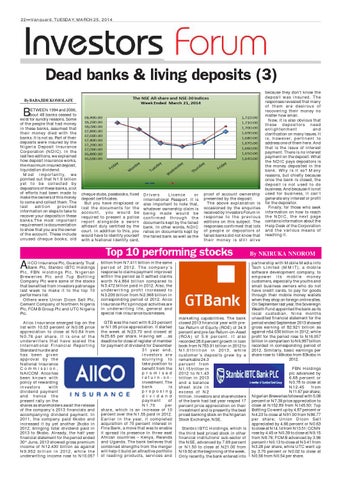
ETWEEN 1994 and 2006, about 48 banks ceased to exist for sundry reasons. Some of the people that had money in these banks, assumed that their money died with the banks. It is not so. Part of their deposits were insured by the Nigeria Deposit Insurance Corporation (NDIC). In the last two editions, we explained how deposit insurance works, the maximum insured deposit, liquidation dividend. Most importantly, we pointed out that N1.9 billion yet to be collected by depositors of these banks, a lot of efforts had been made to make the owners of this money to come and collect them. The last edition provided information on steps to take to recover your deposits in these banks.The most important requirement is documentation to show that you are the owner of the account. These include unused cheque books, old
cheque stubs, passbooks, fixed deposit certificates. But you have misplaced or lost the documents for the account, you would be required to present a police report alongside a sworn affidavit duly certified by the court. In addition to this, you would have to identify yourself with a National Identity card,
Drivers Licence or International Passport. It is also important to note that, whatever ownership claim is being made would be confirmed through the documents kept by the failed bank. In other words, NDIC relies on documents kept by the failed bank as well as the
proof of account ownership presented by the deposit. The above explanation is occasioned by the enquiries received by Investors Forum in response to the previous editions on this subject. The responses confirmed that lots of people or depositors of failed banks did not know that their money is still alive
Top 10 performing stocks A
IICO Insurance Plc, Guaranty Trust Bank Plc, Stanbic IBTC Holdings Plc, FBN Holdings Plc, Nigerian Breweries Plc and 7up Bottling Company Plc were some of the stocks that benefited from investors patronage last week to make it to the top 10 performers list. Others were Union Dicon Salt Plc, Cement Company of Northern Nigeria Plc, FCMB Group Plc and UTC Nigeria Plc.
billion from N7.411 billion in the same period of 2012. The company ’s response to claims payment improved within the period as it settled claims worth N4.864 billion compared to N3.472 billion paid in 2012. Also, the underwriting profit increased to N3.209 billion from N2.968 billion in corresponding period of 2012. Aiico Insurance Plc’s principal activities are in underwriting life, general and special risk insurance businesses.
Aiico Insurance emerged top on the list with 10.53 percent or N0.08 price appreciation to close at N0.84 from N0.76 per share. It is one of the underwriters that have scaled the International Financial Reporting Standard hurdle and has been given approval by the National Insurance Commission, NAICOM. Aiico has been known with policy of rewarding investors with dividend payment and hence the present rally on the shares as shareholders await the release of the company’s 2013 financials and accompanying dividend payment. In 2011, the company paid 6kobo and increased it by yet another 2kobo in 2012, bringing total dividend paid in 2013 to 8kobo. Already, the half year financial statement for the period ended 30th June, 2013 showed gross premium income of N12.430 billion as against N9.952 billion in 2012, while the underwriting income rose to N10.057
GTB was the next with 8.23 percent or N1.95 price appreciation. It started the week at N23.70 and closed at N25.65 per share. Having set …as deadline for close of register of member for payment of dividend for December 31 year end, investors are scurrying to take position to benefit from the p r o m i s e d return-oninvestment. The bank is proposing d i v i d e n d payment of N1.70 per share, which is an increase of 10 percent over the N1.55 paid in 2012. Earlier in the year, it completed acquisition of 70 percent interest in Fina Bank, a move that was to enable it spread its presence in three east African countries – Kenya, Rwanda and Uganda. The bank believes that combined strengths from the merger will help it build an attractive portfolio of leading products, services and
marketing capabilities. The bank closed 2013 financial year with pretax Return of Equity (ROE) of 34.9 percent and pre-tax Return-on-Asset (ROA) of 5.6 percent. It also recorded 28.6 percent growth in loan book from N783.91 billion in 2012 to N1.01trillion in 2013, while customer ’s deposits grew by a remarkable 24.3 percent from N1.15 trillion in 2012 to N1.43 trillion in 2013 and a balance sheet size in excess of N2 trillion. Investors and shareholders of the bank had last year reaped 17 percent price appreciation on their investment and is presently the best priced banking stock on the Nigerian Stock Exchange, NSE. Stanbic IBTC Holdings, which is the third best priced stock in other financial institutions’ sub-sector of the NSE, advanced by 7.69 percent or N1.50 to close at N21.00 from N19.50 at the beginning of the week. Only recently, the bank entered into
because they don’t know the deposit was insured. The responses revealed that many of them are desirous of recovering their money no matter how small. Now, it is also obvious that these depositors need enlightenment and clarification on many issues. It is, however, pertinent to address one of them here. And that is the issue of interest payment. There is no interest payment on the deposit. What the NDIC pays depositors is the money deposited in the bank. Why is it so? Many reasons, but chiefly because once the bank is closed, the deposit is not used to do business. And because it is not used for business, it can’t generate any interest or profit for the depositor. Finally, for those who seek information on how to reach the NDIC, the next page contains information about the Help Desk of the Corporation and the various means of reaching it.
By NKIRUKA NNOROM partnership with Mobile Media Info Tech Limited (MMIT), a mobile software development company, to empower its mobile money customers, especially the youths and small business owners who do not have credit cards, to pay for goods through their mobile money wallets when they shop on foreign online sites. On September last year, the Sovereign Wealth Fund appointed the bank as its local custodian. Nine months unaudited financial statement for the period ended September 2013 showed gross earning of 82.921 billion as against n64.030 billion in 2012, while profit for the period rose to N16.057 billion in comparison to N6.997 billion recorded in corresponding period of 2012. Similarly, basic earnings per share rose to 146kobo from 83kobo in 2012. FBN Holdings plc advanced by 6.68 percent or N0.78 to close at N12.45 from N11.67 per share; Nigerian Breweries followed with 5.08 percent or N7.39 price appreciation to close at N152.89 from N145.50; 7up Bottling Co went up by 4.87 percent or N4.23 to close at N91.00 from N86.77 per share; Union Dicon Salt appreciated by 4.66 percent or N0.63 to close at N14.14 from N13.51; CCNN rose by 4.45 or N0.39 to close at N9.15 from N8.76; FCMB advanced by 3.96 percent r N0.13 to close at N3.41 from N3.28 per share, while UTC went up by 3.70 percent or N0.02 to close at N0.56 from N0.54 per share.