SUNDAY VANGUARD, NOVEMBER 17, 2013, PAGE 47
Adieu Mike Akhigbe, the NNS Fearless BY TUNDE OGBEHA TRIBUTE IN BRIEF The late former chief of the general staff (CGS) and the two other Musketeers
M
IKE, I find it unbelievable and difficult to talk about you in the past. I remember how it all began in 1967 during the interview process that preceded our admission into the Nigeria Defence Academy (NDA). You, Dave (Senator David Mark) and I hobnobbed as if we came from the same home. While it was understandable between Dave and I, who have been together as boys in the Nigerian Military School, Zaria, you became the tripod of our brotherhood and friendship. And you did this seamlessly. Together, we grew from boys to men. Our coursemates called us ‘the three Musketeers’ and we lived to the billing. We did a lot of things together both good and bad but mostly good things. Our Creator, the Almighty God, has called you to his side and one leg of our tripod has been removed and you are irreplaceable. But I will continue to remember our last two encounters. Precisely last December 26, my family and I were at your London residence for the Christmas celebration and I will hold the discussions and jokes we
,
TRIBUTE
so mighty a Defender. From Him who loves me now so well what power my soul shall sever? Shall life or death, shall earth or hell? No, I am His for ever. Amen”
shared very dearly. Also, in February this year, you, Dave and I had what has turned out to be our last physical contact of final reunion of the body. You were upbeat and very optimistic about your treatment and recovery process. All our subsequent phone chats never betrayed emotions of an impending death. And I was hopeful of another re-union. The last phone call of October 21, 2013 from you laid this hope to rest. Your subsequent departure remains a shock that left devastating effect on me. I will miss you. As Christians, the Bible teaches us to give thanks in all things and situations. We give thanks to God for giving you to us and for uniting us as brothers and friends until He called you home. Like Paul, the Apostle, you have fought the good fight, you have fin-
We nicknamed you NNS Fearless because of your character, you were brave, adventurous, courageous, compassionate and hardworking. I was therefore not surprised that you rose not only to the pinnacle of your profession (Navy) but became the number two citizen of Nigeria. A position you accomplished with patriotism, dedication and commitment. In all your assignments you excelled. You played very significant roles at critical times in the history of our country. You were a blessing not only to NDA Regular 3 or Edo State but to Nigeria and they will equally miss you. You lived a committed and practical Christian life, full of love, humility and compassion , touching and enriching lives for everyone without discrimination. I am proud of your achievements. On behalf of my family, I pray that the Lord will grant your soul eternal rest and peace until we meet at the feet of our Lord Jesus Christ. Amen Adieu my brother and friend, NNS FEARLESS. *Ogbeha, a retired brigadiergeneral, was a senator of the Federal Republic of Nigeria.
You lived a committed and practical Christian life, full of love, humility and compassion , touching and enriching lives for everyone without discrimination. I am proud of your achievements
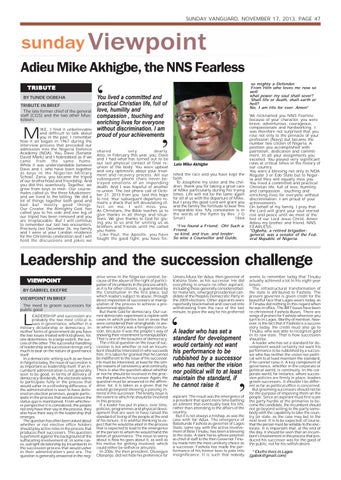
, Late Mike Akhigbe ished the race and you have kept the faith. To Josephine my sister and the children, thank you for taking a great care of Mike particularly during his trying times. Life will not be the same again for all of us with the departure of Mike, but I pray the good Lord will grant you and the family the fortitude to bear this irreparable loss. My consolation is in the words of the hymn by Rev. J G Small 1866
”I’ve found a Friend; Oh! Such a Friend, so kind, and true, and tender; So wise a Counsellor and Guide,
Leadership and the succession challenge BY GABRIEL EKEFRE VIEWPOINT IN BRIEF The need to groom successors for public good
L
EADERSHIP and succession are probably the two most critical is sues in governance, whether in a military dictatorship or democracy. In neither forms of government do you have the two issues treated with kid gloves, for, one determines, to a large extent, the success of the other. The successful handling of leadership and succession brings very much to bear on the nature of governance itself. In a democratic setting such as we have in Nigeria today, the issue of succession is as important as leadership itself. If an incumbent administration is not generally seen to be good, in terms of delivery of democracy dividends, the electorate wants to participate fully in the process that would usher in a refreshing difference. If the administration is seen to have delivered on election promises, people participate in the process that would ensure the status quo is maintained. From whichever perspective it is considered, the people not only have their say in the process, they also have their way in the leadership that emerges. The question has often been asked about whether or not elective office holders should play active roles in the process that produces their successors. This question is pertinent against the background of the suffocating involvement of, in some cases, outright dictatorship by incumbents in the succession process that would usher in their administration’s post era. The question is generally answered in the neg-
ative sense in the Nigerian context, because of the abuse of the right of participation of incumbents in the process which, as it is for other citizens, is guaranteed by the Constitution in the first place, but which leaders subject to abuse, through direct imposition of successors or manipulation of the process to achieve a predetermined objective. But thank God for democracy. Our current democratic experiment is replete with cases in which parties lost in areas that were considered their strongholds; in areas where victory was a foregone conclusion, because it was the people’s way of showing their resentment to manipulation. That is one of the beauties of democracy. The critical question on the issue of succession is not whether or not an incumbent should be interested in who succeeds him. It is taken for granted that he cannot be indifferent to the issue of his successor. He must be interested, at least for the simple reasons of consistency and continuity. There is also the question about whether or not he should be involved in the process that produces his successor. Again, the question must be answered in the affirmative, for, it is taken as a given that he would go beyond showing a passing interest in his successor. The knotty issue is the extent to which he should be involved in this process. If a leader has put in place, over time, policies, programmes and physical development that are seen to have raised the standard of living of the people at the end of his tenure, it is wishful thinking to expect that he would be aloof in the process that is expected to lead to the emergence of the person to whom he would hand the baton of governance. The issue to worry about is how he goes about it, as well as his motive for getting involved, which could either be selfish or altruistic. In 2006, the then president, Olusegun Obasanjo, did not hide his preference for
Umaru Musa Yar’Adua, then governor of Katsina State, as his successor. He did everything to ensure no other aspirant, including those generally considered better materials, emerged presidential candidate of the Peoples Democratic Party in the 2009 elections. Other aspirants were reportedly blackmailed and coerced into withdrawing from the race of the last minute, to pave the way for his preferred
,
VIEWPOINT
A leader who has set a standard for development would certainly not want his performance to be rubbished by a successor who has neither the vision nor political will to at least maintain the standard, if he cannot raise it
,
aspirant. The result was the emergence of a president that spent more time battling an ailment that eventually took his life, rather than attending to the affairs of the country. But it is not always a mishap, as was the case with Yar ’Adua. The emergence of Babatunde Fashola as governor of Lagos State, some say, with the active involvement of Bola Tinubu, has been a blessing to the state. A dark horse whose position as chief of staff to the then Governor Tinubu made him the most unlikely choice as a successor, Fashola has made the performance of his former boss to pale into insignificance. It is such that nobody
seems to remember today that Tinubu actually achieved a lot in his eight-year tenure. The infrastructural transformation of the state is attributed to Fashola. The present governor is given credit for the beautiful face that Lagos wears today, as if Tinubu did nothing in this regard when he was in office. The BRT buses have been re-christened Fashola Buses. There are songs of praises for Fashola wherever you turn to in Lagos. Worthy of mention, however, is the fact that if Fashola is a success story today, the credit must also go to Tinubu, who was able to recognize gold in its raw state. That is how succession should be. A leader who has set a standard for development would certainly not want his performance to be rubbished by a successor who has neither the vision nor political will to at least maintain the standard, if he cannot raise it. A key component of governance, whether in the corporate or political world, is continuity. In the corporate world, for instance, where succession policies are firmly in place, leaders groom successors. It shouldn’t be different as far as political office is concerned. But grooming successors should not be for the purpose of imposing them on the people. Since an aspirant must first scale the party hurdle at the primaries to become the candidate, the incumbent should not go beyond selling to the party somebody with the capability to take the country (or state, as the case may be) to the next level. It is to be expected, of course, that the person must be sellable to the electorate. It is important that, at the end of the day, it should be seen that an incumbent’s involvement in the process that produced his successor was for the good of the public, not for his selfish desire.
* Ekefre lives in Lagos (gabek@gmail.com)