8—Vanguard, TUESDAY, SEPTEMBER 17, 2013
Sovereign Wealth Fund invests $200m in US bonds
4 oil firms, 2 CEOs arraigned over N2.9bn fuel subsidy scam BY EVELYN USMAN
BY WILLIAM JIMOH, with agency reports
N
I G E R I A’ S Sovereign Wealth Fund, SWF, has invested more than $200 million in the United States bond market. The fund was given by the SWF to UBS, Credit Suisse and Goldman Sachs, to manage a fixed income portfolio. The investment, though relatively small, adds Nigeria to the small cadre of commodity-rich countries that over the past decade have become one of the most powerful forces in global financial markets through their sovereign wealth funds. Chief executive of the $1billion Nigerian Sovereign Investment Authority, NSIA, Uche Orji, said the fund gave UBS $50 million last week to invest in US Treasuries. A further $150 million is being transferred this week to Credit Suisse and Goldman Sachs to build a US corporate bond portfolio. Speaking to newsmen in Abuja, Orji, a former banker who was recruited to set up the fund last year further said, “This is a major milestone for us.” Orji who had earlier in June said that he had delayed making any initial investments due to the volatility in global markets noted that he felt the bond market was now “fairly valued”. The first investment comes ahead of this week’s crucial meeting of the Federal Reserve. The US Central Bank is likely to start phasing out its bond buying programme that has kept interest rates at ultra-low levels. “There is more optimism now,” Mr Orji said. The Nigeria sovereign wealth fund is the third largest in sub-Saharan Africa, after the $6.9 billion Botswana and $5 billion Angola funds, though tiny compared to those of oil producers such as Saudi Arabia, Norway and Abu Dhabi, which have more than $600 billion in assets each.
L
AGOS—THE last may not have been heard about the fuel subsidy scam by some oil companies as the Special Fraud Unit of the Nigeria Police Force, have charged four companies and two Managing Directors/Chief Executive Officers to court for allegedly obtaining N2.9 billion from the Federal Government under false pretence of importing petroleum products into the country. The companies which were also alleged to have made the claims through forged documents, included Geacan Energy Limited and its Managing Director, Petroleum Brokers Limited and its managing director, Lister Oil Limited and Oando Marketing. The unit in a statement signed by its spokesperson, Ngozi Nsitume, explained that a petition was addressed to it by the Presidential Committee on Verification and Reconciliation of Fuel Subsidy payment. It added that carrying out verification of shore tank certificates and sales proceeds for all the fuel imported into Nigeria, discovered some infractions in the importation made by one of the companies. The statement said the infraction was discovered “in the importation made by Geacan Energy Limited in April and October 2011, via vessels MT AIDIN and MT BRAVE, against which N2.9 billion was paid to Geacan Energy as subsidy. The case was investigated by detectives from the unit and a prima facie case has been established against the suspects.” The suspects were charged and arraigned before Justice Mohammed Kurya of the Federal High Court, Ikoyi, on a seven count charge. Count one read “that you Geacan Energy Limited, Chinyerem Anekwem Anike Nweze (F), Managing Director/Chief Executive Officer of Geacan Energy Limited; Petroleum Brokers Limited, Ogundipe Olanira (M), Managing Director/CEO of Petroleum Brokers Limited, Lister Oil and Oando Plc, between January and April 2011 in Lagos, within the jurisdiction of the Federal High court, conspired among yourselves and with others at large, to commit a felony to wit, obtaining the sum of N1,323,162,160.76 as subsidy from the Federal Government under false pretence that Geacan Energy Limited imported and sold 17,837,160.00 litres of Petroleum Motor spirit, PMS, into Nigeria via vessel MT AIDIN (EX MT STENA FR8) and thereby committed an offence punishable under section 8(a)of the Advance Fee Fraud Related offences Act cap A6, laws of the Federation of Nigeria, 2004;
read with section 3(1) of the same Act.” Count two alleged that the Managing Director of GEACAN Energy Limited, Chiyerem Nweze made forged import and vessels documents to obtain the payment of fuel subsidy valued at N1. 3 billion, while count three alleged that GEACAN and its managing
director obtained N1.3 billion as fuel subsidy from the Federal Government between January and April 2011 on a false pretence that they had imported the product into Nigeria and sold 17,837,160.00 via an oil vessel. In count four, Lister Oil Limited and Oando Plc were alleged to have aided Geacan
Energy Limited, its Managing Director and Petroleum Brokers Limited and its managing director to obtain the sum of N1.3 billion fuel subsidy from the Federal Government “on the false pretence that the said Geacan Energy Limited was imported and sold 17,837,160.00 litres of PMS via vessel MT AIDIN(EX MT STENA FR8)”
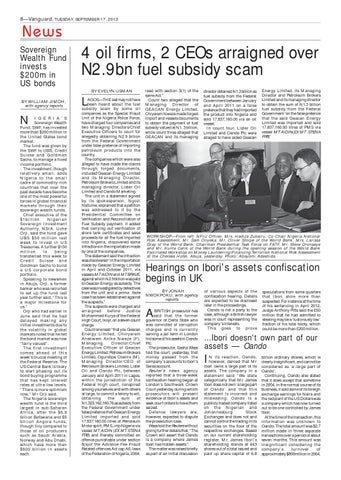
WORKSHOP—From left: NFIU Officer, Mrs. Hadiza Zubairu; Co-Chair Nigeria National Risk Assessment, Mr. Sam Onyeka; Mr. Oliver Stolpe of the World Bank; Mrs. Larissa Gray of the World Bank; Chairman Presidential Task Force on FATF, Mr. Steve Oronsaye and Mr. Kunta Celik of the World Bank during the opening session of the World Bank Facilitated Workshop on Money Laundering/Financing Terrorism National Risk Assessment at the Chelsea Hotel, Abuja, yesterday. Photo: Abayomi Adeshida.
Hearings on Ibori's assets confiscation begins in UK BY JONAH NWOKPOKU, with agency reports
A
BRITISH prosecutor has said that the former governor of Delta State who was convicted of corruption charges and is currently serving a jail term in London hid some of his assets in Oando Plc. The prosecutor, Sasha Wass told the court, yesterday, that money passed from the company’s accounts to Ibori’s Swiss account. Reuter’s news agency reported that a three-week confiscation hearing began at London’s Southwark Crown Court yesterday during which prosecutors will present evidence of Ibori’s assets and seek court orders to have them seized. Defence lawyers are, however, expected to dispute the prosecution case. Wass told the Reuters without giving further details that, “The Crown will assert that Oando is a company where James Ibori has hidden assets.” The matter was raised briefly as part of an initial discussion
of various aspects of the confiscation hearing. Details are expected to be disclosed later in the proceedings. Oando is not a party to the case, although a British lawyer was in court representing the company’s interests. This goes to prove
speculations from some quarters that Ibori stole more than suspected. For instance at the time of his sentencing in April 2012, Judge Anthony Pitts said the £50 million that he had admitted to stealing may be a ‘ludicrously low’ fraction of his total booty, which could be more than £200 million.
...Ibori doesn't own part of our assets — Oando
I
N its reaction, Oando, however, denied that Mr Ibori owns a large part of its assets. The company in a statement said “We state categorically that Mr. James Ibori does not own ‘a large part of Oando’ and that this statement is incorrect and misleading. Oando is a publicly traded company listed on the Nigerian and Johannesburg Stock Exchanges and does not and cannot control the trading in its securities on the floor of the respective exchanges. Based on our current shareholding register, Mr. James Ibori’s shareholding stands at 443 shares out of a total issued and paid up share capital of 6.8
billion ordinary shares, which is clearly insignificant, and cannot be considered as ‘a large part of Oando’. Continuing, Oando also stated that it does accept that sometime in 2004, in the normal course of its business, it sold some of its foreign exchange earnings for Naira and the recipient of the US Dollars was a company which has now turned out to be one controlled by James Ibori. At the time of the transaction, this information was unknown to Oando. The total amount was $2.7 million made in three separate transactions over a period of about seven months. This amount was insignificant considering the company ’s turnover of approximately $800million in 2004.