VANGUARD, THURSDAY, NOVEMBER 14, 2013—41
National Confab: Nothing should be off-limit — Bishop Udogu RT. Reverend Paul Udogu is the Bishop of Church of Nigeria (Anglican Communion) Afikpo Diocese, Ebonyi State. In this interview the cleric bares his mind on key national issues in the country especially the proposed national dialogue, saying that ethnic nationalities must answer the question as to whether they still want to continue as a nation. EXCERPTS: BY PETER OKUTU
W
HAT is your reaction to the initiative by President Jonathan for a National conference? It is a welcome development that is long overdue. We salute the initiatives of Mr. President at inaugurating the advisory committee under the chairmanship of Dr. Femi Okurounmu that will work out the modalities for the national dialogues or conference. We are aware that the advisory committee is busy visiting the six geopolitical zones and collecting memoranda from the
general public on what should be the modalities of the national dialogue. What should be the structure of the conference? The space called Nigeria was negotiated by the colonialists with the various ethnic nationalities that inhabit the space. Each of these ethnic nationalities has a position with respect to their interest and expectations from the entity called Nigeria. They must therefore form the key groups in any discussion about Nigeria. Participation on basis such as local government, state, geopolitical zones should be
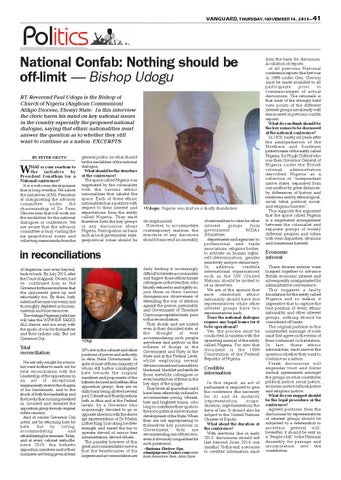
•Udogu: Nigeria was laid on a faulty foundation de-emphasized. However, to accommodate contemporary realities, the structure of any discourse should transcend an assembly
in reconciliations of litigations and even beyond, back to back. By July 2010, after the Court of Appeal, Owerri, had re- confirmed him as the Governor for the second time, that the opponents gave up and reluctantly too. By then, both sides had become war weary and thoroughly depleted in human, material and time resources. The vintage Nigerian politician will take the WINNER TAKES ALL stance, and run away with the spoils of war for themselves and their lackeys only. But not Governor Orji.
Total reconciliation He not only sought for a truce, but went further to reach out for total reconciliation with the Leadership of the oppositions in an act of exceptional magnanimity even to the chagrin of his lieutenants, and to the shock of both the leadership and the hawks that cunning sneaked in, invaded and derailed the opposition group from its original noble cause(s). And of course Governor Orji acted, not by returning hate for hate, but by loving, accommodating and rehabilitating his enemies. Today, and at every cabinet reshuffle, since 2010, the hitherto opposition members and/or their nominees are being given at least
•Orji 50% slot in the cabinet and other positions of power and authority in Abia State Government. In spite of most of them (majority of whom still harbor unmitigated hate towards the original members and proponents of the hitherto focused and selfless Abia opposition group), they are on daily basis being allotted several juicy Cabinet and Board positions both in Abia and at the Federal levels, by a Governor who surprisingly decided to go in opposite direction with the above apt representation of Dr Martin Luther King. In so doing, he drew strength and raised the bar to operate devoid of rancor free administration, devoid of hate. The paradox however of this great and commendable move is that the beneficiaries of his largesse and accommodation are
daily finding it increasingly difficult to tolerate accommodate and ‘forgive’ those of their former colleagues in the trenches, who bluntly refused to and rightly so, join them in their various disingenuous divisiveness of extending the war of attrition against the person, personality and Government of Theodore Orji to unacceptable limits, prior to this reconciliation. They shrink and are united even in their disunited state, at the thought of ever accommodating such people anywhere and anyhow in the scheme of things in the Government and Party in the State and at the Federal Level, whilst employing several devious unused and unusable to blackmail, blacklist and exclude those erstwhile colleagues or even benefactors of theirs in the hey days of the jungle. They block all space that could have been effectively utilized to accommodate young, vibrant, best and brightest brains, who long to contribute their quota to the socio-political and economic development of the State. When they are not appropriating to themselves key positions in Government, they are recommending one of their own, even if obviously unqualified for such position(s). •Biafrana Ekekwe Egu, otimkpujesus@yahoo.comwrote from Amaokwe Item, Abia State
of nationalities to cater for other interest groups from government MDA’s (Ministries, departments and agencies) to professional and trade associations, religious bodies, to activists on human rights, self-determination, gender sensitivity and pro democracy. In addition, credible international organizations such as the UN (United Nations) should be invited to sit as observers. We are of the opinion that each identified ethnic nationality should have five representatives while other interest groups have two representatives each. Does the national dialogue require any legal frame for it to be operational? Yes, the process must be conducted in tandem with the operating manual of the entity called Nigeria. For now that document is the 1999 Constitution of the Federal Republic of Nigeria.
Credible information In this regard, an act of parliament is required to give the conference (the necessity for it) and its modality (representation, scope, duration, implementation) the force of law. It should also be subject to the United Nations Charter of Equity. What about the duration of the conference? With elections due in early 2015, discussions should not last beyond June 2014 (six months). To this end, a recourse to credible information must
form the basis for discussion. A collation of reports of all previous National conference reports (the first was in 1966 under Gen. Gowon) must be made available to all participants prior to commencement of actual discussions. The rationale is that most of the strongly held view points of the different interest groups are already well enunciated in previous confab reports. What do you think should be the key issues to be discussed at the national conference? In 1920, barely six years after the amalgamation of the Northern and Southern protectorates of the entity called Nigeria, Sir Hugh Clifford who was then Governor General of Nigeria under the British colonial administration described Nigeria as a collection of “independent native states, separated from one another by great distances, by differences of history and traditions and by ethnological, racial, tribal, political, social, and religious barriers”. This supports the argument that the space called Nigeria is a negotiated arrangement between the colonialist and separate groups of widely different peoples and tribes with clear disparities, divisions and sometimes hatreds.
Economic interest These diverse entities were lumped together to advance British economic interest and subsequently amalgamated for administrative convenience. This suggests a faulty foundation for the entity called Nigeria and so makes it imperative that to capture the true position of every ethnic nationality and other interest groups, nothing should be considered off limits. The original partners in this unintended marriage of sorts must first agree on the terms of their continued co-habitation. In fact, these ethnic nationalities, must answer the question whether they want to continue as a nation. Frank discussions will engender trust and foster mutual agreements amongst the groups on what constitutes political justice, social justice, economic justice cultural justice and religious justice. What do you suggest should be the legal procedure of the conference? Agreed positions from the discussions by representatives of interest groups should be subjected to a referendum to ascertain general will. hereafter, it should be sent as a “People’s bill” to the National Assembly for passage and incorporation into the constitution.