24—Vanguard, TUESDAY, DECEMBER 11, 2012
BRIEF Navy thwarts attempt to steal seized oil vessel By EMMA AMAIZE
W
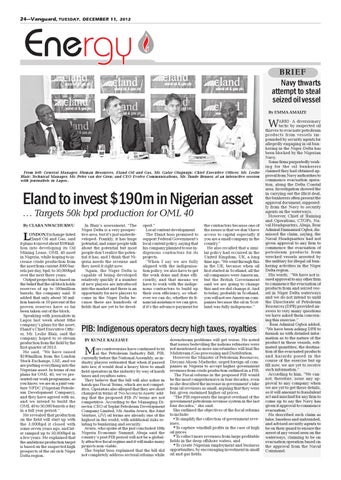
From left: General Manager, Human Resources, Eland Oil and Gas, Mr. Gafar Olagunju; Chief Executive Officer, Mr. Leslie Blair; Technical Manager, Mr. Peter van der Gren; and CEO Evolve Communications, Mr. Tunde Renner, at an interactive session with journalists in Lagos..
Eland to invest $190m in Nigerian asset … Targets 50k bpd production for OML 40 By CLARA NWACHUKWU
L
ONDON Exchange-listed Eland Oil and Gas, said it plans to invest about $190million into developing its Oil Mining Lease, OML 40 asset in Nigeria, while hoping to increase crude production from the asset from current 3000 barrels per day, bpd, to 50,000bpd over the next three years. Output projection is based on the belief that the oil block holds reserves of up to 500million barrels, the company said. It added that only about 50 million barrels or 10 percent of the proven reserves have so far been taken out of the block. Speaking with journalists in Lagos last week about 6the company’s plans for the asset, Eland’s Chief Executive Officer, Mr. Leslie Blair, said the company hoped to re-stream production from the field by the first quarter of 2013. He said, “We have raised $190million from the London Stock Exchange, LSE, and we are putting everything into the Nigerian asset. In terms of our plans for OML 40, we’ve presented our work programme, as you know, we are in a joint venture NPDC (Nigerian Petroleum Development Company), and they have agreed with us, and we intend to build the OML 40 to 50,000 barrels a day in a full year period.” He revealed that production on the field will start up with the 3,000bpd it closed with some seven years ago, and later ramped up to 50,000bpd in a few years. He explained that the ambitious production target is based on the suspected high prospects of the oil-rich Niger Delta region.
In Blair’s assessment, “The Niger Delta is a very prospective area, but it’s just underdeveloped. Frankly, it has huge potential, and some people talk about the potential but most people don’t realize the potential it has, and I think that Nigeria needs the revenue and they need it right now. “Again, the Niger Delta is capable of being developed relatively quickly if a number of new players are introduced into the market and there is an opportunity for new players to come in the Niger Delta because there are hundreds of fields that are yet to be devel-
oped.” Local content development The Eland boss promised to support Federal Government’s local content policy, saying that his company planned to use indigenous contractors for its projects. “When I say we are fully aligned with the indigenisation policy, we also have to get the work done and done efficiently, and that means we have to work with the indigenous contractors to build up their own efficiency, so whatever we can do, whether its financial assistance we can give, if it’s the advance payment for
the contractors because one of the issues is that we don’t have access to capital especially if you are a small company in the country.” He also recalled that a similar policy had occurred in the United Kingdom, UK, a long time ago. “We went through this in the UK, because when oil first started in Scotland, all the oil companies were American, but the British Government said we are going to change this and we did change it. And to today, probably in Scotland, you will not see American companies because the oil in Scotland was fully indigenous.”
PIB: Indigenous operators decry high taxes, royalties BY KUNLE KALEJAYE
M
ore controversies have continued to tri al the Petroleum Industry Bill, PIB, currently before the National Assembly, as industry players reiterated that when if passed into law, it would deal a heavy blow to small field operators in the industry by way of harsh taxes and royalties rates. They believe that the bill will also usher in harsh gas Fiscal Terms, which are not competitive. Operators also alleged that they are short changed in terms of ‘No Access to Assets’ adding that the proposed PIB JV terms are not competitive. According to the Managing Director, CEO of Seplat Petroleum Development Company Limited, Mr. Austin Avuru, the Joint Venture, (JV) oil terms are already one of the highest in the world, with additional risks relating to bunkering and security. Avuru, who spoke at the just concluded 18th Nigeria Economic Summit, Abuja said the country’s post PIB period will not be a globally attractive fiscal regime and it will make many projects non-viable. The Seplat boss explained that the bill did not completely address sectoral reforms while
downstream problems will get worse. He noted that issues bedeviling the nations refineries were not mentioned as more uncertainties will trial the Midstream (Gas processing and Distribution. However the Minister of Petroleum Resources, Diezani Alison-Madueke, urged foreign oil companies in Nigeria to accept higher government revenues from crude production outlined in a PIB. The Fiscal reforms in the proposed PIB would be the most comprehensive in four decades, even as she described the increase in government’s take from oil revenues as small, arguing that they were fair, given sustained higher oil prices. “The PIB represents the largest overhaul of the government petroleum revenue system in the last four decades,” she said. She outlined the objectives of the fiscal reforms to include: •To simplify the collection of government revenues, •To capture windfall profits in the case of high oil prices •To collect more revenues from large profitable fields in the deep offshore waters, and •To create Nigerian employment and business opportunities, by encouraging investment in small oil and gas fields.
ARRI- A diversionary tactic by suspected oil thieves to evacuate petroleum products from vessels impounded by security agents for allegedly engaging in oil bunkering in the Niger-Delta has been blocked by the Nigerian Navy. Some firms purportedly working for the oil bunkerers claimed they had obtained approval from Navy authorities to commence evacuation operation, along the Delta Coastal area. Investigation showed the in carrying out the illicit deal, the bunkerers often present the approval document, supposedly from the Navy to security agents on the waterways. However, Chief of Training and Operations, CTOPs, Naval Headquarters, Abuja, Rear Admiral Emmanuel Ogboi, dismissed the claim, saying, the Naval Headquarters had not given approval to any firm to commence the evacuation of petroleum products from wrecked vessels arrested by the military for illegal oil bunkering activities in the Niger Delta region. His words, “We have not issued approval to any other firm to commence the evacuation of products from and seized vessel in Niger Delta waterways and we do not intend to until the Directorate of Petroleum Resources (DPR) provided answers to very many questions we have asked them concerning this exercise.” Rear Admiral Ogboi added, “We have been asking DPR to furnish us with detailed information as to the nature of the product in these vessels, estimated quantities, the destination of the evacuated products and hazards posed in the course of the exercise but up till now, we are yet to receive such information.” According to him, “We cannot, therefore, issue any approval to any company when we are yet to get these details, so it will amount to fraudulent act and mischief for any firm to come up to say the Navy has given it approval to commence evacuation.” He described such claim as false, baseless and unfounded, and advised security agents to be on their guard to ensure the arrest of any vessel seen on the waterways, claiming to be on evacuation operation based on the approval from the Naval Command.