28 —VANGUARD, THURSDAY, JULY 4, 2013
ASUU, ASUP strikes ground varsities, polys Continues from page 27 promptly.”
ASUP’s grievances
ASUP has maintained that it embarked on the industrial action in its bid to call government’s attention to improved conditions for polytechnic staff and the provision of learning materials and equipment, as well as improved infrastructure for institutions. Rising from its 74th National Executive Council (NEC) meeting, held between June 26 and 27 at the Federal Polytechnic, Oko, Anambra State, ASUP declared the continuation of the strike, insisting that the Federal Government must implement the agreement reached with them in 2010. According to its National President, Mr. Chibuzor Asomugha, the union has been agitating against the non-constitution of Governing Councils of Polytechnics, Monotechnics and Colleges of Technology; non-release of white paper of the Visitation Panels to the Federal Polytechnics, noncommencements of the NEEDS Assessment of the Nigerian Polytechnics and the noncreation of a National Polytechnics Commission (NPC), which it preferred to the National Board for Technical Education (NBTC). However, at the state chapters, the union has attributed its disruption of academic activities to failure of most state governments to implement the approved salary package (COMPCASS) and 65 years retirement age for academic staff in polytechnics. This is even as it decried the decrepit state of infrastructure/ teaching facilities in most stateowned polytechnics,
monotechnics and colleges of technology. Recall that the union had sometime in May 2013 given government a twoweek ultimatum to meet their demands or witness total downing of tools by them. With no positive response from the government, the union made good its threat, which has lingered until the time of filing this report. Barr. Timothy Oluwalogbon Ogunseye, ASUP chairman, Federal Poly, Ilaro said; “We are saying the Federal Government should bring to life the National Polytechnic Commission. We want NPC as against the current National Board for Technical Education which supervises not only polytechnics but also technical schools which are sometimes equivalent of secondary schools. Secondly, we are saying no to the integrated polytechnic pay roll system (ICPS) which they are trying to bring on board. We are saying that if the university can enjoy the grace of autonomy in this area, nothing should stop them from extending it to the p o l y t e c h n i c s . We had an agreement between the Federal Government and our union which was signed in 2009 and clause of the agreement was that there should be a review every three years. Our union had since 2011 informed the government that it will be due for review February last year to set in motion a machinery to constitute the panel to look into the review of the agreement but up till now, noting has been done. We are calling on the government to embark on the general needs of the polytechnics as a whole so that our needs can be properly identified and met. We are also asking the Federal Government to increase
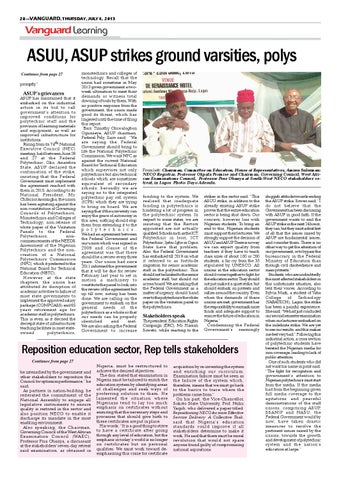
From left: Chairman, Committee on Education, House of Representatives, Aminu Suleiman; NECO Registrar, Professor Okpala Promise and Chairman, Governing Council, West African Examinations Council, Professor Pius Obanya at South-West NECO stakeholders' retreat, in Lagos. Photo: Dayo Adesulu. funding to the system. We realised that inadequate funding in polytechnics is hindering a lot of progress in the polytechnic system. In respect to some states, we are insisting that the Rectors appointed are not actually qualified. Schools such as the ICT Polytechnic in Isori, ICT Polytechnic, Ijebu-Igbo in Ogun State have that problem. Also, the Federal Government has embarked till 2019 on what it referred to as fortitude migration for senior academic staff in the polytechnic. This should not be limited to the senior academic staff, but should cut across board. We are asking that the Federal Government as a matter of urgency, should hand over to the polytechnics the white paper on the visitation panel to the polytechnics.
Stakeholders speak
The president, Education Rights Campaign (ERC), Mr. Hassan Soweto, while reacting to the
strikes in the sector said; “This ASUU strike, in addition to the already existing ASUP strike proves that the entire education sector is being shut down. Our concern, however, lies with Nigerian students. To bring an end to this, Nigerian students must support their lecturers. We strongly support the decision of ASUU and ASUP. There is no way we can expect quality from teachers if they have to teach class sizes of about 100 or 200 students, a far cry from the 35 stipulated by UNESCO. All unions in the education sector should come together to fight for the education sector. They should not just make it a quiet strike, but should embark on protests and rallies around the country. Even when the demands of these unions are met, government has the responsibility to earmark more funds and adequate support to ensure the future of education in Nigeria.” Condemning the Federal Government’s seemingly
Reposition education sector, Rep tells stakeholders Continues from page 27 be intensified by the government and other stakeholders to reposition the Council for optimum performance,” he said. As partners in nation-building, he reiterated the commitment of the National Assembly to engage all legislative instruments to ensure quality is restored in the sector and also position NECO to enable it discharge its mandate in the most enabling environment. Also speaking, the Chairman, Governing Council of the West African Examination Council (WAEC), Professor Pius Obanya, a discussant at the stakeholders' seven-day retreat said examination, as obtained in
Nigeria, must be restructured to achieve the desired objectives. The don stated that examination in Nigeria must be tailored to enrich the education system by identifying areas of challenges and seek ways of proferring solution to them. He lamented the situation where Nigerians tend to lay too much emphasis on certificates without ensuring that the necessary steps and processes that should give birth to these certificates are put in place. His words; “It is a good thing to strive to have a certificate after going through any level of education, but the emphasis in today’s world is no longer on certificates but on personal qualities. We must work toward deemphasising this craze for certificate
acquisition by re-inventing the system and enriching our curriculum. Examination failure must be seen as the failure of the system which, therefore, means that we must go back to the basics to trace where the problems came from.” On his part, the Vice-Chancellor, Sokoto State University, Prof. Nuhu Yaqub, who delivered a paper titled: Repositioning NECO for more Effective Service Delivery: A Collective Task, said that Nigeria’s education standards could improve if all stakeholders determine to make it work. He said that there must be moral revolution that would not spare anyone found guilty of compromising national aspirations.
sluggish attitude towards ending the ASUP strike, Soweo said; “I do not believe that the Government has been discussing with ASUP in good faith. If the government wants to end the ASUP strike in the next 24 hours, they can, but they must admit first of all that the issues raised by ASUP are fundamental issues, and consider them. There is no other way to get the attention of our government, or to bypass the bureaucracy in the Federal Ministry of Education than through civil disobedience and mass protests.” Students, who are undoubtedly the most affected stakeholders in this unfortunate situation, also lent their voices. According to Sylvia Mark, a student of Yaba College of Technology (YABATECH), Lagos, the strike has been a painful experience. She said; “We had just concluded our second semester examination when our lecturers embarked on the indefinite strike. We are yet to see our results, and this makes me feel very bad.” Following this industrial action, a cross section of polytechnic students have berated the Nigerian media for non-coverage, leading to lack of public attention. One of such students who did not want his name in print said; “The fight for recognition and government’s attention to Nigerian polytechnics must start from the media. If the media had from the beginning given full media coverage to the agitations and peaceful demonstrations of the staff unions, comprising ASUP, SSANIP and NASU, the Federal Government would by now, have taken drastic measures to resolve the pertinent issues raised by the unions, towards the growth and development of polytechnic system and the nation’s education at large.”