FRINGE
a
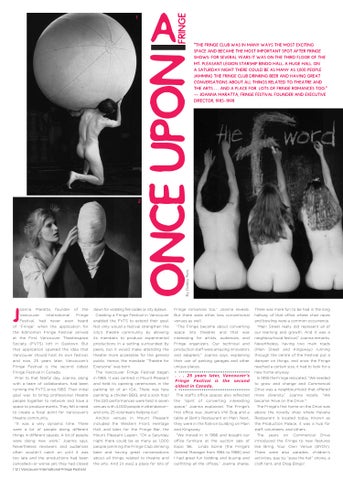
“THE FRINGE CLub Was IN MaNy Ways THE MOsT ExCITING spaCE aNd bECaME THE MOsT IMpORTaNT spOT aFTER FRINGE sHOWs. FOR sEvERaL yEaRs IT Was ON THE THIRd FLOOR OF THE MT. pLEasaNT LEGION sTaRsHIp bINGO HaLL. a HuGE HaLL. ON a saTuRday NIGHT THERE COuLd bE as MaNy as 1,000 pEOpLE JaMMING THE FRINGE CLub dRINkING bEER aNd HavING GREaT CONvERsaTIONs abOuT aLL THINGs RELaTEd TO THEaTRE aNd THE aRTs . . . aNd a pLaCE FOR LOTs OF FRINGE ROMaNCEs TOO.” — JOaNNa MaRaTTa, FRINGE FEsTIvaL FOuNdER aNd ExECuTIvE dIRECTOR, 1985-1998
ONCE upON
1
By Debby Reis
2
J
oanna Maratta, founder of the Vancouver International Fringe Festival, had never even heard of “Fringe” when the application for the Edmonton Fringe Festival arrived at the First Vancouver Theatrespace Society (FVTS) loft in Gastown. But that application sparked the idea that Vancouver should host its own festival, and now, 25 years later, Vancouver’s Fringe Festival is the second oldest Fringe Festival in Canada. Prior to that fateful day, Joanna, along with a team of collaborators, had been running the FVTS since 1983. Their initial goal was to bring professional theatre people together to network and have a space to produce events. They felt a need to create a focal point for Vancouver’s theatre community. “It was a very dynamic time. There were a lot of people doing different things in different spaces. A lot of people were doing new work,” Joanna says. Nevertheless reviewers and audiences often wouldn’t catch on until it was too late and the productions had been cancelled—or worse yet, they had closed
| 12 | Vancouver International Fringe Festival
down for violating fire codes or city bylaws. Creating a Fringe Festival in Vancouver enabled the FVTS to extend their goal. Not only would a festival strengthen the city’s theatre community by allowing its members to produce experimental productions in a setting surrounded by peers, but it would make attending the theatre more accessible for the general public. Hence, the mandate “Theatre for Everyone” was born. The Vancouver Fringe Festival began in 1985. It was centred in Mount Pleasant and held its opening ceremonies in the parking lot of an IGA. There was face painting, a chicken BBQ, and a sock hop! The 220 performances were held in seven venues with 4,000 people in attendance— and only 25 volunteers helping out! Anchor venues in Mount Pleasant included the Western Front, Heritage Hall, and later, for the Fringe Bar, the Mount Pleasant Legion. “On a Saturday night there could be as many as 1,000 people jamming the Fringe Club drinking beer and having great conversations about all things related to theatre and the arts. And [it was] a place for lots of
Fringe romances too,” Joanna reveals. But there were other, less conventional venues as well. “The Fringe became about converting space into theatres and that was interesting for artists, audiences, and Fringe organizers. Our technical and production staff were amazing innovators and adapters,” Joanna says, explaining their use of parking garages and other unique places.
. . . 25 years later, Vancouver’s Fringe Festival is the second oldest in Canada. The staff’s office spaces also reflected the “spirit of converting interesting space,” Joanna explained. The Fringe’s first office was Joanna’s VW Bug and a table at Bert’s Restaurant on Main. Next, they were in the flatiron building on Main and Kingsway. “We moved in in 1986 and bought our office furniture at the auction sale of Expo ‘86. Linda Gorrie [the Fringe’s General Manager from 1984 to 1988] and I had great fun bidding and buying and outfitting all the offices,” Joanna shares.
There was more fun to be had in the long hallway of that office where chair races and bowling were a common occurrence. “Main Street really did represent all of our learning and growth. And it was a neighbourhood festival,” Joanna remarks. Nevertheless, having two main roads (Main Street and Kingsway) running through the centre of the Festival put a damper on things, and once the Fringe reached a certain size, it had to look for a new home anyway. In 1995 the Fringe relocated. “We needed to grow and change and Commercial Drive was a neighbourhood that offered more diversity,” Joanna recalls. “We became ‘Alive on the Drive.’” The Fringe’s first home on the Drive was above the novelty shop where Havana Restaurant is located today. Known as the Production Palace, it was a hub for staff, volunteers, and others. The years on Commercial Drive introduced the Fringe to new features like Bring Your Own Venue (BYOV). There were also parades, children’s activities, pay by “pass the hat” shows, a craft tent, and Drag Bingo!