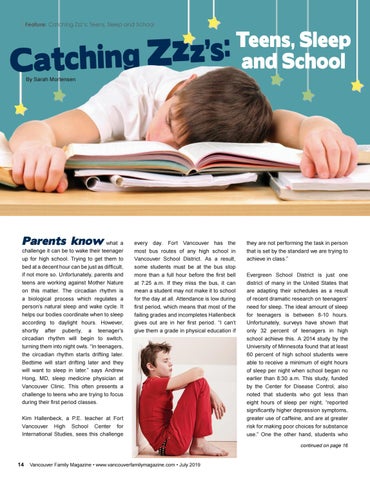
Feature: Catching Zzz’s: Teens, Sleep and School
z Z g n i h c t Ca By Sarah Mortensen
Parents know what a
challenge it can be to wake their teenager up for high school. Trying to get them to bed at a decent hour can be just as difficult, if not more so. Unfortunately, parents and teens are working against Mother Nature on this matter. The circadian rhythm is a biological process which regulates a person’s natural sleep and wake cycle. It helps our bodies coordinate when to sleep according to daylight hours. However, shortly after puberty, a teenager’s circadian rhythm will begin to switch, turning them into night owls. “In teenagers, the circadian rhythm starts drifting later. Bedtime will start drifting later and they will want to sleep in later.” says Andrew Hong, MD, sleep medicine physician at Vancouver Clinic. This often presents a challenge to teens who are trying to focus during their first period classes.
Teens, Sleep z’s: and School
every day. Fort Vancouver has the most bus routes of any high school in Vancouver School District. As a result, some students must be at the bus stop more than a full hour before the first bell at 7:25 a.m. If they miss the bus, it can mean a student may not make it to school for the day at all. Attendance is low during first period, which means that most of the failing grades and incompletes Hallenbeck gives out are in her first period. “I can’t give them a grade in physical education if
Kim Hallenbeck, a P.E. teacher at Fort Vancouver High School Center for International Studies, sees this challenge
they are not performing the task in person that is set by the standard we are trying to achieve in class.” Evergreen School District is just one district of many in the United States that are adapting their schedules as a result of recent dramatic research on teenagers’ need for sleep. The ideal amount of sleep for teenagers is between 8-10 hours. Unfortunately, surveys have shown that only 32 percent of teenagers in high school achieve this. A 2014 study by the University of Minnesota found that at least 60 percent of high school students were able to receive a minimum of eight hours of sleep per night when school began no earlier than 8:30 a.m. This study, funded by the Center for Disease Control, also noted that students who got less than eight hours of sleep per night, “reported significantly higher depression symptoms, greater use of caffeine, and are at greater risk for making poor choices for substance use.” One the other hand, students who continued on page 16
14
Vancouver Family Magazine • www.vancouverfamilymagazine.com • July 2019