2 • january 2013
Olympia calling Fresh from election to his first full term in the Senate chamber, veteran lawmaker Mike Padden talks priorities
NEWS
The Current
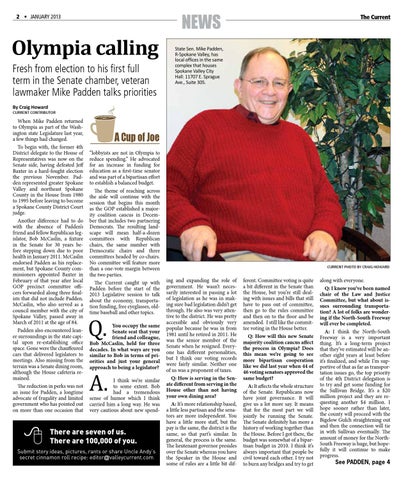
State Sen. Mike Padden, R-Spokane Valley, has local offices in the same complex that houses Spokane Valley City Hall: 11707 E. Sprague Ave., Suite 305.
By Craig Howard Current Contributor
When Mike Padden returned to Olympia as part of the Washington state Legislature last year, a few things had changed. To begin with, the former 4th District delegate to the House of Representatives was now on the Senate side, having defeated Jeff Baxter in a hard-fought election the previous November. Padden represented greater Spokane Valley and northeast Spokane County in the House from 1980 to 1995 before leaving to become a Spokane County District Court judge. Another difference had to do with the absence of Padden’s friend and fellow Republican legislator, Bob McCaslin, a fixture in the Senate for 30 years before stepping down due to poor health in January 2011. McCaslin endorsed Padden as his replacement, but Spokane County commissioners appointed Baxter in February of that year after local GOP precinct committee officers forwarded along three finalists that did not include Padden. McCaslin, who also served as a council member with the city of Spokane Valley, passed away in March of 2011 at the age of 84. Padden also encountered leaner surroundings in the state capital upon re-establishing office space. Gone were the chauffeured cars that delivered legislators to meetings. Also missing from the terrain was a Senate dining room, although the House cafeteria remained. The reduction in perks was not an issue for Padden, a longtime advocate of frugality and limited government who has pointed out on more than one occasion that
A Cup of Joe “lobbyists are not in Olympia to reduce spending.” He advocated for an increase in funding for education as a first-time senator and was part of a bipartisan effort to establish a balanced budget. The theme of reaching across the aisle will continue with the session that begins this month as the GOP established a majority coalition caucus in December that includes two partnering Democrats. The resulting landscape will mean half-a-dozen committees with Republican chairs, the same number with Democratic chairs and three committees headed by co-chairs. No committee will feature more than a one-vote margin between the two parties. The Current caught up with Padden before the start of the 2013 Legislative session to talk about the economy, transportation funding, free eyeglasses, oldtime baseball and other topics.
Q.
You occupy the same Senate seat that your friend and colleague, Bob McCaslin, held for three decades. In what ways are you similar to Bob in terms of priorities and just your general approach to being a legislator?
A.
I think we’re similar to some extent. Bob had a tremendous sense of humor which I think carried him a long way. He was very cautious about new spend-
There are seven of us. There are 100,000 of you. Submit story ideas, pictures, rants or share Uncle Andy’s secret cinnamon roll recipe: editor@valleycurrent.com
Current photo by Craig Howard
ing and expanding the role of government. He wasn’t necessarily interested in passing a lot of legislation as he was in making sure bad legislation didn’t get through. He also was very attentive to the district. He was pretty accessible and obviously very popular because he was in from 1981 until he retired in 2011. He was the senior member of the Senate when he resigned. Everyone has different personalities, but I think our voting records were fairly similar. Neither one of us was a proponent of taxes. Q: How is serving in the Senate different from serving in the House other than not having your own dining area? A: It’s more relationship based, a little less partisan and the senators are more independent. You have a little more staff, but the pay is the same, the district is the same, so that part’s similar. In general, the process is the same. The lieutenant governor presides over the Senate whereas you have the Speaker in the House and some of rules are a little bit dif-
ferent. Committee voting is quite a bit different in the Senate than the House, but you’re still dealing with issues and bills that still have to pass out of committee, then go to the rules committee and then on to the floor and be amended. I still like the committee voting in the House better. Q: How will this new Senate majority coalition caucus affect the process in Olympia? Does this mean we’re going to see more bipartisan cooperation like we did last year when 44 of 46 voting senators approved the same budget? A: It affects the whole structure of the Senate. Republicans now have joint governance. It will give us a lot more say. It means that for the most part we will jointly be running the Senate. The Senate definitely has more a history of working together than the House. Before I got there, the budget was somewhat of a bipartisan budget in 2010. I think it’s always important that people be civil toward each other. I try not to burn any bridges and try to get
along with everyone. Q: I know you’ve been named chair of the Law and Justice Committee, but what about issues surrounding transportation? A lot of folks are wondering if the North-South Freeway will ever be completed. A: I think the North-South Freeway is a very important thing. It’s a long-term project that they’ve estimated will be another eight years at least before it’s finalized, and while I’m supportive of that as far as transportation issues go, the top priority of the 4th District delegation is to try and get some funding for the Sullivan Bridge. It’s a $20 million project and they are requesting another $4 million. I hope sooner rather than later, the county will proceed with the Bigelow Gulch straightening out and then the connection will tie in with Sullivan eventually. The amount of money for the NorthSouth Freeway is huge, but hopefully it will continue to make progress.
See PADDEN, page 4