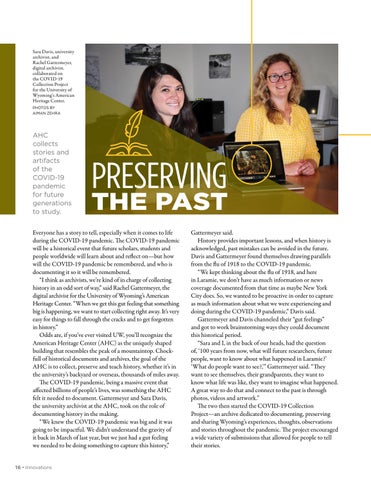
Sara Davis, university archivist, and Rachel Gattermeyer, digital archivist, collaborated on the COVID-19 Collection Project for the University of Wyoming’s American Heritage Center. PHOTOS BY AIMAN ZEHRA
AHC collects stories and artifacts of the COVID-19 pandemic for future generations to study.
PRESERVING
THE PAST
Everyone has a story to tell, especially when it comes to life during the COVID-19 pandemic. The COVID-19 pandemic will be a historical event that future scholars, students and people worldwide will learn about and reflect on—but how will the COVID-19 pandemic be remembered, and who is documenting it so it will be remembered. “I think as archivists, we’re kind of in charge of collecting history in an odd sort of way,” said Rachel Gattermeyer, the digital archivist for the University of Wyoming’s American Heritage Center. “When we get this gut feeling that something big is happening, we want to start collecting right away. It’s very easy for things to fall through the cracks and to get forgotten in history.” Odds are, if you’ve ever visited UW, you’ll recognize the American Heritage Center (AHC) as the uniquely shaped building that resembles the peak of a mountaintop. Chockfull of historical documents and archives, the goal of the AHC is to collect, preserve and teach history, whether it’s in the university’s backyard or overseas, thousands of miles away. The COVID-19 pandemic, being a massive event that affected billions of people’s lives, was something the AHC felt it needed to document. Gattermeyer and Sara Davis, the university archivist at the AHC, took on the role of documenting history in the making. “We knew the COVID-19 pandemic was big and it was going to be impactful. We didn’t understand the gravity of it back in March of last year, but we just had a gut feeling we needed to be doing something to capture this history,” 16 • Innovations
Gattermeyer said. History provides important lessons, and when history is acknowledged, past mistakes can be avoided in the future. Davis and Gattermeyer found themselves drawing parallels from the flu of 1918 to the COVID-19 pandemic. “We kept thinking about the flu of 1918, and here in Laramie, we don’t have as much information or news coverage documented from that time as maybe New York City does. So, we wanted to be proactive in order to capture as much information about what we were experiencing and doing during the COVID-19 pandemic,” Davis said. Gattermeyer and Davis channeled their “gut feelings” and got to work brainstorming ways they could document this historical period. “Sara and I, in the back of our heads, had the question of, ‘100 years from now, what will future researchers, future people, want to know about what happened in Laramie?’ ‘What do people want to see?,’” Gattermeyer said. “They want to see themselves, their grandparents, they want to know what life was like, they want to imagine what happened. A great way to do that and connect to the past is through photos, videos and artwork.” The two then started the COVID-19 Collection Project—an archive dedicated to documenting, preserving and sharing Wyoming’s experiences, thoughts, observations and stories throughout the pandemic. The project encouraged a wide variety of submissions that allowed for people to tell their stories.