SPRING 2022
On Call A MAGAZINE FOR FRIENDS OF THE UNIVERSITY OF WISCONSIN SCHOOL OF VETERINARY MEDICINE
Stronger Together SVM leads national effort to train and connect clinician-scientists
Ready for Launch DVM students create software startup to support veterinarians
2022
Iverson Bell
Midwest Regional
Diversity
Summit
MAY 20-22
MADISON, WISCONSIN
The University of Wisconsin-Madison School of Veterinary Medicine is honored to host this crucial event on our campus for the first time.
From Talk to Action:
Becoming a Change Agent on Your Campus
LEARN MORE:
Faculty, staff, students, and administrators will come together to promote diversity, equity, and inclusion in veterinary medicine, with special focus on academia. This work is vital to all of our roles both in academic settings and the greater veterinary medical community. We all play a part in ensuring that our institutions reflect our values and are inclusive spaces for all.
WWW.VETMED.WISC.EDU/IVERSON-BELL-SUMMIT
SPRING 2022
Features In Each Issue 4 Message from the Dean Slowly Returning to Normalcy 5 Menagerie A diverse collection of news and information from the SVM
Why Science Needs Veterinarians
10
The University of Wisconsin School of Veterinary Medicine is bolstering the veterinary clinician-scientist workforce, training veterinarians to join research teams to advance animal and human health. With support from a $3 million grant from the National Institutes of Health, the program funds training opportunities for veterinarians at various career stages and brings together veterinarians, physicians, and PhD scientists.
Page 10
16 Comparatively Speaking A special section for alumni of the Veterinary Science and Comparative Biomedical Sciences graduate programs 18 DVM Badger Den News for and about graduates of the Doctor of Veterinary Medicine program
More 5 Ask a UW Veterinarian 5 Socializing with the SVM 20 Students at Work 22 Patient Profile
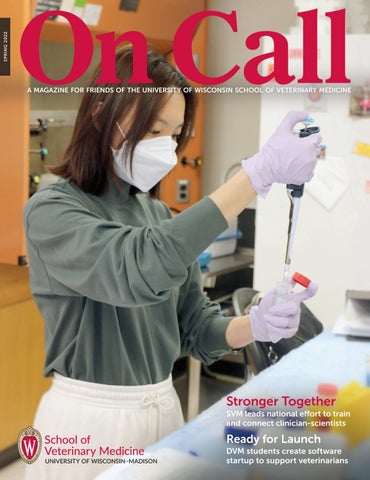
On the Cover
14
Startup Addresses Complexities of Veterinary Referrals Annie Pankowski DVMx’23 never expected to become co-founder of a tech startup. However, as veterinary medical clinics faced a sharp increase in demands for care services during the COVID-19 pandemic, help was needed to maximize efficiency and patient referral systems. Annie and her sister Ali, both veterinary medical students, envisioned a solution in Transfur, a software model that harmonizes the process between primary and specialty veterinarians.
Doctoral student Yinghua Wang pipettes samples as part of research studying hematopoietic stem cells, which give rise to mature blood cells in bone marrow. Wang is a member of the lab of Xuan Pan, an associate professor of oncology and veterinarianscientist who studies stem cell-based therapeutic interventions and novel cancer therapies. (Photo: Meghan Lepisto/UW School of Veterinary Medicine) ©2022 Board of Regents of the University of Wisconsin System
Page 14 On Call
3
Slowly Returning to Normalcy
BRYCE RICHTER
Message from the Dean
Welcome to the spring issue of On Call. I hope your winter was pleasant and that your spring is enjoyable. At the University of Wisconsin School of Veterinary Medicine (SVM), we are slowly returning to something closer to normal, with COVID case numbers significantly decreased locally and nationally when writing this and the overwhelming majority of our instruction occurring in person. It has been a long two years for all of us, and I know that includes you, too. I hope and expect that the coming months and years will Mark D. Markel be much more normal than the past 24-plus months. This issue of On Call highlights some of the areas where the UW School of Veterinary Medicine leads the nation in much of what it does. We spotlight efforts led by professor Lauren Trepanier to develop, mentor, and train clinician-scientists to advance research that benefits both humans and animals. The success and growth of these veterinary scientists — current and future — is critical to protecting public health and keeping pace with the challenges posed by new and emerging threats. In addition, we share the story of Annie Pankowski, a member of our DVM Class of 2023, and her sister, Ali, a veterinary medical student at the University of California-Davis. The pair has been recognized and supported by Varsity Venture Studio to launch a software startup called Transfur. Transfur emerged as a direct solution to an industry-wide problem for veterinary medical clinics amid increased demand for care services during the COVID-19 pandemic, providing ways to maximize staff efficiency and patient referral management systems. I wish them both well in this exciting endeavor. And you’ll find several examples of SVM research at the cutting edge of science and public health. This includes professor Yoshihiro Kawaoka, who continues to lead the nation in his virology work and was recently recognized for his pursuit of a pan-coronavirus vaccine. Such a vaccine would protect against a broad range of coronaviruses, including the virus responsible for the COVID-19 pandemic. I also want to recognize and honor the passing of one of our outstanding faculty members, Linda Sullivan, a 1987 graduate of the SVM. Linda’s career was characterized by decades of service and leadership as a professor, mentor, and philanthropist. She was an exceptional teacher who shaped the careers of countless veterinarians and drove positive change in the school. Outside of the classroom, she had a tremendous impact, spearheading initiatives in support of local humane societies, canine-assisted therapy for hospitalized pediatric patients, and cancer research. She truly exemplified how the SVM can positively affect our students, profession, and community (read more on page 19). As we continue to emerge from the COVID-19 pandemic, I hope you have an outstanding spring and coming summer. If you have an opportunity, drive by the school to see the progress of our building expansion project, which is almost a year into construction. As a reminder, the expansion is scheduled for completion in mid-2023 and remodeling of our current building in 2024.
SPRING 2022
Administration Mark D. Markel, Dean Lynn Maki, Associate Dean for Student Academic Affairs Nancy Parkinson, Assistant Dean for Human Resources Ed Rodriguez, Associate Dean for Budget and Finance Peggy Schmidt, Associate Dean for Professional Programs Chris Snyder, Associate Dean for Clinical Affairs and Director, UW Veterinary Care M. Suresh, Associate Dean for Research and Graduate Training Kristi V. Thorson, Associate Dean for Advancement and Administration Lauren Trepanier, Assistant Dean for Clinical and Translational Research
Editorial Editor/Writer: Meghan Lepisto Contributing Writers: Alisyn Amant, Maddie Arthur, Chris Barncard, Kelly April Tyrrell, Eric Hamilton, Emily LeClerc, Rachael Lee Photography: Meghan Lepisto, Jeff Miller, Seth Moffitt, David Nevala, Bryce Richter Design: Christine Knorr, University Marketing Additional Design: Ashley Voss
Connect with Us Please send your feedback and comments to oncall@vetmed.wisc.edu, 608-263-6914, or On Call Editor, 2015 Linden Drive, Madison, WI 53706. www.vetmed.wisc.edu www.uwveterinarycare.wisc.edu facebook.com/uwvetmed facebook.com/uwveterinarycare twitter.com/uwvetmed twitter.com/uwvetmeddean youtube.com/uwvetmed instagram.com/uwvetmed
On Call is also available online at: www.vetmed.wisc.edu/on-call The printing and distribution of this magazine were funded by donations to the school. To make
Mark D. Markel, Dean @uwvetmeddean
4
On Call | Spring 2022
a gift, contact Pat Bowdish at 608-332-4750 or pat.bowdish@supportuw.org or Heidi Kramer at 608-327-9136 or heidi.kramer@supportuw.org.
Menagerie
Ask a UW Veterinarian IST OC K
PH OT O :J
O SS IM D
Protecting Pets from Insect Pests This expert response comes from Amy Nichelason, a veterinarian with UW Veterinary Care’s Primary Care service. Question: As the weather warms and more time is spent outdoors, how can we best protect our animal companions from diseases spread by insects? Answer: Several bugs and parasites can spread disease to your pet. These include mosquitoes (which can transmit heartworm), ticks (Lyme disease, anaplasmosis, or ehrlichiosis), and fleas (tapeworms). Mites, lice, and fleas can also cause generalized itchiness to your pet. Insect prevention should occur yearround. Although insects and arachnids are not typically active during winter months in Wisconsin, several tick species can become active when the temperature is above freezing. Knowing when to begin preventative treatment during temperature fluctuations can be challenging. Instead, we recommend year-round prevention to ensure adequate protection. There are many preventative treatment options, ranging from pills or topical products to flea and tick collars to yearly injections. Your veterinarian can help you find the right option. In general, preventative treatment is much safer and less invasive than treating your pet for insect-borne diseases, but if your pet has underlying health issues be sure to discuss this with your veterinarian.
Pets who spend a lot of time outdoors or live in high-risk areas are more likely to contract an insect-borne disease. Companion Animal Parasite Council maps (capcvet.org/maps) show disease prevalence by state and county. While it is important to search for and remove ticks from your pet during the summer high season, this should not replace preventative tick therapies. Nymphal or immature ticks can spread Lyme disease and, at about one millimeter in size (similar to a poppy seed), they are difficult to see with the naked eye. Finally, we recommend your pet be screened for insect-transmitted diseases every year or two, depending on your prevention method and your pet’s lifestyle. This will ensure any underlying disease is diagnosed and treated sooner rather than later. If your pet displays symptoms such as coughing, difficulty breathing, lethargy, or joint pain, see your veterinarian, as these can be symptoms of an insect-borne disease.
Have a question for our veterinary medical experts? Send it to oncall@vetmed.wisc.edu. We cannot guarantee responses to all submissions. For any urgent pet health issue, please contact your veterinarian directly.
Socializing with the SVM Friends of the school sharing their thoughts (and pets) on social media... Good news! Today JeanBob received the final dose of his chemotherapy series (dressed for the occasion of course)! He’s had a tough month with tumor surgery, recovery, and chemo every week. You wouldn’t know it though! He is perfection in a bow tie. –jean.bob.bart Via SVM Instagram (@uwvetmed)
So thankful to be celebrating the new year with my best friend thank you @uwvetmed for making that possible! –@krazy_kat_lady_katie Via SVM Instagram (@uwvetmed)
Another good recheck for my Snickers today. The Dr. always tells me what a handsome good boy he is. –Toni Smith Jensen Via SVM Facebook (@uwvetmed)
On Call
5
Menagerie SVM Researchers Lead Effort to Create Universal Coronavirus Vaccine Viruses can be wily adapters, changing their identities to find new hosts and thwart efforts to stop them. That’s why University of Wisconsin–Madison researchers and their collaborators are making progress toward developing universal vaccines against some of the planet’s most harmful pathogens, including the virus family responsible for the COVID-19 pandemic. Last fall, the National Institutes of Health announced it was investing in three teams working to develop a vaccine that would simultaneously work against a broad range of coronaviruses. Among them is a research collaboration, the Pan-Coronavirus Vaccine consortium, led by UW–Madison School of Veterinary Medicine Professor of Pathobiological Sciences Yoshihiro Kawaoka. “This pan-coronavirus vaccine is basically preparing for the future,” Kawaoka says. The SARS-CoV-2 virus, which causes COVID-19, belongs to a larger family of coronaviruses that tend to make humans and other animals sick, including Middle East Respiratory Syndrome Coronavirus (MERS) and Severe Acute Respiratory Syndrome Coronavirus (SARS), both of which are also responsible for epidemics. At least four other coronaviruses infect most people by age 10, causing little more than annoying colds. Since the original strain of SARS-CoV-2 virus first emerged in late 2019, numerous versions (variants) have also appeared as the virus replicates, and typos in its genetic code equip it with slightly different properties. Sometimes, these changes have been consequential and — as happened with the delta and omicron variants — have become what public health officials call variants of concern. As these variants emerge, experts rush to study whether they will still respond to the countermeasures developed to combat them, including vaccines. The project led by Kawaoka and his collaborators, totaling about $7 million in funding from the National Institute of Allergy and Infectious Diseases, is looking for a vaccine or vaccines that could train our immune systems to respond to a broader array of coronaviruses, including SARS-CoV-2, and their variants. Before 2019, no one had ever seen SARS-CoV-2. If successful, a pan-coronavirus vaccine would also protect against other as-yet-unknown coronaviruses. Vaccines tend to rely on features of a pathogen that are most likely to help the body’s immune system both identify it and also mount a response, preventing or limiting illness. Most vaccines are relatively specific to the pathogen they target. The COVID-19 vaccines now authorized or approved by the Food and Drug Administration in the U.S., and by the
6
On Call | Spring 2022
World Health Organization globally, have proven effective at protecting people from severe illness and death from SARS-CoV-2, even as variants and waning immunity have rendered the vaccines less effective at preventing initial infection. “The pan-coronavirus vaccine may not be as effective as a vaccine that is specific for a particular strain, like SARS-CoV-2,” says Kawaoka, but the trade-off for reduced Yoshihiro Kawaoka effectiveness is increased coverage. Adds Peter Halfmann, research associate professor in the Kawaoka lab at the Influenza Research Institute at UW–Madison, it would mean “having something ready to go in case something did pop up.” For instance, if the world already had a pan-coronavirus vaccine in March 2020, it could have served as a mitigation tool until vaccines specific to SARS-CoV-2 could be developed. “Ideally, though,” Kawaoka says, “a pan-coronavirus vaccine that is as effective as a specific vaccine would be nice.” And that’s what the researchers seek to do. In particular, the consortium is searching for regions of the viral spike protein (a unique feature that gives coronaviruses their name) that are most likely to be shared between members of the coronavirus family. Once identified, the scientists will test how well these portions of the protein stimulate the immune systems of mice to generate an antibody response, and compare this to data from independent, complementary studies of human immune reactions. Members of the collaboration will then select those proteins, or antigens, that perform well and use them to vaccinate mice and hamsters (a good model because they develop illness
3D print of a SARSCoV-2 particle, the virus that causes COVID19. The virus surface (blue) is covered with spike proteins (red) that enable the virus to enter and infect human cells. Researchers with the Pan-Coronavirus Vaccine consortium will search for regions of the viral spike protein that are most likely to be shared between members of the coronavirus family.
NIH (2)
similar to humans), studying how well the vaccines protect the animals when they are exposed to coronaviruses in the lab. The researchers will also take the high-performing antigens and attach them to a nanoparticle that mimics a whole virus. Kawaoka’s lab had already been testing this platform, developed by Ravi Kane at Georgia Tech University, and their own platform as part of efforts to develop a universal influenza vaccine. Preliminary data shows the approach might also work for coronaviruses. The researchers will also study how long vaccine-induced immunity lasts and whether vaccination can prevent transmission between animals. Kawaoka expects vaccine candidates they identify now are at least five years away from the clinic, but his lab and others will continue to invest the time, energy, and resources to solving these challenges. The future may depend on it. Kelly April Tyrrell
Before 2019, no one had ever seen SARSCoV-2. If successful, a pan-coronavirus vaccine would also protect against other as-yet-unknown coronaviruses.
Important Insights Into Omicron Since the outset of the COVID-19 pandemic, Yoshihiro Kawaoka, a professor of pathobiological sciences at the School of Veterinary Medicine, has been studying how SARS-CoV-2 is transmitted and causes COVID-19. This is in addition to broader work by multiple SVM researchers to better understand, control, and prevent this and future pandemic outbreaks. Kawaoka and colleagues published several new studies in January related to COVID-19 and the omicron variant. The first study confirms that, compared to earlier versions of the SARSCoV-2 virus, omicron causes less severe disease in mice and hamsters, which are reliable models for understanding COVID-19. The findings, published in the journal Nature, align with preliminary data from studies of people infected with the variant, which emerged in fall 2021, and offer insight into the nature of the disease with omicron. The collaborative effort was the work of the SARS-CoV-2 Assessment of Viral Evolution (SAVE) program of the National Institute of Allergy and Infectious Diseases. “SAVE meets four times per week,” Kawaoka explains, and includes teams analyzing sequences from viruses isolated across the world and screening for new variants; studying the biology of new variants in animal models; and working to isolate viruses for study, examining viral replication and testing how well previous infection or vaccination provides protection against emerging variants. Researchers who typically compete for publications and funding have come together in light of the COVID-19 crisis.
Peter Halfmann, a research associate professor with the SVM, was among the first in the world to isolate the omicron variant from human samples from infected patients for study. Once the viruses were isolated from the samples, scientists throughout the SAVE network began to test them in mice and hamsters. Animal studies are an important step in understanding new variants and how well they respond to existing countermeasures, such as vaccines and therapies. An additional study published Jan. 26 in the New England Journal of Medicine led by Kawaoka found that the drugs behind the new pills to treat COVID-19 remain very effective against the omicron variant of the virus in lab tests. However, lab tests also showed that the available antibody therapies — typically given intravenously in hospitals — are substantially less effective against omicron than against earlier variants of the virus. If the ability of the antiviral pills to combat omicron is confirmed in human patients, it would be welcome news. Public health officials expect the pills to become an increasingly common treatment for COVID-19 that will reduce the severity of the disease in at-risk patients and decrease the burden of the pandemic. The Kawaoka lab is now studying new antibody candidates to identify ones that could neutralize the omicron variant. Kelly April Tyrrell and Eric Hamilton On Call
7
ROB STREIFFER
Menagerie
Thirteen-lined ground squirrels curled up for seasonal hibernation can slow their metabolic rates to as little as 1 percent of their waking activity.
Microbes Help Hibernating Animals Recycle Nutrients, Maintain Muscle To get through a long winter without food, hibernating animals — like the 13-lined ground squirrel — can slow their metabolism by as much as 99 percent, but they still need important nutrients like proteins to maintain muscles while they hibernate. A new study from the University of Wisconsin–Madison shows that hibernating ground squirrels get help from microbes in their guts. The discovery could help people with muscle-wasting disorders and even astronauts on extended space voyages. “The longer any animal doesn’t exercise, bones and muscles start to atrophy and lose mass and function,” says Hannah Carey, a professor
emerita in the UW School of Veterinary Medicine and co-author of the new study, published in January in the journal Science. “Without any dietary protein coming in, hibernators need another way to get what their muscles need.” One source of nitrogen, a vital building block for amino acids and proteins, accumulates in the bodies of all animals (including humans) as urea, a component of urine. The researchers knew that urea that moved into the squirrels’ digestive tract could be broken down by some gut microbes, which also need nitrogen for their own proteins. But the researchers wanted to see if some of that urea nitrogen
Bits of news from around the school Daryl Buss, former dean and professor emeritus with the UW School of Veterinary Medicine, received the 2022 Billy E. Hooper Award for Distinguished Service from the American Association of Veterinary Medical Colleges (AAVMC). Buss was honored for his more than 50-year career, including clinical practice, teaching, leadership of academic institutions and AAVMC, and serving as editor-in-chief of the Journal of Veterinary Medical Education. Buss served for 17 years as dean of the UW School of Veterinary Medicine, where he continued to teach cardiovascular physiology, his specialty. Nigel Cook, professor and chair of the Department of Medical Sciences, is the recipient of the 2021 American Association of Bovine Practitioners (AABP) Award of Excellence, which recognizes consistent and direct influence on daily activities of veterinarians in bovine practice. Cook is known for his expertise in cow comfort, lameness prevention, management of heat stress, cow wellbeing, and more. He is a past president of AABP and a current member of the AABP Lameness Committee. Tony Goldberg, a professor of epidemiology, will team with the U.S. Fish and Wildlife Service, with funding from the National Oceanic and Atmospheric Administration, to build
8
On Call | Spring 2022
a database of fish viruses in Wisconsin waters. The effort is one of 12 new research projects Wisconsin Sea Grant announced in February to build Great Lakes understanding, leading to science-based management and policy decisions. In Wisconsin, the Department of Natural Resources sells more than 1 million fishing licenses each year. Maria Krenz DVM’06 and her ZimmVet veterinary clinic in Zimmerman, Minnesota, were awarded the 2021 American Animal Hospital Association-Accredited Practice of the Year. The honor recognizes the outstanding achievements of accredited practice teams and celebrates ongoing advancements in veterinary medicine. Fellow SVM graduate Abby Soderberg DVM’18 is also part of the ZimmVet team. Albee Messing, professor emeritus of comparative biosciences and founder of the Alexander Disease Lab, co-led a new study that offers a potential treatment for Alexander disease – a significant step in efforts to help people with the disease. The typically fatal condition is a progressive and rare neurological disorder with no cure or standard course of treatment. The study, published in Science Translational Medicine, provided preliminary data instrumental for a human clinical trial of the treatment being led by Ionis Pharmaceuticals.
freed up by the microbes was also being incorporated into the squirrels’ bodies. They injected urea made with trackable isotopes of carbon and nitrogen into the blood of squirrels at three stages — during the active days of summer, early in winter hibernation and late in winter. Some of the squirrels had also been treated with antibiotics to kill off the majority of the microbes in their intestines. As predicted, isotope-containing nitrogen was released by some of the gut microbes that degraded the injected urea. “We followed that nitrogen to (the) livers (of the squirrels), primarily — where it is used to make many proteins — and some to muscles,” says study co-investigator Fariba Assadi-Porter, a UW–Madison emeritus biochemist who specializes in tracking the isotopes.
“We believe we’re seeing the isotopelabeled nitrogen molecules go from the host to the microbiome, then converted to usable molecules by the microbes before coming back to the host again, essentially being ‘recycled’ in the hibernating animal.” The researchers observed two differences that support this microbial path. The squirrels whose gut microbes were largely depleted by antibiotics had far less of the trackable nitrogen in their liver and muscles. And when the researchers sequenced the genomes of microbes found in the squirrels’ guts, they found that as winter hibernation dragged on there was an increase in the presence of genes related to production of an enzyme called urease. “Urease is not made by animals. Only microbes that express urease are
able to split the urea molecule and release its nitrogen,” says Carey, whose work is supported by the National Science Foundation. “As long as the right microbes are present, it’s a transaction between them and the host — each get some of the nitrogen released to tide them over until hibernation ends.” Describing the keys to survival over the duration of hibernation could help people on low-nitrogen diets or with disorders that cause muscles to atrophy. It could also make it possible for humans to make lengthy trips to distant planets. Putting space travelers into a hibernation-like state means they wouldn’t need to take as much food, water, and oxygen, and would produce less waste and carbon dioxide, saving vast amounts of weight and fuel. Chris Barncard
Overheard
Recent commentary by and about those at the SVM “If we start to see some really divergent viral variants popping up in deer in certain places, that would be a red flag.”
– Tony Goldberg, professor of epidemiology, discussing with The New York Times the concern that white-tailed deer could become a reservoir for SARS-CoV-2, and the need for long-term genomic surveillance of the virus in deer, which scientists have found are easily infected.
“All of our beautiful outdoor spaces where we want to be, also are the spaces where mosquitoes and ticks want to be.” – Lyric Bartholomay PhD’04, professor of pathobiological sciences, speaking with Spectrum News 1 about how additional risk for Lyme and other vector-borne diseases could be on the horizon in a warmer Wisconsin, as ticks and mosquitoes stay active longer.
“Anytime horses were out, we were out there. We were standing right next to all the best horses in the world.” – Lisa Borzynski DVM’93, who traveled to Tokyo, Japan as a veterinarian for the Tokyo Olympics equestrian events, caring for and monitoring the health and welfare of equine competitors throughout their preparation and events.
“We forget that cows aren’t robots, they are cows.” – Nigel Cook, professor of food animal production medicine, during a recent Dairyland Initiative workshop where he described distinct behavioral patterns in cows that must be considered when designing a barn for voluntary milking systems or robots.
“The virus is like a horror movie villain. Every time you think it is dead, it comes back.” – Thomas Friedrich, professor of pathobiological sciences, speaking with the Milwaukee Journal Sentinel about the evolutionary path of SARSCoV-2, the COVID-19 virus.
“Most of the patients we’ve met come to us not because something bad happened in nature, but because they had some sort of human interaction that caused them to become injured or orphaned. So we feel that we are just giving back and trying to undo some of the damage caused to the environment.” – Erin Lemley, a wildlife veterinary technician at Dane County Humane Society’s Wildlife Center, where the UW School of Veterinary Medicine provides veterinary medical care to animals.
On Call
9
Grant Promoting Clinician-Scientist Training Propels SVM as Leader in Field By Maddie Arthur
Emma Sweet DVMx’22, left, and Keegan Lim DVMx’24, right, conduct molecular biology experiments in the lab of School of Veterinary Medicine associate professor Rob Lipinski.
T
he University of Wisconsin School of Veterinary Medicine is bolstering the veterinary clinician-scientist workforce through a five-year, $3 million grant from the National Institutes of Health (NIH). Clinician scientists are those with training in clinical care (through their DVM degree, in the case of veterinarians) who are also engaged in biomedical research. An NIH report describes the need to train more veterinary clinician-scientists, citing the small relative size of the workforce and their important contributions to the advancement of clinical practice for both people and animals. 10
On Call | Spring 2022
“The overarching goal of the grant is to train veterinarians to join translational research teams in an effort to advance animal and human health, translating scientific research into advancements for diseases common to both veterinary and human patients,” explains Lauren Trepanier, professor and assistant dean for clinical and translational research at the School of Veterinary Medicine. Spearheaded by Trepanier, the NIH grant funds three opportunities for veterinarians at various stages in their careers. Twelve funded two-year research fellowships allow residency-trained veterinarians to join interdisciplinary research groups with MDs, PhDs, and
other DVMs, bringing their clinical experience to a project spanning human and animal health. This piece of the program aims to bridge the gap between a residency and faculty position, where conducting independent research is expected. Elizabeth Rose, a veterinarian and second-year graduate student at North Carolina State University, applied for the two-year fellowship program as she was finishing up her residency training in anatomic pathology and preparing to pursue her PhD. “I knew that I wanted to incorporate translational medicine into my graduate research,” Rose says. “My
MEGHAN LEPISTO (2)
undergraduate and veterinary school research endeavors were all humanfocused and allowed me to appreciate the immense impact of animal models on human medicine.” This principle is evident in her fellowship research: Rose studies intestinal ischemia, a common cause of illness and death in newborns. Using a pig model of the condition, she aims to inform potential treatments for patients in the human neonatal intensive care unit. Through the fellowship, Rose gained access to cutting-edge laboratory techniques and incorporated her background in veterinary medicine to investigate the relationships between animal and human health. “The process of applying to the fellowship also prepared me to apply for additional grant opportunities,” she adds. Six fellows have been appointed to the program so far, with a total of 12 fellowships funded through the grant. Participants come from locations as far and wide as Pennsylvania, North Carolina, and Colorado. The second opportunity supported by the NIH grant is the Translational Research Immersion Program, described by Trepanier as a “bootcamp” for conducting research as an earlycareer veterinary faculty member. This program includes mentorship in applying for research grants during a 2.5 day-long workshop, along with optional grant coaching over the next year to provide faculty with direct feedback while they work on grant applications. Following the initial conference, participants are placed into small groups based on the funding organizations and deadlines of their upcoming grant proposal submissions. “Participating in the Translational Research Immersion Program was one of the best professional development moves I’ve made in my career so far,” says Laura Van Vertloo, an assistant
A five-year, $3 million grant to the UW School of Veterinary Medicine from the National Institutes of Health will bolster the veterinary clinician-scientist workforce through research training and collaboration.
professor of veterinary clinical sciences at Iowa State University. Since taking part in the training in 2020, Van Vertloo has had several grant proposals make it to final review or be funded — an accomplishment she credits to her mentorship during and after the program. Grant writing is a crucial skill in academia and one that many early-career faculty members lack in confidence and training. “I have done a lot to try to turn myself into a mature, self-sustaining faculty member, and this program has given me a tremendous boost of confidence in grant writing,” Van Vertloo says. Finally, the grant funds a series of Translational Summits designed to encourage mid-career veterinary faculty members to expand their research endeavors and collaborate with human physicians as a part of their work. These 1.5-day, focused workshops invite MDs, PhDs, and DVMs working on diseases shared by people and companion animals to learn about translational medicine across disciplines. To encourage attendance from
“Participating in the translational health research program was one of the best professional development moves I’ve made in my career so far.”
physicians, the summits are affiliated with national meetings held by groups that attract MDs and PhDs, including the American Kidney Foundation and Association for Research in Vision and Ophthalmology. Several research presentations during each workshop compare diseases in people versus companion animals. Additionally, during breakout sessions, participants can discuss their research priorities and coordinate collaborations moving forward. “The goal is to open the eyes of physicians to the spontaneous animal models that veterinarians are very familiar with,” Trepanier describes. “The summits explain how physicians can shift or supplement the research they’re doing, where they induce On Call
11
By the Numbers
disease in lab animals, by also utilizing spontaneous disease in pets.” Two summits have taken place so far, with a total of 10 planned throughout the five-year grant. Three summits are scheduled in 2022, with topics ranging from inherited retinal diseases to protein-losing kidney disease to aging-related sarcopenia, a syndrome of progressive loss of muscle mass that is prevalent in people and companion animals. “Seeing the lightbulb go off in a physician’s head during these events makes me really proud as a vet,” says Trepanier, who is also the Melita Grunow Family Professor in Companion Animal Health. “Veterinarians have a lot to offer in terms of comparative skills that enhance the medical profession.” Providing up-and-coming faculty members and recent graduates opportunities to be involved in research is imperative to advancing veterinary medicine as a whole. “While going into private practice serves the public on a case-by-case basis, translational research serves a critical role in providing specialists and independent clinics with new
5-YEAR
$3
MILLION
GRANT
from the National Institutes of Health will bring veterinarians and physicians together in support of human and animal health
12
TWO–YEAR FELLOWSHIPS
for residency-trained veterinarians provide targeted research training within interdisciplinary research groups
2.5
-DAY TRANSLATIONAL HEALTH RESEARCH BOOTCAMPS for early-career veterinary faculty cover study development, grant writing, and more, followed by one year of grant-writing mentoring
10
for mid-career veterinary faculty convene established veterinary and human medical researchers studying the same diseases common to veterinary and human patients
1 3 OF
The UW School of Veterinary Medicine is one of only three vet schools in the nation to provide a clinician-researcher emphasis for students in the DVM curriculum
12
On Call | Spring 2022
SETH MOFFITT
NATIONAL TRANSLATIONAL HEALTH SUMMITS
“The overarching goal of the grant is to train veterinarians to join translational research teams in an effort to advance animal and human health.”
techniques, drugs, or approaches to problems,” says Trepanier. The veterinary medicine curriculum does not typically offer clinician-scientist training, according to the NIH. The UW School of Veterinary Medicine is a leader in this field, providing students with a multitude of opportunities to pursue research during their time at the school. “We are one of only three vet schools in the country that allow students to declare a clinicianresearcher emphasis,” Trepanier says. To receive this designation, students must participate in an Introduction to Veterinary Research course as a first- or second-year student, complete a selective course in clinical study design, and participate in a summer research program. Since its launch in 2018, 10 students have completed the DVM Clinician Research Emphasis, with even more students participating in various aspects of the program. The school expects four students to graduate with the emphasis in 2022. In conjunction with the programs funded by the NIH grant, this curriculum is a testament to the integral work happening at the school to support veterinarian-scientist training and advance the veterinary profession and public health. Veterinarian Sarah Adrianowycz of UW Veterinary Care’s Oncology Service stands with Coco, an 11-year-old Pomeranian mix enrolled in a clinical study investigating a novel immunotherapy treatment for melanoma. As an oncology clinical trials intern, Adrianowycz is gaining advanced training in clinical studies aimed at developing new and more effective diagnostic and treatment options for cancer.
Student Perspective: Research Inspiration The UW School of Veterinary Medicine (SVM) provides many opportunities for students to gain valuable research experience with broad and significant benefits for animal and human health. These include dual degree and certificate programs, graduate research training, lab research openings, fellowships, and the SVM Summer Scholars program. Summer Scholars, specifically, allows veterinary medical students to engage in a summer research training program with mentors, including weekly seminars and discussion groups, to enhance their appreciation, interest, and knowledge of future career opportunities in biomedical research. Amongst a critical need to train more clinicianscientists and future leaders to conduct biomedical and veterinary research, you can find an inspiring array of budding scientists throughout the school. Here, five of these individuals share their perspectives.
Ashley Kuehnl, Tyler Alvarez, and Yinghua Wang, left to right, are three scientists in training in the lab of Xuan Pan, an associate professor of oncology and veterinary clinician-scientist at the School of Veterinary Medicine.
Ashley Kuehnl, DVM/PhD candidate and research assistant in the Pan lab “Since starting in the lab as an hourly worker as a second-year undergraduate, I’ve worked on multiple independent projects studying adult hematopoiesis (the production of blood cells), including a summer scholars internship last summer. Now, I’m a combined DVM/PhD graduate student in the first year of my PhD training. After I graduate, I hope to use my training as a veterinary scientist to perform comparative oncology research in an academic setting.”
Tyler Alvarez, UW–Madison undergraduate alumnus; lab manager and research intern in the lab of Xuan Pan, associate professor of oncology “I was born with a couple serious medical issues, which caused me to have long stays in hospitals growing up. My family and I were always looking for new and improved treatment options, so we met with many of the top doctors in the world. From a young age, these doctors showed me that anything is possible with a little ingenuity and a lot of hard work. I want to dedicate my life to the pursuit of knowledge in the hopes that my work will lead to a better future for current and subsequent generations. I plan on going to graduate school and using knowledge from my current position to help me along my journey.”
MEGHAN LEPISTO (2)
Keegan Lim DVMx’24, 2022 Summer Scholars applicant “As an undergraduate, I participated in several ecological studies, which fueled my interest in research. Now, as a second-year veterinary student with growing interests in ecology, pathology, and One Health, I am eager to explore how I can conduct and incorporate research in my future career as a community leader for both human and animal welfare. I can think of no better place than the SVM to leverage such training, and I’m grateful for the opportunity to learn directly from leaders in the field.”
Ashley Kuehnl, a DVM/PhD candidate at the School of Veterinary Medicine, flushes bone marrow cells under a laboratory fume hood as part of research into the production of blood cells. Following graduation, Kuehnl hopes to use her training as a veterinary scientist to perform comparative oncology research.
Emma Sweet DVMx’22, former Summer Scholars participant in the lab of Rob Lipinski, associate professor of comparative biosciences “When I started veterinary school, I wasn’t sure what kind of veterinarian I wanted to be – a specialist, researcher, public health vet, or clinician. I had a background in research and was interested in strengthening my skills and learning more while in school. Though I ultimately fell in love with clinical practice, research will always be a part of my practice as I will have to interpret and utilize new findings throughout my entire career. And someday, I may find myself running research on my own!” Yinghua Wang, PhD candidate and research assistant in the Pan lab “Growing up, I always loved science, and in college, I found my interest in biomedical science. My current research focuses on hematopoietic stem cells: stem cells that give rise to mature blood cells in the bone marrow. After I graduate, I want to use my research skills to improve the health and life span of the human population.” On Call
13
Veterinary Students Launch Software Startup to Serve Clinics By Alisyn Amant
Annie Pankowski (foreground) assists her mother, veterinarian Diane Craig, during surgery at Craig’s veterinary medical clinic in California.
A
nnie Pankowski, a
student at the University of Wisconsin School of Veterinary Medicine, never expected to add co-founder of a tech startup to her list of accomplishments. However, in a partnership with her sister, Ali Pankowski, the pair stood at the helm of Transfur, Inc.’s creation. During the pandemic, veterinarians noticed a sharp increase in demands for care services and especially strained to find ways to maximize the efficiency of their staff and referral management systems. Transfur emerged as a direct
14
On Call | Spring 2022
solution to this industry-wide problem. The platform allows veterinarians to request, send and review the medical records of patients who have received care from other clinics through a business-to-business software model. It uses artificial intelligence to extract relevant information from an animal’s previous medical history. The founders envision it being used by a variety of veterinary professionals, including specialists, primary care providers, and care coordinators. Pankowski was supposed to begin work at a campus research lab when COVID-19 put a halt to operations
in spring 2020. While coursework shifted virtual, she returned home to California, where her sister also studies veterinary medicine at the University of California, Davis. To keep busy in their free time, the siblings decided to help their mom, a veterinarian, at her practice. It was at her mother’s clinic that Pankowski experienced the tediousness of current record-keeping and sending techniques. “I wanted to get more experience in the lingo and incoming cases,” Pankowski says. “I would pre-read all of her cases that were coming in that
and further as time went on. Eventually, they found themselves meeting with Varsity’s leadership. They got a call of congratulations when it was determined they had been chosen as one of 15 ideas to advance to the exploration phase of the process. Every month after that, they met biweekly with Varsity to come up with answers to technical, business-oriented questions: What is the exact problem? What does the solution look like? Who would benefit from this solution? After the exploration phase, the Pankowskis’ idea was one of four final business ideas selected to participate in a “sprint week” right before final exams in April 2021. Varsity’s sprint week essentially compresses six months of a startup’s life into three and a half days, which includes customer meetings, financial modeling, design, and more. The sprint week culminates in a pitch session, where teams present their business ideas to a room of venture capitalists for potential investment. “We got to listen to everybody else’s pitch when they gave it. One of them had already started a business. One of them was a lawyer already. And there were all these super successful people that, you know, they’ve already done it. They’ve already been there,” Pankowski says. “We weren’t really expecting to be selected for investment, honestly, just because of the caliber of pitches that were given.” The idea of Transfur, however, was extremely compelling to the investors in the room. The Pankowski sisters suddenly added entrepreneur to their resumes. “When we found out we were selected for investment, it was honestly a shock. When we were on the call, I thought they were just going to say, ‘Thanks so much. You guys are awesome, it was so fun to work with you. But ultimately, we decided on
COUYSETR EINA O KNA P IKSW 2
day and write a short history with important things my mom should look out for before she goes into this consultation with the client… It was mostly an exercise for myself.” However, even when Pankowski went back to Wisconsin for school, she continued writing up client notes for her mother. “She said it was super helpful because she didn’t have enough time to really go through each record. So even when I wasn’t home helping, I was at school doing that for her on the weekends,” Pankowski recalls. “I was laughing to myself like, ‘There’s got to be some technology that could do this better than how I’m doing it.’” Thus, the idea for Transfur began to emerge — an idea that would eventually transform into a computer software solution that efficiently completes what Pankowski spent time doing by hand. It was during this time that she happened to come across an ad from Varsity Venture Studio, backed by the Wisconsin Alumni Research Foundation (WARF) and High Alpha Innovation, an Indianapolis-based venture studio that partners with large companies and universities to innovate through startup creation. “It said, ‘Do you have a need for technology to provide a solution in your life?’ And I was like, yeah, actually,” Pankowski says. After talking with her sister, they decided to submit a few short sentences in response to the call to action, detailing the current issues around inefficient record management in the veterinary profession. Neither necessarily expected anything to come of it, but they believed they had a million-dollar idea and needed to start somewhere. Initially, Varsity Venture Studio evaluated around 150 total submissions. The Pankowski sisters were asked to flesh out their idea further
Sisters Ali (left) and Annie Pankowski.
someone else.’ And that was not the conversation,” she adds. Looking back on the experience, Pankowski is grateful for the support provided at UW–Madison for those hoping to transform ideas or innovations into products and services, and the entrepreneurial approach encouraged on campus. Despite securing funding for the startup, Pankowski and her sister don’t plan to drop out of veterinary school. Already in her third year, Annie emphasized the importance of finishing her education at the School of Veterinary Medicine. She has no plans to become a CEO, but she and Ali will remain on the advisory board of the company. Because Transfur was launched through the venture studio model, the company is able to develop and scale quickly with support in essential functions like hiring, finance, human resources, legal, marketing, and design. “I think that what really drove the product was that we want to use this in our lives,” Pankowski says. “The impact you could have on veterinarians is pretty profound.” Learn more: www.transfur.vet. On Call
15
Comparatively Speaking
COURTESY TAYLOR WEARY (2)
Connecting the Dots on Human-Chimpanzee Health
Goldberg and Weary with a box of nearly 2,000 nasal swabs shipped to UW–Madison in October for research exploring how respiratory pathogens move from humans to chimpanzees.
T
aylor Weary, a DVM/PhD dual degree student at the University of Wisconsin School of Veterinary Medicine, is the inaugural recipient of the Dr. Gregory D. Bossart Memorial One Health Scholarship. The $5,000 scholarship, administered by the One Health Commission and funded by the Georgia Aquarium, aims to support research exploring the intersections between human, animal, and environmental health, known as the One Health framework. Weary is a member of the lab of Tony Goldberg, a professor in the School of Veterinary Medicine Department of Pathobiological Sciences and director of the Kibale EcoHealth Project. This long-term research project studies health and ecology in and around Kibale National Park in Uganda. Weary studies the movement of respiratory diseases from human children to chimpanzees in Kibale National Park. This type of transmission, called reverse zoonosis, is known to cause deadly disease outbreaks in wild chimpanzee populations. However, little is known about how human disease infiltrates chimpanzee populations. “It is now clear that common human respiratory pathogens can infect and kill wild chimpanzees, but we do
not understand how these pathogens enter chimpanzee populations,” Weary explains. Past investigations in Kibale and elsewhere have shown that chimpanzees are being infected by pathogens that cause the “common cold” in children. The lab hypothesizes that these pathogens, mostly viruses, are transmitted by adults who enter the forest without having
Weary, second from left, trains Kasiisi Project staff to perform a nasal swab.
16
On Call | Spring 2022
DREW ENIGK
“Healthy Children, Healthy Chimps is a platform for translating our results into action using the One Health ideal, showing that the health of local children is inextricably linked to the health of chimpanzees.” Kanyawara chimpanzee siblings Likizo, left, and Leakey, right.
symptoms. If this is the case, current regulations for entering forests with wild apes may need to be modified. Weary’s research aims to determine which respiratory pathogens infect adults and children living near Kibale National Park and the seasonal patterns of those pathogens. Combined with data from other studies, these data will show how such pathogens move from humans to chimpanzees. “We expect to identify human respiratory pathogens that pose a risk for chimpanzees and identify when, where, and how transmission is most likely to occur,” Weary says. Because of the timing of the study — researchers began sampling human and chimpanzee subjects prior to the COVID-19 pandemic — the project can provide critical insights into how “common cold” pathogens behaved during pandemic-related school closures and subsequent reopenings. “We can determine which pathogens reemerge first, whom these pathogens infect, and where and when they re-establish,” Weary explains. Using results from Weary’s research, the newly established Healthy Children, Healthy Chimps (HCHC) program hopes to reduce human to ape disease transmission through local policy change in areas surrounding Kibale National Park. This project is a collaboration between the Kibale EcoHealth
Project and the Kasiisi Project, an education nonprofit serving children near Kibale National Park. “HCHC is a platform for translating our results into action using the One Health ideal, showing that the health of local children is inextricably linked to the health of chimpanzees,” Weary explains. The Kasiisi Project has laid a groundwork for enacting meaningful change in Ugandan education, conservation, and human health. With their partnership, Weary hopes her research can help guide policy focused on reducing pathogen transmission to chimpanzees. “We envision strategies such as on-site testing of forest workers during peak transmission seasons, decontamination protocols that are custom-tailored for high-risk agents, monitoring of school children to track transmission and improve child health, and biosecurity protocols that focus on the biological and epidemiological attributes of the most problematic pathogens,” Weary writes in her scholarship application. This set of research and educational projects intends to help improve the health of children and apes near Kibale National Park and throughout Sub-Saharan Africa. Maddie Arthur On Call
17
DVM Badger Den Alumna Envisions, and Builds, a More Inclusive Veterinary Community
C
COURTESY CARA WILLIAMS
ara Williams has found a perfect fit as a veterinary medical officer at the U.S. Centers for Disease Control and Prevention (CDC), but she faced numerous hurdles on the way to her dream career. Feelings of burnout, absence of worker protections, and a lack of diversity within the field burdened Williams. But she persevered. Now, Williams, an alumna of the UW School of Veterinary Medicine Class of 2013 and diplomate of the American College of Veterinary Preventive Medicine, continues to nurture and build a more inclusive community for future generations of doctors. In fall 2021, she spoke with current SVM students in an alumni spotlight series, offering advice and inspiration to those about to follow in her footsteps. Early on, Williams was unsure about what career to pursue. She knew that she loved animals and learning about the natural world; while other kids watched cartoons, she often turned on Animal Planet or Discovery Channel. With that in mind, she decided on an animal science undergraduate degree at the University of Illinois Urbana-Champaign.
“I remember sitting in one of my animal science class requirements, chemistry, and thinking, ‘Wow, this chemistry class is so hard, somebody should call me doctor by the end of it,’” Williams says with a laugh. “So why not become an animal doctor?” After finishing her bachelor’s degree, she took a year off to shadow and work with numerous veterinary and human health professionals. She learned how to draw blood and complete other related tasks as an assistant and receptionist at a small animal clinic. At the hospital where her mother worked, she got a job as a lab animal research technician. Finally, she landed a position at the Lincoln Park Zoo in Chicago, helping the lead veterinarian with research. “I love the diversity of experiences, skill sets, and opportunities that veterinarians have, and all the different types of jobs that you can do,” Williams says. “So I decided… this is for me. I applied to 10 different schools, got into six of them, and decided to go to Wisconsin.”
“When you make time to care for yourself and be with friends and family, that’s the only way to prevent burnout and be able to nurture both a career and a lifestyle that you can cherish for a lifetime.”
A Message to DVM Alumni By the time you read this column it will be spring, yet I am writing it in early January, so I am thinking of the start of a new year and all the school has to look forward to in 2022. It promises to be a year of meaningful milestones and celebrations. In May, the school will host for the first time the Iverson Bell Midwest Regional Diversity Summit. In June, we will celebrate our first 35th class reunion when we welcome back to the school, among others, the class of 1987. Your alumni advisory board plans to launch a UW School of Veterinary Medicine alumni association in 2022. And throughout the year, we will recognize several construction-related milestones on the new addition – including the construction industry’s traditional topping off (Google it, I needed to!). What strikes me as I look ahead is how much we’ve continued to move forward during the numerous challenges
18
On Call | Spring 2022
of the last two years, making many of these milestones and celebrations possible. We have all faced difficulties as a result of the pandemic – both personally and professionally. And while some of those challenges will undoubtedly leave us forever changed for reasons good and bad, I see how we all have cause to be excited by the future. With hard work and an unwavering commitment to our mission, the school continued to do great things. We have so much to look forward to, not only in 2022 but beyond. Likewise, I have heard from many of you about the stress and challenges you have faced, but also the opportunities you have seen (and taken!), lessons learned, and positive changes you made as a result. My hope is that as we emerge from the pandemic, we all take with us much to be grateful for and optimism about the many good things yet to come. Kristi V. Thorson Associate Dean for Advancement and Administration
Immediately, Williams was surprised by the lack of diversity within the school. She was one of only two Black students. “I’m sticking out like a sore thumb. At least, that’s how it felt to me. So that was difficult,” Williams says. “That’s not to say I didn’t like my classmates. I love them… But it’s just kind of hard when you’re the lonely only.” She wanted to change that narrative. She began by becoming the local chapter president of Veterinarians as One Inclusive Community for Empowerment (VOICE) and later took on the role of national president of the organization. Williams and her peers within VOICE focused on respecting differences in culture and ethnicity, increasing diversity in veterinary medicine and supporting one another. Through these experiences, she learned lessons she would carry into her professional life, especially when she landed a job working at a practice with challenging conditions. The rural clinic was severely understaffed, demanding long work hours with limited resources, and did not represent a diverse population. “I would get snide remarks about my hair, and then the clinic staff and boss would just laugh along with them, rather than backing me up,” Williams recalls. “It wasn’t easy. I felt really isolated. And I felt like I needed the support that I had in vet school through VOICE.” So, Williams made a change. She resigned from her position, determined to find work that would allow for more family time. “When you make time to care for yourself and be with friends and family, that’s the only way to prevent burnout and be able to nurture both a career and a lifestyle that you can cherish for a lifetime,” she says. Amidst the turmoil of searching for that balance, Williams created a Facebook group that, after expanding to accommodate numerous veterinarians seeking a supportive community, became the Multicultural Veterinary Medical Association (MCVMA). The organization, of which Williams serves as founder and past president, provides anti-discrimination training to allies in the veterinary profession through webinars and conferences. The group held its inaugural conference in 2021, featuring sessions presented by more than 60 Black, Indigenous, and other people of color (BIPOC) veterinary professionals. In the wake of the Black Lives Matter movement, they also coordinated and partnered with numerous organizations to address systemic changes to be made within the veterinary medical field. Throughout all of this, Williams continued to advance her career. Eventually, she found her calling at the CDC, regulating the importation of animals that pose a zoonotic
threat to the nation’s public health. It took time, but she encourages young veterinary medicine students to persist. “Look at my resume, and it looks like I’ve done amazing things, but when you hear my story, you can see a lot of the challenges that don’t show up on a piece of paper,” Williams says. “In spite of imposter syndrome, value yourself and create the career you deserve.” Alisyn Amant
In Memoriam The UW School of Veterinary Medicine regrets to announce the loss of an alumna. Linda Sullivan DVM’87 passed away in February following a long battle with ovarian cancer. Sullivan was a member of the University of Wisconsin School of Veterinary Medicine’s charter class and a treasured SVM professor. Through decades of service, leadership, and philanthropy, she had a tremendous impact on the school, students, peers, and the profession of veterinary medicine. Sullivan created and managed the Dog Jog, an annual event that, in over 30 years, raised more than $500,000 for local humane societies and the school’s spay and neuter program with animal shelters. She also helped launch the Pet Pals program at American Family Children’s Hospital. During twice-weekly sessions, Pet Pals volunteers and their dogs provided comfort to hospitalized children and their families. UW DVM students participated in medical evaluations and behavior testing of prospective therapy dogs. Pet Pals set the stage for the newly established Canine Health and Medical Pals (CHAMPs) program, which expands on the philosophy by providing full-time, trained facility dogs to patients at the hospital as part of their treatment plan. As a professor, Sullivan’s teaching always focused on what would most effectively help students learn and better the community outside of the classroom. She shaped the careers of future veterinarians in the laboratory sections of a range of courses including bacteriology, parasitology, and clinical pathology. Through her service on numerous SVM committees and as the advisor for the Companion Animal Club, her voice was consistently a driving force for positive change. The Wisconsin Alumni Association Award for Excellence in Leadership and Walter F. Renk Distinguished Professor Award are two notable honors Sullivan received for her outstanding contributions across teaching, academic service, and community service.
On Call
19
Students at Work
DAVID NEVALA | USED WITH PERMISSION OF INTERNATIONAL COUNCIL FOR VETERINARY ASSESSMENT (3)
New Veterinary Sports Medicine Club to Focus on Athletic Animals
Fernando Marqués, left, clinical associate professor of large animal internal medicine, examines an equine patient at UW Veterinary Care held by then-veterinary medical student Jessica Joniaux DVM’18.
A
ll over the world, athletes spend countless hours training to perfect their technique. To mend the physical toll it takes, there are teams of physical therapists, nutritionists, and researchers taking care of these athletes. The recently founded Veterinary Sports Medicine and Rehabilitation (VSMR) Club at the University of Wisconsin School of Veterinary Medicine is seeking to teach students how to bring this same level of care to animals. Whether it’s providing a full body massage to a shepherding dog or a physical therapy regimen specifically designed for a racehorse, veterinary sports medicine addresses the unique needs of working and competing animals. Veterinary sports medicine and rehabilitation refers to a branch of veterinary medicine that studies and treats athletic animals. It particularly focuses on problems of the neuromusculoskeletal system that often accompany competitive sports. Club president Maggie Coakley DVMx’24 and vice president Sabina Dayal DVMx’24 say the purpose of the VSMR club is “educating students, 20
On Call | Spring 2022
graduates, and faculty members who are interested in learning more about this field.” By joining the VSMR club, students are offered immersive opportunities within both large- and small-animal sports medicine. Their meetings comprise many different activities: lectures with certified guest speakers; American College of Veterinary Sports Medicine and Rehabilitation representatives speaking on paths to residency; and handson experiences in the form of wet labs, including lameness exams, nerve blocking, and joint injections. Coakley and Dayal were inspired to join this field due to their previous experiences with athletic animals, and being athletes themselves. Coakley says education is what you make of it: “If you have interests that lie outside of the core curriculum, it’s important to seek out opportunities to be exposed to those topics.” The growing field of veterinary sports medicine is surprisingly interdisciplinary, involving not only kinesthesiology (a medical field that studies therapy for the
movement of muscles and joints), but aspects of internal medicine and even biomechanics. Fernando Marqués is a clinical associate professor of large animal internal medicine at the School of Veterinary Medicine, with board certification in veterinary sports medicine and rehabilitation. He works with horses that compete in a variety of sports, such as show jumping or racing. As a specialist in internal medicine, his clinical work takes into consideration not only the musculoskeletal system, but all internal systems as a whole. He emphasized that an athlete’s performance also depends on the health of the entire body, not just muscles and joints. Unlike human athletes, animals are unable to verbally communicate their complaints and symptoms. This requires clinicians to examine and consider multiple factors before making a diagnosis. “The difference is that, for us, as human athletes, you go for a run and you feel maybe that that’s not a good day for you to push more,” says Marqués. “Whereas if you’re riding a horse, you need to sense your horse; the horse will not tell you in words.” Take, for example, a horse that comes in with an uneven gait. “You have to think where it’s a truly musculoskeletal problem or is it a neurological problem,” Marqués says. “Those are challenging cases or interesting cases to work with to understand.” Add the element of a rider, their weight load, and stresses they put on an animal, and it becomes much more complex. Especially in cases where a rider is inexperienced,
Marqués, center, seen here examining a patient while speaking with veterinary medical students, notes that animal athletes require specific treatments depending on their area of work or competition.
“Veterinary sports medicine and rehabilitation is important because it helps athletic and working animals be able to perform to their full potential.”
The new Veterinary Sports Medicine and Rehabilitation Club for students will address the unique needs of working and competing animals.
a horse may experience an uneven weight while running: “It’s like, if you were walking, you know, leaning on one leg… in a while you get sore on that leg, right?” says Marqués. Ultimately, veterinary sports medicine is important for the same reason human sports medicine is. Animals also require very specific treatments depending on what sport they compete in. “Think of humans. For example, a marathon runner would not have the same lesions or problems like a volleyball player would or a tennis player would,” says Marqués. The field has a dual purpose, Coakley says: “Veterinary sports medicine and rehabilitation is important because it helps athletic and working animals be able to perform to their full potential.” Dayal adds, “It helps animals by improving their quality of life and helping with managing chronic pain or diseases.” The area of veterinary sports medicine and rehabilitation is an ever-evolving field. “[There are] so many things that we can do and many questions to be answered,” says Marqués. Rachael Lee
On Call
21
MADISON POLICE DEPARTMENT (2)
Patient Profile
Cooper, right, meets Cookie, left, at UW Veterinary Care, where he spent more than two weeks recovering from colic and other medical issues.
Police Horse Cooper Pulls Through On a warm July day, police horse Cooper started showing colic symptoms. His caretakers rushed him to the UW School of Veterinary Medicine (SVM), but complications soon arose. The 9-year-old Percheron, who has served with the Madison Police Department’s (MPD) Mounted Patrol Unit for five years, ended up spending more than two weeks at UW Veterinary Care in the summer of 2021. Colic can encompass numerous gastrointestinal issues and symptoms, though it is broadly classified as abdominal pain. It tends to be treated medically or surgically depending on the cause of illness. Cooper was cared for by a team that included residents Alycia Kowalski and Sarah White, and Alexandra Burton, a clinical assistant professor of Large Animal Medicine. Upon Cooper’s arrival, Burton quickly realized he would need emergency surgery, and she pushed to begin the operation as soon as she finished his initial examination. “The faster you can get them on the surgical table, the better chance they have of surviving,” Burton says. White and Mike Prichard, a surgical instructor, completed the operation. At the Madison Mounted Horse Patrol’s barn, Kenneth Mulry waited anxiously to hear about Cooper. “I never left the farm that day,” Mulry says. “Just waiting to hear — I just needed to know that he survived the surgery.” Mulry has been an officer for 25 years, and is Cooper’s only rider. He believes in the strength of the partnerships between police animals and their handlers, emphasizing “They’re not just tools to us. They’re our partners, and we have to look out for them as much as they look out for us.” Unfortunately, Cooper developed postoperative ileus, a condition that led to a build-up of fluid within his stomach. His muscle enzyme levels also increased unexpectedly, an outcome that is sometimes typical in post-operation stages. Cooper’s care team dealt with these unforeseen circumstances by giving him 22
On Call | Spring 2022
intravenous fluid and nutritional support, and meticulously monitoring his vitals. “Dr. White spent a lot of nights not sleeping very much, being with Cooper, taking caring of him, and looking out for problems,” Burton recalls. She credits this dedication as playing a large role in Cooper’s eventual recovery. Cooper’s care was costly, but the department benefited from an SVM effort to make veterinary medical care more accessible to police units statewide. UW Veterinary Care currently has 46 active memorandums of understanding with Wisconsin state law enforcement agencies to provide discounted care to their policing animals. Additionally, community members bonded over their love for Cooper and fundraised a large portion of the expenses through social media channels like GoFundMe. Throughout Cooper’s stay at the SVM, posts across platforms were flooded with well-wishes for his recovery. Mulry also expressed his gratitude to Cooper’s sponsors, Lynne and Rich Schifreen, who continuously help fund the horse’s care. In August, Cooper returned home. And in September, following stall rest, he was able to rejoin his herd of fellow MPD horses to graze and frolic with friends. Though he hasn’t yet returned to service, he is expected to make a full comeback to patrol duties in 2022 and meanwhile continues to participate in training activities. Alisyn Amant
SCHOLARSHIP LIFTS “THETHISBURDEN OF STUDENT DEBT
SIGNIFICANTLY... IT ALLOWS ME TO FOCUS ON LEARNING WHAT I NEED TO KNOW TO BECOME THE BEST VETERINARIAN THAT I CAN BE AND GET THE MOST OUT OF MY EDUCATION, WITHOUT WORRYING SO MUCH ABOUT FINANCES IN THE YEARS TO COME.”
Taylor Apfelbeck DVMx’22 Fluno Scholars-Ahles Scholarship recipient
The Fluno Scholars-Ahles Scholarship supports DVM students from northern Wisconsin. It was established by Jere and Anne Fluno in memory of a fraternity brother, the late Peter Ahles, and in honor of Ahles’ daughter, Amy, a 1994 School of Veterinary Medicine graduate.
Average UW veterinary student debt load* upon graduation
$132,263 NATIONAL AVERAGE: $169,742
Average total scholarship support awarded per student
$3,200
Minimum annual gift to create a new, named scholarship
$1,000
*includes those with no DVM debt, total education debt
SUPPORT SVM STUDENTS
Your scholarship gift will help students achieve their dreams, and open doors for future veterinary medical leaders. Consider a gift of any size to the school’s general scholarship fund today, or contact us for more information about creating your own named scholarship.
LEARN MORE Heidi Kramer, Senior Director of Development 608-327-9136 | heidi.kramer@supportuw.org MAKE A GIFT TODAY Scan the code at right or visit go.wisc.edu/svm-scholarships
2015 Linden Drive Madison, WI 53706-1102
One to Rule Them All Researchers at UW–Madison, led by School of Veterinary Medicine Professor of Pathobiological Sciences Yoshihiro Kawaoka, are making progress toward developing universal vaccines against some of the planet’s most harmful pathogens, including the virus family responsible for the COVID-19 pandemic. The team is one of just three selected by the National Institutes of Health to develop a vaccine that would simultaneously work against a broad range of coronaviruses. The project, titled the Pan-Coronavirus Vaccine consortium, totals about $7 million in funding. Read more on page 6.