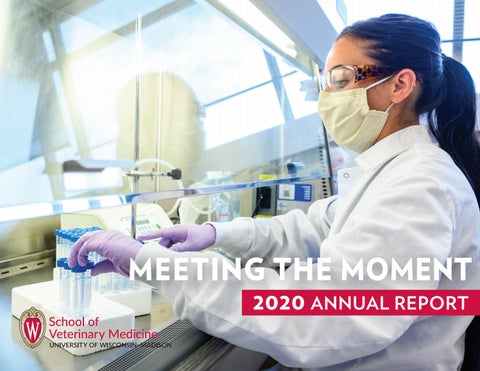
MEETING THE MOMENT 2020 ANNUAL REPORT
CONTENTS
4
MESSAGE FROM THE DEAN:
From Prime Time to a Pandemic .
6
RISING TO THE CHALLENGE OF COVID-19
8
TRAINING FUTURE VETERINARIANS
10
DELIVERING COMPASSIONATE CARE
12
Administration
FOSTERING NEW SCIENTISTS & NOVEL DISCOVERIES
MARK D. MARKEL Dean
14
Writing & Editing MEGHAN LEPISTO Publications & Media Relations Manager
RUTHANNE CHUN DVM’91 Associate Dean for Clinical Affairs
Design & Production ASHLEY VOSS Communications & Marketing Manager
NANCY PARKINSON Assistant Dean for Human Resources ED RODRIGUEZ Associate Dean for Budget & Finance PEGGY SCHMIDT Associate Dean for Professional Programs
16 18
ADVANCING THE SCHOOL
RECOGNITION FOR EXCELLENCE & SERVICE
COVER: Megan Skoyen DVMx’22 dispenses viral transport media for COVID-19 test kits that are being created at the Wisconsin Veterinary Diagnostic Lab (WVDL) at UW-Madison. The WVDL is partnering with the Wisconsin State Lab of Hygiene, University Health Services, the School of Medicine and Public Health and others on campus to conduct widespread COVID-19 testing for all students, faculty and staff. (Photo: Bryce Richter)
Editorial Staff
DALE BJORLING Associate Dean for Research & Graduate Training
LYNN MAKI Associate Dean for Student Academic Affairs
FURTHERING THE WISCONSIN IDEA
2020 ANNUAL REPORT
KRISTI V. THORSON Associate Dean for Advancement & Administration LAUREN TREPANIER Assistant Dean for Clinical & Translational Research KEN WALLER MS’07, DVM’07 Assistant Dean for Clinical Affairs
Photography DENISE GARLOW MEGHAN LEPISTO BRYCE RICHTER/UW-Madison
The UW School of Veterinary Medicine uses gift funds to produce its publications. To donate to the school, contact: PAT BOWDISH Managing Senior Director of Development pat.bowdish@supportuw.org (608) 332-4750 HEIDI KRAMER Senior Director of Development heidi.kramer@supportuw.org (608) 327-9136
Learn more about the ways the UW School of Veterinary Medicine is advancing animal and human health:
vetmed.wisc.edu uwveterinarycare.wisc.edu animalsneedheroestoo.com
@uwvetmed
This report is also available online at vetmed.wisc.edu/annual-report ©2020 Board of Regents of the University of Wisconsin System
MESSAGE FROM THE DEAN
FROM PRIME TIME TO A PANDE EMIC The 12 months covered within this annual report encompass a year of highs and lows, elation and upset. Yet one thing has remained consistent: Each opportunity and challenge has been met with and showcased the tremendous dedication and resolve of the school’s faculty, staff, students, and supporters. Beginning with one of the highest of plateaus, July 2019 saw more than a decade of effort from the School of Veterinary Medicine rewarded when our building expansion and renovation project, essential to our future success and excellence, was enumerated and signed into law in the 2019-21 state budget. This critical achievement was made possible through the foresight and support of friends of the school, as well as Chancellor Rebecca Blank and other campus and UW System leaders, Wisconsin legislators, and Governor Tony Evers. In the state budget, the school was asked to raise $38 million in gift funds toward our $128 million building project. A $15 million gift from the Wisconsin Alumni Research Foundation in September pushed us beyond the $38 million goal, providing sufficient funds to design and then begin construction of the expansion. The school continues 4
University of Wisconsin School of Veterinary Medicine
Our elation continued when in February the school was featured in a Super Bowl commercial broadcast to millions – a once-in-a-lifetime opportunity that I never could have imagined. David MacNeil, founder and CEO of WeatherTech, chose to honor his golden retriever Scout and the School of Veterinary Medicine in the company’s 2020 Super Bowl spot, in gratitude for the cancer care Scout received at UW Veterinary Care. Following the commercial’s release, the school received gifts from all U.S. states and around the world in support of our clinical research to advance cancer treatments and technology. Equally important, the ad spotlighted on a global stage the crucial — and sometimes overlooked — impact of veterinary medicine in providing care for beloved companions and advancing research that benefits animal and human health. Scout, unfortunately, passed away in March, but his legacy continues in our work to advance innovative therapies to fight cancer and other devastating diseases. BRYCE RICHTER
Then, this spring, the novel coronavirus struck and we, like all the world, have ever since been adapting. With tremendous patience, expertise, and resolve, our faculty and staff have continued to deliver outstanding instruction, research, and clinical care in safe and effective ways. In response to the pandemic, many of our faculty are vetmed.wisc.edu
Heartbreakingly, numerous recent incidences of violence against Black Americans have illuminated the racial injustices wrought by — and still prevalent in — this nation. The school is steadfastly committed to diversity, equity, and inclusion, and understanding and addressing racism. Forging a supportive institutional culture for all students, faculty, and staff, and recruiting and ensuring academic success for a diverse student body, have been part of our foundational priorities for many years. We will redouble these efforts under the leadership of Richard Barajas, who was hired this spring into the new position of director of diversity, equity, and inclusion and joined the school in September. My hope over the coming years is that we will be known as one of the most inclusive and diverse schools on the UW-Madison campus and a leader nationally in these efforts, and that all marginalized communities will feel a sense of belonging and inclusion in the profession of veterinary medicine, and specifically within the UW TOP: The new Lot 67 parking structure across the School of Veterinary Medicine. The months ahead will undoubtedly continue to bring wide-ranging challenges. I know we will rise to meet these moments while strengthening the education of our students, the clinical care provided to patients, and our research to benefit both animals and people. For your passionate and dedicated support of our work, thank you. I wish you and your families all the best as you navigate these difficult times.
BRYCE RICHTER
Design for the building project is nearly complete and construction on the parking ramp across from the school, to make space for our adjacent expansion, is scheduled for completion this December. Building expansion construction is slated to begin in 2021, with completion in 2023. The renovations in the current building should be done by the end of 2024. I look forward to continuing to update you as the project advances, and to one day welcome you into this new space.
studying ways to better understand, control, and prevent this and future outbreaks. This has led to the highest annual grant award amount in the school’s history at $28.4 million — a testament to our international leadership in infectious disease research.
2020 ANNUAL REPORT
to raise the funds needed — an additional $15-20 million — to fully outfit the building with the specialized equipment required by our complex clinical cases, research laboratories, and teaching spaces.
street from the Veterinary Medicine Building will be complete in December, making way for construction of the school’s expansion to break ground in 2021. BOTTOM: Richard Barajas joined the school in September as its first-ever director of diversity, equity, and inclusion.
ON, WISCONSIN!
Mark D. Markel Dean, UW School of Veterinary Medicine Vilas Distinguished Achievement Professor 5
RISING TO THE CHALLENGE OF COVID-19 Patient, dedicated, flexible, resilient — these are just a few words to describe the commitment shown by School of Veterinary Medicine faculty, staff, and students while navigating the uncharted territory of COVID-19. Throughout this pandemic and the hard work required, we have remained devoted to exceptional instruction, clinical care, and research.
Devotion through Drastic Change
When teaching abruptly moved online in March for the remainder of the spring semester, faculty, staff, and students demonstrated flexibility, devotion, and drive to creatively find ways to deliver instruction remotely. Instructional teams determined how best to adapt and ensure that students could complete the academic year. Faculty and staff swiftly learned new technologies and modified teaching materials. For fourth-year veterinary medical students, clinicians and staff worked rapidly to implement clinically relevant virtual experiences, including online rounds and hospital cases streamed through live and recorded video. Lab instructors worked adeptly to mimic hands-on experiences. The school’s Personal and Wellness Support Services (PAWSS) shifted online to support students virtually amid an uptick in anxiety, depression, and mental health needs. With all in-person events canceled on campus, the school also ensured that students had the opportunity to celebrate their achievements. Members of the SVM family and loved ones tuned in to a virtual Celebration of Excellence in April. In May, the Class of 2020’s graduation and investiture ceremony was celebrated online, with hopes of holding a future in-person event in coordination with UW-Madison. Lessons learned from the experience will carry forward to future instruction, whether in-person, virtual, or a hybrid form — the current approach for the fall 2020 semester. 6
University of Wisconsin School of Veterinary Medicine
RESEARCH HIGHLIGHTS: •
From the outset of the pandemic, virologist Thomas Friedrich and collaborators began parsing the genetic sequences of virus samples from patients in Wisconsin. These genetic signatures allow scientists to follow how the coronavirus spreads through the world, helping determine whether an outbreak is due to community spread or an introduction into a community due to travel. He and colleagues are now working on a saliva test for the virus.
•
An international collaboration of virologists at the School of Veterinary Medicine and the vaccine companies FluGen (co-founded by the SVM’s Yoshihiro Kawaoka and Gabriele Neumann) and Bharat Biotech has begun the development and testing of a unique vaccine against COVID-19 called CoroFlu.
•
Professor Adel Talaat, an expert on nanotechnology-based vaccines, is also working on a potential vaccine against COVID-19, based on technology previously developed to combat another kind of coronavirus that causes disease in poultry.
•
In addition to working toward a vaccine, Kawaoka is studying how SARSCoV-2, the virus that causes COVID-19, is transmitted and causes disease. A study of Syrian hamsters (which share important features of human disease) showed the animals develop infections deep in their lungs with damage similar to human patients, developed antibodies protecting them against future infection, and responded well to treatment with antibodies from the blood of other hamsters that had been infected. The work demonstrates that hamsters are an important animal model for evaluating vaccines, treatments, and drugs against COVID-19.
•
In addition, Kawaoka’s lab demonstrated that cats can readily become infected with SARS-CoV-2 and may be able to pass the virus to other cats. Importantly, none of the SARS-CoV-2-infected cats showed symptoms of illness.
Professor Thomas Friedrich, for example, is part of a collection of researchers at more than 30 institutions putting their skills together to study coronavirus and sharing all they find among the group. “It’s all of us in humanity against the virus, so we need to pool our resources,” he says.
•
This work highlights the school’s long history of international leadership in infectious disease research, as well as veterinary medicine’s critical contributions to tackling urgent health challenges, be they human or animal.
Professor and Shelter Medicine Program Director Sandra Newbury DVM’03 is leading a study in several U.S. states to test animal shelter cats that might have previously been exposed to human COVID-19 cases, and worked with the CDC and American Veterinary Medical Association to develop recommendations for shelters housing potentially exposed pets.
•
Professor Jorge Osorio and colleagues are studying the effectiveness of dogs trained in immediate scent detection of SARS-CoV-2. Initial findings suggest dogs could be useful to diagnose viral infection in humans.
Initially, in mid-March, UW Veterinary Care closed temporarily when a School of Veterinary Medicine employee was diagnosed with COVID-19. During the closure, care continued for hospitalized patients and clinicians remained available remotely to consult with outside veterinary medical practitioners. The hospital reopened the following week to serve life-threatening emergencies and current patients requiring ongoing treatments or medically necessary appointments. Since then, operations gradually increased to include additional cases, with strict safety protocols in place to protect the health of clients, staff, and the community. New services have also been introduced to help reach pets and people despite the pandemic, including a Primary Care telemedicine service. Throughout, Ruthanne Chun DVM’91, associate dean for clinical affairs and teaching hospital director, has worked tirelessly to keep herself and colleagues apprised of rapidly changing protocols and procedures in line with veterinary medical and public health guidelines. For months she has been in consultation with other veterinary medical teaching hospitals and worked to update key stakeholders, including clients, referring veterinarians, and our own UW Veterinary Care team. Through the university’s Badger Talks statewide outreach series, Chun also brought viewers behind the scenes of UW Veterinary Care in June for a special tour delivered online that, to date, has been viewed more than 7,000 times.
Advancing the Fight
School of Veterinary Medicine researchers are leading several studies at the forefront of fighting COVID-19, helping to address major challenges of the disease and advance vaccine, treatment, and containment strategies. Findings have been shared globally not only with fellow scientists but also with the public through myriad media interviews and online presentations.
2019 ANNUAL REPORT
Persevering for Patients
TRAINING FUTURE VETERINARIANS You can’t be what you can’t see, as the adage goes. More than 90 percent of veterinarians in the United States are white, and veterinary medicine remains one of the least diverse professions in the country.
This is just one of many efforts underway at the SVM to help prospective students learn more about veterinary medicine, recruit to the school and profession a diverse population of students that better represents society, and support their academic success. Our Office of Academic Affairs attends college fairs; conducts outreach to campuses, middle and high schools; engages with school counselors, parents, teachers, pre-vet clubs, academic advisors, and practitioners; and participates in workshops and events for underrepresented populations. The school also has numerous efforts underway to recruit, select, and retain a diverse workforce and enhance the inclusive climate at the school. This past fall, the SVM engaged all first-year veterinary medical students in a diversity dialogue to enhance students’ understanding of diversity and their peers’ experiences. The school also cosponsored an interprofessional lunch and learn series focused on topics related to equity, diversity, and inclusion impacting the health sciences, including mental health in diverse communities, the impact of race-based stress, and equity and bias in healthcare. 8
Clinical Assistant Professor Grayson Doss teaches a group of students from the Class of 2020 during a reptile handling lab in 2019.
MEGHAN LEPISTO
To increase outreach to diverse communities, inspire young people toward veterinary medicine, and help diversify the veterinarian workforce, this year the UW School of Veterinary Medicine established a chapter of the national program How We Role. The program curriculum was created for children in grades K–4 who are educationally disadvantaged due to socioeconomic status, race, or ethnicity, aimed at helping kids learn about the breadth of careers in veterinary medicine and how veterinarians’ work benefits both people and animals. Starting in the spring 2020 semester, members of two of the school’s student organizations – Veterinarians as One Inclusive Community for Empowerment (VOICE) and Veterinary Medical Outreach Organization (VMOO) — with the guidance and support of Professor Joan Jorgensen DVM’93 and admissions staff |member Carmen Reamer began implementing the program’s fun and engaging lessons with students at the Boys and Girls Club of Dane County.
As one important sign of progress, students who are Black, Indigenous, or from other underrepresented racial and ethnic groups represent one quarter of the school’s incoming Class of 2024 (24 of 96 students). Nationally, the number of racially and/or ethnically underrepresented DVM students currently stands at 17.4 percent of total enrollment – a figure that continues to rise.
Infrastructure Updates
Just as the school continuously innovates its curriculum to prepare students for a breadth of careers and professional opportunities, we also evolve our teaching spaces. This year we renovated the school’s two teaching laboratory spaces with updated lighting, AV functionality, lab benches, and more to better support student learning. The school’s previous clinical skills lab (separate from the Clinical Skills Training Center in the new Renk Learning Center) was also renovated with new surgical equipment and instrumentation to create a multipurpose space for clinical teaching, resident and faculty training and research, and support of multiple courses and labs. We also improved continuity across fourth-year students’ clinical rotations, better defined clinical competencies and rotation outcomes, and used feedback from student evaluations in multiple preclinical, lab-based courses to guide the development of instructional resources that enhance student learning.
In response to student feedback, in October the school hosted a Career Exploration Day for all current veterinary medical students. The event featured a panel discussion with alumni from a variety of career paths, a career fair with employers representing a range of areas in the profession, and social time and networking. Through a separate opportunity, students also received individualized feedback on their resumes and cover letters.
100%
The school continues to develop seminars and workshops focused on mental health support and financial OF SCHOLARSHIP planning. This year we hosted Mental APPLICANTS Health First Aid training and two RECEIVED AID presentations on suicide prevention, Total student aid awarded as well as drop-in support groups (2019-20): $2M for first- and second-year students focused on transitional issues and concerns typically encountered early in the curriculum, and for third- and fourth-year students exploring topics such as imposter syndrome, stress management, and transitions into a new role. Also, at new student orientation last fall students explored how to deal with failure as part of the educational process and learned how to appropriately use financial resources to support the DVM education. In addition, the school hosted a financial wellness workshop series, bi-monthly visits from the Office of Financial Aid to assist students with financial aid and loan questions, a lecture on student loan management, and individual meetings with financial advisors for students in the graduating Class of 2020 to discuss loans, financial planning, contract negotiations, insurance, and other topics.
96%
OF THE CLASS OF 2020
secured jobs or continued with their educational training by August 2020
vetmed.wisc.edu
DVM Student Debt Load* Upon Graduation * includes those with no DVM debt, total educational debt
UW AVERAGE
$119,960 NATIONAL AVERAGE
$162,436
Class of 2024 // AT-A-GLANCE
96
STUDENTS ACCEPTED out of a highly competitive pool of 1,267 applicants 188 WI RESIDENTS 1,079 NON-RESIDENTS
RESIDENCY WI Resident 62 Non-Resident 34
46
Undergraduate colleges & universities represented
WI Residents
PRIMARY AREAS OF INTEREST
Students from the Class of 2024 have a diverse range of interests, as indicated on their applications
FOOD ANIMAL - 15 OTHER* - 11
SEX
Woman Man
MIXED - 10 79 17
WILDLIFE/ZOO - 8 EQUINE - 8
82% Women
ACADEMIC BACKGROUNDS
17
ACROSS THE UNITED STATES
SMALL ANIMAL - 36
65%
3.67 AVERAGE GPA
AVIAN/EXOTICS - 4 RESEARCH/INDUSTRY- 4
2019 ANNUAL REPORT
Better Prepared for Life and Careers
different undergraduate majors represented
• • • • • • • • • • • • • • • • •
Animal Science Anthropology Biochemistry Biological Sciences Biology Biomedical Science Chemistry Classical Civilization Dairy Science Ecology Integrative Biology Journalism Microbiology Neuroscience Psychology Veterinary Medicine Zoology
* Includes laboratory animal, shelter medicine, public health, and undecided interests
9
DELIVERING COMPASSIONATE CARE When clinicians at the UW School of Veterinary Medicine began caring for Scout in July 2019, they had no idea they would soon inspire, and appear in, a Super Bowl commercial. But they had a canine star on their hands and a very appreciative client who set in motion the ad’s production. As Super Bowl LIV aired in February, Scout appeared alongside members of the school’s faculty and staff who were part of the 7-year-old golden retriever’s cancer treatment journey. The commercial, paid for by WeatherTech, manufacturer of automotive accessories and home and pet care products, followed Scout’s journey, encouraged viewers to donate to the school’s cancer research efforts, and highlighted the importance of this work in advancing innovative cancer treatments and technology. Scout was a member of the family of WeatherTech founder and CEO David MacNeil. Sadly, Scout passed away in March, but he beat the odds against a grave prognosis for even short-term survival.
WEATHERTECH
Last summer, Scout collapsed and was rushed to his local animal hospital, where an ultrasound revealed a tumor on his heart. He was diagnosed with hemangiosarcoma, an aggressive cancer of blood vessel walls, and given a life expectancy of no more than one month without treatment. Searching for more information, Scout and his family traveled to UW Veterinary Care on the recommendation of their local veterinarian. Specialists arrived at a cutting-edge treatment plan that included chemotherapy, radiation therapy, and immunotherapy. By September, his heart tumor was 90 percent smaller than its original size and he maintained an exceptional quality of life. Even before Scout’s inspirational and heartwarming story aired during the Super Bowl, it generated global attention across social media and in hundreds of news stories. In the weeks following the commercial’s release, it continued to elevate the university’s faculty and staff, share a cancer research message worldwide, and lift the entire veterinary medical field.
UW-MADISON
10
Thousands of donations from all 50 states, plus several foreign countries, have had an immediate impact, allowing the school’s Oncology Service to hire an additional clinical trials intern (a post-graduate veterinarian pursuing specialty training), move ahead with more oncology clinical trials, and purchase specialized equipment, including a new radiotherapy delivery system that incorporates several important treatment advancements. University of Wisconsin School of Veterinary Medicine
One example is the interdisciplinary, pioneering approach of clinicians like Jason Bleedorn, an orthopedic surgeon who utilizes 3D printing to produce patient-specific bone models for clinician use at UW Veterinary Care and across the country. For recent patient Jem, a young rescue dog from Indiana now in a loving adoptive home, this meant remedying a complex deformity that others believed to be unfixable. Jem’s front legs curved inward like a banana due to a bone deformity. Bleedorn used advanced computer-assisted design software to virtually design and plan 3D models for Jem’s corrective surgeries, and manufactured leg bone models with the school’s 3D printing technology. First, he used the models to rehearse correction options for Jem’s deformity. Then, he 3D-printed custom cutting guides for use in the operating room with Jem. Our experts also helped develop a new computed tomography (CT) scanner that is the first on the market to vertically scan the lower legs of a standing, sedated horse and horizontally scan the head and neck. Because the patient can remain standing, there is no need for general anesthesia. This now makes CT technology available to “almost every patient and client that walks through our door since it’s safe, fast, and costeffective,” says Clinical Associate Professor Samantha Morello. vetmed.wisc.edu
2020 ANNUAL REPORT
Whether our patients are Super Bowl celebrities or simply the stars of their own family, we value every animal we serve and work to find ways to help clients and patients in every situation. This includes developing innovative treatments and technologies that create new possibilities in patient care.
MEGHAN LEPISTO
COURTESY JASON BLEEDORN (2)
Ideas Become Reality
(Left) Orthopedic surgery patient Jem visits UW Veterinary Care prior to surgery. (Middle) A 3D leg bone model used to plan Jem’s corrective limb procedures. (Right) An equine patient receives a standing CT of the head and neck in the Morrie Waud Large Animal Hospital.
The system fills a longstanding, unmet need in the diagnosis and treatment of a variety of conditions facing horses and other large animals; CT images provide improved imaging of bone and soft tissue compared to traditional X-rays, aiding more definitive diagnoses and treatment plans. The first-ever machine became available for patients of our Morrie Waud Large Animal Hospital in 2019. It has led to findings undetectable by earlier diagnostic methods and could aid early detection of equine stress injuries, helping to prevent fractures. The technology also has applications in human medicine. Intellectual property from the machine is being licensed to develop a standing CT that more precisely delivers radiotherapy to human cancer patients in an upright position, minimizing the risk for unnecessary side effects.
PATIENT VISITS // AT-A-GLANCE (2019-20) Canine - 18,779
Avian - 589
Feline - 4,114
Lapine - 531
Equine - 948
Bovine - 175
Other* - 1,057
*includes Rodentia, Reptile, Porcine, Mustelidae, Camelid, Insectivora, Caprine, Marsupial, Ovine, Primate, Fish, Amphibian, and other mammals.
11
FOSTERING NEW SCIENTISTS & NOVEL DISCOVERIES It’s been a record year for the School of Veterinary Medicine research enterprise. This fiscal year the school was awarded over $28 million of research grant support – the highest award amount the school has ever achieved and 45 percent higher than the previous fiscal year. This tremendous achievement is made possible by the scientific acumen and broad talent of our faculty, staff, and students, as well as the cross-cutting impact of research pursued within our walls to address critical animal and human health challenges, from the novel coronavirus to cancer prevention. To expand our diverse team of high-caliber faculty, in 2018-19 the school added two new faculty positions and welcomed five new tenure track faculty with strong research interests. As an indication of our scientists’ leadership in their fields, in July 2019 Professor Hannah Carey became president of the Federation of American Societies for Experimental Biology, an organization representing 29 scientific societies with a membership of more than 130,000 researchers worldwide. Carey is the first president in the group’s 107-year history whose appointment is in a School of Veterinary Medicine. The school’s Comparative Biomedical Sciences (CBMS) graduate program continues to garner a top 10 national ranking for its research performance among 51 programs in veterinary medical sciences according to Academic Analytics, a distinction it has received for many consecutive years. The program’s interdisciplinary breadth trains scientists at the leading frontiers of biomedical research. Speaking to the excellence of students in the program, CBMS students garner highly competitive research support, which this year included a fellowship from the National Science Foundation and a grant from the Morris Animal Foundation.
12
University of Wisconsin School of Veterinary Medicine
The year saw a range of transformative research milestones from the School of Veterinary Medicine aimed at tackling global health challenges. Continuing the school’s leadership in infectious disease research and vaccine development, clinical trials are underway for a new Ebola vaccine and universal flu vaccine created by SVM scientists, and faculty were involved in the development of a new vaccine against the mosquito-borne viral disease dengue fever. MEGHAN LEPISTO
Senna, a 9-year-old Catahoula leopard dog, receives an exam at UW Veterinary Care as part of his treatment for cancer. The School of Veterinary Medicine has been awarded a grant to bring physicians and veterinarians together to advance knowledge of shared diseases across different species, such as cancer.
Translational Health Benefits
In 2019 the school was awarded a five-year, $3 million grant from the National Institutes of Health to bolster efforts to bring physicians and veterinarians together to study shared diseases across different species. Because of their familiarity with the comparative aspects of disease, veterinarians are uniquely positioned to contribute expertise to translational research teams in support of human and animal health. “Our goal is to leverage the skills of veterinary specialists and bring them into research teams, helping physicians and Ph.D. researchers see that many of the diseases they study also occur in animals, and what veterinarians know about these diseases in animals can help advance treatment in people,” says Professor Lauren Trepanier, principal investigator on the grant and assistant dean for clinical and translational research. The training program will support the development of graduate veterinarians into skilled clinician-scientists and help address gaps in knowledge of human and animal diseases. The program offers two-year funded fellowships at 15 veterinary medical schools to provide targeted research training to veterinarians just out of residency; a biennial research immersion program to equip early-career veterinary faculty with more confidence as researchers; and a series of summits across the country to convene established veterinary and human medical researchers who are studying the same diseases. The initiative is part of larger efforts at the SVM to train the next generation of academic veterinarians in outstanding clinical skills, teaching abilities, and research capabilities. We continue to enhance the support and resources available for basic and clinical research, including providing faculty and trainee research opportunities, a monthly clinical research seminar series, and grant writing workshops. vetmed.wisc.edu
Our faculty pushed forward a better understanding of methods to evaluate new treatments for multiple sclerosis and Parkinson’s disease and provided important genetic insights into parasitic filarial nematodes. Researchers also helped develop a tiny, customizable nanocapsule that offers an alternative to viral delivery of gene therapy and are testing whether a state-of-the-art, ultra-thin bandage carrying antimicrobial silver can defeat the “biofilms” that shield bacteria from antibiotics.
2020 ANNUAL REPORT
Research in Action
In addition, SVM scientists showed that piperonyl butoxide, a chemical commonly used in household and agricultural insecticides, interferes with a critical developmental signaling pathway, resulting in stunted forebrain development and signature facial abnormalities. They also revealed how genes and hormones interact to develop male reproductive systems – a step toward illuminating why disorders in these organs have become more common and how we might prevent them. Finally, researchers are exploring how exposure to common environmental chemicals, like those found in tobacco smoke and yard products, and individual genetic differences in response to them, put dogs at risk for common cancers. Related to wildlife, our faculty identified a newly discovered virus infecting nearly a third of America’s bald eagle population; investigated wide spread die-offs of freshwater mussels nationwide; and are studying several aspects of whooping crane conservation. 13
FURTHERING THE WISCONSIN IDEA Every day, the UW School of Veterinary Medicine makes lives better by training veterinarians, conducting research that benefits animals and people, caring for patients, and providing service to the state and beyond. The Wisconsin Idea drives this work, inspiring us to improve people’s lives through research, teaching, and outreach. The application of our expertise to serve the citizens of Wisconsin and the world is broad, ranging from introducing youth to veterinary medicine at a local science celebration to traveling globally to consult on wildlife conservation or teaching a new toxicology course in Sierra Leone to help address pollution problems. This year our faculty also informed horse owners about emergent diseases and the need for vaccination, shared resources and recommendations regarding an increased incidence of heart disease in dogs on certain types of diets, provided training and technical assistance to animal shelters, and much more. Our outreach efforts also include offering timely insights to media and the public. In 2019-20, the SVM and its faculty, staff, students, and alumni were cited in news outlets more than 2,520 times, discussing everything from protecting yourself and your animals from ticks and mosquitoes to caution regarding blue-green algae. In another highlight, the school’s involvement in the Vaccination Against Canine Cancer study, the largest clinical trial in the history of veterinary medicine, was featured in a Big Ten Network LiveBig vignette airing during network programming.
Cut and Save
BRYCE RICHTER
14
In fall 2019 the School of Veterinary Medicine launched a partnership with the local nonprofit organization Madison Cat Project to host at the school monthly spay and neuter clinics. With approximately 60 surgeries completed at each daylong clinic, the events help students gain valuable hands-on experience while combatting cat overpopulation. The response from students has been so enthusiastic that there is at times a waiting list to assist. A majority of patients at the monthly clinics come from outdoor cat colonies. Following the Trap-Neuter-Return method advocated by animal sheltering professionals, the cats are humanely trapped by their caretakers, transported to the clinic to be spayed or neutered and vaccinated, then returned. These interventions stop reproduction, helping to control and, over time, reduce the colony’s population. University of Wisconsin School of Veterinary Medicine
A two-year, $600,000 grant from PetSmart Charities awarded in 2020 will support additional staff members, client services, and student training opportunities for Wisconsin Companion Animal Resources, Education, and Social Services (WisCARES), an outreach partnership of the UW–Madison schools of veterinary medicine, pharmacy, and social work.
BRAD CIRRICIONE
MEGHAN LEPISTO
Unconditional Love
A Journey Together
Students from the UW School of Veterinary Medicine are a key partner for Journey Together Service Dog Inc., a nonprofit charitable organization that provides highly trained service dogs at no charge to Wisconsin residents diagnosed with PTSD.
The initiative’s biannual workshops on facility design also continued to be well-received by farmers, veterinarians, nutritionists, and other industry consultants. Program faculty and staff presented on dairy cattle housing, lameness prevention, calf care practices, and more to nearly 3,000 attendees at over two dozen events in nine countries. And the program’s free smartphone apps for dairy producers were downloaded more than 850 times in 2019.
Dogs in training reside at the Oshkosh Correctional Institution, where inmates provide their care and training. Students visit the prison monthly to present veterinary lessons on common dog illnesses, disease prevention, and first aid procedures to help inmates know what signs or symptoms to watch for in the dogs. “When the students come in and teach things, the medical reports that come out of the prison are significantly better,” says Brenda Cirricione, director of training for Journey Together. “I have stronger confidence that the men won’t miss a symptom of a serious condition.”
The program has continued its growth since relocating to a larger facility in spring 2018, adding surgical and dentistry procedures, an x-ray unit, in-house laboratory testing, and new business hours, now open five days a week. The southside Madison neighborhood surrounding WisCARES is considered a veterinary desert, lacking veterinary clinics and pet care resources.
Since 2012, nearly 180 inmates have volunteered with the program. After two years of training dogs are placed with clients with PTSD, ranging from military veterans to domestic abuse victims. The program benefits the inmates, as well; its emphasis on teamwork, empathy, critical thinking, communication, and other versatile skills help the men prepare for life and employment following release.
BRYCE RICHTER
WisCARES provides veterinary medical care, housing support and advocacy, pet boarding and fostering, a pet food and supply pantry, and other services to Dane County pet owners experiencing or at risk of homelessness, as well as the county’s lower socioeconomic population.
vetmed.wisc.edu
The school’s Dairyland Initiative, which provides producers the information they need to build well-designed cattle housing that optimizes cows’ well-being, had one of its most impactful years in 2019. Visitors to the program’s website, where all content is now available for free due to generous sponsor support, almost tripled this year, totaling nearly 17,000 users worldwide.
2020 ANNUAL REPORT
Delivering for Dairy Farmers
PHOTOS: (Left)Johnnie, a six-year-old Collie, stands patiently as Priscilla Naula DVM’20 assists with his care at the Wisconsin Companion Animal Resources, Education, and Social Services (WisCARES) clinic in South Madison in 2018. (Middle) A Journey Together service dog comforts his owner. (Above) Holstein cattle eat feed at the UW Dairy Cattle Center on Sept. 1, 2020.
15
ADVANCING THE SCHOOL Hospital clients, clinic sponsors, alumni, community members, industry partners, and more — the UW School of Veterinary Medicine receives the gracious support of donors from all walks of life with gifts of all sizes, all of which make a difference.
The school continued its fundraising success in the 2019-20 fiscal year. From July 1, 2019, to June 30, 2020, the school saw the support of nearly 8,900 total donors, securing $12.8 million in new gifts and pledges. By the end of the fiscal year, we had raised a cumuluative $45 million toward the building expansion campaign. Through June 30, we also raised $123 million in UW-Madison’s All Ways Forward comprehensive campaign, which launched in 2013. Funds raised through this campaign have provided not only support for the building expansion, but also allowed for investments in our faculty, research, and substantial new commitments to scholarship support for students. In addition, campaign success includes future estate gifts that have been documented, which will ensure long-term investments in the school. Tantamount to this year’s momentum was the school’s appearance in WeatherTech’s 2020 Super Bowl commercial alongside Scout, the beloved golden retriever of WeatherTech founder and CEO David MacNeil. Since the airing of the commercial, thousands of generous animal lovers have made gifts to support our clinical cancer research and aid the purchase of specialized equipment that will help clinicians and researchers in identifying new cancer-fighting drugs and treatments. Gifts have ranged from $5 to $50,000 in generous support from State Farm Insurance and $250,000 from Petco Foundation. This has had an immediate impact on our Oncology Service (see page 10), showing the potential created by many donors coming together to make an impact.
FLAD ARCHITECTS
None of our accomplishments would be possible without the generous support of friends of the school. Gifts have driven substantial new commitments to scholarship support for students; allowed for investments in exceptional faculty, pioneering research, and life-saving discoveries; secured cutting-edge diagnostics and equipment for our teaching hospital; advanced essential renovations and the school’s forthcoming building expansion; ensured long-term investments through future estate gifts; and much more.
Building Our Future
Following the inclusion of the School of Veterinary Medicine’s building expansion project in the 2019-21 Wisconsin budget that Governor Evers signed into law in July, the school remained focused on raising the $38 million in private gift support needed to allow the building expansion project to be bid and constructed. State-supported borrowing in the state budget will fund approximately two-thirds of our $128 million expansion and renovation project, while the school was committed to raising the remainder of funds. In a critical milestone, a $15 million gift from the Wisconsin Alumni Research Foundation in September pushed the school past the necessary $38 million. The building project has since advanced on several important fronts. A five-story parking garage in the east half of the large parking lot across from the school is slated for completion this December to make room for the building expansion. And we are actively designing the expansion with Flad Architects, Foil Wyatt Architects & Planners LLC, Affiliated Engineers, Inc., and representatives from UW-Madison, UW System, and Wisconsin’s Department of Administration. The design will be completed later this year, with construction to begin in spring 2021 and completion of the addition projected for 2023. Renovations of the existing building are to be finished in late 2024. We remain focused on continuing to raise more than $15 million more in gift funds to fully outfit the building with the specialized equipment required by our complex clinical cases, research laboratories, and teaching spaces.
16
University of Wisconsin School of Veterinary Medicine
For 30 years, gifts to the Companion Animal Fund in honor of beloved animals have supported critical health care studies at the School of Veterinary Medicine, yielding advancements in the diagnosis, treatment, and prevention of disease. Discoveries to emerge from fund-supported studies include more effective pain control, improved surgical methods, and new insights into debilitating diseases, helping pets in our care and around the world live longer, healthier lives. Donations to the Companion Animal Fund most often originate as gifts made in honor of pets who have passed away. Gifts come from veterinary clinics that have cared for the animals and established strong ties with the school, as well as individual donors. Thanks to donors’ generosity, we have increased Companion Animal Fund research support by more than 100 percent over the past four years, most recently awarding $182,000 to 20 projects in 2019.
Celebration Fit for a Laureate
In July 2019 we welcomed back to campus William C. Campbell MS’54, PhD’57 to recognize his many contributions to the school, UW–Madison, and beyond. Campbell was a recipient of the 2015 Nobel Prize in Physiology and Medicine for the discovery of the drug avermectin (and its derivative, ivermectin). These drugs were found to be highly effective against a wide variety of parasites, with enormous impact on both veterinary and human medicine – today alleviating the burden of many parasitic infections in livestock, companion animals, and people worldwide.
vetmed.wisc.edu
DENISE GARLOW
At a July 2019 campus reception in his honor, William C. Campbell (right) shares a laugh with Marulasiddappa Suresh (left), Director of the Comparative Biomedical Sciences Graduate Program and John E. Butler Professor of Comparative and Mucosal Immunology,
Campbell’s research into parasites and parasitic diseases started as a graduate student at UW in the Department of Veterinary Science, the precursor to the SVM’s Comparative Biomedical Sciences graduate program. Campbell recently provided a gift to the university to establish the William C. Campbell Excellence in Parasitology and Vector Biology Award, which will support an annual award for graduate student training and research in these areas.
8,892
TOTAL DONORS (2019-20) $12.7 MILLION TOTAL NEW GIFTS AND PLEDGES
Financials EXPENDITURES BY SOURCE
22.8%
% OF BUDGET FROM STATE SUPPORT IN 2020 2019 - 24% 2018 - 24%
2017 - 25% 2016 - 29%
EXPENDITURES BY PURPOSE (in millions) Teaching Hospital (21.0M)
(in millions)
$82.3M
2020 ANNUAL REPORT
The Gift of Better Health
$82.3M
School (17.6M)
Gifts $6.8M
Student Aid $2.5M
Grants $21.2M
Instruction $38.6M
Program Revenue $21.6M
Other* $8.2M
Tuition $13.9M
Research** $33.0M
GPR* $18.8M * State appropriations (less estimated tuition and fees)
* Student services, public service, and academic support ** Primarily research grants and contracts
17
RECOGNITION FOR EXCELLENCE AWARDS
Kristen Bernard
Fellow, American Academy of Microbiology
Hannah Carey
2020 Postdoctoral Mentoring Award
Nigel Cook
AWARDS & HONORS HIGHLIGHTS (2019-20)
Christopher Dold DVM’01
Each year, the school’s students, faculty, and staff earn numerous accolades in a wide variety of fields, as exemplified in the list below.
Lynn Maki
This is not a comprehensive list of awards and honors, only a representative sample from July 1, 2019 – June 30, 2020.
Sheila McGuirk
More at go.wisc.edu/svm-awards-honors.
Don Kahn Award, American College of Veterinary Microbiology
HEIDI KRAMER
2019 WVMA Veterinarian of the Year Award National Humanitarian Medal, American Humane
Ian Duncan
2020 John Dystel Prize for Multiple Sclerosis Research, National MS Society Seven Seals Award, Employer Support of Guard and Reserve Honorary Klussendorf Award
Sarah Raabis
Linda Schuler
Veterinary Research Excellence Award, Zoetis
Kristi Thorson
2019 WVMA Friend of Veterinary Medicine Award
Chad Vezina
Vilas Faculty Mid-Career Investigator Award
Karen Young
2019 Lifetime Achievement Award, American Society for Veterinary Clinical Pathology
LEADING THE WAY
Marie Bucko DVMx’21, Douglas Kratt DVM’98 and Mark Markel round out a trifecta of leaders of national veterinary medicine organizations with connections to the UW School of Veterinary Medicine. The trio in 2019-20 served in the roles, respectively, of president of the Student American Veterinary Medical Association, president-elect of the American Veterinary Medical Association, and President of the Association of American Veterinary Medical Colleges.
LEADERSHIP ROLES Kristen Bernard
President, American Society for Virology
Hannah Carey
President, Federation of American Societies for Experimental Biology
Ruthanne Chun
President, Oncology Specialty, American College of Veterinary Internal Medicine
Distinguished Veterinary Teacher Award, Zoetis 18
University of Wisconsin School of Veterinary Medicine
RECOGNITION OF SERVICE Jill Pelisek
Margo Edl
Janet Raddatz
Patrick S. Farrell MS’83, DVM’87*
John Schaefer ’81
Charity Gottfredsen ’02, MS’07, DVM’07*
Karl Solverson ’94, DVM’99*
Dan Grimm
Thomas Torhorst ’65
Melita F. Grunow
Karen Walsh ’81, MA’89
Peter Hanson MS’94, PhD’97*
All degrees listed are earned from UW-Madison. * Indicates alumni of the UW School of Veterinary Medicine.
Fitchburg, Wisconsin
Middleton, Wisconsin Russell, Pennsylvania
THANK YOU TO OUR 2019-20 BOARD OF VISITORS The Board of Visitors for the UW School of Veterinary Medicine serves as an external advisory body to the dean of the school. Members of the board have attained prominence in their respective careers and are chosen because of their value in providing sound advice and counsel to the dean. Read more about the board members at vetmed.wisc.edu/board-of-visitors.
Chicago, Illinois
Waterford, Wisconsin Lake Geneva, Wisconsin Boston, Massachusetts
Janet Hoehnen
Milwaukee, Wisconsin
Alan Holter
Dodgeville, Wisconsin
Milwaukee, Wisconsin Plymouth, Wisconsin Harshaw, Wisconsin Westby, Wisconsin Racine, Wisconsin
Madison, Wisconsin
OUR THANKS TO THE SVM ALUMNI ADVISORY BOARD
The Alumni Advisory Board enhances the school’s support of and relationship with alumni by providing input on alumni-related activities and communications and the best ways to keep alumni connected.
Nancy Ballsrud MBA’75
Phil Jennings JD’93
John Baumann ’82
Diane Larsen ’80, DVM’90, PhD’99*
John Been DVM ’88*
Steve Larson MS’70
Debbie Cervenka
Jeffry A. Neuenschwander ’82 Detroit, Michigan
Dawn Mogilevsky DVM’90
Terrence Clark DVM’87*
Esther Olson
Kathy Reilly DVM’90
Minneapolis, Minnesota Monroe, Wisconsin
Prairie du Sac, Wisconsin Santa Rosa Beach, Florida Cottage Grove, Wisconsin
vetmed.wisc.edu
Madison, Wisconsin Duluth, Georgia
Fort Atkinson, Wisconsin
Belleville, Wisconsin
2020 ANNUAL REPORT
Tim Connor EMBA’09
Monica Bender DVM’91 Sharon Campbell DVM’88 Holly Hovanec DVM’18 Diane Larsen DVM’90, PhD’99 Jennifer Lorenz DVM’09
Ty Vannieuwenhoven DVM’89 19
Non-profit Organization U.S. POSTAGE PAID MADISON, WI PERMIT NO. 658
2015 Linden Drive Madison, WI 53706
SEW GRATEFUL
It took Cindy Pischke over an hour to sew her first golden retriever-themed face mask. Now, after sewing more than 85 masks for Facebook friends across the country, Pischke can sew a mask in under 20 minutes. The project began at the onset of the COVID-19 pandemic, with a request for a face mask from an immunocompromised friend. It has since gained momentum as a fundraising effort to benefit the UW School of Veterinary Medicine, where Pischke and her husband Peter brought their golden, Patience (pictured), for advanced surgical care.
We thank the generous donors who provided funding for the production of this publication.