14 Feature
Western Eye December 2012
Feature
What is the AGM?
> Following the last AGM in November, Sangita Lal explains how it works and why it is so important
Sangita Lal feature@westerneye.net
W
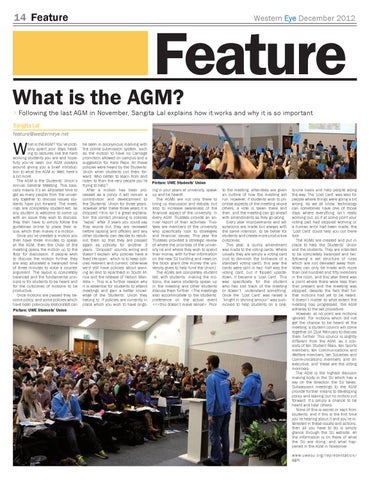
hat is the AGM? You’ve probably spent your days heading to lectures like the hard working students you are and hopefully you’ve seen our AGM posters around giving you a brief introduction to what the AGM is. Well, here’s a bit more. The AGM is the Students’ Union’s Annual General Meeting. This basically means it’s an allocated time to get as many people from the university together to discuss issues students have put forward. The meetings are completely student-led, as any student is welcome to come up with an issue they wish to discuss; they then have to simply follow the guidelines online to place their issue, which then makes it a motion. Once you’ve created a motion you then have three minutes to speak at the AGM, then the Chair of the meeting opens the motion up to the floor for discussion. If people wish to discuss the motion further they are also allocated a balanced time of three minutes to voice a counter argument. The layout is completely balanced and the fundamental principle is for students to be heard and for the outcomes of motions to be productive. Once motions are passed they become policy, and some policies which have been previously elaborated can Picture: UWE Students’ Union
be seen in anonymous marking with the online submission system, such as the motion to have no Carnage promotion allowed on campus and a suggestion for Halls Reps. All these policies were heard by the Students’ Union when students put them forward. Who better to learn from and listen to than the very people you’re trying to help? After a motion has been processed as a policy it will remain a contribution and development to the Students’ Union for three years. However after these three years it is dropped <this isn’t a great explanation the correct phrasing is policies “lapse” after 3 years you could say they expire but they are reviewed before lapsing and officers and any other students can decide to resubmit them so that they are passed again as policies for another 3 years. “Dropped” sounds wrong and doesn’t explain why policies have a fixed life span, which is to keep policies relevant and current, otherwise we’d still have policies about wanting an end to Apartheid in South Africa and the release of Nelson Mandela >. This is a further reason why it is essential for students to attend meetings and gain a better knowledge of the Students’ Union they belong to. If policies are currently in place which you wish to have ongo-
Picture: UWE Students’ Union ing in your years at university, speak up and be heard! The AGMs are not only there to bring up discussion and debate, but also to increase awareness of the financial aspect of the university. In every AGM, Trustees provide an annual report of their activities. Trustees are members of the university who specifically look to strategies and financial issues. This year the Trustees provided a strategic review of where the priorities of the university lie and where they wish to spend their money, with further information on the new SU building and news on the block grant (the money the university gives to help fund the Union) The AGMs are completely student led, with students making the motions, the same students speak up in the meeting and other students discuss them further. <The meetings also accommodate to the students’ preference on the actual event <<<this doesn’t make sense>. Prior
to the meeting, attendees are given an outline of how the meeting will run. However, if students wish to prioritise aspects of the meeting above others, a vote is taken there and then, and the meeting can go ahead with amendments as they go along. Every year improvements and adaptations are made but always with the same intention, to be better for students and create more productive outcomes. This year, a quirky amendment was made to the voting cards. Where usually they are simply a voting card (not to diminish the brilliance of a standard voting card), this year the cards were split in two: half was the voting card, but if flipped upsidedown, it became a ‘Lost Card’. This was specifically for the student who has lost track of the meeting or doesn’t understand something. Once the ‘Lost Card’ was raised a “knight in shining armour” was summoned to help students on a one-
to-one basis and help people along the way. The ‘Lost Card’ was also for people where things were going a bit wrong. As we all know, technology can sometimes have one of those days where everything isn’t really working out, so if at some point your voting pad had stopped working or a human error had been made, the ‘Lost Card’ could help you out there too! The AGMs are created and put in place to help the Students’ Union and the students. They are intended to be completely balanced and fair, following a set structure of rules which are not deviated away from. Votes can only be made with more than one hundred and fifty members in the room, and this year there was a point where there were less than that present and the meeting was stopped, despite the fact that further motions had yet to be heard. It doesn’t matter to what extent the meeting has progressed, the AGM adheres to the set procedure. However, at no point are motions ignored. For motions which did not get the chance to be heard at the meeting, a student council will come together on 21st February to discuss them further. This council is slightly different from the AGM, as it consists of ten Student Reps, ten Sports members, ten Communications and Welfare members, ten Societies and Communications members and an executive, and these are the voting members. The AGM is the highest decision making body in the SU which has a say on the direction the SU takes. Subsequent meetings to the AGM provide further means to developing policy and leaving out no motion put forward. It’s simply a chance to be heard and hear others. None of this is secret or kept from students, and if this is the first time you’re hearing about it and you’re interested in these issues and actions, then all you have to do is simply glance through the SU website. All the information is on there of what the SU are doing, and what happened in the AGM in November. www.uwesu.org/representation/ agm