




In the United States, citizens have the opportunity to participate in their government and influence policy decisions through voting. It’s not often that you hear someone critique this basic premise of our government. On paper, it is perhaps the best system in the world. But a small addition to my first statement reveals a problem that is not often discussed: in the United States, citizens have the opportunity to influence policy decisions through voting, even if they have absolutely no understanding of the policies about which they are voting. An area where this has become an increasingly prevalent issue is in the world of economics. Economic policy decisions are crucial to battling issues such as the climate crisis. Through economic policy, we can shift incentives and correct market failures by applying costs to the destruction of the environment. There are decades of accumulated knowledge and proof of efficacy of certain environmental-economic policy solutions, yet many of these policies have never come to fruition. It’s like giving a student all the answers to an exam and them still answering questions wrong. A classic example is carbon-pricing
policies. In general, carbon-pricing policies incentivize the development of green energies by putting a price on a firm’s ability to pollute. This idea was first introduced in 1973 by British-born engineer David Gordon Wilson, who proposed a tax on large, polluting firms’ CO2 emissions. Since then, carbon-pricing has moved to the forefront of economic research. In accordance with economic theory and decade’s worth of data from small-scale implementation, economists have essentially reached a consensus on these policies: they are both effective (reduce emissions) and efficient (cost-effective). However, small-scale implementation of these policies is not enough, and international coordination and stronger policies are needed to reach acceptable emissions standards. Carbon-pricing policies, unfortunately, are just one instance of economic academia being ignored on the political stage. So, what exactly is the barrier between economic knowledge and policy implementation? I argue that there are two main factors: economic illiteracy and the political economy. Survey studies show that the majority of the adult population has a basic understanding of
economics, but struggle when it comes to specifics and policy implications. Voters make decisions based on their preconceived notions about what certain economic policies are trying to achieve, which are oftentimes completely misguided. For example, in a 2019 survey conducted by Hunger Free America, over 70% of self-identified Democrats supported increased federal spending on the U.S. food stamp program, SNAP. However, economic research indicates that the most effective policy at reducing hunger is direct cash assistance, or Universal Income. By voting for politicians who support increased spending on SNAP, these voters are unknowingly upholding a program that has proven to be ineffective in comparison to programs in other developed nations. Economically illiterate voters view the problem too simply: food insecurity is a major problem in the United States, so increased spending on the current nutritional assistance program must be a desired policy. The issue is that this is not the best policy; The U.S government has the capability to be much more effective at reducing food insecurity. This example illustrates
the problem of economic illiteracy perfectly: voter decisions are not based on concrete results from policy implementations, but rather on whether or not their
people. Similarly, to right-leaning voters, a politician who proposes a carbon tax does not care about business owners and the free market. The reality is that in both
economic implications of a carbon tax.
The interplay of our Democratic institutions with self-seeking individuals, political parties, and interest groups is the other side of the policy implementation barrier.

International Monetary Fund
December 2019 Study: Projected carbon tax revenue from $35/$75 per ton carbon tax.
preconceived idea of a policy fits their moral values. To most left-leaning voters, a politician who disagrees with increased spending on SNAP does not care about poor
of these cases, the voters have a fundamental misunderstanding of what these policies actually achieve.
Of course, it is unrealistic to expect every one of these left-leaning voters to read the countless publications on SNAP and its alternatives, just as it is unrealistic to expect every right leaning voter to research all the
Economic-environmental policy decisions are made by political representatives with compromised interests, not economists. Just as most voters do not consider the concrete results of economic policies, neither do politicians. Instead, politicians devote time, energy, and money into figuring out which policies will garner support from their voter base, rather than figuring out what policies will reach their intended goals. The two-party system creates a grouping of economic policies under the labels of “Democrat policies” or “Republican policies” so that voters do not evaluate their stance on policies individually. And just as these voters are influenced by the two-party system, politicians are confined to certain ideologies in order to maintain support within their party. In other words, politicians are hesitant to support certain policies which may not align with their political party for fear that they will lose their party’s support. One can compare the Democrat and Republican parties to factories producing inelastic goods: they continuously produce politicians to represent their seldom-changing set of policies, and their voter bases vote for (consume) these candidates without second thought. If these politicians shift their rhetoric and offer support to policies on the other side of the political spectrum or to more extreme policies, they are cast out of their party
(defective) and demand from their voter base disappears.
To put a cherry on top, money is a major influencer in the political economy and is a determinant of what policies we see politicians supporting. Corporations, labor unions, single-issue organizations, and other interest groups spend billions of dollars hiring lobbyists who advocate on behalf of their clients for certain policies. In the case of the environment, there are two sides trying to influence the direction of policy: environmentalists and businesses with non-renewable energy interests. Interest groups on the environmentalist side consist of non-profit organizations and businesses with renewable energy interests. Contrast this with interest groups on the other side, which consists of mega-corporations like ExxonMobil, Chevron, BP, Shell, and others, and the most pertinent issue with environmental policy implementation is revealed. Renewable energy interest groups are simply not able to compete with large, polluting firms on the political stage, leading to disastrous effects. During the last midterm election, non-renewable energy interest groups outpaced renewable energy groups thirteen to one in terms of political giving. While it is difficult to quantify the exact impact that lobbying discrepancies have on the outcome of legislation, some experts believe it is one of the most significant contributors to stalling climate action. In 2009, a national emissions cap-and-trade scheme (a form of carbon-pricing) called the Waxman-Markey bill passed through the house of representatives but failed in the senate. Researchers concerned with
why this bill failed hypothesized that lobbying was a major player, so they attempted to quantify the impact it had through research. They estimated that lobbying decreased the probability of the bill passing from 55% to 42%. In other words, lobbying was likely the deciding factor as to why we failed to implement a national emissions cap-and-trade scheme.

The issue I have presented in this piece is an incredibly frustrating and complex one with no simple solution. To approach this problem, one would need to completely re-envision the structure of our democracy and redetermine who is responsible for economic policy decisions. If we wanted to separate economic academia from politics, one idea is the creation of “economic administrations.” Similar to how the Federal Reserve Board of Governors is appointed, the president would appoint an independent group of economists to make economic policy decisions for a certain number of years. This would limit political bias, as the group would consist of pure
InfluenceMap Spring 2019 report on climate lobbying.
academics whose decisions are not being influenced by lobbyists. However, attempting to increase the input of economists in policy decisions is a slippery slope, as the trade-off is a less direct say in government from individual citizens. Perhaps some of the more feasible ideas come in the form of increasing economic literacy. Specifically, increasing general understanding of how economics intersects with everyday life and political outcomes. I believe an introductory economics course should be mandatory at every high school, and students should learn about market failures and inefficiencies our current economy is facing. This would lead to increased awareness of the intersection of economics and environmentalism and promote more informed voter decisions.
Individual citizens having a voice in politics is a critical part of freedom for many Americans, but we must accept that this comes with tradeoffs. In the words of Nobel prize winning economist George
Stigler, “The public has chosen to speak and vote on economic problems, so the only open question is how intelligently it speaks and votes.”
Big oil’s real agenda on climate change. InfluenceMap. (2019, March). Retrieved December 30, 2021, from https://influencemap.org/report/How-Big-Oil-Continues-to-Oppose-the-Paris-Agreement38212275958aa21196dae3b76220bddc
Dolšak, N., Adolph, C., & Prakash, A. (2020, July 6). Policy Design and public support for carbon tax: Evidence from a 2018 US National Online Survey Experiment. Wiley Online Library. Retrieved December 29, 2021, from https://onlinelibrary.wiley.com/doi/full/10.1111/ padm.12657
Fernald, L. C. H., & Gosliner, W. (2019, December). Alternatives to snap: Global approaches to addressing childhood poverty and food insecurity. Retrieved March 1, 2022, from https://www.ncbi.nlm.nih. gov/pmc/articles/PMC6836775/
Kirk, K. (2021, April 2). Fossil fuel political giving outdistances renewables 13 to one. Yale Climate Connections. Retrieved December 29, 2021, from https://yaleclimateconnections.org/2020/01/fossil-fuel-political-giving-outdistances-renewables-13-to-one/
Lubrano, A. (2019, November 27). Most voters in both parties support increasing food stamps for those in poverty, poll finds. Retrieved March 1, 2022, from https://www.inquirer.com/news/ trump-food-stamps-poverty-impeachment-holiday-20191127.html
Report of the high-level commission on carbon prices. Carbon Pricing Leadership Coalition. (2017, May 29). Retrieved December 29, 2021, from http://www.carbonpricingleadership.org/report-of-the-highlevel-commission-on-carbon-prices
Rosentiel, T. (2020, May 30). Public knows basic facts about politics, economics, but struggles with specifics. Retrieved March 1, 2022, from https://www.pewresearch. org/2010/11/18/public-knows-basic-factsabout-politics-economics-but-struggleswith-specifics/
Study quantifies lobbying influence on Climate Change Policy. UCSB Bren School of Environmental Science & Management. (2019, May 27). Retrieved December 29, 2021, from https://bren.ucsb.edu/news/ study-quantifies-lobbying-influence-climate-change-policy
Walstad, W. (1998, December 1). Why it’s Important to Understand Economics. Retrieved March 1, 2022, from https:// www.minneapolisfed.org/article/1998/ why-its-important-to-understand-economics#:~:text=George%20Stigler%2C%20a%20Nobel%20Laureate,because%20it%20contributes%20to%20two
In 2020, the Korean movie “Parasite” won Best Picture in the Oscars, making a name not only in the film industry but around the globe. This film became extremely renowned because it profoundly depicted the ingrained inequalities in South Korea’s society - the suffocating contrasts of the rich and the poor. But inequality is not confined to South Korea or nearby East Asia regions; inequality happens nearly everywhere. America, for example, also stands for a place in which diversified, promising opportunities are generated, but intensified inequalities are hiding beneath.
Iris Soojin Park, an undergraduate economics alum at the University of Wisconsin-Madison, examined opportunity inequality to infer income inequality in the U.S. and her home country of South Korea in her thesis “Inequality of Opportunity in the United States and South Korea.”[1] Normatively

speaking, everyone may deserve an equal opportunity in an ideal society. Yet, in reality, we often see people attain different levels of education and engage in divergent jobs. Research even suggested that such variances could stem from your zip code and neighborhood from early childhood stages[2]. Economists try measuring these ‘variant outcomes’ by the Lorenz Curve, the derived Gini coefficient, or the other empirical methods, while the income(general) inequality naturally exists. Then the consequent question people might ask is: What is this income inequality attributable to? The composition of the income inequality can be mainly divided into two categories - the opportunity inequality and the effort inequality. The opportunity inequality and its factors “circumstance variables” capture the conditions that one can hardly decide on their own, such as sex, race, and family background. The effort inequality, on the other hand, implies the “effort variables” and situations in which one can utilize different degrees of effort to achieve distinguished individual outcomes. In this research, effort variables are simply defined as all the non-circumstance variables.
To further discuss her research models, Park explains that her
research method was based on the previous study of Checchi and Peragine (2010), with two parts “ex-ante,” focusing on circumstances, and “ex-post,” focusing on effort, approach, which both measure income inequality[3]. The ex-post approach which Park implemented suggests that the opportunity equality among each person should appear once individuals’ degree of effort is controlled. To control the effort l evels, XWS is denoted to the smooth income vector (XS) that captures the effect of circumstances on individuals’ income. Similarly, to control the circumstance levels, XBS is denoted to capture the effect of effort on individuals’ income. The Mean Log Deviation (MLD(X)) is then used to measure the Inequality Indexes, with I(XS) representing general income inequality, I(XWS) representing opportunity inequality, and I(XBS) representing effort inequality. The fraction I(XWS) / I(XS) means overall share of income inequality caused by opportunity inequality, and I(XBS) / I(XS) means overall share of income inequality caused by effort inequality. Thus, these two proportions and the MLD indexes could be used for further inference. While circumstance has been commonly discussed while
identifying income variation and inequality, discussion of the effects of effort variables does not gain enough attention as it should. The value of Park’s research stands right on this foothold that she built an analysis of the U.S. and South Korea regarding the composition of income inequality with the circumstance/effort variables examination, since not so much precedent studies using this method have been conducted in the U.S. It is worth noting that in this study Park defined circumstance variables and effort variables to be independent of each other, which might not always be the real case. An obvious counterexample is the education an individual can achieve. Education level is often the mixed result from both circumstance and effort, as one might work hard on coursework, engage in myriads of extracurriculars, and probably have supporting family backgrounds. This situation is simplified in Park’s research assumptions extending for empirical analysis. Speaking of the datasets, Park analyzes demographics in the US and South Korea. The former includes sex, race, income level, and the
education level of parents with a sample size of 25,000 throughout 2007-2017, and the latter considers labor information, income, and parents’ education level and occupation with a sample size of 7,800 from 2003-2019, discarding ethnicity since South Korea is relatively racially homogeneous. The statement that “Income inequality is significantly affected by opportunity inequality” might be already expected, and Park’s findings certify it with several more statistical findings. First of all, individual circumstances (i.e. opportunity inequality) still affect income inequality (i.e. general inequality) to a great degree, with a percentage of 18% in the U.S. and 22% in South Korea. These statistics also suggest that an individual’s sex and parental education, which are listed under circumstance variables of the opportunity inequality, play prominent roles in determining one’s income in South Korea than in the U.S. Furthermore, while South Korea reveals a relatively greater opportunity inequality than the U.S., the general income inequality is adversely larger in the U.S. than in South Korea. This result implies individual effort (effort inequality) impacts a higher proportion of income inequality in America than in South Korea. Lastly, in terms of regional analysis, while
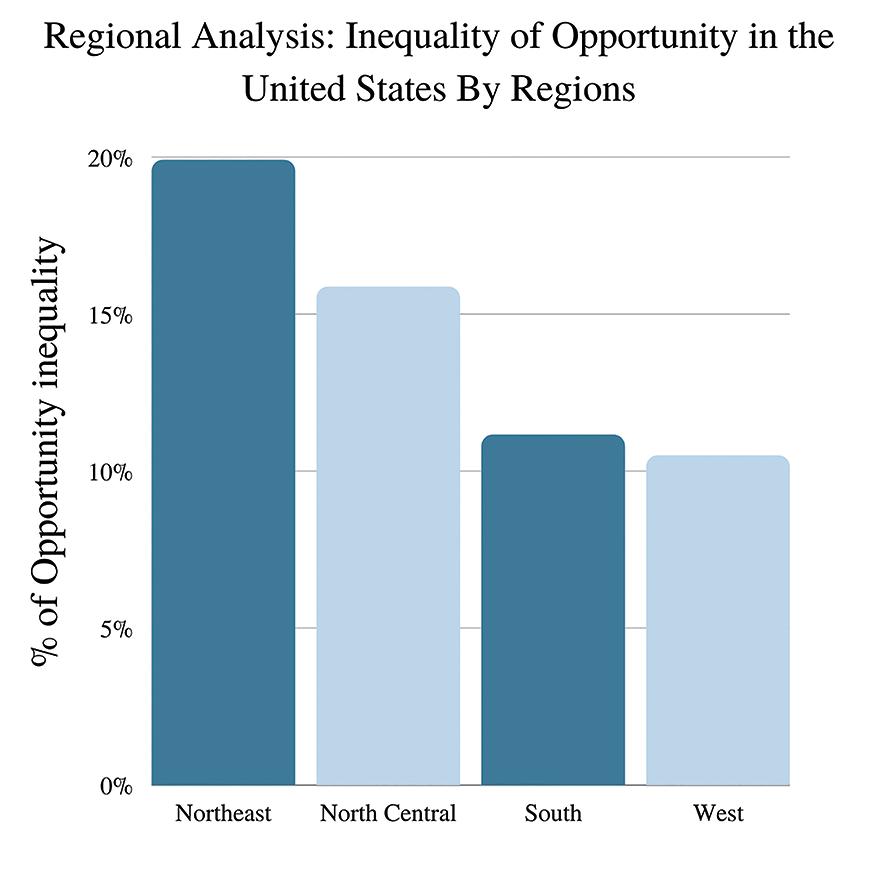
the difference of opportunity inequality in South Korea is not significant, the U.S. displays huge divergence among different areas. Generally, the Northeast has a more significant opportunity inequality than the South and the West, and a potential cause may be the relative abundance of high-skilled laborers in the Northeast. While people in the Northwest put in great effort to acquire higher degrees of education, it is possibly not enough for them to get jobs from such a competitive environment, which means parents’ privileged ability derived from educational background (circumstance) is still a critical factor in these young students’ ability to ‘realize’ their academic credentials into high salaries. This alerts the issue of intergenerational mobility[4][5].
Our general expectation of income inequality and opportunity inequality is validated in Park’s study, but there remains some room for justification. As a first limitation discussed previously, this study assumed effort is independent of circumstances, saying that it fits empirical cases. But sometimes there are occasions that we can

not easily define which category a situation belongs to. For example, Park listed education acquired, labor market participation, and birth choice as counterexamples of her core assumption, and these violations are simplified in the research assumptions so that they could fit empirical cases. However, a question might arise is that when a determinant commingles with both the circumstance and effort categories and is simply omitted, the interpretation of the percentage of income inequality caused by opportunity inequality apparently would also be affected/ distorted. Park did not justify this issue clearly, which might mitigate the credit of the research result. Secondly, Park’s study would be more inclusive and well-rounded if it had run “state-by-state” analysis in the U.S. and had explained why the rural area of South Korea has a higher total inequality and opportunity inequality than Seoul Metropolitan. The former is mainly restricted by the fact that not enough sufficient and varied datasets were acquired amongst the states. The latter, though not stated in her study, is quite intriguing while inspecting the statistical results and leaves room for eliciting further arguments and study. Meanwhile, the composition of the general inequality figure shown in this study is partitioned with respect to sex, and the treatment of these partitions of the “South Korea vs the U.S.” analysis caused a bit of confusion. Understandably, a circumstance variable is chosen to illustrate the opportunity inequality share, but we would also be interested in seeing the result if examined by race or the other circumstance variables, given that race
might provide a different angle of interpreting the percentage of opportunity inequality in varied areas. It would be better if we see such comparisons in this study. Also, the location partitions of the U.S. are divided into four areas - Northeast, North Central, South, and Westwhile South Korea is simply defined as Seoul vs Rural area. Even though it is stated that regional differences in South Korea are not significant, the yardstick of this comparison identifying “significant” remains unanswered in this study.
Overall, despite the several limitations discussed above, this research still confirmed our intuition of how opportunity/effort inequality affects income/general inequality. Park suggests a compelling answer to “Why does individual effort yield higher outcomes in America than in South Korea”- it is due to the differences in education systems and the scarcity of workers possessing post-secondary degrees in these two countries. Accordingly, the data reports that 70% of the young population in South Korea earns a college degree[6], dominating that of 47% in America[7]. Since the scarcity of higher degrees of education for a laborer is relatively low in South Korea, it will be more challenging for a South Korean student to compete for a job and thus the outcomes for a South Korean student’s effort would t ypically be lower than for an American. This inference is aligned with her finding that the Northeast has a larger opportunity inequality than the South and the West. Following a similar argument, we could restate that ample opportunities for higher-level educ ation are provided in South Korea

and the Northeast area, compared domestically, the marginal benefit of acquiring higher degrees diminishes and thus it is not enough for young adults in these areas to realize their education into high returns.
Park, I., (2021). Inequality of Opportunity in the United States and South Korea. Department of Economics, the University of Wisconsin-Madison.
Chetty, R., & Hendren, N. (2018). The Impacts of Neighbor hoods on Intergenerational Mobility I: Childhood Exposure Effects. Quarterly Journal of Economics, 133(3), 1107–1162. https://doi-org.ezproxy.library. wisc.edu/https://academic.oup.com/qje/ issue
Checchi, D., & Peragine, V. (2010). Inequality of opportunity in Italy. The Journal of Economic Inequality, (8), 429–450. https://doi.org/10.1007/s10888-009-9118-3 Aiyar, S., & Ebeke, C. (2019). Inequality of Opportunity, Inequality of Income and Economic Growth. IMF Working Paper. Chetty, R., & Hendren, N. (2018). The Impacts of Neighborhoods on Intergenerational Mobility II: County-Level Estimates. Quarterly Journal of Economics, 133(3), 1163–1228. https://doi-org.ezproxy.library. wisc.edu/https://academic.oup.com/qje/ issue
Kim, V. (2019). In a tough market, young South Koreans vie for the security of government jobs. Los Angeles Times. https://www.latimes.com/world/asia/la-fgsouth-korea-jobs-20190206-story.html
Frezza, R., Ayres, C., Aghanoury, P., Coffman, T., & Johnson, J. (2018). South Korea Has the Most Educated Young People in the Entire World. College Media Network. https://www.collegemedianetwork.com/ south-korea-has-the-most-educatedyoung-people-in-the-entire-world/

Every investor’s goal is to beat the market at the lowest possible cost, measured by risk. However, not every market participant can achieve such a performance. Because of the way financial markets are designed, for every win there is a corresponding loss. With the development of the Modern Portfolio Theory, most analysts’ perceptions of risk and return have changed. The secret? Diversification. Even though research in finance has proven that diversification has its advantages, some wealthy and successful investors, such as Warren Buffett, argue against it.
To begin with, those in favor of the Modern Portfolio Theory, which states that for every reward, there is a corresponding risk, claim that diversifying one’s investments across different asset classes or securities can help achieve a stable return. Spreading investment risk is based on simple statistics such as standard deviation, and correlation coefficients1. In other words, for investors to secure their portfolio’s return against risk, they
should employ statistical models that minimize the level of risk for each additional percentage point increase in return.
On the other hand, there is plenty of evidence that rejecting the Modern Portfolio Theory can bring outstanding results, and the most remarkable example is Warren Buffett. As Frazinni et al.2 point out, Buffett’s success has mainly been due to his ability to construct a theory of investing that focuses on navigating high risk, instead of avoiding most of it. This approach contradicts the Modern Portfolio Theory, more specifically its claim that investors should invest in multiple asset classes to avoid the risk of owning only a few risky securities. One common statistic used to calculate the return per level of risk is the Sharpe ratio. To find the Sharpe ratio, an investor takes the portfolio’s return, subtracts the risk-free rate, and then divides this difference by the standard deviation of the portfolio’s return. The higher this ratio, the better a portfolio or an indexfund is managed. Frazinni et al.3 also show
that Buffett’s Sharpe ratio, which is consistently above the market’s, does not compare to what most professionals demand. In other words, it seems that Buffett can earn significant returns per risk, but since his Sharpe ratio is below standards, it implies that there must be an additional factor that contributes to his long-lasting success. Buffett has an investing advantage compared to his competition, the investment fun ds. For example, Ellispoints out that most investment funds tend to underperform relative to their benchmarks. So, it seems that there must be a secret in investment theory that differentiates Warren Buffett from other investors. One suggestion is that most fund managers tend to be active investors, meaning that they aspire to beat the market by constantly buying and selling securities. As Ellis5 states, one major drawback of excessive buying and selling of securities relates to the costs associated with numerous trades. In other words, it seems that active trading is not the key to success, because after all, nothing is free in
the investment world, not even making a transaction.
To provide additional evidence against the Modern Portfolio theory, here are some of Warren Buffett’s thoughts on the Modern Portfolio Theory and the financial theory that is highly acclaimed in schools. In one interview, Buffet claimed that the current theory of investments - mainly the Modern Portfolio Theory - is very misleading6. He states that this is not the way investing should be taught. He then continues to explain that it is a mistake to associate a company’s high rate of return with a high degree of risk7. Based on these insights from “The Greatest Investor of All Time,” it is evident that rejecting the Modern Portfolio Theory can bring fortune to wise investors.
Based on these two opposing views, it seems that the investment theory that is taught in most business schools can be deceptive. I agree, however, that it can help aspiring investors get a better understanding of how capital markets work, but most students tend to overlook this information. What they want to understand is how to build wealth and not make foolish mistakes with their investments. In addition, it can be hard to believe that the Modern Portfolio Theory can make you a billionaire, while Warren Buffet keeps claiming that he does not believe in it.
After all, Buffett has been named the best investor of all time! He keeps consistently making impressive returns on his investments. Based on this, I think that professors need to change the information they teach in finance and investment classes. Maybe there needs to be less focus on the relationship between risk and
returns. Instead, aspiring professionals should learn to focus their attention on how a business works and why it generates certain returns.
In conclusion, it seems that the Modern Portfolio Theory, especially the idea of diversification, can be misleading. If we acknowledge that its scope is to help minimize the risk that arises in portfolio construction, then the theory provides valuable insight. If, however, we think about achieving extraordinary returns on our investments, then the theory fails to provide us with an answer. After all, everyone hopes to beat the market and to become wealthy. In my opinion, to achieve those goals and to become financially independent, investors should not base their judgment solely on the Modern Portfolio Theory.
1Rasiah D. Post-Modern Portfolio Theory Supports Diversification in an Investment Portfolio to Measure Investment’s Performance. Journal of Finance and Investment Analysis. 2012;1(1). Retrieved from: https://ezproxy.library.wisc.edu/login?url=https://www. proquest.com/scholarly- journals/ post-modern-portfolio-theory-supports/ docview/2573397251/se-2.
2 Frazzini, A., Kabiller, D., C.F.A., & Pedersen, L. H. (2018). Buffett’s Alpha. Financial Analysts Journal, 74(4), 35-55. Retrieved from: https://ezproxy.library. wisc.edu/login?url=https://www.proquest. com/scholarly-journals/buffetts- alpha/ docview/2139472034/se-2
3 Frazzini, A., Kabiller, D., C.F.A., & Pedersen, L. H. (2018). Buffett’s Alpha. Financial Analysts Journal, 74(4), 35-55. Retrieved from: https://ezproxy.library. wisc.edu/login?url=https://www.proquest. com/scholarly-journals/buffetts- alpha/ docview/2139472034/se-2
4 Ellis, C. D., C.F.A. (2012). Murder on the Orient Express: The Mystery of Underperformance. Financial Analysts Journal,
68(4), 13-19. Retrieved from: https://ezproxy.library.wisc.edu/login?url=https://www.proquest.com/ scholarly-journals/murder- on-orient-express-mystery-underperformance/ docview/1033569434/se-2?accountid=465
5 Ellis, C. D., C.F.A. (2012). Murder on the Orient Express: The Mystery of Underperformance. Financial Analysts Journal, 68(4), 13-19. Retrieved from: https://ezproxy.library.wisc.edu/login?url=https://www.proquest.com/ scholarly-journals/murder- on-orient-express-mystery-underperformance/ docview/1033569434/se-2?accountid=465
6 Niebuhr, K. (2017). Warren Buffett and Charlie Munger vs Modern Portfolio Theory.
Karlbooklover.com. Retrieved from: https://www.karlbooklover.com/
7 Niebuhr, K. (2017). Warren Buffett and Charlie Munger vs Modern Portfolio Theory.
Karlbooklover.com. Retrieved from: https://www.karlbooklover.com/

Professor Noah Williams is the Curt and Sue Culver Professor of Economics and an Adjunct Fellow at the Manhattan Institute. A graduate of the University of Chicago, he was formerly an Assistant Professor at Princeton University and is currently the director and founder of CROWE, the Center for Research on the Wisconsin Economy. In this interview we discuss the state of the Wisconsin economy, lessons learned from the pandemic, advice for undergraduates, and his upcoming research. Since this interview, Professor Williams released a paper exploring the effects of eliminating Wisconsin’s state income tax.
When did you discover economics?
I took an economics course in high school; It was really just personal finance like balancing your checkbook, but they called it
economics. We also watched Milton Friedman’s PBS series Free to Choose, which focused on a number of economic and policy problems at the time. I kept that in the back of my mind, but when I arrived at college I wanted to major in math and physics. After a year, I realized I was a bit over my head, so I was going to major in public policy and do something more applied. Economics seemed like a happy medium between the two using mathematical tools but then applying them to policy and politics.
After your undergrad at the University of Chicago, you were a research assistant at the Fed’s Board of Governors. Is this what led you to pursue graduate school?
Coming out of undergrad, I was fairly sure I wanted to do it. I had
actually applied to a few programs directly and thought about going straight through, but wanted to be sure and get a broader experience. I went to the Fed for two years and had a great experience there. I was able to learn more directly from economists and I worked on a couple of papers. One paper actually ended up getting published in the AER (American Economic Review) and it kind of became well-known in the area of banking crises—I was involved with some of the empirical work with that. Even though I was an economics major interested in math, I actually didn’t have that strong of a math background. So in my time off, I took some additional classes at George Washington University. It was a good transitional period, and I met my wife there.
Much of your research centers around macroeconomics, monetary policy, and state-level policy. Why those topics specifically?
Well, I think for a lot of people, the main interface between economics and the policy world comes through monetary policy. There’s fiscal policy as well, but that’s much more indirect and mediated through Congress with long delays. Economists have the most direct influence on monetary policy, so it seemed like a natural question. I guess it also ties into the theoretical questions about how we operate in the world of uncertainty or imperfect information— because this is something policymakers have to face.
What is the Center for Research on the Wisconsin Economy (CROWE) and your role within it?

CROWE is an economic research/policy center and I am currentlythe director. I was really the force in getting it off the ground. As a part of the Economics Department, our focus is on state-level economic and policy issues with an obvious focus on Wisconsin, but not solely. I got interested in starting this because there were a number of questions that came about by some local consulting groups and by the Economic Advisors Roundtable, organized with state agencies and commerce groups, regarding the regional economy. There’s a whole wealth of literature to draw on nationally or internationally to tackle these problems, but not much on the state level. So, aside from research, we also have an outreach component to businesses, policymakers, and community groups around the state. We also run a number of student research groups. At both the undergraduate and master’s levels, people start off by assisting on papers but ultimately we’ve had a number of papers co-authored with students in the past couple of years. If anyone is interested, they can reach out to me. We’ve also had activities where we bring speakers to campus, and that’s something we’re looking to continue as well.
In August, CROWE published a brief that found that in states which terminated their enhanced COVID unemployment benefits, there were positive effects on their labor market. Can you elaborate on your findings?
Yeah, so first a little background on the policy: The unemployment rate hit nearly 15% in April 2020 coming off record lows. As a policy response, Congress passed the CARES Act, and there were later variations that provided enhanced unemployment benefits. Unemployment benefits are a joint Federal and state program administered at the state level. A typical unemployment benefits program (in the absence of Federal interventions) provides six months of benefits and there’s a maximum you get in Wisconsin. On top of that, the Federal government provided an additional $600 per week, which continued through the fall. Later there was an extension which cut it to $300 that was extended again at the beginning of 2021. They also expanded the pool of people who could apply, including gig workers, part-time workers, and people with shorter work histories. So, alongside massive unemployment, we saw massive unemployment claims. With all social insurance programs, there’s a tradeoff between insurance and incentives. We want to provide insurance for people who were thrown out of work through no fault of their own. At the same time, we want to provide incentives for people to go back to work, understanding that all benefits provide somewhat of a disincentive. Then it’s just a question of how big that effect is and how do we balance the insurance versus incentives component. So with the $300 top-up, there were various calculations that found 40% of people who were unemployed earned more on unemployment than they did while they were working. So, at least for that class of people, it seems like these benefits provided a disincentive. Why go back to work if you’re earning more than you did on the job and you don’t have to pay taxes on it? You don’t have to commute, you don’t have to pay for childcare, and all these other side effects as well. The flip side is that these benefits were shorter duration. If you have a job offer out there, you may not want to leave that hanging to claim these benefits.
So, taking all of this into account, was there a measurable effect of these enhanced benefits on unemployment? I think the earliest programs
terminated around June—about half of states opted out early. So, what I did in that brief was I just looked comparatively at those states which ended benefits to see whether there was a notable effect. Adjusting for state and regional differences, what I found was there was a significant—but I would stay modest—impact on employment in the states that did end their benefits early. The effect was larger where you would expect it to be: in the industries that were the lowest-paying and hardest-hit by the pandemic, particularly hotels and restaurants.
How would you describe the current state of the Wisconsin economy?
I like to think of where we were before the pandemic, where we’ve been, and where we are now. Late 2019, early 2020, we had record low unemployment rates. The number one complaint of businesses then was finding people to fill open jobs. That’s the current complaint again even though unemployment is higher now than it was. Wisconsin bounced back from the pandemic relatively rapidly in the fall of 2020, but really since the beginning of this year we’ve seen relatively slow growth. The unemployment rate has been basically flat since December 2020. I think the last month (September) there were net zero jobs created—I think there was actually a slight decline. Still, employment has bounced back, but we’re still below where we were during the pandemic. Generally, there’s a lot of focus on the labor market because of all the anomalies we’ve seen. If we look more broadly at the economy, output is above pre-pandemic levels. There are big distributional questions there, but on average, incomes are up substantially, some of that coming from Federal transfers but also increased wages. It’s really the labor market where we’re seeing a lot of difficulties.
What assumptions in your research did the pandemic test? How has it changed your thinking?
Oh, that’s a good question. Coming back to the labor market, people argue about how responsive people are to changes in wages and changes in benefits. I think that there’s been a more general consensus over the past decade in economics that some of these effects aren’t as large as we first thought. So, like I said, there was a modest impact of these unemployment benefit programs. It’s probably smaller in the data than I
would’ve expected, ex-ante. Another economic outcome that surprised me was how rapidly people adapted. If you look at measures of consumption and retail spending, that had a very short dip but bounced back relatively quickly because people had many more margins of adjustment than we generally give them credit for. People went to the store less often, but when they did go to the store, they bought more. People move their purchases from in-store to online—that’s a huge change. They also change what they spent their money on, so instead of going out to restaurants, people bought things at home. So in the aggregate it doesn’t look big, but behind the scenes there’s a lot of variation.
How do you close the gap between policymakers aneconomists?
Overall, I think the gap has been narrowing over time in the sense that economic ideas seem to be circulated more rapidly and implemented faster than in the past. Maybe this is social media, maybe it’s the internet more broadly. Sometimes that’s good, sometimes the ideas aren’t fully worked out yet. There’s now a new infrastructure of various websites and publications which do a better job at translating some of the academic research into lay speak, like Vox. So I think the ideas are filtering out from the academy to the broader public much better. In monetary policy, the central bankers are becoming more academic. So a number of regional Fed Presidents are economics PhDs, whereas before many more of them had been drawn from the banking industry. It still seems like lawyers ended up in a lot of these top positions too, like Jerome Powell.
UW-Madison is one of the largest undergraduate producers of eventual economics PhDs in the country. Any advice for the many students here interested in pursuing further education in economics?
10 or 15 years ago, my advice would have been to take as much math as you can, particularly if you’re interested in a PhD. I think that’s still sound advice, but to be honest, that is less crucial than it used to be. I think there’s been a change in the profession more towards applied and empirical topics. So, I think developing a better sense of the world and what you want to study is equally important as learning the tools. It’s not just the technique, economics is about applying those to
interesting real-world questions. Previously, I think people with a more real-world focus may have been dissuaded but I think we’re seeing that come back now.
What’s coming next in your research?
There’s one project that I’ve been working on for a while. Some of it is related to the Center (CROWE). Some of it is gonna have an applied side and some of it gonna have an academic side. Broadly, the academic side is looking at models of state-level economies and the impact of policy at the state level doing theoretical modeling but also counterfactuals. So, if we were to change tax policy in Wisconsin, how would that affect output, employment, consumption, and so on? We will have some work on that coming out relatively soon. We’re thinking of a policy proposal about changing the tax structure in Wisconsin. Wisconsin is a relatively high income tax, low sales tax state. So we want to look at what would happen if we change that around—lowering income taxes and making up some of the revenue with an increased sales tax.

Ioften stumble into friendly debates with roommates or classmates surrounding sleeping habits and schoolwork. It seems the widely held belief is that unless you are a master of time management, sleep often comes second to schoolwork. Why do we value a little extra studying over a little extra sleep? I was curious how economists view this time versus productivity tradeoff. It turns out, the topic of sleep has rested heavily on the minds of economists and social scientists in recent years. Researchers are showing a growing sense of interest to include sleep as an economic variable in their social experiments. This in large part is due to the findings that demonstrate insufficient sleep and rising levels of sleep disorders are leading to lower productivity and in turn resulting in growing economic costs.[5] However, many of these studies are targeted at working adults, but what do these sleep studies mean for students? It turns out that because of the unquantifiable nature of productivity benefits, students tend to undervalue additional sleep. It is now widely established that insufficient sleep is harmful to your short and long-term physical health. In fact, the CDC has recently declared insufficient sleep a “public health epidemic.”[5] According to the Harvard Medical School, sleep deprivation is linked to higher mortality risk and many
health problems, including obesity, diabetes, high blood pressure, and heart disease.[1] The Harvard Medical School also explains that insufficient sleep can even potentially leave you “more vulnerable to mental health issues such as depression and anxiety.”[1] Not only does insufficient sleep have negative physical health effects, but several recent studies demonstrate the economic implications of a less productive, tired workforce.
On a microeconomic level, sleep was widely held as an economic constant in studies of economic decision-making and productivity until economist Dan Hamermesh published “Sleep and the Allocation of Time.” Hamermesh argued that time spent sleeping is inversely related to both the wage and the time spent working in the labor market. He concluded that sleep should be factored into economic studies more because the choice of how much to sleep is affected by the same economic variable as other consumer choices.[4] More recently, many studies are finding deeper relationships between sleep and productivity loss, with corresponding effects on national GDP. Studies find that even the smallest changes to increasing your sleep duration could have a significant impact on the economy. The Rand Corporation finds that “if individuals that slept under six hours
started sleeping six to seven hours then this could add $226.4 billion to the U.S. economy.[5] They calculate that the U.S. loses roughly $411 billion dollars, 2.2% of GDP, each year to a loss of productivity from insufficient sleep.[5] Another interesting study attempted to determine the correlation between salary and sleep duration. In our time zone system, according to the clock, “sunset happens roughly one hour earlier on the eastern edge of the time zone than the western edge.”[2] So in this study, researchers used two cities, one on the eastern edge of the central time zone and one on the west. They found that the further east you go, the more people tend to be sleeping. The researchers’ “main result is that sleeping one extra hour per night on average increases wages by 16%, highlighting the importance of restedness to human productivity. [2] This number may be surprisingly high and may lack causation in the experimental design, but it does give another hint as to the importance of restedness on productivity and economic outcomes.
“An individual that sleeps on average less than six hours per night has a 13 percent higher mortality risk than someone sleeping between seven and nine hours”
At this point, more studies like these are documenting varying aspects of sleep and its relation to economic topics. These studies are
fascinating and certainly worth examining, but what do they mean for students? Many of these sleep studies have focused on adult populations and specifically working populations, but students provide a different case study due to our varying incentives and definitions of “work.” For instance, in the most basic of utility functions, we learn that utility is a function of leisure and consumption, with consumption being the wage rate multiplied by the hours worked. However, “for a college student, a strict ‘wage rate’ does not exist.”[6] Essentially, college students’ “work” is made up of both academic priorities and extracurricular obligations - both not necessarily paid for by a measurable wage rate.[6] In a way, students are studying with a future wage rate in mind (which is heavily discounted) and you could even argue a negative wage rate from paying for education. Sleep is also a biological necessity, while our other consumer options, work, and leisure, are not by themselves necessities. This adds to the complexity of factoring in the choice of hours spent sleeping into a utility function. Essentially, this lack of a defined wage rate for students leads to a cloudy view of the benefits of additional sleep. It’s harder to grasp or see increases in productivity while studying than an increase in your earnings. Naturally, the question arises on the evidence surrounding sleeping more and higher student achievement. Many studies find it difficult to extract cause and effect relationships between sleep and student performance because of the complexity of factors affecting sleep decision-making. There are causal questions of whether it’s just true that students who sleep more perform better rather than more
sleep being the cause of their higher performance. Nevertheless, one study offers a potentially promising answer. These researchers find a “statistically significant and relatively large effect of sleep on test scores” and estimate that the optimal sleep time in adolescents (children aged 10-19) is 9.25 hours.
[3] Exactness is worrisome in these studies because it can fail to account for the multidimensional nature of sleep decision-making, but this study does provide a potential answer to the sleep-achievement relationship.
I have always personally found that I function much better as a person with more sleep, and I think most everyone would agree. Why then, do students seem to reject more sleep? The response I usually receive in these friendly debates is: “I don’t have the time.” Now I should clarify, I don’t mean to say that overall, extra studying is worse because you lose sleep: sometimes that studying is needed and we are unable to fit studying earlier in the day for a variety of factors. But from the economist’s perspective, it appears Americans value sleep far too little, and students specifically are no exception. By attempting to examine this “public health crisis” with the tools of an economist, it begins to come into focus that lack of sleep is not only a health problem but a more personal, microeconomic problem with macroeconomic implications. For students, the lack of a clear “wage rate” for studying, along with a complex set of incentives makes it difficult to allocate our time effectively and rationally. This irrationality results in students valuing any kind of studying, no matter how efficient, over some extra sleep that would yield more productivity the next day. In
comes the economic concept of opportunity cost: How productive are you with your current sleep vs. how productive could you be with more sleep? It appears that because it may not be visible or as easy to calculate, students tend to undervalue the opportunity cost of losing sleep. With this in mind, perhaps we should place a little more emphasis on more sleep for students, and the next time you’re pushing past your usual bedtime to crank out some more studying, maybe set down the books and lay down for some wellearned shuteye. Your body, mind, productivity, and probably test scores will thank you.
1. Corliss, Julie. (2017). The Health Hazards of Insufficient Sleep. Harvard Health Publishing: Harvard Medical School. https://www.health.harvard.edu/staying-healthy/the-health-hazards-of-insufficient-sleep
2. Dubner, Steven. (2015). The Economics of Sleep Part 2. Freakonomics Podcast. https://freakonomics.com/podcast/theeconomics-of-sleep-part-1-a-new-freakonomics-radio-episode/
3. Eide, E. R., & Showalter, M. H. (2012). Sleep and Student Achievement. Eastern Economic Journal, 38(4), 512–524. http:// www.jstor.org/stable/23271228
4. Hamermesh, D. and Biddle J. (1989). Sleep and the Allocation of Time. National Bureau of Economic Research. https:// www.nber.org/papers/w2988
5. Hafner, Marco. & Taylor, Jirka. Why Sleep Matters: Quantifying the Economic Costs of Insufficient Sleep. RAND Corporation. (n.d.). Retrieved February 14, 2022, from https://www.rand.org/randeurope/ research/projects/the-value-of-the-sleepeconomy.html
6. Maleki, A. (2010). The Economics of Sleep for a College Student. Yale Economic Review, 6(2), 16-18. Retrieved from https://ezproxy.library.wisc.edu/ login?url=https://www.proquest.com/ scholarly-journals/economics-sleep-college-student/docview/857666455/se-2?accountid=465
In fall 2021, the world’s most indebted company——Chinese real estate company Evergrande missed its debt repayment deadline. This incident worsened the debt crisis of this debt giant, who had already accumulated a total liability of over $300 billion US dollars. The Evergrande debt crisis caused a stir in the global financial market and its impact on the Chinese economy is profound. It not only revealed the unhealthy expansion of the real estate sector in the past 20 years but also provided the government and the public a great
chance to see through the fancy boom of the housing industry. Here
I will analyze the history of the Chinese real estate “upsurge”, how the current crisis occurred, and the similarities and differences between the Chinese crisis and the 2007-08 U.S. housing market crash. I will also discuss the social impacts such expansion brings.

The 2007-08 financial crisis in the U.S. originated also in the real estate sector where the “American Dream” featuring big houses was seen as a political goal, often used
in partisan propaganda to attract votes. Political pressure pushed Congress to allow for deregulation of home taxes, which resulted in reduced taxes and loan screening. Interest rate was also kept low to allow for more production, construction, and market activities (home purchases and credit expansion). Banks then chose to sell their mortgages for liquidity. Financial intermediaries deliberately designed financial instruments like mortgage-back securities (MBS) and collateralized debt obligations (CDO) and poured countless mon-
ey into the pool with the help of the shadow banking system. MBS and CDOs were re-wrapped mortgage IOUs. The risk of the mortgage market was transferred to investors and savers (Chinn & Frieden, 2011).
However, under a completely different political system, the Chinese crisis was a different story. It must be analyzed from the very beginning of the Chinese economic reform, which changed the economic route from a planned economy to a market economy.
In the first 30 years of the republic, there were no private houses in the country. All houses are property of the state, and the state was responsible for constructing, maintaining, and distributing houses. However, the state soon felt that the housing maintenance for the whole country was too heavy a burden to take on. Therefore, the state decided to commercialize the housing market by increasing the rent and allowing real estate sales to individuals. This policy encouraged firms to build houses for sale and individuals to own their own homes. Increased construction meant increased economic activities in tens of related industries including construction, raw materials, intermediaries,and more modernized cities. After tasting the benefits of real estate commercialization, the central government allowed for land renting and selling in 1990 and ended the planned distribution of houses in 1998, which was unimaginable even 10 years earlier. Private capital entered the housing market and soon pushed the housing price up to an unprecedented level. In some cities like Hainan, a coastal city in east China, the price of 670 square-meter land even reached 1.2 million yuan (about 200,000 dollars). In
comparison, an average worker in Shanghai only earned 32 dollars each month in 1990.
In the early 21st century, land and housing prices in China never ceased rising. Like in the United States, the Chinese government also encouraged people to buy houses by putting forward policies such as tax refunds, loosening loan requirements, subsidizing the real estate industries, etc. The reason behind this was the fast-growing virtual sector of the economy and the unhealthy investment environment in the entire country: the real sector of the economy was experiencing the impact of mass money issuing, which was reflected in both a high growth rate and a high inflation rate. Imagine this juxtaposition: investing in the real sector gives a profit of about 7% while investing in the virtual sector, which includes real estate trading, results in almost 30% profit. Many industries found it difficult to focus on their own field because the real estate industry is so lucrative. As a result, many manufacturers began to invest in real estate. Consequently, in the first two decades of the 21st century, manufacturers of furniture, electronics, industrial raw materials, clothing, medicine, and many other fields all began investing in the real estate market. Even state-owned banks and infrastructure companies bought and sold properties and real estate companies for profit. The fast booming of the virtual economy greatly reduces the motivation of the real sector.
Some media reports claiming that real estate trading was “saving” the real sector were misleading because depending on selling houses instead of producing goods to profit could only prove that the company and the industry were weak,
and the whole process of paying company debt with capital from the virtual sector was ironic. But however ironic it was, relying on the virtual sector indeed injected a huge amount of capital and kept the real sector apparently “thriving”. The fake thriving did not consolidate the industrial foundation but instead destroyed the companies’ confidence and will to produce. It also resulted in an extremely unstable stock market from which companies drew their money to invest. When the tide of the 200708 financial crisis was about to overwhelm China, the government had no choice but to further print 500 trillion dollars into the stock market to hold the economy together. Also, at one of the government meetings during the crisis, the financial governors confirmed that the country must take the real estate industry as the pillar industry——they were once again taking the heart-saving pill of the financial sector.
The consequence of the real estate boom was millions of vacant houses and skyrocketing housing prices. Local governments welcomed the companies by subsidizing them for the prosperity they could bring to the local community. Officials are promoted on the scale of urbanization expansion under their administration. Construction companies borrowed from the bank to build new houses but had difficulty selling them due to the high price and low demand. Hundreds of construction sites ended up being “ghost towns”, and hundreds of companies accumulated massive amounts of debt, including tycoons like Evergrande, which accumulated more than 300 trillion in debts, almost as much as the GDP of the state of Wisconsin. Companies
like Evergrande have been selling houses at an extremely low price to keep their capital flowing;they have to build and sell to pay for debts and borrow debts to build more. When people’s demand could digest the inventory of houses, the system worked very well and could bring prosperity, but as soon as the economy showed signs of fatigue, excessive borrowing and building created millions of vacant houses. Evergrande had previously entered many other fields (e.g. soccer teams) hoping to get a share of their gold mines, but such expeditions have seen little progress but huge capital loss deteriorating the company’s financial situation. Fortunately, the government has realized the systemic risk behind the real estate boom. It started to reduce risky loaning activities and closely inspect the vacancy rate. Evergrande’s weakness was exposed and accurately targeted. The Evergrande crisis that the world sees is the result of such policy change. Comparing the Chinese housing market to the US counterpart in 2007, we can find a series of interesting similarities and contrasts which might be helpful for understanding the crises.
The Evergrande crisis is similar to the U.S. credit crisis in 2007 in that they both involved the real estate industry under loose government regulation and investors both took houses as an investment instrument instead of living places. The high unit price and frequent price change of houses make it a highly lucrative tool for irrational investment. Besides, house investors usually hide their intention to speculate behind the true demand for housing to avoid regulation. The US government-sponsored Freddie Mac and Fannie Mae thus unin-
tentionally helped housing speculation by reinforcing speculators’ confidence. Similarly, the Chinese government also served such a role by making real estate the pillar industry and encouraging over-expansion.
However, compared to the U.S. crisis which was a national credit expansion, the Chinese housing boom was diverse on a local scale: Chen and Wang (2017) claimed that monetary policies accounted for most of the US boom, whereas in China the impact of monetary policies only accounted for 45% of the price rise. Lai & Van Order (2020) also pointed out that the US housing prices were following the steadily rising rent——the price was chasing price. However, in China the price was more like chasing the rent. Therefore, Lai & Van Order concluded that price in China was more stable and steadily growing compared to the United States. Lai & Van Order claimed that the Chinese housing price rise in 2009-2016 was more related to scarcity than to irrational exuberance. Fang et al. (2016) confirmed the low bubble theory of the Lai & Van Order and claimed that unlike the US credit expansion period, Chinese banks require an over 30% percent down payment, greatly reducing the danger of massive default. On the other hand, Fang et al. also mentioned that Chinese have a very high saving rate, ranging from 20% to 50% in the beginning of the 21st century. The Chinese stock market dwarves before the bank deposit pool of Chinese people. Interestingly, data also showed that investing in real estate is in the long run more profitable than the stock market due to the incredible stability of the former.
The role of the government is also
subtle in the Chinese housing market: unlike the state governments in the US, Chinese local governments have little rights to collect taxes, making them relying on selling land to maintain the financial balance and pay for debts. Therefore, lowering housing prices is actually contradictory to the goal of local governments. Combined with the special system of official evaluating systems emphasizing local prosperity, the real-estate industry soon became government-backed and grew“too big to fail”. Well-informed of this, Chinese people invest more and more on houses, and speculating became a common phenomenon.
Some social factors also contributed to the high demand of real estate investment: Housing has always been taken as a status product in China, especially in the marriage market, where males with houses gain high competitiveness (the fact that single males outnumber single females undoubtedly added to that competition).
The Evergrande Crisis brought about various social and economic problems. Not to mention the scandal of Evergrande officials cashing the company’s property soon after the crisis was revealed, the Chinese housing crisis reveals several social problems of the country: 1) motivation for the real sector is reduced due to the lucrativeness of the virtual sector, imposing potential danger for real sector productivity.
2)Accelerated social stratification caused by the rise of housing prices; rich homeowners get constantly richer, while the poor never get any chance to climb up the social ladder. This is evidenced by the article by Fang, Gu, & Zhou (2019) stating that government officials can often buy houses at a much cheaper price
than non-bureaucratic buyers on average. More importantly, They also showed that the “discounts” for officials are positively related to their power and ranks, depicting a corrupted system. 3) Rising housing prices also impact the satisfaction of Chinese people: Wu et al. (2020) found that social satisfaction level is generally a U-shaped function of family income and number of houses owned: the “middle class” feel the most pressure from their peers and have the lowest satisfaction level than lower and higher classes. This shows that increasing housing prices create social tension between classes and may therefore undermine social stability of the country. 4) Housing price increases may further suppress consumption in the economy and reduce domestic demand: Liu, Wang, & Zhang (2019) suggested that a rising housing price has both crowding-out effect (suppressing) and wealth effect (stimulating) on consumption: in a highly speculative setting, crowding out effect dominates and consumption is suppressed by the housing price rise. On the other hand, when the average housing area increases, the trend shows that as the housing price grows, a sense of asset appreciation may increase total consumption. However, the wealth effect is relatively scarce in China and the crowding-out effect dominates in the country, meaning housing price rises generally suppress the domestic demand, which is harmful for the economy. To some extent, the recent Evergrande crisis is a revelation of various problems in the Chinese housing market and could be an opportunity for the Chinese government to, in their own words, “take a bath and seek remedies”.
Currently, the government must contain the loss and dissolve the crisis gradually to prevent another financial tsunami. Hopefully, through a thorough, systemic revolution in the industry and regulation, the Chinese housing market can finally develop healthily and orderly.
Chen, P., & Wang, F. (2017). A national or local phenomenon? A comparison of the US and the Chinese housing markets. Applied Economics Letters, 24(12), 841-845.
Chinn, M. D., & Frieden, J. A. (2011). Lost Decades: The Making of America’s Debt Crisis and the Long Recovery. WW Norton & Company.
Fang, H., Gu, Q., & Zhou, L. A. (2019). The gradients of power: Evidence from the Chinese housing market. Journal of Public Economics, 176, 32-52.
Fang, H., Gu, Q., Xiong, W., & Zhou, L.-A. (2016, 1 1). Demystifying the Chinese Housing Boom. NBER macroeconomics annual, 30(1), pp. 105-166. doi:10.1086/685953
Lai, R. N., & Van Order, R. A. (2020). A Tale of Two Countries: Comparing the US and Chinese Housing Markets. The Journal of Real Estate Finance and Economics, 61(3), 505-547.
Liu, L., Wang, Q., & Zhang, A. (2019). The impact of housing price on non-housing consumption of the Chinese households: A general equilibrium analysis. The North American Journal of Economics and Finance, 49, 152-164.
Wu, Y., Chen, J., Bian, Z., Wang, H., & Wang, Z. (2020). Housing, housing stratification, and Chinese urban residents’ social satisfaction: Evidence from a national household survey. Social Indicators Research, 152(2), 653-671.

In 1896, William Jennings Bryan, a former Nebraska congressman, gave a speech at the Democratic National Convention that would win him the Democratic presidential nominations in both 1896 and 1900. His historic “Cross of Gold” speech made monetary policy the front and center issue of left-leaning populists who based their presidential campaign off the argument that expansionary monetary policy was a form of revolutionary wealth redistribution from the wealthy eastern financiers to poor indebted farmers. Today the tables appear to have turned. During the Covid-19 Pandemic it has been common to hear an argument like the one expressed in this May 2021 Vox piece: “The issue is, the Fed is a much more powerful force on Wall Street than it is Main Street. Its programs to help small and midsize businesses and states and cities have been far less effective than those set up to help corporations and asset prices.”
There is a popular view that in this K shaped recovery, the Federal Reserve’s quantitative easing programs are protecting the powerful and leaving the rest of us high and dry. The reality is a little more complicated. The Federal Reserve’s asset purchasing program provides stimulus to the economy by pulling a few key levers. The first is the one that everyone can visually see, asset prices. By buying up large quantities of government and mortgage-backed securities, the Fed feeds demand for financial assets, pushing up their price and making rich people who disproportionately own stocks a whole lot richer. The second channel is through bank lending. When the Fed buys securities from financial institutions it pushes a lot of money into the
hands of banks who then lend that money back out to Main Street. Because these banks are flush with cash, theoretically they will lend the money at lower interest rates. Most of the wealth and debt held by middle class families is held in the value of their home and the size of their mortgage. When real interest rates go down, the real cost of a mortgage goes down and demand for housing goes up. In practice, banks may hold onto much of that cash as excess reserves because the Fed has been paying them interest on those reserves since 2008. Regardless, by lowering interest rates the Fed can decrease the debts and increase the wealth of middle-class households. The third big lever of monetary policy is employment. When interest rates go down and the price of securities goes up, it becomes more expensive to save your money rather than spend it. That drives an increase in consumption which creates jobs and increases wages, boosting the finances of poorer and middle-class households who rely primarily on labor income to support themselves.
Research by Epstein and Montecino published in 2015 looked at the relative importance of these levers during the 2008 financial crisis. They found that constricted lending standards made it hard for low-income and middle-class households to take advantage of lower interest rates by refinancing their mortgage.
As a result, when comparing boosted securities prices and increased employment they found that it was likely that the securities prices had the more significant effect, resulting in a mild increase in inequality. Taken alone, this paper would support the conclusion that quantitative easing really is propping up the rich, even if not as dispropor-
tionately as we originally thought. However, another paper by Doepke, Schneider, and Selezneva published in March 2019 arrived at the opposite conclusion by focusing on the wealth effects of rising home prices on middle-class households. They found that expansionary monetary policy helped the middle of the distribution more than it did, rich households.
For this pandemic, there are additional facts in favor of team Fed. Compared to the financial crisis, the pandemic recovery has seen less harsh lending tightening and a quicker lending recovery. Easier lending means access to mortgage refinancing and home price increases, which means more wealth and lower debt payments for middle-class homeowners.
Another key concern is inflation. The papers by Epstein and Montecino and Doepke, Schneider, and Selezneva assume that inflation is low in their estimates. While that may have been a fair assumption in 2009, the current post-pandemic recovery has seen the creeping monster of inflation rear its head once more. If monetary policy has caused higher inflation, this could also play a role in wealth redistribution. Another paper by Doepke and Schneider, this one written in 2006, suggests that inflation could be a good thing for poorer households with more debts. They suggest that households that are younger and middle-class tend to have more debts than assets that are nominal, or in other words that do not rise as quickly as inflation. Older and richer households, by contrast, have more nominal assets than debts.
This means that when inflation occurs, money is redistributed to younger middle-class households as their debts fall and along with rich-
er households’ wealth. For some in the middle of the distribution with fixed-rate mortgages, the creeping monster of inflation might be more like Sesame Street than Godzilla. Critically, this analysis assumes that your wages rise with inflation. If wages fall once you adjust for inflation, poorer households that use labor income as their primary source of income could have to take on more debt to pay rising prices. The Bureau of Labor Statistics reported in January 2022 that real average hourly wages had fallen by 1.7% since January 2021. This estimate is, of course, variable depending on what inflation metrics you use, but there is a real possibility that the inflation is outpacing wages. This effect may not outweigh the other wealth effects, but even if in the aggregate rich households end up losing more wealth than middle-income households to inflation, that may be little solace for a family with a higher grocery bill. Given the recency of the pandemic, there is no way to know for certain who got the most cash from the Fed’s money printers. The research is far from settled and there are a lot of competing effects going on at once. However, the evidence seems to imply that similar to free silver in the 1890s, the Fed’s expansionary monetary policy benefits middle-income households disproportionately by raising their wages and shrinking their mortgage. Considering these findings, it seems little premature to accuse the Fed of crucifying mankind on a cross of QE.
Income Inequality?,” Working Papers Series 28, Institute for New Economic Thinking
Matthias Doepke & Martin Schneider, 2006. “Inflation as a Redistribution Shock: Effects on Aggregates and Welfare,” NBER Working Papers 12319, National Bureau of Economic Research, Inc.
Pandit, Meera. “How Will the Covid Recovery Compare to the Financial Crisis Recovery.” J.P. Morgan Asset Management, February 24, 2021. https://am.jpmorgan. com/us/en/asset-management/adv/insights/market-insights/market-updates/ on-the-minds-of-investors/how-will-thecovid-recovery-compare-to-the-financialcrisis-recovery/.
Rep. The Lost Decade of the Middle Class. Pew Research Center, Washington DC, August 22, 2012. https://www.pewresearch. org/social-trends/2012/08/22/chapter-7income-and-wealth-by-income-tier/.
Stewart, Emily. “Why Stocks Soared While America Struggled.” Vox. Vox, May 7, 2021. https://www.vox.com/business-and-finance/22421417/stock-market-pandemic-economy.
Veronika Selezneva & Martin Schneider & Matthias Doepke, 2015. “Distributional Effects of Monetary Policy,” 2015 Meeting Papers 1099, Society for Economic Dynamics.
Juan A. Montecino & Gerald Epstein, 2015. “Did Quantitative Easing Increase
Recently, I read Factfulness by Hans Rosling, which tells of human progress and examines the overdramatic and misinformed worldview that most people embrace. Dr. Rosling, a Swedish physician, statistician, and professor of Health Care at the Karolinska Institute of Medicine brilliantly refutes common misconceptions of our basic worldview, which is often perpetrated by the media and a growing reliance on technology. More specifically, it focuses on what Dr. Rosling calls “The Gap Instinct,” or the tendency to divide everything into two – such as developed and developing countries. Based on the information in the chapter, I came up with a two-question survey that questioned my respondents’ knowledge of current living conditions in Africa. Specifically, it asked multiple-choice questions surrounding the Libyan infant mortality rate and how this has changed over the past 50 years.
A country’s infant mortality rate is universally agreed upon to be very helpful in examining aggregate economic progress; it is widely trusted as a single ratio that can accurately determine health and the availability of health care within a diverse population. Infant mortality rate is so trusted amongst economists that it is often used to broadly determine poverty and socioeconomic status at various levels of status within a community. Countries with higher income levels and less poverty tend to have higher average levels of education amongst the youth resulting in improved health-care services. These services are likely to improve health outcomes independent of income, such as infant mortality (Baird, 2).
Before asking the questions, I provided the surveyees with basic information about Libya, as I wanted them to have a baseline knowledge of the country and
the current economic situation if they did not already. Furthermore, I provided them with guidelines to help them understand the purpose of the experiment. The following is what I told them before the survey: “Hey everyone. Thank you for taking part in my survey! You’re not expected to know the answer to these questions, but try to guess based on your prior knowledge of poverty/development in Africa and the Middle East. To help you out, Libya is a country in Northern Africa. Most of the country lies within the Sahara desert. Libya has one of the highest GDPs per capita out of all countries in Africa. As of 2018, the average lifespan of a Libyan is 76 years old. Please do not look anything up as that defeats the whole purpose.” Despite giving the surveyees crucial information that exemplified the development of living conditions and the economy in Libya, they performed miserably. Overall, I had 38 people answer my survey.
The correct answer is 11, or the blue portion of the pie chart. Only 36.8% correctly answered 11. As previously mentioned, infant mortality rate is a fascinating statistic that measures all aspects of society. “Like a huge thermometer. Because children are very fragile. There are so many things that can kill them… Their parents and their society manage to protect them from all the dangers that could have killed them: germs, starvation, violence, and so on… It measures the quality of the

whole society”(Rosling, 6). The majority of the respondents completely overdramatized how bad living conditions of people in Libya are, overwhelmingly answering with an infant mortality rate of 64/1000, which is akin to the infant mortality rate in some of the poorest countries in the world. Despite giving the respondents multiple facts indicating the development of health care and recent economic success of Libya, their misconstrued worldview still led them to believe that the infant mortality rate was much higher than it actually is. My next question asked surveyees about how Libya’s infant mortality rate has changed:
The correct answer is 89%, which is represented by the small sliver of orange. Only 2.6%, correctly answered that Libya’s infant mortality rate has decreased by an astounding 89% over the last 50 years. The overwhelming majority held an overdramatic view that since 1970, the living conditions have stayed relatively constant, and therefore the infant mortality rate has only decreased by 25%. This dramatic decrease of 89% is extremely impressive and illustrates the exponential economic growth and development Libya has experienced. Yet, most respondents figured that the disparity in African countries has stayed relatively constant over the past 50 years.

Through my survey and the extensive amount of studies presented in the book, it is obvious that there is a severe misunderstanding among the educated of economic development and progress in foreign countries. Despite the increase in technology and the resulting hyperconnected world we live in, the educated are often unaware of
progress and the living conditions in “thirdworld” countries. What perpetuates our acute misunderstanding? Even when given facts that indicate economic growth and success, people still over-dramatize the abundance of poverty in places like Africa and the Middle East. Why is this?
I firmly believe that the overly pessimistic picture of African economic growth and overall living conditions is drawn from the mainstream media. To obtain larger viewership, media outlets have to focus on stories that grab attention and are emotionally moving. They utilize human natural fears to capture attention. Often, this leads them to report on negative stories – such as death, famine, worsening conditions, disease, etc… – instead of writing on progress.
Likewise, more and more studies have recently been produced that illustrate the importance of headlines to viewership, and how often people only read the headline. A survey from NPR of 1,492 American adults in 2014 “found that 58% did not watch, read, or hear any news beyond the headlines in the previous week.” The result is a domino effect: as more and more citizens read headlines – headlines that are often misguided and disproportionately negative – the educated start to embrace a misguided view of the world. Despite the abundance of information available to the public, this misjudgement is widespread. Furthermore, the way
that the average person consumes media leads to unconscious and predictable biases. As previously mentioned, the media uses fear as an attention-grabbing technique, which causes viewers to overestimate the risks and prevalence of the fears that the media plays upon. To embrace a more accurate worldview, we need to become aware of certain unconscious biases that we often unintentionally adopt. Even with all the world’s imperfections and downfalls that we are constantly reminded of, the world is constantly evolving and progressing to become a safer, healthier, and more adept society.
Baird, Sarah, Jed Friedman, and Norbert Schady. “AGGREGATE INCOME SHOCKS AND INFANT MORTALITY IN THE DEVELOPING WORLD.” The Review of Economics and Statistics 93, no. 3 (2011): 847–56. Davis, Wynne. “Fake or Real? How To Self-Check The News And Get The Facts.” NPR, NPR, 5 Dec. 2016.
Rosling, Hans, Ola Rosling, and Rosling Rönnlund Anna. Factfulness: Ten Reasons We’re Wrong About the World - and Why Things Are Better Than You Think. New York: Flatiron Books, 2018.
“Why Focus On Infant Mortality?” The Association of Maternal & Child Health Programs.
“The purely economic man is indeed close to being a social moron. Economic theory has been much preoccupied with this rational fool.”
-Richard H. ThalerThis rational fool, says one of the founding fathers of behavioral economics, has provided the basis of classical economic models for decades. At the core of many economic models is the idea of rationality. This idea posits that consumers will correctly evaluate risks, rewards, costs, benefits and use this information to make decisions that, everywhere and always, maximize utility. While this simplifying assumption can be extremely helpful in modeling consumer behavior generally, the burgeoning field of behavioral economics seeks to qualify this assumption. Titans in the field of behavioral economics such as Richard Thaler, Daniel Kahneman, and Cass Sunstein argue that consumers often do not act rationally in utility-maximizing manners. Consumers may often act irrationally, ignoring sound statistical and economic thinking, and end up worse off. Two central ideas, heuristics and biases, lay the foundation for the wide applications of behavioral economics. Heuristics can be thought of as quick substitutes for decision
making and together, these two guiding concepts help to back out consumer irrationality; heuristics and biases go hand-in-hand, with the former leading to the latter (shortcuts in decision making, ex-ante, lead to biases, ex-post). In a seminal publication, Nobel prize winners in Economics Amos Tversky and Daniel Kahneman detail the three most important heuristics and biases: representativeness, availability, and adjustment and anchoring. These biases can be summarized.
Representativeness bias: arises when probabilities are evaluated by the “degree to which A is representative of B” (Kahneman and Tversky).
Availability bias: arises from judging the probability of scenarios based on how readily similar occurrences can be brought to mind. For example, overestimating the odds that someone may have a heart attack given that multiple acquaintances have suffered heart attacks in the past.
Adjustment and anchoring bias: arises when estimating an outcome given a starting value. We tend to decide on outcomes that are biased towards the initial value (ex: estimating 1x2x3x4x5x6x7x8 lower than 8x7x6x5x4x3x2x1)
While there are numerous other biases, these three provide the
setting for behavioral economics and serve as the guide when applying behavioral economic analysis. Due to the wide implementation of behavioral economics, this analysis can be set against the backdrop of finance, marketing, public policy, and in any instance where consumers are required to make a decision inside of a given choice architecture (the design in which choices are presented).
In particular however, the field of public health is a notable standout when now more than ever, public health is firmly planted in the forefront of society due to the availability of information on social media. Just as the notoriety of figures such as Anthony Fauci spreads, so does the SARS-CoV-2 virus in America. With vaccination efforts ramping up, the U.S. still lags behind most other developed nations in regards to the proportion of fully vaccinated individuals. Public health professionals seem to still be running into the age-old issue of vaccine hesitancy but now under Operation Warp Speed (the multi-organizational accelerated development of COVID-19 vaccines) and though it is not a catch-all, behavioral economic insights may hold the key to the gap in vaccine acceptance today.
Why the integration of behavioral economic analysis in epidemiology is crucial to improving vaccine acceptance among the hesitant.
“So much of what public health has been able to accomplish, uses the fact that it’s a trusted institution... that trust is getting degraded, people are pushing back. How do you maintain the trust of the public in this environment where trust is being undermined...that’s the challenge.”
-Dr. Ryan Westergaard, Chief Medical Officer and State Epidemiologist for WisconsinIn the annals of pandemic mitigation and public health intervention, a variety of mechanisms have been employed, with public health officials continually adapting to the specific epidemiological markers that differentiate different outbreaks. However it is in the strategies surrounding risk communication and reducing pandemic spread where the field of public health has met its largest challenges as of late. Risk communication involves the dissemination of critical protective information to the public en masse. Historically this has involved the spread of basic information on pathogen activity including how the pathogen is spread, high-risk practices, and protective behavioral measures (Madhav et al., 2017). In conjunction, strategies in reducing spread have included limiting the interaction of infected and uninfected, reducing infectiousness of infected patients, and reducing the susceptibility of uninfected individuals (i.e. vaccination). These historical strategies are time-honored and proven with significant amounts of public health research; they are still mainstays in the arsenal of public health officials. However, with the notable public outcry against COVID-19 vaccine mandates, public health leaders have been forced to reassess the efficacy of these
strategies.
In the U.S., as opposed to less developed countries, the healthcare apparatus benefits from the domestic powerhouse pharmaceutical industry. The supply of COVID-19 vaccines is immense with both Pfizer and Moderna operating out of the U.S. In the early stages of the pandemic, vaccines were being produced at a record rate. They were brought to market with unprecedented velocity aided by the breakthrough technological advancement of mRNA vaccines, but without much foresight into how many vaccines would be demanded. All the while, public health officials raised their concerns over what would happen if supply far outpaced demand. Now, it seems demand is in fact the limiting factor in vaccine uptake for Americans. For example in Wisconsin, efforts such as the conversion of the Alliant Energy Center into a COVID-19 testing and vaccination site were massive undertakings that demonstrated the strengths of traditional public health strategy, but “those were all people that came to us” Dr. Westergaard says (Shah, 2021). Now, implies Dr. Westergaard those who wanted to be vaccinated have been, and those who did not, have not. As Dr. Westergaard explains, while there are those who are very highrisk and still vaccine-hesitant, they are in the minority; “I think it’s in the middle ground where there is more variability.” The middle ground that Dr. Westergaard is referring to consists of those with lower levels of risk of serious health outcomes but to whom the public health messaging that asserts “the life you save may not be your own”, is largely ineffective. The drawbacks to traditional public health strategies are now strikingly apparent.
Dr. Westergaard attributes this truly seismic shift in the impact of public health messaging, this recent ineffectiveness of historically impactful risk communication, to the growing influence that social media exerts. And indeed, in a 2020 study, researchers Steven Lloyd Wilson and Charles Wiysonge found that a “1-point shift upwards in the 5-point disinformation scale is associated with a 2-percentage point drop in mean vaccination coverage year over year,” using a cross-country regression framework that included social media data and polls from the World Health Organization (Wilson and Wiysonge). The positive feedback loops and virtual echo chambers that algorithms like those used by Facebook perpetuate can directly counteract positive and medically accurate public health messaging. Those who are not at the same risk as the elderly or who do not have underlying health conditions are more easily influenced to be vaccine hesitant and less likely to opt into vaccination. This middle ground is the modern battlefield for public health. No longer do public health professionals have unfettered credibility, but instead, have to combat the misinformation that has stymied the COVID-19 vaccination efforts to date. It is precisely in this battle where behavioral economic analysis may be able to turn the tide.
“We’ll have to wait until it is over and we look back... It’s almost like the fog of war. After the war is over, you then look back and say, ‘Wow, this plan, as great as it was, didn’t quite work once they started throwing hand grenades at us.’”
-Dr. Anthony Fauci in an interview with Science
In behavioral economic analysis, researchers analyze purchase tasks, “validated behavioral economic demand procedures,” that allow for researchers to evaluate demand over a range of hypothetical circumstances (Hursh et al., 2020). This is where behavioral economic analysis thrives, in the forecasting of intentions regarding “consumption of novel commodities.” These novel commodities are often not yet available but can be described in simulated markets. In the case of Steven Hursh and his colleagues at the Johns Hopkins School of Medicine and the University of Kansas, who published a study in December of 2020, vaccines are the novel commodity and vaccine demand is the purchase task in question. Using data collected from an online survey from June 2020, the researchers fit exponential demand curves to participant acceptance of a vaccine at varying efficacies. However, they collected this data under two varying premises that sought to root out the bias and irrationality in vaccine uptake: “Standard” vaccine development and a “Warp Speed” condition. Standard conditions reflect historical vaccine development before the COVID-19 pandemic while Warp Speed conditions reflect the accelerated pace of COVID-19 mRNA vaccine development.
Standard condition: “Suppose a COVID-19 vaccine was developed in a total of 18 months, with delivery to the general population by July 2021. Imagine the vaccine has been approved by the Food and Drug Administration (FDA) and the vaccine has undergone a standard and rigorous vaccine evaluation. This evaluation included all three phases of human clinical
trials to determine the vaccine’s safety and effectiveness. You can get the vaccine through your doctor, at no cost to you” (Hursh et al., 2020).
Warp Speed condition: “Suppose a COVID-19 vaccine was developed in a total of 6 months, with delivery to the general population by November 2020. Imagine the vaccine has been approved by the Food and Drug Administration (FDA) as part of an accelerated partnership between the FDA, Centers for Disease Control (CDC), and pharmaceutical companies (this effort is called Operation Warp Speed)... The FDA has relaxed some of its strict evaluation criteria to get the vaccine to the public quickly, but this vaccine will still be approved by the FDA” (Hursh et al., 2020).
The results of this experiment showed that as expected vaccine efficacy decreased, so did vaccine demand. Under Warp Speed conditions, the evaluation of the demand curves “indicated greater reductions in vaccine demand by efficacy.” At a 50% level of vaccine efficacy, vaccine acceptance decreases by 10% from standard conditions to warp speed conditions (Hursh et al., 2020). Further, on the individual level, “rapid vaccine development increased minimum required efficacy for vaccination by over 9% points.”

It is clear that Standard conditions are preferred to those of the Warp Speed conditions, but therein lies the irrationality that behavioral economic analysis can help explain. After all, in ‘relaxing some strict criteria’, Operation Warp Speed merely allowed for an expedited timeline (with some phases of clinical trials overlapping, tests in animals being approved concurrently, and large-scale manufacturing beginning during trials) with no safety measures being sacrificed (USGA).
Under the two conditions, the vaccine is subject to the same levels of FDA approval, indicating both vaccines meet the same safety standards. The only differences are the choice architectures in both conditions. Framing bias is plain to see. Similar to representative bias, framing bias states that given two equally effective options, people tend to choose the option with positive framing as opposed to the one with negative framing (for example, a hand sanitizer that kills 95% of germs opposed to one that leaves 5% of germs alive). In the experiment carried out by Hursh and his colleagues, “Standard” conditions are viewed as safer than “Warp
Speed” due to the negative framing associated with haste and therefore carelessness. The participants, who varied across gender and political alignment, have acted irrationally. Their decisions to vaccinate at varying efficacies reflect the impact of perception of the vaccine that is directly driven by the messaging of public health officials. Here is the crux of the argument for behavioral economic integration into epidemiology and public health. Without the use of behavioral economics analysis, public health officials who are stumped by lower vaccine uptake would fail to recognize the direct impact that their messaging would have on the public; that the simple choice of wording in their messaging would lead to a stark gap in uptake with vaccine options of identical FDA approval. Moreover, public health officials would have unclear direction on how to proceed in minimizing the gap amongst the hesitant without recognizing how cognitive biases play a role. Merely following traditional public health strategy would not have the desired effect as opposed to targeted behavioral approaches that “effectively address false beliefs and skepticism about the rigor of vaccine development.”
“The confidence that individuals have in their beliefs depends mostly on the quality of the story they can tell about what they see, even if they see little.”
-Daniel KahnemanThe findings from Hursh and his colleagues provide evidence for the claim that public health can address vaccine hesitancy from a new, and potentially very fruitful, angle through the integration of behavioral economics. The abili-
ty to quantify the irrationality of those who are vaccine hesitant is a large leap forward for the public health agenda. In the effort to make us healthier, public health officials can take into account our cognitive biases, our irrational behavior, and focus their efforts accordingly. This exciting opportunity for a new wave of public health informed by novel behavioral economic analysis is the kind of interdisciplinary integration that can internalize the lack of trust towards the public health institution, making us all healthier… even if we see little.
nbk525302
Cifuentes-Faura, J. (2020, June). The Importance of Behavioral Economics during COVID-19. Journal of Economics and Behavioral Studies, 12. https://ojs.amhinternational.com/index.php/jebs/article/ view/3038/1940
Hursh, S. R., Strickland, J. C., Schwartz, L. P., & Reed, D. D. (2020, December 3). Quantifying the Impact of Public Perceptions on Vaccine Acceptance Using Behavioral Economics. Frontiers in Public Health. https://www. frontiersin.org/articles/10.3389/ fpubh.2020.608852/full

Madhav, N., Oppenheim, B., Gallivan, M., Mulembakani, P., Rubin, E., & Wolfe, N. (2017). Pandemics: Risks, Impacts, and Mitigation. In Disease Control Priorities: Improving Health and Reducing Poverty. https://europepmc.org/article/nbk/
Office, U. S. G. A. (2021, February 11). Operation Warp Speed: Accelerated COVID-19 Vaccine Development Status and Efforts to Address Manufacturing Challenges | U.S. GAO. https://www.gao.gov/ products/gao-21-319 Shah, R. (2021). Interview with Dr. Ryan Westergaard [An interview with Chief Medical Officer and State Epidemiologist for Wisconsin]. Zoom, Madison, WI.
Soofi, M., Najafi, F., & Karami-Matin, B. (2020, May 21). Using Insights from Behavioral Economics to Mitigate the Spread of COVID-19. Applied Health Economics and Health Policy, 18. https://link.springer.com/article/10.1007/s40258-020-00595-4
Tversky, A., & Kahneman, D. (1974, September 27). Judgement Under Uncertainty: Heuristics and Biases. Science, 185. https://www2.psych. ubc.ca/~schaller/Psyc590Readings/ TverskyKahneman1974.pdf
Wilson, S. L., & Wiysonge, C. (2020, October 1). Social Media and vaccine hesitancy. BMJ Global Health. https://gh.bmj.com/content/5/10/e004206
Without the use of behavioral economics analysis, public health officials who are stumped by lower vaccine uptake would fail to recognize the direct impact that their messaging would have on the public; that the simple choice of wording in their messaging would lead to a stark gap in uptake with vaccine options of identical FDA approval.


In early October 2021, President Joe Biden proposed changes to the former Public Service Loan Forgiveness (PSLF), Total and Permanent Disability (TPD), and Borrower Defense programs, making it easier to satisfy certain loan requirements. The proposed changes will expand who is eligible for loan forgiveness, while also adjusting rejected payments and allowing more types of federal student loans. Biden wants to get people the relief they deserve within categories of public service, disability, or fraud by their schools. As of late January, the PSLF among other programs has already relieved $1.7 billion in private student loan debt¹. Eventually, he hopes to relieve $11.5 billion, acknowledging that America is struggling. However, he is still barely making a dent in the $1.6 trillion student debt crisis².
And something must be done. Rising costs of higher education have been an issue long before the pandemic. As demand for higher education has been increasing, supply has remained stagnant, with institutions
not being able to keep up with the growing number of students. Higher applications and idle enrollment numbers between 1970-2011 have driven the cost of tuition, room and board, and all other external costs up³. This has changed during the pandemic, as costs have also stayed the same with decreased demand within enrollment. However, costs were still high to begin with. The pell grant is a need-based federal subsidy targeted for students going to college. Figure 1 shows the change in value of the Pell grant if it were to be doubled, proving how much money must go towards supporting the high cost of education. Due to many factors, including lack of income, unemployment, and disability, rates of default have also been increasing. As of June 2021, an average of “15% of student loans are in default at any given time” and “11% of new graduates default in the first 12 months of repayment⁴”. For the national economy this is devastating, impeding those that have defaulted from being financially stable and participating in regular consumption and investment.
This is why policymakers have been looking to student loan forgiveness programs to solve short-term issues of default. Amidst Biden’s new plan, many different studies have examined the implications of mass forgiveness. From a mistake made by the National Collegiate, researchers Di Maggio, Yao, and Kalda, looked at a random instance of debt forgiveness. The National Collegiate is one of the largest owners of private student loans. However, in 2016 and 2017, National Collegiate was unable to prove chain of title or historical record of ownership in the loans, leading to a mass amount of loan cancellation⁵. In this instance, they were able to study the effects on labor markets and future financial decisions made by the borrowers. In their research, they discovered that income increased by an average of $3,000 over a three-year period after the discharge. To put this into context, the mean salary
of a person would make this amount in 1.5 months. There were also significant increases in general for borrowers’ geographical mobility, probability of changing jobs, and development of deleveraging. Financially, the rate of delinquency for the treated borrowers dropped, with an average decrease of about 24% relative to the control group⁶. Those who benefitted from the debt discharge were able to contribute more to housing, labor, and other markets, while also avoiding future overhang.
But to what extent should the government support student loan forgiveness? Alongside the Biden administration, many Democratic policymakers are still proposing different levels of loan cancellation. Pointing to the biggest timeline uncertainty in Biden’s plan, Senators Elizabeth Warren, Chuck Schumer, and Bernie Sanders all have their own insight. As of January of 2022, President Biden has extended his student loan relief plans until May 1, 2022. However, for the borrowers contributing to the large proportion of the debt crisis, this plan is only a temporary solution. Once May comes around, student loan debt will continue to persist at their starting rates¹. Compared to Biden’s current plan with loan forgiveness, Sanders has proposed an all-encompassing student debt forgiveness. By eliminating all student debt, all the benefits would apply to every person that has borrowed. Costing $2.2 trillion, he hopes to use a Wall Street speculative tax to pay for it⁷. But why eliminate all debt when those with the largest amount of debt are those who spent the most time in school and have higher degrees? Because of this, many people think that a flaw of the student cancellation plan is the people that would get their debt relieved are people that can afford to make that money back in the future.


Therefore, Warren and Schumer have proposed a targeted loan forgiveness program, canceling up to
$50 thousand for household incomes that are less than $100 thousand. Above this, households will receive $0.33 dollars less in debt cancellation for every dollar of income above $100 thousand, eventually costing about $640 billion⁸. This way, despite the still high cost of cancellation, households that need loan forgiveness the most will benefit.
The reality of today’s America is that many students and former students would benefit from some sort of loan forgiveness, despite the high cost. Using Moody and Fair simulations, one paper was able to put loan forgiveness in context, and analyze its macroeconomic effects. The Moody model has about 1800 variables and uses Keynesian assumptions for the long run while the Fair model has 225 variables and uses Keynesian assumptions throughout the long and short run. This means that with inflation Fair will find that the more accurate relationship between inflation and unemployment is nonlinear as opposed to Moody⁹. The biggest critique of large cancellation plans is the expense, where larger government debt results in weaker economic capacity with higher inflation and less investment. As you can see in Figure 2, with the use of the two simulations, researchers were able to find that the highest inflation peak was at about 0.3 percentage points while the other simulation had inflation peaking at a low 0.09 percentage points. Inflationary pressures from student loan cancellation were discovered to be almost negligible. This means that for the borrower, a promise to eventually cancel loans when they are due, as opposed to right away, adds implicit income no matter what. The financial burden will shift to the federal government, but the government can choose to incur this payment later as opposed to all at once. Just as mentioned earlier, this implicit income will bolster people to contribute more to the different economic markets.
At the end of the day, student loans are still a very important way for people to invest in themselves as well as their future. Getting a higher education increases the likelihood of earning a higher income later on. However, for borrowers who are close to default, loan forgiveness still is the best plan. There is a feasible reasoning behind Biden’s attempts to combat student loan debt, but in the end, more must be done. The money is not being paid back either way, and the federal government will have to incur the dead weight. It is unclear if there is an option that ends in a win-win. However, targeted loan forgiveness seems to be the most accessible and most plausible solution. Using data from different research papers, starting off with an expansion of the federal Pell grant and forgiving $10 thousand for each borrower of lower-income households will still have positive effects on the economy. But in the grand scheme of American politics, there are many other high-expense, debt driving policies that need to be prioritized. Student debt is just one of them.
Lake, Sydney. “More than $13 Billion in Student Loans Has Been Forgiven in the Past Year-Here’s Who Gets It.” Fortune, Fortune, 20 Jan. 2022, https://fortune.com/ education/business/articles/2022/01/20/more-than13-billion-in-student-loans-has-been-forgiven-in-thepast-year-heres-who-gets-it/.
Minsky, A. S. (2021, November 2). Biden’s $11.5 billion in student loan forgiveness: Some is automatic, some is not. Here’s a breakdown. Forbes. Retrieved November 10, 2021, from https://www.forbes.com/sites/adamminsky/2021/11/02/bidens-115-billion-in-studentloan-forgiveness-some-is-automatic-some-is-not-heres-a-breakdown/?sh=36ddf2d97b70.
Li, H. (2013). The Rising Cost of Higher Education: A Supply & Demand Analysis (thesis).
Hanson, M. (2021, July 25). Student loan default rate. Education Data Initiative. Retrieved November 10, 2021, from https://educationdata.org/student-loan-default-rate.
Cowley, Stacy, and Jessica Silver-greenberg. “As Paperwork Goes Missing, Private Student Loan Debts May Be Wiped Away.” The New York Times, The New York Times, 17 July 2017, https://www. nytimes.com/2017/07/17/business/dealbook/stu-
dent-loan-debt-collection.html.
Maggio, M. D., Kalda, A., & Yao, V. (2019). Second chance: Life without student debt. National Bureau of Economic Research , 1–76. https://doi. org/10.3386/w25810
Sanders, B. (n.d.). Free college, cancel debt. Bernie Sanders Official Website. Retrieved November 10, 2021, from https://berniesanders.com/issues/free-college-cancel-debt/.
Chénier, R. C., Shapiro, T., Seamster, L., & Sullivan, L. (2019, April 18). Experts Letter to Warren.
Fullwiler, S., Kelton, S., Ruetschlin, C., & Steinbaum, M. (2020). The Macroeconomic Effects Of Student Debt Cancellation. Levy Economics Institute, 1–68.

Rising costs of higher education have been an issue long before the pandemic. As demand for higher education has been increasing, supply has remained stagnant, with institutions not being able to keep up with the growing number of students.
